Showing posts with label Narrative. Show all posts

Sunday, October 11, 2015

Rape Myths still Happen Here: Sexual Assault on College Campuses

It has been a few weeks since my last post. I've been hard at work at job applications and this post has been particularly difficult to write. This post is about a movie screening of "It Happened Here" held at USC. The movie addresses issues of sexual assault on college campuses and the effects on students there. "The Hunting Ground" is another recent movie that addresses these concerns and I recommend both of them to people interested in delving more into real life experiences and stories of those affected by sexual assault and rape. I will first summarize the reasons why I find films like these extremely important and the rhetorical techniques they used to communicate their message. Then, I will discuss the prevalence of rape myths and why I had to walk out of the Q&A at the movie screening.


IHH and THG tell the larger story of rape and sexual assault that plagues women across the country through the individual stories of a handful of women. The startling statistics that 1 in 5 women are victims of sexual assault during their time in college are presented through the voices of the few. These exemplars add detail, nuance, and a face to the victims of this particular crime. Statistics can often feel cold or unpersuasive - especially if people do not (think they) know anyone affected. There are many reasons why people may not want to share their story, so these crimes may appear anonymously in public discourse - or we only hear the amplified stories of the very few that are false. Kenneth Burke argued that the "circumference" of an event affects its communicative influence. The circumference is related to what counts as the event or environment for an action. For example, if we expand the circumference of "bullying" from only in person to also online and cyber-bullying, the term can take on a whole new meaning. In these films, they seem to be narrowing the circumference, and showing only a few campuses and a few women as stand-ins, or synecdoche, for all college-aged women. The audience is forced to engage and experience the narratives of each woman and, at least in part, sympathize with their situation.

Angie Epifano - one of the storytellers in IHH. Image retrieved from the IHH website.
The two films showed a variety of people affected by sexual assault and rape. There were women who had been drunk, those sober. Some women were at a party, some were victims in their own dorm rooms. Some didn't know their attacker, others were assaulted by friends and significant others. The variation in stories gave the impression that rape and sexual assault happen in many different ways to many different types of people. THG contained a few stories from men who had experienced rape or sexual assault. Overall, the individual narratives united to create a holistic view of sexual assault and college life. The films could have easily focused on the past and fetishized the experiences of the story-tellers. Both films, however, emphasized the present and even the future, choosing to spend most of the films engaged in the reactions of the college administrators and the steps the women were taking to combat future sexual assaults at their universities and across the nation. Descriptions of the assaults were left in the victim's own words and comprised very little of the movie's time. Instead, the films focused on the larger impact of these occurrences and how the women were working to reclaim their voice through campus events and protests (like Take Back the Night) and Title IX lawsuits. I have previously argued, among many others, that documentary films have an immense power to shift public discourse. These films are certainly persuasive and advance an argument, but they also provide real life examples packaged for public consumption. I hope that films like this will help to shift how people talk about sexual assault and rape.

Image retrieved from this website.
My optimism upon seeing this film and reflecting upon it and THG was almost immediately tempered during the Q&A. I first want to thank Director Lisa F. Jackson for attending the screening and handling two audiences members with aplomb and respect. It was far better than I would have done in that position. There was a couple in the back of the auditorium that dominated the Q&A session. As I told people of the event and even as I write it now, I am convinced no one will believe me. They presented a startling cliche of rape myths and expressed my greatest fear - that the film could not soften the hardened distrust of women and rape victims in the public. This is a warming that the following description of the Q&A may be triggering.

The gentleman in the back of the room raised his hand and was called on with the first question. He started his question with a preface about how he was the eldest brother of four sisters. Thinking back, this should have been an immediate red flag a la "I have a lot of black friends" before racists start talking. He asked Jackson why she didn't include any stories of false reporters and those who lied about their assault. He noted that this would have been more "fair" to share "both sides" of the story. Media representations of controversial events are often framed as debates, where there are two equally balanced sides. Similar to John Oliver's report on global warming, Jackson argued that there are so few false reports that giving them space in the film would not be reflective of the overarching narrative. Indeed, the number of false rape reports mirrors the false reports for other crimes. I groaned a bit at his question and I saw a few people shifting in their seats, but so far, it was bearable.

Image retrieved from this website.
A few other people asked questions, but my friend in the back wasn't done. He raised his hand and asked whether women don't "disassociate" themselves from the event while its happening and then "forget" in the morning that the activity was consensual. Perhaps, when reflecting on the event, women "make up" a story to make themselves feel better. It was "obvious" from the film that some of the women couldn't remember a lot of details, and that was an indicator that they were lying as opposed to those that would have a factually accurate and complete story. The women had "wanted" the attention initially, but then regretted the potential effect it would have on their "reputation" and thus cried rape afterwards. Everyone had turned to look at him, and I asked, "Are you serious?" The woman a few seats away from me said, "You're victim blaming." This person, sitting through the entire film, seeing women share their painful stories, hearing the statistics about the frequency of this crime, and learning about how the system fails victims, held fast to his beliefs that it was the victim who was at fault.

In response, a brave woman in the front of the room shared her story of assault and noted that there were probably more women like her in the audience as well. She wondered whether it was the larger culture that encouraged this type of behavior and rewarded men for aggressive behaviors. Our friend raised his hand once more and it was all I could do not to interrupt and claim the microphone back for the female voices in the room. As he received the microphone again, a handful of women left the room. The man echoed the concerns of the previous speaker and talked about the powerful force of masculinity over the mind. He argued that men are not at fault at all and it is really their sexual drives, natural to all men, that are at fault. This man was truly a sight to behold. Some of the most common rape myths that pervade our culture and insidiously undermine the stories of those brave enough to speak out. In retrospect, I'm surprised that he didn't ask what the women in the film were wearing when they were assaulted.

Lady Gaga's music video, "Til it Happens to You" about sexual assault

I mentioned that this person was a part of a couple because at this point, she spoke up. She asked Jackson why more women don't go to the cops right away to have their story verified. She said that the issue of lying and false reporting would be eliminated by lie detector tests. I applaud Jackson for ignoring the absurd part of this question and focused on the many reasons why women may not feel comfortable going to the police and how we might create changes in police protocols. The response I wanted to give, but could not muster the strength to, was to say that all women experience trauma differently. Expecting anyone to submit themselves to being tied up in a chair being asked probing questions about their assault shortly afterwards is completely illogical. Furthermore, lie detector tests measure nervousness and heart rate to detect lying, two things basically guaranteed to happen after an assault. There is a reason why they aren't used in criminal justice systems - they are not accurate enough. This woman echoed her partner's concerns that the victim should be analyzed and be on trial for being assaulted.

I was deeply hurt but this couple's comments and had to leave the audience when the man raised his hand again. He was overpowering all of our collective voices and challenging the basic tenets of what I felt was an excellent film. The Q&A experience highlighted for me that there is still a lot of work to be done to change the minds of many members of the public. This films are making important strides, but rape myths and dominating ideologies can be intractable parts of culture.

Monday, July 14, 2014

The Selfie: Self-Love and Object-Love

There has been an influx of attention on the phenomenon of "the selfie." I know that I am perhaps a little late to this discussion, partly because it is far outside my typical realm of interest. A small epiphany regarding them, however, has prompted me to address what I think is an overlooked but important aspect of the selfie: the Freudian divide between self-love and object-love. The selfie is the perfect integration of our love for technology and our love for ourselves. To illustrate this union, I will first describe the myths of Narcissus and Pygmalion on which Freud based the two extreme disorders of love: ego-libido and object-libido.

Retrieved from this site.
Narcissus was a Greek youth that was captivated by his beauty reflected in the river. He wasted away and finally died being unable to leave his mirror and break his own gaze. The basic version often excludes the presence of Echo, the nymph who falls for Narcissus but is unable to warn him of the danger. She can only repeat the words of others and represents the love that others felt for Narcissus that was not returned. Instead, Narcissus turned his love inward and loved only himself (and specifically, only his aesthetics and beauty). The myth of Narcissus has inspired the phrase "narcissistic personality disorder" or Freud's ego-libido, which links a physical and emotional desire for oneself over others or objects. This is also associated with megalomania, or the idea that oneself is more important or better than others. Before summarizing the tale of Pygmalion, it is easy to note how narcissistic themes can be seen in today's individualized society.

Narcissus discovering his reflection. Retrieved from this site.
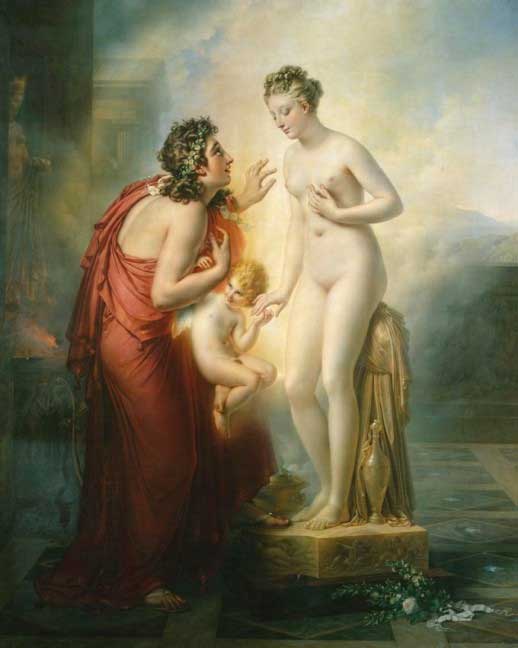
Pygmalion was a Greek artist who built a statue so beautiful that he fell in love with it. Appealing to the gods for reprieve from his unrequited love, his statue Galatea was brought to life by Aphrodite. They married and Pygmalion was able to spend his life with his creation. Many variations, plays and films, have emerged from this myth, where different variations on "brought to life" have emerged. A notable one might be the recent film, Her, where Joaquin Phoenix falls in love with the operating system in his phone. His phone, as an object, came to life with a personalized, teachable, intelligent female voice. In a brilliant dualism, Phoenix even has a sexual experience with Samantha less creepy than phone sex he previously performed with an actual person. Pygmalion is the myth of object-love, in opposition to Narcissus as the myth of self-love. Physical and emotional eros is directed as certain people and objects that epitomize how people can love.

Pygmalion discovers that Galatea is now human.  Image retrieved from this site.
Currently on display in The Lourve, Paris.
The two forms of libido and love: inward and outward come together in the selfie. This new trend in photo-taking simultaneously emphasizes the importance and singularity of the individual and glorifies the technology that allows the self to be captured and spread so easily and prolifically. This is particularly apparent in images that also show the camera in a mirror as opposed to a front facing camera shot. The phone is immortalized in partnership with the individual, a perfect union of self- and object-love. We love ourselves, so we wish to capture our image and likeness. We love our technology, so we capitalize on its capabilities to connect ourselves with the world. As in Narcissus and Pygmalion, the love is often an aesthetic, physical love for appearances, than a deeper emotional love as is lauded in Plato's Symposium.

What Would Jesus Post? Retrieved from this site.
To worship ourselves, we fall into the phone's lens which collapses Narcissus's river. Our phone becomes our partner, come to life in its utility, friendship, and closeness. People cannot be without their technology, phones at their sides or in their hands, preferring the reflective screen to the faces of people around them. Some may say that like Narcissus, we will waste away focused on ourselves, individuality, and narcissism that restricts us from progressing or experiencing the world. Some may say that like Pygmalion, we are too emotionally and physically involved in our technology that we miss the beauty of the world around us in favor of a Google search for its likeness. In my cursory experience with selfies, I take very few and have posted even fewer, I see many positives and negatives to the phenomenon.

Comic by The Oatmeal about the negatives of selfies
Undoubtedly, it has taken news media by storm. The selfie of Obama and Biden made headline news and people were discussing the Oscar selfie (which was potentially a contrived Samsung advertisement) almost as much as the award winners. I'm not sure about the wide appeal of other people's selfies (in the immortal words of Mallory Archer: why would anyone want a picture of someone else's food?), but as a personal expression of self-worth, confidence, and creativity, selfies do have an important role in the rhetoric of identification. Especially considering that some people may not always find themselves presented in media (or they are expressed negatively), online, or in safe spaces, selfies could help establish an online presence and carve out spaces for open discussion about personal identification, labels, and communities. Selfies create visibility, are unapologetic, and bluntly express one's visual appearance, identity, and existence as important and worthy of appreciation. Even if it is produced for personal consumption, it necessary sharing (often on social media sites) encourages a reflection of how it may influence a larger public. The physical presentation of the body demands attention, space, and gaze onto individual, their stories, and potential arguments. The selfie also glamorizes the power of technology, to turn what would have taken many hours of labor to produce a self-portrait can be accomplished in seconds and sent around the world instantaneously.

I hear the cries on both sides about the narcissism and objectification that is implicit in the selfie. But, I see the selfie as merely an offshoot of these larger cultural changes than a root cause or responsible for them. There are innovative potentials in how the selfie could carve out rhetorical communities, enhance identities, and change norms of personal expression. Though I can imagine Kenneth Burke terrified by the reliance on technology that he warned against, I hope that he might appreciate the rhetorical opportunities for identification, mimicry, and understanding between people that may otherwise never have met. And, the rhetorical opportunities for personal expression and control over how one defines themselves and their relation to the world.

Sunday, June 22, 2014

Donald Sterling as a Modern Day Earl Butz

It is impossible to ignore all of the online and offline discussion of the owner of the LA Clippers, Donald Sterling's racist remarks. He noted in a private conversation to his girlfriend that he didn't want her "associating with black people," and specifically bringing them to basketball games. The hypocrisy in Sterling becoming rich off of the labor of black bodies has been addressed better elsewhere, so I wish to address another important part of this discussion: the apologia. Using Kenneth Burke's guilt-redemption cycle, this post will discuss the similarities of Sterling's remarks to the racist statements of Earl Butz, and how these statements implicate the larger American public in the persistence of racism.

Donald Sterling and the Clippers's logo
Earl Butz was Secretary of Agriculture in 1976 who eventually resigned his position after racist comments emerged. This site has the full timeline of the events including the offensive joke. A scholarly article was written about that event by Dr. James Klumpp and Dr. Thomas A. Hollihan called "Debunking the Resignation of Earl Butz: Sacrificing an Official Racist." The title reveals some important terms and information that will inform this comparison between Butz and Sterling. I will also highlight some important differences that reveal modern racial tensions. Butz was "sacrificed" as Klumpp and Hollihan say, as a part of Burke's guilt-redemption cycle. This cycle describes how pollution, or some type of disorder, is introduced into an order, which creates guilt and a subsequent need for purification, purging, and redemption.

Earl Butz, retrieved from this site
For Butz and Sterling, the pollution was their racist statements that shattered the values of equality inherent in their respective social and political orders (government and sports). Both of these institutions are supposed to value equality, all Americans, and their constituents. As public figures, their voices can be seen as stand-ins for the groups that they represent. Butz was "sacrificed" by the Republican Party, who wished to separate their public appearance from racism. The NBA also separated itself from Sterling by banning him from the organization, fining him $2.5 million, and urging him to sell the team. The sacrifice can come in many forms, but it must make the punishment commensurate to the crime committed. Considering that the pollution for each was the potential crumbling of national organizations, the punishments were made quite prominent, public, and severe.
Some prominent reactions to Sterling's statements
Another important similarity between the two are the separation between public and private. Klumpp and Hollihan address this dichotomy by nothing that officials are sometimes seen as not have the right to privacy: anything said even in private could destroy a public persona, one's reputation, and career. Some were quick to jump to Sterling's defense such as columnists at Fox who pointed to the "thoughts" of Sterling as harmless and a personal right. Some articles went as far as to implicate the girlfriend (who recorded the conversation) as the real criminal. In the aftermath of the announcement, Mark Cuban echoed the words of a Fox News reporter about whether convicting people for statements in private could be a "slippery slope" to the thought-police.

Though some of these concerns were raised, there has been overwhelming support for Sterling's punishment. One might say that it was a "success" in some ways in that an athletic profiteer who undermined his own team and the values of the NBA (and perhaps, the country) would be receiving a just punishment. However, Klumpp and Hollihan raise a point of contention with these types of guilt-redemption activities. They note that by creating a sacrificial goat out of Butz and Sterling, we as a nation do not have to address underlying and persistent racism that we may all (or at least most of us) be guilty of. Instead, we can claim that wrongs have been righted and that racism is an individual issue that does not have to be addressed on a societal level. They note that these overt punishments of racism create a culture that "tolerates private racism and its consequences” (p. 11). Jon Stewart adeptly addresses the issue of post-racial society in his critique of Sterling and the recent SCOTUS decision to uphold Michigan's ban on affirmative action.

Retrieved from the Daily Show

What is to be learned by the Donald Sterling incident? One thing is perhaps most important: racism still exists. There is no magical, post-racial world because we have a black president. People haven't stopped being murdered because of their race, people haven't stopped trying to make relevant the KKK, and people still use the n-word. This is only the tip of the iceberg, however, as racism against other minorities, especially immigrant populations, is also a common American theme. Is this what America is all about? We need to take examples like Butz and Sterling and open our eyes to the underlying problems from which these individuals stem. Structural racism is happening and continues to happen; we cannot remain blind to it and only care when individuals break norms of keeping racism a private endeavor. All racism needs to be addressed, and we have a lot of work to do.

Monday, June 16, 2014

Dorian's Descent: All Art is Quite Useless

Dorian's Descent is a new stage adaptation of The Picture of Dorian Gray by Oscar Wilde. Dorian's Descent is a musical that has added an element to the story: the Devil. In this article, I wish to explore the narrative elements of The Picture of Dorian Gray through Walter Fisher's narrative probability and narrative fidelity, the Faust trope, and how the character of the Devil is a narrative disaster. Although I did enjoy the show and thought the singing was quite impressive, the actual lyrics, words, and acting were sub-par, especially compared to a few other musicals and adaptations I have seen in Los Angeles. I will be discussing the play and the book in detail (i.e., spoiler alert!), so I encourage readers to read the book or acquaint themselves with the story.
Poster for Dorian's Descent
The Picture of Dorian Gray is about a young man, Dorian Gray, who becomes obsessed with a portrait that Basil Hallward has painted of him. It shows him in his youth and his prime, characteristics that he realizes, once prompted by his friend Lord Henry Wotton, will fade. In a state of hopelessness, Dorian wishes that the painting might age instead of him, for in its current stage it only serves as a reminder of what he would lose. Without explanation, the painting does begin to change as Dorian becomes involved in the hedonism of Lord Henry's lifestyle. Dorian scorns Basil, engages in illicit sexual activity, murders, and experiments with various vices. The picture ages, its face is marred by a snarl, and the brow is furrowed in perpetual anger and disdain. Eventually disgraced by the harm he has caused, Dorian attempts to absolve himself by stabbing the picture. The two reverse, leaving Dorian himself dead, aged, and hideous and the portrait returned to the beauty which Basil painted.

The picture and Dorian from the movie adaptation
Dorian's Descent infuses a rock opera theme onto the story, which pairs nicely with the descent into hedonism and sin. The element of the Devil, however, removes a very powerful and meaningful part of the play: Dorian's agency, choice, and self-mortification. In the play, the Devil appears and makes an explicit Faustian deal with Dorian so that he may stay young and the portrait may age. The character is doubly unnecessary. First, Lord Henry already serves as the Faustian Devil, the foil to Basil between which Dorian must decide. Having the Devil character undermines Lord Henry's role as the tempting, evil character that lives a sinful, yet seemingly fulfilling life. His presence mirrors the Devil, instead of captivating Dorian's attention in his own right. Furthermore, the Devil as a mystical, magical character removes the potential for Dorian's choice. The supernatural can seem to constrain the choices and available actions of humans, making Dorian's descent into hedonism part of the Devil's plan instead of a meaningful choice of evil over good, Sir Henry over Basil, self over others.

The Devil makes a deal
The beauty of The Picture of Dorian Gray is the unspoken Faust trope. Any one might utter an "I wish . . . " or make selfish requests, placing oneself squarely in the shoes of Dorian, connecting and identifying with him in finding himself in a peculiar situation. Walter Fisher described two elements of narrative rationality (or the logic of stories): narrative fidelity and narrative probability. Narrative fidelity is the perception of how faithful a story is to reality (or the audience's world). Although one might think that this would preclude fantasy, science fiction, or non-fiction from having fidelity. On the contrary, stories such as Harry Potter have high narrative fidelity because they seem real and possible, despite their fantasy elements. We could imagine, though we may not have seen or experienced it, a secret world hidden within our own (thus justifying its lack of presence). Though we may not have experienced or believed possible a changing portrait, we can faithfully imagine our lives as confronting something wholly un-explainable and what our reactions to it might be. The element of the Devil fully violates this type of realismo mágico (think Guillermo del Toro) where it could be possible, and makes the subtle Faust trope seem more like a cliche.

Sibyl Vane's forgotten lyrics
Perhaps most disappointing for me was the changes to the Sibyl Vane character, Dorian's brief love. Before his shift into full hedonism, Dorian fell in love with an actress. Her devotion to her art and her skill in bringing love to life in her performances captivates him. In his courtship of her, however, Dorian destroys Sibyl's ability to act. I have copied her confession after a particularly terrible performance of Romeo & Juliet below, which is one of the more beautiful passages in the book.

"Dorian, Dorian," she cried, "before I knew you, acting was the one reality of my life. It was only in the theatre that I lived. I thought that it was all true. I was Rosalind one night and Portia the other. The joy of Beatrice was my joy, and the sorrows of Cordelia were mine also. I believed in everything. The common people who acted with me seemed to me to be godlike. The painted scenes were my world. I knew nothing but shadows, and I thought them real. You came -- oh, my beautiful love! -- and you freed my soul from prison. You taught me what reality really is. To-night, for the first time in my life, I saw through the hollowness, the sham, the silliness of the empty pageant in which I had always played. To-night, for the first time, I became conscious that the Romeo was hideous, and old, and painted, that the moonlight in the orchard was false, that the scenery was vulgar, and that the words I had to speak were unreal, were not my words, were not what I wanted to say. You had brought me something higher, something of which all art is but a reflection. You had made me understand what love really is. My love! My love! Prince Charming! Prince of life! I have grown sick of shadows. You are more to me than all art can ever be. What have I to do with the puppets of a play?"

Sibyl has so greatly fallen for Dorian that she cannot pretend to love as she once did. This confession is made all the more beautiful when she takes her life after Dorian rejects her love. In the play version, Sibyl is a singer whose voices makes Dorian fall in love. Substituting singing for acting makes sense in the musical, but it is the other change that ruins it for me. Instead of falling out of love, causing Sibyl to ruin her craft, the Devil character makes Sibyl forget her lines before a show. The audience loses this beautiful insight into Sibyl's innocence and thus undermines her death as the tipping point in Dorian's sanity. This change further supports my comments below about Dorian's actions being orchestrated and not of his own choice.

Retrieved from this site
Dorian's Descent is an interesting adaptation of The Picture of Dorian Gray, but its creative changes served only to undermine the beauty, simplicity, and complicity of the book in an attempt to be unique. Without our ability to empathize with Dorian's decisions, which we believe are of his own accord, the audience can only observe and cannot be active participants in the narrative. We are not convinced that this could happen to us, that we would make such a deal with the Devil, or that we are only a few steps away from falling into sin ourselves.

Although this is not the shining review that I'm sure the fledgling play is hoping for, I hope that they take to heart the immortal words of Lord Henry: "There is only one thing in the world worse than being talked about, and that is not being talked about." Certainly this adaptation has given me and I hope any readers some food for thought about how narratives are updated, adapted, and changed in the pursuit of artistic creativity and to teach us about issues that plague society.

Sunday, February 23, 2014

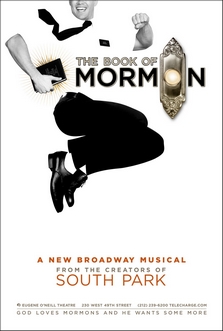
Book of Mormon: A Latter Day for the Latter Day Saints?

Book of Mormon has recently come to Los Angeles and I have now seen the musical twice. There are a few important notes that I would like to make regarding the musical. I won't have too many spoilers or descriptions of the musical, but if you haven't seen it or would like to remain in mystery, then turn back now!

Retrieved from Wikipedia

The first point I'd like to make about the musical is the various reactions it has received due to its concentrated treatment of the Mormon faith. Based on an episode of South Park where the Mormon faith is described in song, including a chorus calling it "dumb," the Book of Mormon primarily follows Elder Price on his missionary trip. Matt Stone and Trey Parker are comedians and the musical follows the comedic and often offensive style of their TV show and movies. Though the show has received much praise including Tony awards and nominations, there has been much backlash from the Mormon community that the show paints their faith as something to laugh at, and not seriously consider as a legitimate faith. I have previously written about the Mormon faith and how it complicated Mitt Romney's run for presidency. Part of its problem is its youth where "ancient upstate New York" is a biblical location and the Garden of Eden is located in Missouri. The relative "all-American" prophet is something foreign and different from the traditional Middle Eastern locations.

The backlash that it has received overestimates the exclusivity of Stone and Parker's critique. What the Book of Mormon does is present the Mormon faith as similar to other faiths, not distinct. When one considers the equally occult and supernatural forces that define other religions, laughing at the Mormon faith means that people are laughing at all faiths. In the song "I Believe" Elder Price sings about all the things that he believes in as a part of his faith. The first two lines are quite Christian in nature: "I believe that the Lord God created the universe" and "I believe that he sent his only son to die for my sins." Not until line three is a marked changed expressed where he sings, "I believe that ancient Jews built boats and sailed to America" that elicits much laughter from the audience. The chorus notes that "I am a Mormon and a Mormon just believes." In a sense, this is a critique of all religions that just believe the doctrines put forth by their faith. Is it any less funny or unbelievable for their to be a Christian version that statements "I believe that Christ turned water into wine"? Or "I believe that Mary gave a virgin birth?" Or "I believe that Christ resurrected after being crucified?"


This song touches on the key component of all religions: faith. There is little to no evidence of all of these supernatural and religious occurrences, so for Mormon doctrine is equally as legitimate and believable as all other faiths. Even if the audience does not catch onto the criticism, the Book of Mormon expertly causes everyone to consider the beliefs that they hold as true and examine why their faith holds weight, if any, over others. The Book of Mormon also expresses other similarities to faiths such as missionary trips, studying the Bible, guilt over sinning, and uncertainties about its teachings. As an atheist, it was clear to me upon watching the show that this was a critique of all religions, their systems of beliefs, and the arbitrary hierarchy and discrimination directed towards Mormonism.

Perhaps the Mormon Church understood the great potential in the play as an avenue to reach new members. In the playbill for Book of Mormon, the Church took out three full page advertisements. The first is a white male noting "I read the book." The second is a Latina female with the text, "the book is always better." The final page is a black male who notes, "you've seen the play, now read the book." All three advertisements contain three methods to learn more information: a QVC, website address, and instructions to text "BOOK" to 33733. The faces of the individuals are highlighted to reveal their diversity and the power of the individual to find more information. The play centers around the "Book" of Mormon, so the advertisements push viewers to explore the book through its original text instead of simply through the play version. For the first advertisement, having read the book is a point of pride, a way for savvy-going theater-goers can engage with the play more fully. The advertisements take advantage of a captive audience that is engaging, perhaps for the first time, with the Mormon faith and gives them the opportunity to learn more.

Retrieved from this review
Those who may be visiting the show and preparing to laugh may not be the best audience to find converts. I thought similarly after seeing street preachers in Las Vegas. But, the places where there may be the most resistance are also perhaps the areas with the most potential and opportunity. Just as Elder Price entered a missionary location in a poor town in Africa, the Mormon Church is braving hostile territory with an unlikely chance of success. But just as Elder Price and Elder Cunningham attempt to change the landscape for Mormon missionaries, the Church also attempts to affect the narrative of attendees by offering its own version. Either way, this musical has people discussing the faith and has exposed many people worldwide to its teachings and doctrines. The Church is smart to see this as an opportunity instead of a threat and everyone would be best served by appreciating the critical nature of the play not as anti-Mormon, but as inquiry of the role of faith in general.

Tuesday, September 3, 2013

Cyborgs: Entertainment and Reality

Many great scholars before me and currently have performed more extensive inquiries into the nature of cyborgs and the growing intersection of humankind with technology. My interest has been piqued in this topic tangentially, as I have interests in the use of technology for information gathering, dissemination, validation, and power. Inf/using technology in our daily lives is simply an inevitability that communication scholars must address, and cyborgs are an interesting "end product" in my mind. The cyborg represents a unity between humans and technology, faults and flaws permanently mended by technological advancements and prowess.

Because the cyborg, for the most part, only exists in fiction, much of the cyborg's mythology comes from media representations. The relationship between humans and technology range from fully robotic operation with human appearance (e.g., The Stepford Wives) to humans with technological modifications (e.g., Planet Terror) with traditional definitions of "cyborgs" operating near the halfway point (e.g., the Six Million Dollar Man). They key appears to be integration, where a character has equal or mostly equal human and technological parts that operate as parts of a unified whole. Someone using a gun (i.e., picking it up and using it) is quite different from having one functioning as a leg and being able to fire it from internal signals instead of pulling the trigger.


After some pondering (and heated discussion with my significant other) about the nature of cyborgs, we also reached a conclusion that cyborgs are not merely people with technological parts (e.g., a person with a pacemaker), but this technological addition must perform a fundamentally inhuman task. Iron Man, though he has a metallic plate protecting his heart, the addition of this technology does not provide him inhuman strength, power, or wit (that's just Robert Downey Jr.). Will Smith, however, in I-Robot, does have robotic additions that give him extra strength and powers, like the superhero that Iron Man is. Instead of a suit that can be taken on and off, true cyborgs have integrated technology with their human bodies to advance the form beyond what was previously possible.

The thinking about cyborgs began with my viewing of The Amazing Spiderman, where the antagonist has lost a limb and pines for its re-growth and repair. Whereas he believes the solution lies in cross-species DNA, the attempt to achieve this ends spectacularly well, a la The Fly. When I think of his pining over perfection, and yet the inability to consider a prosthetic arm, it echoes my feelings above that the functionality of the cyborg is the key. A prosthetic arm would perform basic functionality of an arm, but to replicate it perfectly and to extend its strength, a robotic replacement would be needed. What Dr. Collins realizes is that in his search for perfection, he must replace the entirety of the human body, for it is weak and vulnerable. In his transition to a lizard-human hybrid, he becomes similar to a cyborg in that his human form has been replaced with stronger and more powerful parts to complement the human form.


A live example of the cyborg may be found in Neil Harbisson, a color blind person who used a prosthetic eye piece to hear colors. Though he sees colors in shades of grey, the eye piece translates each types of color, including its shade and vibrancy, into sounds that he can understand. He is attempting to have the eye piece surgically attached to his spine, fully integrating the eye piece to his human form. There's no need for me to define him as a cyborg, he's done that already.


The Cyborg Foundation that he founded is the first organization working to defend cyborg rights and indeed encourages people to embrace technological additions. One of their listed aims is "to extend human senses and abilities by creating and applying cybernetic extensions to the body" and they describe their missions statement as "helping people to become cyborgs." This is quite a radical step in theory but these changes are already beginning. Consider the Futurama episode "Eye-Phone" that made fun of the attachment that people have to their technology by implanting one's phone behind the eye socket. Now, Google Glass is in its "explorer" mode and may soon become a normalized part of our technological experience.


Photo source
In the future, cyborgs may become the new human rights campaign. Whereas in the past, people have been dehumanized based on the color of their skin, their choice of religion, and their sexuality and partner preferences, the future may hold civil rights battles on behalf of cyborgs and their definition as more than/human. If the past battles were about defining humanity in terms of property, voting, and marriage, then future definitions of humanity will surely be tested.

Wednesday, April 3, 2013

Vampires and the Narrative of TV Shows

Despite the proliferation of vampire/zombie/werewolf media figures in recent years, I find myself drawn into the various iterations and rule changes that simultaneously govern the characters and direct the plot in some popular shows and movies. How these rules change within the same mythology determine the flow of action and restrict plot twists complicate "lore" for the sake of an engaging narrative.

Dean and Sam on "Supernatural" encounter various ghosts, mythical creatures, and curses that each can be undone through their unique combination of research/brains and violence/brawn. There is a repetitive scene where Sam discusses the multitude of "lore" and history surrounding the supernatural occurrence and the two brothers discuss which solution or cure is the accurate one. Despite the various myths and folklore surrounding the situation, the brothers eventually find the solution, whether it be by manipulating the history or using a tried and true method.
Jessica on True Blood

Vampire on Supernatural
Caroline on Vampire Diaries

For example, the vampires on Supernatural are different from the ones on Vampire Diaries or True Blood. On Supernatural, vampires grow an extra row of teeth that emerge from the top gums. On Vampire Diaries, the creatures' teeth only emerge when they see blood or are about to feed and it is only the canines that grow to be longer and pointed. True Blood also only has one set of teeth grow, but it is the lateral incisors instead of the canines. Supernatural vampires create more vampires by bleeding into an open wound on a human's body. Those on Vampire Diaries become vampires when they die with vampire blood inside of them (and complete the transition once they consume human blood). True Blood vampires turn when they are drained of their vampire blood and replace it by drinking (and thus replacing) their blood with vampire blood (and complete the transition once they are buried in the ground). These various methods of transformation drastically change the plot of each show. Unique to Vampire Diaries, someone could be at risk for becoming a vampire without their knowledge (accidentally or unknowingly consuming vampire blood), while the other shows involve some type of direct contact with a vampire.

Perhaps the most interesting adaptation to the vampire myth is the sun. In True Blood, the vampires almost exclusively interact in the evening. They are vulnerable during the day when they are resting in their coffins and burn to death once entering the sun. This allows for interesting plot devices where vampires must fight through the pain of sun to help humans, the creation of vampire-friendly hotels with blacked out windows, and the constant threat of attack during the daylight hours. The setting and rising sun becomes a countdown clock for action in the show where tasks cannot be or have to be completed before a certain time. Fairy blood thus becomes a powerful and all-consuming commodity because it allows the vampires to walk unharmed in the sun, driving much of the action and focus around Sookie Stackhouse.

Eric and Russell burning in the sunlight
Vampire Diaries gets around this biopower by relieving the vampires of their reliance on the sun. By using the power of witches, they have magical rings that allow them to walk in the daytime. This creates another interesting set of restrictions that makes vampires more difficult to identify. Danger is thus more prominent and surprising as people who cannot come out during the day are easily identified in True Blood as vampires. In both series, vampires are restricted in their consumption of human blood. True Blood vampires use a synthetic blood (the namesake of the show) to curb their thirst for human blood, though there emerges a strong divide between vampires who consume True Blood (mainstreamers) and those who still feed on humans. An analogy can be made to this distinction and the Chick Fil-A argument that constructs consumption with identity politics. Vampire Diaries vampires do not have a synthetic blood option, but many choose to rob blood banks or feed from animals in order to avoid harming humans. Again, the stigma involved in the consumption of humans is both honored and vilified as competing groups determine their own consumption rules. Interestingly, Vampire Diaries vampires can consume "human" food, while True Blood vampires cannot (instead they "flavor" their food by changing the diet of the human).

Vampires and supernatural creatures are similarly constructed with different rules and restrictions in the media to allow for and direct certain plot points and devices. The key to the differences is keeping them believable, probable, and consistent. Fisher used the terms narrative fidelity (internal consistency) and narrative probability (external consistency). The interesting twist in shows such as Supernatural, Vampire, Diaries, and True Blood is that the existence of these creatures in and of themselves problematic to "reality". Given their existence, however, the shows can construct their own rules based on different mythologies. As long as they make sense within their own narrative reality, the audience can watch multiple shows and still engage with the vampire narrative.

Wednesday, February 27, 2013

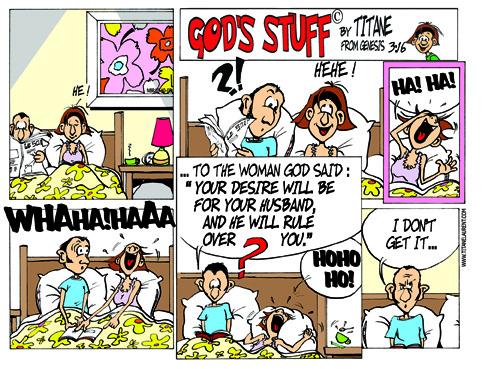
God the Mother: Femininity and the Bible

On USC's campus in the past fall, I was approached by a woman as I was walking home from class. Thinking that she might be looking for directions, I was surprised when she approached me and asked if I had  heard of "God the Mother". I hadn't; of course I had heard of God the Father, the traditional Judeo-Christian  appositive for a higher power. I was intrigued and asked her to tell me more. This facet of Christianity follows a path of divinity for a character they call "the mother". She is described in Revelation and also in Galatians as Christ's "bride" and the "mother" of all humans. When Christ returns in his second coming, the World Mission Society Church of God believe that both female and male forms will come to rule.

Upon first hearing, these ideas sounded unique and ground-breaking to me. A larger, more prominent role for women? To be considered divine and worshiped  playing a role (as opposed to the passive Virgin Mary role) in human salvation? It seemed a positive and reassuring step in the right direction for gender equality in faith. The patriarchal system in Christianity is undeniably exclusive to females. Although some facets do allow for women to be ordained and serve in higher roles, typically faiths that believe in consubstantiation do not allow for female priests as the priest becomes Christ momentarily during the transformation of the bread to the body of Christ. Furthermore, many biblical passages undermine the role of women and encourage subordination. For example, 1 Timothy 2:12 reads, "I do not permit a woman to teach or to exercise authority over a man; rather, she is to remain quiet". Titus 2:5 describes that women should "be self-controlled and pure, to be busy at home, to be kind, and to be subject to their husbands, so that no one will malign the word of God". This is of course excluding the many passages that discuss women as property or commodities to exchange. This hierarchy of the male over the female has been reinforced or at least continued through faith (and also science, see Ferngren's Science and Religion), so I thought that this group might be an interesting foil to traditional interpretations.

I agreed to attend weekly meetings with a missionary on campus and learn more about the faith. Fascinated, I took many notes on our meetings. I quickly found, though, that this church was not as different in their treatment as I initially thought. Learning about the "God the Mother" figure reinforced for me that this was merely a different manifestation of the already sexist female role in Christianity. Similar to the role of the Virgin Mary, as I briefly described above, the Heavenly Mother emerges as a vessel, place holder, and masculine foil, with no power, characteristics, or importance herself. Instead, the Heavenly Mother incorporates the traditional gender roles of femininity (i.e., bride, spouse, mother) into a divine form. Though it may seem encouraging to have a female face among the divine, her role as a foil to Christ removes any autonomy and importance in her narrative role. To maintain narrative fidelity (as proposed by Fisher's narrative paradigm), the patriarch must still be in place and the hero of the story must remain the male protagonist. The Heavenly Mother does not challenge this role, become a hero or protagonist herself, but merely complements the masculine figure.

From Godstuffcartoons.com

The Heavenly Mother, and consequentially, all women, are also only laded, valued, or given importance when they fulfill their gender roles. The Heavenly Mother does not have a name, like Christ, or a purpose, other than to serve Christ and be the mother of all humans. The Heavenly Mother thus becomes nothing more than the Virgin Mary: a divine vagina. Her sexual organs are the only meaning she provides for the narrative, as a sexual object for Christ as bride and a vessel for human life as mother. The woman I met with emphasized the importance of the family structure, the "nuclear" mother, father, children unit that is the backbone of society. This structure is a metaphor for the larger Father, Mother, and humankind as children. After prompting by me, my faith partner also admitted that the LGBTQ community does not fit this holy female-male binary (transfemales not in possession of the normative sexual organs) so should be banned from marriage.

My hopes for a more inclusive, engaging, and female-friendly version of Christianity were definitely dashed. I see no benefit to having a divine female figure if her only contribution to the faith is her vagina and its function. I continued to meet with the conversation partner for a few weeks, learning about why her faith was the "true" faith and the literal word of the Bible and its importance. Not only does this faith believe in the second coming, but they believe it will happen in our lifetime. During that apocalypse, we will be welcomed by both Christ and his bride, to be reunited as a heteronormative, nuclear family.

Wednesday, November 21, 2012

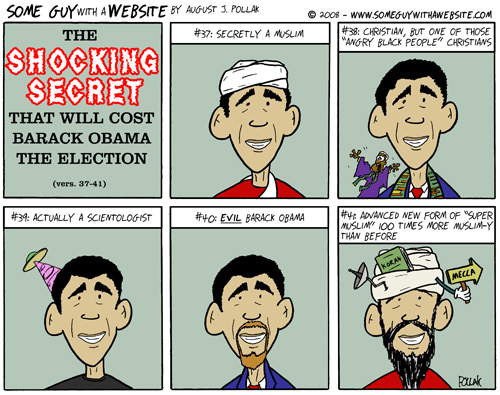
Negative Narratives: Obama is a Muslim

Although commonly known as false, 17% of registered voters still think that Obama is a Muslim. Carefully placed and constructed media and political narratives have created this false, yet influential narrative. I bring up this specific example because of a question posed to me at the NCA conference on the Romney and Mormonism panel. The panel was questioned why voters would consider a Muslim more “mainstream” than a Mormon. After a few stunned moments and a brief corrective response, I wondered as to the likelihood of finding a well-educated academic asking such a question to me at a panel specifically addressing the intersection of religion and politics at a competitive national conference.
The reality that such narratives can gain traction in the public sphere demonstrate who damaging unregulated political advertising and web presence can be. Though Geer argues for the benefit of negative advertising in "In Defense of Negativity", there appears to be more evidence to the contrary. Increased levels of personal attacks, deceptive and manipulated information, and subtle racial comments have become commonplace in American politics. Even though Obama can counter such narratives on his web sites and in media statements, for those who doubt Obama or are looking for confirmation of their skepticism can cling to relevant narratives and ignore contradictory information. Is Obama the most adamant and vocal Christian ever? No. Does he incorporate religion and traditional Judeo-Christian values into his politics as strongly as others? No. But does that mean that people have the right to doubt his Christianity? Furthermore, what does this say about our country when being a Muslim is a derogatory identification that precludes one from the presidency?
The truth is that negative campaigning increases cynicism, allows for the spread of misleading or outright false information, and creates a culture of division. My NCA experience represents for me the negative effects that I have studied being realized. It is one thing to read about the racial connotations of the William "Willie" Horton advertisement and it is another to encounter someone who truly believes what is nothing more than a conspiracy theory that survives only through the radical echo chambers that exist online. With low voter turnout and vicious character attacks from SuperPACs and 527s, I hope that negative campaigning will eventually reach its peak and disappear. For the sake of democracy, a healthy public sphere, and unity in the face of elections, the fostering of a negative political culture must end.

Wednesday, July 18, 2012

Batman and Rhetoric: Transforming Human to Legend

The trilogy finale of the Batman series from Christopher Nolan finishes July 20th (or for the avid fans, midnight tomorrow night). The finality of the trilogy has been confirmed with Christopher Nolan and Christian Bale abandoning the project after this film. Though I was more than a little upset when rumors of Johnny Depp as the Riddler were squashed, I appreciate the finality of the series. I respect the ability of both actors and directors to sacrifice profit for the sake of a coherent and meaningful story line.


After re-watching the first two in preparation for the midnight premiere, I was struck by the iconic Liam Neeson line from Batman Begins: "If you make yourself more than just a man, if you devote yourself to an ideal, and if they can't stop you, then you become something else entirely...a legend, Mr. Wayne." The line is meant to encourage Bruce Wayne to abandon his mortality and chase immortality as a symbol, a legend. Many people around the world have devoted themselves to causes and emerged as icons for movements, causes, goals, and values. Rosa Parks, Mother Teresa, and Harvey Milk were just people, but through their actions and values, they have become legends, eternal, immortal symbols of equal rights, charity, and acceptance. The narratives of their lives have transcended the normal good and evil, the trials and tribulations of being human, and the faults, flaws, and sins inherent in all humans. These people, and many others are, in a way, superheros, super-people, because they have become more than just people. Their stories and actions become symbolic representations of events more significant than can be contained within one human life, body, and narrative.
Similarly, Batman is the comic representation of everyday heroes, who has transcended his Bruce Wayne, human persona for Batman, a superhero, legendary symbol of justice. By abandoning his humanity and replacing it with a mysterious persona, people in the comics turn to Batman as a savior, not as a person. Though Bruce Wayne has money and with that money comes power and the ability to transform into Batman, Bruce Wayne cannot fight crime, be an ally to the police force, and terrorize Gotham's criminals. Every person, though, has the power to become that better, idealized version of ourselves, immortal in our story and legacy. This occurs through committing oneself to a cause, extending oneself past human constraints, and becoming more than just a person. We can all leave legacies, whether positive or negative, and its corresponding strength and staying power is only restricted by our actions.


Not only do people become legacies, but the words that we use leave sometimes unforgettable impressions on the world. The power of the spoken word is why I wanted to pursue communication in an advance degree, so I could explore language as symbolic. Kenneth Burke famously described humans as symbol-using animals and rhetoric as the study of those symbols that create meaning (Grammar of Motives, 1970). Words are merely words, tools with different definitions, interpretations, and meanings. But when used with a purpose, for a cause, words can become infamous, last beyond the life of a person, and serve as everlasting symbols. 


Think of the immortal words of Abraham Lincoln: "this nation, under God, shall have a new birth of freedom -- and that government of the people, by the people, for the people, shall not perish from the earth." Or the words of Ghandi, "you must be the change you wish to see in the world" or Martin Luther King Jr., "when we allow freedom ring, when we let it ring from every village and every hamlet, from every state and every city, we will be able to speed up that day when all of God's children, black men and white men, Jews and Gentiles, Protestants and Catholics, will be able to join hands and sing in the words of the old Negro spiritual: Free at last! Free at last! Thank God Almighty, we are free at last!" These words have transcended each person and left a rhetorical legacy of the unity of the United States, the importance of peace, and the eternal struggle for equality.


One's legacy is thus a combination of actions and words (or just actions if we consider physical action and symbolic action) that is for the most part under each of our control. We can devote ourselves to a cause, use our language symbolically for a cause, and transcend mere mortality to leave a permanent mark on the world.


I am looking forward to the midnight premiere, in part for the transportation power of film and also to imagine for a few hours, that I can also reach immortality through my words and actions.

Wednesday, July 4, 2012

Visual Communication Reflection 2: Tattoos

As a continuation of last week's post, I'd like to discuss the second paper on the Body and Visuals Panel at the Visual Communication conference I attended at the end of June.

The second paper was interested in collecting narratives of tattoos based on the history and evolution of the tattoo. Although tattoos can be used for a variety of purposes such as branding (e.g., Holocaust survivors), identification (e.g., gang or group loyalties), and memorials (e.g., dates of a loved one's death), the underlying link between them all is the narrative behind its acquisition and personal importance as permanent (mostly, at least) body art. The presentation mostly focused on the functions of tattoos, types of tattoos, and the basic storytelling design of tattoos.

Although the paper was in its beginning stages, the most interesting part for me was the overarching idea of "modification" and changing the body from its "original" form in order to tell a story. In ways that remind me of the transgender body, the "original" form is, for whatever reason, not the correct form, so modifications are undergone to make an outer body reflective of an inner soul. Additionally, the researchers discussed the personal vs public nature of tattoos in terms of placement, size, and color. A small black outlined tattoo on the hip bone has a different meaning than a colorful, bright, large face or neck tattoo. Prominence can change the significance of the tattoo and reflect the private vs public nature of the tattoo's narrative. From the heavily tattooed to the minimalists, from the professional to the amateur, tattoos all tell stories.
I would like to expand upon the idea of storytelling by expanding the narrative beyond just the physical tattoo. Not only can a tattoo be a narrative, representative of past events, victories, losses, membership, and loyalty, but it can also be the narrative in and of itself. Consider, for example, tribal cultures that use tattoos as markings for the transition from childhood to adulthood, where the very act of getting the tattoo is the transition. Enduring the pain for long hours symbolizes manhood to the tribe. The design and pattern of the tattoo is thus trivial; it is the act of being tattooed that truly holds narrative importance.

A modern example that comes to mind is the show Ink Master. Jumping on the skill-based competition reality show craze, Ink Master is a competition for tattoo artists. The trailer is below, but don't be fooled by the pig carcasses and painting challenges. During every episode they tattoo real people, whom they called the "human canvasses". Completing the metaphor of tattoo as an art, the humans serve as the canvass and location for the design. Perhaps the most painful part of the episode is the critique section, where the tattoos are described and critiqued in vivid detail by the judges. The person who just got the tattoo can watch and learn everything wrong with the permanent image now engraved on their skin, for the purpose of deciding who is eliminated from the contest. Who would do such a thing? Well, apparently at least 52 (ten contestants, one eliminated each round, finale is the final 3) or
To be a "human canvass", you apply through the Ink Master website, where you describe your tattoo of interest and "the full story of why you want to get the tattoo". Because part of the episode shows the interaction between artist and canvass, the story behind their tattoo is important for the appeal and entertainment value of the show. The most interesting episode, however, was the finale, where human canvasses signed up and volunteered to get any tattoo. I repeat, they came on the show and allowed the three finalists to mark them with any tattoo the artist wanted. Although these were the final three and arguably the best of the contest, they were still deciding the location, design, color, and style of a permanent mark for someone who had no say in the matter.

Surprisingly enough, the calculation above reflects only a fraction of the applications received to be a human canvass. The important part is the last sentence on the screenshot says "due to the high volume of applicants, ink master is unable to respond to everyone". In other words, so many people are willing to get tattoos on the show, for which they receive no monetary compensation or even travel reimbursement, that they cannot even send a rejection email.

The narratives of the tattoo, especially those in the finale episode, is not the tattoo, but the experience of getting the tattoo. The design matters not at all, could be anything from Japanese lotus flowers to a pin-up girl to a tribal arm band. When someone asks about the tattoo, the story will not be about its design, but a narrative of being on TV, the anxiety about its quality, and the ignorance as to its design.

The narrative power of tattoos, therefore, is not limited to the story in the ink, but is truly the story of the person who decided to get a tattoo, their reasons, experience, and story.

Wednesday, February 29, 2012

Heracles: Modern Lessons from Ancient Tales

What can Ancient Greek texts tell us about our modern times? Aquila Theatre would argue they tell us just as much today as they did when they were first performed. In the case of Euripides's Heracles during the Peloponnesian War during the 400s BCE, the horrors of war and violence brought home mirror the stories of today's veterans. At the USC Vision and Voices event I attended last night, I was in absolute awe at the integration of Greek themes in modern wars, not the least of which were two of the actors who were themselves veterans of the Vietnam War. Additionally, the chorus, a staple of Greek theatre, was played by footage of interviews with veterans echoing themes of chorus lines in the original script. The acting was impressive, especially behind the main characters' masks and the interpretation of madness striking Heracles was nothing short of incredible. The real reason I would like to write this post, though, is not necessarily to praise the play, but to discuss the salient points about war and narrative that it evokes.
Heracles Performance

What was most striking about the event was the similarity in war narratives from all veterans from WWII to Vietnam to Iraq and Afghanistan, which were all ultimately similar to the Peloponnesian narrative of Heracles. The themes of loss, isolation, madness, and brotherhood span the gaps of space and time and were apparent in every veteran's war narrative. I will expand about these similarities below, but first, I would like to pose the question about what this means for our servicemen and women, that they have a unifying, common experience that the rest of society cannot hope to even imagine? How can a return to civilian life ever truly occur? Has the experience of war created permanently fractured minds and roles for the veteran?

A common theme was one of brotherhood and isolation during and after times of war. An Iraq veteran discussed the scariest moment of his service was when he saw his bunk mate disappear in a cloud of sand produced by a mortar. The fear of losing his friend, not the danger to himself was the moment he remembered, the feeling he had was of brotherhood and loyalty to the friend. Theseus was this friend to Heracles in the play, where he immediately forgave Heracles for murdering his family because of the friendship that they had. Even going so far as to help Heracles up, though he was covered in blood, to take him to Athens to start again. The bonds creating through fighting side by side, risking lives side by side as one veteran described as happening with people who were "previously strangers" not months before. These bonds become stronger than blood and isolate soldiers from friends and family who were not at war. One of the first scenes was of a woman who was lamenting her loss of relationship with her family who now did not know her. She could not be the person she was after war, because that person was foreign to them. Instead, she had to start over, completely from scratch, to build a relationship with her own family. A younger sister had aged from a child to a college student and they were to each each other, complete strangers.

The final theme that pervaded the stories was that of madness. Many interviewees mentioned comrades in war that has become obsessed with killing and the power that came with it. One veteran told a story of a soldier who had stopped another soldier from killing an old man. Instead of killing the man, he lit up a cigarette for each of them. After lighting the cigarettes and enjoying a few puffs, the soldier then proceeded to kill the man, previously showing mercy, then showing incredible hate and fury soon afterward. The madness of Heracles was similarly swift and temperamental, influenced by interference from the Gods. Although Heracles was ultimately able to find some solace in knowing that his actions were not completely his own, today's veterans can take no refuge from their actions, because no matter how influenced by the terrors of war, there are still performed by their own hands.

Within the topic of madness, it is easy to apply Burke's dramatist pentad. When one analyzes the five points of  an event (act, actor, agency, purpose, and scene), emphasizing one part over the other can lead to different conclusions about responsibility and motivation. The story of the old man can be seen as: actor - soldier, act - killing the old man, scene - war torn Iraq, purpose - killing the enemy, and agency - the military weapon and command. If one emphasizes the purpose, scene, and agency, that this was a soldier commanded by superior officers in a time of war to kill the enemies, then the act can be justified as heroic, honorable, and a call of duty. Emphasizing the act, and the actor, however changes the event from a war-time standard to a single man, a soldier, but a solitary one under no direct duress, killing an elderly man. When you minimize scene, the time of war, and instead just focus on the killing of an elderly man after a sign of compassion becomes a terrible, horrific, and unjustifiable act of murder. One thing is certain, one can never truly separate any of these five, just as one cannot separate a soldier from his duty and the scene of war. Is the soldier's act truly one of madness then? Or is it a justified response given the situation and motivation for the action?  In either interpretation, there is a theme of madness and its effects on a soldier that is prominent and of great importance to the sanity and well-being of soldier's returning home.

The play was a marvel in that it succinctly and uniquely linked the modern atrocities of war with a classic Greek text. The combination created a contextualization of war in theatrical terms and the application of theatre to the real world.