Showing posts with label Branding. Show all posts

Sunday, October 12, 2014

Dangerous Advertising and Disingenuous Controversy

Students of mine have turned in papers this week that critique different advertisements. Their papers have prompted me to think, as I have before (gender in advertising, political advertisements, religion and advertising, interactive advertising, and exclusionary advertising) about different advertisements that propose a cause or campaign instead of a product. My students had the choice of a traditional product advertisement and one form a non-profit. It was much easier to see the direct purpose of the for-profit advertisement: to sell a product. Oftentimes, however, the advertisements for non-profit groups have to be more creative in order to peddle something far less tangible than a car or a purse. These attempts to be innovative can backfire, causing more attention to the advertisement campaign itself than the message it is trying to convey.

Retrieved from this site.
In rhetorical theory, this is called disingenuous controversy. Fritch, Palczewski, Farrell, and Short proposed the term to describe situations when an ancillary aspect of an event occupies attention and the actual message (which itself could be controversial and counter-hegemonic) is lost. Their example was the comments by Ward Churchill where he compared the workers in the World Trade Center as "little Eichmanns" when describing the justifications for the 9/11 attacks. The purpose was to raise questions about the American economic structure and how it constrained and motivated the actions of the 9/11 terrorists. But, instead of this critique gaining media attention, people focused on his comparison between the Nazi bureaucrat and workers in the World Trade Center as offensive, insensitive, and unpatriotic.

Following the Nazi theme, I first want to discuss the advertising campaign that ran in Germany to promote HIV/AIDS awareness. The campaign features graphic images of infamous leaders such as Adolph Hitler, Joseph Stalin, and Saddam Hussein having sex with women. This campaign was eventually pulled in part because of its graphic nature and outrage over the use of these infamous faces in relations with women. The campaign read, "AIDS is a mass murderer" and encouraged viewers to associate something traditionally thought-of as pleasurable with something inherently disgusting and deadly. The graphic depiction in the advertisement coupled with the unique history in Germany that makes the presentation of Hitler challenging, however, overshadowed the consciousness-raising of re-thinking about the dangers of unprotected sex.

Retrieved from this site.
The second campaign I'd like to present is a campaign by 10:10, which is a climate change advocacy non-profit. The advertisement shows various situations where people are asked about their opinions on climate change. A few that declare that they do not believe in global warming or that we should not act towards it are shown exploding violently. The version that received the most attention featured children exploding in their classrooms. The campaign seemed to be questioning the value of dissenters and how those who do not engage or pay attention are ultimately doomed. The violence, especially towards children, however, became the focus of the campaign instead of the message of the future of humanity.


These "dangerous" advertisements risk an audience backlash in favor of capturing people's attention. When the alternative is complete silence or apathy, perhaps a bit of attention-grabbing is in order. There are certainly risks to this type of advertisement. Non-profits may be more likely to risk these strategies because they are not beholden to shareholders or a bottom line. When attention is at an all time premium, with the variety of options for viewing, being offensive or crude is one way to be sure one gets eyes, if not support.

Monday, July 14, 2014

The Selfie: Self-Love and Object-Love

There has been an influx of attention on the phenomenon of "the selfie." I know that I am perhaps a little late to this discussion, partly because it is far outside my typical realm of interest. A small epiphany regarding them, however, has prompted me to address what I think is an overlooked but important aspect of the selfie: the Freudian divide between self-love and object-love. The selfie is the perfect integration of our love for technology and our love for ourselves. To illustrate this union, I will first describe the myths of Narcissus and Pygmalion on which Freud based the two extreme disorders of love: ego-libido and object-libido.
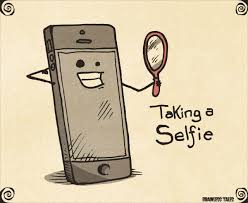
Retrieved from this site.
Narcissus was a Greek youth that was captivated by his beauty reflected in the river. He wasted away and finally died being unable to leave his mirror and break his own gaze. The basic version often excludes the presence of Echo, the nymph who falls for Narcissus but is unable to warn him of the danger. She can only repeat the words of others and represents the love that others felt for Narcissus that was not returned. Instead, Narcissus turned his love inward and loved only himself (and specifically, only his aesthetics and beauty). The myth of Narcissus has inspired the phrase "narcissistic personality disorder" or Freud's ego-libido, which links a physical and emotional desire for oneself over others or objects. This is also associated with megalomania, or the idea that oneself is more important or better than others. Before summarizing the tale of Pygmalion, it is easy to note how narcissistic themes can be seen in today's individualized society.

Narcissus discovering his reflection. Retrieved from this site.
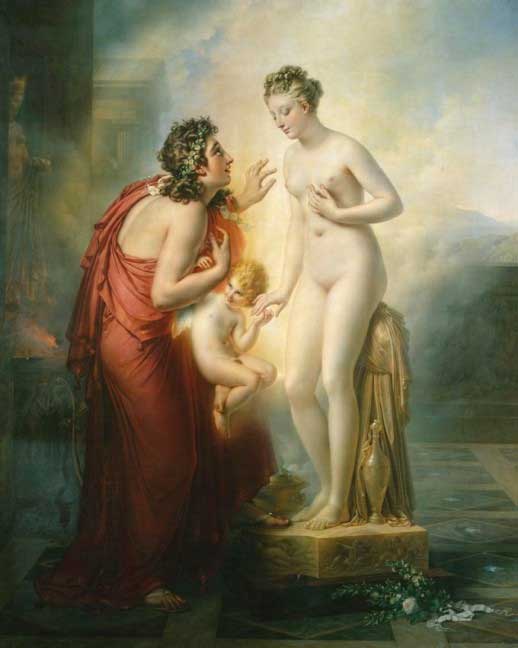
Pygmalion was a Greek artist who built a statue so beautiful that he fell in love with it. Appealing to the gods for reprieve from his unrequited love, his statue Galatea was brought to life by Aphrodite. They married and Pygmalion was able to spend his life with his creation. Many variations, plays and films, have emerged from this myth, where different variations on "brought to life" have emerged. A notable one might be the recent film, Her, where Joaquin Phoenix falls in love with the operating system in his phone. His phone, as an object, came to life with a personalized, teachable, intelligent female voice. In a brilliant dualism, Phoenix even has a sexual experience with Samantha less creepy than phone sex he previously performed with an actual person. Pygmalion is the myth of object-love, in opposition to Narcissus as the myth of self-love. Physical and emotional eros is directed as certain people and objects that epitomize how people can love.

Pygmalion discovers that Galatea is now human.  Image retrieved from this site.
Currently on display in The Lourve, Paris.
The two forms of libido and love: inward and outward come together in the selfie. This new trend in photo-taking simultaneously emphasizes the importance and singularity of the individual and glorifies the technology that allows the self to be captured and spread so easily and prolifically. This is particularly apparent in images that also show the camera in a mirror as opposed to a front facing camera shot. The phone is immortalized in partnership with the individual, a perfect union of self- and object-love. We love ourselves, so we wish to capture our image and likeness. We love our technology, so we capitalize on its capabilities to connect ourselves with the world. As in Narcissus and Pygmalion, the love is often an aesthetic, physical love for appearances, than a deeper emotional love as is lauded in Plato's Symposium.
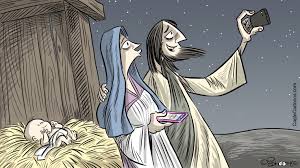
What Would Jesus Post? Retrieved from this site.
To worship ourselves, we fall into the phone's lens which collapses Narcissus's river. Our phone becomes our partner, come to life in its utility, friendship, and closeness. People cannot be without their technology, phones at their sides or in their hands, preferring the reflective screen to the faces of people around them. Some may say that like Narcissus, we will waste away focused on ourselves, individuality, and narcissism that restricts us from progressing or experiencing the world. Some may say that like Pygmalion, we are too emotionally and physically involved in our technology that we miss the beauty of the world around us in favor of a Google search for its likeness. In my cursory experience with selfies, I take very few and have posted even fewer, I see many positives and negatives to the phenomenon.

Comic by The Oatmeal about the negatives of selfies
Undoubtedly, it has taken news media by storm. The selfie of Obama and Biden made headline news and people were discussing the Oscar selfie (which was potentially a contrived Samsung advertisement) almost as much as the award winners. I'm not sure about the wide appeal of other people's selfies (in the immortal words of Mallory Archer: why would anyone want a picture of someone else's food?), but as a personal expression of self-worth, confidence, and creativity, selfies do have an important role in the rhetoric of identification. Especially considering that some people may not always find themselves presented in media (or they are expressed negatively), online, or in safe spaces, selfies could help establish an online presence and carve out spaces for open discussion about personal identification, labels, and communities. Selfies create visibility, are unapologetic, and bluntly express one's visual appearance, identity, and existence as important and worthy of appreciation. Even if it is produced for personal consumption, it necessary sharing (often on social media sites) encourages a reflection of how it may influence a larger public. The physical presentation of the body demands attention, space, and gaze onto individual, their stories, and potential arguments. The selfie also glamorizes the power of technology, to turn what would have taken many hours of labor to produce a self-portrait can be accomplished in seconds and sent around the world instantaneously.

I hear the cries on both sides about the narcissism and objectification that is implicit in the selfie. But, I see the selfie as merely an offshoot of these larger cultural changes than a root cause or responsible for them. There are innovative potentials in how the selfie could carve out rhetorical communities, enhance identities, and change norms of personal expression. Though I can imagine Kenneth Burke terrified by the reliance on technology that he warned against, I hope that he might appreciate the rhetorical opportunities for identification, mimicry, and understanding between people that may otherwise never have met. And, the rhetorical opportunities for personal expression and control over how one defines themselves and their relation to the world.

Sunday, April 20, 2014

The Weak and the High Maintenance: Female Stereotypes in Advertising

This was not the intended blog post for this Sunday, but a few recent advertisements have been on my mind, recently. Their repetition on the TV channels I watch and on Hulu has increasingly bothered me in their portrayal of the female. I will link to them both here and then discuss the problems that emerge in the persistent stereotyping (especially gender stereotyping) that occurs in media.

The first commercial is from Verizon, which advertises that if you buy a phone, you'll get a second free. Then, the commercial explores various options for who the second phone should be given to. Attempting humor, the commercial proposes that a girlfriend may enjoy the free phone, "but don't tell her that it's free." The face of the female fades from happy to disgruntled. This commercial plays on the "high maintenance" girlfriend trope where females are not happy or satisfied unless a lot of money has been spent. Shows such as Bridezillas, MTV True Life, arguably every Real Housewives version, emphasize this theme of women as spoiled, needing immediate and constant care, and focused on the material. These stereotypes overpower a more dimensional representation of the female outside of material goods and characterize all women as high maintenance. This description itself is inherently offensive. One's provides maintenance to a car or an object, not to a person. There is the association with a female as an accessory, a tool, an object needing maintenance, improvement, and upgrades in order to function. This also implies that the partner (oftentimes male) in the relationship is the only one with purchasing power. This clip from Bridezillas, featuring Remy and Rob, illustrates the dynamic quite well.


The Verizon commercial bother me, because it ignites these stereotypes as women as only valuing the material, lacking purchasing power, and only superficially strong in their demand of items they cannot provide for themselves. Even in the portrayal of strong women who declare they deserve certain items or treatment, there is an underlying weakness in the women who rely on others for self-validation, respect, and attention.

The second commercial focuses more on the vegetarian as weak, but the non-present character is given a female gender. This is a commercial from Walmart about setting a table for an Easter lunch. The planner describes why certain people are placed in certain spots noting that her vegetarian sister is at the opposite end of the table "so she can't see the ham." My first reaction was one of disgust that a commercial would rely on stereotyping vegetarians as too weak to even see meat. Though this is just a small statement, a lot of information is imparted in a short amount of time to the viewer. The audience is surely meant to consider the planner quite respectful. But, the implications are that vegetarians (and perhaps specifically female ones) cannot stomach the sight of food they cannot consume.

Both of these commercials highlight the importance of stereotyping in the world of advertising. When a company has only 30 seconds to compare one's attention and express the benefits of a product or service, stereotyping is a potential strategy. Originally conceptualized as the images that one sees in one's head, stereotyping is now defined as a mental shortcut that associates certain characteristics with others. There are racial, gender, ethnic, religious, political, and geographic stereotypes, all which connect a person to a host of underlying associations. Stereotyping makes sense if one's goal is to impart information as quickly and as succinctly as possible. The human brain is lazy and would rather use mental shortcuts to absorb, process, and respond to information. Popkin called this "low information rationality" where people tend to use the least amount of information possible to make their decisions. He connected this specifically to voting, where people may vote in elections based solely on a party affiliation, a rumor about a candidate, or even their aesthetic appearance over delving in deeply into issues and more complex information.

Apologies for the video quality. South Park's "Museum of Tolerance"

Though stereotyping may make sense for advertisers, other media theories, such as cultivation, encourage us to reconsider the potential consequences of long term, frequent consumption of media tropes. If females are consistently portrayed as weak, high maintenance, powerless, vulnerable, and other "feminine" characteristics, how can we expect a new generation that is more open to feminism and equality? There are certainly many factors that influence people's attitudes, opinions, and behaviors, but it may not be surprising that a media that reflects and stereotypes females in such as way may also be contributing to other gender-based issues. There are many examples I could pull from, but I will encourage people to look at this video from Fox News about women being paid "what they're worth."

Sunday, February 23, 2014

Book of Mormon: A Latter Day for the Latter Day Saints?

Book of Mormon has recently come to Los Angeles and I have now seen the musical twice. There are a few important notes that I would like to make regarding the musical. I won't have too many spoilers or descriptions of the musical, but if you haven't seen it or would like to remain in mystery, then turn back now!

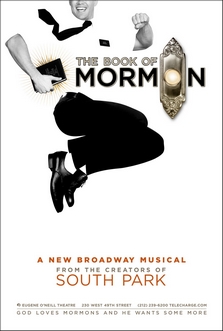
Retrieved from Wikipedia

The first point I'd like to make about the musical is the various reactions it has received due to its concentrated treatment of the Mormon faith. Based on an episode of South Park where the Mormon faith is described in song, including a chorus calling it "dumb," the Book of Mormon primarily follows Elder Price on his missionary trip. Matt Stone and Trey Parker are comedians and the musical follows the comedic and often offensive style of their TV show and movies. Though the show has received much praise including Tony awards and nominations, there has been much backlash from the Mormon community that the show paints their faith as something to laugh at, and not seriously consider as a legitimate faith. I have previously written about the Mormon faith and how it complicated Mitt Romney's run for presidency. Part of its problem is its youth where "ancient upstate New York" is a biblical location and the Garden of Eden is located in Missouri. The relative "all-American" prophet is something foreign and different from the traditional Middle Eastern locations.

The backlash that it has received overestimates the exclusivity of Stone and Parker's critique. What the Book of Mormon does is present the Mormon faith as similar to other faiths, not distinct. When one considers the equally occult and supernatural forces that define other religions, laughing at the Mormon faith means that people are laughing at all faiths. In the song "I Believe" Elder Price sings about all the things that he believes in as a part of his faith. The first two lines are quite Christian in nature: "I believe that the Lord God created the universe" and "I believe that he sent his only son to die for my sins." Not until line three is a marked changed expressed where he sings, "I believe that ancient Jews built boats and sailed to America" that elicits much laughter from the audience. The chorus notes that "I am a Mormon and a Mormon just believes." In a sense, this is a critique of all religions that just believe the doctrines put forth by their faith. Is it any less funny or unbelievable for their to be a Christian version that statements "I believe that Christ turned water into wine"? Or "I believe that Mary gave a virgin birth?" Or "I believe that Christ resurrected after being crucified?"


This song touches on the key component of all religions: faith. There is little to no evidence of all of these supernatural and religious occurrences, so for Mormon doctrine is equally as legitimate and believable as all other faiths. Even if the audience does not catch onto the criticism, the Book of Mormon expertly causes everyone to consider the beliefs that they hold as true and examine why their faith holds weight, if any, over others. The Book of Mormon also expresses other similarities to faiths such as missionary trips, studying the Bible, guilt over sinning, and uncertainties about its teachings. As an atheist, it was clear to me upon watching the show that this was a critique of all religions, their systems of beliefs, and the arbitrary hierarchy and discrimination directed towards Mormonism.

Perhaps the Mormon Church understood the great potential in the play as an avenue to reach new members. In the playbill for Book of Mormon, the Church took out three full page advertisements. The first is a white male noting "I read the book." The second is a Latina female with the text, "the book is always better." The final page is a black male who notes, "you've seen the play, now read the book." All three advertisements contain three methods to learn more information: a QVC, website address, and instructions to text "BOOK" to 33733. The faces of the individuals are highlighted to reveal their diversity and the power of the individual to find more information. The play centers around the "Book" of Mormon, so the advertisements push viewers to explore the book through its original text instead of simply through the play version. For the first advertisement, having read the book is a point of pride, a way for savvy-going theater-goers can engage with the play more fully. The advertisements take advantage of a captive audience that is engaging, perhaps for the first time, with the Mormon faith and gives them the opportunity to learn more.

Retrieved from this review
Those who may be visiting the show and preparing to laugh may not be the best audience to find converts. I thought similarly after seeing street preachers in Las Vegas. But, the places where there may be the most resistance are also perhaps the areas with the most potential and opportunity. Just as Elder Price entered a missionary location in a poor town in Africa, the Mormon Church is braving hostile territory with an unlikely chance of success. But just as Elder Price and Elder Cunningham attempt to change the landscape for Mormon missionaries, the Church also attempts to affect the narrative of attendees by offering its own version. Either way, this musical has people discussing the faith and has exposed many people worldwide to its teachings and doctrines. The Church is smart to see this as an opportunity instead of a threat and everyone would be best served by appreciating the critical nature of the play not as anti-Mormon, but as inquiry of the role of faith in general.

Wednesday, January 23, 2013

Open Access Journals: Information for/by everyone?

I had previously scheduled a different topic, but in light of a few well-reasoned and interesting blog posts by my colleagues at USC, I've decided to throw my own hat into the ring about open-access journals and the future of publishing. I encourage you to read Alex Leavitt's initial post and Andrew Schrock's response post before reading my response below.

First, I wish to declare my support for Alex and Andrew in their praise of open-access. In theory, the term is a sign of open information, shared meanings, and enlightenment. I find, however, that such thinking is, at least in current iterations, overly optimistic. In this vein, I agree more closely with Andrew's caution towards open-access in that there are other things to consider before launching a personal crusade. Alex has taken a more hard-line approach, calling for the complete abstention of "closed access", not only for himself, but for all scholars.  Below I will enumerate issues that I have with such a declaration and why I would urge scholars to question the implications and consequences of such actions. I will also explain why I find Andrew's response and the continuation of some of his ideas as a more practical compromise.

I would call attention to the overarching idea of the initial post: that open-access is moral and hortatorical/obligatory for scholars. This is known as the fallacy by composition, or the logical reasoning that assumes that something true of part of a whole must also be true of the whole. I completely agree that pursuing open access and supporting it is a noble goal for scholars, but I do not agree with its universal application. The implication in making such generalizations is that for all scholars, no matter their discipline or situation, that this is the correct or moral move. This, I believe, excludes the work of other scholars who may not study new technologies, be passionate about open-access and the share of information, or have the same gain by making such an announcement. The community in which and the topics which Alex studies uniquely positions him to make this declaration. Rhetorical scholars would have no interest in my admission to do the same. Creating a blanket statement by definition ignores scholarly differences that may prohibit and inhibit one from making the same choice. Although this would merit another blog post entirely, I will mention here briefly the notion of "white male privilege" that creates a hegemonic structure that rewards those in power for taking risks and penalizes others for not conforming. Whereas a great media and Internet scholar like danah boyd can "get away with" avoiding closed-access publishing, others without such clout or experience could have their careers dashed for making the same choice. This is also inherently linked to one's name/mark in a field and one's youth (read newness) to academia.

This brings me to the issue of "choice" in general. I have previously written about this in regards to the Taylor Cotter incident, and the topic emerges here again. The truth is that although "open access" is a laudable goal, who is this information really "open" to? As Andrew mentions, scholars live in  "privileged media and spaces that are not open to everyone" by definition, because our work is shared not necessarily to the general public, but for the purposes of academic advancement, theory, and methodology. This is not applicable to all scholars, of course, but I feel that for the majority, it is. For example, my current RAship with the Earth Science Communication Initiative is working on helping combine multiple voices (scientists, politicians, religious leaders, and activists) in working towards climate change. Will the people we work with and access be interested in the theory papers I write on apocalyptic rhetoric and political inaction? Probably not. Will they be interested in plans for action, evaluations of the conversations  and solutions? Most likely. That distinction for me is the clear divide between open and closed access, simply not everything has to be or is somehow better because it can (but won't) be accessed by non-scholars. Andrew makes this point as well, noting that few people have ever denied him copies of papers he has wished to read. I have also never been denied and I have emailed copies of my papers after conferences when asked even if in theory they reside only in closed-accessed spaces. As a side note, aren't all universities closed systems of information? How many people get to see the paper I wrote for Randy Lake's "Social Movements as Rhetorical Form" class unless I publish it? Wasn't the creation of journals and online publications for this very reason?

The ultimate goal of "open access", I would assume, is for the free and open sharing of information, an online Habermasian coffee shop of academic intellect. But, I think one of the best places for this to happen is at conferences and meet-ups. Of course, this brings me back to the idea of choice and the access related to money/wealth that some scholars do not have. Conferences, especially inter/national ones are not affordable for everyone, though I think academics are creating solutions to this such as local conferences (my VisComm conference in Utah was more engaging than the national ones I've been to) and creating tiers of payment for cheaper options of registration. Those issues aside, conferences are more personal and expressive points of interaction that online spaces (for now). I am sure that the capabilities will continue to grow, but for now, there is no equivalent to the panel experience. For example, my past panel at NCA gained me new colleagues, gave me new insights into the topic (Romney's Mormonism), and I exchanged numerous business cards from panel attendees. This most likely would not have been possible if I had merely posted this paper online. Part of the problem is in the bog of online scholarship, where does one begin? How to sift through all of the information accessible? Again, it comes down to one's name in the field. Whereas Alex may be receiving much attention for his post, this one will most likely go unnoticed. How does one get to the place where open-access is recognized, lauded, and meaningful? After participating in the current system.

Andrew also praises the networking opportunities that come from associations and conferences that may not be hosting everything online, as spaces for expression and exchanging of ideas. These are possible because of communication associations that host them. These associations are also responsible for the publishing issues that we have. As a previous employee of a journal publishing company, I will first say that vilifying the publishing company for the state of academic research is not only unwarranted, but it is also counterproductive. Without going into too much detail about the process, I would merely say this: how successful would a publishing company be that placed restrictions on its clients? Publishing companies provide printing and online service at the request of the association/organization, nothing more. It is that group's decision for how to have journals accessed and available to members. These prices increase with options and there may be monetary royalties per subscriber or journal downloaded, but overall, these are restrictions and choices placed by the organizations themselves. Are we now to boycott any type of scholarly communication organization? Do we become lone wolf scholars trapped in an online bubble? Either way, the publishing company is simple providing a service, information and access is not for them to decide.

In conclusion, though I admire Alex's passion for the open-access movement, I find it highly problematic to engage with at the exclusion of associations, journals, and other scholars. I find myself agreeing with Andrew, more or less and his more measured approach, that praises free and open publication, but does not demonizes those who do not engage, as there are many  reasons for doing so. To think that I could not approach my friend and colleague to work on a paper, conference submission, or journal saddens me because those ideas/collaborations will be fully lost to the academic community, as opposed to being slightly restricted. I suppose that I will not be co-authoring anything with Alex in the future, but perhaps Andrew and I may.

To summarize, TL;DR
  • Open access in theory is a moral no-brainer, but in application, it is problematized by issues of choice, universality, and execution
  • Female, minority, or any combination of intersectionality may not have the same "choice" that Alex made
  • Scholars who are young, at lower ranked universities, or not in technology/new media studies may be unduly hurt by restricting their publishing
  • The current system is changing to encompass more of these demands for online access (why destroy and boycott the system that is already attempting to do what we ask of it?)
  • Shouldn't we be opening access to those we know will read/are interested, as opposed to the general public out of principle? (obviously this depends on one's field/research)
  • There is no substitute currently for the in-person exchange of information
  • Associations/organizations that obtain/release information are to blame, not publishing companies
  • Currently, these associations provide scholars with more benefits that restrictions

Wednesday, July 4, 2012

Visual Communication Reflection 2: Tattoos

As a continuation of last week's post, I'd like to discuss the second paper on the Body and Visuals Panel at the Visual Communication conference I attended at the end of June.

The second paper was interested in collecting narratives of tattoos based on the history and evolution of the tattoo. Although tattoos can be used for a variety of purposes such as branding (e.g., Holocaust survivors), identification (e.g., gang or group loyalties), and memorials (e.g., dates of a loved one's death), the underlying link between them all is the narrative behind its acquisition and personal importance as permanent (mostly, at least) body art. The presentation mostly focused on the functions of tattoos, types of tattoos, and the basic storytelling design of tattoos.

Although the paper was in its beginning stages, the most interesting part for me was the overarching idea of "modification" and changing the body from its "original" form in order to tell a story. In ways that remind me of the transgender body, the "original" form is, for whatever reason, not the correct form, so modifications are undergone to make an outer body reflective of an inner soul. Additionally, the researchers discussed the personal vs public nature of tattoos in terms of placement, size, and color. A small black outlined tattoo on the hip bone has a different meaning than a colorful, bright, large face or neck tattoo. Prominence can change the significance of the tattoo and reflect the private vs public nature of the tattoo's narrative. From the heavily tattooed to the minimalists, from the professional to the amateur, tattoos all tell stories.
I would like to expand upon the idea of storytelling by expanding the narrative beyond just the physical tattoo. Not only can a tattoo be a narrative, representative of past events, victories, losses, membership, and loyalty, but it can also be the narrative in and of itself. Consider, for example, tribal cultures that use tattoos as markings for the transition from childhood to adulthood, where the very act of getting the tattoo is the transition. Enduring the pain for long hours symbolizes manhood to the tribe. The design and pattern of the tattoo is thus trivial; it is the act of being tattooed that truly holds narrative importance.

A modern example that comes to mind is the show Ink Master. Jumping on the skill-based competition reality show craze, Ink Master is a competition for tattoo artists. The trailer is below, but don't be fooled by the pig carcasses and painting challenges. During every episode they tattoo real people, whom they called the "human canvasses". Completing the metaphor of tattoo as an art, the humans serve as the canvass and location for the design. Perhaps the most painful part of the episode is the critique section, where the tattoos are described and critiqued in vivid detail by the judges. The person who just got the tattoo can watch and learn everything wrong with the permanent image now engraved on their skin, for the purpose of deciding who is eliminated from the contest. Who would do such a thing? Well, apparently at least 52 (ten contestants, one eliminated each round, finale is the final 3) or
To be a "human canvass", you apply through the Ink Master website, where you describe your tattoo of interest and "the full story of why you want to get the tattoo". Because part of the episode shows the interaction between artist and canvass, the story behind their tattoo is important for the appeal and entertainment value of the show. The most interesting episode, however, was the finale, where human canvasses signed up and volunteered to get any tattoo. I repeat, they came on the show and allowed the three finalists to mark them with any tattoo the artist wanted. Although these were the final three and arguably the best of the contest, they were still deciding the location, design, color, and style of a permanent mark for someone who had no say in the matter.

Surprisingly enough, the calculation above reflects only a fraction of the applications received to be a human canvass. The important part is the last sentence on the screenshot says "due to the high volume of applicants, ink master is unable to respond to everyone". In other words, so many people are willing to get tattoos on the show, for which they receive no monetary compensation or even travel reimbursement, that they cannot even send a rejection email.

The narratives of the tattoo, especially those in the finale episode, is not the tattoo, but the experience of getting the tattoo. The design matters not at all, could be anything from Japanese lotus flowers to a pin-up girl to a tribal arm band. When someone asks about the tattoo, the story will not be about its design, but a narrative of being on TV, the anxiety about its quality, and the ignorance as to its design.

The narrative power of tattoos, therefore, is not limited to the story in the ink, but is truly the story of the person who decided to get a tattoo, their reasons, experience, and story.

Friday, May 11, 2012

Research Tools for Students and Faculty: Personal Websites

I personally use Google Sites, but there are dozens of free website interfaces that you can use to help make a brand online. It's egocentric, but necessary, to Google yourself and figure out what people are seeing about you in online spaces. Privacy no longer applies in job applications, college admissions, internship interviews, and the like, if it is out there online, it will be found by employers, supervisors, and advisors. One way to combat the inclusiveness of online information is to increase the traffic to sites that you own, which will then appear higher on a Google search list. Owning your own domain can be powerful, but even free sites will give you a better presence online than none at all.

Domain names can be purchased at multiple hosting sites such as GoDaddy with renewable contracts for the licensing. For example, I just looked up EmmaFrancesBloomfield.com which is an available domain name for $17 for two years. These prices are truly irresistible to think that for less than a dinner out, you can have your own, personalized website for a few years. And if making your own site is daunting, you can use free site builders such as Google Sites and uCoz, but link it to your paid domain name. This provides you the professional touch of the domain name (most free sites use their company name in the site address: https://sites.google.com/site/efbloomfield/), but the ease of free site building.

My free website on Google Sites is simple, but accessible. Especially for graduate students who do not have as many interactive needs as faculty members, the free software is a great start to a website. uCoz has more interactive capabilities, but first I will discuss the positives of Google Sites:
  • Multiple pages within a website make creating different categories for information easy
  • File Cabinet web interface to create a page of file uploads and links (e.g., add a Dropbox link to CV, photos from a conference, links to article abstracts, etc).
  • Announcements page can be subscribed to by RSS to keep people updated on important news
  • Pre-made and easily customized templates from fun and quirky to sleek and professional
  • Easily link to other websites to increase traffic between branded sites
If you're looking for more interactive website, uCoz has interfaces for blogs, photo galleries, professional templates, and thousands of "gadgets" to attach to the page. uCoz also allows for editing in the designs if you have the capability to write script for the page. The layout is more complicated than Google Sites, but that is part of the appeal. The additional layers of information and tweaking create much more nuanced and personalized web pages that Google Sites can, but you have to be willing to put in the time.

There are many other site builders out there, Yola, Lifeyo, Cif2, Jimdo, Webs, Wix, and Weebly, so I would suggest taking the time to compare, this is your brand, after all. Your website is someone's first impression of you. Don't you want your best foot forward? Channel Goffman, present yourself in the best light, and have your information, that you control, be found.

Friday, April 20, 2012

Research Tools for Students and Faculty: Google Citation

Once in graduate school and during the tenure process, academics are concerned with one thing: branding. Creating one's own website (site comparison forthcoming), formatting and meticulously combing one's CV, and  constructing an online presence are all important parts of one's academic brand and profile. In order to facilitate  one's online identity as a scholar, I'm going to take this post to explain two important ways to ensure that your academic publications and profile are the top results for your name.

Google Citation is an off-shoot of Google Scholar that creates profiles for academics by linking their publications within the scholar database. When someone searches Google Scholar to look for a publication or a topic area and finds an article of interest, they can select the author and be linked to their profile. Within this profile is the author's other articles in the Scholar database, the number of articles that have cited each article over the years, and links to those articles. Becoming familiar with Google Citations helps a scholar in two ways: creating a branding opportunity and tracking one's citations and web of scholarly interaction.

Google Scholar often auto-creates profiles for the more prolific authors by finding similarly cited names and linking the articles together. For new scholars and academics however, we can do part of the work for Google by creating our own profiles and linking our own publications there. The benefits to this (instead of letting Google create own for you) is that your profile will be available for searches and attached to your articles sooner and will be completed with more information. Scholars can upload their own profile photograph, create a verified email address for contact, key areas of research interests, links to other sites (like a research blog or professional website), and manually add articles that Google Citation might not have added (due to differences in citation style or name changes).

Keeping track of one's citations is a great way to create connections with other scholars with shared citations and cited each other's articles. With the multitude of journals and publications across field lines, scholars are often not aware of the people citing their articles or similar or tangential work in the same line of inquiry. This is great way to contact other scholars for panels at conferences, to find colleagues at institutions that might be hiring, or to find co-authors.

These benefits can be doubled if one has multiple citation sites. Other databases similar to Google Scholar have their own author profiles. Consider making one at each of the more popular search engines to make sure that your work is being connected to your brand. Other notable citation sites are ResearcherID at Web of Science and Scopus.

Keeping track of all of these sites is one more task on the ever-growing list of to-dos for academics, but this is an important one. Being able to link all of one's publications increases the likelihood of being found by other scholars and overall creates a stronger brand for the graduate student and faculty academic.