Many bloggers have been commenting on the recent Supreme Court ruling on for-profit businesses and the availability of birth control for employees. There are many directions this post could take, and each of those could be an entire post long. In favor of breadth over depth (and in deference to others who have done the details better justice than I could), I will list a few points regarding this ruling.
I have been abroad for an argumentation conference, so the news of the Supreme Court ruling in favor of Hobby Lobby came as a NYT update on my phone. At first, I was absolutely shocked, then heartbroken to hear that the ruling was 5-4. I could hear the chanting in my head: Hobby Lobby is people! Hobby Lobby is people! Businesses were given the rights of humans, where a non-human is ascribed the rights guaranteed to citizens and people in American law, while the rights of females are destroyed.
1) This only impacts for-profit businesses: specifically religious non-profits were already exempt from the Obamacare mandate. Now, all businesses and industries can impose religious beliefs despite the nature of the company. One could make the argument that choosing or accepting employment at a religious organization may require adherence with certain religious rules. But, these expectations have now been extending to employment at a Chick-Fil-A or Hobby Lobby or any business that decided birth control was immoral.
2) Pro-choice and pro-reproductive freedom does not mean support for abortion or birth control: I hear the conflation quite frequently that because people are pro-choice that they support abortion or want women to have abortions. Likewise, to be pro-birth control means that all women should always be taken some kind of birth control. The support is for choice. The support is for females as rational, decision-makers to decide for themselves what is best for their own bodies.
3) Businesses are not people: Though Citizens United and this Supreme Court case have stated otherwise, I firmly argue that businesses are not and cannot be people. People have the freedom of speech, the freedom of religious expression, the freedom to protest, etc. Businesses are non-human, economic networks that are organized around profit. Businesses are made up of people, but a business itself is not capable of free speech, protest, or religious expression. Simply put: how could a business be religious? Do Hobby Lobby stores attend mass? Do they pray? Do they get baptized, confirmed, or search for vocations?
4) Birth control is not just for reproduction regulation: Although this is obviously the most important and contested use, there are other non-reproductive reasons (such as regulating periods and estrogen levels) for the use of birth control. Providing the opportunity for businesses to deny birth control for "moral" reasons also allow for the denial of its purely medical uses. Though I dislike slippery slope arguments, I feel the need here to make a short one. If anything and everything can be subsumed under the idea of "violating religious expression," then anything from wearing a headscarf, getting divorced, wearing a cross, or any "religious whim" could result in firing.
There will certainly be many subsequent cases that unfold from this important decision. I hope that courts will stop rolling back the rights of females and move away from valuing businesses over actual human beings. This decision was certainly a disappointment for women's rights and the pro-choice movement. It is important, however, to acknowledge that despite the negative consequences of this ruling, people do have reasonable, legitimate reasons for their religious views and how they choose to express them. What is not acceptable is having these personal religious views interfere with and impose on the lives of others.
I've titled this piece specifically in reference to a previous post justifying anti-choice instead of pro-life for the description of abortion right's opponents. The point of the post is to discuss a few interesting manifestations of visual rhetoric in anti-choice arguments that I've recently noticed. The visual tactics of the abortion movement have been documented well by those scholars who have come before me, especially in terms of the photographs and images of aborted and damaged fetuses as resembling born children in appearance and described action (Petchesky, 1987; Lake & Pickering, 1998; Condit, 1990). My first artifact heavily references these visual elements in equating the fetus to a baby. A new service called "3D Babies" allows for parents to upload photographs of their ultrasounds which can then be printed into a doll-like plastic sculpture.
These dolls reflect the argumentative tactic of representing life as starting from conception. Due to the physical resemblances of a fetus to an infant, the doll represents a visual argument for the protection of the fetus as one would protect a child. This image is described on the website as a 23-24 week old baby "measuring 8 inches from crown to rump." At 24 weeks, the fetus is nearing the end of the second trimester, so is nearly considered a viable fetus that could survive outside of the womb. Because of this, third trimester abortions are currently illegal in most countries. Consequently, abortions at this stage in the pregnancy comprise less than 1.3% of all abortions. The likelihood of a fetus looking like this doll when aborted is very low. This decision, then, is strategic in that the fetus is as far along as possible without being illegal to abort, thus appearing much like an infant. 91.8% of fetuses are aborted in the first trimester, (or less than 13 weeks) which makes their appearance closer to an embryo, only called a fetus at 12 weeks.
These visual choices are strategies to associate a fetus with an infant, one of the most (if not the most) vulnerable population on the planet.This is paired with cries to protect those who cannot protect themselves. The power of the visual and the associations that come from it can serve to overpower logic and the verbal by calling upon the aesthetic and the visceral. This is in part the strategy of laws that require ultrasounds before allowing access to abortions. The law provides a visual connection that the woman/mother and fetus/child share. If one sees the ultrasound images, one might be less likely to abort, directly associating the images on the screen with a potential life that cannot be avoided. The efficacy or ethics of this law could surely be debated, but the point I'm making here is the ingrained power of the visual to elicit emotion and its role as an anti-choice strategy. Facing visually one's actions is tantamount to removing agency if it clouds the judgment of agents. The intended purpose of this law is certainly to halt abortions or at least give women pause (or immense guilt). The woman, then, cannot make a personal decision of her own thought without the visual pressures of the potentially aborted fetus. The ultrasound and 3D doll images present that problem: that the fetus is a potential life, baby, and child experienced and seen as true.
The 3D doll can be purchased by whomever might want one, and I would hope that it would not be used as a persuasive tool to encroach upon agency. The larger issue for me is the laws that force the power of visuals on women making important, stressful, and life-changing decisions. Certainly images and narrative hyperbole about well developed fetuses (past the second trimester) being aborted are questionably moral actions. One cannot, however, stop them from being used in public forums, protests, and billboards. Something that should not be allowed, however, are deceptive images and unnecessary invasive practices forced upon women before receiving a potentially life-saving medical procedure.
As an informed public, scholars, and voters, we must all consider the potentially deceptive qualities of visuals and the arguments that they are making. For the ongoing abortion controversy, visuals and they employment are extremely important in helping the anti-choice movement portray women seeking abortions as murderers and masking invasive, sexist laws as protective statues. There are many intriguing documentaries about this issue, specifically as realized in America. I would particularly recommend Unborn in the USA that does directly discuss the visual strategies involved in the debate.
Recently I read Stephen Toulmin's "Tyranny of Principles," an article written in 1981, but one I found highly relevant to current times. Toulmin, perhaps most famous for his Toulmin Model of Argumentation, describes the evolution of rules and laws from traditional discretionary practices in Roman times. I found this piece fascinating because it helps contextualize a common point of controversy in modern judicial and moral arguments, and also because I find rhetoric's roots in the judicial system and its constant tension with "ethics" (the good man speaking well) worthy of discussion.
Toulmin begins the article by describing previous methods of judiciary practices, where there were no written laws or precedents in Rome for judges to base decisions. Instead, each individual case was handled as a separate, distinct scenario in which all mitigating or unique circumstances were taken into consideration. People trusted the knowledge and discretion of the pontiffs, not an overarching law. But, as Toulmin describes, multiple factors (including immigration that changed societal norms and a need for more and thus less trained judges) constructed a need for established and referable rules which today are the basis for Western judicial systems. This transition is truly a double-edged sword, for now equality and consistency have been established, but in its stead, we sacrifice equity. Simply consider Jean Valjean in Hugo's Les Misérables, who served 19 years (5 for the crime and 14 additional for trying to escape) for
stealing bread to feed his nephew. Did he steal? Yes. Was this crime worthy of 5 years in jail? To Javert, a servant of God and the Law, there are no mitigating circumstances, a crime is a crime. And even when the tables turn and Valjean lets Javert escape, Javert is still bent on returning Valjean to jail. He eventually experiences a mental break where he cannot justify living in a world where people like Valjean violate his standards of right and wrong.
Philip Quast: Javert's Suicide
The transformation of the judicial system, our reliance on the Constitution and precedent has emphasized the letter over the spirit of the law, removed wiggle room, and devalued mitigating circumstances. One need only consider the death of Savita Halappanavar, who died from birth complications after the abortion she requested was denied. The religious (and in this case Catholic) view of abortion as wholly wrong contributed to Savita's death, whose health was not a justification for the abortion. Many anti-choice advocates do allow for abortion in cases of rape, incest, or the health of the mother, but there are prominent American politicians and even doctors that do not. In response to Savita's death, Irish politicians are attempting to re-legislate the rules concerning abortions and when the health of the mother overrides the abortion ban. As Toulmin argues, society must be wary of an over-reliance on these rules, and must refrain from adjusting laws with more laws, instead of addressing the morality and ethics of the original law.
Toulmin's article is a useful transition for me to discuss inherent discrimination and a lack of equity in
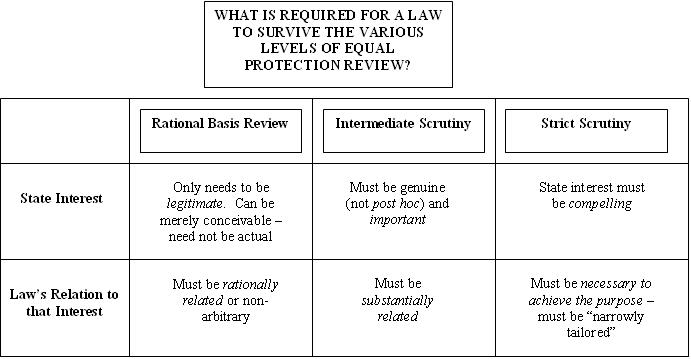
the judicial system that I learned about in a fall class. We discussed the different levels of scrutiny that the courts in America give to different types of discriminatory laws under the equal protection clause. For example, the strictest level of scrutiny is given to laws based on race and national origin, which is a prominent reason why many affirmative action cases lose when brought to court, because they treat people of different races differently. This fact, though in part justified through previous discriminatory measures that make affirmative action necessary, are not mitigating circumstances. The only way for racial discrimination of any kind to be allowed through governmental approval is if there is a "compelling state interest" and the discrimination is the most efficient way to address that interest. A famous example of this is the Japanese Internment Camps that were ruled constitutional since they did address American fears over Japanese immigrants during World War II.
Under strict scrutiny is intermediate scrutiny, for cases of gender discrimination. Under that is rational basis review, where discrimination cases based on sexual orientation or mental health are decided. I find it quite ironic that such levels exist at all. Why are different forms of discrimination created into a hierarchy of discrimination? Isn't this organization in and of itself discriminatory? It seems to me quite hypocritical and unjust for someone to receive different punishments or court ruling simply because they are a different type of bigot than someone else. I find these different strands inextricably linked. How deeply and strongly do we rely on rules of law, and for example, these seemingly hypocritical rules, when they lead to death and discrimination? Toulmin argued that we as a society should not mistake equality for equity, be satisfied with unjust laws, and tie our morality unquestionably to the rule of law. "We need to recognize that a morality based entirely on general rules and principles is tyrannical and dis-proportioned, and that only those who make equitable allowances for subtle individual differences have a proper feeling for the deeper demand of ethics" (p. 107 in Foss's Readings in Contemporary Rhetoric). I would hope that people would learn to be open-minded towards people's circumstances, take into account circumstances and mitigation, and let ourselves be human, reasonable, and overcome our obsession with perfection, black/white dichotomies, and absolutism.
I'd previously wanted to title this: Words you shouldn't say anymore, but I changed the title to reflect how my opinions aren't those of everyone. Prescribing language changes for all people, though I believe that these are respectful and accurate changes, is problematic for many reasons. These suggestions are more for people who are already in line with my beliefs, namely liberal ones, and how to adjust your language choices to be more respectful of others and values.
Racial slurs: First of all, my previous post on Django referenced this briefly, but racial slurs are not appropriate in every day use. This primarily applies to the non-African American, black, brown, or identifying groups that may use racial slurs in jest, for shock value, or as a political statement. They are not words that most of us should or can say, by re-appropriating them into white vernacular, they lose their political meaning and importance. Simply put, these words can be used to reinforce power hierarchies and should not be used lightly or at all by dominant groups.
Tarantino Responding to Criticism about Django
Pro-life: This term has bothered me for a long time. What exactly is pro-life about banning women from having abortions? Abortions can be a life-saving procedure and refusing one can lead to complications and death. The idea that a fetus is alive is based on religious definitions that life begins at conception. For non-believers or those that operate under a different definition of when life begins, the life of the mother is the life that needs to be protected. The life of the mother is not always immediately in physical danger, as was Savita Halappanavar's, but there is always emotional and psychological life to worry about. Although many pregnancies are intentional, women do become pregnant for many reasons accidental or through force. Denying these women the right to closure and healing from rape, incest, or other emotional traumas can be damaging to a woman's life as well. Instead of "pro-life" which I have described as very misleading, I endorse the term "anti-choice" to emphasize the true issue: deciding for women what they wish to do with their bodies. If life were really the issue, then the woman's life would weigh importance as well, which for many anti-choice groups, though not all, it is of secondary importance, if that. Perhaps the most disturbing part of the anti-choice movement is that by equating the fetus with a child, they respond to abortion clinics and places like Planned Parenthood as if they were attacking murderers. Abortion practitioners have been threatened and killed (pro-life, huh?) and funding for PP has been cut in many states.
Savita Halappanavar
English in general: I recently read an amazing chapter from bell hooks who discussed the emphasis on clean, pure English as a means of stripping people (primarily former slaves and their descendants) from keeping in touch with their roots through dialect. She quoted a poem by Adrienne Rich saying, "this is the language of my oppressor, but I need it to talk to you". This statement is powerful and I feel needs no explanation or extrapolation except to say that the hegemony of the English language is not something always laudable. We should all try to learn other languages and encourage others (as bell hooks describes in a teaching role) whether they be friends, family, or students to speak how they feel comfortable speaking and encourage expression in multiple voices.
Boy/girlfriend, wife/husband: I think that these words should be replaced with the gender neutral counterparts of "significant other", "partner", "spouse", etc. Assigning and using these terms reinforces heteronormative definitions of marriage that use the binary gender terms, male and female, as the standard. Despite setbacks, such as Proposition 8, marriage is on its way to being redefined as open to homosexual couples. To reflect this openness and one's agreement with the changes, more gender neutral terms should be used to describe couples. Some homosexual couples may prefer the girl/girl friend or boy/boy friend terms, and that should be respected. For general conversation, however, the gender neutral terms are more encompassing and respectful. This gender neutrality follows for trans* and members of the queer community. Pronoun and name usage is something that I am still struggling with, but I find that simply asking for one's preferred gender pronoun is the best option. For some, their outward appearance may not reflect where they are on their personal journey of identification and which gender pronoun they would prefer. One's sexual organs does not adequately describe most people's gender identities and can be restricting in terms of expression. I remember hearing a quotation from a friend at an LGBTQ event at Northeastern: "I wish I had been born a girl, instead of just having this vagina." This statement highlights the struggle of many people attempting to realign their physical gender with one's felt gender and how sexual organs should be not be defining characteristic of a human being.
These are a few suggestions for different word choices that I think might be helpful for more open, liberal-minded people. For people who are anti-choice, pro-heteronormativity, and perhaps unconcerned with issues of race, these suggestions may fall on deaf ears. For others, I hope that these at least spark some thinking about the power of the words that we use, what context we use them, and who we use them with in defying hierarchies and promoting equality.
Doing research on the intersection of religion/politics and religion/science have brought forth some interesting, shocking, and saddening examples of what happens when these collisions occur.
Some things that I have read have made me echo the immortal words of Professor Farnsworth on Futurama:
This bill in Tennessee would place those who have had an abortion on an information-sharing list similar to sex-offenders.
The passage of this law in Idaho questions women's abilities to understand if they have been raped and requires them to view an ultrasound of the fetus before obtaining an abortion.
A doctor in Kansas is being stripped of her medical license for agreeing to provide an abortion to a 10 year-old rape victim carrying her uncle's child.
Protesters at Gay Day in Michigan threatened to rape and kill participants in the event, quoting and relying on biblical verses to justify the attack.
Representative Andy Gipson (R - MS) stated and then confirmed his opinion that it is people's duty to follow the word of God by having members of the LGBTQ community put to death.
Doctors in South Dakota are now required (as upheld by a recent ruling) to advise women seeking an abortion that there is a psychological link between having an abortion and depression and suicide.
Republican politicians confirm the active disenfranchisement techniques of Republicans towards African American and Latino voters.
Massachusetts judge approves a sex change operation for an inmate and sparks outrageous comments about the rights of prisoners, sex change operations, and tax allocation.
Stories like these ones above are not always bad, however. They remind me that there are still issues in the world that need to be addressed and corrected. We as people, part of humanity, cannot be satisfied with partial victories, segmented success, or the fracturing of freedom and equality.
Other news stories, however, help me to strike my best Freddie Mercury pose and exclaim:
The passage of the Affordable Care Act allow for equal coverage for women and access to preventative measures so they can be in more control of their health care.
Obama's statements on gay marriage and the Democratic Party supporting the repeal of the Defense of Marriage Act, though a small step, is an important first political gesture to inclusive marriage equality.
The repeal of Don't Ask, Don't Tell ended the prevention against open homosexuals from serving in the military and allowed for people to be open and honest about their identities.
The election of the first openly gay Senator and the passage of marriage equality in Maine and Maryland.
I hope that in the future, I will see more progress towards the acceptance, tolerance, and inclusion of all of humanity through equal treatment and opportunities. These are goals that we all can strive for and as scholars, voters, and communicators, we can strive for change together.
During my summer in Pittsburgh, I traveled across the state multiple times and saw many conservative billboards. My time spent in Philadelphia, Boston, and Los Angeles has not afforded me such exposure and I found many of them worthy of comment. The power of the billboard is in its simple, clear messaging, stylistic dimensions, and highly partisan statements. The limited space is no place for moderate remarks, especially when they come from third-party groups and can be as brutal as possible. One of my favorite billboards read "Coal: red, white, and blue, and always green". The appeal to colors highlights how patriotic it is to support coal, but also its eco- or environmentally friendly properties. There is no room for argument or debate on the billboard, simply a statement that the viewer can agree or disagree with as one drives past.
The purpose of this post, spurred by my interest in billboards and political advertising, is to describe a few political advertisements in the 2012 presidential election cycle. The advertisements share important information about candidates that are small, concise, sound bites for easy consumption. One that was prominently on display entering downtown Pittsburgh said:
Obama supports gay marriage and abortion, do you? The word "supports" portrays Obama as one who wants everyone to participate in gay marriage or have abortions, as opposed to supporting an individual's rights to choose these for themselves. Asking the viewer to reflect on these topics encourages an emotional and negative response in those questioning or already leaning conservative (at least on social issues). The enthymematic conclusion to this billboard is that by voting Republican, you will be voting for someone who does not support these rights, ergo Romney does not support gay marriage and abortion rights. This can be a powerful motivator for those who are undecided or conservatives who are concerned about Romney's reputation for flip-flopping on social issues.
Another way that Romney is trying to re-claim the conservative base is to promote the Christian ideals he shares as a Mormon. The Mormon.TV videos highlight their belief in Jesus Christ, "the savior of mankind", the variety of people who follow the Mormon faith. Mormonism has a negative association with being mysterious, cult-like, and secretive. This website and their television advertisements can help in part to assuage those concerns that Mormons are somehow dangerous, occult, or different by sharing the experiences of Mormons as people and how their faith is (for the most part) similar to mainstream Judeo--Christian beliefs. In fact, the differences between Mormonism and Christianity is the same between Christianity and Judaism, they simply believe in the divine inspiration of one more book.
An Obama advertisement that caught my eye was the "For All" advertisements that are being shared on Facebook. Borrowing from the unifying visual statements of the 99%, the advertisements show celebrities and everyday Americans and what they are passion about and fight for. The statement is quite unifying in the copying of the action, but also in the overarching statement that people vote not just for themselves, but to protect the rights of others.
The juxtaposition of celebrities and everyday Americans also creates an inclusive environment, while also capitalizing on the celebrity support that Obama receives. This is also a contagion effect, where supporters can also mimic the post position and upload their own versions. Just as the 99% signs showed people holding up signs to portray their economic/employment/education situations for the Internet to see, this simple act of writing on the hand (and holding it over the heart as in the Pledge of Allegiance) can be mimicked by everyone worldwide. The visual is a powerful one and one that supporters and independents feel they can engage and connect with.
As the debates are underway and the campaign is heading into the final stages, the advertisements are more likely going to be even more negative and targeted. I never realized how many political advertisements that I saw when I lived in Pennsylvania until I moved to Massachusetts and California and now have seen very few. The ability of technology to micro-target communities means that voters in swing states are receiving the most advertisements and attention from candidates whereas other "safe" states will get very little attention. Trends that I perceive are the increasingly negative third-party advertisements, the focus on values and "change" from Obama (who seems impervious to gaffes or media attention for mistakes), and the struggling Romney campaign trying to salvage the conservative wing with whatever means necessary.