Students of mine have turned in papers this week that critique different advertisements. Their papers have prompted me to think, as I have before (gender in advertising, political advertisements, religion and advertising, interactive advertising, and exclusionary advertising) about different advertisements that propose a cause or campaign instead of a product. My students had the choice of a traditional product advertisement and one form a non-profit. It was much easier to see the direct purpose of the for-profit advertisement: to sell a product. Oftentimes, however, the advertisements for non-profit groups have to be more creative in order to peddle something far less tangible than a car or a purse. These attempts to be innovative can backfire, causing more attention to the advertisement campaign itself than the message it is trying to convey.
In rhetorical theory, this is called disingenuous controversy. Fritch, Palczewski, Farrell, and Short proposed the term to describe situations when an ancillary aspect of an event occupies attention and the actual message (which itself could be controversial and counter-hegemonic) is lost. Their example was the comments by Ward Churchill where he compared the workers in the World Trade Center as "little Eichmanns" when describing the justifications for the 9/11 attacks. The purpose was to raise questions about the American economic structure and how it constrained and motivated the actions of the 9/11 terrorists. But, instead of this critique gaining media attention, people focused on his comparison between the Nazi bureaucrat and workers in the World Trade Center as offensive, insensitive, and unpatriotic.
Following the Nazi theme, I first want to discuss the advertising campaign that ran in Germany to promote HIV/AIDS awareness. The campaign features graphic images of infamous leaders such as Adolph Hitler, Joseph Stalin, and Saddam Hussein having sex with women. This campaign was eventually pulled in part because of its graphic nature and outrage over the use of these infamous faces in relations with women. The campaign read, "AIDS is a mass murderer" and encouraged viewers to associate something traditionally thought-of as pleasurable with something inherently disgusting and deadly. The graphic depiction in the advertisement coupled with the unique history in Germany that makes the presentation of Hitler challenging, however, overshadowed the consciousness-raising of re-thinking about the dangers of unprotected sex.
The second campaign I'd like to present is a campaign by 10:10, which is a climate change advocacy non-profit. The advertisement shows various situations where people are asked about their opinions on climate change. A few that declare that they do not believe in global warming or that we should not act towards it are shown exploding violently. The version that received the most attention featured children exploding in their classrooms. The campaign seemed to be questioning the value of dissenters and how those who do not engage or pay attention are ultimately doomed. The violence, especially towards children, however, became the focus of the campaign instead of the message of the future of humanity.
These "dangerous" advertisements risk an audience backlash in favor of capturing people's attention. When the alternative is complete silence or apathy, perhaps a bit of attention-grabbing is in order. There are certainly risks to this type of advertisement. Non-profits may be more likely to risk these strategies because they are not beholden to shareholders or a bottom line. When attention is at an all time premium, with the variety of options for viewing, being offensive or crude is one way to be sure one gets eyes, if not support.
This was not the intended blog post for this Sunday, but a few recent advertisements have been on my mind, recently. Their repetition on the TV channels I watch and on Hulu has increasingly bothered me in their portrayal of the female. I will link to them both here and then discuss the problems that emerge in the persistent stereotyping (especially gender stereotyping) that occurs in media.
The first commercial is from Verizon, which advertises that if you buy a phone, you'll get a second free. Then, the commercial explores various options for who the second phone should be given to. Attempting humor, the commercial proposes that a girlfriend may enjoy the free phone, "but don't tell her that it's free." The face of the female fades from happy to disgruntled. This commercial plays on the "high maintenance" girlfriend trope where females are not happy or satisfied unless a lot of money has been spent. Shows such as Bridezillas, MTV True Life, arguably every Real Housewives version, emphasize this theme of women as spoiled, needing immediate and constant care, and focused on the material. These stereotypes overpower a more dimensional representation of the female outside of material goods and characterize all women as high maintenance. This description itself is inherently offensive. One's provides maintenance to a car or an object, not to a person. There is the association with a female as an accessory, a tool, an object needing maintenance, improvement, and upgrades in order to function. This also implies that the partner (oftentimes male) in the relationship is the only one with purchasing power. This clip from Bridezillas, featuring Remy and Rob, illustrates the dynamic quite well.
The Verizon commercial bother me, because it ignites these stereotypes as women as only valuing the material, lacking purchasing power, and only superficially strong in their demand of items they cannot provide for themselves. Even in the portrayal of strong women who declare they deserve certain items or treatment, there is an underlying weakness in the women who rely on others for self-validation, respect, and attention.
The second commercial focuses more on the vegetarian as weak, but the non-present character is given a female gender. This is a commercial from Walmart about setting a table for an Easter lunch. The planner describes why certain people are placed in certain spots noting that her vegetarian sister is at the opposite end of the table "so she can't see the ham." My first reaction was one of disgust that a commercial would rely on stereotyping vegetarians as too weak to even see meat. Though this is just a small statement, a lot of information is imparted in a short amount of time to the viewer. The audience is surely meant to consider the planner quite respectful. But, the implications are that vegetarians (and perhaps specifically female ones) cannot stomach the sight of food they cannot consume.
Both of these commercials highlight the importance of stereotyping in the world of advertising. When a company has only 30 seconds to compare one's attention and express the benefits of a product or service, stereotyping is a potential strategy. Originally conceptualized as the images that one sees in one's head, stereotyping is now defined as a mental shortcut that associates certain characteristics with others. There are racial, gender, ethnic, religious, political, and geographic stereotypes, all which connect a person to a host of underlying associations. Stereotyping makes sense if one's goal is to impart information as quickly and as succinctly as possible. The human brain is lazy and would rather use mental shortcuts to absorb, process, and respond to information. Popkin called this "low information rationality" where people tend to use the least amount of information possible to make their decisions. He connected this specifically to voting, where people may vote in elections based solely on a party affiliation, a rumor about a candidate, or even their aesthetic appearance over delving in deeply into issues and more complex information.
Apologies for the video quality. South Park's "Museum of Tolerance"
Though stereotyping may make sense for advertisers, other media theories, such as cultivation, encourage us to reconsider the potential consequences of long term, frequent consumption of media tropes. If females are consistently portrayed as weak, high maintenance, powerless, vulnerable, and other "feminine" characteristics, how can we expect a new generation that is more open to feminism and equality? There are certainly many factors that influence people's attitudes, opinions, and behaviors, but it may not be surprising that a media that reflects and stereotypes females in such as way may also be contributing to other gender-based issues. There are many examples I could pull from, but I will encourage people to look at this video from Fox News about women being paid "what they're worth."
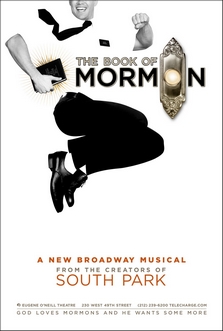
Book of Mormon has recently come to Los Angeles and I have now seen the musical twice. There are a few important notes that I would like to make regarding the musical. I won't have too many spoilers or descriptions of the musical, but if you haven't seen it or would like to remain in mystery, then turn back now!
The first point I'd like to make about the musical is the various reactions it has received due to its concentrated treatment of the Mormon faith. Based on an episode of South Park where the Mormon faith is described in song, including a chorus calling it "dumb," the Book of Mormon primarily follows Elder Price on his missionary trip. Matt Stone and Trey Parker are comedians and the musical follows the comedic and often offensive style of their TV show and movies. Though the show has received much praise including Tony awards and nominations, there has been much backlash from the Mormon community that the show paints their faith as something to laugh at, and not seriously consider as a legitimate faith. I have previously written about the Mormon faith and how it complicated Mitt Romney's run for presidency. Part of its problem is its youth where "ancient upstate New York" is a biblical location and the Garden of Eden is located in Missouri. The relative "all-American" prophet is something foreign and different from the traditional Middle Eastern locations.
The backlash that it has received overestimates the exclusivity of Stone and Parker's critique. What the Book of Mormon does is present the Mormon faith as similar to other faiths, not distinct. When one considers the equally occult and supernatural forces that define other religions, laughing at the Mormon faith means that people are laughing at all faiths. In the song "I Believe" Elder Price sings about all the things that he believes in as a part of his faith. The first two lines are quite Christian in nature: "I believe that the Lord God created the universe" and "I believe that he sent his only son to die for my sins." Not until line three is a marked changed expressed where he sings, "I believe that ancient Jews built boats and sailed to America" that elicits much laughter from the audience. The chorus notes that "I am a Mormon and a Mormon just believes." In a sense, this is a critique of all religions that just believe the doctrines put forth by their faith. Is it any less funny or unbelievable for their to be a Christian version that statements "I believe that Christ turned water into wine"? Or "I believe that Mary gave a virgin birth?" Or "I believe that Christ resurrected after being crucified?"
This song touches on the key component of all religions: faith. There is little to no evidence of all of these supernatural and religious occurrences, so for Mormon doctrine is equally as legitimate and believable as all other faiths. Even if the audience does not catch onto the criticism, the Book of Mormon expertly causes everyone to consider the beliefs that they hold as true and examine why their faith holds weight, if any, over others. The Book of Mormon also expresses other similarities to faiths such as missionary trips, studying the Bible, guilt over sinning, and uncertainties about its teachings. As an atheist, it was clear to me upon watching the show that this was a critique of all religions, their systems of beliefs, and the arbitrary hierarchy and discrimination directed towards Mormonism.
Perhaps the Mormon Church understood the great potential in the play as an avenue to reach new members. In the playbill for Book of Mormon, the Church took out three full page advertisements. The first is a white male noting "I read the book." The second is a Latina female with the text, "the book is always better." The final page is a black male who notes, "you've seen the play, now read the book." All three advertisements contain three methods to learn more information: a QVC, website address, and instructions to text "BOOK" to 33733. The faces of the individuals are highlighted to reveal their diversity and the power of the individual to find more information. The play centers around the "Book" of Mormon, so the advertisements push viewers to explore the book through its original text instead of simply through the play version. For the first advertisement, having read the book is a point of pride, a way for savvy-going theater-goers can engage with the play more fully. The advertisements take advantage of a captive audience that is engaging, perhaps for the first time, with the Mormon faith and gives them the opportunity to learn more.
Those who may be visiting the show and preparing to laugh may not be the best audience to find converts. I thought similarly after seeing street preachers in Las Vegas. But, the places where there may be the most resistance are also perhaps the areas with the most potential and opportunity. Just as Elder Price entered a missionary location in a poor town in Africa, the Mormon Church is braving hostile territory with an unlikely chance of success. But just as Elder Price and Elder Cunningham attempt to change the landscape for Mormon missionaries, the Church also attempts to affect the narrative of attendees by offering its own version. Either way, this musical has people discussing the faith and has exposed many people worldwide to its teachings and doctrines. The Church is smart to see this as an opportunity instead of a threat and everyone would be best served by appreciating the critical nature of the play not as anti-Mormon, but as inquiry of the role of faith in general.
During my summer in Pittsburgh, I traveled across the state multiple times and saw many conservative billboards. My time spent in Philadelphia, Boston, and Los Angeles has not afforded me such exposure and I found many of them worthy of comment. The power of the billboard is in its simple, clear messaging, stylistic dimensions, and highly partisan statements. The limited space is no place for moderate remarks, especially when they come from third-party groups and can be as brutal as possible. One of my favorite billboards read "Coal: red, white, and blue, and always green". The appeal to colors highlights how patriotic it is to support coal, but also its eco- or environmentally friendly properties. There is no room for argument or debate on the billboard, simply a statement that the viewer can agree or disagree with as one drives past.
The purpose of this post, spurred by my interest in billboards and political advertising, is to describe a few political advertisements in the 2012 presidential election cycle. The advertisements share important information about candidates that are small, concise, sound bites for easy consumption. One that was prominently on display entering downtown Pittsburgh said:
Obama supports gay marriage and abortion, do you? The word "supports" portrays Obama as one who wants everyone to participate in gay marriage or have abortions, as opposed to supporting an individual's rights to choose these for themselves. Asking the viewer to reflect on these topics encourages an emotional and negative response in those questioning or already leaning conservative (at least on social issues). The enthymematic conclusion to this billboard is that by voting Republican, you will be voting for someone who does not support these rights, ergo Romney does not support gay marriage and abortion rights. This can be a powerful motivator for those who are undecided or conservatives who are concerned about Romney's reputation for flip-flopping on social issues.
Another way that Romney is trying to re-claim the conservative base is to promote the Christian ideals he shares as a Mormon. The Mormon.TV videos highlight their belief in Jesus Christ, "the savior of mankind", the variety of people who follow the Mormon faith. Mormonism has a negative association with being mysterious, cult-like, and secretive. This website and their television advertisements can help in part to assuage those concerns that Mormons are somehow dangerous, occult, or different by sharing the experiences of Mormons as people and how their faith is (for the most part) similar to mainstream Judeo--Christian beliefs. In fact, the differences between Mormonism and Christianity is the same between Christianity and Judaism, they simply believe in the divine inspiration of one more book.
An Obama advertisement that caught my eye was the "For All" advertisements that are being shared on Facebook. Borrowing from the unifying visual statements of the 99%, the advertisements show celebrities and everyday Americans and what they are passion about and fight for. The statement is quite unifying in the copying of the action, but also in the overarching statement that people vote not just for themselves, but to protect the rights of others.
The juxtaposition of celebrities and everyday Americans also creates an inclusive environment, while also capitalizing on the celebrity support that Obama receives. This is also a contagion effect, where supporters can also mimic the post position and upload their own versions. Just as the 99% signs showed people holding up signs to portray their economic/employment/education situations for the Internet to see, this simple act of writing on the hand (and holding it over the heart as in the Pledge of Allegiance) can be mimicked by everyone worldwide. The visual is a powerful one and one that supporters and independents feel they can engage and connect with.
As the debates are underway and the campaign is heading into the final stages, the advertisements are more likely going to be even more negative and targeted. I never realized how many political advertisements that I saw when I lived in Pennsylvania until I moved to Massachusetts and California and now have seen very few. The ability of technology to micro-target communities means that voters in swing states are receiving the most advertisements and attention from candidates whereas other "safe" states will get very little attention. Trends that I perceive are the increasingly negative third-party advertisements, the focus on values and "change" from Obama (who seems impervious to gaffes or media attention for mistakes), and the struggling Romney campaign trying to salvage the conservative wing with whatever means necessary.
The latest set of advertisements from "Got Milk?" denigrate average Americans, scientists, and innovators who attempt to improve upon the world's health and well-being. The underlying narrative that underscores this new wave of advertisements is that the current definition of milk as cow's milk is good enough, why bother creating anything new? The two examples below clearly outline this theme of negativity.
The first commercial places a fat cat businessman on the "Board of Unnecessary" with literally money-to-burn who is looking for a way to waste his billions. With other ideas being "too practical" and "too easy", he finally decides to research how to make milk out of "beans and nuts" as a ludicrous and unnecessary endeavor. Not only does this frame the creators and manufacturers of non-cow milk products such as soy milk, almond milk, and coconut milk as evil, rich, and with bad intentions, but it also insults Americans who are foolish enough to purchase these "non-milk" products.
The caveman commercial mimics the first style of the unnecessary, but is perhaps more insulting. Instead of comparing non-milk product creators to businessmen, those who produce and purchase them are compared to primitive cavemen. Specifically, those of us who do not purchase milk are "Gary", the slow caveman who is ridiculed and scoffed at by his higher-intellect friends who cannot understand why Gary would want to make milk from a nut. I would call Gary an innovator, someone who is not just accepting what is told, but tries to create something better. Perhaps nuts are easier to come by than cows, perhaps using nuts reduces ethical concerns for the mistreatment of animals, and perhaps growing nuts does not waste gallons of water and acres of farmland. Gary, though portrayed negatively in this advertisement, has stumbled upon a healthier, more ethical, and environmentally friendly method of creating a cow's milk substitute. And we should fault him for such creativity? What other ideas would have never come to fruition if every idea was given as much scorn as the "Got Milk?" campaign treats non-milk products?
Obviously, the "Got Milk?" campaign is using these tactics to increase the purchase of cow's milk after their market has been invaded by companies such as Silk, 8th Continent, Almond Breeze, and others. The market is getting crowded and there is one thing that the other milks have in common: they do not come from cows. From a marketing standpoint, this position and isolation of other products makes sense, but I shudder to think at the consequences for consumers and the country if the ideals of milk is the only milk that should be consumed (especially if that means drinking whole milk) and that innovation against standards (the "if it ain't broke, don't fix it" mentality) is cause for criticism.
The final aspect of this new campaign that I would like to address is the new "Got Milk?" homepage entitled "many imitations, still no equal" that is an interactive game where viewers must find the "real milk", all the while being confronted with facts and ingredients about other types of milk that lie in wait on the page. Coconut milk is described as "spooky how real this looks, huh?" mocking the preservatives and gelling components of the beverage as attributing to coconut milk's fake quality, despite the ingredients being listed serving as milk's pasteurization process. Additionally, many non-milk products have a longer shelf-life due to those additives. Hazelnut milk is treated no better with the tagline "what's that stuff on the bottom? yikes" referring to the sediment that can arise in hazelnut milk (and other bean milks like soy milk), which is why they often contain the label "shake well before use". Almond milk is degraded for its color, "pretty funky color" despite its appearance as light gray on the screen, one of the closest to white. Lastly, soy milk is described as "this came from a cow? please" even though soy milk has never claimed to be from a cow. I can only surmise that this claim comes from soy milk's appropriation of the term "milk" for its product. And although it may not be milk as in the traditional definition (which specifically mentions being produced by a mammal), these products use the word milk as an indicator for how their product should be used: as a milk substitute.
Innovation is constructed by the new set of advertisements as something unnecessary, burdensome, and ultimately detrimental. A society without innovation, without progress or advancement would leave us without current technology, knowledge, and success in the world. Is this really the message that the "Got Milk?" campaign really wants to send to youth and parents who will be consuming this advertising and making choices at the supermarket? Milk, especially non-skim milk options, are full of sugar and fat with as many calories as a 12 oz Coca-Cola (around 140 calories) with as much as half of those calories from fat (in the case of whole milk). If "Got Milk?" is advertising the status quo in terms of milk consumption, perhaps there can be a suggestion to prefer skim over whole? Simply allowing for consumption of food products to stay the same downplays underscores larger issues of weight and obesity in America that it is not enough of a problem to pursue or give credence to healthier alternatives.
For more information about these advertisements in terms of the history of alternative milk products, please refer to http://skepticalvegan.wordpress.com/
A few commercials have recently piqued my interest into the art of advertising, especially when the marketing of a product alienates users. This is, of course, a natural by-product of items such as feminine hygiene products that have gender specific functions, but for products that are not gender-specific, what would be the purpose in alienating possible buyers?
The first example that comes to mind are "Yorkie" candy bars that my family used to eat growing up. These are purpose chocolate bars that are so dark they are "not for girls"
Eating chocolate is obviously not exclusively a male-centered act nor is chocolate a male-centered item, but the advertising for Yorkies caters to this divide. The sign in the artwork implicates a standard restroom sign, so although the language might imply that "women" might eat the chocolate, visually, the statement is exclusionary to all genders.
My thoughts about Yorkies were initiated by the new Dr. Pepper commercial about their 10 calorie brand. As the first comment on the YouTube video states, "if people could just politely unknot their knickers we could all appreciate this for what it is: a joke." But what damage do jokes, even at their most parodied and stereotyped forms do for the formation of genders? Make a judgment for yourself while watching the video below.
Even as a joke, albeit not a very funny one, there is one statement in particular that is impossible to ignore: "keep your romantic comedies and lady drinks, we're good." The distinction between a 10 calorie soda and a "lady drink" is an interesting parody, as one might typically associate "diet" drinks as a female market. What is inherently "manly" about a 10 calorie soda is left unknown in the commercial, but the action movie backdrop (complete with large weaponry, a robotic snake, motorcycles and "catchphrases") as compared to a romantic comedy, makes the statement that women are less likely to enjoy these types of movies over romantic comedies. As a female who despises romantic comedies and adores horror and action, these types of generalizations are offensive and unnecessary. One might assume that even women who fall into these preferences would find the commercial distasteful. Even if not, why would marketers run the risk of alienating a large percentage of the consumer-base. Especially in a society where women are still the main shoppers and Robertson's theories of "low commitment consumer behavior" indicate an ease of changing shopping conditions, marketers are taking huge risks in associating the feminine with interpretative messages of weak, averse to excitement/action, boring, overly sensitive, and other negative notions often associated with "girly" tendencies.
I have issue with the association of the genders as a dichotomy, in general, but these dichotomies are rampant in mainstream media and are thus areas for criticism in scholarly research. What would advertisers say to transitioning consumers? Consumers that identify as both or neither male or female? How successful are these stereotypes still in reaching wide audiences for long-term brand association when the changing of the population indicates a trend away from these black and white distinctions?
Robertson, T. S. (1976). Low-commitment consumer behavior. Journal of Advertising Research 16(2), 19-24.