Showing posts with label Pentad. Show all posts

Sunday, March 16, 2014

Thin Privilege and LGBTQ Issues: Discrimination based on Choice

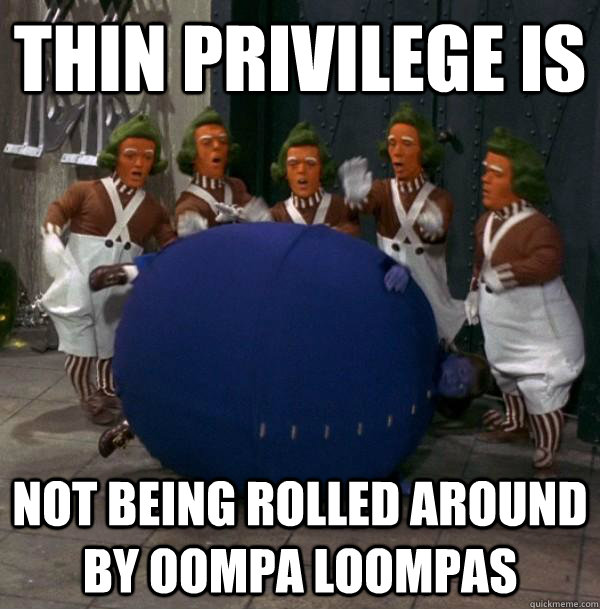
There has been a recent surge in websites, blogs, and tumblrs that deal with "Thin Privilege." These sites have also spawned spoof or parody sites  which have in turn encouraged reaction sites. In the back-and-forth on these websites that I have followed, I would like to comment on a common theme which I think connects issues of health and bodies to the LGBTQ community: choice. First, I will explain these communities then I will draw from examples from each and compare them through Burke's pentad as revolving around agency and choice.

Retrieved from this blog
Thin Privilege reflects the advantages and benefits that come with being thin (or non-fat) in a society that values skinny bodies over large bodies. This has resulted in cultural and institutionally prejudices levied at non-thin people. Thisisthinprivilege.tumblr.com is dedicated to individuals sharing their personal stories of discrimination because of their size. Key themes are the idea that being large in body is associated with unhealthiness (which they argue is not necessarily true), being impacted by a lack of services available to them (such as the size of airplane seats), lacking role models in media, and experiencing fat stigma (e.g., strangers trying to give diet advice or calling names). The stories range from not being able to find clothing sizes in stores to having doctors ignore potential health issues because weight was a perceived larger concern. This site often posts "troll" questions and comments and critiques them as coming from a place of privilege or purposefully trying to undermine their cause. The key take-away from this site is that no one with privilege can deny others their claim to discrimination, police their language, or undermine their cause.

Retrieved from this blog as an example of skewed expectations and a world made for unrealistic body sizes.
From comments on these webpages, I found immense similarities to discussions of LGBTQ rights. The similarities center around the idea of choice. If one believes that being fat or being LGBTQ is a choice, they are more likely to be negative, critical, and dismissive of societal backlash that occurs for them. If one believes that these identifications happen naturally or are a product of the environment (e.g., hereditary/genetic), then one is more sympathetic to the effects experienced. This proclivity to blame the individual (agent) or the environment (scene) can be mapped onto Burke's pentad. The pentad is a tool that critic's can use to analyze situations in terms of its agent, agency, purpose, scene, and act. If the act performed is discrimination against someone, emphasizing the agent may cause one to believe that the recipient caused it themselves. Emphasizing the scene, however, may cause one to believe that society fosters discriminatory attitudes against minority communities. Papers I've been working on, influenced strongly by papers by Brock (1990), argue that these can be directly related to political ideology. Republicans may be more likely to consider the agent responsible (e.g., pull one up by one's bootstraps) and Democrats may be more likely to consider extenuating circumstances (e.g., how scenic factors influence one's actions and treatment).

Retrieved from this site
To consider a large person and a gay person autonomous agents that make choices about their identity is to remove environmental and societal factors from responsibility. This type of view undermines the culpability of institutions and those with normative privilege (e.g., thin and hetero-) for discrimination. Somehow, making a choice to do something as opposed to having it happen to you, makes one more deserving of disdain and scorn. Those who had no choice can be viewed as vulnerable, victims, and innocent. Analyzing these situations as similar help us to connect issues of discrimination and shared experiences of minorities against ableist/cis/hetero/white/male society. From within that community, it is hard to assign oneself culpability and guilt; people would rather blame the individual than admit shared responsibility for discrimination. Just as people were quick to yell "post-race!" with the election of Obama, people are quick to jump to answers that do not include our own or systemic faults.

Retrieved from this site to represent the traditional Barbie size to the new "real proportions" doll

How does society move beyond discrimination? I think it's important for those of us with privilege is to step back and truly listen to the words of those without privilege or those at the intersections. We cannot understand the discrimination not having been privy to it. Trying to deny the stories of others or to argue with our own stories of discrimination only perpetuates structural inequalities. Just consider the backlash that happened when a new Barbie copy with "realistic proportions" came out that would encourage girls to idolize being unhealthy. Instead, why can we not consider these positive steps to creating a more inclusive culture that teaches people to love and respect their own bodies, no matter its size? ThisisThinPrivilege.tumblr.com is fighting against other blogs and the system that devalues fat bodies. Though this article is not meant to be evaluative, it cannot help but reach the conclusion that to reduce people's identities to arbitrary choices is to undermine the perpetual problem of discrimination. As posted on the website, people are fighting a system that "systematically reduces each of us to our dress size, hip measurement, and waist size, then grants favors, opportunities, or simple lack of punishment when the numbers are low enough" and instead fights for a system that treats everyone as equally human.

Wednesday, February 29, 2012

Heracles: Modern Lessons from Ancient Tales

What can Ancient Greek texts tell us about our modern times? Aquila Theatre would argue they tell us just as much today as they did when they were first performed. In the case of Euripides's Heracles during the Peloponnesian War during the 400s BCE, the horrors of war and violence brought home mirror the stories of today's veterans. At the USC Vision and Voices event I attended last night, I was in absolute awe at the integration of Greek themes in modern wars, not the least of which were two of the actors who were themselves veterans of the Vietnam War. Additionally, the chorus, a staple of Greek theatre, was played by footage of interviews with veterans echoing themes of chorus lines in the original script. The acting was impressive, especially behind the main characters' masks and the interpretation of madness striking Heracles was nothing short of incredible. The real reason I would like to write this post, though, is not necessarily to praise the play, but to discuss the salient points about war and narrative that it evokes.
Heracles Performance

What was most striking about the event was the similarity in war narratives from all veterans from WWII to Vietnam to Iraq and Afghanistan, which were all ultimately similar to the Peloponnesian narrative of Heracles. The themes of loss, isolation, madness, and brotherhood span the gaps of space and time and were apparent in every veteran's war narrative. I will expand about these similarities below, but first, I would like to pose the question about what this means for our servicemen and women, that they have a unifying, common experience that the rest of society cannot hope to even imagine? How can a return to civilian life ever truly occur? Has the experience of war created permanently fractured minds and roles for the veteran?

A common theme was one of brotherhood and isolation during and after times of war. An Iraq veteran discussed the scariest moment of his service was when he saw his bunk mate disappear in a cloud of sand produced by a mortar. The fear of losing his friend, not the danger to himself was the moment he remembered, the feeling he had was of brotherhood and loyalty to the friend. Theseus was this friend to Heracles in the play, where he immediately forgave Heracles for murdering his family because of the friendship that they had. Even going so far as to help Heracles up, though he was covered in blood, to take him to Athens to start again. The bonds creating through fighting side by side, risking lives side by side as one veteran described as happening with people who were "previously strangers" not months before. These bonds become stronger than blood and isolate soldiers from friends and family who were not at war. One of the first scenes was of a woman who was lamenting her loss of relationship with her family who now did not know her. She could not be the person she was after war, because that person was foreign to them. Instead, she had to start over, completely from scratch, to build a relationship with her own family. A younger sister had aged from a child to a college student and they were to each each other, complete strangers.

The final theme that pervaded the stories was that of madness. Many interviewees mentioned comrades in war that has become obsessed with killing and the power that came with it. One veteran told a story of a soldier who had stopped another soldier from killing an old man. Instead of killing the man, he lit up a cigarette for each of them. After lighting the cigarettes and enjoying a few puffs, the soldier then proceeded to kill the man, previously showing mercy, then showing incredible hate and fury soon afterward. The madness of Heracles was similarly swift and temperamental, influenced by interference from the Gods. Although Heracles was ultimately able to find some solace in knowing that his actions were not completely his own, today's veterans can take no refuge from their actions, because no matter how influenced by the terrors of war, there are still performed by their own hands.

Within the topic of madness, it is easy to apply Burke's dramatist pentad. When one analyzes the five points of  an event (act, actor, agency, purpose, and scene), emphasizing one part over the other can lead to different conclusions about responsibility and motivation. The story of the old man can be seen as: actor - soldier, act - killing the old man, scene - war torn Iraq, purpose - killing the enemy, and agency - the military weapon and command. If one emphasizes the purpose, scene, and agency, that this was a soldier commanded by superior officers in a time of war to kill the enemies, then the act can be justified as heroic, honorable, and a call of duty. Emphasizing the act, and the actor, however changes the event from a war-time standard to a single man, a soldier, but a solitary one under no direct duress, killing an elderly man. When you minimize scene, the time of war, and instead just focus on the killing of an elderly man after a sign of compassion becomes a terrible, horrific, and unjustifiable act of murder. One thing is certain, one can never truly separate any of these five, just as one cannot separate a soldier from his duty and the scene of war. Is the soldier's act truly one of madness then? Or is it a justified response given the situation and motivation for the action?  In either interpretation, there is a theme of madness and its effects on a soldier that is prominent and of great importance to the sanity and well-being of soldier's returning home.

The play was a marvel in that it succinctly and uniquely linked the modern atrocities of war with a classic Greek text. The combination created a contextualization of war in theatrical terms and the application of theatre to the real world.

Friday, December 9, 2011

Rape as an aggressor-less crime

Girls legs with panties around the ankles--reads she didn't want to do it, but she couldn't say no
There has been much uproar about the new Pennsylvania Liquor Control Board advertisements to reduce binge drinking in teenagers. The Feministing blog has already published an informational piece about the piece:  Feministing PLCB article

What I would like this blog post, though, is to analyze the image surrounding this message, Burke's pentad, and what it means for constructing feminist forms. From the text and the woman on the floor, the advertisement paints the picture of a party-goer who has had too much to drink and now is making bad decisions that has lead her to this "underwear around the ankle" predicament. The outstanding factor for me is not the relative crudeness of the picture, but about how all of the focus in the text and in the image is on the woman and not the possible aggressor. It is highly unlikely that a woman, even when intoxicated could manage such a position without assistance, whether wanted or unwanted does not matter, for consent cannot be given while intoxicated. Despite the legal hypocrisy that the woman could not "say no" because of her condition, the actuality is that she could not say yes. For, it is a crime, known as "date rape" to perceive drunkenness as consent in any situation. The absence of someone to help her get to this state and the absence of any other person or player in the larger text paint a picture that the woman has done all of these actions to herself and is responsible entirely of her own imminent rape. This removes any blame from the other half of the rape equation and scapegoats the woman as the sole actor.

 It is clear in the text on the poster that the implications of the picture is that every decision made, even while heavily intoxicated and unable to control one's own actions, is the actor's fault. This focus on the actor as is explained above, has interesting implications in Kenneth Burke's pentad, the five parts of dramatism: the actor/agent, the scene, the act, the agency, and the purpose. Focusing or favoring one of these aspects over another leads to a changing lens of victimage and blaming. (Burke, 1945). When the actor or agent is favored as the dominant spoke of the pentad, there is a break away from the surroundings or scene and the mitigating circumstances, but places all of the agent that performs the act. In this scenario, these implications are especially offensive, as this paradigm would allow for the woman to be the performer of her own rape, leaving the aggressor completely blameless in the act. For it was the agent, the woman, as a drinker, party-goer, and bad decision maker that brought her to this point, and thus, she acts as the scapegoat for the crime committed. The advertisement even goes one point farther to implicate the friends of this woman, presumably more women, as agents in her rape for not intervening and correcting her bad decisions. This advertisement tells nothing of the man's responsibility to make good decisions, to not over-drink, and to respect, not rape, women. It says nothing about the man's friends who may have intervened to stop him from committing the act, but instead implicate the females for refusing to do what the law says they cannot: say no. These opinions are standard and can be related to the myth of man sexuality as strong, dominant, and overpowering and that man is weak when it comes to the fairer sex. Women, on the other hand, can control this urge, use it against a man, so thus, in any sexual encounter, the man is acting as expected, the woman is truly the one in control, and thus the one to blame.

If the scene had been the more dominant focus, the ad might have looked like a party, where people were standing, chatting, perhaps dancing, and drinking. The words over the image might have said, "don't let the party get carried away" or a phrase about the party getting out of control, or leading where it shouldn't. That would be an implication of the scenario, the situation as playing a large part in the act. It is the drinking, the party atmosphere, the fun-loving, free-spirited, and trusting nature of trying to have a good time, that leads to the impairment of judgment that can lead to date rape. This is opposed to the agent-focused view where the drinking is a conscious bad decision made by a female that leads to her own victimization.

In terms of constructing feminist forms, the advertisement offers a few conflicting views on the power of women. First, it perpetuates the stereotype of the woman as the Jezebel, as the sexual being that controls sexual encounters, and as the one to blame for her sexual conduct. There is something slightly empowering about the idea that woman are the actors and make their own choices and are not subject to the will of peers, the party atmosphere, or insistent males, but this lens forms cracks when judgment is impaired, for it allows for this same constructive view to destroy a woman's chance of avoiding victimization. Yes, a woman should be in charge of her own decisions, but this is a scenario where choice and judgment are taken out of the equation, and decision-making becomes not an aid, but a hindrance to one's safety. When constructing the feminine form in this ad, it is an obvious focus on the underwear as the only clothing visible. Is the woman wearing nothing but underwear? Or, more likely, is wearing something provocative, so that one might assume that her dress and manner of action is consistent with that of a seductress, an agent with a clear motivation.

In all fairness, this advertisement has been published with good intentions: to limit and discourage binge drinking. This is a goal that one would hope Liquor Control Boards would be worried about controlling. But, the larger issue here is that by trying to cut down on underage drinking, only one half of the equation, the woman, is blamed and scapegoated in a rape fantasy, portrayed by her pose on what appears to be a bathroom floor. Men are not implicated as having control over their actions, as being responsible just as the women are expected to be, but appear to get a pass on being blamed for rape and the guilt that comes from committing such a heinous and damaging crime. One could wonder about the amount of women who believe these fantasies, that they themselves are responsible for their rape, and thus do not report it. Is the production and expansion of these myths of feminine hyper-sexuality and responsibility for rape harming the reputation of women, creating leeway for men to free themselves from blame for committing rape, and destroying the possibility for prosecution of these crimes? I would say yes, completely and utterly yes.

Burke, Kenneth. 1945. A Grammar of Motives. Berkeley: U of California P, 1969