Showing posts with label News Coverage. Show all posts

Sunday, September 7, 2014

The Online Activist: Making Charity Cold as Ice

There have been many commentaries on the ALS Ice Bucket Challenge, hereafter IBC, including some by my colleagues at Annenberg. I have very mixed feelings about the challenge and they are quite scattered. I will attempt, then, to parse some of my more scholarly opinions on the matter in my overall criticism of the challenge as an event in narcissism and exploitation that has ultimately generated a lot of money for a great cause. In this sentence, I want it to be clear that the process by which these donations are raised is where my primary concern lies and not with the cause itself. Certainly, encouraging donations is a positive enterprise, but I am not completely deontological in that I feel that a critical look at the process and means by which these are obtained are necessary.
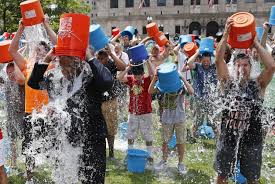
Retrieved from this site.
My first issue with the IBC is the notion of "challenge." There has been an increase of challenge and dare activities on the Internet where people are constantly trying to one-up each other. We had planking, for example, where people would try and lie supine on random objects, often in danger. The more dangerous or precarious the planking, the more valuable in terms of Internet clout. Then, came the video challenges by which people were dared to do something inherently dangerous, like jump off a bridge. Not surprisingly, this resulted in the deaths of a few people after drowning trying to meet the dare. Though meant as harmless fun (of which even my lovely siblings have participated in), these challenges raise important questions of safety and what activities the Internet are encouraging off-line. Others have been injured in so-called "cold water plunges" that are often media stunts to raise money for charities or certain causes. These challenges raise questions of agency and the choice of the "dared." When we are really talking about life and death, how can we not see challenge culture as a negative aspect of the Internet that encourages risky and dangerous behavior?

Planking on the edge of a building. Retrieved from this site.
These "I nominate X, X, and X" phrases remind me of the chain letters of the 90s where you had to forward these ridiculous stories (in Yahoo and Hotmail, typically) or someone would come kill you in the evening. What actually happens if you don't accept an IBC, cold water challenge, or forward a chain email? Absolutely nothing. The challenge culture simply takes your unwillingness to do a dare from middle school slumber parties to a global audience. In a word, it's childish. The maintenance of these challenges perpetuates the dangerous culture of one-upping and daring, although not specifically present in the IBC. What we communicate has essentially stayed the same, but how we communicate it has changed. Ong would see the evolving communication technologies as simply offering new forms that communication can take, such as the dare. The IBC has the countdown clock and the threat of non-compliance that email chains (and blackmail, by the way) have to motivate people to act. The dare takes the spirit of altruism out of the donations, because it is reduced to the act of one-upping others, blending in with the crowd, and passing the dare on to others.

My second issue is the notion that this particular charity is particularly worthy, or that I am forced to donate to this particular one. I think that donating to charity is definitely a worthwhile cause and one that the IBC has reminded me that I should do more of. But, why ALS? They have simply come up with this marketing campaign. They, like all charities, are not particularly worthy or more deserving than so many other of the great charities out there that one could donate to. Why should my choice in charity donation be limited because of a "dare" I receive on Facebook? Why shouldn't I donate to a charity that I care about? That I believe does good work? That I feel is not getting enough attention? Perhaps I have been personally affected by close family member having Alzheimer's or diabetes and wish to donate to them. Is this somehow less acceptable because I am not performing the dare made of me? Why should someone else decide where I give my money? This article brings up important concerns about what the money will be used for and the benefits of massive donations to a specific charity (especially one like ALS which focuses on research and impacts very few people).

Retrieved from this site.
My third issue is the performative aspect of the challenge that promotes narcissism and exhibitionism rather than a concern for the charity. Why should I have to dump water on my head to do a good deed? Not to mention the many concerns this has raised in California because of the drought. Why do I have to film it and share it with others? Why isn't donation a private act that doesn't need public display? Because it's not about my donation, it's about me. It's about my public performance of doing good work. Modern culture cannot do a good deed without getting recognized for it. We need public recognition of every A, every act of kindness, every charity. Dumping water is about including myself in the story of ALS and its success, about feeling good about my involvement. The IBC reminds me quite strongly of the "Fitch the Homeless" movement where people donated all of their Abercrombie & Fitch clothes to the homeless. On the surface, just like the IBC, this campaign did provide many donations of much-needing clothing for the homeless. But, this campaign leaves a similarly negative taste in my mouth because of the reasoning behind the actual donations. They were not out of the sake of the good deeds or that the homeless were in need, but that we were getting back at Abercrombie & Fitch CEO would made comments about his clothing being only for "cool kids." Yes, in response to this statement, let's donate all of the Abercrombie & Fitch clothing to the most non-cool kids ever. As this article put it: "what [this campaign] ends up doing is using people experiencing homelessness as pawns to make a political statement." The IBC similarly exploits the narcissism and dare culture of the Internet to encourage donations. Is the end result a positive? Definitely. But should we condone these types of reasons to donate? Absolutely not.

Retrieved from this site.
Donations are not a matter of being dared or used as a way to spite others. Donations should be about caring, giving, appreciating others, working monetarily towards a cause that you believe in. If this is the new way that people donate, then it changes the dynamics of charity, and may shift our thinking so that we require dares and challenges to make a donation. We couldn't act independently or privately for the benefit of a cause, but would need to publicly present ourselves and declare that others must congratulate or copy us in order for the good deed to be meaningful.

I want to reiterate that I think the donations raised about the IBC are absolutely amazing. I never would have thought that reinvigorating the giving spirit (sort of) especially for my generation could be done so successfully (especially after the Kony 2012 disaster). I think that the impassioned speeches of my colleagues on Facebook have been well heard and I do not look down or condemn anyone for doing the IBC. I merely wish to raise questions (albeit rather passionately myself) about the purpose of these type of videos, what they are actually promoting, and the motivations behind the good deeds that make me skeptical of the lasting power of this campaign and others that may try to imitate it.

I will not participate in this if someone challenges me. I've decided that I don't want to perpetuate a culture that made my brother jump off of a bridge, take away people's agency in deciding to donate, or reducing the act of charity to an event in narcissism. I do think that donations are a positive act and this challenge has caused me to see that people don't donate enough. I may donate because of this, I may not. It may be to ALS, it may be to a different charity, or none at all. But, I will not make it a public spectacle or "dare" others to have the giving spirit or shame them into performing for a Facebook audience. Instead, I encourage everyone to see the larger message in the beauty of charity and reject the process by which this challenge is perpetuated.


Monday, July 21, 2014

Intergenerational Arguments about Climate Change

The consequences of climate change have become more prominent, but many of the harsher, more extreme consequences will not be felt by this generation. Part of the difficulty in crafting persuasive climate change arguments is about "jumping" the inter-generational gap. An intergenerational argument encourages people to act not in their own interest, but in the interest of future generations. Though most of us alive today will likely avoid most of the harshest effects of climate change, our children and certainly our grandchildren, will not be as lucky. People tend to be fickle, however. They are many things vying for our attention, pulling us in different directions, so anything further off than right NOW seems too far off to be worthy of our time. As Burke noted in Permanence and Change: “A philosopher, if he has a toothache, is more likely to be interested in dentistry than in mathematical symbolism. Communication cannot be satisfactory unless the matter discussed bears in some notable respect upon the interests of the auditor” (p. 37).

Retrieved from this site
How do we get people to care for youth? For animals? For anyone but ourselves? It is not simply a matter of narcissism or selfishness; it is just far easier for people to react based on their immediate surroundings. Thinking ahead requires much more energy than simple observation, putting oneself in a different mindset is difficult, and there can be other, conflicting loyalties that stop one from accepting long-term arguments. One of these arguments is economic: short-term business and profits may suffer when making long-term environmentally friendly decisions. Another complicating factor may be religious beliefs about human's dominion over the earth. Or, it might simply be a political affiliation that often denies science and climate arguments in deliberative spaces (Gauchat, 2012).

Author and activist Zadie Smith. Retrieved from this site
One of the ways to spread intergenerational messages is online. When public spaces may be held to standards of balance or may receive denialist backlash, the internet can serve as a location for the expression of information. A recent article by author Zadie Smith called, "Elegy for a Country's Seasons" addresses the current apathy in the climate change debate and how she might explain our inaction to her granddaughter. This excerpt from the piece is particularly important as the excuses given seem to pale in comparison to the burden that we will leave this young girl and all children as we bicker over money and politics.

"This will no doubt look very peculiar to my seven-year-old granddaughter. I don’t expect she will forgive me, but it might be useful for her to get a glimpse into the mindset, if only for the purposes of comprehension. What shall I tell her? Her teachers will already have explained that what was happening to the weather, in 2014, was an inconvenient truth, financially, politically—but that’s perfectly obvious, even now. A global movement of the people might have forced it onto the political agenda, no matter the cost. What she will want to know is why this movement took so long to materialize. So I might say to her, look: the thing you have to appreciate is that we’d just been through a century of relativism and deconstruction, in which we were informed that most of our fondest-held principles were either uncertain or simple wishful thinking, and in many areas of our lives we had already been asked to accept that nothing is essential and everything changes—and this had taken the fight out of us somewhat" Smith, para. 11.

Written articles may take time to read through and may not offer direct and easy consumption of information (however beautiful and engaging Smith's article is). Another potential solution is to create videos that craft intergenerational arguments. This video is from the Australian Coal Mining Company that has a unique intergenerational plan for halting the effects of climate change.


This humorous video has an important point. It mirrors the argument by Smith about passing the buck onto future generations when we could have done something about it. When we stand back and look at the potential consequences, what are our excuses? Is it really enough to look at dollar signs or listen to denialists when we are faced with the guilt of harming all future life? Dramatic? Maybe. Accurate? Certainly. These arguments are not always successful, but people should try to become more attuned to them. Focusing on the current effects now can be an entryway in to discussing how it will only get worse, and our children will suffer for it.

Sunday, June 22, 2014

Donald Sterling as a Modern Day Earl Butz

It is impossible to ignore all of the online and offline discussion of the owner of the LA Clippers, Donald Sterling's racist remarks. He noted in a private conversation to his girlfriend that he didn't want her "associating with black people," and specifically bringing them to basketball games. The hypocrisy in Sterling becoming rich off of the labor of black bodies has been addressed better elsewhere, so I wish to address another important part of this discussion: the apologia. Using Kenneth Burke's guilt-redemption cycle, this post will discuss the similarities of Sterling's remarks to the racist statements of Earl Butz, and how these statements implicate the larger American public in the persistence of racism.

Donald Sterling and the Clippers's logo
Earl Butz was Secretary of Agriculture in 1976 who eventually resigned his position after racist comments emerged. This site has the full timeline of the events including the offensive joke. A scholarly article was written about that event by Dr. James Klumpp and Dr. Thomas A. Hollihan called "Debunking the Resignation of Earl Butz: Sacrificing an Official Racist." The title reveals some important terms and information that will inform this comparison between Butz and Sterling. I will also highlight some important differences that reveal modern racial tensions. Butz was "sacrificed" as Klumpp and Hollihan say, as a part of Burke's guilt-redemption cycle. This cycle describes how pollution, or some type of disorder, is introduced into an order, which creates guilt and a subsequent need for purification, purging, and redemption.

Earl Butz, retrieved from this site
For Butz and Sterling, the pollution was their racist statements that shattered the values of equality inherent in their respective social and political orders (government and sports). Both of these institutions are supposed to value equality, all Americans, and their constituents. As public figures, their voices can be seen as stand-ins for the groups that they represent. Butz was "sacrificed" by the Republican Party, who wished to separate their public appearance from racism. The NBA also separated itself from Sterling by banning him from the organization, fining him $2.5 million, and urging him to sell the team. The sacrifice can come in many forms, but it must make the punishment commensurate to the crime committed. Considering that the pollution for each was the potential crumbling of national organizations, the punishments were made quite prominent, public, and severe.
Some prominent reactions to Sterling's statements
Another important similarity between the two are the separation between public and private. Klumpp and Hollihan address this dichotomy by nothing that officials are sometimes seen as not have the right to privacy: anything said even in private could destroy a public persona, one's reputation, and career. Some were quick to jump to Sterling's defense such as columnists at Fox who pointed to the "thoughts" of Sterling as harmless and a personal right. Some articles went as far as to implicate the girlfriend (who recorded the conversation) as the real criminal. In the aftermath of the announcement, Mark Cuban echoed the words of a Fox News reporter about whether convicting people for statements in private could be a "slippery slope" to the thought-police.

Though some of these concerns were raised, there has been overwhelming support for Sterling's punishment. One might say that it was a "success" in some ways in that an athletic profiteer who undermined his own team and the values of the NBA (and perhaps, the country) would be receiving a just punishment. However, Klumpp and Hollihan raise a point of contention with these types of guilt-redemption activities. They note that by creating a sacrificial goat out of Butz and Sterling, we as a nation do not have to address underlying and persistent racism that we may all (or at least most of us) be guilty of. Instead, we can claim that wrongs have been righted and that racism is an individual issue that does not have to be addressed on a societal level. They note that these overt punishments of racism create a culture that "tolerates private racism and its consequences” (p. 11). Jon Stewart adeptly addresses the issue of post-racial society in his critique of Sterling and the recent SCOTUS decision to uphold Michigan's ban on affirmative action.

Retrieved from the Daily Show

What is to be learned by the Donald Sterling incident? One thing is perhaps most important: racism still exists. There is no magical, post-racial world because we have a black president. People haven't stopped being murdered because of their race, people haven't stopped trying to make relevant the KKK, and people still use the n-word. This is only the tip of the iceberg, however, as racism against other minorities, especially immigrant populations, is also a common American theme. Is this what America is all about? We need to take examples like Butz and Sterling and open our eyes to the underlying problems from which these individuals stem. Structural racism is happening and continues to happen; we cannot remain blind to it and only care when individuals break norms of keeping racism a private endeavor. All racism needs to be addressed, and we have a lot of work to do.

Sunday, February 2, 2014

The Dangers of Pervasive Skepticism: Creationism, Anti-Vaccines, and Climate Deniers

A recent LA Times op-ed by Pat Morrison addressed importance similarities between science-deniers that affect more people than just believers. Creationists and anti-vaccine advocates affect the collective intellectual and physical health of those around them due to their rejection of scientific evidence. Though this is an important point, it only scrapes the surface of larger issues surrounding pervasive skepticism and the borrowing of scientific authority.

In associating science with faith, deniers of current scientific knowledge present themselves as "true" science. These groups portray themselves as fighting against hegemonic elites that wish to silence minority opposition. Anti-vaxxers claim the right to abstain, equating scientific practice with replacing parental control. Creationists point to gaps in scientific research and claim that science requires a greater leap of faith than religious explanations.

Retrieved from Ape, Not Monkey

 By appealing to scientific standards of skepticism, re-testing, and a progressive search for knowledge, science-deniers can pose as legitimate scientific inquiry. Creationists use this platform to enter science textbooks, school boards, and even university faculty. Anti-vaxxers use this platform to flood public spaces with literature, websites, and non-profits.

Other skeptical groups, such as climate deniers, also appeal to “scientific” facts and gaps in evidence to forestall legislative action. Democratic Senator (CA) Barbara Boxer held a committee about the President’s Action Plan that was met with much controversy over Dr. Judith Curry’s testimony. In this testimony, Dr. Curry misrepresented Intergovernmental Panel on Climate Change’s reports on current scientific evidence and cherry-picked statements of uncertainty about current predictions.

Morrison’s original comparison begins to uncover this larger, pervasive issue of skepticism that ignores scientific evidence and authority, and replaces it with a facade of scientific inquiry. The key mistake in the piece however, is the piece’s ending that states, “Ignorance is curable by education, but willfully ignoring the facts can be contagious — and even fatal.” To assume that education is the missing link between science accepters and deniers is to oversimplify the argumentative frameworks that each occupies.

Those who believe in creationism tie their beliefs to every action of their lives as a guiding force. The origin of humanity is not merely an issue of fact, but of the definition and explanation for one’s entire life. Rejecting creationism or not fighting for its inclusion in schools is viewed as a betrayal of faith and submission to the elites of science that denies alternative explanations.

Retrieved from Vaccine Truth

 Anti-vaxxers are focused on protecting their children and the children of others, an extremely powerful motivating factor. Simply presenting new information or facts may not deter strongly held beliefs influenced by celebrity moms or one’s peers.

Those who deny climate change may find themselves more fiercely loyal to a political party or economic influences than long-term environmental protection. More science and data may fall on deaf ears, as other priorities overshadow and complicate accepting new information.

Kenneth Burke, rhetorician and scholar, wrote in Attitudes Towards History, “The shift to another attitude, requiring a different rationalization, does involve ‘conflict.’ Insofar as we do not ‘travel light,’ we thus assemble much intellectual baggage, and the attempt to reshape this to new exigencies may require considerable enterprise” (p. 184). To replace the baggage collected over one’s entire life with new, contradictory exigencies nearly requires rejection. Introducing new information or repeating old information through education is rarely enough to shift rationalizations for action and behavior.

Skeptics do not “ignore the facts;” they simply do not respect the facts lauded by scientific frameworks. Instead, they replace with their own facts such as the importance of God’s role in human origins, the autonomy of parents over children, and the benefits of short term party loyalty over long term environmental protection. The issue is not, then, ignorance, but of warring frameworks that are currently empowered by a skeptical culture to reject scientific authority. Instead, the focus should be on separating what is science and what is not, giving skeptics a voice, but not allowing that voice to be labeled scientific.

The culture of skepticism is damaging scientific enterprise and Morrison is right to point out the wide effects that skepticism has. The conclusion, however, is not to rely on education, but acknowledging alternative viewpoints while minimizing their influence.

Wednesday, November 21, 2012

Negative Narratives: Obama is a Muslim

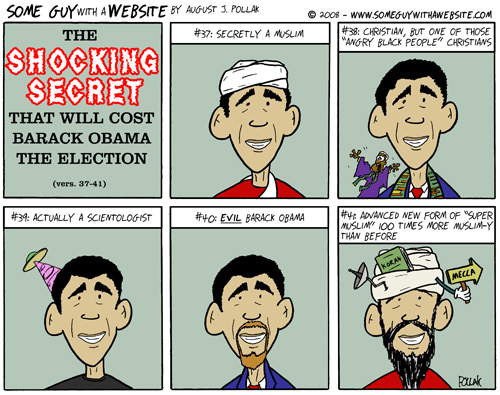
Although commonly known as false, 17% of registered voters still think that Obama is a Muslim. Carefully placed and constructed media and political narratives have created this false, yet influential narrative. I bring up this specific example because of a question posed to me at the NCA conference on the Romney and Mormonism panel. The panel was questioned why voters would consider a Muslim more “mainstream” than a Mormon. After a few stunned moments and a brief corrective response, I wondered as to the likelihood of finding a well-educated academic asking such a question to me at a panel specifically addressing the intersection of religion and politics at a competitive national conference.
The reality that such narratives can gain traction in the public sphere demonstrate who damaging unregulated political advertising and web presence can be. Though Geer argues for the benefit of negative advertising in "In Defense of Negativity", there appears to be more evidence to the contrary. Increased levels of personal attacks, deceptive and manipulated information, and subtle racial comments have become commonplace in American politics. Even though Obama can counter such narratives on his web sites and in media statements, for those who doubt Obama or are looking for confirmation of their skepticism can cling to relevant narratives and ignore contradictory information. Is Obama the most adamant and vocal Christian ever? No. Does he incorporate religion and traditional Judeo-Christian values into his politics as strongly as others? No. But does that mean that people have the right to doubt his Christianity? Furthermore, what does this say about our country when being a Muslim is a derogatory identification that precludes one from the presidency?
The truth is that negative campaigning increases cynicism, allows for the spread of misleading or outright false information, and creates a culture of division. My NCA experience represents for me the negative effects that I have studied being realized. It is one thing to read about the racial connotations of the William "Willie" Horton advertisement and it is another to encounter someone who truly believes what is nothing more than a conspiracy theory that survives only through the radical echo chambers that exist online. With low voter turnout and vicious character attacks from SuperPACs and 527s, I hope that negative campaigning will eventually reach its peak and disappear. For the sake of democracy, a healthy public sphere, and unity in the face of elections, the fostering of a negative political culture must end.

Tuesday, October 23, 2012

Netvibes: Research tools for students and scholars

Netvibes is a great research tool for scholars and a news tool for people alike. There are various types of RSS feed dashboards, but this one has the features and ease of use that works for me. Coupling this tool with the PagetoRSS functionality, creates a one-stop research location.

I have the Netvibes dashboard load as one of my homepages, making sure that I see the headlines in my research areas of interest. Because the dashboard is full of RSS feeds (as well as other widgets), it automatically updates, making my research time more efficient and easy. As opposed to an iGoogle homepage, the Netvibes dashboard allows for tabbed feeds, where dozens of tabs organize feeds by topic area. The set-up and organize of each tab can be changed in terms of columns and how many headlines the feeds draw. The site advertises "limitless personalization" from background art to widgets and apps, custom layouts, and RSS feed options.


This is the homepage of my dashboard, which has a weather app, general news feeds, a to-do list, and notepad. Each tab has a different research interest and toggling between tabs brings up new feeds and apps that I've loaded to the page. Adding the feeds are as easy as copying the link to the RSS feed on a website and pasting it in the "Add Content" tab at the top left corner of the dashboard. This adds a box to the page that updates with headlines and articles. I primarily use GoogleNews, JSTOR updates, and professional blogs to populate my tabs. My background is a nice, relaxing beach as a personal touch to the dashboard. 

The benefits of this tool (similar to other dashboards) are multiple. I find Netvibes the most convenient and intuitive to use, but the salient point is that these dashboard and RSS feeds can deliver relevant news and journal articles in various topics to one location.
  • With minimal set-up, the RSS feeds automatically pull in information
  • Dashboard can be accesses anywhere with an internet connection
  • Apps and widgets, such as weather, notepads, and to-do lists (with hundreds of others) are easily added through the "add content" link
  • Tabs organize and separate different research topics with no limit in the number of tabs
  • Adding content is as easy as copying and pasting links
  • Easily delete and modify feeds
  • PagetoRSS makes sites without RSS feeds easily accessible on a dashboard
The Netvibes's dashboards are automatically private, but people can publish their dashboards or share them with others. Additionally, premium features are available for those who are willing or for some reason need extra features and functionality.


There is an overwhelming amount of information online. Checking one location instead of multiple locations helps save time and sanity for scholars of any discipline. Whichever dashboard works best for you, make sure to update it and routinely check it, so you will always be up-to-date on timely, important, and relevant news for your research interests.

Thursday, April 19, 2012

Levels of Visual Framing: A New Method for a New Paradigm


Framing as a theory of communication in the news media has received much attention and coverage from scholars since its inception by Erving Goffman (1974). A paradigm shift in framing studies has only recently occurred, however, as scholars are increasingly looking at the importance, salience, and enduring-power of visuals to complement and amplify the effects of verbal statements. Though there have been scholars engaged in visual framing studies (i.e., Abraham & Appiah, 2006; Borah, 2009; Brantner, Lobinger, & Wetzstein, 2011; Frosh, 2011; Geske & Brown, 2008; Lake & Pickering, 1998; Mullen, 1997; Parry, 2011), an article published last year highlights the disjointed nature of these inquiries and proposes a systematic method for analyzing and interpreting such use of visuals as a framing device (Rodriguez & Dimitrova, 2011). My review of this article will highlight the usefulness of the proposed method as evidenced by my use of the method for my final paper in Media and Politics at USC with Dr. Tom Hollihan analyzing the covers of TIME Magazine and their representation of international leaders and domestic figures during times of global conflict.

Rodriguez and Dimitrova (2011) begin by outlining modern framing literature and the steps that scholars have taken to incorporate visual framing into their analyses. Describing current visual framing studies as lacking “conceptual and methodological consistency, Rodriguez and Dimitrova outline a four-step process which I have adopted to test its benefits and drawbacks (2011). For the sake of brevity, I have included here one image to illustrate the process.

TIME Magazine Cover: General Douglas MacArthur -- Aug. 27, 1945

Here is an image of General MacArthur during World War II which is included in my larger paper analysis and will be the example for this post. The first step of the process is to describe in full what is in the image from the foreground, background, large items, and small detail. The second step is to describe stylistic features such as the use of color, size, camera angle, visual effects, and manipulation within the image. Level three interprets symbols and objects in the image for meanings. The final level creates an overarching and coherent narrative and interpretation of the image by combining description, stylistic elements, and symbolism.

Though this is a simple process, its clear outline and distinctive steps provides more comparative analysis between scholars than merely a description of the image or another interpretation with less structure. Although I believe this simplicity might leave some important aspects of the visual framing process lacking, this process was sufficient in providing the framework for the analysis of the TIME Magazine covers for my paper. Before I outline some possible areas of improvement, here is the analysis of General MacArthur's cover as interpreted using Rodriguez and Drimitrova's process (2011).

The cover image shows a drawn picture of General MacArthur in full military attire from the shoulders up looking off to the left. MacArthur is standing before a flag, which has a blue background with a red circle in the middle with white stars circling it and slightly puncturing its edges. His expression is one of determination and focus as he is framed by the large background of the flag. The image color scheme is that of red, white, and blue, patriotic colors framing the large and centrally featured military figure. MacArthur's flag symbolizes America with its blue background and white stars wounding and attacking the red dot of the Japanese flag in its center. His appearance in the front of the image from the shoulders up may symbolize his disposition as a statue, unwavering and strong. MacArthur is represented as a powerful, patriotic American leader and military commander who has surrounded Japan with American military might and has damaged the enemy, perhaps to the point of incapacitation. Unworried about the scene behind him, MacArthur is looking towards the future, perhaps to the next battle to be won or foe to be defeated.

This process provides a consistent description as featured above to which I compared all of the cover images selected for the paper across various conflicts, time periods, and geographic representations. One benefit of this model is thus the ability to compare images across different spaces and with different origins to one another to elicit overall patterns and schema of portrayal. Although I used only TIME covers, this process could be used to compare images from different publications, media, and sources.

The detriment I find to this method is the lack of what I believe is a necessary fifth stage. The description focuses solely on the image itself and loses much symbolic and interpretive value that could be gleaned from contextualization. I would add a fifth layer to this process by also encouraging scholars to contextualize the image, interrogate its source and purpose for being used, as well as possible historical significance, temporal events relevance, and the creator's background and agenda. Included in this fifth stage would also be insights into the political economy of the news media and how that influences image selection and manipulation.

For example, pro-life and pro-choice groups may use the same image of pregnant woman to advocate for their position, but without contextualizing the group and its message, the interpretations would be the same from Rodriguez and Dimitrova's process. Additionally, viewing an image of George W. Bush's “mission accomplished” picture may be interpreted as a patriotic, military celebration of a war's success. But knowledge of the Iraq War and its specific staging as a propaganda device (Hollihan, 2008) creates a more accurate and inclusion interpretation of the image as a comical public relations attempt to commemorate a failed invasion based on fabrication that led to scandal and mockery in the media.

These are just a few examples of when an image's source can be just as important as the image content, which is why I would offer its inclusion in importance to contemporary scholars who are interested in studying the power of visual framing.

Sunday, April 8, 2012

Easter 2012 and the Importance of the Pope

With Easter celebrations occurring today, I cannot help but think about the importance of Catholicism, the Pope, and religion in general on our world. Although I have posted previously that atheists should stand up for their beliefs, I believe still in religious expression and freedom, as long as the actions and behaviors that stem from these beliefs do not harm or infringe upon the rights of others. To these more extreme interpretations of religion, I am exploring the rhetoric of Rick Santorum and of the Westboro Baptist Church, so be sure to check my blog for updates on those topics soon.

First, I would like to discuss the importance of religion in modern society, from political to health to social issues, before discussing the specific importance of Pope Benedict XVI and his recent trips to Latin and South America.

In light of religion, Catholicism as an exemplar, and its influence on global policies, religious rhetoric and the ways that people incorporate religion into their lives is of the utmost importance. Considering that more than 80% of the world considers itself religious, with nearly 1 billion people believing specifically in Catholicism, the words and messages of the Pope, a social and cultural icon, have great influence in the modern day proceedings around the world. Religious leaders still have positions of prominence in many countries, from America's religious right to the Iranian Ayatollah, and their opinions can influence constituents and thus policy-makers in making decisions for entire countries and regions.

For example, the Catholic Church has repeatedly advocated against contraception use in Africa, despite the threat of HIV/AIDS transmission in the population. African religious leaders and missionaries tending to the sick there also preach abstinence and avoiding contraception, making it difficult for those advocating for condom use and safer sex to reduce HIV transmission to gain a foothold in many African populations. Religious influences may subvert scientific treatments for the disease and restrict those who have access to contraceptive measures that may restrict the transmission of the virus.

As Hilary Clinton stated in her UN speech this year, there is a new human rights issue plaguing the nation. The human rights of homosexual, bisexual, and transgender individuals have been denied in many countries, including America, for reasons that have roots in tradition, morality, and faith. The Catholic Church has been against recognizing homosexual unions, allowing adoption for same-sex couples, and offering gender neutral or more inclusive options for identification. Followers of Catholicism define marriage as being between a man and a woman. These teachings are not limited to Catholicism as many religious groups oppose contraception and rights for the LGBTQ community. However, in both the US and internationally, Catholicism can be considered an exemplar of religious influence in politics, social order, and community building.

Because the Pope heavily influences the Catholic community through encyclicals, proclamations, and visiting speeches, his words, ideas, and priorities can change the tides for political, social, and cultural policies and traditions. His influence may be epitomized by a recent Miami Herald article which states "Pope's visit to Cuba leaves little reason for hope". This may be a comparison to claims that Pope John Paul II helped spur the fall of communism as Pope Benedict XVI's visit to Cuba was one of mixed reviews. While a New York Times article referenced the Pope's urging of political reform, this request fell on deaf ears as politicians stated that political reforms would not be following the economic ones. Can we really describe this visit as a failure, though? It was the first visit to Cuba since John Paul II's visit in 1998 and symbolically shows that the Pope and Catholicism has not forgotten Cuba. Above all, I think that Benedict's visit reinforces the idea that he and perhaps many Catholics feel that the Pope does have the power to influence governments. If not, I feel there would not have been such negative reviews of the visit, as if him arriving and speaking there would change the entire political climate of the country.

In the case of the Pope, it is hard to delineate where one's expectations are too high or too low. His influence in global power is unmistakable and perhaps unmatched, but there are limits to the effectiveness of single visits and requests. In respect to the Easter holiday today, I admire the faith placed in the Pope to exact political change in Cuba but also critique how quickly this faith can turn to disappointment. The Pope is one man, and surely the world would not want one man, no matter their background or faith, to have such power and control over governments, nations, and people. But, it appears that the Pope does, because people and the media give him this power. Considering Pope Benedict XVI's tendency to be more conservative and to follow the letter of the Bible, there may be more changes in the Catholic community to come.