Showing posts with label Skepticism. Show all posts

Sunday, September 7, 2014

The Online Activist: Making Charity Cold as Ice

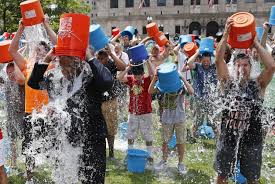
There have been many commentaries on the ALS Ice Bucket Challenge, hereafter IBC, including some by my colleagues at Annenberg. I have very mixed feelings about the challenge and they are quite scattered. I will attempt, then, to parse some of my more scholarly opinions on the matter in my overall criticism of the challenge as an event in narcissism and exploitation that has ultimately generated a lot of money for a great cause. In this sentence, I want it to be clear that the process by which these donations are raised is where my primary concern lies and not with the cause itself. Certainly, encouraging donations is a positive enterprise, but I am not completely deontological in that I feel that a critical look at the process and means by which these are obtained are necessary.
Retrieved from this site.
My first issue with the IBC is the notion of "challenge." There has been an increase of challenge and dare activities on the Internet where people are constantly trying to one-up each other. We had planking, for example, where people would try and lie supine on random objects, often in danger. The more dangerous or precarious the planking, the more valuable in terms of Internet clout. Then, came the video challenges by which people were dared to do something inherently dangerous, like jump off a bridge. Not surprisingly, this resulted in the deaths of a few people after drowning trying to meet the dare. Though meant as harmless fun (of which even my lovely siblings have participated in), these challenges raise important questions of safety and what activities the Internet are encouraging off-line. Others have been injured in so-called "cold water plunges" that are often media stunts to raise money for charities or certain causes. These challenges raise questions of agency and the choice of the "dared." When we are really talking about life and death, how can we not see challenge culture as a negative aspect of the Internet that encourages risky and dangerous behavior?

Planking on the edge of a building. Retrieved from this site.
These "I nominate X, X, and X" phrases remind me of the chain letters of the 90s where you had to forward these ridiculous stories (in Yahoo and Hotmail, typically) or someone would come kill you in the evening. What actually happens if you don't accept an IBC, cold water challenge, or forward a chain email? Absolutely nothing. The challenge culture simply takes your unwillingness to do a dare from middle school slumber parties to a global audience. In a word, it's childish. The maintenance of these challenges perpetuates the dangerous culture of one-upping and daring, although not specifically present in the IBC. What we communicate has essentially stayed the same, but how we communicate it has changed. Ong would see the evolving communication technologies as simply offering new forms that communication can take, such as the dare. The IBC has the countdown clock and the threat of non-compliance that email chains (and blackmail, by the way) have to motivate people to act. The dare takes the spirit of altruism out of the donations, because it is reduced to the act of one-upping others, blending in with the crowd, and passing the dare on to others.

My second issue is the notion that this particular charity is particularly worthy, or that I am forced to donate to this particular one. I think that donating to charity is definitely a worthwhile cause and one that the IBC has reminded me that I should do more of. But, why ALS? They have simply come up with this marketing campaign. They, like all charities, are not particularly worthy or more deserving than so many other of the great charities out there that one could donate to. Why should my choice in charity donation be limited because of a "dare" I receive on Facebook? Why shouldn't I donate to a charity that I care about? That I believe does good work? That I feel is not getting enough attention? Perhaps I have been personally affected by close family member having Alzheimer's or diabetes and wish to donate to them. Is this somehow less acceptable because I am not performing the dare made of me? Why should someone else decide where I give my money? This article brings up important concerns about what the money will be used for and the benefits of massive donations to a specific charity (especially one like ALS which focuses on research and impacts very few people).

Retrieved from this site.
My third issue is the performative aspect of the challenge that promotes narcissism and exhibitionism rather than a concern for the charity. Why should I have to dump water on my head to do a good deed? Not to mention the many concerns this has raised in California because of the drought. Why do I have to film it and share it with others? Why isn't donation a private act that doesn't need public display? Because it's not about my donation, it's about me. It's about my public performance of doing good work. Modern culture cannot do a good deed without getting recognized for it. We need public recognition of every A, every act of kindness, every charity. Dumping water is about including myself in the story of ALS and its success, about feeling good about my involvement. The IBC reminds me quite strongly of the "Fitch the Homeless" movement where people donated all of their Abercrombie & Fitch clothes to the homeless. On the surface, just like the IBC, this campaign did provide many donations of much-needing clothing for the homeless. But, this campaign leaves a similarly negative taste in my mouth because of the reasoning behind the actual donations. They were not out of the sake of the good deeds or that the homeless were in need, but that we were getting back at Abercrombie & Fitch CEO would made comments about his clothing being only for "cool kids." Yes, in response to this statement, let's donate all of the Abercrombie & Fitch clothing to the most non-cool kids ever. As this article put it: "what [this campaign] ends up doing is using people experiencing homelessness as pawns to make a political statement." The IBC similarly exploits the narcissism and dare culture of the Internet to encourage donations. Is the end result a positive? Definitely. But should we condone these types of reasons to donate? Absolutely not.

Retrieved from this site.
Donations are not a matter of being dared or used as a way to spite others. Donations should be about caring, giving, appreciating others, working monetarily towards a cause that you believe in. If this is the new way that people donate, then it changes the dynamics of charity, and may shift our thinking so that we require dares and challenges to make a donation. We couldn't act independently or privately for the benefit of a cause, but would need to publicly present ourselves and declare that others must congratulate or copy us in order for the good deed to be meaningful.

I want to reiterate that I think the donations raised about the IBC are absolutely amazing. I never would have thought that reinvigorating the giving spirit (sort of) especially for my generation could be done so successfully (especially after the Kony 2012 disaster). I think that the impassioned speeches of my colleagues on Facebook have been well heard and I do not look down or condemn anyone for doing the IBC. I merely wish to raise questions (albeit rather passionately myself) about the purpose of these type of videos, what they are actually promoting, and the motivations behind the good deeds that make me skeptical of the lasting power of this campaign and others that may try to imitate it.

I will not participate in this if someone challenges me. I've decided that I don't want to perpetuate a culture that made my brother jump off of a bridge, take away people's agency in deciding to donate, or reducing the act of charity to an event in narcissism. I do think that donations are a positive act and this challenge has caused me to see that people don't donate enough. I may donate because of this, I may not. It may be to ALS, it may be to a different charity, or none at all. But, I will not make it a public spectacle or "dare" others to have the giving spirit or shame them into performing for a Facebook audience. Instead, I encourage everyone to see the larger message in the beauty of charity and reject the process by which this challenge is perpetuated.


Sunday, June 29, 2014

Earth Sciences Communication Initiative

I am traveling for the next few weeks to attend the International Society for the Study of Argumentation Conference in Amsterdam. Instead of a longer, more in-depth piece, I hope that you may read a few blog pieces that I've written for the Earth Sciences Communication Initiative. This is a long-running research partnership that I've had that focuses on the intersection of the environment, politics, communication, rhetoric, and advocacy. More information on the group can be found on ESCInitiative.org.

Harm to Animal and Plant Life as Motivation
This article explores the potential threats of climate change to animal and plant life. More specifically, it addresses how these threats are conceptualized as motivation for taking action towards environmental protection. These might not be as successful rhetorical strategies as appealing to direct threats to ourselves or future generations, but they still reflect a potential opportunity for change.

Polarizing/Politicizing the Climate Change Debate
This is a topic I've written about a few times before. The article addresses how political loyalties can trump considerations of environmental protection, making short term benefits more convincing than long term ones.

Creation Care: Uniting Science with Moral Imperatives
In response to Pope Francis I's recent discussions of climate change and environmental stewardship, this article addresses the creation care movement and how it marries environmental concern with a moral imperative to act. You can read my four part, intensive critique of this movement here (Part 1, Part 2, Part 3, Part 4).

Climate Change is No Joke. . . or Is It?
This article interrogates the use of humor as a potential tactic in promoting forgiveness and action. Instead of condemning and punishing people for environmental crimes, the comic frame could allow for a more positive, productive engagement with environmental topics.

Sunday, April 27, 2014

Creation Care Part 1: Where Religion and the Environment Intersect

Given the tumultuous and often contradictory natures of religion and the environment, the creation care movement has arisen in an unusual predicament. Guided by religion and undeterred by previous difficulties, creation care members seek to unite a moral obligation to the environment with climate change advocacy. This new movement operates in an important gap, often appealing to the youth, that could offer appealing solutions and arguments for grassroots progress on the environment. Interested in the opinions and demographics of this group, I performed an online survey of members on a few creation care mailing lists. In this post, I will discuss a few of the open-ended answers that were particularly interesting. This week, I am examining answers to one question about the compatibility of science and religion. Future posts will look at apocalypticism, interpretation of biblical verse, and optimism about the future.


Political cartoon retrieved from this blog

60 participants completed the survey and 52 submitted complete responses. A few prominent patterns emerged that provide insight into the beliefs of creation care members. These responses could not be generalized to the entire creation care movement, and the Judeo-Christian creation care movements are certainly far different from other iterations such as Muslim or Hindu creation care. But, the prominence of these patterns do indicate the possibility of shared opinions and frameworks for future inquiries. Overall, survey takers were confident about their knowledge of climate change and its consequences. They also expressed a mix of worry and hope towards the possibility of mitigating climate change's consequences.

Creation Care logo from Climate Progress

Survey takers were asked about the compatibility of science and religion. After coding for compatibility, unsure, and incompatibility, there was a consensus among the 52 surveys. All participants responded that they saw science and religion as compatible. Although it is common for scientific and religious frameworks to be in competition with one another, these creation care members viewed them as completely compatible. There are some religiously-oriented climate denial groups, such as the Cornwall Alliance, that undermine efforts to protect the environment. Oftentimes, a belief in climate change is associated with denying God's ultimate power over the apocalypse. Associations with religious identity and conservative politics often encourage thinking monetarily instead of environmentally.

The respondents, though, who identity as members of creation care groups, do not fall along traditional correlations. Participants identified across the political spectrum, but they all agreed on the importance of protecting the environment because of underlying religious identifications. Science and religion both support the potential risks and encourage action. Skepticism and doubt can cause pervasive apathy and negative consequences that creation care has found a way to overcome.

Image retrieved from this blog

One respondent noted that "science and religion are best friends." One commented that "they are completely compatible and if they appear to not be, then there is an error in the interpretation of the religious truth or of the scientific data." This respondent believes that it is not possible for science and religion to be contradictory. Many respondents echoed similar themes about finding God's work within scientific inquiry. "Science is an explanation of how God works and allows me to become more deeply rooted in Him and his beauty." Another simply wrote, "Science is Man's search for God in Nature." The closest a respondent got to noting incompatibility was the statement, "sometimes they are cranky with each other."

Sunday, September 22, 2013

Underestimating the Enemy: Creationism vs Evolution

At the beginning of August, I attended the Alta Argumentation Conference in Alta, Utah. There I was presenting a paper titled, "The Institute for Creation Research as a case study of scientific and religious argument: Revisiting argumentation fields in a postmodern context." The paper was presented on a panel of other papers about "religious argument." To summarize the points of my argument, I was discussing the ICR as an example of postmodern and contemporary creationism discourse. ICR is attempting to blur the lines between science and religion in order to present the illusion that science proves the story of Genesis.


The Logical Process of Science and Creationism: Source
My paper interrogated why creationism is still so persuasive to many people and why scientific consensus has not squashed this alternative story. In addition to this argument, I also stretched communication and argumentation theory by introducing a new term "deceptive controversy" and expanding the role of argument fields to creative normative standards. After finishing my speech and waiting for the Q&A, I thought about the theoretical implications for my argument and had prepped myself to defend my new term and the application of argument fields. Instead the first question I got was roughly paraphrased as: Aren't you giving ICR too much credit? They are obviously non-scientific, so what is the point of your paper?
To say I was shocked was an understatement. My extension of argument theory was not being questioned, but the very purpose and need for my intervention was. Unfortunately, I reacted more passionately and unprofessionally than I would have liked, feeling defensive of my research. I would like to take this blog post to react more professionally than I did then.
It is imperative that scholars and scientists take opposition from creationists seriously. Although science and logic show the truth of natural selection and evolutionary mechanics, that is unconvincing to more than half of the nation's population. The power of these narratives and the hold that biblical accounts have on the American public are underestimated at the risk of knowledge and innovation. There still remain issues of creationists gaining position on school boards, colleges accepting creationists on their staff, and the steady dominance of creationist thinking in the US.
Steady maintenance of science denial: Source
My inquiry was not to suggest that one should consider ICR scientific, but to examine how and why ICR does say that it is scientific. What is it about ICR's discourse that convinced hundreds of thousands of subscribers each month to read and examine its arguments? That was the point of my inquiry: to examine the patterns, rhetoric, and argument style that keep creationists relevant in modern society. Armed with this knowledge, how do we address and restrict its presence in areas of society it does not belong?
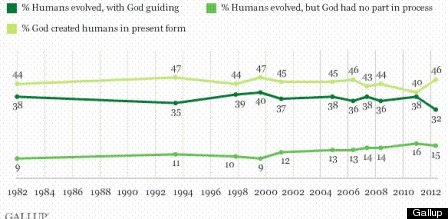
My paper took samples of ICR's discourse and broke the arguments down to their basic elements to determine if they really were scientific or not. Recent polls show only 15% of Americans believe in the occurrence of evolution without supernatural intervention, with 46% believing the in the Biblical account of origins with God (a Judeo-Christian one). That's nearly a majority of Americans who deny a scientific consensus of evolutionary mechanisms explaining origins. Groups such as ICR receive millions of dollars in charitable donations, run talking tours, sponsor museums and even a award degrees from an accredited school. Creationism discourse is alive and well in the United States, at least in the public sphere.


It is a mistake to assume that everyone approaches the creation/evolution controversy with the knowledge and capacity of intellectuals. What my questioner was really saying was that "isn't everyone in America as smart as I am? Only fools would believe in creationism." Because he saw the truth in evolution, he immediately discredited the possibility of creationism as being a valid threat. But it is. It has been and remains a threat to scientific standards, classroom education, and the knowledge of millions of Americans. To discredit their opposition is to err as many scientists have done before. To simply say "look at the science", "look at the consensus" is not enough. These facts are not convincing in the way that many academics and scholars wish that they were.


Wednesday, November 21, 2012

Negative Narratives: Obama is a Muslim

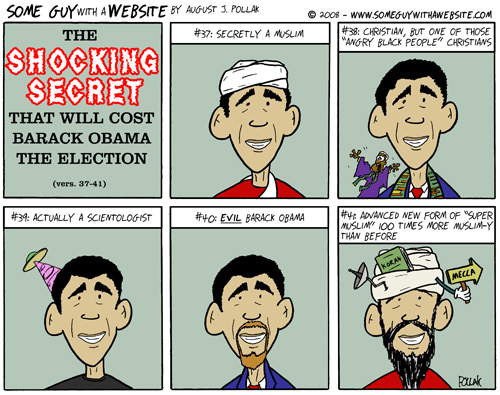
Although commonly known as false, 17% of registered voters still think that Obama is a Muslim. Carefully placed and constructed media and political narratives have created this false, yet influential narrative. I bring up this specific example because of a question posed to me at the NCA conference on the Romney and Mormonism panel. The panel was questioned why voters would consider a Muslim more “mainstream” than a Mormon. After a few stunned moments and a brief corrective response, I wondered as to the likelihood of finding a well-educated academic asking such a question to me at a panel specifically addressing the intersection of religion and politics at a competitive national conference.
The reality that such narratives can gain traction in the public sphere demonstrate who damaging unregulated political advertising and web presence can be. Though Geer argues for the benefit of negative advertising in "In Defense of Negativity", there appears to be more evidence to the contrary. Increased levels of personal attacks, deceptive and manipulated information, and subtle racial comments have become commonplace in American politics. Even though Obama can counter such narratives on his web sites and in media statements, for those who doubt Obama or are looking for confirmation of their skepticism can cling to relevant narratives and ignore contradictory information. Is Obama the most adamant and vocal Christian ever? No. Does he incorporate religion and traditional Judeo-Christian values into his politics as strongly as others? No. But does that mean that people have the right to doubt his Christianity? Furthermore, what does this say about our country when being a Muslim is a derogatory identification that precludes one from the presidency?
The truth is that negative campaigning increases cynicism, allows for the spread of misleading or outright false information, and creates a culture of division. My NCA experience represents for me the negative effects that I have studied being realized. It is one thing to read about the racial connotations of the William "Willie" Horton advertisement and it is another to encounter someone who truly believes what is nothing more than a conspiracy theory that survives only through the radical echo chambers that exist online. With low voter turnout and vicious character attacks from SuperPACs and 527s, I hope that negative campaigning will eventually reach its peak and disappear. For the sake of democracy, a healthy public sphere, and unity in the face of elections, the fostering of a negative political culture must end.

Wednesday, August 15, 2012

In Media Res: Polarization of Climate Change

This week, I'm curating a post on In Media Res as a part of the political polarization theme week. My post discusses the clear split between Democrats and Republicans in the debate about mitigating climate change.

Here is the link to the entire post and video clip. Read, comment, and enjoy!

http://mediacommons.futureofthebook.org/imr/2012/08/15/doubting-science-along-party-lines-polarization-climate-change


Tuesday, April 24, 2012

Eliminating the Electoral College: A Solution to Voter Skepticism

Voter skepticism and overall political aversion is a staggering problem for American political life. Where more people chose not to vote than do and where college students do not even know many prominent political figures (see further discussion here), how do we overcome these issues to create a more aware, active, and optimistic public?


One can always link the importance of emotions over reason to modern day cynicism. This has been a constant theme as the transition from logical fidelity to narrative fidelity requires a shift from analyzing arguments logically to evaluating stories emotionally. If the story of American politics conjures up feelings of regret, shame, disgust, and anger, one is more likely not to participate in that story or that it is not faithful to their picture of themselves or the country. In light of decreased political participation across all groups, perhaps there is less voter participation at the polls, but that the venting of frustrating has moved elsewhere. As more and more people turn to the Internet to express frustrations, remix images for humor, and participate in online interactions, voter participation has dipped over nearly all age groups and educational levels (Hollihan, 2008, Uncivil Wars, chapter 12).

I do not feel that the skepticism in society can be controlled or diminished until politicians change their methods of garnering support, reaching out to voters, and campaigning. Considering that the money and the votes are found more prevalently today in public opinion polls, name recognition, and negative advertising and debating, I do not have confidence that this will change in the future, but perhaps there is hope in some new legislation that can influence these decisions.

One important way I feel that people can be more empowered is by eliminating the electoral college. Although this has been a proposition for a long time and many efforts have been thwarted, I feel that this is one of the most important ways that people can feel reinvigorated by the power of their vote. If a direct popular vote is enacted, then candidates could no longer (or at least to a lesser extent) preference certain states for advertising and visiting. More of the public would have greater access to political information and engagement opportunities. In addition, I believe that voting numbers would increase as Republicans in “blue” states and Democrats in “red” states could still attend the polls and be confident that their vote was going to the candidate of their choosing instead of being lost in the electoral votes.


Many voters were undervalued in the elections in 2000 and 2004, when the popular vote gave the opposing candidate the win, but the electoral college (and the US Supreme Court) gave George W. Bush the presidency. How supportive of the governmental system can the public be expected to be when the direct voting will of the public is denied? When people in safe states can go an entire political campaign without hearing much at all from candidates but when swing states are inundated with information, advertising, and messages, how politically knowledgeable and active can we expect our nation to be? I believe that by removing the electoral college from presidential elections, more people will feel empowered to vote for candidates, much of the attention from candidates will be dispersed to all states, and people will not feel left out or cheated by the system.


Although there are many more steps that can and should be taken to make politics more engaging and equal for the public, the suggestion above is obviously an overly optimistic account of how easily politics can change. Part of the issue, of course, is that those in the system are the ones with the power and that make the decision to change the system. So, any type of legislation that will disadvantage incumbents is likely to fail. Fortunately, there has been legislation in the past and a current movement that has been ratified by 9 states with bills still moving through state legislatures, so perhaps this change is on the horizon.


What other changes would you be interested in seeing? Changes to campaign finance reform? Easy of access to voter registration? Increased civics requirements in public schools? There are many ways that the political system can be changed for the better, and I hope that more gain traction in the years to come.