Showing posts with label Evolution. Show all posts

Sunday, November 9, 2014

Denialism Studies and Re-claiming History

Image retrieved from this site.
I have been a little behind on my blog posts because I have been focusing on my prospectus. Also, last weekend, I attended a conference called, "Manufacturing Denial" which took up time with some great presentations and discussions. I was honored to be invited by the Strassler Center to take part. At the conference, I gave a paper on the similar argument patterns and rhetorical strategies in Holocaust-denial, climate change denial, and evolution denial. The three forms appeal to a unifying framework of conspiracy that allows them to construct enemies, discredit evidence, and shift the burden of proof onto historians and scientists. The article that served as the launching point for this larger piece can be read here. Summarizing comments from the conference can be read here by Dr. Massimo Pigliucci, who I had the pleasure to meet and discuss evolution with at the conference.


Presenting on my panel at the Strassler Center at Clark University. Photo credit to Khatchig Mouradian.
This post will address some important themes that emerged and will place them in conversation with a speech by Martin Luther King, Jr. who spoke out against the Vietnam War. His words echo in the present conflict as relevant and insightful. Similar to the foreign war sanctioned by government with dire, material consequences, denialism is often a pervasive, legitimized, and powerful force that begs us look at history and important rhetorical moments for guidance. 
The series of panels addressed many instances of denial, such as the genocide during World War II, the Armenian genocide, genocide in Rwanda and Cambodia, climate change, evolution, health effects of tobacco, autism vaccines, GMOs, political myths, and others. The variety of opinions ranged between questioning the worth of focusing and responding to denial to trumpeting the great work of exposing denial in its various forms. Some even went as far as to advocate for criminalizing denialism, as some European countries have done with the Holocaust, in all of its forms. They argued that not only are the memories of victims tarnished and 'the truth' being re-written, but also the mental and emotional well-being of descendants and citizens are affected by denialism.

Image retrieved from this site.
In the case of climate change, scholars argued that denialism promotes gridlock in the political system and stymies preventative action. Denialism, thus, is paramount to leading to thousands (and even millions) of preventable deaths. One scholar argued that the genocide of both humans and nature may have more casualties than any genocides in the past. Though I appreciate the candor of these scholars and respect that they are elevating issues such as climate change to the level of genocide in its consequences, criminalization is not the answer. It is quite easy for denialists to take advantage of criminalization as silencing the truth. The University of Utah Press, who came under fire repeatedly for published books that denied the Armenian genocide, has recently published a book by Lewy called "Outlawing Genocide Denial: The Dilemmas of Official Historical Truth" about the dangers of outlawing. Any type of law against denialism must somehow avoid issues of freedom of speech, specifically in America, and that everyone has opinions, however seemingly irrational or misguided they are.  In his speech, King argued that "communism will never be defeated by the use of atomic bombs or nuclear weapons." Taking firm, violent action against those with differing opinions is rarely a way to change people's minds or completely quash those opinions. In fact, a common theme at the conference was the likelihood that being faced with opposing information may encourage a backfire effect that heightens the original belief. War and violence conquers; it does not convince.
One common theme that came up among the panelists and my own paper were that although literal and blatant denial is often most studied by academics and heard about by the public, denial in its implicit and subtle forms can be the most insidious. In the Q&A, an audience member asked if scholars were not misplacing their time and efforts by trying to combat denialists instead of working on other research. I argue with King, Jr., however, who argued that "silence is betrayal." To not address important points of deception and denial is to remain passive and allow for evil to flourish. One of my co-panelists argued that "sunlight is the best disinfectant." Scholarship, in part, is based off of the very values that we are decrying: skepticism. Scholars look critically at the state of reality, question norms, and expose constructed and often subtle workings of power. Denialists occupy an extreme version of this healthy skepticism to where even basic evidence, consensus of truth, and facts are discounted, seen as fabricated, and are questioned. How do we negotiate and foster healthy skepticism and critical analysis without invoking cynicism and isolation?

Image retrieved from this site.
Although King was met with resistance to his speaking out against the Vietnam War and his advocacy for peace in the Civil Rights movement he felt obligated to fulfill his duty, follow his path, and oppose the evils that he saw. King argued that "men do not easily assume the task of opposing their government's policy." At the conference, the Armenian genocide and the Turkish government's attempt to rename the genocide as "the events of 1915" and paint the Armenian victims as insurgents speaks to a national, government-supported policy to change the past and rewrite history. It is not easy to oppose the government and break out of the "apathy of conformist thoughts." It is certainly much easier for many of us as scholars to turn the other cheek and focus on other issues. But when denial of facts and the subsequent gridlock and inaction occurs that threatens knowledge, public deliberation, and the future stability of the world, how can we not act?

Sunday, June 8, 2014

Bryan College Controversy: Religion on (Scopes) Trial

In 1925, a small town became the center of national attention. It housed the court case John Thomas Scopes vs the State of Tennessee that addressed the teaching of the Bible in science education. In 2014, this same small town of Dayton, Tennessee is undergoing a similar controversy where science and religion meet in the realm of education.

Image retrieved from Biologos

 Bryan College, founded in memory of Williams Jennings Bryan after the Scopes Trial, has issued a new statement of faith that faculty must sign. This clarification in BC policy is receiving heated backlash from faculty and students. Due to the stricter statement, BC may lose 25% of its faculty. BC students have released a petition against the new statement and BC faculty has voted no confidence on the school’s administrators. This new statement of faith is not changing the stance of BC, which aligns with its namesake’s opinion on the immorality of evolution and the truth of biblical creationism. Instead, this change highlights the literalism of the Bible by further polarizing acceptable belief systems. This article will explore these changes in light of the ever-present dichotomy of science and religion, with the context of the Scopes trial, and the actual teachings of Bryan. In short, BC is working against two of the characteristics of Bryan’s teachings (the potential for interpretation and the importance of populism) and in essence, abandoning its namesake.

Clarence Darrow (left) sitting with William Jennings Bryan (right) before Scopes Trial. Retrieved from this site.

 Bryan was the prosecutor in the famous 1925 trial, arguing in favor of fining Scopes for teaching that humanity descended from a lower order of animals. The Butler Act, which Scopes was tried for violating, declared the immutability of the Bible and the inerrancy of the Genesis account of Adam and Eve. This was and still is an important element of fundamentalism, the values on which BC was founded. In the cross-examination day of the trial, however, Bryan compromised literalism but noting that “I believe everything in the Bible should be accepted as it is given there: some of the Bible is given illustratively. For instance: "Ye are the salt of the earth." I would not insist that man was actually salt, or that he had flesh of salt, but it is used in the sense of salt as saving God's people.” Bryan also said that the six days of creation were “not six days of twenty-four hours.” For Bryan, the statements in the Bible were accurate descriptions, but what was more important was not individual interpretations but the values that the Bible upheld.

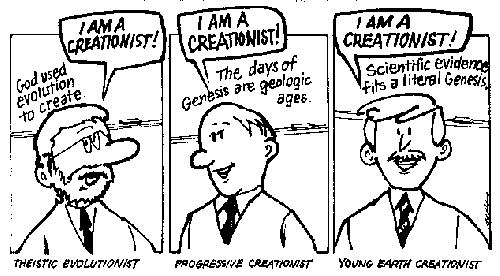
In Bryan’s summation of the trial, he proposed a strict dichotomy between religion and science, saying that one was the path to Christ and the other would crucify Him. In the 1920’s, and perhaps not until the intelligent design movement of the 1990’s, the idea that evolution and creationism could be rectified was perhaps outside of the purview of many Americans. But, many faculty members at BC do ascribe to labels such as “progressive evolutionists and theistic evolutionists and old-Earth creationists.” The previous BC statement of faith noted that “the origin of man was by fiat of God.” Interpreting fiat to be an all-encompassing act of creating the world, some professors at BC married religion and science and incorporating evolutionary theory into their personal beliefs and classroom teachings. They have taken the words of the Bible illustratively, so they are able to stay in line with the statement of faith.

Different forms of creationism. Retrieved from this site.

The new statement of faith, however, undermines these creative interpretations. Now, faculty must agree that “all humanity is descended from Adam and Eve. They are historical persons created by God in a special formative act, and not from previously existing life forms.” This statement puts many jobs at risk because it removes faculty that believe in any evolutionary history of humanity or of Adam and Eve as symbolic placeholders.

Upon a recent trip to Dayton in March, I had a conversation with a priest and an archivist at BC’s library. We were all reading through documents about Bryan, the trial, and the founding of the college. The priest was in the archive reading for clarification on Bryan’s teachings about biblical literalism. He was concerned that many of his closest friends, the best faculty at the school, and devout, loyal Christians would be unable to sign the new, stricter, and, at this point only proposed, new statement of faith. The priest was concerned that many great, Christian teachers would be lost and hard to replace. Although they may have had more creative interpretations of some biblical phrases, the priest considered their marrying of physical observation with biblical teachings as in line with Bryan’s teachings.

Logo of BC student newspaper. Retrieved from the Brian Triangle website.

BC students are also in agreement. They noted in their petition that they are saddened that BC “will alienate faculty, our brothers and sisters in Christ, by requiring them to affirm a negative on an ancillary matter of faith.” For the populous of BC, the tightening of the statement of faith only serves to divide rather than unite people of faith that have the common goal of teaching Bryan’s creationist values.

The archivist gave me a card for her husband’s creationist non-profit and seemed unconcerned with the changes. Although she said that some faculty taught evolution or believed in it, what was important was that the Genesis story was still taught at BC and the values of it were fully ingrained in all parts of its curriculum. She noted that if students had issues with particular professors and their more creative interpretations, they could easily take classes with a more fundamentalist professor. The campus was an open place where at least variations on creationism were discussed freely. The new clarification would place this openness in jeopardy. BC is surely staying within its rights to clarify its statement and to fight for literalism, especially within a threatening, secular environment. This statement is adopted, however, against the wishes of its students and faculty, making the authorities at BC domineering and elite over the wants of its people. Bryan’s values of populism, the will of the people over the elites, were once in opposition to the elitism of science that would remove all mention of Christ from classrooms. Now, BC wishes to do the same, but to strip its students of all access to evolution, despite that it awards biology and environmental science degrees.

What is at issue here is the extreme polarization of science and religion that is shrinking the opportunity for middle ground, mutual respect, and open deliberation. I do not mean to argue that creationism is a valid scientific explanation, but simply that people should not be so quick to judge people for staying true to religious ideals while incorporating scientific and material evidence in their belief systems. As more and more people take note of scientific evidence for evolution, there is more vocal push back from religious fundamentalists that distance themselves from intelligent design perspectives. Adopting new frameworks and stretching current ones is incredibly difficult. Attempts at marrying them and making sense of one’s religious convictions in light of science is something to be valued, not disdained.

BC student protest image. #hearmyvoiceBC. Retrieved from this site.
BC cannot avoid the protests and disagreement from their own students and faculty, nor from the general public about the favoring of religion over science. As the students said themselves, “the clarification promotes factionalism at the cost of honest debate and discussion.”  This decision, perhaps in response to more prominent attention to the issue, is minimizing the space for education about scientific explanation for origins. BC was created when creationism and evolution simply could not be rectified. But, now, it is clear that BC is isolating itself from its students, faculty, the potential partnership of science and religion, and illustrative biblical teachings, in contrast to the teachings of its namesake. We will never know what Bryan would say about this iteration of the human origins controversy. But, I would put money on the will of the people over the BC elites that work risk compromise and biblical values in favor of fervent literalism.

Sunday, March 9, 2014

Energy Darwinism: Substituting Economic Benefits with Moral Imperatives

Concerns over climate change has pushed the delicate relationship between short term benefits and long term risks and economic and environmental balance. Recent reports published by Citi (and subsequent national commentary on them) have focused on the idea of "Energy Darwinism." In this post, I hope to explicate this term, relate it to evolution and natural selection as the metaphor implies, and what this says about moral and religious obligations to the environment. 


Retrieved from this blog
As a brief point of introduction, natural selection, or "Darwinism" is the basic mechanism of evolution. From the assemblage of single-celled organisms to humanity, genetic variations accumulate over time and create branches of descendants and all of the life on earth today. The basic tenets of natural selection is that mutations occur in DNA to produce variations which are then competitively selected by the environment, mating preferences, and predator/prey relationships. Interpretations of evolution often forgo the opportunity for supernatural or divine intervention, making it a materialist theory of origins. Thus, evolutionary theory has often been opposed by religious adherents who regard it as immoral and too largely focused on the environment as a guiding force. Alternative narratives often find a role for a deity such as creationism or intelligent design. Labeling evolution "Darwinism" is in part a rhetorical strategy to reduce the explanatory power of evolution to the worship of an individual.


Retrieved from this blog
Although natural selection was not meant to be applied to other areas of life, especially not human life, many people have demonized the competitive spirit of natural selection as damaging to humanity. Social Darwinism is an attempt to label philosophies of human competition with evolutionary characteristics. Energy Darwinism is a new application of evolutionary theories to industry reactions to environmental protection. The concept refers to the economic benefits of businesses becoming more eco-friendly. As carbon becomes more expensive as demand remains (or increases) and supply decreases, businesses themselves will move towards alternative sources in order to remain competitive. There is an irony in professing that Darwinism, which is often levied as a negative descriptor of human competition, aggression, and exploitation is used as industry competition that may drive down prices, encourage innovation for selfish needs for profit/money. Energy Darwinism may seem a simple, logical concept, but there are sinister implications and consequences for such thinking.

If the changing economic environment will change naturally to encourage better business practices, this removes the responsibility of industry to be purposeful actors and the government from intervening in environmental protection. There would be no need for regulations, national laws, and international agreements about reducing carbon and encouraging change because industries will naturally adjust to environmental pressures. Industries are reduced to the world of motion (such as the basic functions of animals), incapable of rational and symbolic action (such as the functioning of humans) that would require thoughtful reflection and intervention. Furthermore, the discussion of environmental protection is reduced to economic benefits, arguably the reason why the environment has been harmed to such extent. Energy Darwinism removes economic structures from culpability and instead worships it as the source of salvation. The system will correct itself, so there is no need for activism or change.


Retrieved from this blog
A better motivation for environmental protection perhaps lies in moral arguments instead of economic ones. Though Energy Darwinism provides hope that businesses might be motivated to act, economic motivations are certainly questionable for immediate actions. Especially considering the Key Stone Pipeline and other important changes happening now, it seems that waiting for industries to succumb to pressures in the economic system will be too little, too late. Religious arguments, however, often propose moral obligations to protect the Earth for future generations and appeals to charity to help those in less developed countries accommodate environmental change. These arguments are certainly more appealing on a basic level of caring for fellow humanity, but it is perhaps overly optimistic to think that these arguments might ever have the persuasive power of dollar signs. 

Sunday, February 2, 2014

The Dangers of Pervasive Skepticism: Creationism, Anti-Vaccines, and Climate Deniers

A recent LA Times op-ed by Pat Morrison addressed importance similarities between science-deniers that affect more people than just believers. Creationists and anti-vaccine advocates affect the collective intellectual and physical health of those around them due to their rejection of scientific evidence. Though this is an important point, it only scrapes the surface of larger issues surrounding pervasive skepticism and the borrowing of scientific authority.

In associating science with faith, deniers of current scientific knowledge present themselves as "true" science. These groups portray themselves as fighting against hegemonic elites that wish to silence minority opposition. Anti-vaxxers claim the right to abstain, equating scientific practice with replacing parental control. Creationists point to gaps in scientific research and claim that science requires a greater leap of faith than religious explanations.

Retrieved from Ape, Not Monkey

 By appealing to scientific standards of skepticism, re-testing, and a progressive search for knowledge, science-deniers can pose as legitimate scientific inquiry. Creationists use this platform to enter science textbooks, school boards, and even university faculty. Anti-vaxxers use this platform to flood public spaces with literature, websites, and non-profits.

Other skeptical groups, such as climate deniers, also appeal to “scientific” facts and gaps in evidence to forestall legislative action. Democratic Senator (CA) Barbara Boxer held a committee about the President’s Action Plan that was met with much controversy over Dr. Judith Curry’s testimony. In this testimony, Dr. Curry misrepresented Intergovernmental Panel on Climate Change’s reports on current scientific evidence and cherry-picked statements of uncertainty about current predictions.

Morrison’s original comparison begins to uncover this larger, pervasive issue of skepticism that ignores scientific evidence and authority, and replaces it with a facade of scientific inquiry. The key mistake in the piece however, is the piece’s ending that states, “Ignorance is curable by education, but willfully ignoring the facts can be contagious — and even fatal.” To assume that education is the missing link between science accepters and deniers is to oversimplify the argumentative frameworks that each occupies.

Those who believe in creationism tie their beliefs to every action of their lives as a guiding force. The origin of humanity is not merely an issue of fact, but of the definition and explanation for one’s entire life. Rejecting creationism or not fighting for its inclusion in schools is viewed as a betrayal of faith and submission to the elites of science that denies alternative explanations.

Retrieved from Vaccine Truth

 Anti-vaxxers are focused on protecting their children and the children of others, an extremely powerful motivating factor. Simply presenting new information or facts may not deter strongly held beliefs influenced by celebrity moms or one’s peers.

Those who deny climate change may find themselves more fiercely loyal to a political party or economic influences than long-term environmental protection. More science and data may fall on deaf ears, as other priorities overshadow and complicate accepting new information.

Kenneth Burke, rhetorician and scholar, wrote in Attitudes Towards History, “The shift to another attitude, requiring a different rationalization, does involve ‘conflict.’ Insofar as we do not ‘travel light,’ we thus assemble much intellectual baggage, and the attempt to reshape this to new exigencies may require considerable enterprise” (p. 184). To replace the baggage collected over one’s entire life with new, contradictory exigencies nearly requires rejection. Introducing new information or repeating old information through education is rarely enough to shift rationalizations for action and behavior.

Skeptics do not “ignore the facts;” they simply do not respect the facts lauded by scientific frameworks. Instead, they replace with their own facts such as the importance of God’s role in human origins, the autonomy of parents over children, and the benefits of short term party loyalty over long term environmental protection. The issue is not, then, ignorance, but of warring frameworks that are currently empowered by a skeptical culture to reject scientific authority. Instead, the focus should be on separating what is science and what is not, giving skeptics a voice, but not allowing that voice to be labeled scientific.

The culture of skepticism is damaging scientific enterprise and Morrison is right to point out the wide effects that skepticism has. The conclusion, however, is not to rely on education, but acknowledging alternative viewpoints while minimizing their influence.

Sunday, September 22, 2013

Underestimating the Enemy: Creationism vs Evolution

At the beginning of August, I attended the Alta Argumentation Conference in Alta, Utah. There I was presenting a paper titled, "The Institute for Creation Research as a case study of scientific and religious argument: Revisiting argumentation fields in a postmodern context." The paper was presented on a panel of other papers about "religious argument." To summarize the points of my argument, I was discussing the ICR as an example of postmodern and contemporary creationism discourse. ICR is attempting to blur the lines between science and religion in order to present the illusion that science proves the story of Genesis.


The Logical Process of Science and Creationism: Source
My paper interrogated why creationism is still so persuasive to many people and why scientific consensus has not squashed this alternative story. In addition to this argument, I also stretched communication and argumentation theory by introducing a new term "deceptive controversy" and expanding the role of argument fields to creative normative standards. After finishing my speech and waiting for the Q&A, I thought about the theoretical implications for my argument and had prepped myself to defend my new term and the application of argument fields. Instead the first question I got was roughly paraphrased as: Aren't you giving ICR too much credit? They are obviously non-scientific, so what is the point of your paper?
To say I was shocked was an understatement. My extension of argument theory was not being questioned, but the very purpose and need for my intervention was. Unfortunately, I reacted more passionately and unprofessionally than I would have liked, feeling defensive of my research. I would like to take this blog post to react more professionally than I did then.
It is imperative that scholars and scientists take opposition from creationists seriously. Although science and logic show the truth of natural selection and evolutionary mechanics, that is unconvincing to more than half of the nation's population. The power of these narratives and the hold that biblical accounts have on the American public are underestimated at the risk of knowledge and innovation. There still remain issues of creationists gaining position on school boards, colleges accepting creationists on their staff, and the steady dominance of creationist thinking in the US.
Steady maintenance of science denial: Source
My inquiry was not to suggest that one should consider ICR scientific, but to examine how and why ICR does say that it is scientific. What is it about ICR's discourse that convinced hundreds of thousands of subscribers each month to read and examine its arguments? That was the point of my inquiry: to examine the patterns, rhetoric, and argument style that keep creationists relevant in modern society. Armed with this knowledge, how do we address and restrict its presence in areas of society it does not belong?
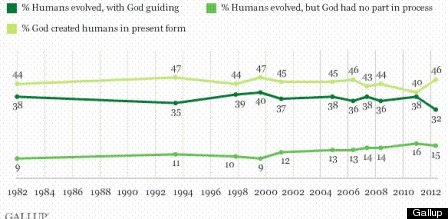
My paper took samples of ICR's discourse and broke the arguments down to their basic elements to determine if they really were scientific or not. Recent polls show only 15% of Americans believe in the occurrence of evolution without supernatural intervention, with 46% believing the in the Biblical account of origins with God (a Judeo-Christian one). That's nearly a majority of Americans who deny a scientific consensus of evolutionary mechanisms explaining origins. Groups such as ICR receive millions of dollars in charitable donations, run talking tours, sponsor museums and even a award degrees from an accredited school. Creationism discourse is alive and well in the United States, at least in the public sphere.


It is a mistake to assume that everyone approaches the creation/evolution controversy with the knowledge and capacity of intellectuals. What my questioner was really saying was that "isn't everyone in America as smart as I am? Only fools would believe in creationism." Because he saw the truth in evolution, he immediately discredited the possibility of creationism as being a valid threat. But it is. It has been and remains a threat to scientific standards, classroom education, and the knowledge of millions of Americans. To discredit their opposition is to err as many scientists have done before. To simply say "look at the science", "look at the consensus" is not enough. These facts are not convincing in the way that many academics and scholars wish that they were.