It is impossible to ignore all of the online and offline discussion of the owner of the LA Clippers, Donald Sterling's racist remarks. He noted in a private conversation to his girlfriend that he didn't want her "associating with black people," and specifically bringing them to basketball games. The hypocrisy in Sterling becoming rich off of the labor of black bodies has been addressed better elsewhere, so I wish to address another important part of this discussion: the apologia. Using Kenneth Burke's guilt-redemption cycle, this post will discuss the similarities of Sterling's remarks to the racist statements of Earl Butz, and how these statements implicate the larger American public in the persistence of racism.
Earl Butz was Secretary of Agriculture in 1976 who eventually resigned his position after racist comments emerged. This site has the full timeline of the events including the offensive joke. A scholarly article was written about that event by Dr. James Klumpp and Dr. Thomas A. Hollihan called "Debunking the Resignation of Earl Butz: Sacrificing an Official Racist." The title reveals some important terms and information that will inform this comparison between Butz and Sterling. I will also highlight some important differences that reveal modern racial tensions. Butz was "sacrificed" as Klumpp and Hollihan say, as a part of Burke's guilt-redemption cycle. This cycle describes how pollution, or some type of disorder, is introduced into an order, which creates guilt and a subsequent need for purification, purging, and redemption.
For Butz and Sterling, the pollution was their racist statements that shattered the values of equality inherent in their respective social and political orders (government and sports). Both of these institutions are supposed to value equality, all Americans, and their constituents. As public figures, their voices can be seen as stand-ins for the groups that they represent. Butz was "sacrificed" by the Republican Party, who wished to separate their public appearance from racism. The NBA also separated itself from Sterling by banning him from the organization, fining him $2.5 million, and urging him to sell the team. The sacrifice can come in many forms, but it must make the punishment commensurate to the crime committed. Considering that the pollution for each was the potential crumbling of national organizations, the punishments were made quite prominent, public, and severe.
Another important similarity between the two are the separation between public and private. Klumpp and Hollihan address this dichotomy by nothing that officials are sometimes seen as not have the right to privacy: anything said even in private could destroy a public persona, one's reputation, and career. Some were quick to jump to Sterling's defense such as columnists at Fox who pointed to the "thoughts" of Sterling as harmless and a personal right. Some articles went as far as to implicate the girlfriend (who recorded the conversation) as the real criminal. In the aftermath of the announcement, Mark Cuban echoed the words of a Fox News reporter about whether convicting people for statements in private could be a "slippery slope" to the thought-police.
Though some of these concerns were raised, there has been overwhelming support for Sterling's punishment. One might say that it was a "success" in some ways in that an athletic profiteer who undermined his own team and the values of the NBA (and perhaps, the country) would be receiving a just punishment. However, Klumpp and Hollihan raise a point of contention with these types of guilt-redemption activities. They note that by creating a sacrificial goat out of Butz and Sterling, we as a nation do not have to address underlying and persistent racism that we may all (or at least most of us) be guilty of. Instead, we can claim that wrongs have been righted and that racism is an individual issue that does not have to be addressed on a societal level. They note that these overt punishments of racism create a culture that "tolerates private racism and its consequences” (p. 11). Jon Stewart adeptly addresses the issue of post-racial society in his critique of Sterling and the recent SCOTUS decision to uphold Michigan's ban on affirmative action.
What is to be learned by the Donald Sterling incident? One thing is perhaps most important: racism still exists. There is no magical, post-racial world because we have a black president. People haven't stopped being murdered because of their race, people haven't stopped trying to make relevant the KKK, and people still use the n-word. This is only the tip of the iceberg, however, as racism against other minorities, especially immigrant populations, is also a common American theme. Is this what America is all about? We need to take examples like Butz and Sterling and open our eyes to the underlying problems from which these individuals stem. Structural racism is happening and continues to happen; we cannot remain blind to it and only care when individuals break norms of keeping racism a private endeavor. All racism needs to be addressed, and we have a lot of work to do.
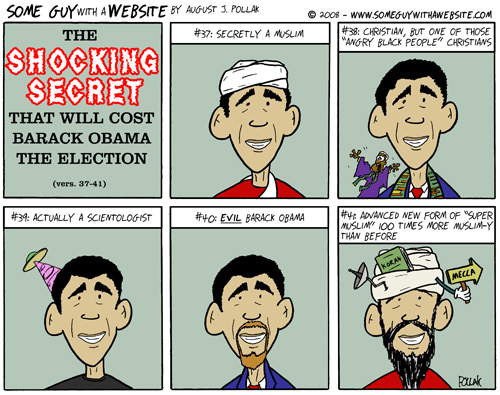
Although commonly known as false, 17% of registered voters still think that Obama is a Muslim. Carefully placed and constructed media and political narratives have created this false, yet influential narrative. I bring up this specific example because of a question posed to me at the NCA conference on the Romney and Mormonism panel. The panel was questioned why voters would consider a Muslim more “mainstream” than a Mormon. After a few stunned moments and a brief corrective response, I wondered as to the likelihood of finding a well-educated academic asking such a question to me at a panel specifically addressing the intersection of religion and politics at a competitive national conference.
The reality that such narratives can gain traction in the public sphere demonstrate who damaging unregulated political advertising and web presence can be. Though Geer argues for the benefit of negative advertising in "In Defense of Negativity", there appears to be more evidence to the contrary. Increased levels of personal attacks, deceptive and manipulated information, and subtle racial comments have become commonplace in American politics. Even though Obama can counter such narratives on his web sites and in media statements, for those who doubt Obama or are looking for confirmation of their skepticism can cling to relevant narratives and ignore contradictory information. Is Obama the most adamant and vocal Christian ever? No. Does he incorporate religion and traditional Judeo-Christian values into his politics as strongly as others? No. But does that mean that people have the right to doubt his Christianity? Furthermore, what does this say about our country when being a Muslim is a derogatory identification that precludes one from the presidency?
The truth is that negative campaigning increases cynicism, allows for the spread of misleading or outright false information, and creates a culture of division. My NCA experience represents for me the negative effects that I have studied being realized. It is one thing to read about the racial connotations of the William "Willie" Horton advertisement and it is another to encounter someone who truly believes what is nothing more than a conspiracy theory that survives only through the radical echo chambers that exist online. With low voter turnout and vicious character attacks from SuperPACs and 527s, I hope that negative campaigning will eventually reach its peak and disappear. For the sake of democracy, a healthy public sphere, and unity in the face of elections, the fostering of a negative political culture must end.
Doing research on the intersection of religion/politics and religion/science have brought forth some interesting, shocking, and saddening examples of what happens when these collisions occur.
Some things that I have read have made me echo the immortal words of Professor Farnsworth on Futurama:
This bill in Tennessee would place those who have had an abortion on an information-sharing list similar to sex-offenders.
The passage of this law in Idaho questions women's abilities to understand if they have been raped and requires them to view an ultrasound of the fetus before obtaining an abortion.
A doctor in Kansas is being stripped of her medical license for agreeing to provide an abortion to a 10 year-old rape victim carrying her uncle's child.
Protesters at Gay Day in Michigan threatened to rape and kill participants in the event, quoting and relying on biblical verses to justify the attack.
Representative Andy Gipson (R - MS) stated and then confirmed his opinion that it is people's duty to follow the word of God by having members of the LGBTQ community put to death.
Doctors in South Dakota are now required (as upheld by a recent ruling) to advise women seeking an abortion that there is a psychological link between having an abortion and depression and suicide.
Republican politicians confirm the active disenfranchisement techniques of Republicans towards African American and Latino voters.
Massachusetts judge approves a sex change operation for an inmate and sparks outrageous comments about the rights of prisoners, sex change operations, and tax allocation.
Stories like these ones above are not always bad, however. They remind me that there are still issues in the world that need to be addressed and corrected. We as people, part of humanity, cannot be satisfied with partial victories, segmented success, or the fracturing of freedom and equality.
Other news stories, however, help me to strike my best Freddie Mercury pose and exclaim:
The passage of the Affordable Care Act allow for equal coverage for women and access to preventative measures so they can be in more control of their health care.
Obama's statements on gay marriage and the Democratic Party supporting the repeal of the Defense of Marriage Act, though a small step, is an important first political gesture to inclusive marriage equality.
The repeal of Don't Ask, Don't Tell ended the prevention against open homosexuals from serving in the military and allowed for people to be open and honest about their identities.
The election of the first openly gay Senator and the passage of marriage equality in Maine and Maryland.
I hope that in the future, I will see more progress towards the acceptance, tolerance, and inclusion of all of humanity through equal treatment and opportunities. These are goals that we all can strive for and as scholars, voters, and communicators, we can strive for change together.
At risk of being self-serving, this week I am reviewing an article that I wrote at my undergraduate university, Northeastern. My reasoning for this is that I will be presenting it at the International Communication Association conference next week in Phoenix, and I believe that walking through the piece with specific attention to limitations and implications will help prepare me. Feedback and comments are always welcome, but on this post in particular.
The purpose of the study was to evaluate the use of values in presidential announcement speeches. Using the three front-runners from the Republican and Democratic parties in 2008, the types of values and their frequencies were coded for compliance with value theory. Perelman & Olbrechts-Tyteca (1969) outline 5 ways to begin the process of persuasion, named the "premises of agreement". They proposed that values are one of these premises and that values can be split into concrete and abstract categories that correspond with conservative and liberal ideologies, respectively. Matching these ideologies with their current political label, researchers created a list of abstract and concrete values (based off of public opinion polls) to see if politicians were using the "correct" values. Assuming that values are more successful in creating agreement with those of the same ideology, the politicians that are most successful in doing this may see the most success in the campaign.
Using Trent and Friedenberg's 1978 evaluation of announcement speeches as "telescopic" of the campaign, the announcement speech was coded for each candidate. The results showed that Obama, Edwards, and Paul were the only candidates that used a specific type of value more than another, with Obama being the only one that used the "correct" type of value more. McCain, Clinton, and Romney showed no statistically significant preference for either value (alpha level = .05). Paul used significantly more abstract values (liberal) than concrete values (conservative) and Edwards preferred the opposite. Obama significantly favored abstract values, which according to Perelman and Olbrechts-Tyteca are associated with the liberal ideology, which is his own party affiliation, p = .02.
This results have important implications for how candidates are structuring their campaigns to appeal to voters and creates a quantitative measure for a rhetorical technique and its success.
There are important limitations to the study, which are outlined further in the paper, but will be listed here:
coding of the speech was done in an "inauthentic" environment
speech was read, not heard
there are many factors that determine presidencies, so the narrowing of success to one variable is impossible
though determining factors and their influence is important for scholars of political rhetoric and communication
only coded one speech of the campaign instead of a sampling of multiple speeches
creating a completely inclusive list of values is probably impossible, so this study may be missing other important values that would be influential in forming agreement
This article is to be presented at ICA in its current form and I am happy that another project (about the difficulty in coding for values) is in progress due to this study.