I recently saw "The Forest," a horror movie that discusses the Aokigahara Forest in Mount Fuji, Japan. The forest is known for its association with people committing suicide in the forest. The forest is said to be haunted by yurei, or the ghosts of those who have taken their lives in the forest. As with other horror films that I have analyzed (The Purge: Anarchy, Teeth, Crimson Peak, It Follows, The Visit, and Pride + Prejudice + Zombies), I will first summarize the film and then discuss some elements of the film that bear further critique. For "The Forest," I'd like to address issues of exoticism and Orientalism, responses to trauma, as well as issues of agency and explanation. This review will contain spoilers of the movie's key moments and plot developments.
The movie focuses on Sara and her twin sister, Jess. Sara travels to Japan to look for Jess once notified by police that her sister is missing in the Aokigahara Forest. Convinced that her twin bond tells her that Jess is alive, Sara disregards the warnings of pretty much everyone in the film and goes into the forest. With this incredibly long build-up and character development, Sara finally enters the forest and camps out with Aiden, a man she met hours earlier in a local bar. This is where the visions start happening and Sara is confronted with haunting images of dead bodies, ghosts, and people she isn't quite sure are alive or not. The climax of the film comes when she becomes suspicious enough of Aiden to stab him and leave herself alone in the forest. A final vision consumes her and she re-enacts finding her parents dead in her house with Jess. In this vision, Sara and Jess's father comes back to life and attacks Sara with a death-grip on her arm. Sara slices at her father's hand to free herself from his grasp. At this point, the continuity is not clear to me, so I will piece together what I think happened. Sara, in her mind, escapes her father's grasp and runs through the forest, trying to get back to the path. But, she's actually sliced her own wrists instead of her father's non-existent hands and has bled out. Her soul, or perhaps spirit, running through the forest alerts her sister, who had been camping the entire movie and seemingly unaffected by the yurei, and starts her running towards the path. Jess is eventually led back to the forest's entrance (in part by her sister's yurei?) and is reunited with Sara's fiance, who at first thinks it is Sara that has emerged from the forest. As the two look into the forest, they see Sara's yurei with glowing eyes.
Sara and Aiden in the forest. Image retrieved from this site.
Overall, I was not wowed by the film and would rate it as below average compared to other horror films, although not quite as awful as The Visit. In watching it, however, I was struck by a few details that stood out to me as unique in films I've recently watched and unique to my usual blog analysis. First, I'll address issues of Orientalism and exoticism. Edward Said argued that Western culture patronizes and infantilizes Eastern culture. Western media portrayals of Asia exoticizes Eastern culture and provides them no personal value or consideration beyond gross stereotypes. These inaccurate representations undermine the ability of the West and Western people to understand or value Eastern culture. When The Forest came out, there was backlash in the press that the film painted Japanese culture in a negative light. Many reviewers noted the distinct lack of any Japanese main characters, despite the film happening in Japan (why couldn't Aiden have been Japanese?), and the odd behaviors of many of those that were highlighted. When Sara enters her sister's classroom in Japan, one of the schoolgirls literally freaks out and cannot be consoled at the sight of seeing her teacher again. Although Jess is presumably there to teach children English, the girl is unable to communicate at all in English and instead stammers with cliche wide-eyes and a schoolgirl uniform about the supernatural and ghost stories. Every Japanese person appears to be an expert on local folklore and preoccupied with death. From the woman who keeps dead bodies in her basement and the tour guide who seems numb to cutting down hanged bodies, the movie portrays Japanese people as uncaring and obsessed with death. Many reviewers pointed out the potential for racism and mischaracterization. I must agree that the film engaged in white-washing of a Japanese health epidemic and used the Aokigahara Forest as nothing more than a foreign, exotic backdrop for foregrounding the important, tragic lives of white Americans.
Sara being dragged away by the yurei. Image retrieved from this site.
Reviews also condemned the film for ignoring an important mental health crisis and making light of a serious epidemic in Japan. One review asked, what if a similar film was made about the Golden Gate Bridge in San Francisco, another location that experiences many suicides. Borrowing from my previous points, this conceptualization of Japanese sites as specifically "haunted," exoticizes Japanese culture as being odd, occult, or unnatural. The suicide forest is not addressed as meaningful or an issue for the protagonist to tackle. The forest is merely a "creepy" location for the protagonist to search for her sister. In ignoring the mental health issues inherent in the forest, the movie does touch upon the trauma that Sara and Jess went through in their parents death. The distinction drawn between them is that Jess actually saw her parents' dead bodies while Sara did not. Sara frequently mentions that in not looking, she was not fully there for her sister and could not help her bear that burden. It is then Sara and not Jess who is repeatedly told that she is "filled with sadness," and should not enter the forest. Having seen her parents' bodies, Jess is somehow more fully able to cope with her parents' death. I do not wish to make grand conclusions about what is appropriate and not, but it does strike me as an incredibly interesting statement on trauma and coping mechanisms. There are many different ways to respond with losing loved ones, this case in a murder-suicide. The film seems to argue, or at least, imply that in not fully seeing and acknowledging her trauma, Sara has set herself up for her own suicide. Jess is much stronger against the yurei and the influences of the forest, because she has "faced" her trauma and has overcome it. The messages, however coded and unapparent, may send harmful messages to people coping with their own trauma, who may or may not be seeking actual medical and professional advice to counter or correct media images. While many reviewers advocated boycotting the film for its damaging portrayal of the forest and mental illness, others noted that "art should not be censored."
The very first analytical thought I had about the movie was about the lack of agency given to the people who enter the forest. I was struck by the fact that in showing Sara killing herself based on a "trick" of the yurei, that they were removing agency from everyone else who entered the forest. Perhaps they didn't really want to die, but were similarly tricked. Suicide is truly an awful act, and one that I have familiarity with, but minimizing the decision-making power of those who engage in it left me with a bad taste in my mouth. For the film to pawn off the responsibility from individuals to ghosts and supernatural trickery is to provide an explanation that denies the need for broad consideration of mental health and depression. To invoke Burke's pentadic ratio, the film removes agency from individuals and instead focuses on the scene, the Aokigahara Forest, as mitigating the individual's responsibility for their actions. I'm not saying that we should be blaming individuals for taking their lives, there are oftentimes many influencing factors at play. But, I am wary of a film that seems to reduce suicide to the hallucinations caused by the supernatural. I am reminded of Aaron Mahnke's podcast, Lore. In episode 11, Black Stockings, Mahnke discusses myths about fairies who would kidnap children and adults and replace them with "changelings." In his description of the podcast, Mahnke's describes the human need to create stories "to explain the unexplainable." Faced with mental illness and physical disability, it was easier for people to see others as less-than-human and others, instead of caring for fellow humans who were different. Instead of working to solve the issues that lead to suicide sites, like the Aokigahara Forest, people may excuse the actions using supernatural circumstances. This removes agency from individuals, particularly those with mental illness, and ignores larger societal problems.
As far as horror movies go, I thought this film was full of cliches and added nothing to the genre. It also brought up some interesting rhetorical implications for its depictions of Asian cultures, trauma, and mental illness. I hope that in the future that horror films might take more caution in subject matter selection and treatment of sensitive subjects. I agree with one blogger that art should not be censored, but I do think that in making films, people should be concerned with how their treatment might influence audiences and make statements about other cultures and mental illnesses.
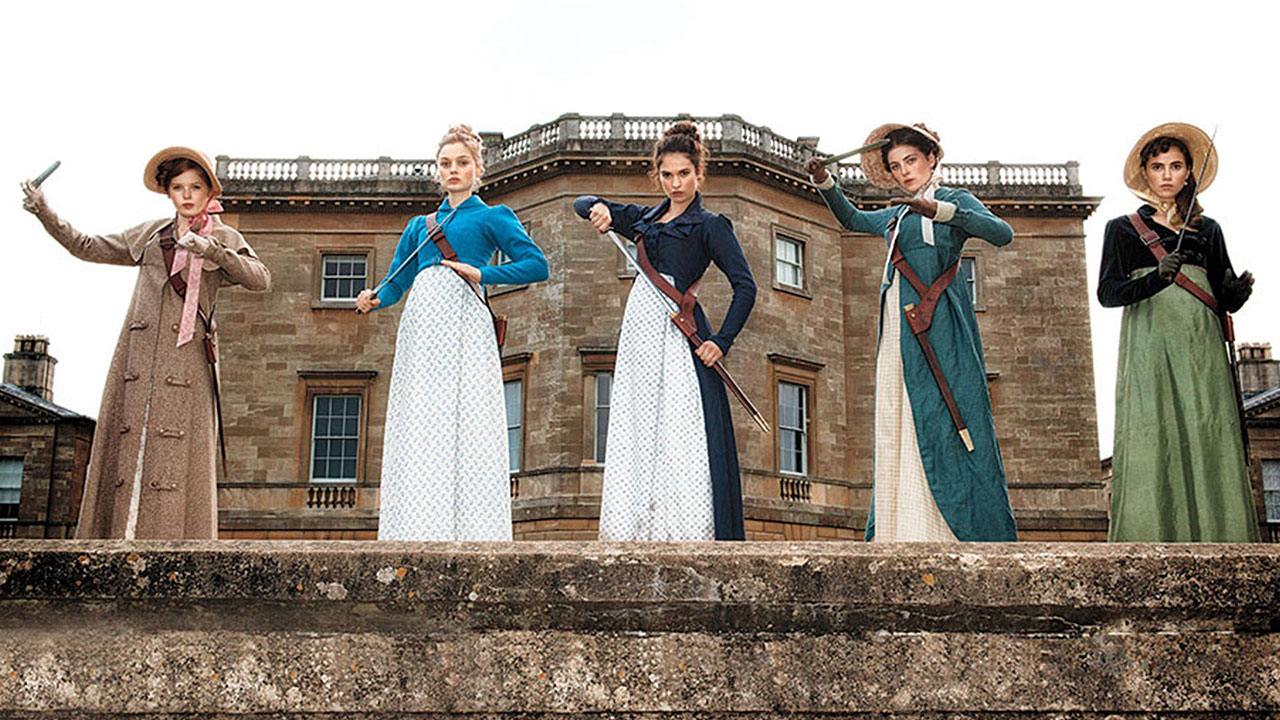
This past Thursday, I attended a film screening of Pride and Prejudice and Zombies, the latest film to be adapted from a book....that was itself adapted from a different book. I remember when the book Pride and Prejudice and Zombies came out, and I thought the book might lure unsuspecting youth into actually enjoying a literary matsterpiece and classic. I greatly enjoyed reading the original and admit that I snubbed the pop culture revival. Upon given the opportunity to go to a screening, however, I put my skepticism aside. As a film, I thought PPZ was excellent, extremely entertaining and just enough of the original to be a humorous homage. I have to say that Lily James and Matt Smith stole the show and created exciting and entertaining characters. This blog is not simply about movie reviews, however, so I feel compelled to discuss some elements of communication and rhetorical theory that, in this case, heightens my enjoyment of the film, and one cautionary note. I will first address what I felt were positive feminist inversions in the film through perspective by incongruity before discussing the future of orality and literacy. Suffice to say, this post will have comments about specific elements of the film. You have been warned.
Although many of the fighting scenes became repetitive, I never tired of the many scenes of the Bennet sisters pulling knives out of garter belts or revealing hidden weapons from underneath their dresses. The Bennet sisters were trained as Chinese warriors and often came to the aid of their family and male counterparts. In discussing these scenes, I am reminded of Kenneth Burke's perspective by incongruity, by which two disparate things are united to highlight the differences between them. In PPZ, I found this concept in play along multiple dimensions. The weaponry along the exaggerated feminity of the time period. Large skirts and corsets are made to restrict the movements of ladies, and yet the Bennet sisters move seemingly without pause to eliminate dozens of potential zombie threats. Furthermore, the juxtaposition of 19th century language and style with a contemporary horror fascination reflected the movie's unique narrative. One of my favorite parts was the puppeter-style history book that explained the relationship between the plague and the zombie outbreak - fascinating legitimization of a decidedly impossible occurrence.
Perspective by incongruity also laid a stark humor over the entire novel. The imminent zombie horde emphasizes how absurd the choice of husbands for Elizabeth is and the amount of time and attention given to such occasions. Even with zombies attacking and killing people at the balls, Mrs. Bennet and many of the people present are preoccupied with marriage and inheritances. The incongruence of these simultaneous acts highlights the odd traditions of the past and reignites the agency of Elizabeth in choosing her husband, despite the risks. I have recently paid much attention to the rise of feminist themes in horror movies (such as Teeth, It Follows, and Crimson Peak). I am happy to find these themes traversing genres and emerging in a more mainstream film. I hope these themes do not become overblown and trite, and keep their sincerity and calls for reconsidering the roles of women in narratives.
I did enjoy PPZ and found many instances of progressive film-making. I do wonder, however, if the creation of such films do not damage readership. When I first encountered the novel, I thought at least people would still be reading - what is there now? I do not mean to undermine film as a medium of communication, but I wonder what the long term effects are of children brought up watching the Lord of the Rings, Pride and Prejudice, Roald Dahl novels, the Great Gatsby, and Bride to Teribithia. Furthermoe, what happens when these film adaptations are perversions of the original text? Excellent movies, to be sure, but I wonder what components of visuality and literacy, minus orality, are lost on the current generation.
It has been a few weeks since my last post. I've been hard at work at job applications and this post has been particularly difficult to write. This post is about a movie screening of "It Happened Here" held at USC. The movie addresses issues of sexual assault on college campuses and the effects on students there. "The Hunting Ground" is another recent movie that addresses these concerns and I recommend both of them to people interested in delving more into real life experiences and stories of those affected by sexual assault and rape. I will first summarize the reasons why I find films like these extremely important and the rhetorical techniques they used to communicate their message. Then, I will discuss the prevalence of rape myths and why I had to walk out of the Q&A at the movie screening.
IHH and THG tell the larger story of rape and sexual assault that plagues women across the country through the individual stories of a handful of women. The startling statistics that 1 in 5 women are victims of sexual assault during their time in college are presented through the voices of the few. These exemplars add detail, nuance, and a face to the victims of this particular crime. Statistics can often feel cold or unpersuasive - especially if people do not (think they) know anyone affected. There are many reasons why people may not want to share their story, so these crimes may appear anonymously in public discourse - or we only hear the amplified stories of the very few that are false. Kenneth Burke argued that the "circumference" of an event affects its communicative influence. The circumference is related to what counts as the event or environment for an action. For example, if we expand the circumference of "bullying" from only in person to also online and cyber-bullying, the term can take on a whole new meaning. In these films, they seem to be narrowing the circumference, and showing only a few campuses and a few women as stand-ins, or synecdoche, for all college-aged women. The audience is forced to engage and experience the narratives of each woman and, at least in part, sympathize with their situation.
Angie Epifano - one of the storytellers in IHH. Image retrieved from the IHH website.
The two films showed a variety of people affected by sexual assault and rape. There were women who had been drunk, those sober. Some women were at a party, some were victims in their own dorm rooms. Some didn't know their attacker, others were assaulted by friends and significant others. The variation in stories gave the impression that rape and sexual assault happen in many different ways to many different types of people. THG contained a few stories from men who had experienced rape or sexual assault. Overall, the individual narratives united to create a holistic view of sexual assault and college life. The films could have easily focused on the past and fetishized the experiences of the story-tellers. Both films, however, emphasized the present and even the future, choosing to spend most of the films engaged in the reactions of the college administrators and the steps the women were taking to combat future sexual assaults at their universities and across the nation. Descriptions of the assaults were left in the victim's own words and comprised very little of the movie's time. Instead, the films focused on the larger impact of these occurrences and how the women were working to reclaim their voice through campus events and protests (like Take Back the Night) and Title IX lawsuits. I have previously argued, among many others, that documentary films have an immense power to shift public discourse. These films are certainly persuasive and advance an argument, but they also provide real life examples packaged for public consumption. I hope that films like this will help to shift how people talk about sexual assault and rape.
My optimism upon seeing this film and reflecting upon it and THG was almost immediately tempered during the Q&A. I first want to thank Director Lisa F. Jackson for attending the screening and handling two audiences members with aplomb and respect. It was far better than I would have done in that position. There was a couple in the back of the auditorium that dominated the Q&A session. As I told people of the event and even as I write it now, I am convinced no one will believe me. They presented a startling cliche of rape myths and expressed my greatest fear - that the film could not soften the hardened distrust of women and rape victims in the public. This is a warming that the following description of the Q&A may be triggering.
The gentleman in the back of the room raised his hand and was called on with the first question. He started his question with a preface about how he was the eldest brother of four sisters. Thinking back, this should have been an immediate red flag a la "I have a lot of black friends" before racists start talking. He asked Jackson why she didn't include any stories of false reporters and those who lied about their assault. He noted that this would have been more "fair" to share "both sides" of the story. Media representations of controversial events are often framed as debates, where there are two equally balanced sides. Similar to John Oliver's report on global warming, Jackson argued that there are so few false reports that giving them space in the film would not be reflective of the overarching narrative. Indeed, the number of false rape reports mirrors the false reports for other crimes. I groaned a bit at his question and I saw a few people shifting in their seats, but so far, it was bearable.
A few other people asked questions, but my friend in the back wasn't done. He raised his hand and asked whether women don't "disassociate" themselves from the event while its happening and then "forget" in the morning that the activity was consensual. Perhaps, when reflecting on the event, women "make up" a story to make themselves feel better. It was "obvious" from the film that some of the women couldn't remember a lot of details, and that was an indicator that they were lying as opposed to those that would have a factually accurate and complete story. The women had "wanted" the attention initially, but then regretted the potential effect it would have on their "reputation" and thus cried rape afterwards. Everyone had turned to look at him, and I asked, "Are you serious?" The woman a few seats away from me said, "You're victim blaming." This person, sitting through the entire film, seeing women share their painful stories, hearing the statistics about the frequency of this crime, and learning about how the system fails victims, held fast to his beliefs that it was the victim who was at fault.
In response, a brave woman in the front of the room shared her story of assault and noted that there were probably more women like her in the audience as well. She wondered whether it was the larger culture that encouraged this type of behavior and rewarded men for aggressive behaviors. Our friend raised his hand once more and it was all I could do not to interrupt and claim the microphone back for the female voices in the room. As he received the microphone again, a handful of women left the room. The man echoed the concerns of the previous speaker and talked about the powerful force of masculinity over the mind. He argued that men are not at fault at all and it is really their sexual drives, natural to all men, that are at fault. This man was truly a sight to behold. Some of the most common rape myths that pervade our culture and insidiously undermine the stories of those brave enough to speak out. In retrospect, I'm surprised that he didn't ask what the women in the film were wearing when they were assaulted.
Lady Gaga's music video, "Til it Happens to You" about sexual assault
I mentioned that this person was a part of a couple because at this point, she spoke up. She asked Jackson why more women don't go to the cops right away to have their story verified. She said that the issue of lying and false reporting would be eliminated by lie detector tests. I applaud Jackson for ignoring the absurd part of this question and focused on the many reasons why women may not feel comfortable going to the police and how we might create changes in police protocols. The response I wanted to give, but could not muster the strength to, was to say that all women experience trauma differently. Expecting anyone to submit themselves to being tied up in a chair being asked probing questions about their assault shortly afterwards is completely illogical. Furthermore, lie detector tests measure nervousness and heart rate to detect lying, two things basically guaranteed to happen after an assault. There is a reason why they aren't used in criminal justice systems - they are not accurate enough. This woman echoed her partner's concerns that the victim should be analyzed and be on trial for being assaulted.
I was deeply hurt but this couple's comments and had to leave the audience when the man raised his hand again. He was overpowering all of our collective voices and challenging the basic tenets of what I felt was an excellent film. The Q&A experience highlighted for me that there is still a lot of work to be done to change the minds of many members of the public. This films are making important strides, but rape myths and dominating ideologies can be intractable parts of culture.
The consequences of climate change have become more prominent, but many of the harsher, more extreme consequences will not be felt by this generation. Part of the difficulty in crafting persuasive climate change arguments is about "jumping" the inter-generational gap. An intergenerational argument encourages people to act not in their own interest, but in the interest of future generations. Though most of us alive today will likely avoid most of the harshest effects of climate change, our children and certainly our grandchildren, will not be as lucky. People tend to be fickle, however. They are many things vying for our attention, pulling us in different directions, so anything further off than right NOW seems too far off to be worthy of our time. As Burke noted in Permanence and Change: “A philosopher, if he has
a toothache, is more likely to be interested in dentistry than in
mathematical symbolism. Communication cannot be satisfactory unless the
matter discussed bears in some notable respect upon the interests of the
auditor” (p. 37).
How do we get people to care for youth? For animals? For anyone but ourselves? It is not simply a matter of narcissism or selfishness; it is just far easier for people to react based on their immediate surroundings. Thinking ahead requires much more energy than simple observation, putting oneself in a different mindset is difficult, and there can be other, conflicting loyalties that stop one from accepting long-term arguments. One of these arguments is economic: short-term business and profits may suffer when making long-term environmentally friendly decisions. Another complicating factor may be religious beliefs about human's dominion over the earth. Or, it might simply be a political affiliation that often denies science and climate arguments in deliberative spaces (Gauchat, 2012).
Author and activist Zadie Smith. Retrieved from this site
One of the ways to spread intergenerational messages is online. When public spaces may be held to standards of balance or may receive denialist backlash, the internet can serve as a location for the expression of information. A recent article by author Zadie Smith called, "Elegy for a Country's Seasons" addresses the current apathy in the climate change debate and how she might explain our inaction to her granddaughter. This excerpt from the piece is particularly important as the excuses given seem to pale in comparison to the burden that we will leave this young girl and all children as we bicker over money and politics.
"This will no doubt look very peculiar to my seven-year-old granddaughter. I don’t expect she will forgive me, but it might be useful for her to get a glimpse into the mindset, if only for the purposes of comprehension. What shall I tell her? Her teachers will already have explained that what was happening to the weather, in 2014, was an inconvenient truth, financially, politically—but that’s perfectly obvious, even now. A global movement of the people might have forced it onto the political agenda, no matter the cost. What she will want to know is why this movement took so long to materialize. So I might say to her, look: the thing you have to appreciate is that we’d just been through a century of relativism and deconstruction, in which we were informed that most of our fondest-held principles were either uncertain or simple wishful thinking, and in many areas of our lives we had already been asked to accept that nothing is essential and everything changes—and this had taken the fight out of us somewhat" Smith, para. 11.
Written articles may take time to read through and may not offer direct and easy consumption of information (however beautiful and engaging Smith's article is). Another potential solution is to create videos that craft intergenerational arguments. This video is from the Australian Coal Mining Company that has a unique intergenerational plan for halting the effects of climate change.
This humorous video has an important point. It mirrors the argument by Smith about passing the buck onto future generations when we could have done something about it. When we stand back and look at the potential consequences, what are our excuses? Is it really enough to look at dollar signs or listen to denialists when we are faced with the guilt of harming all future life? Dramatic? Maybe. Accurate? Certainly. These arguments are not always successful, but people should try to become more attuned to them. Focusing on the current effects now can be an entryway in to discussing how it will only get worse, and our children will suffer for it.
There has been an influx of attention on the phenomenon of "the selfie." I know that I am perhaps a little late to this discussion, partly because it is far outside my typical realm of interest. A small epiphany regarding them, however, has prompted me to address what I think is an overlooked but important aspect of the selfie: the Freudian divide between self-love and object-love. The selfie is the perfect integration of our love for technology and our love for ourselves. To illustrate this union, I will first describe the myths of Narcissus and Pygmalion on which Freud based the two extreme disorders of love: ego-libido and object-libido.
Narcissus was a Greek youth that was captivated by his beauty reflected in the river. He wasted away and finally died being unable to leave his mirror and break his own gaze. The basic version often excludes the presence of Echo, the nymph who falls for Narcissus but is unable to warn him of the danger. She can only repeat the words of others and represents the love that others felt for Narcissus that was not returned. Instead, Narcissus turned his love inward and loved only himself (and specifically, only his aesthetics and beauty). The myth of Narcissus has inspired the phrase "narcissistic personality disorder" or Freud's ego-libido, which links a physical and emotional desire for oneself over others or objects. This is also associated with megalomania, or the idea that oneself is more important or better than others. Before summarizing the tale of Pygmalion, it is easy to note how narcissistic themes can be seen in today's individualized society.
Narcissus discovering his reflection. Retrieved from this site.
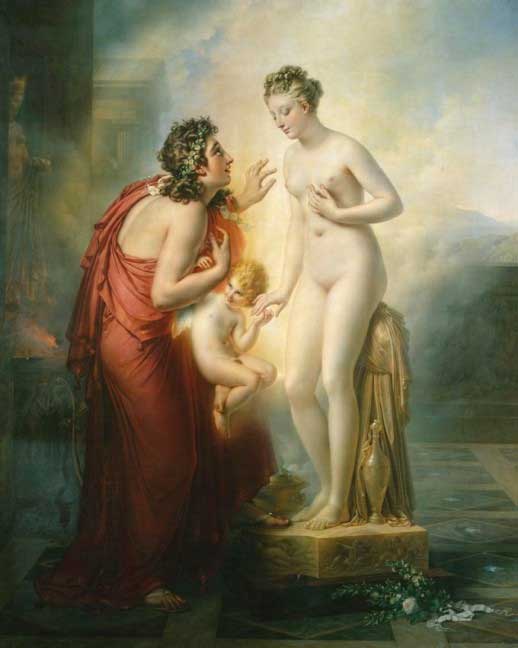
Pygmalion was a Greek artist who built a statue so beautiful that he fell in love with it. Appealing to the gods for reprieve from his unrequited love, his statue Galatea was brought to life by Aphrodite. They married and Pygmalion was able to spend his life with his creation. Many variations, plays and films, have emerged from this myth, where different variations on "brought to life" have emerged. A notable one might be the recent film, Her, where Joaquin Phoenix falls in love with the operating system in his phone. His phone, as an object, came to life with a personalized, teachable, intelligent female voice. In a brilliant dualism, Phoenix even has a sexual experience with Samantha less creepy than phone sex he previously performed with an actual person. Pygmalion is the myth of object-love, in opposition to Narcissus as the myth of self-love. Physical and emotional eros is directed as certain people and objects that epitomize how people can love.
Pygmalion discovers that Galatea is now human. Image retrieved from this site.
Currently on display in The Lourve, Paris.
The two forms of libido and love: inward and outward come together in the selfie. This new trend in photo-taking simultaneously emphasizes the importance and singularity of the individual and glorifies the technology that allows the self to be captured and spread so easily and prolifically. This is particularly apparent in images that also show the camera in a mirror as opposed to a front facing camera shot. The phone is immortalized in partnership with the individual, a perfect union of self- and object-love. We love ourselves, so we wish to capture our image and likeness. We love our technology, so we capitalize on its capabilities to connect ourselves with the world. As in Narcissus and Pygmalion, the love is often an aesthetic, physical love for appearances, than a deeper emotional love as is lauded in Plato's Symposium.
To worship ourselves, we fall into the phone's lens which collapses Narcissus's river. Our phone becomes our partner, come to life in its utility, friendship, and closeness. People cannot be without their technology, phones at their sides or in their hands, preferring the reflective screen to the faces of people around them. Some may say that like Narcissus, we will waste away focused on ourselves, individuality, and narcissism that restricts us from progressing or experiencing the world. Some may say that like Pygmalion, we are too emotionally and physically involved in our technology that we miss the beauty of the world around us in favor of a Google search for its likeness. In my cursory experience with selfies, I take very few and have posted even fewer, I see many positives and negatives to the phenomenon.
Comic by The Oatmeal about the negatives of selfies
Undoubtedly, it has taken news media by storm. The selfie of Obama and Biden made headline news and people were discussing the Oscar selfie (which was potentially a contrived Samsung advertisement) almost as much as the award winners. I'm not sure about the wide appeal of other people's selfies (in the immortal words of Mallory Archer: why would anyone want a picture of someone else's food?), but as a personal expression of self-worth, confidence, and creativity, selfies do have an important role in the rhetoric of identification. Especially considering that some people may not always find themselves presented in media (or they are expressed negatively), online, or in safe spaces, selfies could help establish an online presence and carve out spaces for open discussion about personal identification, labels, and communities. Selfies create visibility, are unapologetic, and bluntly express one's visual appearance, identity, and existence as important and worthy of appreciation. Even if it is produced for personal consumption, it necessary sharing (often on social media sites) encourages a reflection of how it may influence a larger public. The physical presentation of the body demands attention, space, and gaze onto individual, their stories, and potential arguments. The selfie also glamorizes the power of technology, to turn what would have taken many hours of labor to produce a self-portrait can be accomplished in seconds and sent around the world instantaneously.
I hear the cries on both sides about the narcissism and objectification that is implicit in the selfie. But, I see the selfie as merely an offshoot of these larger cultural changes than a root cause or responsible for them. There are innovative potentials in how the selfie could carve out rhetorical communities, enhance identities, and change norms of personal expression. Though I can imagine Kenneth Burke terrified by the reliance on technology that he warned against, I hope that he might appreciate the rhetorical opportunities for identification, mimicry, and understanding between people that may otherwise never have met. And, the rhetorical opportunities for personal expression and control over how one defines themselves and their relation to the world.
It is impossible to ignore all of the online and offline discussion of the owner of the LA Clippers, Donald Sterling's racist remarks. He noted in a private conversation to his girlfriend that he didn't want her "associating with black people," and specifically bringing them to basketball games. The hypocrisy in Sterling becoming rich off of the labor of black bodies has been addressed better elsewhere, so I wish to address another important part of this discussion: the apologia. Using Kenneth Burke's guilt-redemption cycle, this post will discuss the similarities of Sterling's remarks to the racist statements of Earl Butz, and how these statements implicate the larger American public in the persistence of racism.
Earl Butz was Secretary of Agriculture in 1976 who eventually resigned his position after racist comments emerged. This site has the full timeline of the events including the offensive joke. A scholarly article was written about that event by Dr. James Klumpp and Dr. Thomas A. Hollihan called "Debunking the Resignation of Earl Butz: Sacrificing an Official Racist." The title reveals some important terms and information that will inform this comparison between Butz and Sterling. I will also highlight some important differences that reveal modern racial tensions. Butz was "sacrificed" as Klumpp and Hollihan say, as a part of Burke's guilt-redemption cycle. This cycle describes how pollution, or some type of disorder, is introduced into an order, which creates guilt and a subsequent need for purification, purging, and redemption.
For Butz and Sterling, the pollution was their racist statements that shattered the values of equality inherent in their respective social and political orders (government and sports). Both of these institutions are supposed to value equality, all Americans, and their constituents. As public figures, their voices can be seen as stand-ins for the groups that they represent. Butz was "sacrificed" by the Republican Party, who wished to separate their public appearance from racism. The NBA also separated itself from Sterling by banning him from the organization, fining him $2.5 million, and urging him to sell the team. The sacrifice can come in many forms, but it must make the punishment commensurate to the crime committed. Considering that the pollution for each was the potential crumbling of national organizations, the punishments were made quite prominent, public, and severe.
Another important similarity between the two are the separation between public and private. Klumpp and Hollihan address this dichotomy by nothing that officials are sometimes seen as not have the right to privacy: anything said even in private could destroy a public persona, one's reputation, and career. Some were quick to jump to Sterling's defense such as columnists at Fox who pointed to the "thoughts" of Sterling as harmless and a personal right. Some articles went as far as to implicate the girlfriend (who recorded the conversation) as the real criminal. In the aftermath of the announcement, Mark Cuban echoed the words of a Fox News reporter about whether convicting people for statements in private could be a "slippery slope" to the thought-police.
Though some of these concerns were raised, there has been overwhelming support for Sterling's punishment. One might say that it was a "success" in some ways in that an athletic profiteer who undermined his own team and the values of the NBA (and perhaps, the country) would be receiving a just punishment. However, Klumpp and Hollihan raise a point of contention with these types of guilt-redemption activities. They note that by creating a sacrificial goat out of Butz and Sterling, we as a nation do not have to address underlying and persistent racism that we may all (or at least most of us) be guilty of. Instead, we can claim that wrongs have been righted and that racism is an individual issue that does not have to be addressed on a societal level. They note that these overt punishments of racism create a culture that "tolerates private racism and its consequences” (p. 11). Jon Stewart adeptly addresses the issue of post-racial society in his critique of Sterling and the recent SCOTUS decision to uphold Michigan's ban on affirmative action.
What is to be learned by the Donald Sterling incident? One thing is perhaps most important: racism still exists. There is no magical, post-racial world because we have a black president. People haven't stopped being murdered because of their race, people haven't stopped trying to make relevant the KKK, and people still use the n-word. This is only the tip of the iceberg, however, as racism against other minorities, especially immigrant populations, is also a common American theme. Is this what America is all about? We need to take examples like Butz and Sterling and open our eyes to the underlying problems from which these individuals stem. Structural racism is happening and continues to happen; we cannot remain blind to it and only care when individuals break norms of keeping racism a private endeavor. All racism needs to be addressed, and we have a lot of work to do.
This post is part 2 of my discussion of a survey I performed of creation care members. Last week's post focused on the compatibility of science and religion and this week will discuss apocalypticism. Before analyzing answers about member's beliefs, I will describe the phenomenon of eschatology and human belief in end times.
Kenneth Burke discusses the immense importance of beginnings and endings as creating the coherent drama of one's life. Similar to a novel or a poem, the ending makes sense because of the beginning and every beginning implies its ending. Oftentimes, there are clues, patterns, and events along one's life that provide insight into its potential endings. Looking back, people want to have their life make sense, justify choices, and being they took the road less traveled. People have always been interested in human origins even to the point of intense controversy and debate. Endings as well, have been of great interest of public concern. It seems, that people are more interested in the far past and the far future, instead of what's right in front of them.
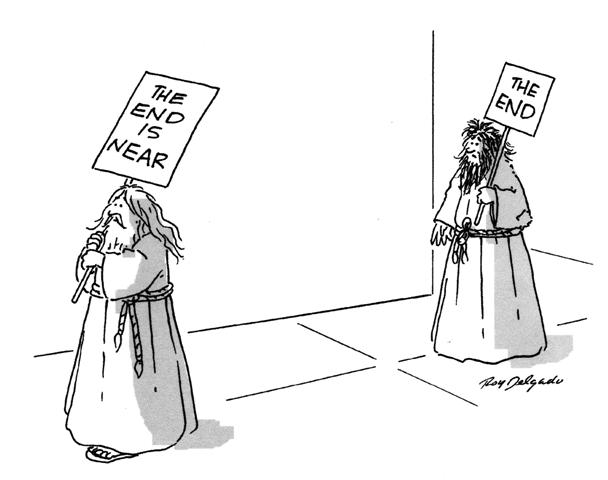
Looking forward and backward, but not at the present. Retrieved from this blog.
Creation care members, however, do not often focus on the future. They certainly believe in the apocalypse, but they do not have an established eschatology (or vision of how the world will end) that occupies their time or attention. One respondent noted, "speculations about an apocalyptic war and all the rest of this only detract us from the real issues of the world in which we have been placed by God." Nearly half of respondents discussed the purposeful vagueness of the Bible in leaving out specifics. Many responses referenced Matthew 24:36 which reads "But about about that day or hour no one knows, not even the angels in heaven, nor the Son, only the Father." "That day" references the day of apocalypse, or the day of revelation when the return of Christ will occur. This verse is often used when apocalyptic prophecies are unconfirmed.
These respondents noted discomfort in discussing the details of their beliefs. One respondent said, "I don't like to speculate on this. I believe Jesus will return, and He will renew all things. That's all I'm comfortable saying." They all, however, expressed that they had a personal eschatology and were trusting in God to save them. One respondent noted, "I have no idea and Scripture calls on me not to worry or guess when it will end." These responses indicate a shared commitment to the present and an awareness but lack of concern for the future. This appreciation of apocalypse may be in part how creation care members can unite religious belief in (potentially environmental) apocalypse and motivation for action. One respondent argued that thinking about the apocalypse is wasted time: " I'd rather spend my energy trying to make it a better place--a place where life can flourish, rather than focusing on an end that seems unclear."
A few respondents directly linked climate change with the apocalypse. "I do wonder whether climate change will be the physical change to the earth that will usher in Christ's return, simply because it has the potential to make the planet uninhabitable for humans and many other things," said one respondent. Another responded, "I think the climate crisis could end the world as we know it, with life reduced to a much more basic level in various parts of the world, and with great loss of life." A few respondents argued that the Rapture would occur and Christ would judge his followers based on how they treated the world. One noted, "I am committed to the idea that if or when Jesus comes back, there will be plenty of clean power technology around for helping humanity here on earth." This respondent believes in the rapture, but wants to leave the earth in a better environmental condition for those that are left behind.
Creation care members have somehow captured the idea of apocalypse and used it as motivation to act. Not only do they believe that Christ may judge them, but they are also concerned with those who will not be raptured to Heaven. Although belief in apocalypse is often associated with a lack of action or even the welcoming of climate change, creation care members appear to fall in a unique category. As discussed last week, creation care members have found a way to unite science and religion in a modern natural theology. Now, it appears that they have also managed to unite a belief in the apocalypse with an urge to mobilize and act.
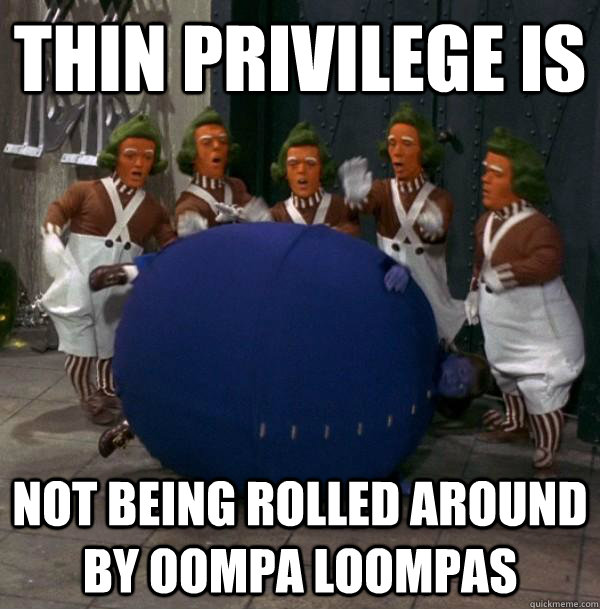
There has been a recent surge in websites, blogs, and tumblrs that deal with "Thin Privilege." These sites have also spawned spoof or parody sites which have in turn encouraged reaction sites. In the back-and-forth on these websites that I have followed, I would like to comment on a common theme which I think connects issues of health and bodies to the LGBTQ community: choice. First, I will explain these communities then I will draw from examples from each and compare them through Burke's pentad as revolving around agency and choice.
Thin Privilege reflects the advantages and benefits that come with being thin (or non-fat) in a society that values skinny bodies over large bodies. This has resulted in cultural and institutionally prejudices levied at non-thin people. Thisisthinprivilege.tumblr.com is dedicated to individuals sharing their personal stories of discrimination because of their size. Key themes are the idea that being large in body is associated with unhealthiness (which they argue is not necessarily true), being impacted by a lack of services available to them (such as the size of airplane seats), lacking role models in media, and experiencing fat stigma (e.g., strangers trying to give diet advice or calling names). The stories range from not being able to find clothing sizes in stores to having doctors ignore potential health issues because weight was a perceived larger concern. This site often posts "troll" questions and comments and critiques them as coming from a place of privilege or purposefully trying to undermine their cause. The key take-away from this site is that no one with privilege can deny others their claim to discrimination, police their language, or undermine their cause.
Retrieved from this blog as an example of skewed expectations and a world made for unrealistic body sizes.
From comments on these webpages, I found immense similarities to discussions of LGBTQ rights. The similarities center around the idea of choice. If one believes that being fat or being LGBTQ is a choice, they are more likely to be negative, critical, and dismissive of societal backlash that occurs for them. If one believes that these identifications happen naturally or are a product of the environment (e.g., hereditary/genetic), then one is more sympathetic to the effects experienced. This proclivity to blame the individual (agent) or the environment (scene) can be mapped onto Burke's pentad. The pentad is a tool that critic's can use to analyze situations in terms of its agent, agency, purpose, scene, and act. If the act performed is discrimination against someone, emphasizing the agent may cause one to believe that the recipient caused it themselves. Emphasizing the scene, however, may cause one to believe that society fosters discriminatory attitudes against minority communities. Papers I've been working on, influenced strongly by papers by Brock (1990), argue that these can be directly related to political ideology. Republicans may be more likely to consider the agent responsible (e.g., pull one up by one's bootstraps) and Democrats may be more likely to consider extenuating circumstances (e.g., how scenic factors influence one's actions and treatment).
To consider a large person and a gay person autonomous agents that make choices about their identity is to remove environmental and societal factors from responsibility. This type of view undermines the culpability of institutions and those with normative privilege (e.g., thin and hetero-) for discrimination. Somehow, making a choice to do something as opposed to having it happen to you, makes one more deserving of disdain and scorn. Those who had no choice can be viewed as vulnerable, victims, and innocent. Analyzing these situations as similar help us to connect issues of discrimination and shared experiences of minorities against ableist/cis/hetero/white/male society. From within that community, it is hard to assign oneself culpability and guilt; people would rather blame the individual than admit shared responsibility for discrimination. Just as people were quick to yell "post-race!" with the election of Obama, people are quick to jump to answers that do not include our own or systemic faults.
Retrieved from this site to represent the traditional Barbie size to the new "real proportions" doll
How does society move beyond discrimination? I think it's important for those of us with privilege is to step back and truly listen to the words of those without privilege or those at the intersections. We cannot understand the discrimination not having been privy to it. Trying to deny the stories of others or to argue with our own stories of discrimination only perpetuates structural inequalities. Just consider the backlash that happened when a new Barbie copy with "realistic proportions" came out that would encourage girls to idolize being unhealthy. Instead, why can we not consider these positive steps to creating a more inclusive culture that teaches people to love and respect their own bodies, no matter its size? ThisisThinPrivilege.tumblr.com is fighting against other blogs and the system that devalues fat bodies. Though this article is not meant to be evaluative, it cannot help but reach the conclusion that to reduce people's identities to arbitrary choices is to undermine the perpetual problem of discrimination. As posted on the website, people are fighting a system that "systematically reduces each of us to our dress size, hip measurement, and waist size, then grants favors, opportunities, or simple lack of punishment when the numbers are low enough" and instead fights for a system that treats everyone as equally human.
A recentLA Times op-ed by Pat Morrison addressed importance
similarities between science-deniers that affect more people than just
believers. Creationists and anti-vaccine advocates affect the collective
intellectual and physical health of those around them due to their rejection of
scientific evidence. Though this is an important point, it only scrapes the
surface of larger issues surrounding pervasive skepticism and the borrowing of
scientific authority.
In associating science with faith, deniers of current
scientific knowledge present themselves as "true" science. These
groups portray themselves as fighting against hegemonic elites that wish to
silence minority opposition. Anti-vaxxers claim theright to abstain, equating scientific practice with
replacing parental control. Creationists point to gaps in scientific research
and claim that science requires a greaterleap of faith than religious explanations.
By appealing to scientific standards of skepticism,
re-testing, and a progressive search for knowledge, science-deniers can pose as
legitimate scientific inquiry. Creationists use this platform to enter science textbooks,
school boards,
and even university faculty.
Anti-vaxxers use this platform to flood public spaces withliterature,websites, andnon-profits.
Other
skeptical groups, such as climate deniers, also appeal to “scientific” facts
and gaps in evidence to forestall legislative action. Democratic Senator (CA)
Barbara Boxer held a committee about the President’s
Action Plan that was met with much controversy over Dr. Judith Curry’s
testimony. In this testimony, Dr. Curry misrepresented Intergovernmental Panel
on Climate Change’s reports on current scientific evidence and cherry-picked
statements of uncertainty about current predictions.
Morrison’s
original comparison begins to uncover this larger, pervasive issue of
skepticism that ignores scientific evidence and authority, and replaces it with
a facade of scientific inquiry. The key mistake in the piece however, is the
piece’s ending that states, “Ignorance is curable by education, but willfully
ignoring the facts can be contagious — and even fatal.” To assume that
education is the missing link between science accepters and deniers is to
oversimplify the argumentative frameworks that each occupies.
Those who
believe in creationism tie their beliefs to every action of their lives as a
guiding force. The origin of humanity is not merely an issue of fact, but of the
definition and explanation for one’s entire life. Rejecting creationism or not
fighting for its inclusion in schools is viewed as a betrayal of faith and
submission to the elites of science that denies alternative explanations.
Anti-vaxxers
are focused on protecting their children and the children of others, an extremely
powerful motivating factor. Simply presenting new information or facts may not
deter strongly held beliefs influenced by celebrity moms or one’s peers.
Those who
deny climate change may find themselves more fiercely loyal to a political
party or economic influences than long-term environmental protection. More
science and data may fall on deaf ears, as other priorities overshadow and
complicate accepting new information.
Kenneth
Burke, rhetorician and scholar, wrote in Attitudes
Towards History, “The shift to another attitude, requiring a
different rationalization, does involve ‘conflict.’ Insofar as we do not ‘travel
light,’ we thus assemble much intellectual baggage, and the attempt to reshape
this to new exigencies may require considerable enterprise” (p. 184). To replace
the baggage collected over one’s entire life with new, contradictory exigencies
nearly requires rejection. Introducing new information or repeating old
information through education is rarely enough to shift rationalizations for
action and behavior.
Skeptics do not “ignore the facts;”
they simply do not respect the facts lauded by scientific frameworks. Instead,
they replace with their own facts such as the importance of God’s role in human
origins, the autonomy of parents over children, and the benefits of short term party
loyalty over long term environmental protection. The issue is not, then,
ignorance, but of warring frameworks that are currently empowered by a
skeptical culture to reject scientific authority. Instead, the focus should be
on separating what is science and what is not, giving skeptics a voice, but not
allowing that voice to be labeled scientific.
The culture of skepticism is damaging
scientific enterprise and Morrison is right to point out the wide effects that
skepticism has. The conclusion, however, is not to rely on education, but
acknowledging alternative viewpoints while minimizing their influence.
The trilogy finale of the Batman series from Christopher Nolan finishes July 20th (or for the avid fans, midnight tomorrow night). The finality of the trilogy has been confirmed with Christopher Nolan and Christian Bale abandoning the project after this film. Though I was more than a little upset when rumors of Johnny Depp as the Riddler were squashed, I appreciate the finality of the series. I respect the ability of both actors and directors to sacrifice profit for the sake of a coherent and meaningful story line.
After re-watching the first two in preparation for the midnight premiere, I was struck by the iconic Liam Neeson line from Batman Begins: "If you make yourself more than just a man, if you devote yourself to an ideal, and if they can't stop you, then you become something else entirely...a legend, Mr. Wayne." The line is meant to encourage Bruce Wayne to abandon his mortality and chase immortality as a symbol, a legend. Many people around the world have devoted themselves to causes and emerged as icons for movements, causes, goals, and values. Rosa Parks, Mother Teresa, and Harvey Milk were just people, but through their actions and values, they have become legends, eternal, immortal symbols of equal rights, charity, and acceptance. The narratives of their lives have transcended the normal good and evil, the trials and tribulations of being human, and the faults, flaws, and sins inherent in all humans. These people, and many others are, in a way, superheros, super-people, because they have become more than just people. Their stories and actions become symbolic representations of events more significant than can be contained within one human life, body, and narrative.
Similarly, Batman is the comic representation of everyday heroes, who has transcended his Bruce Wayne, human persona for Batman, a superhero, legendary symbol of justice. By abandoning his humanity and replacing it with a mysterious persona, people in the comics turn to Batman as a savior, not as a person. Though Bruce Wayne has money and with that money comes power and the ability to transform into Batman, Bruce Wayne cannot fight crime, be an ally to the police force, and terrorize Gotham's criminals. Every person, though, has the power to become that better, idealized version of ourselves, immortal in our story and legacy. This occurs through committing oneself to a cause, extending oneself past human constraints, and becoming more than just a person. We can all leave legacies, whether positive or negative, and its corresponding strength and staying power is only restricted by our actions.
Not only do people become legacies, but the words that we use leave sometimes unforgettable impressions on the world. The power of the spoken word is why I wanted to pursue communication in an advance degree, so I could explore language as symbolic. Kenneth Burke famously described humans as symbol-using animals and rhetoric as the study of those symbols that create meaning (Grammar of Motives, 1970). Words are merely words, tools with different definitions, interpretations, and meanings. But when used with a purpose, for a cause, words can become infamous, last beyond the life of a person, and serve as everlasting symbols.
Think of the immortal words of Abraham Lincoln: "this nation, under God, shall have a new birth of freedom -- and that government of the people, by the people, for the people, shall not perish from the earth." Or the words of Ghandi, "you must be the change you wish to see in the world" or Martin Luther King Jr., "when we allow freedom ring, when we let it ring from every village and every hamlet, from every state and every city, we will be able to speed up that day whenallof God's children, black men and white men, Jews and Gentiles, Protestants and Catholics, will be able to join hands and sing in the words of the old Negro spiritual:Free at last! Free at last! Thank God Almighty, we are free at last!" These words have transcended each person and left a rhetorical legacy of the unity of the United States, the importance of peace, and the eternal struggle for equality.
One's legacy is thus a combination of actions and words (or just actions if we consider physical action and symbolic action) that is for the most part under each of our control. We can devote ourselves to a cause, use our language symbolically for a cause, and transcend mere mortality to leave a permanent mark on the world.
I am looking forward to the midnight premiere, in part for the transportation power of film and also to imagine for a few hours, that I can also reach immortality through my words and actions.
There has been much uproar about the new Pennsylvania Liquor Control Board advertisements to reduce binge drinking in teenagers. The Feministing blog has already published an informational piece about the piece: Feministing PLCB article
What I would like this blog post, though, is to analyze the image surrounding this message, Burke's pentad, and what it means for constructing feminist forms. From the text and the woman on the floor, the advertisement paints the picture of a party-goer who has had too much to drink and now is making bad decisions that has lead her to this "underwear around the ankle" predicament. The outstanding factor for me is not the relative crudeness of the picture, but about how all of the focus in the text and in the image is on the woman and not the possible aggressor. It is highly unlikely that a woman, even when intoxicated could manage such a position without assistance, whether wanted or unwanted does not matter, for consent cannot be given while intoxicated. Despite the legal hypocrisy that the woman could not "say no" because of her condition, the actuality is that she could not say yes. For, it is a crime, known as "date rape" to perceive drunkenness as consent in any situation. The absence of someone to help her get to this state and the absence of any other person or player in the larger text paint a picture that the woman has done all of these actions to herself and is responsible entirely of her own imminent rape. This removes any blame from the other half of the rape equation and scapegoats the woman as the sole actor.
It is clear in the text on the poster that the implications of the picture is that every decision made, even while heavily intoxicated and unable to control one's own actions, is the actor's fault. This focus on the actor as is explained above, has interesting implications in Kenneth Burke's pentad, the five parts of dramatism: the actor/agent, the scene, the act, the agency, and the purpose. Focusing or favoring one of these aspects over another leads to a changing lens of victimage and blaming. (Burke, 1945). When the actor or agent is favored as the dominant spoke of the pentad, there is a break away from the surroundings or scene and the mitigating circumstances, but places all of the agent that performs the act. In this scenario, these implications are especially offensive, as this paradigm would allow for the woman to be the performer of her own rape, leaving the aggressor completely blameless in the act. For it was the agent, the woman, as a drinker, party-goer, and bad decision maker that brought her to this point, and thus, she acts as the scapegoat for the crime committed. The advertisement even goes one point farther to implicate the friends of this woman, presumably more women, as agents in her rape for not intervening and correcting her bad decisions. This advertisement tells nothing of the man's responsibility to make good decisions, to not over-drink, and to respect, not rape, women. It says nothing about the man's friends who may have intervened to stop him from committing the act, but instead implicate the females for refusing to do what the law says they cannot: say no. These opinions are standard and can be related to the myth of man sexuality as strong, dominant, and overpowering and that man is weak when it comes to the fairer sex. Women, on the other hand, can control this urge, use it against a man, so thus, in any sexual encounter, the man is acting as expected, the woman is truly the one in control, and thus the one to blame.
If the scene had been the more dominant focus, the ad might have looked like a party, where people were standing, chatting, perhaps dancing, and drinking. The words over the image might have said, "don't let the party get carried away" or a phrase about the party getting out of control, or leading where it shouldn't. That would be an implication of the scenario, the situation as playing a large part in the act. It is the drinking, the party atmosphere, the fun-loving, free-spirited, and trusting nature of trying to have a good time, that leads to the impairment of judgment that can lead to date rape. This is opposed to the agent-focused view where the drinking is a conscious bad decision made by a female that leads to her own victimization.
In terms of constructing feminist forms, the advertisement offers a few conflicting views on the power of women. First, it perpetuates the stereotype of the woman as the Jezebel, as the sexual being that controls sexual encounters, and as the one to blame for her sexual conduct. There is something slightly empowering about the idea that woman are the actors and make their own choices and are not subject to the will of peers, the party atmosphere, or insistent males, but this lens forms cracks when judgment is impaired, for it allows for this same constructive view to destroy a woman's chance of avoiding victimization. Yes, a woman should be in charge of her own decisions, but this is a scenario where choice and judgment are taken out of the equation, and decision-making becomes not an aid, but a hindrance to one's safety. When constructing the feminine form in this ad, it is an obvious focus on the underwear as the only clothing visible. Is the woman wearing nothing but underwear? Or, more likely, is wearing something provocative, so that one might assume that her dress and manner of action is consistent with that of a seductress, an agent with a clear motivation.
In all fairness, this advertisement has been published with good intentions: to limit and discourage binge drinking. This is a goal that one would hope Liquor Control Boards would be worried about controlling. But, the larger issue here is that by trying to cut down on underage drinking, only one half of the equation, the woman, is blamed and scapegoated in a rape fantasy, portrayed by her pose on what appears to be a bathroom floor. Men are not implicated as having control over their actions, as being responsible just as the women are expected to be, but appear to get a pass on being blamed for rape and the guilt that comes from committing such a heinous and damaging crime. One could wonder about the amount of women who believe these fantasies, that they themselves are responsible for their rape, and thus do not report it. Is the production and expansion of these myths of feminine hyper-sexuality and responsibility for rape harming the reputation of women, creating leeway for men to free themselves from blame for committing rape, and destroying the possibility for prosecution of these crimes? I would say yes, completely and utterly yes.
Burke, Kenneth. 1945. A Grammar of Motives. Berkeley: U of California P, 1969