Showing posts with label Racism. Show all posts

Thursday, June 18, 2015

I'm Blacker than Rachel Dolezal: Race, Identity, and Transracial Bodies

I meant to publish this post on Sunday, but I couldn't even remotely wrap my head around the twists and turns in the Rachel Dolezal story to make a coherent blog post. With the extra time to think, this may come closer. As a white, cisgender, able-bodied, heterosexual woman - I know that I fall victim to the same privileges of Dolezal and many people commenting on this story. I hope that my voice comes across as an ally and curious academic instead of offensive.

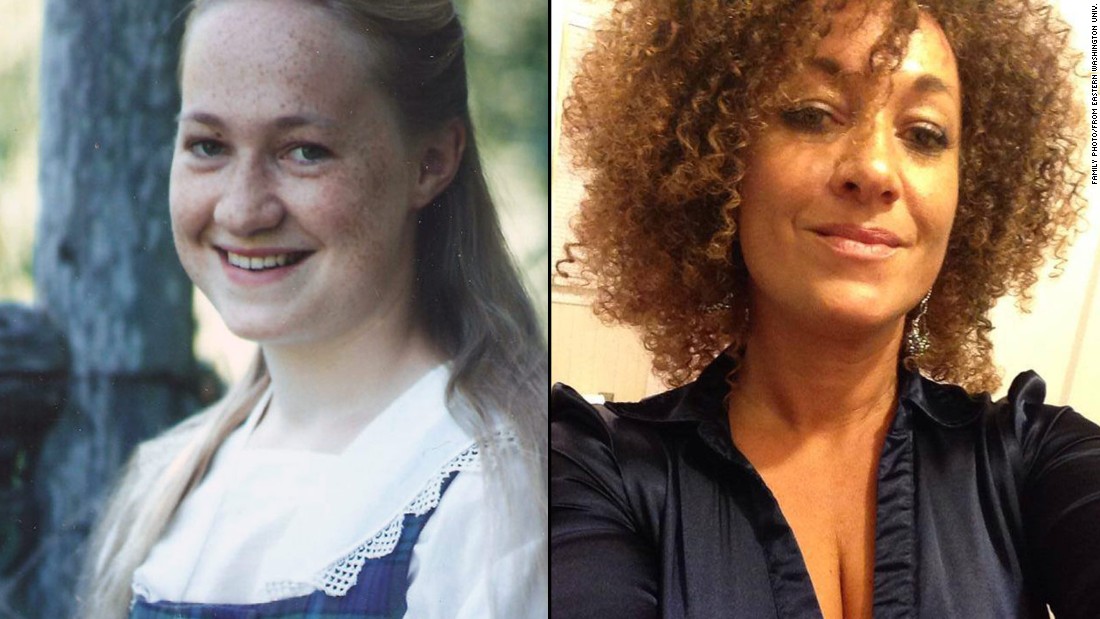
Dolezal as a white and black woman. Retrieved from CNN.
Let's start with the facts (or as close as we can get). Dolezal's parents are Caucasian and her heritage is made up of German, Swedish, and Czech ancestry. She went to Howard University and then got a job in Africana Studies at Eastern Washington University and became a chapter leader in the NAACP in Spokane, Washington. This is a relatively uninteresting history, even for a white person. There are no rules about who is allowed to teach what type of courses and many white people have been prominent actors in the NAACP. White women have taught courses about black women and men have taught feminist theory classes. Academic knowledge about these subjects is not exclusive. Of course, there are benefits to having professors who can address these perspectives from a particular standpoint, but having allies address these topics is also beneficial.

What, then, is the issue? The issue is that Dolezal, despite being a white woman, a blonde-haired, blue-eyed white woman at that, identifies and presented herself as a black woman. Dolezal's birth race did not jibe with the identity that she wished to portray, so she performed the identity of an African American. Many people believe that race, gender, and sexuality are social constructs - they are performed behaviors and identities that communicate to others who and what we are. Dolezal decided to perform and go through life (at least for those ten years) as an African American.

Prince Koyangi's first Tumblr post with profile picture. Retrieved from this site.
For those who were as confused as I was by this discovery of a potentially "transracial" person, I am going to walk through my thought process on the matter. I am aware this term traditionally refers to transracial adoption, where birth parents are of a different race than their children. The term was first brought to my attention, however, through the excellent work of friend and colleague, Alex Sastre. She discussed the transracial/transethnic Tumblr case of Prince Koyangi. For me, this term linguistically matches a similar, but different phenomenon in transgender people. I do not wish to make this comparison, at least in a fully equal sense, but I do want to explain the difficulties for people, and perhaps especially cisgender white people, to unpack the trans* identity.

One thing that I initially noted was a similarity in language between how news sites and people on Facebook were responding to Dolezal's actions. For me, terms like "impostor," "deceived," "pretended," "misleading," "lied," and others echoed claims that transgender people are somehow lying or deceiving people with impure motivations. One need only recall the disgusting words of Mike Huckabee in response to Caitlyn Jenner's announcement: "Now I wish that someone told me that when I was in high school that I could have felt like a woman when it came time to take showers in PE." These accusations assume that people are deceitful in their gender identity for the purpose of advantage in some way.

People began to talk about Dolezal in this same manner - that posing as black would somehow benefit her in her job prospects and appointment in the NAACP. A poignant note here is, as others have pointed out, that Dolezal potentially took that appointment away from a woman of color. There are other reports that Dolezal faked hate crimes against her to garner sympathy. Certainly, these are negative, consequential, and deceitful actions. But does that mean that transracial people do not exist?


A friend and colleague, Kari Storla, emailed me the above video by a black, trans*female vlogger, Kat Blaque. I appreciated the link and spent a lot of time thinking about Blaque's arguments. For me, I couldn't get past the apparent hypocrisy - Blaque was telling her truth, but was denying the possibility that Dolezal was telling hers. Isn't it really a matter of personal identity that is not something that any of us can determine? How is it Blaque's or any of our responsibilities to tell Dolezal that she is in fact lying and we are the ones with truth? When Dolezal says, that she "identifies" as a black woman, why do we not take her at her word? Many trans*people discover their identities later in life and some may never transition in an aesthetically explicit way for many reasons such as safety, finances, or personal choice. Dolezal certainly identified as white when she sued Howard for racial discrimination, but perhaps she discovered her identity later in life?

Any way I sliced it, I couldn't see a tangible difference between transgender and transracial individuals, despite a gut instinct that they were different. There are many times when my personal opinion towards something (that Dolezal is crazy and this can't possibly be a thing) is offset by my intellectual musings. There must be a reason to my nagging doubts, right? A small epiphany occurred during a conversation with my partner. We discussed the idea of privilege and how men transition into women and Dolezal transitioned into a black woman. We discussed ideas of passing and that some people can transition into the other gender more easily than others, can "pass" as something they are not. We discussed how I am a Caucasian woman and would never be mistaken for something else, despite having African ancestry. We discussed how people like Barack Obama, Tiger Woods, and even Stuart Hall, will never be anything but black men.

Cartoon explanation of white privilege. Retrieved from this site.
That's when it clicked - transgender people reflect a spectrum of identities. Trans*people identity as male-to-female, female-to-male, gender fluid, agender, and many other evolving labels. But, the idea of transracial-ness is distinctively a privilege of whites. Whites can "put on" and appropriate the culture of other races, and have for centuries. They are able to do this, as Richard Dyer notes, because they are the center, the normal, the non-race. If a black woman adopts a white hairstyle and bleaches her skin, she will never be anything but a black woman. But, if a white woman adopts a black hairstyle and a tan, she can be (and was) perceived as black. This lack of equality, of cross-racial mobility, solidified my opinion. Dolezal is not transracial, she is not a black woman, but a white woman who has appropriated black culture for personal reasons. There is no trans*ness about being transracial, because the privilege is reserved for those able to adopt the races of others - whites. I am still musing about this topic, but thinking through Dolezal's story has enlightened me about the different ways that white privilege functions in today's society.

This post certainly ignores other complicated aspects of this story such as historical racism, biological determinants of race, and blackface. Those are all important points as well that I do not mean to undermine. They did not, however, play a role in clarifying for me why the Dolezal story is so disturbing and yet simultaneously worthy of philosophical discussion. This story will probably engage more people as more facts are learned and I hope that it culminates in more important conversations about race and its tangible effects on life and society. It also brings attention to the unending struggle between the mind and body and the danger of not conforming with society's expectations.

Sunday, August 31, 2014

Race and Class in The Purge: Anarchy

I've already addressed my opinions on the societal shun of horror films. I think that horror films are much more inventive and experimental than traditional genre films and I wish more of my peers appreciated their subtle depth and creativity. This post is specifically about the second installment of The Purge, which I highly encourage everyone watch. Unlike the original, The Purge: Anarchy is a slick thriller with a moral message about class, race, and oppression. I will briefly discuss the horror aesthetics in this film (and its original) before discussing this interconnected themes of hierarchy and exploitation. The cultural scholar and common person alike would greatly benefit from exploring these themes on the silver screen (even with a bit of gore). It may not need saying, but this post will contain spoilers of both films.

The Purger: Anarchy Trailer. Retrieved from YouTube.

The first film was typical of its genre. There were cliche pop-out-from-behind-a-corner fake scares, misdirection, and a dearth of larger meaning than the human urge to kill. The film centered around the near future where a government has issued a 24-hour lift of all laws allowing society to "purge" through murder, robbery, etc. This results in a lower crime rate through the rest of the year and a boon in sales of home defense systems. The first film followed a family that had a break-in in their home after the young son tried to save a man being hunted in their neighborhood. This film was simply okay, an interesting idea poorly executed and mostly abandoned for the cheap and easy scares. I almost didn't go see the second film because of my disappointment in the first. I'm very glad that I didn't miss it.

Retrieved from this site.
The Purge: Anarchy focuses on the streets that are ravaged by roaming bands of vigilantes and the mysterious presence of military and government forces patrolling the streets. A Malcolm X type figure (Carmelo) becomes a prominent character who preaches that the purge is a government tactic to eradicate the poor (and subsequently, minorities) in order to keep the crime rate down during the year. We find out during the film that the government is targeting low income neighborhoods, kidnapping people, and performing genocides of the lower classes. One black woman and her daughter are saved from this government kidnapping by a (white) purger looking for revenge on the man who killed his son in a car accident.

Retrieved from this site.
Two scenes stand out for me as particularly shocking and expressive. The father of the woman saved from government forces disappears early in the film. The daughter and granddaughter find out that he has sold himself to a rich white family for $100,000 to allow them to purge in the safety of their home. The white family has literally bought a poor, black body as if it were property, to ruthlessly destroy and exploit it without exposing themselves to the risks of the purge. There is a poignant frame where the nuclear family is standing around the father wielding weapons in their pristine suits and plastic-wrapped living room of expensive art. Their massacre of this man will be their new art, their secret expression of white privilege that protects their valuables, status, and domination over the lower class.

Auctioneer before the hunt. Retrieved from this site.
The second powerful scene is shown briefly at the end of the trailer where a woman in a blue dress announces before a seated group of people in fancy dress that they have collected the last purge of the evening. The main characters are released into a pitch black maze where the highest bidders enter with night vision goggles and weapons to hunt them down. There are obvious echoes here about the purchasing of bodies as in the previous scene, but it also echoes themes from Richard Connell's "The Most Dangerous Game." This short story is about a stranded man looking for protection who ends up being hunted down for sport like an animal in a rich man's safari game. Humans being the most cunning (and thus perhaps most satisfying to kill) animal provides an elevated type of sport than the traditional hunt. Indeed, the highest bidders in The Purge: Anarchy wear traditional British fox hunting uniforms as if they were out in a normal hunting activity and not viciously murdering other people. In a quite satisfying ending, I will simply mention that the group manages to get a hold of one of the night vision goggles and weapons, making the hunt more of a fair fight.

Both of these scenes highlight for me the interrelationship between class and race and the exploitative powers of a system that only reifies the lasting order and undervalues the lives of poor and minority bodies. In this film, both the rich and the government specifically target and kill blacks, the homeless, deviants, and youth in an attempt to eradicate and "purge" the society of perceived evils. This movie asks us all to reflect on who is in power, what oppressive acts are they committing, and who does society really serve. Both the murderers and the white families who can afford to lock up and hide are complicit in the exploitation and eradication of people deemed unworthy of life. Just as a police officer in Ferguson made a decision of life and death for Michael Brown, The Purge: Anarchy asks us to consider who is in control and what those consequences are. Who gets to define who is worthy of life? Who gets to define how punishment is laid out? Who is in control of our streets, our livelihoods, our identities as targets or as civilians?

Carmelo, leader of the anti-purge movement. Retrieved from this site.
Carmelo is trying to start a revolt against this system. He targets the rich, white, and off-limits bodies to upend the genocide of the poor and the minorities. His tactics are in part successful, at least in saving the lives of the main characters, but his ultimate goal is left unfulfilled. Will it take violent revolution to change the system? Can violence itself do anything but reify the use of violence as a peace-keeping tactic? If anything can be learned in the current state of Ferguson, it is that the tensions between authority, race, and class run deep, and define for entire groups of people their ability to claim a place on this earth free from fear and death. That is unacceptable and violates the very basics of human rights. The Purge: Anarchy brings these themes to life in an exaggerated thriller that asks us to ponder our own situation: how far off are we from this being our reality?

Sunday, June 22, 2014

Donald Sterling as a Modern Day Earl Butz

It is impossible to ignore all of the online and offline discussion of the owner of the LA Clippers, Donald Sterling's racist remarks. He noted in a private conversation to his girlfriend that he didn't want her "associating with black people," and specifically bringing them to basketball games. The hypocrisy in Sterling becoming rich off of the labor of black bodies has been addressed better elsewhere, so I wish to address another important part of this discussion: the apologia. Using Kenneth Burke's guilt-redemption cycle, this post will discuss the similarities of Sterling's remarks to the racist statements of Earl Butz, and how these statements implicate the larger American public in the persistence of racism.

Donald Sterling and the Clippers's logo
Earl Butz was Secretary of Agriculture in 1976 who eventually resigned his position after racist comments emerged. This site has the full timeline of the events including the offensive joke. A scholarly article was written about that event by Dr. James Klumpp and Dr. Thomas A. Hollihan called "Debunking the Resignation of Earl Butz: Sacrificing an Official Racist." The title reveals some important terms and information that will inform this comparison between Butz and Sterling. I will also highlight some important differences that reveal modern racial tensions. Butz was "sacrificed" as Klumpp and Hollihan say, as a part of Burke's guilt-redemption cycle. This cycle describes how pollution, or some type of disorder, is introduced into an order, which creates guilt and a subsequent need for purification, purging, and redemption.

Earl Butz, retrieved from this site
For Butz and Sterling, the pollution was their racist statements that shattered the values of equality inherent in their respective social and political orders (government and sports). Both of these institutions are supposed to value equality, all Americans, and their constituents. As public figures, their voices can be seen as stand-ins for the groups that they represent. Butz was "sacrificed" by the Republican Party, who wished to separate their public appearance from racism. The NBA also separated itself from Sterling by banning him from the organization, fining him $2.5 million, and urging him to sell the team. The sacrifice can come in many forms, but it must make the punishment commensurate to the crime committed. Considering that the pollution for each was the potential crumbling of national organizations, the punishments were made quite prominent, public, and severe.
Some prominent reactions to Sterling's statements
Another important similarity between the two are the separation between public and private. Klumpp and Hollihan address this dichotomy by nothing that officials are sometimes seen as not have the right to privacy: anything said even in private could destroy a public persona, one's reputation, and career. Some were quick to jump to Sterling's defense such as columnists at Fox who pointed to the "thoughts" of Sterling as harmless and a personal right. Some articles went as far as to implicate the girlfriend (who recorded the conversation) as the real criminal. In the aftermath of the announcement, Mark Cuban echoed the words of a Fox News reporter about whether convicting people for statements in private could be a "slippery slope" to the thought-police.

Though some of these concerns were raised, there has been overwhelming support for Sterling's punishment. One might say that it was a "success" in some ways in that an athletic profiteer who undermined his own team and the values of the NBA (and perhaps, the country) would be receiving a just punishment. However, Klumpp and Hollihan raise a point of contention with these types of guilt-redemption activities. They note that by creating a sacrificial goat out of Butz and Sterling, we as a nation do not have to address underlying and persistent racism that we may all (or at least most of us) be guilty of. Instead, we can claim that wrongs have been righted and that racism is an individual issue that does not have to be addressed on a societal level. They note that these overt punishments of racism create a culture that "tolerates private racism and its consequences” (p. 11). Jon Stewart adeptly addresses the issue of post-racial society in his critique of Sterling and the recent SCOTUS decision to uphold Michigan's ban on affirmative action.

Retrieved from the Daily Show

What is to be learned by the Donald Sterling incident? One thing is perhaps most important: racism still exists. There is no magical, post-racial world because we have a black president. People haven't stopped being murdered because of their race, people haven't stopped trying to make relevant the KKK, and people still use the n-word. This is only the tip of the iceberg, however, as racism against other minorities, especially immigrant populations, is also a common American theme. Is this what America is all about? We need to take examples like Butz and Sterling and open our eyes to the underlying problems from which these individuals stem. Structural racism is happening and continues to happen; we cannot remain blind to it and only care when individuals break norms of keeping racism a private endeavor. All racism needs to be addressed, and we have a lot of work to do.

Sunday, February 9, 2014

USC Fence and Visibility Politics

Retrieved from Change.org
Responding to security concerns regarding an on-campus shooting in the fall of 2012, the University of Southern California (USC) built a chain-link fence around its campus for the start of the 2013 spring semester. The main section of USC’s University Park Campus was enclosed and ushered in with it new security protocols. Previously, the campus was a free space to walk through at any time of day. Now, anyone wishing to enter campus must negotiate the new openings around the fence. USC affiliates and visitors alike are subject to the gaze of security guards who check identification at specified gate entrances after 9pm. In spite of USC’s presence that extends outside of the main campus area, community members and non-USC affiliates are restricted from accessing campus spaces. The previously unfettered access of the community to campus spaces has been replaced by prominent visual and physical barrier to movement and agency.

The fence has been justified as a security measure to protect students on campus during certain hours. USC does have a primary importance in protecting its students, but choosing to isolate community members because of a few representatives influences the entire community. The consequence of such a symbolic action is to conflate a few violent individuals with the community and to reinforce narratives that off-campus spaces are not safe. This physical division operates as a linguistic turn from the USC community to USC vs. the community. This “us vs. them” mentality occurs through labeling the community as separate from USC affiliates. Carrying a USC ID card provides one access; without it, bodies are turned away and disciplined from entering. In creating this distinction, the community is labeled as violent, criminals, trespassers, unwelcome, and the other. “These names shape our relations with our fellows. They prepare us for some functions and against others, for or against the persons representing these functions. The names go further: they suggest how you shall be for or against” (Burke, 1984, p. 4). The fence helps establish hierarchies in naming that teach USC affiliates how to respond to and treat community members. These rules only operate between 9pm and 6am, but the labels last longer. Symbolic naming reconstructs the relationship between the community and USC that cannot be changed by the hour of the day.           
Foucault's Panopticon as surveillance
In restricting the movement of the body, USC also controls when those bodies can be seen, have a presence, and occupy certain spaces. Control over the body, or biopower and biopolitics, is a power over the movement of the body, its ability to be seen, and to be heard (Foucault, 1982; Hollinshead, 1999). Casper and Moore (2009) refer to “hysterical blindness” where institutions or people either choose not to or are somehow restricted from seeing or being seen (p. 10). “Hypervisuality” is this opposite, where people are targeted, heavily observed, and monitored (Casper & Moore, 2009, p. 10). This “complex system” of sight and obstruction means that powerful political entities can control who can see and who is seen (Casper & Moore, 2009, p. 10). At USC, bodies of students become marked, by carrying a marked ID, and those of community members unmarked as the “other,” not welcome within campus spaces (Phelan, 2004). Visitors to campus can apply for single-entry access for a specific purpose, creating a temporary mark of approval and access by institutions of power. The body receives either acceptance or denial at the fence border based on its membership in the Trojan Family. As Greg Dickinson (2002) notes, “the subject comes to known itself in some more or less coherent way depends on an ability to locate itself” (p. 7). Locating oneself either inside or outside of the campus borders changes how one defines membership, identity, and body autonomy. Knowledge of surveillance by guards also contributes to one’s ability to locate oneself within the political power structure as a target or threat worth monitoring.

There are concerns that these policies endanger community members while offering little extra protection for USC. Vice President of Student Affairs Michael Jackson published an updated campus policy online that said, “We are taking these steps because we care about the security and safety of our students, faculty, staff, guests and neighbors” (para. 4). It is an interesting rhetorical decision to separate “guests” of USC from its “neighbors,” but certainly these are fluctuating categories. The real importance in this statement is that somehow the construction of the fence will not only add protection for USC affiliates but also to the community members. To the contrary, the Los Angeles Times reported on January 13th, 2013, that blocking the USC campus off from non-students, faculty, and staff poses a risk to community members. For example, community members exiting the Exposition/USC stop on the new Metro Expo line used to be able to walk through “the safe, well-lit shortcut through campus” to catch buses at prominent Jefferson Boulevard stops (Jennings & Xia, 2013, para. 9). Now, community members have to circle the entire USC campus or change their regularly traveled public transportation routes home. The construction of the fence not only places the community under additional surveillance, but it also directly influences the movements of the community, with yet unseen benefits for USC. A Daily Trojan letter to the editor echoed these concerns noting that “as a university we should not sacrifice freedom of movement for relatively little or no added security” (Brown, 2013, para. 4).

Though erected and implemented for supposed safety and benefit, borders oftentimes exacerbate economic, class, and racial divides by establishing rhetorical divisions in identity and membership. How bodies are restricted in their movement, displaced, or undervalued also restricts voice and visibility in terms of the powerful and the powerless. Surveillance, monitoring, and the construction of boundaries are all ways that bodies are disciplined and controlled. These barriers to full cooperation and integration, both physical and symbolic, construct an environment where identity is defined through one’s relationship with institutions of power. USC’s fence highlights the modern implications of race, borders, and visibility, where hierarchies still enact biopower and violate political autonomy. 
Retrieved from Mutual Responsibility
A Change.org petition has been started to “Take down the USC gates.” This petition notes the importance of welcoming, opening spaces, and condemn the “us vs them” mentality that the fence represents. The petition includes a space for comments and a letter addressed to USC President Max Nikias and the Provost Elizabeth Garrett. The petition is nearing the 500 signatures needed to be sent to Nikias and Garrett. The power of such a petition may be limited in terms of practical changes, but the petition is itself symbolic that the USC community is in part against the policy instituted by the administration. A lack of student support and involvement, however, many indicate that many are already accustomed to the surveillance and limitations that it imposes. Some may be optimistic about the future of surveillance, but it appears that great action and effort to shift notions of visibility are needed to reclaim privacy and personal autonomy.

References
Brown, N. (2013, January 22). In response to security measures. Daily Trojan. Retrieved from http://dailytrojan.com/2013/01/22/letter-to-the-editor-75/
Burke, K. (1984). Attitudes toward history. Berkeley, CA: University of California Press.
Casper, M. J., & Moore, L. J. (2009). Missing bodies: The politics of visibility. New York, NY: New York University Press.
Dickinson, G. (2002). Joe’s rhetoric: Finding authenticity at Starbucks. Rhetoric Society Quarterly, 32(4), 5–27. doi:10.1080/02773940209391238
Foucault, M. (1982). The subject and power. Critical inquiry, 8(4), 777–795.
Foucault, M. (2012). The history of sexuality: An introduction. New York, NY: Random House Digital, Inc.
Hollinshead, K. (1999). Surveillance of the worlds of tourism: Foucault and the eye-of-power. Tourism Management, 20(1), 7–23. doi:10.1016/S0261-5177(98)00090-9
Jennings, A., & Xia, R. (2013, January 15). USC rolls out the unwelcome mat. Los Angeles Times. Retrieved from http://articles.latimes.com/2013/jan/15/local/la-me-usc-safety-20130116
Phelan, P. (2004). Unmarked: The politics of performance. New York, NY: Routledge.

Wednesday, January 16, 2013

Post-Racial Society and Django Unchained

First, the title is a bit of a misnomer, as I believe there is no such thing as a post-racial society, a society "behind" or "after" race. It is merely used as a foil to the representation of slavery in Tarantino's Django Unchained and as an entry point into this inquiry into modern race relations and more specifically, the changing role of race in American society, culture, and politics. Here I will insert a fairly large disclaimer that I am not the person who can/should/ought to be writing about this topic, but I am attempting to broaden my rhetorical and scholarly horizons that have been opened to me by colleagues whom I deeply respect. This is an initial attempt to incorporate these discussions into my scholarly purview.

Photo from Wikipedia of the 1,000,000 Hoodie March in honor of Trayvon Marting
Walkers wore hoodies and carried Skittles representing Trayvon's outfit/pocket contents when killed
Considering the long, complicated history of race in America, it is naive to think that a simple presidential election could replace, mitigate, or somehow atone for the past. Stories that make headline news about the disenfranchisement of minorities in elections, Arizona's SB1070, and the murder of Trayvon Martin should reiterate that racial hierarchies and prejudice are still alive and well in America.

Though not "healed" fully in any way, Django Unchained has emerged as a cinematic reminder of how far we have come from the days of slavery some 200 years ago. Though there is little evidence of Mandingo fighting, the classic Tarantino emphasis on gore was a startling reminder of the gruesome way that slaves were treated. The whippings, dog attacks, punishments, and exploitation of "comfort slaves" serve as stark visual counterparts to the often diluted textbook descriptions. Though audiences have positively responded to Django, notable critic of Tarantino's works, Spike Lee, made a strong statement for not watching the film as blaxploitative and racist. I have already read further into this divide in an article by Sean Tierney called "Quentin Tarantino in Black and White" in the book Critical Rhetorics of Race. To summarize the argument with undeserved brevity, Tierney seeks to explain the negative opinions of Spike Lee towards Tarantino. Primarily, interviews with Tarantino and citing directly from his films show that Tarantino's co-opting of black culture is both offensive and hegemonic. Tarantino profits from black culture without acknowledging the hierarchy that allows him to do so without retribution or without the reverse being possible. Tierney (published before Django Unchained) also mentioned critics' aversion to the overuse of the n-word in Tarantino films. He mentions that the word is often removed from its political context and becomes what the re-appropriation was meant to avoid: having whites use the term and blacks use the term without respect to its political meaning. Though Django is set in times of slavery, the word is used over 100 times during the film, often times for laughs, quote Samuel Jackson, "It that a nigger on a horse?"
Django Movie Poster
I will admit that as a film, I enjoyed Django, but I find myself wondering, if it should have angered me. Over the winter break, I heard a story from my Mom who heard it from my recently passed Great Auntie Phil. She told me about her ancestors, my Great Auntie Phil and her brother, my Grandfather, and their family, who were brought from Africa to Jamaica as slaves. In Africa, the tribe my family belonged to differentiated wealth with bracelets made from various quality material. My Mom told me about the bracelet that she saw passed down to the youngest of the Harry's, my new baby cousin, a finely threaded bracelet of silver, a sign of wealth. I felt a pang of guilt, thinking of the unity of my family that represents a joining of white and black, free and slave, past and present, and what role I, as a blonde, blue-eyed white female, play in that narrative. I do not look in any way like my Jamaican and thus African ancestry, but like my 100% English father, a country that perpetrated much violence and conquered half of the world under the cover of imperialism, progress, and hegemony. Should movies like Django offend me in honor of my family history? The simple answer is that they cannot offend me in the same way they might have offended my Grandfather. Despite the history in my blood, I have not had, could never have, nor could ever imagine a life unlike the privileged one I currently have. Understanding that in and of itself has been a life-changing realization. The truth is that I did sit in the movie theater, ponder the recent readings on racial rhetoric, but at the end of the day, simply enjoyed the film as a Tarantino epic, an Inglorious Basterds of the Civil War era.

Political Cartoon retrieved online: thoughtful representation of race dynamics
I don't know what movies like Django Unchained offer to race relations in America. I would assume that these films complicate the relationship by glorifying a by-gone era and reinforcing that the changes from then to now is somehow sufficient or substantial. Spike Lee has said that he will not see the film, but I wish that he would. I would much appreciate a more critical and knowledgeable lens on the details of the film. I've merely laid brushstrokes over the existence of the film and its director. A more in-depth look into the film would be quite enlightening.

Award update: Quite a noticeable pan of Jamie Foxx's performance but great praise for Tarantino, DiCaprio, and Waltz this award season. At the Golden Globes, Django was up for best picture, Tarantino for best director and best screenplay (winner), Waltz and DiCaprio were up for best supporting actor (Waltz won), yet Foxx was not nominated. Again, the Oscars has Django nominated for best screenplay and best picture, with Waltz gaining the only actor win.