I recently saw a pre-screening of M. Night Shyamalan's "The Visit" at USC. I was excited to see the film because the trailer looked creepy and, as others have noted, this was potentially a epic comeback for the director. I am a fan of horror movies, so even without the hype, I probably would have gone to see it. I have to say that while it is better than many of Shyamalan's movies, I was very disappointed with the film. I am not going to "spoil" the cliché Shyamalan twist, but address the three main problems I had with the film. First, I will address my small concerns about the flow of the movie and its stylistic choices. I also was concerned by its attempts to corner the "comedy horror" genre through racial appropriation. Finally, I find problematic the use of disability as the catalyst for shock moments. Although there are no spoilers, I will discuss some scenes of the film in detail.
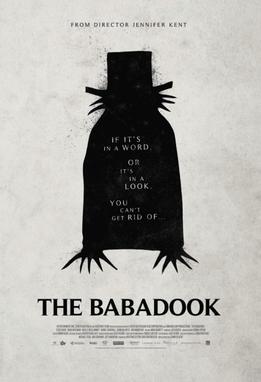
The appeal of the first-person, found footage horror films has waned for me. Original uses, such as the Blair Witch Project, were pioneers in filmmaking style. Other films made great use of the medium, such as the V/H/S series. I also found that this style worked for the gritty and entertaining As Above So Below. For most movies, however, I feel that the found footage genre reduces the thrills that it tries to engage. The camera angles and the following of the drama is completely limited by one of the characters moving it or its placement in a fixed position. Thus, the camera is either a static frame or is missing a character. Because the camera reacts with the character, frightening sequences are often cut short. In The Visit, the two children often interrupt or come across their grandma in various aggressive or startling actions. The audience, however, gets barely a glimpse before the main characters run away in fear. What could be longer, thrilling scenes turn into brief "shock" moments where the music amps up and something flashes before the screen. This type of horror tricks seems quite overplayed, where there are far more intriguing moments of horror in present day films. I hope to discuss It Follows more in an upcoming post, but I will note briefly here that it makes fabulous use of every day activities and long scenes where there is immense building of terror and suspense. Another great contemporary example is The Babadook, where the female protagonist bravely encounters the ghoul in her home in long, terrifying battle, instead of a brief flash in a window or doorway.
Now that I've indulged my pure opinions on the horror genre, I will now engage more theoretically motivated concerns. While I did find The Visit funny (Katy Perry!), the humor was mostly nested in appropriating black culture and the juxtaposition between freestyle culture and a young, white boy. The younger brother in the film, Tyler, adopts the style, mannerisms, and attitude of black culture for the purpose of comedic relief. Comedy and horror often go together. For example, the iconic Evil Dead series could seamlessly make you laugh while you were terrified and a bit uneasy. This is epitomized in the Evil Dead 2 (my favorite of the series) scene in which the items in the cabin start laughing along with Ash - frightening and yet you cannot help but laugh along. Another one of my favorite horror films, Cabin in the Woods, makes you pause for reflecting at our own fascination with horror. The office party scene epitomizes the movie's brilliant satire work (and its opening is delightfully Funny Games-esque). Instead, the comedy in The Visit is pure relief, with no purpose behind it but to distract from what we just saw (brief as it already was) or poke fun at the disabled grandparents. I will discuss more about the grandparents later, but first I want to further discuss Tyler's character.
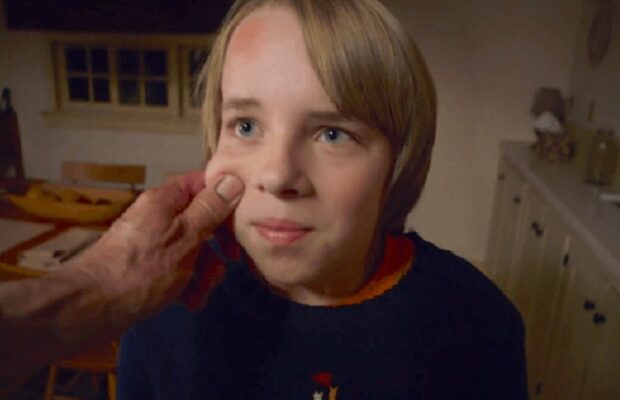
Image of Tyler in The Visit. Retrieved from this site.
The character is quite sweet and has his vulnerable moments where he seeks his sister's comfort. More often than not, Tyler draws his strength through his impersonation of black culture. As The Wrap's review noted, scenes where Tyler raps about women and sex are "burp[s] of coarse comedy." They seem out of place and forced, as if the only thing funny about the situation is that a young white boy might imitate gangster culture. This imitation, however, appropriates a different culture and undermines its history and purpose. The scene where Tyler raps on the train next to a black men, who is a worker on the train, is truly cringe-worthy. Kenneth Burke called this "perspective by incongruity" - where a word is applied in a completely new context and given a new meaning. What was once a unique part of black culture is now applied in a different context - a juxtaposition that creates humor. The humor is crude and appropriates black culture and further distracts from what could have been intriguing horror scenes.
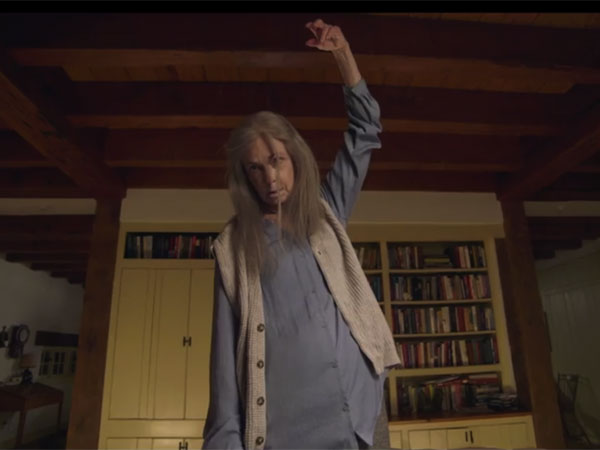
Terror - supposedly, from a scene in The Visit. Retrieved from this site.
More central to the plot of the film is the mental and physical condition of the grandparents. The mother, who they Skype with, frequently brush off erratic behavior as "old people problems" and nothing out of the ordinary. Incontinence, memory loss, confusion, and generally odd behaviors are boiled down to "normal" plights of the elderly. Natural, elderly bodies become a source of scorn and disgust because of there differing abilities. In one scene, Tyler follows his grandfather to a hut, where Tyler thinks he is hiding "secrets." To recall the horror of "what's in the box?" among this reveal is truly embarrassing. The hut does not contain dismembered bodies, secret writings, or clues to a great family mystery. Instead, it contains the grandfather's incontinent diapers. The thrilling sequence of entering the space and watching for the grandfather's return is let down by the "big reveal." At points, I felt quite bad for the grandparents, who were constantly pestered by the granddaughter, Rebecca's, video camera. In an interview with the grandmother, Rebecca repeatedly asked her what happened on the day Rebecca's mother left the house. The grandmother responded many times with sadness, confusion, and aggressive outbursts; this event had obviously caused her great stress and trauma. I felt pity where Shyamalan wanted me to be frightened. But, I wasn't. I wasn't frightened by the effects of aging and sometimes erratic confusion caused by people who may have Alzheimer's or another disorder.
The "evil" in the film is simply that: being old. There is no evil spirit, motivated killer, or other source of evil besides the mentally and physically disabled. And that is a horror trope I simply cannot support: that the elderly and differently-abled are a source of evil and horror. Shyamalan sets up the elderly as the "other"; the ones against which the main characters (and thus the audience) contrasts our identity. But, one day, we may all experience these same problems and I hope that we are met with comfort and appreciation instead of fear and isolation. For those who have seen the movie, I am aware that there is more going on than simple aging. Despite this fact, I believe that this film constructs a rhetorical framework that isolates the elderly and reifies ability as normal.
I meant to publish this post on Sunday, but I couldn't even remotely wrap my head around the twists and turns in the Rachel Dolezal story to make a coherent blog post. With the extra time to think, this may come closer. As a white, cisgender, able-bodied, heterosexual woman - I know that I fall victim to the same privileges of Dolezal and many people commenting on this story. I hope that my voice comes across as an ally and curious academic instead of offensive.
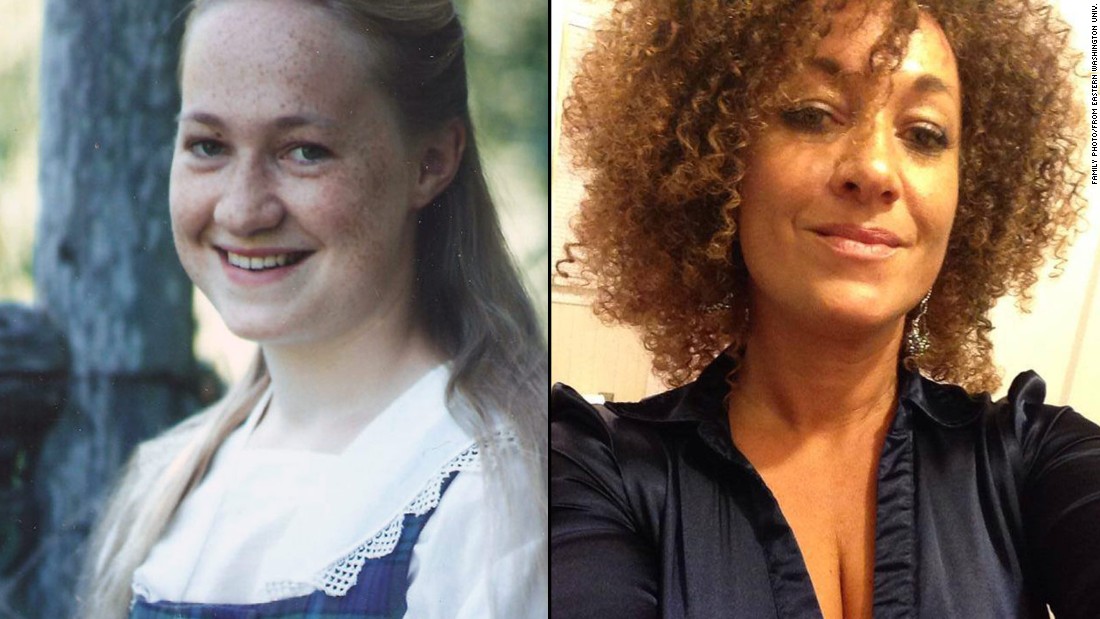
Dolezal as a white and black woman. Retrieved from CNN.
Let's start with the facts (or as close as we can get). Dolezal's parents are Caucasian and her heritage is made up of German, Swedish, and Czech ancestry. She went to Howard University and then got a job in Africana Studies at Eastern Washington University and became a chapter leader in the NAACP in Spokane, Washington. This is a relatively uninteresting history, even for a white person. There are no rules about who is allowed to teach what type of courses and many white people have been prominent actors in the NAACP. White women have taught courses about black women and men have taught feminist theory classes. Academic knowledge about these subjects is not exclusive. Of course, there are benefits to having professors who can address these perspectives from a particular standpoint, but having allies address these topics is also beneficial.
What, then, is the issue? The issue is that Dolezal, despite being a white woman, a blonde-haired, blue-eyed white woman at that, identifies and presented herself as a black woman. Dolezal's birth race did not jibe with the identity that she wished to portray, so she performed the identity of an African American. Many people believe that race, gender, and sexuality are social constructs - they are performed behaviors and identities that communicate to others who and what we are. Dolezal decided to perform and go through life (at least for those ten years) as an African American.
Prince Koyangi's first Tumblr post with profile picture. Retrieved from this site.
For those who were as confused as I was by this discovery of a potentially "transracial" person, I am going to walk through my thought process on the matter. I am aware this term traditionally refers to transracial adoption, where birth parents are of a different race than their children. The term was first brought to my attention, however, through the excellent work of friend and colleague, Alex Sastre. She discussed the transracial/transethnic Tumblr case of Prince Koyangi. For me, this term linguistically matches a similar, but different phenomenon in transgender people. I do not wish to make this comparison, at least in a fully equal sense, but I do want to explain the difficulties for people, and perhaps especially cisgender white people, to unpack the trans* identity.
One thing that I initially noted was a similarity in language between how news sites and people on Facebook were responding to Dolezal's actions. For me, terms like "impostor," "deceived," "pretended," "misleading," "lied," and others echoed claims that transgender people are somehow lying or deceiving people with impure motivations. One need only recall the disgusting words of Mike Huckabee in response to Caitlyn Jenner's announcement: "Now I wish that someone told me that when I was in high school that I could have felt like a woman when it came time to take showers in PE." These accusations assume that people are deceitful in their gender identity for the purpose of advantage in some way. People began to talk about Dolezal in this same manner - that posing as black would somehow benefit her in her job prospects and appointment in the NAACP. A poignant note here is, as others have pointed out, that Dolezal potentially took that appointment away from a woman of color. There are other reports that Dolezal faked hate crimes against her to garner sympathy. Certainly, these are negative, consequential, and deceitful actions. But does that mean that transracial people do not exist?
A friend and colleague, Kari Storla, emailed me the above video by a black, trans*female vlogger, Kat Blaque. I appreciated the link and spent a lot of time thinking about Blaque's arguments. For me, I couldn't get past the apparent hypocrisy - Blaque was telling her truth, but was denying the possibility that Dolezal was telling hers. Isn't it really a matter of personal identity that is not something that any of us can determine? How is it Blaque's or any of our responsibilities to tell Dolezal that she is in fact lying and we are the ones with truth? When Dolezal says, that she "identifies" as a black woman, why do we not take her at her word? Many trans*people discover their identities later in life and some may never transition in an aesthetically explicit way for many reasons such as safety, finances, or personal choice. Dolezal certainly identified as white when she sued Howard for racial discrimination, but perhaps she discovered her identity later in life? Any way I sliced it, I couldn't see a tangible difference between transgender and transracial individuals, despite a gut instinct that they were different. There are many times when my personal opinion towards something (that Dolezal is crazy and this can't possibly be a thing) is offset by my intellectual musings. There must be a reason to my nagging doubts, right? A small epiphany occurred during a conversation with my partner. We discussed the idea of privilege and how men transition into women and Dolezal transitioned into a black woman. We discussed ideas of passing and that some people can transition into the other gender more easily than others, can "pass" as something they are not. We discussed how I am a Caucasian woman and would never be mistaken for something else, despite having African ancestry. We discussed how people like Barack Obama, Tiger Woods, and even Stuart Hall, will never be anything but black men.
Cartoon explanation of white privilege. Retrieved from this site.
That's when it clicked - transgender people reflect a spectrum of identities. Trans*people identity as male-to-female, female-to-male, gender fluid, agender, and many other evolving labels. But, the idea of transracial-ness is distinctively a privilege of whites. Whites can "put on" and appropriate the culture of other races, and have for centuries. They are able to do this, as Richard Dyer notes, because they are the center, the normal, the non-race. If a black woman adopts a white hairstyle and bleaches her skin, she will never be anything but a black woman. But, if a white woman adopts a black hairstyle and a tan, she can be (and was) perceived as black. This lack of equality, of cross-racial mobility, solidified my opinion. Dolezal is not transracial, she is not a black woman, but a white woman who has appropriated black culture for personal reasons. There is no trans*ness about being transracial, because the privilege is reserved for those able to adopt the races of others - whites. I am still musing about this topic, but thinking through Dolezal's story has enlightened me about the different ways that white privilege functions in today's society. This post certainly ignores other complicated aspects of this story such as historical racism, biological determinants of race, and blackface. Those are all important points as well that I do not mean to undermine. They did not, however, play a role in clarifying for me why the Dolezal story is so disturbing and yet simultaneously worthy of philosophical discussion. This story will probably engage more people as more facts are learned and I hope that it culminates in more important conversations about race and its tangible effects on life and society. It also brings attention to the unending struggle between the mind and body and the danger of not conforming with society's expectations.