Showing posts with label Apocalypse. Show all posts

Sunday, August 31, 2014

Race and Class in The Purge: Anarchy

I've already addressed my opinions on the societal shun of horror films. I think that horror films are much more inventive and experimental than traditional genre films and I wish more of my peers appreciated their subtle depth and creativity. This post is specifically about the second installment of The Purge, which I highly encourage everyone watch. Unlike the original, The Purge: Anarchy is a slick thriller with a moral message about class, race, and oppression. I will briefly discuss the horror aesthetics in this film (and its original) before discussing this interconnected themes of hierarchy and exploitation. The cultural scholar and common person alike would greatly benefit from exploring these themes on the silver screen (even with a bit of gore). It may not need saying, but this post will contain spoilers of both films.

The Purger: Anarchy Trailer. Retrieved from YouTube.

The first film was typical of its genre. There were cliche pop-out-from-behind-a-corner fake scares, misdirection, and a dearth of larger meaning than the human urge to kill. The film centered around the near future where a government has issued a 24-hour lift of all laws allowing society to "purge" through murder, robbery, etc. This results in a lower crime rate through the rest of the year and a boon in sales of home defense systems. The first film followed a family that had a break-in in their home after the young son tried to save a man being hunted in their neighborhood. This film was simply okay, an interesting idea poorly executed and mostly abandoned for the cheap and easy scares. I almost didn't go see the second film because of my disappointment in the first. I'm very glad that I didn't miss it.

Retrieved from this site.
The Purge: Anarchy focuses on the streets that are ravaged by roaming bands of vigilantes and the mysterious presence of military and government forces patrolling the streets. A Malcolm X type figure (Carmelo) becomes a prominent character who preaches that the purge is a government tactic to eradicate the poor (and subsequently, minorities) in order to keep the crime rate down during the year. We find out during the film that the government is targeting low income neighborhoods, kidnapping people, and performing genocides of the lower classes. One black woman and her daughter are saved from this government kidnapping by a (white) purger looking for revenge on the man who killed his son in a car accident.

Retrieved from this site.
Two scenes stand out for me as particularly shocking and expressive. The father of the woman saved from government forces disappears early in the film. The daughter and granddaughter find out that he has sold himself to a rich white family for $100,000 to allow them to purge in the safety of their home. The white family has literally bought a poor, black body as if it were property, to ruthlessly destroy and exploit it without exposing themselves to the risks of the purge. There is a poignant frame where the nuclear family is standing around the father wielding weapons in their pristine suits and plastic-wrapped living room of expensive art. Their massacre of this man will be their new art, their secret expression of white privilege that protects their valuables, status, and domination over the lower class.

Auctioneer before the hunt. Retrieved from this site.
The second powerful scene is shown briefly at the end of the trailer where a woman in a blue dress announces before a seated group of people in fancy dress that they have collected the last purge of the evening. The main characters are released into a pitch black maze where the highest bidders enter with night vision goggles and weapons to hunt them down. There are obvious echoes here about the purchasing of bodies as in the previous scene, but it also echoes themes from Richard Connell's "The Most Dangerous Game." This short story is about a stranded man looking for protection who ends up being hunted down for sport like an animal in a rich man's safari game. Humans being the most cunning (and thus perhaps most satisfying to kill) animal provides an elevated type of sport than the traditional hunt. Indeed, the highest bidders in The Purge: Anarchy wear traditional British fox hunting uniforms as if they were out in a normal hunting activity and not viciously murdering other people. In a quite satisfying ending, I will simply mention that the group manages to get a hold of one of the night vision goggles and weapons, making the hunt more of a fair fight.

Both of these scenes highlight for me the interrelationship between class and race and the exploitative powers of a system that only reifies the lasting order and undervalues the lives of poor and minority bodies. In this film, both the rich and the government specifically target and kill blacks, the homeless, deviants, and youth in an attempt to eradicate and "purge" the society of perceived evils. This movie asks us all to reflect on who is in power, what oppressive acts are they committing, and who does society really serve. Both the murderers and the white families who can afford to lock up and hide are complicit in the exploitation and eradication of people deemed unworthy of life. Just as a police officer in Ferguson made a decision of life and death for Michael Brown, The Purge: Anarchy asks us to consider who is in control and what those consequences are. Who gets to define who is worthy of life? Who gets to define how punishment is laid out? Who is in control of our streets, our livelihoods, our identities as targets or as civilians?

Carmelo, leader of the anti-purge movement. Retrieved from this site.
Carmelo is trying to start a revolt against this system. He targets the rich, white, and off-limits bodies to upend the genocide of the poor and the minorities. His tactics are in part successful, at least in saving the lives of the main characters, but his ultimate goal is left unfulfilled. Will it take violent revolution to change the system? Can violence itself do anything but reify the use of violence as a peace-keeping tactic? If anything can be learned in the current state of Ferguson, it is that the tensions between authority, race, and class run deep, and define for entire groups of people their ability to claim a place on this earth free from fear and death. That is unacceptable and violates the very basics of human rights. The Purge: Anarchy brings these themes to life in an exaggerated thriller that asks us to ponder our own situation: how far off are we from this being our reality?

Sunday, May 25, 2014

Creation Care Part 4: Where do we go from here?

There have been scholarly discussions over the purpose/value/potential impact that the creation care movement might have. It is tempting to be pessimistic in a political culture that seems to be stuck in the constant polarization between affirmation and denial instead of focusing on efficacy to action. I see some potential in the creation care movement, however. Although the loudest voices we hear are focused on denialism and their detractors who try to debate them, most Americans lie in the middle. I am not concerned with convincing the denialists, but with changing the debate. Creation care could potentially be an avenue to speak the (religious) language of many Americans and people around the globe. The movement shifts the conversation from quibbling over scientific data, undermining science as a field of inquiry, and valuing money over people, to intergenerational arguments about charity, and a deep concern for the poor and nature.

Though I agree that too much optimism will only lead to disappointment, I feel that there are positive steps being taken and creation care messages being presented in the media. Recently, Pope Francis I made a strong statement in support of creation care. This was perhaps his most prominent and widely covered statement directly about the environment. Francis has repeatedly spoken out about the values of charity, has decried the poverty specifically relative to the wealth of some priests. It may come as no surprise, then, that Francis links these values to caring for the environment “because if we destroy Creation, Creation will destroy us.” The full remarks can be heard here, which outline Francis’s emphasis on balance between humans, humans and the environment, and humans and their spirituality.

St. Francis of Assisi, retrieved from this site
Referencing his namesake (St. Francis of Assisi), Francis encouraged his followers, and indeed all of humanity, to be “custodians of creation.” This phrase is interchangeable with the “stewardship” of creation that reflects Genesis 2:15 which calls for humans to “work and take care of” the Garden of Eden (New International Version). The story of Genesis is often considered to be in contradiction with itself, as it contains phrases that seem to laud the role of humanity as having dominion over the world and also phrases that support taking care of cultivating the earth. This reflects a difference in interpretation, which Francis is trying to push towards the latter view where Creation is a gift rather than property to be exploited.

You can order Hayhoe's book on Amazon
Creation care has also been in the news with the works of Katharine Hayhoe, a climatologist from Texas Tech and an outspoken evangelical Christian. She was named to Time's 100 Pioneers list with an article written about her by Don Cheadle. They worked together on Years of Living Dangerously, a Showtime TV series that used celebrities as correspondents to investigate issues surrounding climate change. The episode "Preacher's Daughter," specifically addresses creation care as a movement that could impact policies and public opinion about the environment. At an event with Ian Somerhalder (a correspondent in the Preacher's Daughter episode), he noted that the more people who watch the show, the more the media networks will understand that this is an important issue that real people want real answers to, instead of just pundits and talking heads.


There is certainly language a plenty to indicate despair, irreparable damage, and apathy. But, there is also hope. Hope may live in the gaps of these contradictions, between science and religion as incompatible frameworks, comfort and sacrifice as dichotomous values, and the future versus the end of the world as motivating eschatologies.

Sunday, May 11, 2014

Creation Care Part 2: Where Apocalypse and Action Intersect

This post is part 2 of my discussion of a survey I performed of creation care members. Last week's post focused on the compatibility of science and religion and this week will discuss apocalypticism. Before analyzing answers about member's beliefs, I will describe the phenomenon of eschatology and human belief in end times.

Kenneth Burke discusses the immense importance of beginnings and endings as creating the coherent drama of one's life. Similar to a novel or a poem, the ending makes sense because of the beginning and every beginning implies its ending. Oftentimes, there are clues, patterns, and events along one's life that provide insight into its potential endings. Looking back, people want to have their life make sense, justify choices, and being they took the road less traveled. People have always been interested in human origins even to the point of intense controversy and debate. Endings as well, have been of great interest of public concern. It seems, that people are more interested in the far past and the far future, instead of what's right in front of them.

Looking forward and backward, but not at the present. Retrieved from this blog.
Creation care members, however, do not often focus on the future. They certainly believe in the apocalypse, but they do not have an established eschatology (or vision of how the world will end) that occupies their time or attention. One respondent noted, "speculations about an apocalyptic war and all the rest of this only detract us from the real issues of the world in which we have been placed by God." Nearly half of respondents discussed the purposeful vagueness of the Bible in leaving out specifics. Many responses referenced Matthew 24:36 which reads "But about about that day or hour no one knows, not even the angels in heaven, nor the Son, only the Father." "That day" references the day of apocalypse, or the day of revelation when the return of Christ will occur. This verse is often used when apocalyptic prophecies are unconfirmed.

Billboard after Camping's May 21, 2011 predicted rapture did not happen. Retrieved from this blog.

These respondents noted discomfort in discussing the details of their beliefs. One respondent said, "I don't like to speculate on this. I believe Jesus will return, and He will renew all things. That's all I'm comfortable saying." They all, however, expressed that they had a personal eschatology and were trusting in God to save them. One respondent noted, "I have no idea and Scripture calls on me not to worry or guess when it will end." These responses indicate a shared commitment to the present and an awareness but lack of concern for the future. This appreciation of apocalypse may be in part how creation care members can unite religious belief in (potentially environmental) apocalypse and motivation for action. One respondent argued that thinking about the apocalypse is wasted time: " I'd rather spend my energy trying to make it a better place--a place where life can flourish, rather than focusing on an end that seems unclear."

A few respondents directly linked climate change with the apocalypse. "I do wonder whether climate change will be the physical change to the earth that will usher in Christ's return, simply because it has the potential to make the planet uninhabitable for humans and many other things," said one respondent. Another responded, "I think the climate crisis could end the world as we know it, with life reduced to a much more basic level in various parts of the world, and with great loss of life." A few respondents argued that the Rapture would occur and Christ would judge his followers based on how they treated the world. One noted, "I am committed to the idea that if or when Jesus comes back, there will be plenty of clean power technology around for helping humanity here on earth." This respondent believes in the rapture, but wants to leave the earth in a better environmental condition for those that are left behind.

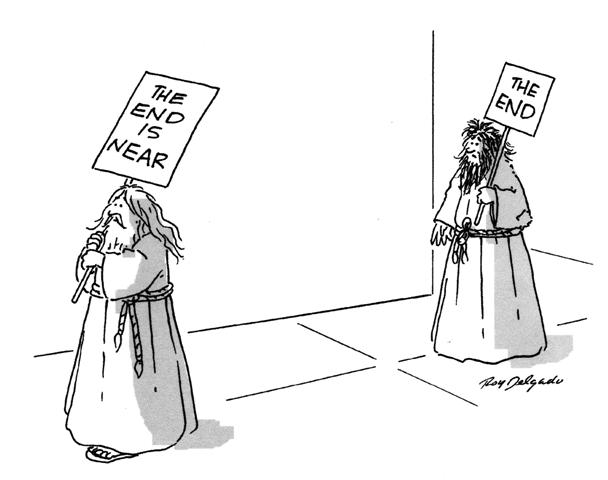
Cartoon retrieved from the Huffington Post.
Creation care members have somehow captured the idea of apocalypse and used it as motivation to act. Not only do they believe that Christ may judge them, but they are also concerned with those who will not be raptured to Heaven. Although belief in apocalypse is often associated with a lack of action or even the welcoming of climate change, creation care members appear to fall in a unique category. As discussed last week, creation care members have found a way to unite science and religion in a modern natural theology. Now, it appears that they have also managed to unite a belief in the apocalypse with an urge to mobilize and act.

Sunday, April 27, 2014

Creation Care Part 1: Where Religion and the Environment Intersect

Given the tumultuous and often contradictory natures of religion and the environment, the creation care movement has arisen in an unusual predicament. Guided by religion and undeterred by previous difficulties, creation care members seek to unite a moral obligation to the environment with climate change advocacy. This new movement operates in an important gap, often appealing to the youth, that could offer appealing solutions and arguments for grassroots progress on the environment. Interested in the opinions and demographics of this group, I performed an online survey of members on a few creation care mailing lists. In this post, I will discuss a few of the open-ended answers that were particularly interesting. This week, I am examining answers to one question about the compatibility of science and religion. Future posts will look at apocalypticism, interpretation of biblical verse, and optimism about the future.


Political cartoon retrieved from this blog

60 participants completed the survey and 52 submitted complete responses. A few prominent patterns emerged that provide insight into the beliefs of creation care members. These responses could not be generalized to the entire creation care movement, and the Judeo-Christian creation care movements are certainly far different from other iterations such as Muslim or Hindu creation care. But, the prominence of these patterns do indicate the possibility of shared opinions and frameworks for future inquiries. Overall, survey takers were confident about their knowledge of climate change and its consequences. They also expressed a mix of worry and hope towards the possibility of mitigating climate change's consequences.

Creation Care logo from Climate Progress

Survey takers were asked about the compatibility of science and religion. After coding for compatibility, unsure, and incompatibility, there was a consensus among the 52 surveys. All participants responded that they saw science and religion as compatible. Although it is common for scientific and religious frameworks to be in competition with one another, these creation care members viewed them as completely compatible. There are some religiously-oriented climate denial groups, such as the Cornwall Alliance, that undermine efforts to protect the environment. Oftentimes, a belief in climate change is associated with denying God's ultimate power over the apocalypse. Associations with religious identity and conservative politics often encourage thinking monetarily instead of environmentally.

The respondents, though, who identity as members of creation care groups, do not fall along traditional correlations. Participants identified across the political spectrum, but they all agreed on the importance of protecting the environment because of underlying religious identifications. Science and religion both support the potential risks and encourage action. Skepticism and doubt can cause pervasive apathy and negative consequences that creation care has found a way to overcome.

Image retrieved from this blog

One respondent noted that "science and religion are best friends." One commented that "they are completely compatible and if they appear to not be, then there is an error in the interpretation of the religious truth or of the scientific data." This respondent believes that it is not possible for science and religion to be contradictory. Many respondents echoed similar themes about finding God's work within scientific inquiry. "Science is an explanation of how God works and allows me to become more deeply rooted in Him and his beauty." Another simply wrote, "Science is Man's search for God in Nature." The closest a respondent got to noting incompatibility was the statement, "sometimes they are cranky with each other."

Wednesday, March 6, 2013

Climate Change Skepticism as a Roadblock to Progress

I have previously discussed climate change from the perspective of science and extrapolation to future consequences of global warming. Not only are the predictions highly varied, but the consequences of them range from changing in weather patterns to massive displacement, war, and global food insecurity. The Intergovernmental Panel on Climate Change (IPCC) is often considered the foremost authority on climate change and uses amassed scientific data to create a consensus surrounding climate change, urging countries and politicians to act.


Here is where the problems occur, because policies to limit the effects of climate change are not occurring, especially not in the United States. But why? The answer to this question lies in the polarization of politics and the divide between Republicans and Democrats on the climate change issue. Gauchat (2012) proposed the politicalization of science where over time, the issue of scientific authority has become inextricably tied to political loyalties. Consequently, Republicans and frequent church-goers have significantly lost faith and trust in science as the authority of truth. To accept science as the authority is to abandon other methods of explanation, such as faith, and become disloyal to party lines.

The evidence for this claim is seen not only in the polls that Gauchat analysed, but also from the actions of Congress and the Republicans in it. Funding for climate change research under the Republican chairs of committees and subcommittees has been debated and in some cases cut. In defense of removing National Science Foundation funding for climate change projects, Chairman Ralph Hall (R-TX) said, “the reluctance to engage in conversations with people who have doubts or question the veracity of climate science is at the heart of the wrong doing that undermines trust in climate change science”, thereby legitimating climate contrarians by placing them at even footing with scientists (“Witnesses Highlight Flawed Processes Used to Generate Climate Change Science, Inform Policy,” 2011).

Perhaps most shocking and incredible is the recent ruling by North Carolina that scientists are no longer allowed to use extrapolations to predict future implications of climate change, but can only use past data. This is an exemplar of politics directly interfering with scientific integrity, capabilities, and validity with no justification. Stephen Colbert mocked this bill excellently by noting that North Carolina are blocking scientific inquiry in attempts to hide data that would force them to act in favor of the scientific consensus. Literally restricting science's ability to chart and model future climate change implications further undermines science's ability to predict problems and urge political action. For without powerful, scientifically accurate, and frankly, worrisome data, how are politicians to be convinced to action?

Herein lies another complication: the urgency of climate change and in fact its very existence is wholeheartedly rejected by many politicians, making any attempt to convince them quite fruitless. Climate change skeptics or contrarians simply will not be persuaded by any scientific plea for action, no matter how urgent or convincing. The situation is remarkably quite similar to the idea of the religious apocalypse: for no matter how urgent or persuasive a prophet of the rapture is, non-religious, agnostic, or atheistic people will simply not be persuaded. Faith to them, just as science appears to be for Republicans and church-goers, does not hold any persuasive clout.


The result of this skepticism is the questioning of all scientific data to support policy ideas. Instead of taking action, politicians wait for "conclusive" scientific evidence, which threatens the world's ability to ever fully prepare for the consequences of climate change. Soon, it may be too late to act, and we will reach the tipping point, where there is no longer the opportunity for preventative measures, but only response. How serious these consequences will be revealed only through time, but we know now that the longer we wait, the worse it will be. Soon, it will be too late to act, but the world will cry out the famous words of Macbeth (Act 3, Scene 4):


"I am in blood, stepped in so far that, should I wade no more,
Returning were as tedious as go o'er"

Wednesday, January 30, 2013

Climate Change and Public Opinion

I previously mentioned delving into the relationship between belief in the apocalypse and intelligence. An article from Reuters reported, "Gottfried [author of the study] also said that people with lower education or household income levels, as well as those under 35 years old, were more likely to believe in an apocalypse during their lifetime or in 2012, or have anxiety over the prospect". Although the apocalypse came and went in 2012, new predictions emerge just as quickly as they pass. There is a seemingly societal need and urge to respect an "end times" or create an eschatology that justifies actions. For example, the Westboro Baptist Church has created a pre-millenialist view of Christ's second coming, where God is angered by the support of and equality given to members of the LGBTQ community, as well as other "sinful" actors. Once the world delves into too much sin, Christ will return and usher in the rapture, new millennium, and punish the sinners and all who aided them. 

Not all views of the apocalypse are religious, but many religions include their own "end times" stories as a foil to their creation myths. Climate change is an interesting complement to echatological views of the end of the world, as damage and degradation of the environment are popular "signs". Furthermore, the consequences predicted as the most severe or "worst case scenario" for climate change could bring the Earth into irreversible global catastrophe.

Yale's Project on Climate Change Communication published a study about the six types of Americans from the "alarmed" to the "dismissive". Despite a scientific consensus on anthropogenic global warming/climate change, nearly equal percentages of the population are highly concerned (12%) as least concerned (10%). Though most Americans fall in the middle categories from generally concerned to disengaged (62%), all groups except for the dismissive group felt like they needed more information about climate change. The dismissive group, though science would indicate that they are wrong or perhaps the least accurately informed felt that they were the most informed about climate change (91% of dismissives said they were very or fairly well-informed).
Graph from Yale's Project on Climate Change Communication (2011)

Gauchat and the Pew Poll on Values would indicate that the politicalization of science has created a large divide between Democrats and Republicans on the environment. Gauchat (2012) discussed the correlation between religious service attendance and conservatism with an increased doubt in the authority of science. Doubting the scientific evidence or predictions for the environment could greatly affect one's opinion of climate change, a environmental future that is difficult to see or completely grasp.

Although knowledge and concern for global warming is polarizing around political parties, there is hope that more people overall are concerned or at least a majority is concerned with the changes occurring in current temperatures and future risks around the globe.

Wednesday, September 26, 2012

The Apocalypse is Near, the Only Question is How?

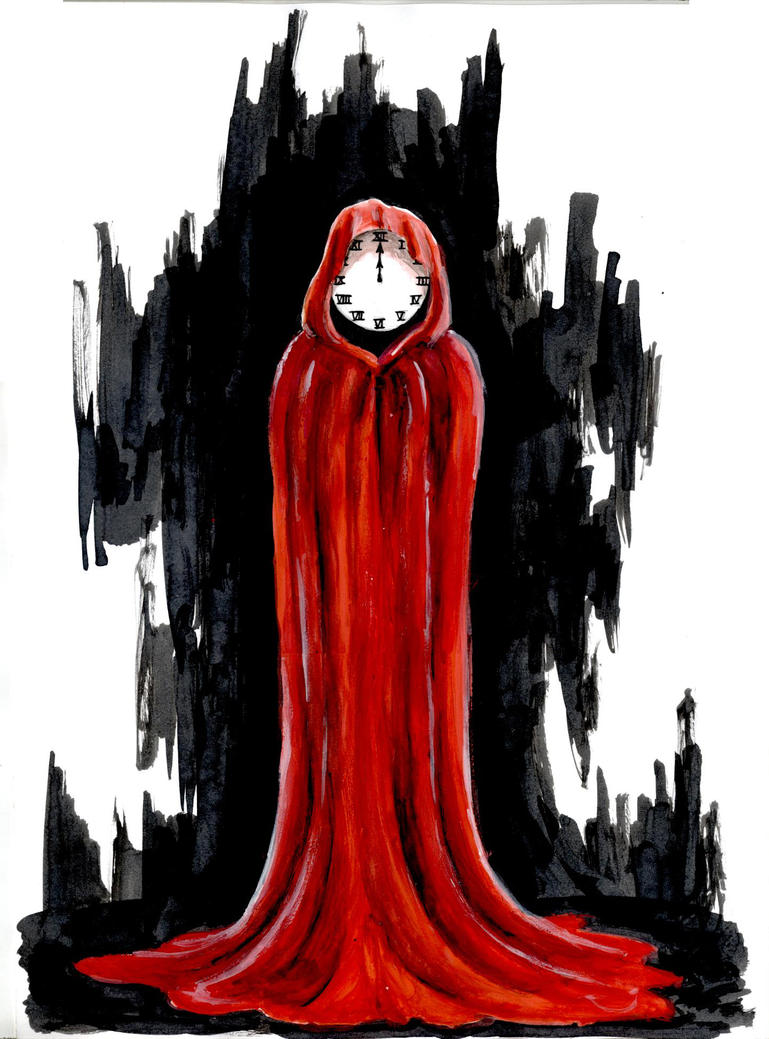
Tick tock, tick tock, tick tock. The clock has been an immutable symbol of life, with each second passing signifying the unstoppable journey towards death. When our time will run out is a mystery, but its inevitability is universally known. In the classic Edgar Allen Poe tale, "The Masque of the Red Death", even the rich and powerful Prince Prospero cannot hide from the ticking black clock of death. For time ends for all of us, and the fear of death, the unknown, the uncertainty of its timing, has played an important role in the creation of laws, social structures, and mythologies.


One representation of the connection between time and death can be found in the Doomsday Clock. This large, symbolic clock is a measurement for how close the world is to destruction, annihilation, and the apocalypse. Its initial intention in 1947 (created by the Bulletin of Atomic Scientists) was to measure the likelihood of nuclear war with 7 minutes to midnight the original time. Using midnight and the tolling of the clock as the endpoint to the countdown, the clock does not move constantly as a normal clock would. Instead, the hands are moved closer and farther away in response to certain actions and occurrences in the world. For example, the clock moved to two minutes to midnight in 1953, during the height of the Cold War. Despite its original symbolism, the Doomsday Clock now responds and moves in accordance to not only nuclear threats, but other apocalyptic threats such as nuclear energy, climate change and malicious technologies. The most recent move from seventeen minutes to five minutes to midnight reflects a topic previously discussed on this blog: climate change. Citing research about the consequences of climate change, the Doomsday Clock moves nearly as close to imminent destruction as under the threat of nuclear war.

The symbolism and rhetoric of the Doomsday Clock makes the comparison of climate change to nuclear war, legitimizing the threat by equating them. To consider the threat from climate change as equal to as as dangerous as nuclear war is a powerful rhetorical statement being made by the BAS. Whether one agrees that climate change should be included in the Doomsday Clock or not, the idea that the end is near is a belief held by many people worldwide. A recent poll shows that 15% of the world population believes that the world will end during their lifetime. Interesting to note is that one's belief in the apocalypse happening in our lifetime is negatively associated with education level. The implications of this could be as simple as those with less education are more likely to be persuaded by alarmist or apocalyptic rhetoric that answers their questions about life and death. This is a relationship that might need further explication and research in another post, but the finding in this study is an intriguing point. Overall, one in seven people believe in the impending apocalypse, and though these percentages fluctuate across nations, the tendency towards apocalyptic thoughts is a global phenomenon. That is to say, it is human to worry and be anxious about death, believing that the end is always near. The range of how the apocalypse will occur varies.


Some believe that the earth will eventually be consumed by the sun.

Some believe that the rapture will occur, saving religious believers and turning the world into a war-torn wasteland.

Some believe that climate change will become unstoppable, with massive flooding, displacement, famine, extreme weather, and war.

Some believe that a disease or virus will infect the world's population causing massive chaos and death.

Some believe that militant groups or governments may obtain nuclear weapons and begin a domino effect of nuclear war.

These beliefs range widely from the scientific to the religious to the fantastical, but the interesting point is that the end is not debated, only when and how. Just as no one can stop the ticking clock in the velvet room, humankind is aware of its eventual destruction, whether personal or global.


Wednesday, August 15, 2012

In Media Res: Polarization of Climate Change

This week, I'm curating a post on In Media Res as a part of the political polarization theme week. My post discusses the clear split between Democrats and Republicans in the debate about mitigating climate change.

Here is the link to the entire post and video clip. Read, comment, and enjoy!

http://mediacommons.futureofthebook.org/imr/2012/08/15/doubting-science-along-party-lines-polarization-climate-change


Wednesday, June 20, 2012

Zombie Apocalypse, Religion, and Psychosis

As much as I would want to put all of my Left 4 Dead training to practice on a real zombie apocalypse, the CDC reports that the recent zombie-like behaviors nationwide have no discernible cause. In other words: there is no zombie apocalypse, there are no walking dead, just people acting out currently inexplicable cannibalistic urges. But where do these urges come from? What spurs and incites people to commit such actions? I cannot help but recall St. Augustine's infamous words, "Whence evil?" Furthermore, where does the fascination with the walking dead come from? What do their recent re-emergence in popular culture (possible replacing or undermining the vampire trend) symbolize for the current generation?

The solutions to these questions can be found in the psychology and philosophy that form the base of human action. Although there cannot always be a single answer to all questions, neither do all questions have unique answers. In finding the roots of the zombie rumors, I'd like to explore the news articles covering the events and then propose Freud's neurosis theory as an interesting intersection between religion and madness.

The first news story broke in May 2012 when a naked man, later identified as Rudy Eugene, attacked a homeless man and began to eat his face. Only after being shot by police officers did the attack end with reports of him snarling and acting like an animal in his attack and consumption. The culprit was drugs, hallucinogens such as LSD and "bath salts" can raise body temperatures and cause intense delirium. Drug-induced psychosis, then, is to blame for this zombie-like attack, where a human acts distinctively inhuman and consumes flesh. Traditionally, zombies are considered the "living dead", a person resurrected in a type of half-life after death. The mythology of the zombie has been altered in film, particularly. Whereas traditional representations (Shaun of the Dead, Night of the Living Dead, Zombieland) are still made, there are more plausible (used loosely) variations that are becoming more common. Virus-induced zombie-like behavior is showcased in 28 Days Later and I Am Legend, where people are still alive and human but a disease that alters behavior and attitude. These types of interpretations make the drug-induced actions in Miami a relevant and palpable occurrence of zombies. At least, zombies in the modern interpretation, where anger and disease plague the mind, not the results of re-animation.


Later in that same week, a news story broke about a student at Morgan State University, Alexander Kinyua, who had murdered his roommate and had eaten his brains and heart. The scapegoat in this case was insanity, as documented on the student's Facebook page. Not only did he mention murder and killing in the time before and after the murder, but he was often referring to himself as a warrior and marking himself with war paint. Insanity is thus the culprit for his actions, driving his consumption of the roommate. Information about his past are still unknown, but perhaps inquiry will reveal past trauma or rationale for his obsession with murder that drove him to kill.

Another zombie news story shocked the nation not a week later, where a San Antonio woman, Otty Sanchez, killed her infant son, eating his brains and a few of his toes. Probably the most disturbing part of this story was the report that her actions were taken at the devil's behest. Motivated perhaps from fear, loyalty, confusion, or paranoia, her belief in the devil and his power killed her son by guiding her actions.

The "boy who cried zombie" aspect of these news stories is not the only aspect that links them. Freud would argue that they are all linked by an even stronger, guiding force: repression. Freud argued that underlying, repressed trauma and urges linked from sexual frustration (the stereotypical "Oedipus Complex") causes all forms of neurosis and abnormal behavior in humans. All actions, including religious convictions, are all aberrational behaviors caused by insanity and mental distress. The third story surely supports this case, as her request from the devil was a form of hallucination or psychosis to imagine spiritual callings to commit a heinous act. Instead of religion, the first and second stories were motivated by drugs and perhaps mental instability and obsession with death. Freud would categorize all of these actions (taking drugs, mental distress, and belief in religion) as the same problem: psychotic behaviors. This psychosis spurred these individuals to action because of past trauma and events that encouraged them to engage in abnormal behaviors. The results, a similar urge to cannibalism, are justifiably  linked because of irrational, obsessional neurosis.*

Without the link between them, as argued by Freud, these three events look dangerously dissimilar. Different parts of the country (Miami, Baltimore, San Antonio), different ages (22-33), and different races (2 black and 1 Latina) made up the current zombie/cannibal line-up. The great disparity places different faces and people on the same problem; it is possible for it to happen to anyone, so who could be next? The speculation online and in the general public was so severe that the CDC had to release a report denying the existence of re-animating the dead or a disease that could cause such behaviors. The attention paid to these attacks by the CDC glorifies and recognizes the events, their link, and provides support for speculators.

If zombie-like events continue to occur, the CDC might receive pressure to investigate more intensely, however absurd the idea of it may seem. One thing is for certain, though. If these events happened to multiple people across the nation, from different backgrounds, and different ages, then the link between them is simply humanity. From humanity we have Freud's psychoanalytic approach to the human mind and the relationship between psychotic actions and mental trauma that explains these occurrences. Is the zombie potential within all of us, then?
*I urge anyone interested in learning more about Freud's opinions on religion and mental distress to turn to Daniel L. Pals's "Eight Theories of Religion" (2006). 2nd Edition, Oxford University Press where the above insights were gleaned.