On Friday, September 25th, I attended an event at the USC Caruso Catholic Center hosted by many organizations including Pando Populus. This organization takes it name from the pando tree and describes its significance on its website: "Above ground, Pando appears to be a vast grove of individual trees. Underground they are all interconnected through a single root system. Each part is affected by and nourishes the other. It has survived this way for as long as 80,000 years." The pando tree is a synecdoche for the interconnectedness of all life and an analogy for how we must work together to correct the damage done to our environment.
The event was held in support of Pope Francis's visit to Washington D.C. and the release of his encyclical "Laudato Si." The event was religious-themed with the Bishop Mary Douglas Glasspool representing the Episcopal Diocese of Los Angeles, held in a Catholic Church, with speakers from the Muslim Public Affairs Council, Faith2Green, and Interfaith Power and Light. The theme, "The Pope is Pando" lauded the work of Francis as a figurehead and representative of how religion can be a uniting force for environmental activism. I've previously discussed the rhetoric of creation care as an emerging social movement with the potential power to tip the scales in favor of larger influence. While the group I studied was primarily evangelical rhetoric, it's clear that many religions are finding common ground in the spiritual to influence their view of the natural.
Logo for the Pope is Pando event. Retrieved from this site.
In Francis's encyclical, he made repeated mention of an "integral ecology" where life is integrated in a familial metaphor. Common to Catholic and Christian rhetoric, the familial metaphor connects people and faith leaders as fathers, mothers, sisters, and brothers. Francis incorporates the environment in the familial metaphor as shared children in God's creation. He argued that the Earth and nature are female family members: "our common home is like a sister with whom we share our life and a beautiful mother who opens her arms to embrace us" (p. 3). The feminization of "Mother Earth" is a phenomenon I would like to explore in a different blog post. For now, I will say that emphasizing the femininity of nature implies vulnerability in need of our protection and to motivate us to save her as one might a damsel in distress. Francis argued, "This sister now cries out to us because of the harm we have inflicted on her by our irresponsible use and abuse of the goods with which God has endowed her" (p. 3). If we are all interconnected - a united organism - then a threat to one part of it is a threat to the whole. Faith appears to be one way that people are transcending differences in order to focus attention away from economics and politics and onto justice, morality, and the environment.
The concept of "materiality" and how physical objects argue is becoming popular in rhetorical criticism. Scholars are beginning to theorize that buildings, cities, monuments, and other physical objects can argue, influence people, and tell stories -- just like words. The history of "the material turn" is quiet expansive (as I've discovered while writing my dissertation about it), but I will summarize some key points before discussing examples.
Traditional rhetorical criticism focused on the speeches of great orators and analyzed the word choices and potential effects. Scholars slowly began to incorporate other objects of study like groups of speakers, genres of speeches, and non-elite speakers. These variations still focused on the spoken and written word, however. Larger changes emerged when scholars began looking at how physical spaces constrain or offer opportunities in the way that speeches invite or construct possibilities for audiences. Moving through a space that has physical obstacles is similar to spoken commands or laws that restrict movement. Physical spaces and objects can themselves be symbols (like words) that have embedded meaning, affect, and significance. Materiality invites audience participation and makes arguments.
The first example of arguing monuments is the Portrait Monument at the US Capitol. The marble monument shows three elegant busts of prominent women in the women's suffrage movement: Elizabeth Cady Stanton, Susan B. Anthony, and Lucretia Mott. There is room for a fourth bust in a lump of un-carved stone in the rear of the monument.
This monument makes a clear argument that the work of women's rights is unfinished. There may have been great women in the past who deserve to be honored, but there is still the need for activism, activists, and progress. Furthermore, viewers of the monument are invited to honor the memories of these three great women by continuing on their work. Their memories do not invoke a sense of completeness or finality; their faces encourage the audience to ask, "what more can be done?" Some people have thought that the unfinished section is meant to be completed when the US elects the first female President. This, however, goes against the intention of the artist, Adelaide Johnson, to show the perpetually unsolved state of gender equality.
Another example is the Atheism bench. This monument is the first public monument to atheism, or a lack of belief in divinity. The American Atheists lost a court case to have a monument to the Ten Commandments removed from a Florida Courthouse. Instead of removing the monument, the court offered them the opportunity to build their own monument. The monument is a bench so as to be a functional piece of public display. It is covered in quotations that specifically mention religion and the American political and legal systems.
The Atheism bench claims space for non-belief outside of a courtroom that, like Lady Liberty, should be blind to concerns of religion. The bench argues that religious belief should not be a factor in the courts. The bench also argues that public space should be free and open space where no ideas should dominate and none should be excluded. The bench also includes, in writing "consequences of breaking the Ten Commandments" as a direct verbal argument against the Ten Commandments monument displayed on the other end of the courthouse.
These are just two examples of how physical spaces can produce arguments. Oftentimes, memorials are coupled with verbal statements, like the Atheism bench, but it is important for scholars to note that images, monuments, and material things can produce independent, standalone arguments.
In 1925, a small town became the center of national attention. It housed the court case John Thomas Scopes vs the State of Tennessee that addressed the teaching of the Bible in science education. In 2014, this same small town of Dayton, Tennessee is undergoing a similar controversy where science and religion meet in the realm of education.
Bryan College, founded in memory of Williams Jennings Bryan after the Scopes Trial, has issued a new statement of faith that faculty must sign. This clarification in BC policy is receiving heatedbacklashfrom faculty and students. Due to the stricter statement, BC may lose25% of its faculty. BC students have released apetitionagainst the new statement and BC faculty has voted no confidence on the school’s administrators. This new statement of faith is not changing the stance of BC, which aligns with its namesake’s opinion on the immorality of evolution and the truth of biblical creationism. Instead, this change highlights the literalism of the Bible by further polarizing acceptable belief systems. This article will explore these changes in light of the ever-present dichotomy of science and religion, with the context of the Scopes trial, and the actual teachings of Bryan. In short, BC is working against two of the characteristics of Bryan’s teachings (the potential for interpretation and the importance of populism) and in essence, abandoning its namesake.
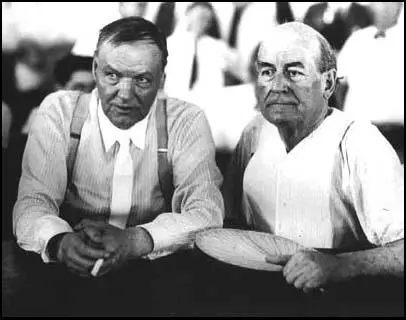
Clarence Darrow (left) sitting with William Jennings Bryan (right) before Scopes Trial. Retrieved from this site.
Bryan was the prosecutor in the famous 1925 trial, arguing in favor of fining Scopes for teaching that humanity descended from a lower order of animals. The Butler Act, which Scopes was tried for violating, declared the immutability of the Bible and the inerrancy of the Genesis account of Adam and Eve. This was and still is an important element of fundamentalism, the values on which BC was founded. In the cross-examination day of the trial, however, Bryan compromised literalism but noting that “I believe everything in the Bible should be accepted as it is given there: some of the Bible is given illustratively. For instance: "Ye are the salt of the earth." I would not insist that man was actually salt, or that he had flesh of salt, but it is used in the sense of salt as saving God's people.” Bryan also said that the six days of creation were “not six days of twenty-four hours.” For Bryan, the statements in the Bible were accurate descriptions, but what was more important was not individual interpretations but the values that the Bible upheld.
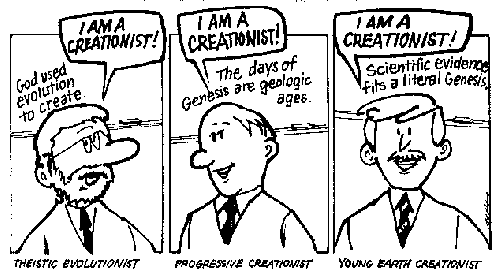
In Bryan’s summation of the trial, he proposed a strict dichotomy between religion and science, saying that one was the path to Christ and the other would crucify Him. In the 1920’s, and perhaps not until the intelligent design movement of the 1990’s, the idea that evolution and creationism could be rectified was perhaps outside of the purview of many Americans. But, many faculty members at BC do ascribe to labels such as “progressive evolutionists and theistic evolutionists and old-Earth creationists.” The previous BC statement of faith noted that “the origin of man was by fiat of God.” Interpreting fiat to be an all-encompassing act of creating the world, some professors at BC married religion and science and incorporating evolutionary theory into their personal beliefs and classroom teachings. They have taken the words of the Bible illustratively, so they are able to stay in line with the statement of faith.
Different forms of creationism. Retrieved from this site.
The new statement of faith, however, undermines these creative interpretations. Now, faculty must agree that “all humanity is descended from Adam and Eve. They are historical persons created by God in a special formative act, and not from previously existing life forms.” This statement puts many jobs at risk because it removes faculty that believe in any evolutionary history of humanity or of Adam and Eve as symbolic placeholders.
Upon a recent trip to Dayton in March, I had a conversation with a priest and an archivist at BC’s library. We were all reading through documents about Bryan, the trial, and the founding of the college. The priest was in the archive reading for clarification on Bryan’s teachings about biblical literalism. He was concerned that many of his closest friends, the best faculty at the school, and devout, loyal Christians would be unable to sign the new, stricter, and, at this point only proposed, new statement of faith. The priest was concerned that many great, Christian teachers would be lost and hard to replace. Although they may have had more creative interpretations of some biblical phrases, the priest considered their marrying of physical observation with biblical teachings as in line with Bryan’s teachings.
Logo of BC student newspaper. Retrieved from the Brian Triangle website.
BC students are also in agreement. They noted in their petition that they are saddened that BC “will alienate faculty, our brothers and sisters in Christ, by requiring them to affirm a negative on an ancillary matter of faith.” For the populous of BC, the tightening of the statement of faith only serves to divide rather than unite people of faith that have the common goal of teaching Bryan’s creationist values.
The archivist gave me a card for her husband’s creationist non-profit and seemed unconcerned with the changes. Although she said that some faculty taught evolution or believed in it, what was important was that the Genesis story was still taught at BC and the values of it were fully ingrained in all parts of its curriculum. She noted that if students had issues with particular professors and their more creative interpretations, they could easily take classes with a more fundamentalist professor. The campus was an open place where at least variations on creationism were discussed freely. The new clarification would place this openness in jeopardy. BC is surely staying within its rights to clarify its statement and to fight for literalism, especially within a threatening, secular environment. This statement is adopted, however, against the wishes of its students and faculty, making the authorities at BC domineering and elite over the wants of its people. Bryan’s values of populism, the will of the people over the elites, were once in opposition to the elitism of science that would remove all mention of Christ from classrooms. Now, BC wishes to do the same, but to strip its students of all access to evolution, despite that it awards biology and environmental science degrees.
What is at issue here is the extreme polarization of science and religion that is shrinking the opportunity for middle ground, mutual respect, and open deliberation. I do not mean to argue that creationism is a valid scientific explanation, but simply that people should not be so quick to judge people for staying true to religious ideals while incorporating scientific and material evidence in their belief systems. As more and more people take note of scientific evidence for evolution, there is more vocal push back from religious fundamentalists that distance themselves from intelligent design perspectives. Adopting new frameworks and stretching current ones is incredibly difficult. Attempts at marrying them and making sense of one’s religious convictions in light of science is something to be valued, not disdained.
BC student protest image. #hearmyvoiceBC. Retrieved from this site.
BC cannot avoid the protests and disagreement from their own students and faculty, nor from the general public about the favoring of religion over science. As the students said themselves, “the clarification promotes factionalism at the cost of honest debate and discussion.” This decision, perhaps in response to more prominent attention to the issue, is minimizing the space for education about scientific explanation for origins. BC was created when creationism and evolution simply could not be rectified. But, now, it is clear that BC is isolating itself from its students, faculty, the potential partnership of science and religion, and illustrative biblical teachings, in contrast to the teachings of its namesake. We will never know what Bryan would say about this iteration of the human origins controversy. But, I would put money on the will of the people over the BC elites that work risk compromise and biblical values in favor of fervent literalism.
There have been scholarly discussions over the purpose/value/potential impact that the creation care movement might have. It is tempting to be pessimistic in a political culture that seems to be stuck in the constant polarization between affirmation and denial instead of focusing on efficacy to action. I see some potential in the creation care movement, however. Although the loudest voices we hear are focused on denialism and their detractors who try to debate them, most Americans lie in the middle. I am not concerned with convincing the denialists, but with changing the debate. Creation care could potentially be an avenue to speak the (religious) language of many Americans and people around the globe. The movement shifts the conversation from quibbling over scientific data, undermining science as a field of inquiry, and valuing money over people, to intergenerational arguments about charity, and a deep concern for the poor and nature.
Though I agree that too much optimism will only lead to disappointment, I feel that there are positive steps being taken and creation care messages being presented in the media. Recently, Pope Francis I made a strong statement in support of creation care. This was perhaps his most prominent and widely covered statement directly about the environment. Francis has repeatedly spoken out about the values of charity, has decried the poverty specifically relative to the wealth of some priests. It may come as no surprise, then, that Francis links these values to caring for the environment “because if we destroy Creation, Creation will destroy us.” The full remarks can be heard here, which outline Francis’s emphasis on balance between humans, humans and the environment, and humans and their spirituality.
Referencing his namesake (St. Francis of Assisi), Francis encouraged his followers, and indeed all of humanity, to be “custodians of creation.” This phrase is interchangeable with the “stewardship” of creation that reflects Genesis 2:15 which calls for humans to “work and take care of” the Garden of Eden (New International Version). The story of Genesis is often considered to be in contradiction with itself, as it contains phrases that seem to laud the role of humanity as having dominion over the world and also phrases that support taking care of cultivating the earth. This reflects a difference in interpretation, which Francis is trying to push towards the latter view where Creation is a gift rather than property to be exploited.
Creation care has also been in the news with the works of Katharine Hayhoe, a climatologist from Texas Tech and an outspoken evangelical Christian. She was named to Time's 100 Pioneers list with an article written about her by Don Cheadle. They worked together on Years of Living Dangerously, a Showtime TV series that used celebrities as correspondents to investigate issues surrounding climate change. The episode "Preacher's Daughter," specifically addresses creation care as a movement that could impact policies and public opinion about the environment. At an event with Ian Somerhalder (a correspondent in the Preacher's Daughter episode), he noted that the more people who watch the show, the more the media networks will understand that this is an important issue that real people want real answers to, instead of just pundits and talking heads.
There is certainly language a plenty to indicate despair, irreparable damage, and apathy. But, there is also hope. Hope may live in the gaps of these contradictions, between science and religion as incompatible frameworks, comfort and sacrifice as dichotomous values, and the future versus the end of the world as motivating eschatologies.
To continue the discussion of creation care, I will discuss the fluidity of Bible verses. There are many, ongoing discussions about interpretations of certain phrases with sometimes a wide range of translations based on different versions of the Bible. Concerns over contradictions in the Bible can lead to difficulties in creating a coherent picture of one's religious beliefs and identity. McCammack (2007) argued that the
differing interpretations of the Bible are not trivial, for adherence to
biblical accuracy is of the utmost importance for evangelicals, who make up a growing percentage of the creation care movement, "green evangelicals."
A few prominent phrases that appear to contradict one another are Genesis 1:26 and Genesis 2:15. Genesis 1:26 reads, "Then God said, 'Let us make mankind in our image, in our likeness, so that they may rule over the fish in the sea and the birds in the sky, over the livestock and all the wild animals, and over all the creatures that move along the ground'" (New International Version). This verse makes use of "rule over," an equivalent of Genesis 1:28's "dominion" or "subdue", to place humanity in a hierarchical position over that of animals and others living creatures in the world. If humanity (Adam and Eve) were God's most important creations, then it may logically follow that everything else in the world is not worthy of protection or keeping. On the other hand, Genesis 2:15 reads "The LORD God took the man and put him in the Garden of Eden to work it and take care of it" (NIV). Other versions swap out these verbs for "tend and watch over it" (New Living Translation), "cultivate it and keep it" (New American Standard Bible), "work it and guard it" (International Standard Version), and "care for it and maintain it" (NET Bible). These verse, only a few after the ones above, appear to place humanity within its scene, not over it. Humanity has been given the divine charge of maintaining and caring for the Earth as another of God's creations. There are many more verses that address the relationship of humanity to nature, but these might be the best known.
Another respondent noted that "dominion is so often misinterpreted as carte blanche permission to do what we want with creation." Dominion implies "that we will be held to account by God for how we manage his creation." Humans will thus be judged for their treatment of the Earth and how kind they were as rulers as one might expect God to be. These responses further support the ability of creation care members to fill in gaps and overcome contradictions where others may perceive them.
Respondents were asked about the apparent contradictions between these two verses in the study and to describe their meaning and compatibility. A frequent response was that people took "rule over" and other verbs of domination too literally, and it might better be translated as calling for stewardship, a kind and tender position of power that cares for the Earth. One respondent noted, "God has created us in His image, and it is this image we are to reflect in our dominion. The second verse describes what this Godly dominion can look like, tending and keeping a garden." For this respondent, the phrases are not contradictory, but complementary. Humanity can rule over animals but also tend to and take care of the Earth; a position of power does not have to be an oppressive one.