Showing posts with label Discrimination. Show all posts

Sunday, September 21, 2014

The Danger and Opportunity in Speaking for/with Others

There are many issues that I feel compelled to address as a rhetorician and social agent of change (Klumpp and Hollihan argue). Engaging with these issues, however, requires reflexivity about my own status as a privileged, white, heterosexual, cisgender, able-bodied, female and how that type of person/body can speak for others. Can I speak for others? Perhaps literally, yes, I could use my platform on this blog and as an academic to speak for others. It wouldn't be well or with full knowledge, but I could. Thus, the better question would be should I speak for others?

On one hand, attention to these important issues of transgender rights, racial inequalities, gender equality, and equality more broadly should have as many advocates as possible. People of all description can be allies and amplify the voices and stories of those who can speak more genuinely about these problems.

Image retrieved from this site.
On the other hand, speaking for others complicates issues of voice, could serve to isolate the voices of others, and reifies a system in which certain voices are more valuable than other voices. In an academic exchange in a journal, Campbell and Biesecker addressed the issue of speaking for women in rhetorical history and how the "canon" of rhetoric that is studied systematically removes female voices. Though Campbell erred on the side of including as many voices as possible into the current canon, Biesecker was in favor of rejecting the canon as a system of tokenization.

The rhetoric of tokenism highlights certain voices that triumph against an oppressive system as evidence that the system is not oppressive. The lauded status of certain individuals (Cloud has an excellent article on Oprah as exemplar) is unique and worthy of note, and their success is linked to their individual qualities. If others simply embodied these same qualities, they could also rise above the system, meaning that change is unnecessary.

This is the token black character on South Park, literally named "Token." Retrieved from this site.
Part of the problem in speaking for others is this dynamic of visibility, voice, invisibility, and silence. To speak for others is to reify that certain voices are not being paid attention to, but it also silences their actual message in favor of a conduit. To remain silent, though, is to allow and passively participate in the maintenance of the status quo.

I am still working through these problems and try to keep them in mind in the work that I address and the comments that I make. I try to always be reflective and aware of the position from which I consume information and process opinions. For now, I err on the side of commenting from my limited position, especially when certain issues are prevalent and pressing.

One issue that has recently emerged, and one which I am reluctant to rehash considering the wishes of my colleagues, has been the Annenberg Innovation Lab Black Twitter project. I wish only to comment on this situation's similarities to the issues of authorship, voice, and who is allowed/should study others as a researcher. A summary of the incident can be read here and an excellent response by my colleague Dayna Chatman can be read here. This incident helped me reflect more on my status as a researcher and how academia as a whole can be more reflexive of how our personal situations affect our approaches to certain issues.

Sunday, September 14, 2014

Catcalling and Power: Hollaback at Violent Male Culture

Catcalling has been appearing frequently in article I've been reading, on social media, and in conversations with friends. I have already discussed more generally the problems that females face specifically on college campuses, but catcalling is a form of aggression that plagues all women. I use the term aggression purposefully and meaningfully as these catcalls are verbal, sexual assaults on females. These are, in many ways, hate crimes in that they are addressed and targeted towards a particular gender. I argue that these are violent, aggressive verbal attacks on females and are not addressed in order to be compliments or flattery. Any woman of all shapes and sizes in clothing from SoCal casual to Boston coats (I have seriously been catcalled walking down Boylston in my HUGE winter jacket) are catcalled. Like rape, catcalling is not about "flattering" or "complimenting" someone; it is about power, laying claim, objectifying, and reifying an order where men can and are allowed to "be men." The clip below is from a Fox News show where four clueless women and one man discuss how flattering and welcoming catcalling is.


The hosts argue "let men be men." This statement characterizes men as overly sexual, aggressive, and blameless for their actions. This attitude let's men off for perpetrating abusive, violent action towards women. The blame is shifted to the victims for not "taking a joke," their choice of outfit that incites a catcall, or walking in a certain area. Victim blaming is never something that should be encouraged or tolerated in society. Just like bullying or assault on college campuses, it is always the fault of the perpetrator, the person committing the crime and assault. It is never the fault of the victim. In the famous words of the recently passed Robin Williams in Good Will Hunting, victims must always remember, "it's not your fault." The hosts of the show should be ashamed of themselves for laughing and tolerating the inane slow clap of their male counterpart. The female presence is not a show or performance for the adoration or approval of males.

Retrieved from this site.
I have been catcalled many times and the first thing that I have thought was not, "oh how nice," or "how flattering!" Instead, it immediately places me in a subject position where my presence is only meaningful in that is a display and object for the male gaze. In one instance, I had a man follow me off a bus in Los Angeles and onto the Metro, yelling at me and attempting to accompany me to my destination. I will probably never forget the fear I felt when I realized he was behind me as I stepped off the bus. My relief in getting out of the situation became sheer panic. He ran up next to me and said, "I'm not trying to scare you sweetie, I just want to marry you." Another time, I was grabbed from behind by a young male on a skateboard on the very street where I live. This catcall, which I tried to ignore, ended in physical assault and made me feel like an object to be squeezed, held, and owned by others. When I step on the street, I have no control over the actions of others, what they may call me, how they may judge me, but I will say that it is more rare than not to have an assault-free day. Louis Althusser noted that when a police officer yells, "Hey you!" at someone, they immediately construct a subject position for them to inhabit. This interpellation is done from a position of power that constructs for the other person an identity that they have no part in constructing. Any reaction is to that assignment position within what Althusser called an "ideological state apparatus" that reifies hierarchy.


Buzzfeed attempted to create a humorous interpretation of catcalling. The video shows "What men are really saying when catcalling." This video is important because it addresses the counter-argument that many people use to defend catcalling: that it is a legitimate way to approach a female. If someone is interested, why not simply call out to them and engage them in conversation? Well, as the video shows and as I fully agree, catcalling is not an invitation. There is no desired or appropriate response. The male simply wishes to undermine the female, assert power, and inflate their own egos. As one of the males in the video states, "I noticed you're confident, so I'm cutting you down to feel powerful." Another notes that he's not sure why he's calling because he wouldn't know what to do if the female responded. When I have tried to respond to catcallers, I am either called a bitch, frigid, or am assumed to already have a boyfriend. Because already being owned by a male is the only reason to call off an approach.

Playboy also recently released a chart that describes when it is appropriate to catcall a female. Though my initial reaction was, "why do you need a flowchart to define the word 'never'?" this chart is important because it incorporates the participation of the female. The only way for catcalling to be appropriate, via this chart, is with the consent and agreement of the female party. This approach considers females active agents instead of simply passive objects to be called upon.

Retrieved from this site.
Catcalling engages issues of hierarchy and ideology. In what situations do females catcall men? In what situations do females have the power to objectify and undermine men? Simply put, they never do. The structure of hierarchy implies that the minority or discriminated group never has the agency or power to discriminate themselves. Any action is performed within that hierarchy. My response to a catcaller is always framed with the male in the right and myself in the wrong. Althusser's police office constructs the situation and appropriates the actions of the passerby without a need for reaction. Because of their respective positions within the system, the act of addressing and calling upon someone places them in the position of vulnerability, object, and minority. Catcalling reifies a structure that says that men are always in a position of power over women.

Retrieved from this site. Stats are specific to Hollaback Boston.
A few organizations, such as Hollaback , are trying to end street harassment. Hollaback focuses on sharing the stories of females who have been harassed in a triple-pronged attempt to promote awareness of how frequent and widespread the issue is, to provide validation for females who have been verbally harassed, and to promote healing through collective storytelling. I hope that initiatives like this can help to make real and present the plight of harassment that females experience every day. We as a society need to move away from victim blaming, listen to the stories of those shamed and objectified, and acknowledge the societal guilt that we all share by allowing this culture to exist. Though I am not knowledeable enough to comment in more depth, I do want to use this post as an opportunity to amplify how these issues often specifically and disproportionately affect women of color and the transgender community.

Sunday, June 8, 2014

Bryan College Controversy: Religion on (Scopes) Trial

In 1925, a small town became the center of national attention. It housed the court case John Thomas Scopes vs the State of Tennessee that addressed the teaching of the Bible in science education. In 2014, this same small town of Dayton, Tennessee is undergoing a similar controversy where science and religion meet in the realm of education.

Image retrieved from Biologos

 Bryan College, founded in memory of Williams Jennings Bryan after the Scopes Trial, has issued a new statement of faith that faculty must sign. This clarification in BC policy is receiving heated backlash from faculty and students. Due to the stricter statement, BC may lose 25% of its faculty. BC students have released a petition against the new statement and BC faculty has voted no confidence on the school’s administrators. This new statement of faith is not changing the stance of BC, which aligns with its namesake’s opinion on the immorality of evolution and the truth of biblical creationism. Instead, this change highlights the literalism of the Bible by further polarizing acceptable belief systems. This article will explore these changes in light of the ever-present dichotomy of science and religion, with the context of the Scopes trial, and the actual teachings of Bryan. In short, BC is working against two of the characteristics of Bryan’s teachings (the potential for interpretation and the importance of populism) and in essence, abandoning its namesake.

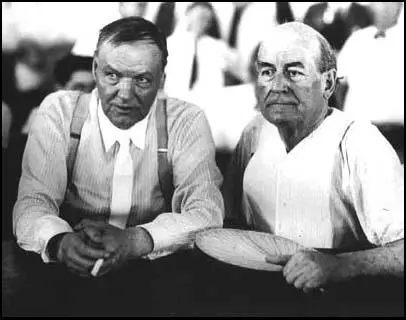
Clarence Darrow (left) sitting with William Jennings Bryan (right) before Scopes Trial. Retrieved from this site.

 Bryan was the prosecutor in the famous 1925 trial, arguing in favor of fining Scopes for teaching that humanity descended from a lower order of animals. The Butler Act, which Scopes was tried for violating, declared the immutability of the Bible and the inerrancy of the Genesis account of Adam and Eve. This was and still is an important element of fundamentalism, the values on which BC was founded. In the cross-examination day of the trial, however, Bryan compromised literalism but noting that “I believe everything in the Bible should be accepted as it is given there: some of the Bible is given illustratively. For instance: "Ye are the salt of the earth." I would not insist that man was actually salt, or that he had flesh of salt, but it is used in the sense of salt as saving God's people.” Bryan also said that the six days of creation were “not six days of twenty-four hours.” For Bryan, the statements in the Bible were accurate descriptions, but what was more important was not individual interpretations but the values that the Bible upheld.

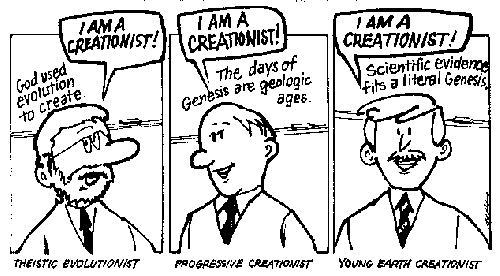
In Bryan’s summation of the trial, he proposed a strict dichotomy between religion and science, saying that one was the path to Christ and the other would crucify Him. In the 1920’s, and perhaps not until the intelligent design movement of the 1990’s, the idea that evolution and creationism could be rectified was perhaps outside of the purview of many Americans. But, many faculty members at BC do ascribe to labels such as “progressive evolutionists and theistic evolutionists and old-Earth creationists.” The previous BC statement of faith noted that “the origin of man was by fiat of God.” Interpreting fiat to be an all-encompassing act of creating the world, some professors at BC married religion and science and incorporating evolutionary theory into their personal beliefs and classroom teachings. They have taken the words of the Bible illustratively, so they are able to stay in line with the statement of faith.

Different forms of creationism. Retrieved from this site.

The new statement of faith, however, undermines these creative interpretations. Now, faculty must agree that “all humanity is descended from Adam and Eve. They are historical persons created by God in a special formative act, and not from previously existing life forms.” This statement puts many jobs at risk because it removes faculty that believe in any evolutionary history of humanity or of Adam and Eve as symbolic placeholders.

Upon a recent trip to Dayton in March, I had a conversation with a priest and an archivist at BC’s library. We were all reading through documents about Bryan, the trial, and the founding of the college. The priest was in the archive reading for clarification on Bryan’s teachings about biblical literalism. He was concerned that many of his closest friends, the best faculty at the school, and devout, loyal Christians would be unable to sign the new, stricter, and, at this point only proposed, new statement of faith. The priest was concerned that many great, Christian teachers would be lost and hard to replace. Although they may have had more creative interpretations of some biblical phrases, the priest considered their marrying of physical observation with biblical teachings as in line with Bryan’s teachings.

Logo of BC student newspaper. Retrieved from the Brian Triangle website.

BC students are also in agreement. They noted in their petition that they are saddened that BC “will alienate faculty, our brothers and sisters in Christ, by requiring them to affirm a negative on an ancillary matter of faith.” For the populous of BC, the tightening of the statement of faith only serves to divide rather than unite people of faith that have the common goal of teaching Bryan’s creationist values.

The archivist gave me a card for her husband’s creationist non-profit and seemed unconcerned with the changes. Although she said that some faculty taught evolution or believed in it, what was important was that the Genesis story was still taught at BC and the values of it were fully ingrained in all parts of its curriculum. She noted that if students had issues with particular professors and their more creative interpretations, they could easily take classes with a more fundamentalist professor. The campus was an open place where at least variations on creationism were discussed freely. The new clarification would place this openness in jeopardy. BC is surely staying within its rights to clarify its statement and to fight for literalism, especially within a threatening, secular environment. This statement is adopted, however, against the wishes of its students and faculty, making the authorities at BC domineering and elite over the wants of its people. Bryan’s values of populism, the will of the people over the elites, were once in opposition to the elitism of science that would remove all mention of Christ from classrooms. Now, BC wishes to do the same, but to strip its students of all access to evolution, despite that it awards biology and environmental science degrees.

What is at issue here is the extreme polarization of science and religion that is shrinking the opportunity for middle ground, mutual respect, and open deliberation. I do not mean to argue that creationism is a valid scientific explanation, but simply that people should not be so quick to judge people for staying true to religious ideals while incorporating scientific and material evidence in their belief systems. As more and more people take note of scientific evidence for evolution, there is more vocal push back from religious fundamentalists that distance themselves from intelligent design perspectives. Adopting new frameworks and stretching current ones is incredibly difficult. Attempts at marrying them and making sense of one’s religious convictions in light of science is something to be valued, not disdained.

BC student protest image. #hearmyvoiceBC. Retrieved from this site.
BC cannot avoid the protests and disagreement from their own students and faculty, nor from the general public about the favoring of religion over science. As the students said themselves, “the clarification promotes factionalism at the cost of honest debate and discussion.”  This decision, perhaps in response to more prominent attention to the issue, is minimizing the space for education about scientific explanation for origins. BC was created when creationism and evolution simply could not be rectified. But, now, it is clear that BC is isolating itself from its students, faculty, the potential partnership of science and religion, and illustrative biblical teachings, in contrast to the teachings of its namesake. We will never know what Bryan would say about this iteration of the human origins controversy. But, I would put money on the will of the people over the BC elites that work risk compromise and biblical values in favor of fervent literalism.

Sunday, June 1, 2014

What do Elliot Rodger and Tal Fortgang have in common?

I had previously started writing a piece in response to the Tal Fortgang “check your privilege” article. I wanted to discuss the plethora of space and attention the media (and society) gives to the white, male, cisgender, able-bodied, heteronormative perspective. I briefly stopped working on that article when news of UCSB’s campus attack became public. I immediately thought that Elliot Rodger’s story was perhaps more deserving of being critiqued. This was when I realized the great similarities between these two men (albeit very far away on the violence spectrum) that can be linked to underlying societal de-valuing of trans- and cis- women. I will address these two situations separately before critiquing the reinforcement of hegemony that allows us to avoid blaming ourselves for the rampant presence of continuous threats of rape and death.

For Tal, being told to “check his privilege” is the worst part of his college experience. Tal’s rejection of his inherent privilege denied the negative experiences of others (at college or elsewhere) of racial discrimination, violence, and sexual assault. The stories of so many women, especially transwomen and women of color, are forever swept under the rug, but the whining of a Princeton-educated, non-struggling story of Tal are lauded as examples of how society is forcing white people to feel guilty “just for existing.” It is quite disheartening to know that one’s story will not be believed simply because one does not have the access to media forums in which to express them. Or, even when those stories are told, they are often the white, cis-woman perspective. Or, when women are threatened, we still rely on the charity of men to raise the alarm and offer suggestions.

I praise the strong, powerful women at other institutions, such as USC and Northeastern (my current and previous institution of higher education) that have shared their story and fought back against institutions that deny women the right to say no, and their legal recourse against perpetrators. I was not strong enough to tell my story. Even with my high level of privilege, I was terrified of the consequences of reporting my sexual assault by a trusted friend at Northeastern. The word “survivor” never rang true for me. “Survivor” would imply that I had faced a natural force, like a tsunami or a disease, and overcame the event and devastating effects.  I didn't, though. I was faced with a human force, a man in complete control of his actions, a friend, who I had given my trust to, had made a conscious decision to act, devalue our friendship, and violate my body. This is, unfortunately, the story of so many women in collegiate settings, but so few are given the space to share their stories, or feel that they can freely and without consequence equally access our rights.

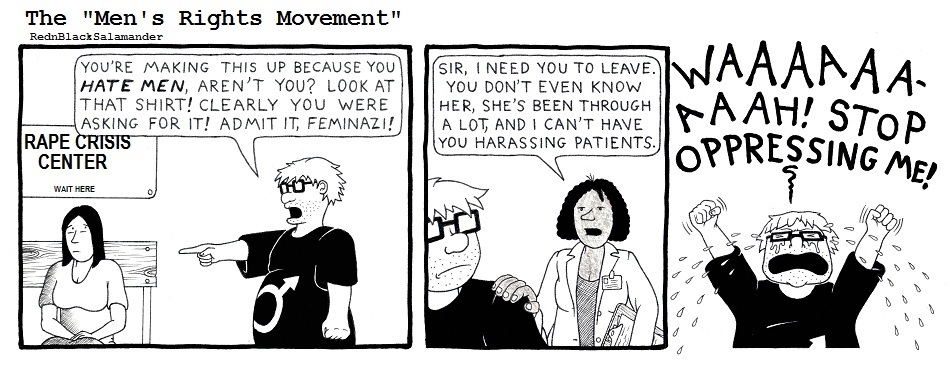
Retrieved from this site
Elliot Rodger’s story is also garnering national attention, including his manifesto where he declares his hatred of women and need to enact revenge through murder. Despite such plain, obvious language, some people have come to Rodger’s defense by displacing blame from his white, male privilege to mental illness. One of my colleagues at USC, Francesca Marie Smith, argued that mental illness can be used as an argumentative strategy to undermine the culpable of agents in a given situation. Examining the 2011 shooting of Gabby Giffords, she concluded that a focus on the mental capacity of Jared Lee Loughner derailed larger conversations about the societal pressures and political polarization that may have fueled the attack.

Elliot should not be memorialized, lauded, made a hero, or removed from blame. This was a calculated, terrorist attack on women as a whole because he had been told “no.” He believed he had a right to the female body as sexual property and projected his own shortcomings on the failure of (female) others. People should not watch his videos or read his manifesto: let us not immortalize a misogynist who decided to take life instead of realize the privilege in his own.

Retrieved from this site
These two stories began and ended very differently. Tal has certainly upset people with his lack of awareness and care for the stories of others, but Elliot has murdered. I do not wish to equate these stories; I am not making claims about “all men.” I am instead commenting on the attributes that they share and what this says about our society.

Both are inherently linked to race and gender, because they laud the white, male perspective over all other bodies. Yes, Elliot was mixed race, but there is no denying his feelings of privilege and superiority that accompany this perspective. Both believe in the power of their privileged body to make decisions and that they have the right to remove of agency from others. Tal and Elliot are not allowed to be told “no,” especially not by people of color or women. Tal cannot be told to “check his privilege” and Elliot cannot be denied sex. These are the autonomous decisions of others that put into question the privilege that Tal and Elliot could not even recognize they had (being blind to their own condition and the conditions of others). 

Retrieved from this site
These men are just two chapters in the larger story of a society that allows their privilege to continue unabated, that celebrates and defends them, and that prevents us from looking inward at our own complicity. If it the fault of people who question Tal’s struggle, Elliot’s mental condition, or my inebriation, then society as a whole is declared “not guilty.” We can live in the façade of a world where these events are mere peppered outliers in a properly functioning society, instead of symptoms of a diseased organism. Walking down the street or taking public transportation is an opportunity for women to be yelled at, groped, followed, threatened, or even worse. Even spending time with trusted friends and family members can lead to the violation of the female body. Althusser's police officer defines the power structure and everyone's position in it by addressing someone, "Hey you!" When I walk down the street and am called "bitch" while being grabbed from behind, that also defines me without my permission, reaction, or ability to subvert.

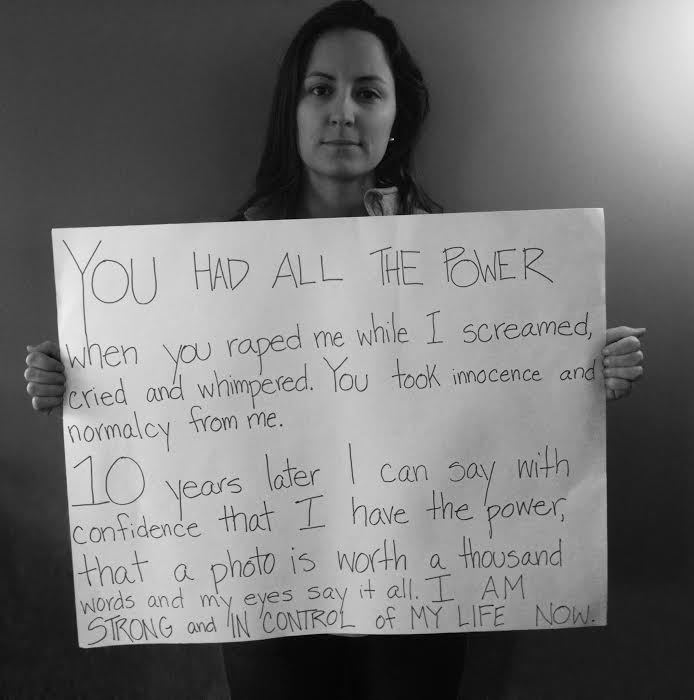
Many more stories of struggle and healing at Project Unbreakable
We cannot let these stories be drowned out by the mob quick to defend the current system. We must give space and attention to those that are fighting for change and awareness of larger issues. We perhaps cannot change the minds of current misogynists or denialists who will resist at all costs the crumbling of the society that preferences them. But, with increased effort, we may be able to usher in new generations brought up in a society that recognizes the issues that face the majority of us and fosters a culture that is actively trying to change it.

Sunday, April 20, 2014

The Weak and the High Maintenance: Female Stereotypes in Advertising

This was not the intended blog post for this Sunday, but a few recent advertisements have been on my mind, recently. Their repetition on the TV channels I watch and on Hulu has increasingly bothered me in their portrayal of the female. I will link to them both here and then discuss the problems that emerge in the persistent stereotyping (especially gender stereotyping) that occurs in media.

The first commercial is from Verizon, which advertises that if you buy a phone, you'll get a second free. Then, the commercial explores various options for who the second phone should be given to. Attempting humor, the commercial proposes that a girlfriend may enjoy the free phone, "but don't tell her that it's free." The face of the female fades from happy to disgruntled. This commercial plays on the "high maintenance" girlfriend trope where females are not happy or satisfied unless a lot of money has been spent. Shows such as Bridezillas, MTV True Life, arguably every Real Housewives version, emphasize this theme of women as spoiled, needing immediate and constant care, and focused on the material. These stereotypes overpower a more dimensional representation of the female outside of material goods and characterize all women as high maintenance. This description itself is inherently offensive. One's provides maintenance to a car or an object, not to a person. There is the association with a female as an accessory, a tool, an object needing maintenance, improvement, and upgrades in order to function. This also implies that the partner (oftentimes male) in the relationship is the only one with purchasing power. This clip from Bridezillas, featuring Remy and Rob, illustrates the dynamic quite well.


The Verizon commercial bother me, because it ignites these stereotypes as women as only valuing the material, lacking purchasing power, and only superficially strong in their demand of items they cannot provide for themselves. Even in the portrayal of strong women who declare they deserve certain items or treatment, there is an underlying weakness in the women who rely on others for self-validation, respect, and attention.

The second commercial focuses more on the vegetarian as weak, but the non-present character is given a female gender. This is a commercial from Walmart about setting a table for an Easter lunch. The planner describes why certain people are placed in certain spots noting that her vegetarian sister is at the opposite end of the table "so she can't see the ham." My first reaction was one of disgust that a commercial would rely on stereotyping vegetarians as too weak to even see meat. Though this is just a small statement, a lot of information is imparted in a short amount of time to the viewer. The audience is surely meant to consider the planner quite respectful. But, the implications are that vegetarians (and perhaps specifically female ones) cannot stomach the sight of food they cannot consume.

Both of these commercials highlight the importance of stereotyping in the world of advertising. When a company has only 30 seconds to compare one's attention and express the benefits of a product or service, stereotyping is a potential strategy. Originally conceptualized as the images that one sees in one's head, stereotyping is now defined as a mental shortcut that associates certain characteristics with others. There are racial, gender, ethnic, religious, political, and geographic stereotypes, all which connect a person to a host of underlying associations. Stereotyping makes sense if one's goal is to impart information as quickly and as succinctly as possible. The human brain is lazy and would rather use mental shortcuts to absorb, process, and respond to information. Popkin called this "low information rationality" where people tend to use the least amount of information possible to make their decisions. He connected this specifically to voting, where people may vote in elections based solely on a party affiliation, a rumor about a candidate, or even their aesthetic appearance over delving in deeply into issues and more complex information.

Apologies for the video quality. South Park's "Museum of Tolerance"

Though stereotyping may make sense for advertisers, other media theories, such as cultivation, encourage us to reconsider the potential consequences of long term, frequent consumption of media tropes. If females are consistently portrayed as weak, high maintenance, powerless, vulnerable, and other "feminine" characteristics, how can we expect a new generation that is more open to feminism and equality? There are certainly many factors that influence people's attitudes, opinions, and behaviors, but it may not be surprising that a media that reflects and stereotypes females in such as way may also be contributing to other gender-based issues. There are many examples I could pull from, but I will encourage people to look at this video from Fox News about women being paid "what they're worth."

Monday, March 24, 2014

Sticky Reputations by Gary Alan Fine: Book Review

When folk singer Peter Seeger died in late January of this year, people were quick to mourn the loss of an American folk legend and activist. People now fondly remember and honor his legacy, but, in the 1950s, Seeger’s reputation was far from respected. “Seeger’s institutional enshrinement is striking when contrasted with his vilification as a political subversive during the McCarthy era” (p. 92). Though Seeger’s historical associations with the party and his testimony at the House Un-American Activities Committee had not changed, public memory of them has. What accounts for these drastic changes in how society remembers individuals? What do consistency and change in reputations tells us about collective memories and societal values?

Retrieved from ABC News

In Sticky Reputations: The Politics of Collective Memory in Midcentury America, Gary Alan Fine explores these issues of individual reputations, group dynamics, collective memory, and political commemoration. Fine approaches issues of memory from a sociological and historical approach, focusing on descriptions of events and the social and dynamic responses to them. Midcentury America encompasses the years between 1935 and 1955, a time of unease and fears about home-grown terrorism. Often referred to as the “McCarthy era”, this narrow time frame still allows for detailed insight into how memory functions politically. Fine’s main contribution to the study of memory is the reliance on and explicating of reputations as imperative to understanding groups, political maneuverings, and a time period. Representatives of and experts in these categories shape collective memories of history. In some cases, memories live on and affect current policy, such as the pervasive metaphor of the Red Scare. Other memories may be forgotten, such as Seeger’s past or the Brown Scare.  How society remembers individuals is a collective process that reflects the memories of groups, institutions, history, and our roles within society. These reputations outlive the individual attached to them, creating varying levels of “stickiness” that continue to resonate and have influence over time.

Sticky Reputations begins by outlining the major themes of reputation, collective memory, and American politics. Fine argues for the lasting importance of individuals and, more importantly, the memory of them that transcends their material being. He begins by describing the quality of memories as interconnected through time. Memories are chained together and influence one another with varying consequences. How society chooses to remember, or is influenced into remembering by institutions, is often due to previous memory “work” that guides how society can and should remember the past.

The book could roughly be divided by its treatment of shifting and sticky reputations. Shifting reputations are ones that change or are modified over time, while sticky ones are immutable and immune to modification. To represent shifting reputations, Fine explores how the Jewish community was once stereotyped as members of the Communist Party. Despite their original association with communism in the 1930s, by the 1950s, “the perceptual linkage . . .  had largely vanished” (p. 23).  The Jewish community’s reputation also changed as individuals broke patterns of association and revealed discrepancies in perceptions of the group. Although the reputations of individuals shifted Jews away from a negative association, some reputations shift group identifications towards one. Fine explores how the demonization of a prominent American First Committee member, Charles Lindberg, and his actions tainted the entire organization. The explanation for Seeger’s memory transformation did not go from individual to group, but instead was a transformation of the same memory over time. In Seeger’s case, “memory agents” actively worked to adjust his reputation and “purified” his reputation (p. 92). Others, such as Elia Kazan, reveal that reputations are “historically unpredictable” (p. 108).

Fine also notes the dichotomy between presence and absence of memory as oversimplified. Using the Brown Scare and Red Scare, Fine explores how these events are equated through metaphor, but the Brown Scare is often lost in history. Oftentimes, the “presence of absence” still carries meaning in politics and, in this case, perceptions of home-grown terrorism. The borrowing of the term “scare” is meant to draw parallels, in part to equate the situation, severity, and needed reaction to extreme right affiliations as with extreme left ones. The fact that the Brown Scare has been lost in public memory indicates a potential misalignment in naming, or perhaps mirrors the more salient threat that people felt from communism than fascism. Though the Brown Scare was important and legitimate at the time, collective memory has forgotten it and only the Red Scare “has entered into American historical consciousness” (p. 80).

Retrieved from this blog
The final chapter returns to the book’s title and discusses Adolf Hitler as the quintessential sticky reputation. Sticky reputations resist change, argument, and transcend individual actions to encompass entire value systems. These types of reputations can be positive or negative. Fine argues that Dr. Martin Luther King, Jr. represents a positive sticky reputation, where criticisms of him are seen as attacks on his work and civil rights, in general. King is now a stand-in for the larger movement, so one is unable to criticize him without criticizing the legacy of civil rights in America. Similarly, negative reputations mean that one cannot reclaim anything positive from Hitler (such as the Nazi health care system) without risking the glorification of the Holocaust. Sticky reputations mean that the individual cannot be separated from values, groups, and the unfolding of history.

Outside of the shifting and sticky aspects of reputation, Fine also explores the nature of expertise and the role of celebrity in political activism. In analyzing the “Who Lost China?” debate, Fine provides a useful framework for qualifying reputation as a combination of qualifications, influence, and innocence. Innocence is perhaps the most complicated term, as it implies that in order for reputations to be considered “experts,” they must be free of any guilty associations with the parties involved. Instead of using the term “unbiased,” Fine connects the potential influence of institutions and politics on experts as guilty, unclean, and impure practices. Only individuals that can maintain a pure, professional relationship with mitigating factors are experts capable of testifying, such as on the economic and political factors in China. Fine also address the politicization of celebrity through a discussion of Hollywood blacklisting. He questions the validity of considering celebrities as political agents who should be held accountable for opinions to the government, the public, and their industry. Using Lilian Gish as an example, Fine traces her film career with her political activism, noting her shifts in political affiliation as leading to her being blacklisted.

Overall, the thread of reputations could be more strongly connected throughout the chapters. All of the chapters touch upon these themes, but they can be disjointed in their continuation of previous chapters and transition to subsequent ones. The common theme of a time period does not entirely succeed in linking these separate, discrete investigations of collective memory and reputations. The book might better be called Reputations without a qualifier, for the lack of a consistent theme of stickiness. The common themes more closely run between memory, how it is socialized, and how people and groups are remembered. The brevity of chapters also leave less than adequate room for the full discussion of these historical events, which is exacerbated by the occasional enumeration of  potential standards and norms for evaluating collective memories. The scholar interested in collective memory and how exemplars can change the course of history will be quite pleased with Sticky Reputations. This book will also appeal to scholars interested in the political aspects of this era of American history. Though unified by common themes of memory and reputation, this book would also serve well as chapter case studies of how memory, and particular characteristics of it, functioned politically in American history. Fine puts forth many illuminating points about the role of the individual and how their reputation has unforeseen influences on their group memberships, political affiliations, American policy, social movements, and modern memory of history. The narrow time frame does not restrict as much as allows Fine to contextualize an important part of American history and allow the audience to find similarities in today’s heightened terror levels and the unease of political threats.

Retrieved from Photoreading


Although the flowers, young girls, and young men may be gone, their reputations will live on, sticking in varying degrees to public memory of history and American identity. Seeger’s reputation changed, allowing for his songs and activism to become synonymous with American values of protest and freedom. Others cannot be appropriated no matter the amount of memory work performed. These sticky reputations reverberate through time and affect group identification, advocacy of certain policies, and collective memory of American history. America remembers itself and finds a place in society by commemorating its exemplary individuals, their actions, and how they transcended history. Fine argues that these aspects of memory combine and chain together to do more than just influence memory; they affect how society remakes itself in the present through comparison with history. How America remembers itself and how contemporary society functions are directly and irrevocably linked to identity formation in the present. Which reputations stick and which are subject to change is an opportunity for inquiry that Fine prompts all scholars of memory and history to consider. For now, only time will tell what reputations stick in the minds of the American public and which are absent from collective memory, with yet unforeseen consequences.

Sunday, March 16, 2014

Thin Privilege and LGBTQ Issues: Discrimination based on Choice

There has been a recent surge in websites, blogs, and tumblrs that deal with "Thin Privilege." These sites have also spawned spoof or parody sites  which have in turn encouraged reaction sites. In the back-and-forth on these websites that I have followed, I would like to comment on a common theme which I think connects issues of health and bodies to the LGBTQ community: choice. First, I will explain these communities then I will draw from examples from each and compare them through Burke's pentad as revolving around agency and choice.

Retrieved from this blog
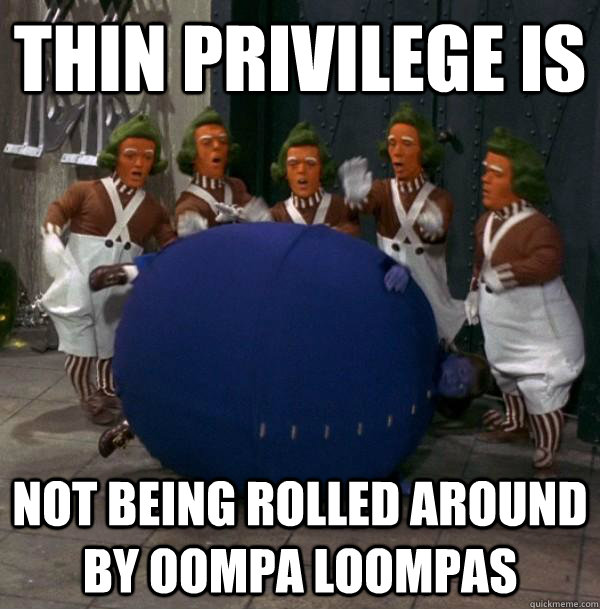
Thin Privilege reflects the advantages and benefits that come with being thin (or non-fat) in a society that values skinny bodies over large bodies. This has resulted in cultural and institutionally prejudices levied at non-thin people. Thisisthinprivilege.tumblr.com is dedicated to individuals sharing their personal stories of discrimination because of their size. Key themes are the idea that being large in body is associated with unhealthiness (which they argue is not necessarily true), being impacted by a lack of services available to them (such as the size of airplane seats), lacking role models in media, and experiencing fat stigma (e.g., strangers trying to give diet advice or calling names). The stories range from not being able to find clothing sizes in stores to having doctors ignore potential health issues because weight was a perceived larger concern. This site often posts "troll" questions and comments and critiques them as coming from a place of privilege or purposefully trying to undermine their cause. The key take-away from this site is that no one with privilege can deny others their claim to discrimination, police their language, or undermine their cause.

Retrieved from this blog as an example of skewed expectations and a world made for unrealistic body sizes.
From comments on these webpages, I found immense similarities to discussions of LGBTQ rights. The similarities center around the idea of choice. If one believes that being fat or being LGBTQ is a choice, they are more likely to be negative, critical, and dismissive of societal backlash that occurs for them. If one believes that these identifications happen naturally or are a product of the environment (e.g., hereditary/genetic), then one is more sympathetic to the effects experienced. This proclivity to blame the individual (agent) or the environment (scene) can be mapped onto Burke's pentad. The pentad is a tool that critic's can use to analyze situations in terms of its agent, agency, purpose, scene, and act. If the act performed is discrimination against someone, emphasizing the agent may cause one to believe that the recipient caused it themselves. Emphasizing the scene, however, may cause one to believe that society fosters discriminatory attitudes against minority communities. Papers I've been working on, influenced strongly by papers by Brock (1990), argue that these can be directly related to political ideology. Republicans may be more likely to consider the agent responsible (e.g., pull one up by one's bootstraps) and Democrats may be more likely to consider extenuating circumstances (e.g., how scenic factors influence one's actions and treatment).

Retrieved from this site
To consider a large person and a gay person autonomous agents that make choices about their identity is to remove environmental and societal factors from responsibility. This type of view undermines the culpability of institutions and those with normative privilege (e.g., thin and hetero-) for discrimination. Somehow, making a choice to do something as opposed to having it happen to you, makes one more deserving of disdain and scorn. Those who had no choice can be viewed as vulnerable, victims, and innocent. Analyzing these situations as similar help us to connect issues of discrimination and shared experiences of minorities against ableist/cis/hetero/white/male society. From within that community, it is hard to assign oneself culpability and guilt; people would rather blame the individual than admit shared responsibility for discrimination. Just as people were quick to yell "post-race!" with the election of Obama, people are quick to jump to answers that do not include our own or systemic faults.

Retrieved from this site to represent the traditional Barbie size to the new "real proportions" doll

How does society move beyond discrimination? I think it's important for those of us with privilege is to step back and truly listen to the words of those without privilege or those at the intersections. We cannot understand the discrimination not having been privy to it. Trying to deny the stories of others or to argue with our own stories of discrimination only perpetuates structural inequalities. Just consider the backlash that happened when a new Barbie copy with "realistic proportions" came out that would encourage girls to idolize being unhealthy. Instead, why can we not consider these positive steps to creating a more inclusive culture that teaches people to love and respect their own bodies, no matter its size? ThisisThinPrivilege.tumblr.com is fighting against other blogs and the system that devalues fat bodies. Though this article is not meant to be evaluative, it cannot help but reach the conclusion that to reduce people's identities to arbitrary choices is to undermine the perpetual problem of discrimination. As posted on the website, people are fighting a system that "systematically reduces each of us to our dress size, hip measurement, and waist size, then grants favors, opportunities, or simple lack of punishment when the numbers are low enough" and instead fights for a system that treats everyone as equally human.

Sunday, February 9, 2014

USC Fence and Visibility Politics

Retrieved from Change.org
Responding to security concerns regarding an on-campus shooting in the fall of 2012, the University of Southern California (USC) built a chain-link fence around its campus for the start of the 2013 spring semester. The main section of USC’s University Park Campus was enclosed and ushered in with it new security protocols. Previously, the campus was a free space to walk through at any time of day. Now, anyone wishing to enter campus must negotiate the new openings around the fence. USC affiliates and visitors alike are subject to the gaze of security guards who check identification at specified gate entrances after 9pm. In spite of USC’s presence that extends outside of the main campus area, community members and non-USC affiliates are restricted from accessing campus spaces. The previously unfettered access of the community to campus spaces has been replaced by prominent visual and physical barrier to movement and agency.

The fence has been justified as a security measure to protect students on campus during certain hours. USC does have a primary importance in protecting its students, but choosing to isolate community members because of a few representatives influences the entire community. The consequence of such a symbolic action is to conflate a few violent individuals with the community and to reinforce narratives that off-campus spaces are not safe. This physical division operates as a linguistic turn from the USC community to USC vs. the community. This “us vs. them” mentality occurs through labeling the community as separate from USC affiliates. Carrying a USC ID card provides one access; without it, bodies are turned away and disciplined from entering. In creating this distinction, the community is labeled as violent, criminals, trespassers, unwelcome, and the other. “These names shape our relations with our fellows. They prepare us for some functions and against others, for or against the persons representing these functions. The names go further: they suggest how you shall be for or against” (Burke, 1984, p. 4). The fence helps establish hierarchies in naming that teach USC affiliates how to respond to and treat community members. These rules only operate between 9pm and 6am, but the labels last longer. Symbolic naming reconstructs the relationship between the community and USC that cannot be changed by the hour of the day.           
Foucault's Panopticon as surveillance
In restricting the movement of the body, USC also controls when those bodies can be seen, have a presence, and occupy certain spaces. Control over the body, or biopower and biopolitics, is a power over the movement of the body, its ability to be seen, and to be heard (Foucault, 1982; Hollinshead, 1999). Casper and Moore (2009) refer to “hysterical blindness” where institutions or people either choose not to or are somehow restricted from seeing or being seen (p. 10). “Hypervisuality” is this opposite, where people are targeted, heavily observed, and monitored (Casper & Moore, 2009, p. 10). This “complex system” of sight and obstruction means that powerful political entities can control who can see and who is seen (Casper & Moore, 2009, p. 10). At USC, bodies of students become marked, by carrying a marked ID, and those of community members unmarked as the “other,” not welcome within campus spaces (Phelan, 2004). Visitors to campus can apply for single-entry access for a specific purpose, creating a temporary mark of approval and access by institutions of power. The body receives either acceptance or denial at the fence border based on its membership in the Trojan Family. As Greg Dickinson (2002) notes, “the subject comes to known itself in some more or less coherent way depends on an ability to locate itself” (p. 7). Locating oneself either inside or outside of the campus borders changes how one defines membership, identity, and body autonomy. Knowledge of surveillance by guards also contributes to one’s ability to locate oneself within the political power structure as a target or threat worth monitoring.

There are concerns that these policies endanger community members while offering little extra protection for USC. Vice President of Student Affairs Michael Jackson published an updated campus policy online that said, “We are taking these steps because we care about the security and safety of our students, faculty, staff, guests and neighbors” (para. 4). It is an interesting rhetorical decision to separate “guests” of USC from its “neighbors,” but certainly these are fluctuating categories. The real importance in this statement is that somehow the construction of the fence will not only add protection for USC affiliates but also to the community members. To the contrary, the Los Angeles Times reported on January 13th, 2013, that blocking the USC campus off from non-students, faculty, and staff poses a risk to community members. For example, community members exiting the Exposition/USC stop on the new Metro Expo line used to be able to walk through “the safe, well-lit shortcut through campus” to catch buses at prominent Jefferson Boulevard stops (Jennings & Xia, 2013, para. 9). Now, community members have to circle the entire USC campus or change their regularly traveled public transportation routes home. The construction of the fence not only places the community under additional surveillance, but it also directly influences the movements of the community, with yet unseen benefits for USC. A Daily Trojan letter to the editor echoed these concerns noting that “as a university we should not sacrifice freedom of movement for relatively little or no added security” (Brown, 2013, para. 4).

Though erected and implemented for supposed safety and benefit, borders oftentimes exacerbate economic, class, and racial divides by establishing rhetorical divisions in identity and membership. How bodies are restricted in their movement, displaced, or undervalued also restricts voice and visibility in terms of the powerful and the powerless. Surveillance, monitoring, and the construction of boundaries are all ways that bodies are disciplined and controlled. These barriers to full cooperation and integration, both physical and symbolic, construct an environment where identity is defined through one’s relationship with institutions of power. USC’s fence highlights the modern implications of race, borders, and visibility, where hierarchies still enact biopower and violate political autonomy. 
Retrieved from Mutual Responsibility
A Change.org petition has been started to “Take down the USC gates.” This petition notes the importance of welcoming, opening spaces, and condemn the “us vs them” mentality that the fence represents. The petition includes a space for comments and a letter addressed to USC President Max Nikias and the Provost Elizabeth Garrett. The petition is nearing the 500 signatures needed to be sent to Nikias and Garrett. The power of such a petition may be limited in terms of practical changes, but the petition is itself symbolic that the USC community is in part against the policy instituted by the administration. A lack of student support and involvement, however, many indicate that many are already accustomed to the surveillance and limitations that it imposes. Some may be optimistic about the future of surveillance, but it appears that great action and effort to shift notions of visibility are needed to reclaim privacy and personal autonomy.

References
Brown, N. (2013, January 22). In response to security measures. Daily Trojan. Retrieved from http://dailytrojan.com/2013/01/22/letter-to-the-editor-75/
Burke, K. (1984). Attitudes toward history. Berkeley, CA: University of California Press.
Casper, M. J., & Moore, L. J. (2009). Missing bodies: The politics of visibility. New York, NY: New York University Press.
Dickinson, G. (2002). Joe’s rhetoric: Finding authenticity at Starbucks. Rhetoric Society Quarterly, 32(4), 5–27. doi:10.1080/02773940209391238
Foucault, M. (1982). The subject and power. Critical inquiry, 8(4), 777–795.
Foucault, M. (2012). The history of sexuality: An introduction. New York, NY: Random House Digital, Inc.
Hollinshead, K. (1999). Surveillance of the worlds of tourism: Foucault and the eye-of-power. Tourism Management, 20(1), 7–23. doi:10.1016/S0261-5177(98)00090-9
Jennings, A., & Xia, R. (2013, January 15). USC rolls out the unwelcome mat. Los Angeles Times. Retrieved from http://articles.latimes.com/2013/jan/15/local/la-me-usc-safety-20130116
Phelan, P. (2004). Unmarked: The politics of performance. New York, NY: Routledge.