Showing posts with label Rhetoric. Show all posts

Sunday, September 13, 2015

"The Visit," Race, and Disability

I recently saw a pre-screening of M. Night Shyamalan's "The Visit" at USC. I was excited to see the film because the trailer looked creepy and, as others have noted, this was potentially a epic comeback for the director. I am a fan of horror movies, so even without the hype, I probably would have gone to see it. I have to say that while it is better than many of Shyamalan's movies, I was very disappointed with the film. I am not going to "spoil" the cliché Shyamalan twist, but address the three main problems I had with the film.  First, I will address my small concerns about the flow of the movie and its stylistic choices. I also was concerned by its attempts to corner the "comedy horror" genre through racial appropriation. Finally, I find problematic the use of disability as the catalyst for shock moments. Although there are no spoilers, I will discuss some scenes of the film in detail.


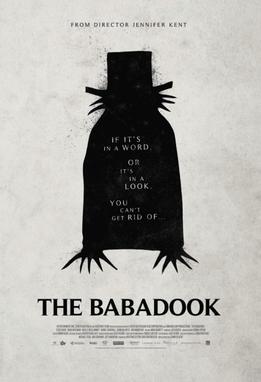
The appeal of the first-person, found footage horror films has waned for me. Original uses, such as the Blair Witch Project, were pioneers in filmmaking style. Other films made great use of the medium, such as the V/H/S series. I also found that this style worked for the gritty and entertaining As Above So Below. For most movies, however, I feel that the found footage genre reduces the thrills that it tries to engage. The camera angles and the following of the drama is completely limited by one of the characters moving it or its placement in a fixed position. Thus, the camera is either a static frame or is missing a character. Because the camera reacts with the character, frightening sequences are often cut short. In The Visit, the two children often interrupt or come across their grandma in various aggressive or startling actions. The audience, however, gets barely a glimpse before the main characters run away in fear. What could be longer, thrilling scenes turn into brief "shock" moments where the music amps up and something flashes before the screen. This type of horror tricks seems quite overplayed, where there are far more intriguing moments of horror in present day films. I hope to discuss It Follows more in an upcoming post, but I will note briefly here that it makes fabulous use of every day activities and long scenes where there is immense building of terror and suspense. Another great contemporary example is The Babadook, where the female protagonist bravely encounters the ghoul in her home in long, terrifying battle, instead of a brief flash in a window or doorway.

Image retrieved from Wikipedia
Image retrieved from this site.

Now that I've indulged my pure opinions on the horror genre, I will now engage more theoretically motivated concerns. While I did find The Visit funny (Katy Perry!), the humor was mostly nested in appropriating black culture and the juxtaposition between freestyle culture and a young, white boy. The younger brother in the film, Tyler, adopts the style, mannerisms, and attitude of black culture for the purpose of comedic relief. Comedy and horror often go together. For example, the iconic Evil Dead series could seamlessly make you laugh while you were terrified and a bit uneasy. This is epitomized in the Evil Dead 2 (my favorite of the series) scene in which the items in the cabin start laughing along with Ash - frightening and yet you cannot help but laugh along. Another one of my favorite horror films, Cabin in the Woods, makes you pause for reflecting at our own fascination with horror. The office party scene epitomizes the movie's brilliant satire work (and its opening is delightfully Funny Games-esque). Instead, the comedy in The Visit is pure relief, with no purpose behind it but to distract from what we just saw (brief as it already was) or poke fun at the disabled grandparents. I will discuss more about the grandparents later, but first I want to further discuss Tyler's character.

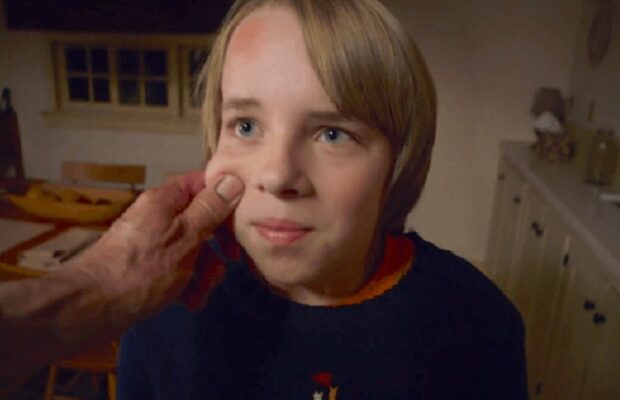
Image of Tyler in The Visit. Retrieved from this site.
The character is quite sweet and has his vulnerable moments where he seeks his sister's comfort. More often than not, Tyler draws his strength through his impersonation of black culture. As The Wrap's review noted, scenes where Tyler raps about women and sex are "burp[s] of coarse comedy." They seem out of place and forced, as if the only thing funny about the situation is that a young white boy might imitate gangster culture. This imitation, however, appropriates a different culture and undermines its history and purpose. The scene where Tyler raps on the train next to a black men, who is a worker on the train, is truly cringe-worthy. Kenneth Burke called this "perspective by incongruity" - where a word is applied in a completely new context and given a new meaning. What was once a unique part of black culture is now applied in a different context - a juxtaposition that creates humor. The humor is crude and appropriates black culture and further distracts from what could have been intriguing horror scenes.

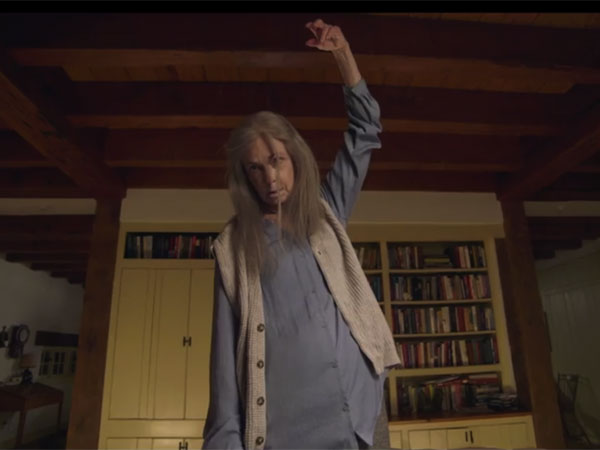
Terror - supposedly, from a scene in The Visit. Retrieved from this site.
More central to the plot of the film is the mental and physical condition of the grandparents. The mother, who they Skype with, frequently brush off erratic behavior as "old people problems" and nothing out of the ordinary. Incontinence, memory loss, confusion, and generally odd behaviors are boiled down to "normal" plights of the elderly. Natural, elderly bodies become a source of scorn and disgust because of there differing abilities. In one scene, Tyler follows his grandfather to a hut, where Tyler thinks he is hiding "secrets." To recall the horror of "what's in the box?" among this reveal is truly embarrassing. The hut does not contain dismembered bodies, secret writings, or clues to a great family mystery. Instead, it contains the grandfather's incontinent diapers. The thrilling sequence of entering the space and watching for the grandfather's return is let down by the "big reveal." At points, I felt quite bad for the grandparents, who were constantly pestered by the granddaughter, Rebecca's, video camera. In an interview with the grandmother, Rebecca repeatedly asked her what happened on the day Rebecca's mother left the house. The grandmother responded many times with sadness, confusion, and aggressive outbursts; this event had obviously caused her great stress and trauma. I felt pity where Shyamalan wanted me to be frightened. But, I wasn't. I wasn't frightened by the effects of aging and sometimes erratic confusion caused by people who may have Alzheimer's or another disorder.

The "evil" in the film is simply that: being old. There is no evil spirit, motivated killer, or other source of evil besides the mentally and physically disabled. And that is a horror trope I simply cannot support: that the elderly and differently-abled are a source of evil and horror. Shyamalan sets up the elderly as the "other"; the ones against which the main characters (and thus the audience) contrasts our identity. But, one day, we may all experience these same problems and I hope that we are met with comfort and appreciation instead of fear and isolation. For those who have seen the movie, I am aware that there is more going on than simple aging. Despite this fact, I believe that this film constructs a rhetorical framework that isolates the elderly and reifies ability as normal.

Sunday, April 12, 2015

Lay me Down in Indiana: Discrimination against the LGBTQ Community

There is a song I keep playing and have been since it was released: Sam Smith's "Lay Me Down." His voice is very powerful and the feelings of loss and love resonated with me. It was only recently, though, that I watched the music video and the deeper meaning of Smith's question "Can I lay by your side?" made sense to me.


Lloyd Bitzer argued that people speak when called to by their rhetorical situation. Smith's music video shows three distinct situations where the same question functions in drastically different ways. The rhetorical situation can be made up of scenic element such as the time, setting, and location, but it also extends to the historical moment, audience, and any urgent events that require (or command) speaking. The first rhetorical situation is a funeral, the second is a wedding ceremony, and the third is a church pew. They all take place in the same physical setting - a church - with the same questions posed by Smith, but are startlingly different rhetorical situations. Note the cross earrings that Smith wears throughout the video symbolizing the importance of faith in the asking and answering of these questions.


In the first scene, Smith sings in front of a closed casket. A funeral often calls forth the epideictic style of speaking, or a eulogy where the dead are praised. The epideictic focuses on the present and makes real and meaningful the death in the past for the present coping of the loss. Smith asks what must be unanswered questions about the ability for him to reconnect physically and emotionally with the person who has passed. The answer is a resounding "no." Smith cannot make sure the person is alright or lay by their side again. Their new home is not among the living. It is unclear who he is mourning which removes the sexual connotations that the question "Can I lay by your side?" could potentially evoke. This scene illuminates the sorrow of loss and the frequent trope of wishing to hold and keep close those we have lost, despite the impossibility of it.


The second scene slowly transitions from a somber funeral to a celebratory wedding. This situation is also one of epideictic, but a loss is not made meaningful in the present, but it is instead a celebration and praise of a relationship, it's past, present, and future. Smith's words transition from a eulogy to wedding vows, where he is asking permission of his partner to cement their relationship legally, to lay by his side and be his protector and keeper. Historically, the wedding night would be the first night of the relationship where couples spent the night. Although not often the case today, the question still poses symbolic connotations of a new stage in the relationship that solidifies monogamy, commitment, and physical compatibility. It should be noted that Smith's partner in the music video and reality is a man. This scene, thus, also carries political connotations surrounding the love and commitment between partners of any sex or gender that is legally allowed. The wedding guests are jumping with joy and dressed all in white in a stark comparison to the somber, black-clad mourning outfits.


This scene transitions, like the first scene, by the camera following a priest. Smith sits alone in a pew, again asking, "Can I lay by your side?" He looks up, pleading and asking his God or deity for permission. Can he perform such actions as a religious person? As a Christian? Is it morally appropriate, right, sinful? This scene poses the question: who has the power to regulate love and relationships? If one considers this scene the first scene chronologically, it is the story of a troubled man concerned about the morality of his sexuality. This scene shows his struggle with matching his desires, spiritually and physically. The assumption is that he overcomes these issues, finds faith and his sexuality compatible, and marries his partner in a religiously recognized church wedding. Then, he suffers the loss of his partner after an indeterminate amount of time and reflects on his series of questions that must once again be addressed to his love.


This music video and song are particularly poignant given the recent Indiana ruling that allows business owners to refuse service on the basis of religious grounds to members of the LGBTQ community. Similar to the Hobby Lobby decision, many are concerned that this ruling sets a dangerous precedent of discrimination as the norm and the dehumanization of certain people due to religious exemption. This reminds me of the recent approval of a ballot initiative in California that would make it legal to kill gay people.

Video made in response to the Indiana ruling

Music has become a prominent way for artists and people to gain more information and express themselves surrounding issues of homosexuality and sexuality. From Macklemore's Same Love, Arcade Fire's We Exist, Hozier's Take me to Church, and many others, music is a realm of public deliberation where the relationship between religion and sexuality is being discussed. With what consequences, we cannot say now, but I am hopeful that the proliferation of representation will not exploit this community but instead provide the opportunity to share their stories.

Sunday, November 16, 2014

Arguing Monuments and Material Rhetoric

The concept of "materiality" and how physical objects argue is becoming popular in rhetorical criticism. Scholars are beginning to theorize that buildings, cities, monuments, and other physical objects can argue, influence people, and tell stories -- just like words. The history of "the material turn" is quiet expansive (as I've discovered while writing my dissertation about it), but I will summarize some key points before discussing examples.

Traditional rhetorical criticism focused on the speeches of great orators and analyzed the word choices and potential effects. Scholars slowly began to incorporate other objects of study like groups of speakers, genres of speeches, and non-elite speakers. These variations still focused on the spoken and written word, however. Larger changes emerged when scholars began looking at how physical spaces constrain or offer opportunities in the way that speeches invite or construct possibilities for audiences. Moving through a space that has physical obstacles is similar to spoken commands or laws that restrict movement. Physical spaces and objects can themselves be symbols (like words) that have embedded meaning, affect, and significance. Materiality invites audience participation and makes arguments.

The first example of arguing monuments is the Portrait Monument at the US Capitol. The marble monument shows three elegant busts of prominent women in the women's suffrage movement: Elizabeth Cady Stanton, Susan B. Anthony, and Lucretia Mott. There is room for a fourth bust in a lump of un-carved stone in the rear of the monument.

Picture retrieved from Architect of the Capitol
This monument makes a clear argument that the work of women's rights is unfinished. There may have been great women in the past who deserve to be honored, but there is still the need for activism, activists, and progress. Furthermore, viewers of the monument are invited to honor the memories of these three great women by continuing on their work. Their memories do not invoke a sense of completeness or finality; their faces encourage the audience to ask, "what more can be done?" Some people have thought that the unfinished section is meant to be completed when the US elects the first female President. This, however, goes against the intention of the artist, Adelaide Johnson, to show the perpetually unsolved state of gender equality.

Another example is the Atheism bench. This monument is the first public monument to atheism, or a lack of belief in divinity. The American Atheists lost a court case to have a monument to the Ten Commandments removed from a Florida Courthouse. Instead of removing the monument, the court offered them the opportunity to build their own monument. The monument is a bench so as to be a functional piece of public display. It is covered in quotations that specifically mention religion and the American political and legal systems.

Picture retrieved from Time Magazine
The Atheism bench claims space for non-belief outside of a courtroom that, like Lady Liberty, should be blind to concerns of religion. The bench argues that religious belief should not be a factor in the courts. The bench also argues that public space should be free and open space where no ideas should dominate and none should be excluded. The bench also includes, in writing "consequences of breaking the Ten Commandments" as a direct verbal argument against the Ten Commandments monument displayed on the other end of the courthouse.

These are just two examples of how physical spaces can produce arguments. Oftentimes, memorials are coupled with verbal statements, like the Atheism bench, but it is important for scholars to note that images, monuments, and material things can produce independent, standalone arguments.

Sunday, September 28, 2014

Using Religion as a Negative Characteristic

Due to my prospectus deadline looming, this week will have to be a short introduction to a topic that has been on my radar for some time. This trend that I have noticed, mainly in denialist rhetoric, uses religion as a negative characteristic that typifies history or science as "fantastic," "not to be trusted," or based solely on "belief" instead of fact.

Image retrieved from this site.
I am currently working on a paper that links the denialist strategies of Holocaust-denialists, climate-deniers, and creationists (evolution-deniers). This paper will explore the strategic arguments made by each group and the potential means to address them. Although it will not directly address this phenomenon, the frequent presence of "religion" as a negative characteristic has prompted my attention. I hope that this brief inquiry, which will be continued in another post or paper, will delve into these characteristics and this odd, recurrent rhetorical pattern.

One Holocaust-denial page (http://expeltheparasite.com/2013/10/28/the-holocaust-hoax-it-never-happened/) argued that Holocaust-confirmers are wedded to their story of history with a religious fervor. The website argued:
"My guess is that people believe the hoax because they want to believe. It fills some deep emotional need—perhaps to overcome a sense of inferiority compared to the Germans, or to somehow join the dominant group in society. The exact answer is beyond any understanding of this writer—but it is an enormously important question nonetheless in the same way that one should try to understand why people believe in religion. Holocaust belief is a kind of new religion—as irrational and ridiculous as any other religion but enormously appealing. For those who have not totally lost their minds, the following reasons for rejecting the hoax may have meaning" (para. 8).
Belief in religion is characterized as "irrational and ridiculous" despite the author's many Christian symbols, crosses, and references to Christ's sacrifice for the good of the white race.

Image retrieved from this site.
Climate deniers are also quite often religious and base their opposition to environmental protection on Christian teachings. The Cornwall Alliance (CA) is a religiously motivated group that denies the importance of climate change and its consequences as distracting from God's true work. Dr. Calvin Beisner, founder of the CA wrote, “religion is the root of any culture, and environmentalism has become a full-fledged religion in its own right. It is the most comprehensive substitute in the world today for Christianity so far as worldview, theology, ethics, politics, economics, and science are concerned” (Beisner, 2013, p. 1). He described environmentalism, or a focus and care on the environment, as a religion, based not on science, but on faith.

I've written about the Institute for Creation Research (ICR) before regarding a conference paper. The paper focused on ICR's magazine, Acts & Facts, that presents research done in their institute that proves creationism. They advertise their magazine as a tool “to counter the lies of evolution” and include education as one of the three prongs of their mission (along with research and communication). ICR undermines evolutionary science as “conflicting with biblical Christianity” and “detractors” to the true worldview (“Creationist Worldview,” para. 4; 6). They publish research articles that support creationism and also interest pieces about political, social, and cultural issues. In an article about education, author Henry Morris  (1973) wrote, “One of the most amazing phenomena in the histoy of education is that a speculative philosophy based on no true scientific evidence could have been universally adopted and taught as scientific fact” (para. 1). He described evolution as a philosophy that worships that religion of naturalism and humanism. Evolution is “the established religion of the state” that has excluded competing voices because they fear the truth (Morris, 1973, para. 4). Evolution, often called "Darwinism," is a religion that worships Darwin as a deity that scientists follow blindly.

Image retrieved from this site.


The extreme irony here is that groups who deny history or science (such as Neo-Nazis, creationists, and climate-deniers) are often themselves deeply religious, namely Christian. What is the logic in using religion as a negative characteristic when one follows religion oneself? It seems hypocritical for religious groups to undermine their opponents by trying to paint them as religious. In one sense, this places both sides on an equal playing field, treated both as beliefs that should be respected. Another possibility is that by reducing the opposing side to religion, the deniers can claim scientific superiority. Though they may rely on religion in their own beliefs, many groups understand the persuasive and authoritative power of evidence, models, and rationality.

Sunday, September 7, 2014

The Online Activist: Making Charity Cold as Ice

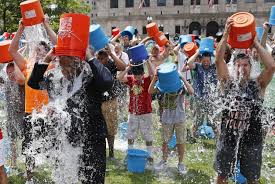
There have been many commentaries on the ALS Ice Bucket Challenge, hereafter IBC, including some by my colleagues at Annenberg. I have very mixed feelings about the challenge and they are quite scattered. I will attempt, then, to parse some of my more scholarly opinions on the matter in my overall criticism of the challenge as an event in narcissism and exploitation that has ultimately generated a lot of money for a great cause. In this sentence, I want it to be clear that the process by which these donations are raised is where my primary concern lies and not with the cause itself. Certainly, encouraging donations is a positive enterprise, but I am not completely deontological in that I feel that a critical look at the process and means by which these are obtained are necessary.
Retrieved from this site.
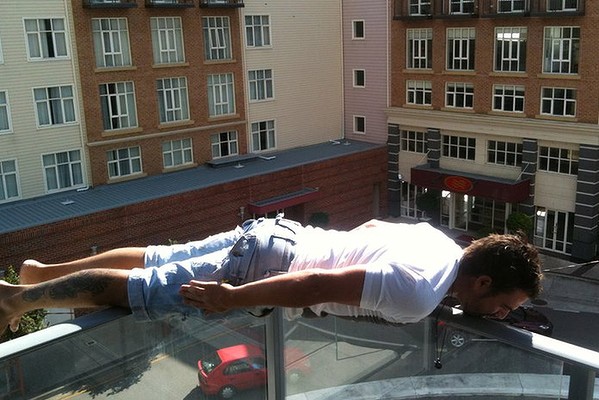
My first issue with the IBC is the notion of "challenge." There has been an increase of challenge and dare activities on the Internet where people are constantly trying to one-up each other. We had planking, for example, where people would try and lie supine on random objects, often in danger. The more dangerous or precarious the planking, the more valuable in terms of Internet clout. Then, came the video challenges by which people were dared to do something inherently dangerous, like jump off a bridge. Not surprisingly, this resulted in the deaths of a few people after drowning trying to meet the dare. Though meant as harmless fun (of which even my lovely siblings have participated in), these challenges raise important questions of safety and what activities the Internet are encouraging off-line. Others have been injured in so-called "cold water plunges" that are often media stunts to raise money for charities or certain causes. These challenges raise questions of agency and the choice of the "dared." When we are really talking about life and death, how can we not see challenge culture as a negative aspect of the Internet that encourages risky and dangerous behavior?

Planking on the edge of a building. Retrieved from this site.
These "I nominate X, X, and X" phrases remind me of the chain letters of the 90s where you had to forward these ridiculous stories (in Yahoo and Hotmail, typically) or someone would come kill you in the evening. What actually happens if you don't accept an IBC, cold water challenge, or forward a chain email? Absolutely nothing. The challenge culture simply takes your unwillingness to do a dare from middle school slumber parties to a global audience. In a word, it's childish. The maintenance of these challenges perpetuates the dangerous culture of one-upping and daring, although not specifically present in the IBC. What we communicate has essentially stayed the same, but how we communicate it has changed. Ong would see the evolving communication technologies as simply offering new forms that communication can take, such as the dare. The IBC has the countdown clock and the threat of non-compliance that email chains (and blackmail, by the way) have to motivate people to act. The dare takes the spirit of altruism out of the donations, because it is reduced to the act of one-upping others, blending in with the crowd, and passing the dare on to others.

My second issue is the notion that this particular charity is particularly worthy, or that I am forced to donate to this particular one. I think that donating to charity is definitely a worthwhile cause and one that the IBC has reminded me that I should do more of. But, why ALS? They have simply come up with this marketing campaign. They, like all charities, are not particularly worthy or more deserving than so many other of the great charities out there that one could donate to. Why should my choice in charity donation be limited because of a "dare" I receive on Facebook? Why shouldn't I donate to a charity that I care about? That I believe does good work? That I feel is not getting enough attention? Perhaps I have been personally affected by close family member having Alzheimer's or diabetes and wish to donate to them. Is this somehow less acceptable because I am not performing the dare made of me? Why should someone else decide where I give my money? This article brings up important concerns about what the money will be used for and the benefits of massive donations to a specific charity (especially one like ALS which focuses on research and impacts very few people).

Retrieved from this site.
My third issue is the performative aspect of the challenge that promotes narcissism and exhibitionism rather than a concern for the charity. Why should I have to dump water on my head to do a good deed? Not to mention the many concerns this has raised in California because of the drought. Why do I have to film it and share it with others? Why isn't donation a private act that doesn't need public display? Because it's not about my donation, it's about me. It's about my public performance of doing good work. Modern culture cannot do a good deed without getting recognized for it. We need public recognition of every A, every act of kindness, every charity. Dumping water is about including myself in the story of ALS and its success, about feeling good about my involvement. The IBC reminds me quite strongly of the "Fitch the Homeless" movement where people donated all of their Abercrombie & Fitch clothes to the homeless. On the surface, just like the IBC, this campaign did provide many donations of much-needing clothing for the homeless. But, this campaign leaves a similarly negative taste in my mouth because of the reasoning behind the actual donations. They were not out of the sake of the good deeds or that the homeless were in need, but that we were getting back at Abercrombie & Fitch CEO would made comments about his clothing being only for "cool kids." Yes, in response to this statement, let's donate all of the Abercrombie & Fitch clothing to the most non-cool kids ever. As this article put it: "what [this campaign] ends up doing is using people experiencing homelessness as pawns to make a political statement." The IBC similarly exploits the narcissism and dare culture of the Internet to encourage donations. Is the end result a positive? Definitely. But should we condone these types of reasons to donate? Absolutely not.

Retrieved from this site.
Donations are not a matter of being dared or used as a way to spite others. Donations should be about caring, giving, appreciating others, working monetarily towards a cause that you believe in. If this is the new way that people donate, then it changes the dynamics of charity, and may shift our thinking so that we require dares and challenges to make a donation. We couldn't act independently or privately for the benefit of a cause, but would need to publicly present ourselves and declare that others must congratulate or copy us in order for the good deed to be meaningful.

I want to reiterate that I think the donations raised about the IBC are absolutely amazing. I never would have thought that reinvigorating the giving spirit (sort of) especially for my generation could be done so successfully (especially after the Kony 2012 disaster). I think that the impassioned speeches of my colleagues on Facebook have been well heard and I do not look down or condemn anyone for doing the IBC. I merely wish to raise questions (albeit rather passionately myself) about the purpose of these type of videos, what they are actually promoting, and the motivations behind the good deeds that make me skeptical of the lasting power of this campaign and others that may try to imitate it.

I will not participate in this if someone challenges me. I've decided that I don't want to perpetuate a culture that made my brother jump off of a bridge, take away people's agency in deciding to donate, or reducing the act of charity to an event in narcissism. I do think that donations are a positive act and this challenge has caused me to see that people don't donate enough. I may donate because of this, I may not. It may be to ALS, it may be to a different charity, or none at all. But, I will not make it a public spectacle or "dare" others to have the giving spirit or shame them into performing for a Facebook audience. Instead, I encourage everyone to see the larger message in the beauty of charity and reject the process by which this challenge is perpetuated.

Monday, July 14, 2014

The Selfie: Self-Love and Object-Love

There has been an influx of attention on the phenomenon of "the selfie." I know that I am perhaps a little late to this discussion, partly because it is far outside my typical realm of interest. A small epiphany regarding them, however, has prompted me to address what I think is an overlooked but important aspect of the selfie: the Freudian divide between self-love and object-love. The selfie is the perfect integration of our love for technology and our love for ourselves. To illustrate this union, I will first describe the myths of Narcissus and Pygmalion on which Freud based the two extreme disorders of love: ego-libido and object-libido.

Retrieved from this site.
Narcissus was a Greek youth that was captivated by his beauty reflected in the river. He wasted away and finally died being unable to leave his mirror and break his own gaze. The basic version often excludes the presence of Echo, the nymph who falls for Narcissus but is unable to warn him of the danger. She can only repeat the words of others and represents the love that others felt for Narcissus that was not returned. Instead, Narcissus turned his love inward and loved only himself (and specifically, only his aesthetics and beauty). The myth of Narcissus has inspired the phrase "narcissistic personality disorder" or Freud's ego-libido, which links a physical and emotional desire for oneself over others or objects. This is also associated with megalomania, or the idea that oneself is more important or better than others. Before summarizing the tale of Pygmalion, it is easy to note how narcissistic themes can be seen in today's individualized society.

Narcissus discovering his reflection. Retrieved from this site.
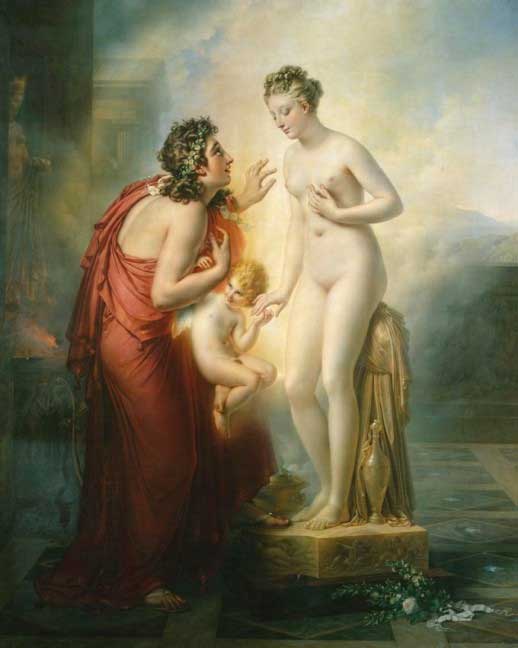
Pygmalion was a Greek artist who built a statue so beautiful that he fell in love with it. Appealing to the gods for reprieve from his unrequited love, his statue Galatea was brought to life by Aphrodite. They married and Pygmalion was able to spend his life with his creation. Many variations, plays and films, have emerged from this myth, where different variations on "brought to life" have emerged. A notable one might be the recent film, Her, where Joaquin Phoenix falls in love with the operating system in his phone. His phone, as an object, came to life with a personalized, teachable, intelligent female voice. In a brilliant dualism, Phoenix even has a sexual experience with Samantha less creepy than phone sex he previously performed with an actual person. Pygmalion is the myth of object-love, in opposition to Narcissus as the myth of self-love. Physical and emotional eros is directed as certain people and objects that epitomize how people can love.

Pygmalion discovers that Galatea is now human.  Image retrieved from this site.
Currently on display in The Lourve, Paris.
The two forms of libido and love: inward and outward come together in the selfie. This new trend in photo-taking simultaneously emphasizes the importance and singularity of the individual and glorifies the technology that allows the self to be captured and spread so easily and prolifically. This is particularly apparent in images that also show the camera in a mirror as opposed to a front facing camera shot. The phone is immortalized in partnership with the individual, a perfect union of self- and object-love. We love ourselves, so we wish to capture our image and likeness. We love our technology, so we capitalize on its capabilities to connect ourselves with the world. As in Narcissus and Pygmalion, the love is often an aesthetic, physical love for appearances, than a deeper emotional love as is lauded in Plato's Symposium.

What Would Jesus Post? Retrieved from this site.
To worship ourselves, we fall into the phone's lens which collapses Narcissus's river. Our phone becomes our partner, come to life in its utility, friendship, and closeness. People cannot be without their technology, phones at their sides or in their hands, preferring the reflective screen to the faces of people around them. Some may say that like Narcissus, we will waste away focused on ourselves, individuality, and narcissism that restricts us from progressing or experiencing the world. Some may say that like Pygmalion, we are too emotionally and physically involved in our technology that we miss the beauty of the world around us in favor of a Google search for its likeness. In my cursory experience with selfies, I take very few and have posted even fewer, I see many positives and negatives to the phenomenon.

Comic by The Oatmeal about the negatives of selfies
Undoubtedly, it has taken news media by storm. The selfie of Obama and Biden made headline news and people were discussing the Oscar selfie (which was potentially a contrived Samsung advertisement) almost as much as the award winners. I'm not sure about the wide appeal of other people's selfies (in the immortal words of Mallory Archer: why would anyone want a picture of someone else's food?), but as a personal expression of self-worth, confidence, and creativity, selfies do have an important role in the rhetoric of identification. Especially considering that some people may not always find themselves presented in media (or they are expressed negatively), online, or in safe spaces, selfies could help establish an online presence and carve out spaces for open discussion about personal identification, labels, and communities. Selfies create visibility, are unapologetic, and bluntly express one's visual appearance, identity, and existence as important and worthy of appreciation. Even if it is produced for personal consumption, it necessary sharing (often on social media sites) encourages a reflection of how it may influence a larger public. The physical presentation of the body demands attention, space, and gaze onto individual, their stories, and potential arguments. The selfie also glamorizes the power of technology, to turn what would have taken many hours of labor to produce a self-portrait can be accomplished in seconds and sent around the world instantaneously.

I hear the cries on both sides about the narcissism and objectification that is implicit in the selfie. But, I see the selfie as merely an offshoot of these larger cultural changes than a root cause or responsible for them. There are innovative potentials in how the selfie could carve out rhetorical communities, enhance identities, and change norms of personal expression. Though I can imagine Kenneth Burke terrified by the reliance on technology that he warned against, I hope that he might appreciate the rhetorical opportunities for identification, mimicry, and understanding between people that may otherwise never have met. And, the rhetorical opportunities for personal expression and control over how one defines themselves and their relation to the world.

Monday, September 30, 2013

Discrimination and Rhetoric in the Judiciary

Recently I read Stephen Toulmin's "Tyranny of Principles," an article written in 1981, but one I found highly relevant to current times. Toulmin, perhaps most famous for his Toulmin Model of Argumentation, describes the evolution of rules and laws from traditional discretionary practices in Roman times. I found this piece fascinating because it helps contextualize a common point of controversy in modern judicial and moral arguments, and also because I find rhetoric's roots in the judicial system and its constant tension with "ethics" (the good man speaking well) worthy of discussion.


Toulmin begins the article by describing previous methods of judiciary practices, where there were no written laws or precedents in Rome for judges to base decisions. Instead, each individual case was handled as a separate, distinct scenario in which all mitigating or unique circumstances were taken into consideration. People trusted the knowledge and discretion of the pontiffs, not an overarching law. But, as Toulmin describes, multiple factors (including immigration that changed societal norms and a need for more and thus less trained judges) constructed a need for established and referable rules which today are the basis for Western judicial systems. This transition is truly a double-edged sword, for now equality and consistency have been established, but in its stead, we sacrifice equity. Simply consider Jean Valjean in Hugo's Les Misérables, who served 19 years (5 for the crime and 14 additional for trying to escape) for 

stealing bread to feed his nephew. Did he steal? Yes. Was this crime worthy of 5 years in jail? 
To Javert, a servant of God and the Law, there are no mitigating circumstances, a crime is a crime. 
And even when the tables turn and Valjean lets Javert escape, Javert is still bent on returning 
Valjean to jail. He eventually experiences a mental break where he cannot justify living in a world 
where people like Valjean violate his standards of right and wrong.


Philip Quast: Javert's Suicide

The transformation of the judicial system, our reliance on the Constitution and precedent has 
emphasized the letter over the spirit of the law, removed wiggle room, and devalued mitigating 
circumstances. One need only consider the death of Savita Halappanavar, who died from birth 
complications after the abortion she requested was denied. The religious (and in this case Catholic) 
view of abortion as wholly wrong contributed to Savita's death, whose health was not a justification 
for the abortion. Many anti-choice advocates do allow for abortion in cases of rape, incest, or the 
health of the mother, but there are prominent American politicians and even doctors that do not. 
In response to Savita's death, Irish politicians are attempting to re-legislate the rules concerning 
abortions and when the health of the mother overrides the abortion ban. As Toulmin argues, society 
must be wary of an over-reliance on these rules, and must refrain from adjusting laws with more laws, 
instead of addressing the morality and ethics of the original law.


Toulmin's article is a useful transition for me to discuss inherent discrimination and a lack of equity in 

the judicial system that I learned about in a fall class. We discussed the different levels of scrutiny that 
the courts in America give to different types of discriminatory laws under the equal protection clause. 
For example, the strictest level of  scrutiny is given to laws based on race and national origin, which is 
a prominent reason why many affirmative action cases lose when brought to court, because they treat 
people of different races differently. This fact, though in part justified through previous discriminatory 
measures that make affirmative action necessary, are not mitigating circumstances. The only way for 
racial discrimination of any kind to be allowed through governmental approval is if there is a "compelling 
state interest" and the discrimination is the most efficient way to address that interest. A famous example 
of this is the Japanese Internment Camps that were ruled constitutional since they did address American 
fears over Japanese immigrants during World War II.


Image Retrieved from National Paralegal
Under strict scrutiny is intermediate scrutiny, for cases of gender discrimination. Under that is rational 
basis review, where discrimination cases based on sexual orientation or mental health are decided. 
I find it quite ironic that such levels exist at all. Why are different forms of discrimination created into 
a hierarchy of discrimination? Isn't this organization in and of itself discriminatory? It seems to me quite
hypocritical and unjust for someone to receive different punishments or court ruling simply because they 
are a different type of bigot than someone else.

I find these different strands inextricably linked. How deeply and strongly do we rely on rules of law, and 
for example, these seemingly hypocritical rules, when they lead to death and discrimination? Toulmin argued
 that we as a society should not mistake equality for equity, be satisfied with unjust laws, and tie our morality
unquestionably to the rule of law. "We need to recognize that a morality based entirely on general rules and
principles is tyrannical and dis-proportioned, and that only those who make equitable allowances for subtle 
individual differences have a proper feeling for the deeper demand of ethics" (p. 107 in Foss's 
Readings in Contemporary Rhetoric). I would hope that people would learn to be open-minded towards 
people's circumstances, take into account circumstances and mitigation, and let ourselves be human,
reasonable, and overcome our obsession with perfection, black/white dichotomies, and absolutism.

Wednesday, January 16, 2013

Post-Racial Society and Django Unchained

First, the title is a bit of a misnomer, as I believe there is no such thing as a post-racial society, a society "behind" or "after" race. It is merely used as a foil to the representation of slavery in Tarantino's Django Unchained and as an entry point into this inquiry into modern race relations and more specifically, the changing role of race in American society, culture, and politics. Here I will insert a fairly large disclaimer that I am not the person who can/should/ought to be writing about this topic, but I am attempting to broaden my rhetorical and scholarly horizons that have been opened to me by colleagues whom I deeply respect. This is an initial attempt to incorporate these discussions into my scholarly purview.

Photo from Wikipedia of the 1,000,000 Hoodie March in honor of Trayvon Marting
Walkers wore hoodies and carried Skittles representing Trayvon's outfit/pocket contents when killed
Considering the long, complicated history of race in America, it is naive to think that a simple presidential election could replace, mitigate, or somehow atone for the past. Stories that make headline news about the disenfranchisement of minorities in elections, Arizona's SB1070, and the murder of Trayvon Martin should reiterate that racial hierarchies and prejudice are still alive and well in America.

Though not "healed" fully in any way, Django Unchained has emerged as a cinematic reminder of how far we have come from the days of slavery some 200 years ago. Though there is little evidence of Mandingo fighting, the classic Tarantino emphasis on gore was a startling reminder of the gruesome way that slaves were treated. The whippings, dog attacks, punishments, and exploitation of "comfort slaves" serve as stark visual counterparts to the often diluted textbook descriptions. Though audiences have positively responded to Django, notable critic of Tarantino's works, Spike Lee, made a strong statement for not watching the film as blaxploitative and racist. I have already read further into this divide in an article by Sean Tierney called "Quentin Tarantino in Black and White" in the book Critical Rhetorics of Race. To summarize the argument with undeserved brevity, Tierney seeks to explain the negative opinions of Spike Lee towards Tarantino. Primarily, interviews with Tarantino and citing directly from his films show that Tarantino's co-opting of black culture is both offensive and hegemonic. Tarantino profits from black culture without acknowledging the hierarchy that allows him to do so without retribution or without the reverse being possible. Tierney (published before Django Unchained) also mentioned critics' aversion to the overuse of the n-word in Tarantino films. He mentions that the word is often removed from its political context and becomes what the re-appropriation was meant to avoid: having whites use the term and blacks use the term without respect to its political meaning. Though Django is set in times of slavery, the word is used over 100 times during the film, often times for laughs, quote Samuel Jackson, "It that a nigger on a horse?"
Django Movie Poster
I will admit that as a film, I enjoyed Django, but I find myself wondering, if it should have angered me. Over the winter break, I heard a story from my Mom who heard it from my recently passed Great Auntie Phil. She told me about her ancestors, my Great Auntie Phil and her brother, my Grandfather, and their family, who were brought from Africa to Jamaica as slaves. In Africa, the tribe my family belonged to differentiated wealth with bracelets made from various quality material. My Mom told me about the bracelet that she saw passed down to the youngest of the Harry's, my new baby cousin, a finely threaded bracelet of silver, a sign of wealth. I felt a pang of guilt, thinking of the unity of my family that represents a joining of white and black, free and slave, past and present, and what role I, as a blonde, blue-eyed white female, play in that narrative. I do not look in any way like my Jamaican and thus African ancestry, but like my 100% English father, a country that perpetrated much violence and conquered half of the world under the cover of imperialism, progress, and hegemony. Should movies like Django offend me in honor of my family history? The simple answer is that they cannot offend me in the same way they might have offended my Grandfather. Despite the history in my blood, I have not had, could never have, nor could ever imagine a life unlike the privileged one I currently have. Understanding that in and of itself has been a life-changing realization. The truth is that I did sit in the movie theater, ponder the recent readings on racial rhetoric, but at the end of the day, simply enjoyed the film as a Tarantino epic, an Inglorious Basterds of the Civil War era.

Political Cartoon retrieved online: thoughtful representation of race dynamics
I don't know what movies like Django Unchained offer to race relations in America. I would assume that these films complicate the relationship by glorifying a by-gone era and reinforcing that the changes from then to now is somehow sufficient or substantial. Spike Lee has said that he will not see the film, but I wish that he would. I would much appreciate a more critical and knowledgeable lens on the details of the film. I've merely laid brushstrokes over the existence of the film and its director. A more in-depth look into the film would be quite enlightening.

Award update: Quite a noticeable pan of Jamie Foxx's performance but great praise for Tarantino, DiCaprio, and Waltz this award season. At the Golden Globes, Django was up for best picture, Tarantino for best director and best screenplay (winner), Waltz and DiCaprio were up for best supporting actor (Waltz won), yet Foxx was not nominated. Again, the Oscars has Django nominated for best screenplay and best picture, with Waltz gaining the only actor win.

Wednesday, September 26, 2012

The Apocalypse is Near, the Only Question is How?

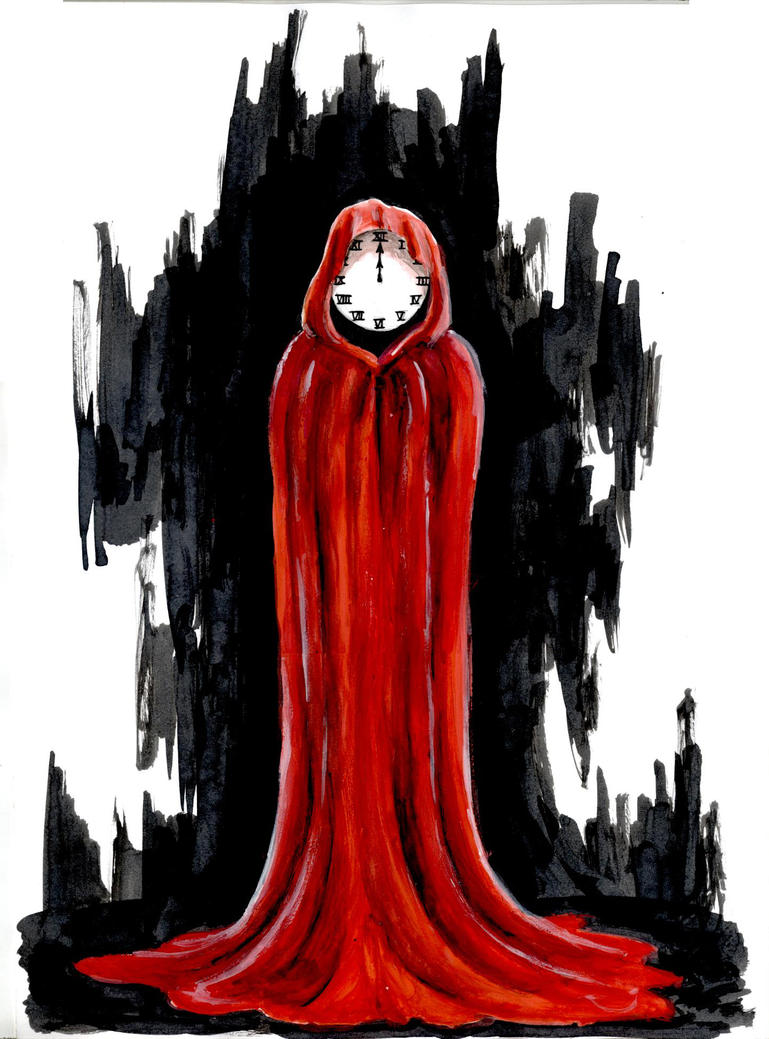
Tick tock, tick tock, tick tock. The clock has been an immutable symbol of life, with each second passing signifying the unstoppable journey towards death. When our time will run out is a mystery, but its inevitability is universally known. In the classic Edgar Allen Poe tale, "The Masque of the Red Death", even the rich and powerful Prince Prospero cannot hide from the ticking black clock of death. For time ends for all of us, and the fear of death, the unknown, the uncertainty of its timing, has played an important role in the creation of laws, social structures, and mythologies.


One representation of the connection between time and death can be found in the Doomsday Clock. This large, symbolic clock is a measurement for how close the world is to destruction, annihilation, and the apocalypse. Its initial intention in 1947 (created by the Bulletin of Atomic Scientists) was to measure the likelihood of nuclear war with 7 minutes to midnight the original time. Using midnight and the tolling of the clock as the endpoint to the countdown, the clock does not move constantly as a normal clock would. Instead, the hands are moved closer and farther away in response to certain actions and occurrences in the world. For example, the clock moved to two minutes to midnight in 1953, during the height of the Cold War. Despite its original symbolism, the Doomsday Clock now responds and moves in accordance to not only nuclear threats, but other apocalyptic threats such as nuclear energy, climate change and malicious technologies. The most recent move from seventeen minutes to five minutes to midnight reflects a topic previously discussed on this blog: climate change. Citing research about the consequences of climate change, the Doomsday Clock moves nearly as close to imminent destruction as under the threat of nuclear war.

The symbolism and rhetoric of the Doomsday Clock makes the comparison of climate change to nuclear war, legitimizing the threat by equating them. To consider the threat from climate change as equal to as as dangerous as nuclear war is a powerful rhetorical statement being made by the BAS. Whether one agrees that climate change should be included in the Doomsday Clock or not, the idea that the end is near is a belief held by many people worldwide. A recent poll shows that 15% of the world population believes that the world will end during their lifetime. Interesting to note is that one's belief in the apocalypse happening in our lifetime is negatively associated with education level. The implications of this could be as simple as those with less education are more likely to be persuaded by alarmist or apocalyptic rhetoric that answers their questions about life and death. This is a relationship that might need further explication and research in another post, but the finding in this study is an intriguing point. Overall, one in seven people believe in the impending apocalypse, and though these percentages fluctuate across nations, the tendency towards apocalyptic thoughts is a global phenomenon. That is to say, it is human to worry and be anxious about death, believing that the end is always near. The range of how the apocalypse will occur varies.


Some believe that the earth will eventually be consumed by the sun.

Some believe that the rapture will occur, saving religious believers and turning the world into a war-torn wasteland.

Some believe that climate change will become unstoppable, with massive flooding, displacement, famine, extreme weather, and war.

Some believe that a disease or virus will infect the world's population causing massive chaos and death.

Some believe that militant groups or governments may obtain nuclear weapons and begin a domino effect of nuclear war.

These beliefs range widely from the scientific to the religious to the fantastical, but the interesting point is that the end is not debated, only when and how. Just as no one can stop the ticking clock in the velvet room, humankind is aware of its eventual destruction, whether personal or global.


Wednesday, August 15, 2012

In Media Res: Polarization of Climate Change

This week, I'm curating a post on In Media Res as a part of the political polarization theme week. My post discusses the clear split between Democrats and Republicans in the debate about mitigating climate change.

Here is the link to the entire post and video clip. Read, comment, and enjoy!

http://mediacommons.futureofthebook.org/imr/2012/08/15/doubting-science-along-party-lines-polarization-climate-change


Wednesday, August 8, 2012

The Politics of Food and Consumption

Consumption and food are not new contributors to political identities, but one may imagine it is so considering the multitude of coverage surrounding the Chick Fil-A "eat-ins" and political denouncements. The old adage, "you are what you eat" echoes common academic themes of consumption outlining important characteristics of someone. Eating is something that people do consistently, and even the absence of eating communicates political, social, and personal values.

As a vegetarian, I have had my entire life of experience defending my choice of following a specific dietary habit. Refusing meat, questioning waiters at restaurants, and scrutinizing ingredients lists are often activities that I have to defend or justify as outside of the norm. People are vegetarians for multiple reasons, often attributing actions to animal rights, environmental concerns, allergies, and religious restrictions. For me, my vegetarianism is a product of tradition and family, being raised a vegetarian since birth and eating and cooking in the vegetarian lifestyle is an important part of my family life. For any reason, removing certain parts of a diet begs the question of explanation (and sometimes inclusion of certain foods, such as cultural foods). These questions would not be necessary unless one's choice in consumption were meaningful or symbolic.


This relationship has risen to great importance and attention in the media with the recent discussion of Chick Fil-A's support of traditional marriage groups and anti-homosexual groups. The politics of the organization has encouraged politicians, celebrities, and the general public to associate their products with their ideologies. Similar reactions have plagued organizations that participate in child-labor, unfair business practices, or are unfair to their employees. Boycotting has been around since the creation of the United States, when people refused to purchase items that were unfairly taxed. What, then, is the issue with Chick Fil-A boycotts and the discussion at hand?

I don't necessarily think that there is anything inherently "wrong" about the Chick Fil-A argument. I would rather media attention be focused on the rights of the LGBTQ community or contextualize these discussions within the larger battle for universal rights and marriage equality. Instead, news reports are often solely focused on the actions of individuals and the organization as opposed to the cause that is driving the discussion. When the news reports become overwhelmed with free speech and balancing the scales by allowing both sides their viewpoints, the actions of Rahm Emanuel and Tom Menino are undermined and discredited.


The most important part of these demonstrations is the power of the individual. Through simple actions such as spending money, kissing, and eating, bodies act as rhetorical tools for the creation and expression of identity. Even if I did consume meat, I would have been happy to participate in the Chick Fil-A boycott, using my consumption, or lack thereof, to complement my political and personal values. Although I admit I was skeptical of the ban at first and questioned its fairness, I am now proud of my alma mater, Northeastern University, for banning Chick Fil-A's establishment in our student center. Banning Chik Fil-A represents the importance of the LGBTQ community on Northeastern's campus, which recently approved general neutral housing, preferred name and pronoun identification, and multiple student groups and training groups for inclusiveness on campus.


Instead of allowing for the power of consumption to force the Chick Fil-A to leave, Northeastern used its political power to avoid the issue altogether. The issue, then, becomes when people are willing to consume, purchase, and use their bodies as supporters of hate, bigotry, and exclusion and are defended as heroes of free speech. In that world, our world, change will be slow and riddled with obstacles. Recognizing the power of consumption and encouraging people to eat consciously may be part of the solution towards equality and empowering businesses as political entities.

Wednesday, July 18, 2012

Batman and Rhetoric: Transforming Human to Legend

The trilogy finale of the Batman series from Christopher Nolan finishes July 20th (or for the avid fans, midnight tomorrow night). The finality of the trilogy has been confirmed with Christopher Nolan and Christian Bale abandoning the project after this film. Though I was more than a little upset when rumors of Johnny Depp as the Riddler were squashed, I appreciate the finality of the series. I respect the ability of both actors and directors to sacrifice profit for the sake of a coherent and meaningful story line.


After re-watching the first two in preparation for the midnight premiere, I was struck by the iconic Liam Neeson line from Batman Begins: "If you make yourself more than just a man, if you devote yourself to an ideal, and if they can't stop you, then you become something else entirely...a legend, Mr. Wayne." The line is meant to encourage Bruce Wayne to abandon his mortality and chase immortality as a symbol, a legend. Many people around the world have devoted themselves to causes and emerged as icons for movements, causes, goals, and values. Rosa Parks, Mother Teresa, and Harvey Milk were just people, but through their actions and values, they have become legends, eternal, immortal symbols of equal rights, charity, and acceptance. The narratives of their lives have transcended the normal good and evil, the trials and tribulations of being human, and the faults, flaws, and sins inherent in all humans. These people, and many others are, in a way, superheros, super-people, because they have become more than just people. Their stories and actions become symbolic representations of events more significant than can be contained within one human life, body, and narrative.
Similarly, Batman is the comic representation of everyday heroes, who has transcended his Bruce Wayne, human persona for Batman, a superhero, legendary symbol of justice. By abandoning his humanity and replacing it with a mysterious persona, people in the comics turn to Batman as a savior, not as a person. Though Bruce Wayne has money and with that money comes power and the ability to transform into Batman, Bruce Wayne cannot fight crime, be an ally to the police force, and terrorize Gotham's criminals. Every person, though, has the power to become that better, idealized version of ourselves, immortal in our story and legacy. This occurs through committing oneself to a cause, extending oneself past human constraints, and becoming more than just a person. We can all leave legacies, whether positive or negative, and its corresponding strength and staying power is only restricted by our actions.


Not only do people become legacies, but the words that we use leave sometimes unforgettable impressions on the world. The power of the spoken word is why I wanted to pursue communication in an advance degree, so I could explore language as symbolic. Kenneth Burke famously described humans as symbol-using animals and rhetoric as the study of those symbols that create meaning (Grammar of Motives, 1970). Words are merely words, tools with different definitions, interpretations, and meanings. But when used with a purpose, for a cause, words can become infamous, last beyond the life of a person, and serve as everlasting symbols. 


Think of the immortal words of Abraham Lincoln: "this nation, under God, shall have a new birth of freedom -- and that government of the people, by the people, for the people, shall not perish from the earth." Or the words of Ghandi, "you must be the change you wish to see in the world" or Martin Luther King Jr., "when we allow freedom ring, when we let it ring from every village and every hamlet, from every state and every city, we will be able to speed up that day when all of God's children, black men and white men, Jews and Gentiles, Protestants and Catholics, will be able to join hands and sing in the words of the old Negro spiritual: Free at last! Free at last! Thank God Almighty, we are free at last!" These words have transcended each person and left a rhetorical legacy of the unity of the United States, the importance of peace, and the eternal struggle for equality.


One's legacy is thus a combination of actions and words (or just actions if we consider physical action and symbolic action) that is for the most part under each of our control. We can devote ourselves to a cause, use our language symbolically for a cause, and transcend mere mortality to leave a permanent mark on the world.


I am looking forward to the midnight premiere, in part for the transportation power of film and also to imagine for a few hours, that I can also reach immortality through my words and actions.