Showing posts with label Evidence. Show all posts

Sunday, September 28, 2014

Using Religion as a Negative Characteristic

Due to my prospectus deadline looming, this week will have to be a short introduction to a topic that has been on my radar for some time. This trend that I have noticed, mainly in denialist rhetoric, uses religion as a negative characteristic that typifies history or science as "fantastic," "not to be trusted," or based solely on "belief" instead of fact.

Image retrieved from this site.
I am currently working on a paper that links the denialist strategies of Holocaust-denialists, climate-deniers, and creationists (evolution-deniers). This paper will explore the strategic arguments made by each group and the potential means to address them. Although it will not directly address this phenomenon, the frequent presence of "religion" as a negative characteristic has prompted my attention. I hope that this brief inquiry, which will be continued in another post or paper, will delve into these characteristics and this odd, recurrent rhetorical pattern.

One Holocaust-denial page (http://expeltheparasite.com/2013/10/28/the-holocaust-hoax-it-never-happened/) argued that Holocaust-confirmers are wedded to their story of history with a religious fervor. The website argued:
"My guess is that people believe the hoax because they want to believe. It fills some deep emotional need—perhaps to overcome a sense of inferiority compared to the Germans, or to somehow join the dominant group in society. The exact answer is beyond any understanding of this writer—but it is an enormously important question nonetheless in the same way that one should try to understand why people believe in religion. Holocaust belief is a kind of new religion—as irrational and ridiculous as any other religion but enormously appealing. For those who have not totally lost their minds, the following reasons for rejecting the hoax may have meaning" (para. 8).
Belief in religion is characterized as "irrational and ridiculous" despite the author's many Christian symbols, crosses, and references to Christ's sacrifice for the good of the white race.

Image retrieved from this site.
Climate deniers are also quite often religious and base their opposition to environmental protection on Christian teachings. The Cornwall Alliance (CA) is a religiously motivated group that denies the importance of climate change and its consequences as distracting from God's true work. Dr. Calvin Beisner, founder of the CA wrote, “religion is the root of any culture, and environmentalism has become a full-fledged religion in its own right. It is the most comprehensive substitute in the world today for Christianity so far as worldview, theology, ethics, politics, economics, and science are concerned” (Beisner, 2013, p. 1). He described environmentalism, or a focus and care on the environment, as a religion, based not on science, but on faith.

I've written about the Institute for Creation Research (ICR) before regarding a conference paper. The paper focused on ICR's magazine, Acts & Facts, that presents research done in their institute that proves creationism. They advertise their magazine as a tool “to counter the lies of evolution” and include education as one of the three prongs of their mission (along with research and communication). ICR undermines evolutionary science as “conflicting with biblical Christianity” and “detractors” to the true worldview (“Creationist Worldview,” para. 4; 6). They publish research articles that support creationism and also interest pieces about political, social, and cultural issues. In an article about education, author Henry Morris  (1973) wrote, “One of the most amazing phenomena in the histoy of education is that a speculative philosophy based on no true scientific evidence could have been universally adopted and taught as scientific fact” (para. 1). He described evolution as a philosophy that worships that religion of naturalism and humanism. Evolution is “the established religion of the state” that has excluded competing voices because they fear the truth (Morris, 1973, para. 4). Evolution, often called "Darwinism," is a religion that worships Darwin as a deity that scientists follow blindly.

Image retrieved from this site.


The extreme irony here is that groups who deny history or science (such as Neo-Nazis, creationists, and climate-deniers) are often themselves deeply religious, namely Christian. What is the logic in using religion as a negative characteristic when one follows religion oneself? It seems hypocritical for religious groups to undermine their opponents by trying to paint them as religious. In one sense, this places both sides on an equal playing field, treated both as beliefs that should be respected. Another possibility is that by reducing the opposing side to religion, the deniers can claim scientific superiority. Though they may rely on religion in their own beliefs, many groups understand the persuasive and authoritative power of evidence, models, and rationality.

Sunday, February 2, 2014

The Dangers of Pervasive Skepticism: Creationism, Anti-Vaccines, and Climate Deniers

A recent LA Times op-ed by Pat Morrison addressed importance similarities between science-deniers that affect more people than just believers. Creationists and anti-vaccine advocates affect the collective intellectual and physical health of those around them due to their rejection of scientific evidence. Though this is an important point, it only scrapes the surface of larger issues surrounding pervasive skepticism and the borrowing of scientific authority.

In associating science with faith, deniers of current scientific knowledge present themselves as "true" science. These groups portray themselves as fighting against hegemonic elites that wish to silence minority opposition. Anti-vaxxers claim the right to abstain, equating scientific practice with replacing parental control. Creationists point to gaps in scientific research and claim that science requires a greater leap of faith than religious explanations.

Retrieved from Ape, Not Monkey

 By appealing to scientific standards of skepticism, re-testing, and a progressive search for knowledge, science-deniers can pose as legitimate scientific inquiry. Creationists use this platform to enter science textbooks, school boards, and even university faculty. Anti-vaxxers use this platform to flood public spaces with literature, websites, and non-profits.

Other skeptical groups, such as climate deniers, also appeal to “scientific” facts and gaps in evidence to forestall legislative action. Democratic Senator (CA) Barbara Boxer held a committee about the President’s Action Plan that was met with much controversy over Dr. Judith Curry’s testimony. In this testimony, Dr. Curry misrepresented Intergovernmental Panel on Climate Change’s reports on current scientific evidence and cherry-picked statements of uncertainty about current predictions.

Morrison’s original comparison begins to uncover this larger, pervasive issue of skepticism that ignores scientific evidence and authority, and replaces it with a facade of scientific inquiry. The key mistake in the piece however, is the piece’s ending that states, “Ignorance is curable by education, but willfully ignoring the facts can be contagious — and even fatal.” To assume that education is the missing link between science accepters and deniers is to oversimplify the argumentative frameworks that each occupies.

Those who believe in creationism tie their beliefs to every action of their lives as a guiding force. The origin of humanity is not merely an issue of fact, but of the definition and explanation for one’s entire life. Rejecting creationism or not fighting for its inclusion in schools is viewed as a betrayal of faith and submission to the elites of science that denies alternative explanations.

Retrieved from Vaccine Truth

 Anti-vaxxers are focused on protecting their children and the children of others, an extremely powerful motivating factor. Simply presenting new information or facts may not deter strongly held beliefs influenced by celebrity moms or one’s peers.

Those who deny climate change may find themselves more fiercely loyal to a political party or economic influences than long-term environmental protection. More science and data may fall on deaf ears, as other priorities overshadow and complicate accepting new information.

Kenneth Burke, rhetorician and scholar, wrote in Attitudes Towards History, “The shift to another attitude, requiring a different rationalization, does involve ‘conflict.’ Insofar as we do not ‘travel light,’ we thus assemble much intellectual baggage, and the attempt to reshape this to new exigencies may require considerable enterprise” (p. 184). To replace the baggage collected over one’s entire life with new, contradictory exigencies nearly requires rejection. Introducing new information or repeating old information through education is rarely enough to shift rationalizations for action and behavior.

Skeptics do not “ignore the facts;” they simply do not respect the facts lauded by scientific frameworks. Instead, they replace with their own facts such as the importance of God’s role in human origins, the autonomy of parents over children, and the benefits of short term party loyalty over long term environmental protection. The issue is not, then, ignorance, but of warring frameworks that are currently empowered by a skeptical culture to reject scientific authority. Instead, the focus should be on separating what is science and what is not, giving skeptics a voice, but not allowing that voice to be labeled scientific.

The culture of skepticism is damaging scientific enterprise and Morrison is right to point out the wide effects that skepticism has. The conclusion, however, is not to rely on education, but acknowledging alternative viewpoints while minimizing their influence.

Sunday, September 22, 2013

Underestimating the Enemy: Creationism vs Evolution

At the beginning of August, I attended the Alta Argumentation Conference in Alta, Utah. There I was presenting a paper titled, "The Institute for Creation Research as a case study of scientific and religious argument: Revisiting argumentation fields in a postmodern context." The paper was presented on a panel of other papers about "religious argument." To summarize the points of my argument, I was discussing the ICR as an example of postmodern and contemporary creationism discourse. ICR is attempting to blur the lines between science and religion in order to present the illusion that science proves the story of Genesis.


The Logical Process of Science and Creationism: Source
My paper interrogated why creationism is still so persuasive to many people and why scientific consensus has not squashed this alternative story. In addition to this argument, I also stretched communication and argumentation theory by introducing a new term "deceptive controversy" and expanding the role of argument fields to creative normative standards. After finishing my speech and waiting for the Q&A, I thought about the theoretical implications for my argument and had prepped myself to defend my new term and the application of argument fields. Instead the first question I got was roughly paraphrased as: Aren't you giving ICR too much credit? They are obviously non-scientific, so what is the point of your paper?
To say I was shocked was an understatement. My extension of argument theory was not being questioned, but the very purpose and need for my intervention was. Unfortunately, I reacted more passionately and unprofessionally than I would have liked, feeling defensive of my research. I would like to take this blog post to react more professionally than I did then.
It is imperative that scholars and scientists take opposition from creationists seriously. Although science and logic show the truth of natural selection and evolutionary mechanics, that is unconvincing to more than half of the nation's population. The power of these narratives and the hold that biblical accounts have on the American public are underestimated at the risk of knowledge and innovation. There still remain issues of creationists gaining position on school boards, colleges accepting creationists on their staff, and the steady dominance of creationist thinking in the US.
Steady maintenance of science denial: Source
My inquiry was not to suggest that one should consider ICR scientific, but to examine how and why ICR does say that it is scientific. What is it about ICR's discourse that convinced hundreds of thousands of subscribers each month to read and examine its arguments? That was the point of my inquiry: to examine the patterns, rhetoric, and argument style that keep creationists relevant in modern society. Armed with this knowledge, how do we address and restrict its presence in areas of society it does not belong?
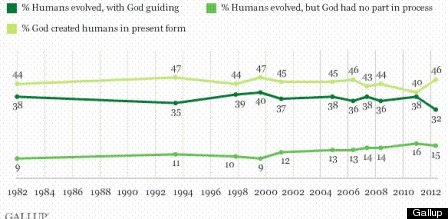
My paper took samples of ICR's discourse and broke the arguments down to their basic elements to determine if they really were scientific or not. Recent polls show only 15% of Americans believe in the occurrence of evolution without supernatural intervention, with 46% believing the in the Biblical account of origins with God (a Judeo-Christian one). That's nearly a majority of Americans who deny a scientific consensus of evolutionary mechanisms explaining origins. Groups such as ICR receive millions of dollars in charitable donations, run talking tours, sponsor museums and even a award degrees from an accredited school. Creationism discourse is alive and well in the United States, at least in the public sphere.


It is a mistake to assume that everyone approaches the creation/evolution controversy with the knowledge and capacity of intellectuals. What my questioner was really saying was that "isn't everyone in America as smart as I am? Only fools would believe in creationism." Because he saw the truth in evolution, he immediately discredited the possibility of creationism as being a valid threat. But it is. It has been and remains a threat to scientific standards, classroom education, and the knowledge of millions of Americans. To discredit their opposition is to err as many scientists have done before. To simply say "look at the science", "look at the consensus" is not enough. These facts are not convincing in the way that many academics and scholars wish that they were.


Tuesday, October 23, 2012

Netvibes: Research tools for students and scholars

Netvibes is a great research tool for scholars and a news tool for people alike. There are various types of RSS feed dashboards, but this one has the features and ease of use that works for me. Coupling this tool with the PagetoRSS functionality, creates a one-stop research location.

I have the Netvibes dashboard load as one of my homepages, making sure that I see the headlines in my research areas of interest. Because the dashboard is full of RSS feeds (as well as other widgets), it automatically updates, making my research time more efficient and easy. As opposed to an iGoogle homepage, the Netvibes dashboard allows for tabbed feeds, where dozens of tabs organize feeds by topic area. The set-up and organize of each tab can be changed in terms of columns and how many headlines the feeds draw. The site advertises "limitless personalization" from background art to widgets and apps, custom layouts, and RSS feed options.


This is the homepage of my dashboard, which has a weather app, general news feeds, a to-do list, and notepad. Each tab has a different research interest and toggling between tabs brings up new feeds and apps that I've loaded to the page. Adding the feeds are as easy as copying the link to the RSS feed on a website and pasting it in the "Add Content" tab at the top left corner of the dashboard. This adds a box to the page that updates with headlines and articles. I primarily use GoogleNews, JSTOR updates, and professional blogs to populate my tabs. My background is a nice, relaxing beach as a personal touch to the dashboard. 

The benefits of this tool (similar to other dashboards) are multiple. I find Netvibes the most convenient and intuitive to use, but the salient point is that these dashboard and RSS feeds can deliver relevant news and journal articles in various topics to one location.
  • With minimal set-up, the RSS feeds automatically pull in information
  • Dashboard can be accesses anywhere with an internet connection
  • Apps and widgets, such as weather, notepads, and to-do lists (with hundreds of others) are easily added through the "add content" link
  • Tabs organize and separate different research topics with no limit in the number of tabs
  • Adding content is as easy as copying and pasting links
  • Easily delete and modify feeds
  • PagetoRSS makes sites without RSS feeds easily accessible on a dashboard
The Netvibes's dashboards are automatically private, but people can publish their dashboards or share them with others. Additionally, premium features are available for those who are willing or for some reason need extra features and functionality.


There is an overwhelming amount of information online. Checking one location instead of multiple locations helps save time and sanity for scholars of any discipline. Whichever dashboard works best for you, make sure to update it and routinely check it, so you will always be up-to-date on timely, important, and relevant news for your research interests.

Friday, November 25, 2011

Dead Crabs and Bike Stealing

Everyone is shaped by their personal backgrounds and experiences that construct their opinions, 
knowledge, and capabilities. Within the world of methods and research, these contexts should be 
taken into account because of their drastic effects on data outcomes. There are multiple categories 
of experience and evidence that are explained that are possible influences on data for which 
researchers should try and be aware. Bourdieu explains the importance of people’s experiences 
especially in the terms of culture, Igo proposes the phenomenon of the over-saturation of survey 
data in modern culture, and Pager discusses ethical and methodological concerns in obtaining 
valid data (particularly in audit research).

One of Bourdieu’s main ideas was that people’ socio-economic class has a profound effect on 
people’s knowledge of culture. People who are born into higher classes are much more likely 
(as indicated by the study performed) to appreciate, understand, and seek out fine art. Because 
of socio-economic status, people are able to enroll in more and higher quality education, 
experiencing a wider array of cultural knowledge reserved for the elite. Exposure to art museums 
and classical music are luxuries usually afforded only to the rich. The survey indicated that the 
knowledge of composers increases dramatically with higher paying jobs and conversely, knowledge 
of mainstream music increases with lower paying, more menial jobs. Thus, if a survey conductor 
or researcher wanted to understand the calming effects of certain types of music or a comparison 
of art pieces, a representative sample of social classes should be maintained as to mimic accurately 
all of the American population.

On the other hand, if a museum or particular company is looking for specific types of people 
socio-economic status would be an important factor to consider when selecting or targeting 
survey-takers. The survey pitfall that comes to find is that of “The Literary Digest” in 1936 that 
predicted Landon would beat FDR in a landslide election. What actually occurred, of course, was 
FDR’s landslide victory that was incorrectly predicted due to bad survey practices. Only those who 
subscribed to the magazine were polled, aka those who had disposable income during the Great 
Depression, which was a niche of Americans more likely to vote for Landon that FDR.

In Igo’s article, the topic shifts to the massive amounts of survey data available to the public. With 
this massive amount of survey data, there are many opportunities for misinterpretations and slanted 
results. One of the reasons Igo listed is when over-saturation occurs is that people become so 
comfortable with questions and can begin to answer the way that they think the survey should be 
answered. Another negative consequence is people become overly sensitive to their lives being 
recorded in the form of ethnographies, surveys, and interviews as indicated by the example of 1920’s 
Indiana. One parody example is that of Monty Python and their “infommercial” of Whizzo butter.


Pager discusses the pitfalls and difficulties of audit research, or research that involves an experiment 
in real-world situations. The study in question was one of job applicants and discrimination of race in 
entry-level job positions. One of the more important issues that arrived was one of ethical concerns. 
Should people be allowed to perform research when people are not aware that they are being tested? 
Obviously, there is some research that cannot be performed without this ignorance, because participants 
would otherwise skew data (no one wants to be viewed as racist/sexist/etc.). But then, what rights do 
these participants have in regards to possible ramifications of participation and how can these rights be 
protected? Practically, research performed that can provide valuable information are given passes by the 
IRB for the purpose of the research, but ethically, should these be allowed to happen? One example of 
this same type of discrimination audit research is the TV show, “What Would you Do?” where the set-up 
is a pair of men stealing a bike, one white and one black, and who gets approached more often by bystanders.


The people on the tape are seen as participating in high levels of racial discrimination, so often want to 
keep their faces blurred. What responsibility do the producers have to exposing the frequency of racist 
behavior versus the privacy rights of the people unaware of their participation? The example of audit research 
is just one type of research that has its drawbacks and confounding variables for which researchers should 
remain vigilant.


These are ideas that I carry with me when performing research. There are always issues of confounding 
evidence or finding ways to have evidence to support your points. All researchers should be wary of different 
ways that research can be compromised in order to produce good quality research that does not violate ethical 
or ideological concerns.