Showing posts with label Article review. Show all posts

Sunday, January 17, 2016

Communicating about Climate Change: The Technical and Public Spheres

This semester, I'm teaching COMM499: Public Controversies, a class that I started as a part of a Provost's Fellowship. As a part of the foundational theory weeks (before we delve into specific topics and controversies), we are discussing sphere theory. Sphere theory involves categorizing different arenas where communication occurs. G. Thomas Goodnight theorized three communication arenas, the public sphere, the private sphere, and the technical sphere. I will first briefly explain these concepts before exploring a recent news article that caught my attention on the complexity of the United Nation's Intergovernmental Panel on Climate Change (IPCC) environmental reports. I argue that these reports are not targetting their intended audience, the public, and are instead retaining too many characteristics of the technical sphere. The UN needs to better bridge the gaps between the technical and the public sphere to increase public understanding of the severity and risks of climate change. Removing jargon and becoming more accessible can help remove the stigma of elitism from science and encourage people to engage themselves more with the science.

For additional discussion of the spheres and climate change, look up Mosley-Jensen's book.
The public, private, and technical spheres have their own standards for engagement with communication and often happen with different scopes, effects, and speakers. The public sphere is so named because it is the arena where the public, people, and politicians communicate about topics in general, accessible language. An example of a communication activity in the public sphere would be President Obama's State of the Union, which is a speech given to the general public about topics of great impact. The private sphere involves more intimate communication between smaller groups of people often not accessible to the public. Conversations between couples, family members, or employees and bosses would be considered private, because they have limited public impact. These conversations may also include situation-specific language, such as inside jokes or personal references. The technical sphere is made up of experts that have a standard, formalized discourse that often includes specified jargon and expectations. Legal jardon and law journals are an example of technical discourse, aimed at a specific, expert audience with advanced knowledge of a particular field.

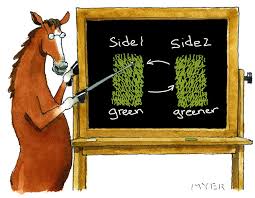
Cartoon retrieved from this site.
In writing climate reports aimed at the general public, the UN is participating in what I call "bridging," where technical knowledge is translated into public discourse. Information created and anlayzed in the technical sphere is transferred to the public sphere. The article in question summarizes the conclusions of linguistics scholars Barkemeyer, Dessai, Monge-Sanz, Renzi, and Napolitano in their 2015 analysis of UN reports between 1990 and 2014. The analysis focused on the readability of the summary section of the reports aimed at policymakers and the public. The authors focused on the complexity of the vocabulary and sentence structure as potential barriers to public understanding. Compared to the readability of tabloid papers (50+ on their scale) and even scientific magazines (30+ on their scale), no IPCC reports surpassed 30 and the most recent barely hit 15. There is evidence that these reports have become increasingly unreadable, making it difficult for the general public to understand the IPCC's analysis and its implications.

Retrieved from Tollefson from the original article in Nature

The article noted that the IPCC is considering adding more members to the board to improve readability or potentially providing better communication training for the summary's writers. In my graduate research on the rhetoric of science and scientific controversies and membership in the Earth Sciences Communication Intiative, I have found that scientists are often more concerned with their own analysis instead of making the content accessible to the public. The jargon used can be off-putting and even unintentionally misleading. For example, my partner is a graduate student in physics and I am often asked to edit his papers. One example of jargon that has repeatedly stuck out to me is the use of "trivial." When my partner calls a result "trivial," he is indicating a specific standard of statistical impact, whereas I read the term with a disparaging and dismissive tone. Because these articles are often written with experts in mind, they also often gloss over important background knowledge or comparative statements that would elucidate the importance of the results. This writing style is appropriate for the technical sphere, but could potentially lead to misinterpretations by the public and can become fodder for climate skeptics.

Image retrieved from this site.
Scientists should pay more attention to how they communicate. Whether that involves creating stronger bridges and training people to go-between, or including communication courses in science programs, Even including more sign-posting types of summaries, such as the chart above, would help clearly and succintly communicate the important take-a-ways for the reports. I think more problems would be minimized if attention to the ways people understand and process information were increased.

Wednesday, January 23, 2013

Open Access Journals: Information for/by everyone?

I had previously scheduled a different topic, but in light of a few well-reasoned and interesting blog posts by my colleagues at USC, I've decided to throw my own hat into the ring about open-access journals and the future of publishing. I encourage you to read Alex Leavitt's initial post and Andrew Schrock's response post before reading my response below.

First, I wish to declare my support for Alex and Andrew in their praise of open-access. In theory, the term is a sign of open information, shared meanings, and enlightenment. I find, however, that such thinking is, at least in current iterations, overly optimistic. In this vein, I agree more closely with Andrew's caution towards open-access in that there are other things to consider before launching a personal crusade. Alex has taken a more hard-line approach, calling for the complete abstention of "closed access", not only for himself, but for all scholars.  Below I will enumerate issues that I have with such a declaration and why I would urge scholars to question the implications and consequences of such actions. I will also explain why I find Andrew's response and the continuation of some of his ideas as a more practical compromise.

I would call attention to the overarching idea of the initial post: that open-access is moral and hortatorical/obligatory for scholars. This is known as the fallacy by composition, or the logical reasoning that assumes that something true of part of a whole must also be true of the whole. I completely agree that pursuing open access and supporting it is a noble goal for scholars, but I do not agree with its universal application. The implication in making such generalizations is that for all scholars, no matter their discipline or situation, that this is the correct or moral move. This, I believe, excludes the work of other scholars who may not study new technologies, be passionate about open-access and the share of information, or have the same gain by making such an announcement. The community in which and the topics which Alex studies uniquely positions him to make this declaration. Rhetorical scholars would have no interest in my admission to do the same. Creating a blanket statement by definition ignores scholarly differences that may prohibit and inhibit one from making the same choice. Although this would merit another blog post entirely, I will mention here briefly the notion of "white male privilege" that creates a hegemonic structure that rewards those in power for taking risks and penalizes others for not conforming. Whereas a great media and Internet scholar like danah boyd can "get away with" avoiding closed-access publishing, others without such clout or experience could have their careers dashed for making the same choice. This is also inherently linked to one's name/mark in a field and one's youth (read newness) to academia.

This brings me to the issue of "choice" in general. I have previously written about this in regards to the Taylor Cotter incident, and the topic emerges here again. The truth is that although "open access" is a laudable goal, who is this information really "open" to? As Andrew mentions, scholars live in  "privileged media and spaces that are not open to everyone" by definition, because our work is shared not necessarily to the general public, but for the purposes of academic advancement, theory, and methodology. This is not applicable to all scholars, of course, but I feel that for the majority, it is. For example, my current RAship with the Earth Science Communication Initiative is working on helping combine multiple voices (scientists, politicians, religious leaders, and activists) in working towards climate change. Will the people we work with and access be interested in the theory papers I write on apocalyptic rhetoric and political inaction? Probably not. Will they be interested in plans for action, evaluations of the conversations  and solutions? Most likely. That distinction for me is the clear divide between open and closed access, simply not everything has to be or is somehow better because it can (but won't) be accessed by non-scholars. Andrew makes this point as well, noting that few people have ever denied him copies of papers he has wished to read. I have also never been denied and I have emailed copies of my papers after conferences when asked even if in theory they reside only in closed-accessed spaces. As a side note, aren't all universities closed systems of information? How many people get to see the paper I wrote for Randy Lake's "Social Movements as Rhetorical Form" class unless I publish it? Wasn't the creation of journals and online publications for this very reason?

The ultimate goal of "open access", I would assume, is for the free and open sharing of information, an online Habermasian coffee shop of academic intellect. But, I think one of the best places for this to happen is at conferences and meet-ups. Of course, this brings me back to the idea of choice and the access related to money/wealth that some scholars do not have. Conferences, especially inter/national ones are not affordable for everyone, though I think academics are creating solutions to this such as local conferences (my VisComm conference in Utah was more engaging than the national ones I've been to) and creating tiers of payment for cheaper options of registration. Those issues aside, conferences are more personal and expressive points of interaction that online spaces (for now). I am sure that the capabilities will continue to grow, but for now, there is no equivalent to the panel experience. For example, my past panel at NCA gained me new colleagues, gave me new insights into the topic (Romney's Mormonism), and I exchanged numerous business cards from panel attendees. This most likely would not have been possible if I had merely posted this paper online. Part of the problem is in the bog of online scholarship, where does one begin? How to sift through all of the information accessible? Again, it comes down to one's name in the field. Whereas Alex may be receiving much attention for his post, this one will most likely go unnoticed. How does one get to the place where open-access is recognized, lauded, and meaningful? After participating in the current system.

Andrew also praises the networking opportunities that come from associations and conferences that may not be hosting everything online, as spaces for expression and exchanging of ideas. These are possible because of communication associations that host them. These associations are also responsible for the publishing issues that we have. As a previous employee of a journal publishing company, I will first say that vilifying the publishing company for the state of academic research is not only unwarranted, but it is also counterproductive. Without going into too much detail about the process, I would merely say this: how successful would a publishing company be that placed restrictions on its clients? Publishing companies provide printing and online service at the request of the association/organization, nothing more. It is that group's decision for how to have journals accessed and available to members. These prices increase with options and there may be monetary royalties per subscriber or journal downloaded, but overall, these are restrictions and choices placed by the organizations themselves. Are we now to boycott any type of scholarly communication organization? Do we become lone wolf scholars trapped in an online bubble? Either way, the publishing company is simple providing a service, information and access is not for them to decide.

In conclusion, though I admire Alex's passion for the open-access movement, I find it highly problematic to engage with at the exclusion of associations, journals, and other scholars. I find myself agreeing with Andrew, more or less and his more measured approach, that praises free and open publication, but does not demonizes those who do not engage, as there are many  reasons for doing so. To think that I could not approach my friend and colleague to work on a paper, conference submission, or journal saddens me because those ideas/collaborations will be fully lost to the academic community, as opposed to being slightly restricted. I suppose that I will not be co-authoring anything with Alex in the future, but perhaps Andrew and I may.

To summarize, TL;DR
  • Open access in theory is a moral no-brainer, but in application, it is problematized by issues of choice, universality, and execution
  • Female, minority, or any combination of intersectionality may not have the same "choice" that Alex made
  • Scholars who are young, at lower ranked universities, or not in technology/new media studies may be unduly hurt by restricting their publishing
  • The current system is changing to encompass more of these demands for online access (why destroy and boycott the system that is already attempting to do what we ask of it?)
  • Shouldn't we be opening access to those we know will read/are interested, as opposed to the general public out of principle? (obviously this depends on one's field/research)
  • There is no substitute currently for the in-person exchange of information
  • Associations/organizations that obtain/release information are to blame, not publishing companies
  • Currently, these associations provide scholars with more benefits that restrictions

Wednesday, August 1, 2012

Hegemony, Choice, and Struggle: Taylor Cotter

This article has received much coverage and critique over the past month, but I wish to add my opinions on the matter of struggle, privilege, and hegemony.

It is not lost on me that this critique of Taylor Cotter's article is hypocritical as she is almost my complete double: Northeastern graduate, female, white, employed, and journalism/communication focused. In spite of these similarities, I would like to dissect Taylor's article and view it as a communication scholar would: in terms of issues of power. The ideas in her article, "A Struggle of Not Struggling" have been met with much contention, minimal but loud support, and debate over her intentions. The article is short so I recommend reading it, but to summarize, the main point of the article is that, for Taylor, having been successful has kept her from experiencing life from a different perspective: the struggling, freelancing journalist. Overall, she imagines what a different life might have been had she not been successful, or, as she describes, if she had fallen on the other side of the statistics.

In part, I can empathize with a general life feeling of uncertainty of making the right choice, wondering about making different decisions, or planning for the worst case scenario. These are natural feelings of anxiety, worry, and preparation that most people experience. The difference, then, is what the topic of anxiety is and what the side the grass is greener on. For Taylor, she pines for the less green side of the fence, the struggle and character-building that comes from falling on the other side of the statistics. Though Taylor could easily change her situation and decide that she wanted to leave her job and move to New York to live her dream lifestyle, she does not. In keeping the job and complaining about it, she denies herself the dreams she pines for, and further insults others who might not have been as fortunate.

The key issue for me is choice. At the end of the day, Taylor chose her life and could easily change her decision. "I chose the path of a full-time job and an adult life. I gave up on the adventures, on freedom, on youth. " Her pining for the other side mistakenly equates a part-time job, living at home, and financially struggling with adventure, freedom, and youth. There is nothing inherently adult about having a job and there is nothing inherently youthful about having adventures. Condemning oneself to a boring, full time job is simply that: a mistake has been made and one has the opportunity to change it. Those who are not as lucky are not necessarily in a different situation, but are trapped, cannot choose. Working a part-time job, living at home, and eating ramen may seem a glamorous, enviable life to one in a higher, more entitled position. To those for which it is daily life, a necessity to survive, the glamor fades quickly.

I may not know what it means to be anything but a privileged, Caucasian, heterosexual, and middle-class ciswoman, but I would not pretend to know anything else. I would not claim to look through the lens of others, understand others, or envy others (at least not intentionally). I, therefore, see the hypocrisy in writing this article and critiquing Taylor, not knowing her full story. But from the article, the only easy-accessible evidence in which she is explicit about her situation, I feel that a character-evaluation and full opinion can be made. The underlying narrative of the greener grass always being on the other side is undermined by hegemonic, pompous overtones.

Hegemony and power are important concepts in communication, especially in gender and cultural studies, where issues of power define all relationships and communication. Whether one believes in the Marx or Foucault brand of hegemony and power, one could argue that Taylor is a representative of the top or ruling class because of her self-reported situation (e.g., in terms of economy, race, opportunity, and social status). Marx would argue that power is held in the top and oppresses those beneath whereas Foucault argued that power is found in every level of society. The power of Marx is oppressive and top-down, but Foucault's power is flexible and multi-directional. Those in the top have the choice to abandon their post, the factory owner could leave power and become employed at the factory, Taylor could quit and pursue a different life. Those in the bottom, however, have no such independent, personal choice, the factory worker cannot simply become the owner, part-time workers cannot simply obtain a full time, well-paying job. The different positions are inherently issues of freedom, choice, and independence. While Taylor "often laments" her life were not different, she does not take the action to change it that others have no power to do. Instead, her lamentations of the path not taken appear as navel-gazing whining of an unnecessary quarter-life crisis. Nothing is permanent about her life, nothing is permanent about anyone's life when one has power. When one lacks power, however, they would not write such an article, for there would have been no choice to be made and thus no opportunity for regret.


Why this article offends, upsets, and bothers people is because by pining for the "other" life, Taylor denies her privilege as a benefit, insults those who have no choice, and embarrass those in her same position that must now justify and defend the hegemonic claims to entitlement by those who are so ungrateful. This is not a question of wishing better decisions had been made, regretting mistakes, or pondering other avenues. This article puts under scrutiny the very definitions of sacrifice, success, hegemony, power, and personal freedom. When choice is stripped from you, you are not free, a fact that Taylor takes for granted.

Thursday, May 17, 2012

Article Review: Rhetorical Criticism of the 2008 Election, Bloomfield & Katula, 2012

At risk of being self-serving, this week I am reviewing an article that I wrote at my undergraduate university, Northeastern. My reasoning for this is that I will be presenting it at the International Communication Association conference next week in Phoenix, and I believe that walking through the piece with specific attention to limitations and implications will help prepare me. Feedback and comments are always welcome, but on this post in particular.

The purpose of the study was to evaluate the use of values in presidential announcement speeches. Using the three front-runners from the Republican and Democratic parties in 2008, the types of values and their frequencies were coded for compliance with value theory. Perelman & Olbrechts-Tyteca (1969) outline 5 ways to begin the process of persuasion, named the "premises of agreement". They proposed that values are one of these premises and that values can be split into concrete and abstract categories that correspond with conservative and liberal ideologies, respectively. Matching these ideologies with their current political label, researchers created a list of abstract and concrete values (based off of public opinion polls) to see if politicians were using the "correct" values. Assuming that values are more successful in creating agreement with those of the same ideology, the politicians that are most successful in doing this may see the most success in the campaign.

Using Trent and Friedenberg's 1978 evaluation of announcement speeches as "telescopic" of the campaign, the announcement speech was coded for each candidate. The results showed that Obama, Edwards, and Paul were the only candidates that used a specific type of value more than another, with Obama being the only one that used the "correct" type of value more. McCain, Clinton, and Romney showed no statistically significant preference for either value (alpha level = .05). Paul used significantly more abstract values (liberal) than concrete values (conservative) and Edwards preferred the opposite. Obama significantly favored abstract values, which according to Perelman and Olbrechts-Tyteca are associated with the liberal ideology, which is his own party affiliation, p = .02.

This results have important implications for how candidates are structuring their campaigns to appeal to voters and creates a quantitative measure for a rhetorical technique and its success.

There are important limitations to the study, which are outlined further in the paper, but will be listed here:

  • coding of the speech was done in an "inauthentic" environment
    • speech was read, not heard
  • there are many factors that determine presidencies, so the narrowing of success to one variable is impossible
    • though determining factors and their influence is important for scholars of political rhetoric and communication
  • only coded one speech of the campaign instead of a sampling of multiple speeches
  • creating a completely inclusive list of values is probably impossible, so this study may be missing other important values that would be influential in forming agreement
This article is to be presented at ICA in its current form and I am happy that another project (about the difficulty in coding for values) is in progress due to this study.

Thursday, May 3, 2012

Article Review: News Coverage of Female Political Candidates, Meeks 2012

In line with my interests in the politics of discrimination, an article in the first issue of this year's Journal of Communication caught my attention. Lindsey Meeks (2012) discusses in "Is She 'Man Enough'? Women Candidates, Executive Political Offices, and News Coverage" how coverage of female candidates changes depending on the office and how articles frame issues of femininity and masculinity. Focusing on four female candidates (Elizabeth Dole, Claire MsCaskill, Hilary Clinton, and Sarah Palin) across four offices (Senator, Governor, Vice President, and President), Meeks proposes to evaluate media coverage for gender stereotypes and bias in the male-dominated world of politics.

Meeks (2012) cites a rich literature from gender studies and communication that describe the difficulties of any person who attempts to fulfill a role, job, or position traditionally associated with the opposite gender. Calling this phenomenon "gender incongruencies", past literature suggests a negative inclination towards those who violate division of labor expectations, thus informing Meek's prediction that coverage of female candidates will follow this pattern. Meeks also calls upon new literature that suggests that people in incongruent gender roles may adopt "subtypes" of their gender to create more complex gender identities that help fill perceived gaps in professional abilities. Because there have been so few female candidates, male candidates have become the norm and thus have set the expectations for candidates. Female candidates are thus "deviant" and "norm breakers" who necessitate additional merit for news coverage.

Performing a content analysis of media coverage in the two highest circulating papers for each candidate's home state, Meeks compared coverage in terms of overall amount of coverage and type of coverage between the female candidates above and their male opponents. Results showed that newspaper coverage of female candidates were statistically more likely to address issues of gender, use both feminine and masculine traits, and discuss issues than the male candidates. Also, as the female candidates ascended to higher political contests (i.e., executive positions), this gendered gap in coverage increased across the board. The only exceptions to this were Palin and Clinton who received less feminine issue coverage and Clinton who received less feminine trait coverage in the executive elections, but it held true for the other 21 categories.

The implications of these results reinforce male hegemony within the political system by categorizing the rise of women to political office as "novelty" or "abnormality". Whereas Obama's "change" was echoed positively in media coverage of his uniqueness to political office, other female candidates are framed as "socially incongruent with political office", perhaps influencing the general public and instilling doubt in the minds of voters to the candidate's capabilities. Meeks concludes that masculine issues (e.g., the economy, war, and defense) are the most prominent in executive elections, female candidates can be viewed as "inauthentic" when advocating masculine platforms or meeting male candidates on those issues. To be inauthentic and incongruent with political office places female candidates at a severe disadvantage in trying to embody the image of a political candidate.

Who will be the next combo-breaker?

Meeks's article is an important contribution to issues that female candidates face when running for political office. I have already mentioned in a previous article that the United States still has progress to be made on achieving true diversity and representation in politics, and I feel that additional research such as Meeks is doing will help to contextualize the problem and perhaps propose real change to the political system. There is, unfortunately, a negative feedback loop, because in order for women not to be seen as "norm breakers", more female candidates have to be associated with and achieve high offices, which is itself inhibited by such labeling.

As a communication and political researcher who has interests in femininity and discrimination, I can only say that I am optimistic that the future of gender equality in politics is coming. I applaud Meeks for continuing this important line of research and sincerely hope that the continuation of the above picture will become more varied, representative, and beautifully diverse over time.