Showing posts with label Catholicism. Show all posts

Sunday, October 18, 2015

Pope Francis and the Environmental Movement: "The Pope is Pando"

On Friday, September 25th, I attended an event at the USC Caruso Catholic Center hosted by many organizations including Pando Populus. This organization takes it name from the pando tree and describes its significance on its website: "Above ground, Pando appears to be a vast grove of individual trees. Underground they are all interconnected through a single root system. Each part is affected by and nourishes the other. It has survived this way for as long as 80,000 years." The pando tree is a synecdoche for the interconnectedness of all life and an analogy for how we must work together to correct the damage done to our environment.

Image retrieved from this site.
The event was held in support of Pope Francis's visit to Washington D.C. and the release of his encyclical "Laudato Si." The event was religious-themed with the Bishop Mary Douglas Glasspool representing the Episcopal Diocese of Los Angeles, held in a Catholic Church, with speakers from the Muslim Public Affairs Council, Faith2Green, and Interfaith Power and Light. The theme, "The Pope is Pando" lauded the work of Francis as a figurehead and representative of how religion can be a uniting force for environmental activism. I've previously discussed the rhetoric of creation care as an emerging social movement with the potential power to tip the scales in favor of larger influence. While the group I studied was primarily evangelical rhetoric, it's clear that many religions are finding common ground in the spiritual to influence their view of the natural.

Logo for the Pope is Pando event. Retrieved from this site.
In Francis's encyclical, he made repeated mention of an "integral ecology" where life is integrated in a familial metaphor. Common to Catholic and Christian rhetoric, the familial metaphor connects people and faith leaders as fathers, mothers, sisters, and brothers. Francis incorporates the environment in the familial metaphor as shared children in God's creation. He argued that the Earth and nature are female family members: "our common home is like a sister with whom we share our life and a beautiful mother who opens her arms to embrace us" (p. 3). The feminization of "Mother Earth" is a phenomenon I would like to explore in a different blog post. For now, I will say that emphasizing the femininity of nature implies vulnerability in need of our protection and to motivate us to save her as one might a damsel in distress. Francis argued, "This sister now cries out to us because of the harm we have inflicted on her by our irresponsible use and abuse of the goods with which God has endowed her" (p. 3). If we are all interconnected - a united organism - then a threat to one part of it is a threat to the whole. Faith appears to be one way that people are transcending differences in order to focus attention away from economics and politics and onto justice, morality, and the environment.

Sunday, May 25, 2014

Creation Care Part 4: Where do we go from here?

There have been scholarly discussions over the purpose/value/potential impact that the creation care movement might have. It is tempting to be pessimistic in a political culture that seems to be stuck in the constant polarization between affirmation and denial instead of focusing on efficacy to action. I see some potential in the creation care movement, however. Although the loudest voices we hear are focused on denialism and their detractors who try to debate them, most Americans lie in the middle. I am not concerned with convincing the denialists, but with changing the debate. Creation care could potentially be an avenue to speak the (religious) language of many Americans and people around the globe. The movement shifts the conversation from quibbling over scientific data, undermining science as a field of inquiry, and valuing money over people, to intergenerational arguments about charity, and a deep concern for the poor and nature.

Though I agree that too much optimism will only lead to disappointment, I feel that there are positive steps being taken and creation care messages being presented in the media. Recently, Pope Francis I made a strong statement in support of creation care. This was perhaps his most prominent and widely covered statement directly about the environment. Francis has repeatedly spoken out about the values of charity, has decried the poverty specifically relative to the wealth of some priests. It may come as no surprise, then, that Francis links these values to caring for the environment “because if we destroy Creation, Creation will destroy us.” The full remarks can be heard here, which outline Francis’s emphasis on balance between humans, humans and the environment, and humans and their spirituality.

St. Francis of Assisi, retrieved from this site
Referencing his namesake (St. Francis of Assisi), Francis encouraged his followers, and indeed all of humanity, to be “custodians of creation.” This phrase is interchangeable with the “stewardship” of creation that reflects Genesis 2:15 which calls for humans to “work and take care of” the Garden of Eden (New International Version). The story of Genesis is often considered to be in contradiction with itself, as it contains phrases that seem to laud the role of humanity as having dominion over the world and also phrases that support taking care of cultivating the earth. This reflects a difference in interpretation, which Francis is trying to push towards the latter view where Creation is a gift rather than property to be exploited.

You can order Hayhoe's book on Amazon
Creation care has also been in the news with the works of Katharine Hayhoe, a climatologist from Texas Tech and an outspoken evangelical Christian. She was named to Time's 100 Pioneers list with an article written about her by Don Cheadle. They worked together on Years of Living Dangerously, a Showtime TV series that used celebrities as correspondents to investigate issues surrounding climate change. The episode "Preacher's Daughter," specifically addresses creation care as a movement that could impact policies and public opinion about the environment. At an event with Ian Somerhalder (a correspondent in the Preacher's Daughter episode), he noted that the more people who watch the show, the more the media networks will understand that this is an important issue that real people want real answers to, instead of just pundits and talking heads.


There is certainly language a plenty to indicate despair, irreparable damage, and apathy. But, there is also hope. Hope may live in the gaps of these contradictions, between science and religion as incompatible frameworks, comfort and sacrifice as dichotomous values, and the future versus the end of the world as motivating eschatologies.

Sunday, August 25, 2013

Papal Authority and Ethos

Ethos is a term that Aristotle used to describe one of the modes of proof, or support for an argument. Ethos is most commonly and simply summarized as authority and credibility, or how well supported the argument is by the speaker, sources, situation, or position. In terms of ethos, the Pope has one of the most powerful appeals to ethos in the world. With over 1 billion Catholics in the world and support for his position coming directly from God, the Pope is an example of a single, infallible speaker with immense authority and control. Indeed, the Pope is considered a direct disciple of Saint Peter, meant to carry out God's will and speak for God on Earth. I expect most of this information is well-known and thus unnecessary, but I repeat it to emphasize the gravity of the next part of the post.

Following the traditional and literal approaches of Pope John Paul II and particularly Pope Benedict XVI, Jorge Mario Bergoglio began his papacy as Pope Francis I on March 13, 2013. Even only a few months into his papacy, he has already caused much stir over his non-traditional approaches to papal speech and behavior. He has forgone the papal "throne" and opted for a less adorned seat in addition to wearing only white.
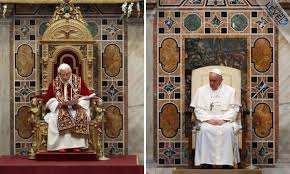
Source: Pope Benedict XVI (left) and Pope Francis I (right)

He has also washed the feet of a Serbian Muslim woman and of prisoners instead of traditionally having his own feet washed after his appointment.

Source: Feet-washing by Pope Francis I

More recently, he was under media attention after carrying his own luggage on his trip to Brazil for World Youth Day.

Source: "Only Pope Francis would carry his own bags aboard the plane for Rio!"

But perhaps most important are the words that he has said about traditional Church positions that have prompted prominent members of the Church and the Vatican itself to issue correctives. I cannot emphasize the irony and importance of this statement enough: prominent Church leaders and the Vatican have corrected the appointed voice of God on Earth, the infallible and unerring. Pope Francis I said on his return from Brazil that he and others should not judge the calling of gays to the priesthood. For a Church who argues for the immorality of gay marriage, this is really only a small step for acceptance, but is revolutionary nonetheless. This statement, however, was rejected by prominent New York Cardinal Timothy Dolan in a statement confirming the Church's official position that still considers sexual relations outside of male/female marriage immoral.

Additionally, Pope Francis I made a statement regarding the morality of atheists. Even those without a belief in God, let alone a Catholic follower could still do good and "we'll find a meeting point." People have interpreted this to mean that good people, no matter their religious affiliation, could be allowed into heaven. After this statement, the Vatican issued a statement that anyone who rejects the Catholic Church "cannot be saved."

What does it mean for the ethos of the Pope to be challenged? Is the Church so tied to tradition and antiquity that it must reverse even the slightest hint of progressive, liberal, and welcoming rhetoric? What role does Pope Francis I play if his position as voice of God is subject to human correction? Can he be trusted and considered an authority by followers?

I do not believe that these small statements truly mean that Pope Francis I is a liberal or that the Church is anywhere close to changing its positions (considering the correctives). To say that finding a place for women in the Church is revolutionary is really to forget the fact that it is 2013. The implications of these statements should not be completely ignored, however. What these statements represent is a small, but meaningful step towards increased inclusion in the Catholic Church. These symbolic gestures, though rejected by others, might promote the increased openness of Catholics or at least temper Catholic backlash to liberal social issues. At least this is a positive step away from some of the past teachings that were highly restrictive and more concerned with pomp and circumstance than change.

Source

Sunday, April 8, 2012

Easter 2012 and the Importance of the Pope

With Easter celebrations occurring today, I cannot help but think about the importance of Catholicism, the Pope, and religion in general on our world. Although I have posted previously that atheists should stand up for their beliefs, I believe still in religious expression and freedom, as long as the actions and behaviors that stem from these beliefs do not harm or infringe upon the rights of others. To these more extreme interpretations of religion, I am exploring the rhetoric of Rick Santorum and of the Westboro Baptist Church, so be sure to check my blog for updates on those topics soon.

First, I would like to discuss the importance of religion in modern society, from political to health to social issues, before discussing the specific importance of Pope Benedict XVI and his recent trips to Latin and South America.

In light of religion, Catholicism as an exemplar, and its influence on global policies, religious rhetoric and the ways that people incorporate religion into their lives is of the utmost importance. Considering that more than 80% of the world considers itself religious, with nearly 1 billion people believing specifically in Catholicism, the words and messages of the Pope, a social and cultural icon, have great influence in the modern day proceedings around the world. Religious leaders still have positions of prominence in many countries, from America's religious right to the Iranian Ayatollah, and their opinions can influence constituents and thus policy-makers in making decisions for entire countries and regions.

For example, the Catholic Church has repeatedly advocated against contraception use in Africa, despite the threat of HIV/AIDS transmission in the population. African religious leaders and missionaries tending to the sick there also preach abstinence and avoiding contraception, making it difficult for those advocating for condom use and safer sex to reduce HIV transmission to gain a foothold in many African populations. Religious influences may subvert scientific treatments for the disease and restrict those who have access to contraceptive measures that may restrict the transmission of the virus.

As Hilary Clinton stated in her UN speech this year, there is a new human rights issue plaguing the nation. The human rights of homosexual, bisexual, and transgender individuals have been denied in many countries, including America, for reasons that have roots in tradition, morality, and faith. The Catholic Church has been against recognizing homosexual unions, allowing adoption for same-sex couples, and offering gender neutral or more inclusive options for identification. Followers of Catholicism define marriage as being between a man and a woman. These teachings are not limited to Catholicism as many religious groups oppose contraception and rights for the LGBTQ community. However, in both the US and internationally, Catholicism can be considered an exemplar of religious influence in politics, social order, and community building.

Because the Pope heavily influences the Catholic community through encyclicals, proclamations, and visiting speeches, his words, ideas, and priorities can change the tides for political, social, and cultural policies and traditions. His influence may be epitomized by a recent Miami Herald article which states "Pope's visit to Cuba leaves little reason for hope". This may be a comparison to claims that Pope John Paul II helped spur the fall of communism as Pope Benedict XVI's visit to Cuba was one of mixed reviews. While a New York Times article referenced the Pope's urging of political reform, this request fell on deaf ears as politicians stated that political reforms would not be following the economic ones. Can we really describe this visit as a failure, though? It was the first visit to Cuba since John Paul II's visit in 1998 and symbolically shows that the Pope and Catholicism has not forgotten Cuba. Above all, I think that Benedict's visit reinforces the idea that he and perhaps many Catholics feel that the Pope does have the power to influence governments. If not, I feel there would not have been such negative reviews of the visit, as if him arriving and speaking there would change the entire political climate of the country.

In the case of the Pope, it is hard to delineate where one's expectations are too high or too low. His influence in global power is unmistakable and perhaps unmatched, but there are limits to the effectiveness of single visits and requests. In respect to the Easter holiday today, I admire the faith placed in the Pope to exact political change in Cuba but also critique how quickly this faith can turn to disappointment. The Pope is one man, and surely the world would not want one man, no matter their background or faith, to have such power and control over governments, nations, and people. But, it appears that the Pope does, because people and the media give him this power. Considering Pope Benedict XVI's tendency to be more conservative and to follow the letter of the Bible, there may be more changes in the Catholic community to come.