Showing posts with label Field of Communication. Show all posts

Sunday, August 30, 2015

Pedagogy Experiments: Grading in Public Speaking

In the beginning of Summer 2015, I taught COMM 204: Public Speaking to ten amazing undergraduate students. We tackled many important topics, such as logical fallacies, overcoming communication anxiety, and building sound, reasoned arguments. A few weeks before the course, one of my friends and colleagues, Kari Storla, forwarded me an article about autonomy and self-grading in the classroom. My first thought was dismay, shock, and disgust - let students....grade...themselves? It seemed like a ridiculous and pointless idea.

Image retrieved from this site.
But, after my gut reaction passed, I thought that public speaking might be the perfect course to tackle this interesting and innovative idea. I drafted a 25/25/50 rule: each student self-graded up to 25 points, the peer grades were averaged out of 25, and I provided the remaining 50. The article noted that few professors give scores below 50%. If 50% is given automatically, why not give the students some autonomy and control over that experience? I gave it a shot and this is what happened.

Overall, I found that the students were quite fair to themselves and their classmates. With the knowledge that everyone was peer-grading, there was a collective dependence on giving everyone decent scores. I averaged grades and all scores were anonymous, but the students still felt responsible for creating a supportive and welcoming environment. Even when comments were quite harsh, "This didn't really address the prompt, not sure I understood it," students (except for 1) still never graded below a 20/25. Across all speeches, there was agreement between the student self grade and the peer grade. Students, on average, gave themselves a 23.6 and the class gave them a 23.4. Even given the opportunity, only 1 student gave themselves perfect 25/25 across all 4 speeches. This same student also received the highest peer grades and the highest score in the course, despite the student having the third highest score from myself, on average.
Image retrieved from this site.
There were no statistically significant differences between grades and a student's race, but there were some interesting patterns. The top three peer graded students were Caucasian while the lowest three were students of color. Overall, though, the peer grades spanned 24.4 to 22.8, a difference of 6%, which could bump a student half a grade. The students of color were also more likely to give themselves lower peer grades. For example, the lowest average self grades, 22.25/25, 22.88/25, and 23.50/25 were all students of color (and two international students). One student (briefly mentioned above) gave consistent low scores to two students of color, averaging a 19.3/25 and 18.2/25. These discrepancies and outlying scores did not affect the overall student average nor did it vary significantly from peers. Because of the low number of students in the class, teachers may want to keep potential biases in mind (for themselves and students participating in peer grading).

Image retrieved from this site.
The self- and peer- grading was done through an app that I previously wrote a post about: Socrative. In the past, I used this app for pop quizzes and anonymous feedback, but in Public Speaking, I used it for immediate scoring of students after speeches. I did not allow technology use during speeches, but started the Socrative quiz for students to give feedback out of 25, with both positive comments and constructive criticism.

I also used Socrative to asked students how they liked the self- and peer- grading. In response to the questions, "I like the method of self and peer grading in COMM 204 this summer," all students responded "Agree" or "Strongly Agree." In response to "I felt like I had more control over my grade because of the self and peer grading policy," I only had 2 neutrals, with the rest "Agree" and "Strongly Agree." In response to "The self and peer grading makes the grading process more fair than just having a teacher grade," I had one neutral response and the rest "Agree" and "Strongly Agree." I had the same one neutral student in response to "I felt that my classmates and myself were reasonable and accurate graders." Students were more neutral towards, "I think that peer and self grading could work in other COMM classes," with four neutrals and the rest, "Agree" and "Strongly Agree." The students all marked "Agree" or "Strongly Agree" with "The self and peer grading policy has positively affected my experience in COMM 204."
Image retrieved from this site.
In the comments, the students were quite candid about how they marked themselves and others. One student admitted, "I felt that I was obviously more bias about grading myself than my peers. I tried to be as unbias[ed] as possible, but I think it was easier for me to mark someone off for something than myself." One student noted the potential risk, "It's an interesting system to implement, although it also relies on the assumption that your classmates also grade you honestly and fairly." Other students saw the process as very beneficial: "Getting to know peer and teacher feedback helps improve and motivate me and helped me boost my confidence."

Overall, I think this experiment was a success. The students responded positively to the policy, despite concerns at first. I was sure to emphasize the community aspects of the course and how important it was to be both fair and supportive. I think this helped the students see the benefit of engaging with this grading system and giving their full attention to their peers. I could imagine this process working well in other classes that might do presentations. In COMM 206: Communication and Culture in Spring 2015, I had many students mentally check out during student presentations about readings. If the students were tasked with grading, however, and knew that they would be as well, perhaps they would pay more attention to their peers. I'm happy that I experimented with this teaching experiment and would encourage students in a Public Speaking or other presentation-heavy course to try it out as well.

Monday, June 1, 2015

Graduate School and Mental Health

I am one day late posting my blog this week, and for good reason. I spent most of Friday, Saturday, and Sunday engaged in family activities (and traveling back home). There has been increased talk at USC about the state of graduate school life and mental health and how current students can improve their quality of life while undergoing an incredibly stressful program of work. During my years on the Graduate Student Government, I worked for 15+ hours as Community Service Director, took three courses which was 9+ hours of in-class time plus reading and homework, worked as a Teaching and Research Assistant for faculty for 20+ hours a week, all while expecting to be doing personal projects, attending conferences, and publishing papers. Now that classes are over, I've passed my qualifying exam, and I am no longer a member of GSG, my time is mostly dominated by working on the dissertation. This is a no less stressful but more flexible academic assignment. I list these responsibilities not to brag about my own accomplishments. Instead, it helps me to reflect on the immense pressure I experience, when I am a graduate student who is not also supporting a family on $30,000 a year, dealing with health issues, or serving as a member of a prolific research team.

Retrieved from this site.
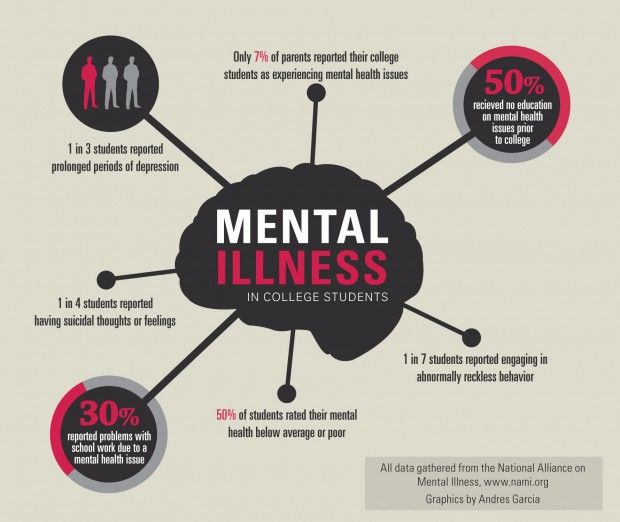
No matter our responsibilities, there is a great amount of pressure of students to succeed in public and suffer in private. It is very uncommon for people to discuss their workloads and admit failure or shortcomings. Instead, they turn into perverse competitions where we compare our workloads to others (I'm guilty of participating in this). When all we are told is "publish or perish," it is difficult to not have some sadness behind congratulatory statements or to take rejections from conferences lightly. To admit failure is to lose the game of PhD life and to express that openly is frowned upon. Research indicates that 60% of graduate students feel hopeless and depressed nearly all the time and 1 in 10 have contemplated suicide. But, there are few, well known resources for these feelings.

Retrieved from this site.
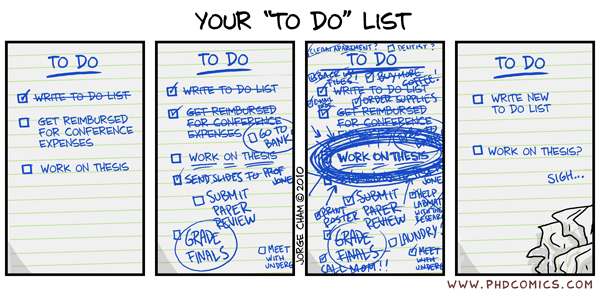
I took up this blog post in response to amazing statements made by my colleagues, Ritesh Mehta and Cynthia Wang, who reflected upon their time at USC. Ritesh made a profound and poignant statement at his dissertation defense about how students should not have to suffer in silence and be afraid to reach out to one another. Although the program is 100+ students in size, it can be quite lonely work staring at a computer screen all day. Cynthia posted similar sentiments on Facebook about sharing failures and talked about being rejected from a journal. I am proud of both of their statements and wanted to make one myself: I recently was rejected from a journal. Although the comments were quite positive, there was a sinking feeling that there was something else back on my plate that was simply unbearable. There was no room to fit it back into the growing list of tasks, assignments, and responsibilities.

Retrieved from PhDComics
I don't think that any of our problems are the result of USC. I would encourage any potential graduate students to consider this amazing and supportive program. I think the problems are deeper, within the PhD experience, and the academic community at large that engages in competitive mentalities and focuses on output instead of the process. Similar to ongoing debates about the requirements placed on medical residents, I think more conversation should begin about the mental well-being of graduate students. Reducing the stigma of sharing is something that I hope will get better as more students create a culture of support rather than judgment. This is something that will ebb and flow with time and does nothing to address institutional expectations. Indeed, when we think about the contributions that we will have as graduate students, it pales in comparison to what we will do as faculty members. Perhaps we need to treat graduate school more as training for academia than a full blown toss into the deep end of academic publishing and stress. This article provides some other potential solutions including increased acknowledgement, specialized training, and more resources.

Retrieved from PhDComics
I took this weekend off, postponed my blog post, and had a friend cover the class that I'm teaching over the summer. I felt guilty for a while for this decision I made, but I think that more of us should be okay with taking more breaks, more mental days off, and enjoying ourselves with family and friends. The computer (and that R&R) will still be there tomorrow.

Sunday, August 24, 2014

Rites of Passage: The Qualifying Exam

I have taken time off from this blog to go through a PhD rite of passage: the qualifying exam. There has been plenty of time for me to reflect on the purpose of the exam and the idea of rite of passage in general. From tests of adulthood to tests of skill to tests of preparation, rites of passage are important rituals in human life. For the past summer, I have been undergoing intensive preparation, reading, memorizing, and note-taking in order to prove my knowledge of my specific areas of expertise. Many schools do the qualifying process differently (and even within a school), but they all share the same goal of measuring knowledge and readiness to achieve the PhD. Now finished the writing process (I still have to defend my answers orally in front of my committee), I have often asked myself why PhD programs require these types of exams and why rites of passage in general are so very important to the maintenance of society.

Define "calm." Retrieved from this site.
I certainly learned a lot about the importance of ritual during my studying. Kenneth Burke argued that rituals reinforce "piety," or the maintenance of an overarching order based on social and role expectations. For example, rituals of marriage reinforce the role that men and women should strive to be husbands and wives. The ritual of confession cleanses sin and reinforces how people perform the role of a good Christian. When I engage in the ritual of the qualifying exam, I reify the order that my knowledge is and should be accurately be measured through my performance on this exam. Considering that the PhD qualifies me to teach students at a university, it would make sense that my exam would try to measure my knowledge, ability to synthesize fields of inquiry, and grasp of my given specialty. But, will I ever truly be asked to perform this type of task again? What does a concentrated burst of studying and writing (without access to notes, materials, or the Internet) really prepare me for?

I think the answer lies in looking at the larger picture of rites of passage and their purpose. There is an episode of "Taboo" where boys undergo extensive body scarification with toothed instruments and razors that bleed profusely all over their bodies. Going through this pain and struggle is part of the child's proof that they are able to understand and undergo the pain of adulthood. Though they may never experience such intensive pain again, this ritual proves that if the child can go through this pain, they can survive everything else.

Warning: This video shows graphic cutting and blood. Retrieved from this site.

The PhD program requires me to undergo a different kind of pain: mental pain. Though comparing this process to extensive tattoos may seem a bit extreme, there are similarities here between pushing oneself to the limit so that all challenges that come afterwards are manageable. Perhaps because of this experience, I will be better able to tackle journal deadlines, advising my own students, preparing for classes, and the myriad of administrative tasks. Not only will I have a base level of understanding of this material to draw from, but I will also be used to the long hours, mental strain, and intense workload. The qualifying exam does not quite measure my ability to succeed in this specific task. It is instead a concentrated and purposefully exaggerated challenge.

On the other side...Retrieved from PhD Comics.
As one of my professors once said, I may thank everyone one day for pushing me to my limits, challenging me, and preparing me for the difficult work ahead of me as a professor. Of course, many people in the PhD program are not interested in continuing into academia. This rite of passage, however, has become a universal part of achieving the PhD, an expected mark of academic excellence that you must achieve to be awarded the degree. As my advisor said, he wouldn't let me take the exam unless he knew I was ready, which perhaps begs the question of whether I am really in danger of failing at all. The point, though, is to undergo the experience and come out a better and well prepared scholar. I remember the pain of running during my first half marathon, but the great feeling of accomplishment after it was over. Of course, the process was extremely difficult, taxing, and exhausting, but now that it is over, I do feel a sense of accomplishment. I hope that this accomplishment is rewarded with a pass in the weeks to come! Best of luck to everyone else going through this rite of passage. See you on the other side!

Tuesday, March 4, 2014

Academic Labor and Producing the Graduate Student

Now half-way through my 5-year program at USC, I have experienced a lot of pressure from the "publish or perish" graduate mindset. In short, I am making no big claims to state that graduate school is about producing research and work, whether in class, through conferences, or in journals. The need to be constantly producing becomes an expectation. Admitting that I did not get into a conference (which we are competitive and selective) elicited, "what do we pay you for?" as a response. People are always concerned with who is publishing where and how frequently and which conferences have deadlines coming up. One's success in performing academic labor is measured by output or the products made. The two papers I entered in that conference that are now works in progress do not "count" until they have been officially recognized at a conference or journal. Un-submitted ideas are never seen, never appreciated, never counted towards tenure. This post is not meant to be a eulogy for all of my un-works, but simply a lead-in to my larger discussion of what it means to produce academic labor.

Retrieved from PhD Comics

As a graduate student, faculty, or staff member at a university, there are constant measurements and metrics in place to ensure one is meeting the unspoken yet pervasive standards of constant productivity. In producing this labor, are we not falling into the trap of capitalism as warned by Marx? Are we not separated from the fruits of our production? Scholars may feel forced or compelled to produce quantity over quality, experiencing distance and separation from their work in an attempt to meet production standards. It is hard to reach the journal-level quality of work when we are constantly being asked to produce paper after paper for classes, conferences, grants, and outside projects. Our salary is fixed, yet we may work extra hours (if one can say the clock is ever off) without compensation. Though we may rise in the ranks to post-doc, clinical faculty, or tenure track faculty, we never fully emerge from the pressures of a proletariat lifestyle that conditions us in the ideology of produce, produce, produce. This is not to undermine the system or call anyone to blame, but simply to reflect on the structure that informs our actions, why it does so, and if can it be changed. If we mean to highlight quality over quantity, how does publish or perish help us get there?

Retrieved from Saturday Morning Breakfast Cereal

The pressure to be thinking, writing, and producing in part encouraged the creation of this blog. This motivation, coupled with my inability to produce journal-quality writings on all the topics I may want to comment on, encourages me to constantly update and consider life in an academic mindset. What is the value of this productive labor? For some, it may be monetary. Google Ads can be placed on Blogger and other Google hosted sites that provide the author a few cents per "click" on the ads placed within the site. I've also received emails about this blog asking me to write up posts about certain products and sell a permanent ad space that I would reference sporadically in my posts. Despite the fact that this is a research blog, not a consumer blog, they offered me $125 for the initial advertisement and $50 for every subsequent reference. This is the example blog post they asked me to use as a template. At first, I was surprised that my random musings on religion, the environment, and culture could be deserving of actual monetary compensation. Or, had I merely been trained by my other graduate work to consider my research a non-monetary exchange value? Although I am not sure what the value is of the words on this blog, I can say that the reputation I am building as a scholar is worth more than the few hundred dollars I would get from advertising for cars on my research blog. I suppose, there is some type of intangible productive value that I do retain from my work, only to be cashed in a few more years down the line, for a higher salary and job security. Until then, the alienation and potentially damaging stress appears to just be part of the process.

Sunday, November 10, 2013

Important Questions for Communication Scholars

These are questions that guide my research and I believe they are important for all researchers and communication scholars. Feel free to add questions in the comments and debate the value of these questions. Within my interests in politics, policy formation, and the negotiation of power, I try to consider:

General Research Questions
What is my object or artifact of inquiry?
Is this artifact "interesting" or valuable to the academic community?
What questions operationalize and analyze my artifact?
How do I answer these questions?
Whose shoulders can I stand on?

Topic Specific Questions
Why do people believe some things over others?
What influences information consumption?
How are people accessing and processing information and data?
What are the effects of technology on social, political, and cultural activities?
Who has power, how did they obtain it, and how do they use it?
Who are the privileged/marginalized voices and what do they say?
What elements of speeches, advertisements, images, and narratives make them persuasive?
What arguments are believed and why?

Sunday, September 15, 2013

Unified Theory of Everything: Physics and Communication

I've come across the dichotomy of physics and communication one too many times to not comment on it as a pattern. When scholars look to compare communication (as a humanities or social science) to a "hard" science, the topic usually turns to physics.

I do not know the reasons for this, but I can make basic assumptions about the two fields. Communication has humans, people, and their interactions as its focus, but physics concerns the interaction between forces, atoms, and particles that are not sentient or of free will. Although humans and particles are quite different in their motivations, actions, and behavior, the two fields actually overlap quite a bit. Both are concerned with interactions, relationship, causes and effects, and patterns. Both fields are also undergoing large arguments about the purpose of the field and how it can be united into one universal theory. For communication scholars, the journey to defining "communication" and linking disparate scholars (from cultural studies to rhetoric to psychology) in their ideology and methodology has been a task thus far daunting and unreachable.

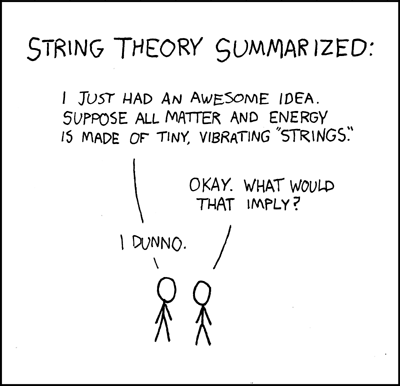
The Theory of Everything is an equally inscrutable theory of physics that links all physical phenomena under one theoretical boundary. The purpose of creating these overarching theories is not lost on me, but I fear they may never be fully realized, especially in our lifetime. The main issue that links both physics and communication in their search for the theories of everything is to find the balance between application and oversimplification. For physics, the search for the universal theory of everything is admission that some theoretical concepts do not universally apply to everything. Fundamental forces are grouped into two categories, general relativity and the three: electromagnetism, weak, and strong forces. These two groups operate under opposing principles, meaning currently, physicists are still pondering the universal forces that govern all interactions. From the rotation and orbits of planets, to the relationship between atoms and particles, there is no one solution to how forces work. The current contender for the theory of everything is "string" theory, that changes the way that matter is defined in order to negotiate the hypocrisy between weak and strong forces. Unfortunately, the theory is still being developed and is not yet being used by current researchers.
XKCD.com
In communication, there is no one theory to when, where, how, and why communication occurs. Some believe that communication is constant, some believe that only meaningful, intentional communication is important. Some believe that communication is a matter of power and oppression, where other focus on communication as persuasion, information, or networks. Introduction to Communication courses are largely a result of the professor's personal inclinations, for a class such as this could not truly begin to be an introduction to every aspect of communication, at least not as it is defined now. There are researchers currently trying to define what communication is and how all aspects of it can be linked with one unified theory with the purpose of creating unified though, research, and meaning out of the field.

I am skeptical that such unified theories will ever truly exist, at least not in ways that everyone can agree on. For what purpose is a communication theory that discounts racial, ethnic, or gender differences? How applicable can a theory be that does not acknowledge the impact of technology, networks, and relationships among people? There are so many different aspects of communication, that to create a unified theory must privilege some and reject others. Reducing the varied, exciting, and unique field of communication to one theory would undermine the ability of researchers to address specific problems, artifacts, and inquiries with the most appropriate theoretical tool. The theory of everything for physics would mainly help simplify physical formulas and streamline research and data, but little would change for most researchers. Simply because, current theories function well to predict small interactions, and general relativity functions well to predict large interactions. Combining them would change very little about these predictions, except for that they would be linked. The one exception would be for those objects that are both tiny and massive; namely, black holes complicate this separation. Black holes are massive, but occupy very little space, so theoretically, both sets of theories should apply, and yet, they cannot.
I applaud scholars whose research finds them looking to larger, theoretical problems. I believe that most researchers, though, might find their time better spent analyzing and solving smaller, more meaningful communication and physics issues.

Smbc-comics.com

Wednesday, January 23, 2013

Open Access Journals: Information for/by everyone?

I had previously scheduled a different topic, but in light of a few well-reasoned and interesting blog posts by my colleagues at USC, I've decided to throw my own hat into the ring about open-access journals and the future of publishing. I encourage you to read Alex Leavitt's initial post and Andrew Schrock's response post before reading my response below.

First, I wish to declare my support for Alex and Andrew in their praise of open-access. In theory, the term is a sign of open information, shared meanings, and enlightenment. I find, however, that such thinking is, at least in current iterations, overly optimistic. In this vein, I agree more closely with Andrew's caution towards open-access in that there are other things to consider before launching a personal crusade. Alex has taken a more hard-line approach, calling for the complete abstention of "closed access", not only for himself, but for all scholars.  Below I will enumerate issues that I have with such a declaration and why I would urge scholars to question the implications and consequences of such actions. I will also explain why I find Andrew's response and the continuation of some of his ideas as a more practical compromise.

I would call attention to the overarching idea of the initial post: that open-access is moral and hortatorical/obligatory for scholars. This is known as the fallacy by composition, or the logical reasoning that assumes that something true of part of a whole must also be true of the whole. I completely agree that pursuing open access and supporting it is a noble goal for scholars, but I do not agree with its universal application. The implication in making such generalizations is that for all scholars, no matter their discipline or situation, that this is the correct or moral move. This, I believe, excludes the work of other scholars who may not study new technologies, be passionate about open-access and the share of information, or have the same gain by making such an announcement. The community in which and the topics which Alex studies uniquely positions him to make this declaration. Rhetorical scholars would have no interest in my admission to do the same. Creating a blanket statement by definition ignores scholarly differences that may prohibit and inhibit one from making the same choice. Although this would merit another blog post entirely, I will mention here briefly the notion of "white male privilege" that creates a hegemonic structure that rewards those in power for taking risks and penalizes others for not conforming. Whereas a great media and Internet scholar like danah boyd can "get away with" avoiding closed-access publishing, others without such clout or experience could have their careers dashed for making the same choice. This is also inherently linked to one's name/mark in a field and one's youth (read newness) to academia.

This brings me to the issue of "choice" in general. I have previously written about this in regards to the Taylor Cotter incident, and the topic emerges here again. The truth is that although "open access" is a laudable goal, who is this information really "open" to? As Andrew mentions, scholars live in  "privileged media and spaces that are not open to everyone" by definition, because our work is shared not necessarily to the general public, but for the purposes of academic advancement, theory, and methodology. This is not applicable to all scholars, of course, but I feel that for the majority, it is. For example, my current RAship with the Earth Science Communication Initiative is working on helping combine multiple voices (scientists, politicians, religious leaders, and activists) in working towards climate change. Will the people we work with and access be interested in the theory papers I write on apocalyptic rhetoric and political inaction? Probably not. Will they be interested in plans for action, evaluations of the conversations  and solutions? Most likely. That distinction for me is the clear divide between open and closed access, simply not everything has to be or is somehow better because it can (but won't) be accessed by non-scholars. Andrew makes this point as well, noting that few people have ever denied him copies of papers he has wished to read. I have also never been denied and I have emailed copies of my papers after conferences when asked even if in theory they reside only in closed-accessed spaces. As a side note, aren't all universities closed systems of information? How many people get to see the paper I wrote for Randy Lake's "Social Movements as Rhetorical Form" class unless I publish it? Wasn't the creation of journals and online publications for this very reason?

The ultimate goal of "open access", I would assume, is for the free and open sharing of information, an online Habermasian coffee shop of academic intellect. But, I think one of the best places for this to happen is at conferences and meet-ups. Of course, this brings me back to the idea of choice and the access related to money/wealth that some scholars do not have. Conferences, especially inter/national ones are not affordable for everyone, though I think academics are creating solutions to this such as local conferences (my VisComm conference in Utah was more engaging than the national ones I've been to) and creating tiers of payment for cheaper options of registration. Those issues aside, conferences are more personal and expressive points of interaction that online spaces (for now). I am sure that the capabilities will continue to grow, but for now, there is no equivalent to the panel experience. For example, my past panel at NCA gained me new colleagues, gave me new insights into the topic (Romney's Mormonism), and I exchanged numerous business cards from panel attendees. This most likely would not have been possible if I had merely posted this paper online. Part of the problem is in the bog of online scholarship, where does one begin? How to sift through all of the information accessible? Again, it comes down to one's name in the field. Whereas Alex may be receiving much attention for his post, this one will most likely go unnoticed. How does one get to the place where open-access is recognized, lauded, and meaningful? After participating in the current system.

Andrew also praises the networking opportunities that come from associations and conferences that may not be hosting everything online, as spaces for expression and exchanging of ideas. These are possible because of communication associations that host them. These associations are also responsible for the publishing issues that we have. As a previous employee of a journal publishing company, I will first say that vilifying the publishing company for the state of academic research is not only unwarranted, but it is also counterproductive. Without going into too much detail about the process, I would merely say this: how successful would a publishing company be that placed restrictions on its clients? Publishing companies provide printing and online service at the request of the association/organization, nothing more. It is that group's decision for how to have journals accessed and available to members. These prices increase with options and there may be monetary royalties per subscriber or journal downloaded, but overall, these are restrictions and choices placed by the organizations themselves. Are we now to boycott any type of scholarly communication organization? Do we become lone wolf scholars trapped in an online bubble? Either way, the publishing company is simple providing a service, information and access is not for them to decide.

In conclusion, though I admire Alex's passion for the open-access movement, I find it highly problematic to engage with at the exclusion of associations, journals, and other scholars. I find myself agreeing with Andrew, more or less and his more measured approach, that praises free and open publication, but does not demonizes those who do not engage, as there are many  reasons for doing so. To think that I could not approach my friend and colleague to work on a paper, conference submission, or journal saddens me because those ideas/collaborations will be fully lost to the academic community, as opposed to being slightly restricted. I suppose that I will not be co-authoring anything with Alex in the future, but perhaps Andrew and I may.

To summarize, TL;DR
  • Open access in theory is a moral no-brainer, but in application, it is problematized by issues of choice, universality, and execution
  • Female, minority, or any combination of intersectionality may not have the same "choice" that Alex made
  • Scholars who are young, at lower ranked universities, or not in technology/new media studies may be unduly hurt by restricting their publishing
  • The current system is changing to encompass more of these demands for online access (why destroy and boycott the system that is already attempting to do what we ask of it?)
  • Shouldn't we be opening access to those we know will read/are interested, as opposed to the general public out of principle? (obviously this depends on one's field/research)
  • There is no substitute currently for the in-person exchange of information
  • Associations/organizations that obtain/release information are to blame, not publishing companies
  • Currently, these associations provide scholars with more benefits that restrictions

Wednesday, October 10, 2012

Conference Pros and Cons

After going to three conferences so far in my academic career (a limited number compared to some of my prolific colleagues), I have already noticed some stark differences between the larger, medium-sized, and smaller conferences. The differences between the Eastern Communication Association, International Communication Association, and the Visual Communication Association conferences left me with much to think about for future conference planning, scheduling, and budgeting.

What is most surprising is that across the board, conferences cost around $700 each. Some of us are lucky enough to receive university funding to help subsidize these costs, but for most unfunded students, post-docs, and recent hires, these prices are restrictive in how many conferences it is feasible to attend. Using the ICA conference as my large conference and VisCom as my small conference, I have listed the pros and cons that I have experienced as a conference novice.


Large conferences - ICA as exemplar
  • great variety
    • I was thrilled to see all of the variety in panels that I could attend. From early morning to early evening, there were dozens of panels that interested me in a variety of topic areas and disciplines. There were even panels in different formats, from posters to panels to speed sessions, to keep my attention.
  • overlap in panels
    • Although the number and variety of panels were great, there was a lot of overlap where I was interested in multiple panels and had to chose which to attend. This is an obvious converse to the above point, but I still felt rude for leaving panels early and had difficulty choosing between panels of interest to me. A few times I felt that I had chosen incorrectly, but felt obligated to stay and be respectful to my fellow scholars.
  • large amount of people
    • This aspect is half green and red simply because for some, this is a positive attribute. For me, however, I felt quite overwhelmed by the amount of people at the conference, resulting in my clinging to the few people I knew and meeting very few new scholars. Surprisingly, for the conference being so large, I had only a dozen people present at my panel.
  • major city
    • Although I didn't explore Phoenix, I knew many of my colleagues who took time to visit the Grand Canyon, go on local tours, and simply wander the city. Next year the conference will be in London, so ICA offers even more sightseeing and travel opportunities. The major city also helped keep prices for flights and hotels down due to competition.
Small conferences - VisCom as exemplar
  • great variety
    • Although the conference was only about visual communication, a small subset of communication, the variety of presentations was astounding! From discussions of the body to politics to memorials to evolution, the panels did not disappoint in variety!
  • small amount of people
    • The small amount of people made for an inclusive and welcoming atmosphere. There was only one panel scheduled for each time slot, so everyone at the conference attended everyone else's panel. Not only was I presenting to many more people than at ICA, but I was having the same scholarly experience that my colleagues were having as well.
  • price for value
    • The registration fee for VisComm was more than double ICA's registration, which was surprising to me. One good aspect of this was that the food was included, so I did save some money there. Although I normally do not spend a lot of money on food anyway, it was a nice change to feel well-feed (and how good the food was!) at the conference.
  • location
    • This is in part related to the price issues above. The VisCom conference was in Midway, Utah, the closest airport being Salt Lake City, which was 1 hour away. The location was inconvenient and the prices to fly into Salt Lake City were expensive and the traveling complicated. The hotel site was beautiful, with a crater, mountains, and landscaping, but the high cost of the flight and hotel caused me to leave without venturing too far from the conference room.
View outside of the Homestead Resort in Midway, Utah

Poster Presentations - ECA as exemplar
  • genuine interest in project
    • People who stopped by to read more into my poster were genuinely interested in my project. Additionally, we had more in-depth and nuanced conversations about the specific aspects of my project that was particularly interesting. I was not talking to an entire room, answering a few generic questions, but was having a personal conversation with a fellow scholar. There was opportunity for sharing, brainstorming, and more intimate discussion.
  • repetition
    • Within those intimate conversations, though, I found myself repeating the basic tenets of my piece over and over again. In a larger panel discussion, I could have answered the questions for everyone a single time. For individuals, however, it was necessary to give my five minutes spiel for everyone who came around. For a two hour poster session, I was hoarse by the end of it.
  • chaotic/loud
    • The ECA's poster session was the first that it had put on for the undergraduates. They apparently had more interest than expected because the room was quite small and posters barely had enough space to stand beside without standing in front of someone else's. If the posters I were sandwiched between each had visitors, it was hard to even see my poster let alone have a conversation about it. These issues may have been alleviated with a different set-up and space, but it is an issue to consider when applying for a poster session.
Overall, I greatly enjoyed my conference experiences this year and look forward to my upcoming year of conferences, which is already being filled by my planned attendance at the National Communication Association conference in Orlando, Florida in November.

Monday, December 19, 2011

Aristotle, an amendment

On our makeshift Christmas Eve last night, my significant other asked me, would I rather sit down and share a meal with Plato or Aristotle? My mind immediately picked Aristotle, as his writings on rhetoric created and have forever impacted my field of study and my own personal interest in rhetoric. There are many aspects of communication and rhetoric that find their roots in Aristotle's writings, but there has always been one aspect of his teachings that has bothered me. I believe my first issue was learning about the distinction between types of rhetoric in my Classical Rhetoric class in undergraduate. Aristotle detailed the separation of rhetoric into four aims or goals: to inform, to entertain, to seek truth, and to persuade. When one thinks of rhetoric, one primarily thinks of the classic, Aristotelian definition: the ability to see and understand in any situation, the available means of persuasion. This prioritizes "to persuade" as the most important and valuable aim of rhetoric. Without going into too much detail on the nuances of rhetoric, this is the aspect with which I have dedicated my education and (I hope) my future career into researching, teaching, and advising about. I began thinking to myself, though, what really separates these aspects? Is persuasion truly that different from informing, entertaining, and seeking truth?


I would like to argue and state here, that persuasion should actually be a heading for all of these aims, an end goal for each of the subsequent three types, with entertainment, information, and truth-seeking as methods and types of persuasion. Persuasion becomes a more generalized term that all three methods of communication have in common: imparting words, meanings, and nonverbal cues to a consumer and receiver with the attempts to create understanding, acceptance, and a desired response. In an expansion of Stuart Halls, "Encoding/Decoding" piece, I would like to amend that words, messages, ideas, are not passed simply for the sake of passing, but that every word, meaning, idea, or gesture, has a purpose in its sending. The addition of a purpose or motivation is not unlike Kenneth Burke's idea of the pentad, in which motivation is a powerful concept. By combining the two, and indicating motivation as an inseparable part of any type of communication, it all becomes influencing and persuasion. For example, are teachers not educators, sharing information with students? But, are they also not trying at every turn to persuade the students that this information is true? That their class is the most important and should be given the most time and attention? That the subject matter and homework is worthwhile to know, to study, to understand? Is this not a type of persuasion that the words and ideas being transmitted to the student are of value? When one is being entertained, whether at a movie, by a story of a friend, or through various aspects of media, is one not being persuaded of a way to feel? An emotion to have? A response to give to the producer? Are we not being persuaded by stand-up comedians that their art is deserving of a laugh? Or that a song by Lady Gaga deserves our dancing along? If we are not convinced a joke is funny, or that the song has a catchy beat, then hasn't the form of entertainment failed to persuade us of its importance? When one tries to seek truth, are they not seeking truth in order to share the truth with others? Convince them that they have finally found truth? This reminds me of the book I have recently finished, The God Delusion, by Richard Dawkins (see next blog post for a book review), in which the entire book is an argument trying to seek the truth about religion, the creation of the universe, evolution, and the human condition. Is this book in and of itself not a larger argument for atheism, the truth of evolution, and the abandonment of faith? Is not the purpose of the book to persuade the reader to accept this truth?

These points are important to me, as my interest in studying rhetoric is the means of which persuasion occurs, how power is transmitted, obtained, and enforced, along with different categories of situations where persuasion occurs. If rhetoric can and should involve all aspects of communication, then there are many unstudied and little examined paths of inquiry that could benefit from a rhetorical lens. There are examples of persuasion being applied as a method to what might be considered traditional forms of media, such as movies. One that comes to mind is the work of Rushing and Frentz on symbolic convergence theory in movies , notably their 1995 book, Projecting the Shadow, The Cyborg Hero in American film.
 Projecting the Shadow
These crossovers between the three can occur and I believe they should occur more often. There are opportunities for more ideas to be created, overlaps to reveal hidden meanings, and new partnerships in the research in fields of cultural, critical, rhetorical, and political endeavors.