Showing posts with label Politics. Show all posts

Sunday, November 9, 2014

Denialism Studies and Re-claiming History

Image retrieved from this site.
I have been a little behind on my blog posts because I have been focusing on my prospectus. Also, last weekend, I attended a conference called, "Manufacturing Denial" which took up time with some great presentations and discussions. I was honored to be invited by the Strassler Center to take part. At the conference, I gave a paper on the similar argument patterns and rhetorical strategies in Holocaust-denial, climate change denial, and evolution denial. The three forms appeal to a unifying framework of conspiracy that allows them to construct enemies, discredit evidence, and shift the burden of proof onto historians and scientists. The article that served as the launching point for this larger piece can be read here. Summarizing comments from the conference can be read here by Dr. Massimo Pigliucci, who I had the pleasure to meet and discuss evolution with at the conference.


Presenting on my panel at the Strassler Center at Clark University. Photo credit to Khatchig Mouradian.
This post will address some important themes that emerged and will place them in conversation with a speech by Martin Luther King, Jr. who spoke out against the Vietnam War. His words echo in the present conflict as relevant and insightful. Similar to the foreign war sanctioned by government with dire, material consequences, denialism is often a pervasive, legitimized, and powerful force that begs us look at history and important rhetorical moments for guidance. 
The series of panels addressed many instances of denial, such as the genocide during World War II, the Armenian genocide, genocide in Rwanda and Cambodia, climate change, evolution, health effects of tobacco, autism vaccines, GMOs, political myths, and others. The variety of opinions ranged between questioning the worth of focusing and responding to denial to trumpeting the great work of exposing denial in its various forms. Some even went as far as to advocate for criminalizing denialism, as some European countries have done with the Holocaust, in all of its forms. They argued that not only are the memories of victims tarnished and 'the truth' being re-written, but also the mental and emotional well-being of descendants and citizens are affected by denialism.

Image retrieved from this site.
In the case of climate change, scholars argued that denialism promotes gridlock in the political system and stymies preventative action. Denialism, thus, is paramount to leading to thousands (and even millions) of preventable deaths. One scholar argued that the genocide of both humans and nature may have more casualties than any genocides in the past. Though I appreciate the candor of these scholars and respect that they are elevating issues such as climate change to the level of genocide in its consequences, criminalization is not the answer. It is quite easy for denialists to take advantage of criminalization as silencing the truth. The University of Utah Press, who came under fire repeatedly for published books that denied the Armenian genocide, has recently published a book by Lewy called "Outlawing Genocide Denial: The Dilemmas of Official Historical Truth" about the dangers of outlawing. Any type of law against denialism must somehow avoid issues of freedom of speech, specifically in America, and that everyone has opinions, however seemingly irrational or misguided they are.  In his speech, King argued that "communism will never be defeated by the use of atomic bombs or nuclear weapons." Taking firm, violent action against those with differing opinions is rarely a way to change people's minds or completely quash those opinions. In fact, a common theme at the conference was the likelihood that being faced with opposing information may encourage a backfire effect that heightens the original belief. War and violence conquers; it does not convince.
One common theme that came up among the panelists and my own paper were that although literal and blatant denial is often most studied by academics and heard about by the public, denial in its implicit and subtle forms can be the most insidious. In the Q&A, an audience member asked if scholars were not misplacing their time and efforts by trying to combat denialists instead of working on other research. I argue with King, Jr., however, who argued that "silence is betrayal." To not address important points of deception and denial is to remain passive and allow for evil to flourish. One of my co-panelists argued that "sunlight is the best disinfectant." Scholarship, in part, is based off of the very values that we are decrying: skepticism. Scholars look critically at the state of reality, question norms, and expose constructed and often subtle workings of power. Denialists occupy an extreme version of this healthy skepticism to where even basic evidence, consensus of truth, and facts are discounted, seen as fabricated, and are questioned. How do we negotiate and foster healthy skepticism and critical analysis without invoking cynicism and isolation?

Image retrieved from this site.
Although King was met with resistance to his speaking out against the Vietnam War and his advocacy for peace in the Civil Rights movement he felt obligated to fulfill his duty, follow his path, and oppose the evils that he saw. King argued that "men do not easily assume the task of opposing their government's policy." At the conference, the Armenian genocide and the Turkish government's attempt to rename the genocide as "the events of 1915" and paint the Armenian victims as insurgents speaks to a national, government-supported policy to change the past and rewrite history. It is not easy to oppose the government and break out of the "apathy of conformist thoughts." It is certainly much easier for many of us as scholars to turn the other cheek and focus on other issues. But when denial of facts and the subsequent gridlock and inaction occurs that threatens knowledge, public deliberation, and the future stability of the world, how can we not act?

Monday, July 21, 2014

Intergenerational Arguments about Climate Change

The consequences of climate change have become more prominent, but many of the harsher, more extreme consequences will not be felt by this generation. Part of the difficulty in crafting persuasive climate change arguments is about "jumping" the inter-generational gap. An intergenerational argument encourages people to act not in their own interest, but in the interest of future generations. Though most of us alive today will likely avoid most of the harshest effects of climate change, our children and certainly our grandchildren, will not be as lucky. People tend to be fickle, however. They are many things vying for our attention, pulling us in different directions, so anything further off than right NOW seems too far off to be worthy of our time. As Burke noted in Permanence and Change: “A philosopher, if he has a toothache, is more likely to be interested in dentistry than in mathematical symbolism. Communication cannot be satisfactory unless the matter discussed bears in some notable respect upon the interests of the auditor” (p. 37).

Retrieved from this site
How do we get people to care for youth? For animals? For anyone but ourselves? It is not simply a matter of narcissism or selfishness; it is just far easier for people to react based on their immediate surroundings. Thinking ahead requires much more energy than simple observation, putting oneself in a different mindset is difficult, and there can be other, conflicting loyalties that stop one from accepting long-term arguments. One of these arguments is economic: short-term business and profits may suffer when making long-term environmentally friendly decisions. Another complicating factor may be religious beliefs about human's dominion over the earth. Or, it might simply be a political affiliation that often denies science and climate arguments in deliberative spaces (Gauchat, 2012).

Author and activist Zadie Smith. Retrieved from this site
One of the ways to spread intergenerational messages is online. When public spaces may be held to standards of balance or may receive denialist backlash, the internet can serve as a location for the expression of information. A recent article by author Zadie Smith called, "Elegy for a Country's Seasons" addresses the current apathy in the climate change debate and how she might explain our inaction to her granddaughter. This excerpt from the piece is particularly important as the excuses given seem to pale in comparison to the burden that we will leave this young girl and all children as we bicker over money and politics.

"This will no doubt look very peculiar to my seven-year-old granddaughter. I don’t expect she will forgive me, but it might be useful for her to get a glimpse into the mindset, if only for the purposes of comprehension. What shall I tell her? Her teachers will already have explained that what was happening to the weather, in 2014, was an inconvenient truth, financially, politically—but that’s perfectly obvious, even now. A global movement of the people might have forced it onto the political agenda, no matter the cost. What she will want to know is why this movement took so long to materialize. So I might say to her, look: the thing you have to appreciate is that we’d just been through a century of relativism and deconstruction, in which we were informed that most of our fondest-held principles were either uncertain or simple wishful thinking, and in many areas of our lives we had already been asked to accept that nothing is essential and everything changes—and this had taken the fight out of us somewhat" Smith, para. 11.

Written articles may take time to read through and may not offer direct and easy consumption of information (however beautiful and engaging Smith's article is). Another potential solution is to create videos that craft intergenerational arguments. This video is from the Australian Coal Mining Company that has a unique intergenerational plan for halting the effects of climate change.


This humorous video has an important point. It mirrors the argument by Smith about passing the buck onto future generations when we could have done something about it. When we stand back and look at the potential consequences, what are our excuses? Is it really enough to look at dollar signs or listen to denialists when we are faced with the guilt of harming all future life? Dramatic? Maybe. Accurate? Certainly. These arguments are not always successful, but people should try to become more attuned to them. Focusing on the current effects now can be an entryway in to discussing how it will only get worse, and our children will suffer for it.

Sunday, June 29, 2014

Earth Sciences Communication Initiative

I am traveling for the next few weeks to attend the International Society for the Study of Argumentation Conference in Amsterdam. Instead of a longer, more in-depth piece, I hope that you may read a few blog pieces that I've written for the Earth Sciences Communication Initiative. This is a long-running research partnership that I've had that focuses on the intersection of the environment, politics, communication, rhetoric, and advocacy. More information on the group can be found on ESCInitiative.org.

Harm to Animal and Plant Life as Motivation
This article explores the potential threats of climate change to animal and plant life. More specifically, it addresses how these threats are conceptualized as motivation for taking action towards environmental protection. These might not be as successful rhetorical strategies as appealing to direct threats to ourselves or future generations, but they still reflect a potential opportunity for change.

Polarizing/Politicizing the Climate Change Debate
This is a topic I've written about a few times before. The article addresses how political loyalties can trump considerations of environmental protection, making short term benefits more convincing than long term ones.

Creation Care: Uniting Science with Moral Imperatives
In response to Pope Francis I's recent discussions of climate change and environmental stewardship, this article addresses the creation care movement and how it marries environmental concern with a moral imperative to act. You can read my four part, intensive critique of this movement here (Part 1, Part 2, Part 3, Part 4).

Climate Change is No Joke. . . or Is It?
This article interrogates the use of humor as a potential tactic in promoting forgiveness and action. Instead of condemning and punishing people for environmental crimes, the comic frame could allow for a more positive, productive engagement with environmental topics.

Sunday, June 22, 2014

Donald Sterling as a Modern Day Earl Butz

It is impossible to ignore all of the online and offline discussion of the owner of the LA Clippers, Donald Sterling's racist remarks. He noted in a private conversation to his girlfriend that he didn't want her "associating with black people," and specifically bringing them to basketball games. The hypocrisy in Sterling becoming rich off of the labor of black bodies has been addressed better elsewhere, so I wish to address another important part of this discussion: the apologia. Using Kenneth Burke's guilt-redemption cycle, this post will discuss the similarities of Sterling's remarks to the racist statements of Earl Butz, and how these statements implicate the larger American public in the persistence of racism.

Donald Sterling and the Clippers's logo
Earl Butz was Secretary of Agriculture in 1976 who eventually resigned his position after racist comments emerged. This site has the full timeline of the events including the offensive joke. A scholarly article was written about that event by Dr. James Klumpp and Dr. Thomas A. Hollihan called "Debunking the Resignation of Earl Butz: Sacrificing an Official Racist." The title reveals some important terms and information that will inform this comparison between Butz and Sterling. I will also highlight some important differences that reveal modern racial tensions. Butz was "sacrificed" as Klumpp and Hollihan say, as a part of Burke's guilt-redemption cycle. This cycle describes how pollution, or some type of disorder, is introduced into an order, which creates guilt and a subsequent need for purification, purging, and redemption.

Earl Butz, retrieved from this site
For Butz and Sterling, the pollution was their racist statements that shattered the values of equality inherent in their respective social and political orders (government and sports). Both of these institutions are supposed to value equality, all Americans, and their constituents. As public figures, their voices can be seen as stand-ins for the groups that they represent. Butz was "sacrificed" by the Republican Party, who wished to separate their public appearance from racism. The NBA also separated itself from Sterling by banning him from the organization, fining him $2.5 million, and urging him to sell the team. The sacrifice can come in many forms, but it must make the punishment commensurate to the crime committed. Considering that the pollution for each was the potential crumbling of national organizations, the punishments were made quite prominent, public, and severe.
Some prominent reactions to Sterling's statements
Another important similarity between the two are the separation between public and private. Klumpp and Hollihan address this dichotomy by nothing that officials are sometimes seen as not have the right to privacy: anything said even in private could destroy a public persona, one's reputation, and career. Some were quick to jump to Sterling's defense such as columnists at Fox who pointed to the "thoughts" of Sterling as harmless and a personal right. Some articles went as far as to implicate the girlfriend (who recorded the conversation) as the real criminal. In the aftermath of the announcement, Mark Cuban echoed the words of a Fox News reporter about whether convicting people for statements in private could be a "slippery slope" to the thought-police.

Though some of these concerns were raised, there has been overwhelming support for Sterling's punishment. One might say that it was a "success" in some ways in that an athletic profiteer who undermined his own team and the values of the NBA (and perhaps, the country) would be receiving a just punishment. However, Klumpp and Hollihan raise a point of contention with these types of guilt-redemption activities. They note that by creating a sacrificial goat out of Butz and Sterling, we as a nation do not have to address underlying and persistent racism that we may all (or at least most of us) be guilty of. Instead, we can claim that wrongs have been righted and that racism is an individual issue that does not have to be addressed on a societal level. They note that these overt punishments of racism create a culture that "tolerates private racism and its consequences” (p. 11). Jon Stewart adeptly addresses the issue of post-racial society in his critique of Sterling and the recent SCOTUS decision to uphold Michigan's ban on affirmative action.

Retrieved from the Daily Show

What is to be learned by the Donald Sterling incident? One thing is perhaps most important: racism still exists. There is no magical, post-racial world because we have a black president. People haven't stopped being murdered because of their race, people haven't stopped trying to make relevant the KKK, and people still use the n-word. This is only the tip of the iceberg, however, as racism against other minorities, especially immigrant populations, is also a common American theme. Is this what America is all about? We need to take examples like Butz and Sterling and open our eyes to the underlying problems from which these individuals stem. Structural racism is happening and continues to happen; we cannot remain blind to it and only care when individuals break norms of keeping racism a private endeavor. All racism needs to be addressed, and we have a lot of work to do.

Sunday, April 20, 2014

The Weak and the High Maintenance: Female Stereotypes in Advertising

This was not the intended blog post for this Sunday, but a few recent advertisements have been on my mind, recently. Their repetition on the TV channels I watch and on Hulu has increasingly bothered me in their portrayal of the female. I will link to them both here and then discuss the problems that emerge in the persistent stereotyping (especially gender stereotyping) that occurs in media.

The first commercial is from Verizon, which advertises that if you buy a phone, you'll get a second free. Then, the commercial explores various options for who the second phone should be given to. Attempting humor, the commercial proposes that a girlfriend may enjoy the free phone, "but don't tell her that it's free." The face of the female fades from happy to disgruntled. This commercial plays on the "high maintenance" girlfriend trope where females are not happy or satisfied unless a lot of money has been spent. Shows such as Bridezillas, MTV True Life, arguably every Real Housewives version, emphasize this theme of women as spoiled, needing immediate and constant care, and focused on the material. These stereotypes overpower a more dimensional representation of the female outside of material goods and characterize all women as high maintenance. This description itself is inherently offensive. One's provides maintenance to a car or an object, not to a person. There is the association with a female as an accessory, a tool, an object needing maintenance, improvement, and upgrades in order to function. This also implies that the partner (oftentimes male) in the relationship is the only one with purchasing power. This clip from Bridezillas, featuring Remy and Rob, illustrates the dynamic quite well.


The Verizon commercial bother me, because it ignites these stereotypes as women as only valuing the material, lacking purchasing power, and only superficially strong in their demand of items they cannot provide for themselves. Even in the portrayal of strong women who declare they deserve certain items or treatment, there is an underlying weakness in the women who rely on others for self-validation, respect, and attention.

The second commercial focuses more on the vegetarian as weak, but the non-present character is given a female gender. This is a commercial from Walmart about setting a table for an Easter lunch. The planner describes why certain people are placed in certain spots noting that her vegetarian sister is at the opposite end of the table "so she can't see the ham." My first reaction was one of disgust that a commercial would rely on stereotyping vegetarians as too weak to even see meat. Though this is just a small statement, a lot of information is imparted in a short amount of time to the viewer. The audience is surely meant to consider the planner quite respectful. But, the implications are that vegetarians (and perhaps specifically female ones) cannot stomach the sight of food they cannot consume.

Both of these commercials highlight the importance of stereotyping in the world of advertising. When a company has only 30 seconds to compare one's attention and express the benefits of a product or service, stereotyping is a potential strategy. Originally conceptualized as the images that one sees in one's head, stereotyping is now defined as a mental shortcut that associates certain characteristics with others. There are racial, gender, ethnic, religious, political, and geographic stereotypes, all which connect a person to a host of underlying associations. Stereotyping makes sense if one's goal is to impart information as quickly and as succinctly as possible. The human brain is lazy and would rather use mental shortcuts to absorb, process, and respond to information. Popkin called this "low information rationality" where people tend to use the least amount of information possible to make their decisions. He connected this specifically to voting, where people may vote in elections based solely on a party affiliation, a rumor about a candidate, or even their aesthetic appearance over delving in deeply into issues and more complex information.

Apologies for the video quality. South Park's "Museum of Tolerance"

Though stereotyping may make sense for advertisers, other media theories, such as cultivation, encourage us to reconsider the potential consequences of long term, frequent consumption of media tropes. If females are consistently portrayed as weak, high maintenance, powerless, vulnerable, and other "feminine" characteristics, how can we expect a new generation that is more open to feminism and equality? There are certainly many factors that influence people's attitudes, opinions, and behaviors, but it may not be surprising that a media that reflects and stereotypes females in such as way may also be contributing to other gender-based issues. There are many examples I could pull from, but I will encourage people to look at this video from Fox News about women being paid "what they're worth."

Monday, March 24, 2014

Sticky Reputations by Gary Alan Fine: Book Review

When folk singer Peter Seeger died in late January of this year, people were quick to mourn the loss of an American folk legend and activist. People now fondly remember and honor his legacy, but, in the 1950s, Seeger’s reputation was far from respected. “Seeger’s institutional enshrinement is striking when contrasted with his vilification as a political subversive during the McCarthy era” (p. 92). Though Seeger’s historical associations with the party and his testimony at the House Un-American Activities Committee had not changed, public memory of them has. What accounts for these drastic changes in how society remembers individuals? What do consistency and change in reputations tells us about collective memories and societal values?

Retrieved from ABC News

In Sticky Reputations: The Politics of Collective Memory in Midcentury America, Gary Alan Fine explores these issues of individual reputations, group dynamics, collective memory, and political commemoration. Fine approaches issues of memory from a sociological and historical approach, focusing on descriptions of events and the social and dynamic responses to them. Midcentury America encompasses the years between 1935 and 1955, a time of unease and fears about home-grown terrorism. Often referred to as the “McCarthy era”, this narrow time frame still allows for detailed insight into how memory functions politically. Fine’s main contribution to the study of memory is the reliance on and explicating of reputations as imperative to understanding groups, political maneuverings, and a time period. Representatives of and experts in these categories shape collective memories of history. In some cases, memories live on and affect current policy, such as the pervasive metaphor of the Red Scare. Other memories may be forgotten, such as Seeger’s past or the Brown Scare.  How society remembers individuals is a collective process that reflects the memories of groups, institutions, history, and our roles within society. These reputations outlive the individual attached to them, creating varying levels of “stickiness” that continue to resonate and have influence over time.

Sticky Reputations begins by outlining the major themes of reputation, collective memory, and American politics. Fine argues for the lasting importance of individuals and, more importantly, the memory of them that transcends their material being. He begins by describing the quality of memories as interconnected through time. Memories are chained together and influence one another with varying consequences. How society chooses to remember, or is influenced into remembering by institutions, is often due to previous memory “work” that guides how society can and should remember the past.

The book could roughly be divided by its treatment of shifting and sticky reputations. Shifting reputations are ones that change or are modified over time, while sticky ones are immutable and immune to modification. To represent shifting reputations, Fine explores how the Jewish community was once stereotyped as members of the Communist Party. Despite their original association with communism in the 1930s, by the 1950s, “the perceptual linkage . . .  had largely vanished” (p. 23).  The Jewish community’s reputation also changed as individuals broke patterns of association and revealed discrepancies in perceptions of the group. Although the reputations of individuals shifted Jews away from a negative association, some reputations shift group identifications towards one. Fine explores how the demonization of a prominent American First Committee member, Charles Lindberg, and his actions tainted the entire organization. The explanation for Seeger’s memory transformation did not go from individual to group, but instead was a transformation of the same memory over time. In Seeger’s case, “memory agents” actively worked to adjust his reputation and “purified” his reputation (p. 92). Others, such as Elia Kazan, reveal that reputations are “historically unpredictable” (p. 108).

Fine also notes the dichotomy between presence and absence of memory as oversimplified. Using the Brown Scare and Red Scare, Fine explores how these events are equated through metaphor, but the Brown Scare is often lost in history. Oftentimes, the “presence of absence” still carries meaning in politics and, in this case, perceptions of home-grown terrorism. The borrowing of the term “scare” is meant to draw parallels, in part to equate the situation, severity, and needed reaction to extreme right affiliations as with extreme left ones. The fact that the Brown Scare has been lost in public memory indicates a potential misalignment in naming, or perhaps mirrors the more salient threat that people felt from communism than fascism. Though the Brown Scare was important and legitimate at the time, collective memory has forgotten it and only the Red Scare “has entered into American historical consciousness” (p. 80).

Retrieved from this blog
The final chapter returns to the book’s title and discusses Adolf Hitler as the quintessential sticky reputation. Sticky reputations resist change, argument, and transcend individual actions to encompass entire value systems. These types of reputations can be positive or negative. Fine argues that Dr. Martin Luther King, Jr. represents a positive sticky reputation, where criticisms of him are seen as attacks on his work and civil rights, in general. King is now a stand-in for the larger movement, so one is unable to criticize him without criticizing the legacy of civil rights in America. Similarly, negative reputations mean that one cannot reclaim anything positive from Hitler (such as the Nazi health care system) without risking the glorification of the Holocaust. Sticky reputations mean that the individual cannot be separated from values, groups, and the unfolding of history.

Outside of the shifting and sticky aspects of reputation, Fine also explores the nature of expertise and the role of celebrity in political activism. In analyzing the “Who Lost China?” debate, Fine provides a useful framework for qualifying reputation as a combination of qualifications, influence, and innocence. Innocence is perhaps the most complicated term, as it implies that in order for reputations to be considered “experts,” they must be free of any guilty associations with the parties involved. Instead of using the term “unbiased,” Fine connects the potential influence of institutions and politics on experts as guilty, unclean, and impure practices. Only individuals that can maintain a pure, professional relationship with mitigating factors are experts capable of testifying, such as on the economic and political factors in China. Fine also address the politicization of celebrity through a discussion of Hollywood blacklisting. He questions the validity of considering celebrities as political agents who should be held accountable for opinions to the government, the public, and their industry. Using Lilian Gish as an example, Fine traces her film career with her political activism, noting her shifts in political affiliation as leading to her being blacklisted.

Overall, the thread of reputations could be more strongly connected throughout the chapters. All of the chapters touch upon these themes, but they can be disjointed in their continuation of previous chapters and transition to subsequent ones. The common theme of a time period does not entirely succeed in linking these separate, discrete investigations of collective memory and reputations. The book might better be called Reputations without a qualifier, for the lack of a consistent theme of stickiness. The common themes more closely run between memory, how it is socialized, and how people and groups are remembered. The brevity of chapters also leave less than adequate room for the full discussion of these historical events, which is exacerbated by the occasional enumeration of  potential standards and norms for evaluating collective memories. The scholar interested in collective memory and how exemplars can change the course of history will be quite pleased with Sticky Reputations. This book will also appeal to scholars interested in the political aspects of this era of American history. Though unified by common themes of memory and reputation, this book would also serve well as chapter case studies of how memory, and particular characteristics of it, functioned politically in American history. Fine puts forth many illuminating points about the role of the individual and how their reputation has unforeseen influences on their group memberships, political affiliations, American policy, social movements, and modern memory of history. The narrow time frame does not restrict as much as allows Fine to contextualize an important part of American history and allow the audience to find similarities in today’s heightened terror levels and the unease of political threats.

Retrieved from Photoreading


Although the flowers, young girls, and young men may be gone, their reputations will live on, sticking in varying degrees to public memory of history and American identity. Seeger’s reputation changed, allowing for his songs and activism to become synonymous with American values of protest and freedom. Others cannot be appropriated no matter the amount of memory work performed. These sticky reputations reverberate through time and affect group identification, advocacy of certain policies, and collective memory of American history. America remembers itself and finds a place in society by commemorating its exemplary individuals, their actions, and how they transcended history. Fine argues that these aspects of memory combine and chain together to do more than just influence memory; they affect how society remakes itself in the present through comparison with history. How America remembers itself and how contemporary society functions are directly and irrevocably linked to identity formation in the present. Which reputations stick and which are subject to change is an opportunity for inquiry that Fine prompts all scholars of memory and history to consider. For now, only time will tell what reputations stick in the minds of the American public and which are absent from collective memory, with yet unforeseen consequences.

Sunday, March 16, 2014

Thin Privilege and LGBTQ Issues: Discrimination based on Choice

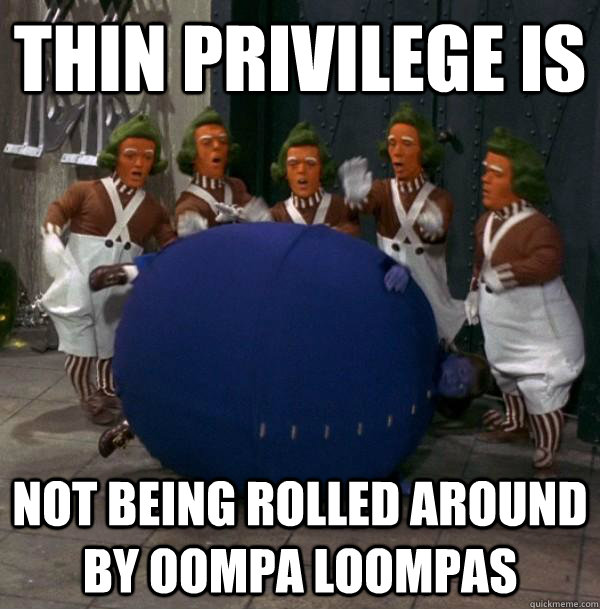
There has been a recent surge in websites, blogs, and tumblrs that deal with "Thin Privilege." These sites have also spawned spoof or parody sites  which have in turn encouraged reaction sites. In the back-and-forth on these websites that I have followed, I would like to comment on a common theme which I think connects issues of health and bodies to the LGBTQ community: choice. First, I will explain these communities then I will draw from examples from each and compare them through Burke's pentad as revolving around agency and choice.

Retrieved from this blog
Thin Privilege reflects the advantages and benefits that come with being thin (or non-fat) in a society that values skinny bodies over large bodies. This has resulted in cultural and institutionally prejudices levied at non-thin people. Thisisthinprivilege.tumblr.com is dedicated to individuals sharing their personal stories of discrimination because of their size. Key themes are the idea that being large in body is associated with unhealthiness (which they argue is not necessarily true), being impacted by a lack of services available to them (such as the size of airplane seats), lacking role models in media, and experiencing fat stigma (e.g., strangers trying to give diet advice or calling names). The stories range from not being able to find clothing sizes in stores to having doctors ignore potential health issues because weight was a perceived larger concern. This site often posts "troll" questions and comments and critiques them as coming from a place of privilege or purposefully trying to undermine their cause. The key take-away from this site is that no one with privilege can deny others their claim to discrimination, police their language, or undermine their cause.

Retrieved from this blog as an example of skewed expectations and a world made for unrealistic body sizes.
From comments on these webpages, I found immense similarities to discussions of LGBTQ rights. The similarities center around the idea of choice. If one believes that being fat or being LGBTQ is a choice, they are more likely to be negative, critical, and dismissive of societal backlash that occurs for them. If one believes that these identifications happen naturally or are a product of the environment (e.g., hereditary/genetic), then one is more sympathetic to the effects experienced. This proclivity to blame the individual (agent) or the environment (scene) can be mapped onto Burke's pentad. The pentad is a tool that critic's can use to analyze situations in terms of its agent, agency, purpose, scene, and act. If the act performed is discrimination against someone, emphasizing the agent may cause one to believe that the recipient caused it themselves. Emphasizing the scene, however, may cause one to believe that society fosters discriminatory attitudes against minority communities. Papers I've been working on, influenced strongly by papers by Brock (1990), argue that these can be directly related to political ideology. Republicans may be more likely to consider the agent responsible (e.g., pull one up by one's bootstraps) and Democrats may be more likely to consider extenuating circumstances (e.g., how scenic factors influence one's actions and treatment).

Retrieved from this site
To consider a large person and a gay person autonomous agents that make choices about their identity is to remove environmental and societal factors from responsibility. This type of view undermines the culpability of institutions and those with normative privilege (e.g., thin and hetero-) for discrimination. Somehow, making a choice to do something as opposed to having it happen to you, makes one more deserving of disdain and scorn. Those who had no choice can be viewed as vulnerable, victims, and innocent. Analyzing these situations as similar help us to connect issues of discrimination and shared experiences of minorities against ableist/cis/hetero/white/male society. From within that community, it is hard to assign oneself culpability and guilt; people would rather blame the individual than admit shared responsibility for discrimination. Just as people were quick to yell "post-race!" with the election of Obama, people are quick to jump to answers that do not include our own or systemic faults.

Retrieved from this site to represent the traditional Barbie size to the new "real proportions" doll

How does society move beyond discrimination? I think it's important for those of us with privilege is to step back and truly listen to the words of those without privilege or those at the intersections. We cannot understand the discrimination not having been privy to it. Trying to deny the stories of others or to argue with our own stories of discrimination only perpetuates structural inequalities. Just consider the backlash that happened when a new Barbie copy with "realistic proportions" came out that would encourage girls to idolize being unhealthy. Instead, why can we not consider these positive steps to creating a more inclusive culture that teaches people to love and respect their own bodies, no matter its size? ThisisThinPrivilege.tumblr.com is fighting against other blogs and the system that devalues fat bodies. Though this article is not meant to be evaluative, it cannot help but reach the conclusion that to reduce people's identities to arbitrary choices is to undermine the perpetual problem of discrimination. As posted on the website, people are fighting a system that "systematically reduces each of us to our dress size, hip measurement, and waist size, then grants favors, opportunities, or simple lack of punishment when the numbers are low enough" and instead fights for a system that treats everyone as equally human.

Monday, September 30, 2013

Discrimination and Rhetoric in the Judiciary

Recently I read Stephen Toulmin's "Tyranny of Principles," an article written in 1981, but one I found highly relevant to current times. Toulmin, perhaps most famous for his Toulmin Model of Argumentation, describes the evolution of rules and laws from traditional discretionary practices in Roman times. I found this piece fascinating because it helps contextualize a common point of controversy in modern judicial and moral arguments, and also because I find rhetoric's roots in the judicial system and its constant tension with "ethics" (the good man speaking well) worthy of discussion.


Toulmin begins the article by describing previous methods of judiciary practices, where there were no written laws or precedents in Rome for judges to base decisions. Instead, each individual case was handled as a separate, distinct scenario in which all mitigating or unique circumstances were taken into consideration. People trusted the knowledge and discretion of the pontiffs, not an overarching law. But, as Toulmin describes, multiple factors (including immigration that changed societal norms and a need for more and thus less trained judges) constructed a need for established and referable rules which today are the basis for Western judicial systems. This transition is truly a double-edged sword, for now equality and consistency have been established, but in its stead, we sacrifice equity. Simply consider Jean Valjean in Hugo's Les Misérables, who served 19 years (5 for the crime and 14 additional for trying to escape) for 

stealing bread to feed his nephew. Did he steal? Yes. Was this crime worthy of 5 years in jail? 
To Javert, a servant of God and the Law, there are no mitigating circumstances, a crime is a crime. 
And even when the tables turn and Valjean lets Javert escape, Javert is still bent on returning 
Valjean to jail. He eventually experiences a mental break where he cannot justify living in a world 
where people like Valjean violate his standards of right and wrong.


Philip Quast: Javert's Suicide

The transformation of the judicial system, our reliance on the Constitution and precedent has 
emphasized the letter over the spirit of the law, removed wiggle room, and devalued mitigating 
circumstances. One need only consider the death of Savita Halappanavar, who died from birth 
complications after the abortion she requested was denied. The religious (and in this case Catholic) 
view of abortion as wholly wrong contributed to Savita's death, whose health was not a justification 
for the abortion. Many anti-choice advocates do allow for abortion in cases of rape, incest, or the 
health of the mother, but there are prominent American politicians and even doctors that do not. 
In response to Savita's death, Irish politicians are attempting to re-legislate the rules concerning 
abortions and when the health of the mother overrides the abortion ban. As Toulmin argues, society 
must be wary of an over-reliance on these rules, and must refrain from adjusting laws with more laws, 
instead of addressing the morality and ethics of the original law.


Toulmin's article is a useful transition for me to discuss inherent discrimination and a lack of equity in 

the judicial system that I learned about in a fall class. We discussed the different levels of scrutiny that 
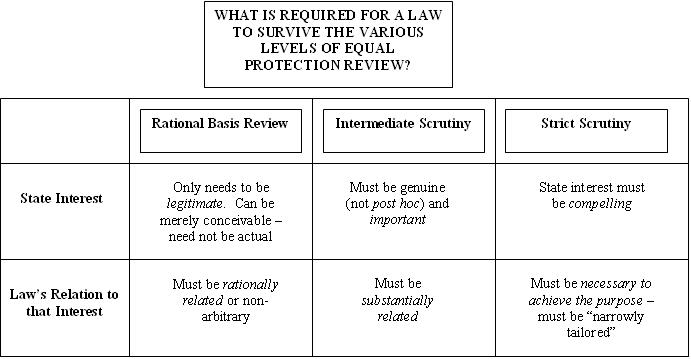
the courts in America give to different types of discriminatory laws under the equal protection clause. 
For example, the strictest level of  scrutiny is given to laws based on race and national origin, which is 
a prominent reason why many affirmative action cases lose when brought to court, because they treat 
people of different races differently. This fact, though in part justified through previous discriminatory 
measures that make affirmative action necessary, are not mitigating circumstances. The only way for 
racial discrimination of any kind to be allowed through governmental approval is if there is a "compelling 
state interest" and the discrimination is the most efficient way to address that interest. A famous example 
of this is the Japanese Internment Camps that were ruled constitutional since they did address American 
fears over Japanese immigrants during World War II.


Image Retrieved from National Paralegal
Under strict scrutiny is intermediate scrutiny, for cases of gender discrimination. Under that is rational 
basis review, where discrimination cases based on sexual orientation or mental health are decided. 
I find it quite ironic that such levels exist at all. Why are different forms of discrimination created into 
a hierarchy of discrimination? Isn't this organization in and of itself discriminatory? It seems to me quite
hypocritical and unjust for someone to receive different punishments or court ruling simply because they 
are a different type of bigot than someone else.

I find these different strands inextricably linked. How deeply and strongly do we rely on rules of law, and 
for example, these seemingly hypocritical rules, when they lead to death and discrimination? Toulmin argued
 that we as a society should not mistake equality for equity, be satisfied with unjust laws, and tie our morality
unquestionably to the rule of law. "We need to recognize that a morality based entirely on general rules and
principles is tyrannical and dis-proportioned, and that only those who make equitable allowances for subtle 
individual differences have a proper feeling for the deeper demand of ethics" (p. 107 in Foss's 
Readings in Contemporary Rhetoric). I would hope that people would learn to be open-minded towards 
people's circumstances, take into account circumstances and mitigation, and let ourselves be human,
reasonable, and overcome our obsession with perfection, black/white dichotomies, and absolutism.

Wednesday, March 6, 2013

Climate Change Skepticism as a Roadblock to Progress

I have previously discussed climate change from the perspective of science and extrapolation to future consequences of global warming. Not only are the predictions highly varied, but the consequences of them range from changing in weather patterns to massive displacement, war, and global food insecurity. The Intergovernmental Panel on Climate Change (IPCC) is often considered the foremost authority on climate change and uses amassed scientific data to create a consensus surrounding climate change, urging countries and politicians to act.


Here is where the problems occur, because policies to limit the effects of climate change are not occurring, especially not in the United States. But why? The answer to this question lies in the polarization of politics and the divide between Republicans and Democrats on the climate change issue. Gauchat (2012) proposed the politicalization of science where over time, the issue of scientific authority has become inextricably tied to political loyalties. Consequently, Republicans and frequent church-goers have significantly lost faith and trust in science as the authority of truth. To accept science as the authority is to abandon other methods of explanation, such as faith, and become disloyal to party lines.

The evidence for this claim is seen not only in the polls that Gauchat analysed, but also from the actions of Congress and the Republicans in it. Funding for climate change research under the Republican chairs of committees and subcommittees has been debated and in some cases cut. In defense of removing National Science Foundation funding for climate change projects, Chairman Ralph Hall (R-TX) said, “the reluctance to engage in conversations with people who have doubts or question the veracity of climate science is at the heart of the wrong doing that undermines trust in climate change science”, thereby legitimating climate contrarians by placing them at even footing with scientists (“Witnesses Highlight Flawed Processes Used to Generate Climate Change Science, Inform Policy,” 2011).

Perhaps most shocking and incredible is the recent ruling by North Carolina that scientists are no longer allowed to use extrapolations to predict future implications of climate change, but can only use past data. This is an exemplar of politics directly interfering with scientific integrity, capabilities, and validity with no justification. Stephen Colbert mocked this bill excellently by noting that North Carolina are blocking scientific inquiry in attempts to hide data that would force them to act in favor of the scientific consensus. Literally restricting science's ability to chart and model future climate change implications further undermines science's ability to predict problems and urge political action. For without powerful, scientifically accurate, and frankly, worrisome data, how are politicians to be convinced to action?

Herein lies another complication: the urgency of climate change and in fact its very existence is wholeheartedly rejected by many politicians, making any attempt to convince them quite fruitless. Climate change skeptics or contrarians simply will not be persuaded by any scientific plea for action, no matter how urgent or convincing. The situation is remarkably quite similar to the idea of the religious apocalypse: for no matter how urgent or persuasive a prophet of the rapture is, non-religious, agnostic, or atheistic people will simply not be persuaded. Faith to them, just as science appears to be for Republicans and church-goers, does not hold any persuasive clout.


The result of this skepticism is the questioning of all scientific data to support policy ideas. Instead of taking action, politicians wait for "conclusive" scientific evidence, which threatens the world's ability to ever fully prepare for the consequences of climate change. Soon, it may be too late to act, and we will reach the tipping point, where there is no longer the opportunity for preventative measures, but only response. How serious these consequences will be revealed only through time, but we know now that the longer we wait, the worse it will be. Soon, it will be too late to act, but the world will cry out the famous words of Macbeth (Act 3, Scene 4):


"I am in blood, stepped in so far that, should I wade no more,
Returning were as tedious as go o'er"

Wednesday, January 30, 2013

Climate Change and Public Opinion

I previously mentioned delving into the relationship between belief in the apocalypse and intelligence. An article from Reuters reported, "Gottfried [author of the study] also said that people with lower education or household income levels, as well as those under 35 years old, were more likely to believe in an apocalypse during their lifetime or in 2012, or have anxiety over the prospect". Although the apocalypse came and went in 2012, new predictions emerge just as quickly as they pass. There is a seemingly societal need and urge to respect an "end times" or create an eschatology that justifies actions. For example, the Westboro Baptist Church has created a pre-millenialist view of Christ's second coming, where God is angered by the support of and equality given to members of the LGBTQ community, as well as other "sinful" actors. Once the world delves into too much sin, Christ will return and usher in the rapture, new millennium, and punish the sinners and all who aided them. 

Not all views of the apocalypse are religious, but many religions include their own "end times" stories as a foil to their creation myths. Climate change is an interesting complement to echatological views of the end of the world, as damage and degradation of the environment are popular "signs". Furthermore, the consequences predicted as the most severe or "worst case scenario" for climate change could bring the Earth into irreversible global catastrophe.

Yale's Project on Climate Change Communication published a study about the six types of Americans from the "alarmed" to the "dismissive". Despite a scientific consensus on anthropogenic global warming/climate change, nearly equal percentages of the population are highly concerned (12%) as least concerned (10%). Though most Americans fall in the middle categories from generally concerned to disengaged (62%), all groups except for the dismissive group felt like they needed more information about climate change. The dismissive group, though science would indicate that they are wrong or perhaps the least accurately informed felt that they were the most informed about climate change (91% of dismissives said they were very or fairly well-informed).
Graph from Yale's Project on Climate Change Communication (2011)

Gauchat and the Pew Poll on Values would indicate that the politicalization of science has created a large divide between Democrats and Republicans on the environment. Gauchat (2012) discussed the correlation between religious service attendance and conservatism with an increased doubt in the authority of science. Doubting the scientific evidence or predictions for the environment could greatly affect one's opinion of climate change, a environmental future that is difficult to see or completely grasp.

Although knowledge and concern for global warming is polarizing around political parties, there is hope that more people overall are concerned or at least a majority is concerned with the changes occurring in current temperatures and future risks around the globe.

Wednesday, November 21, 2012

Negative Narratives: Obama is a Muslim

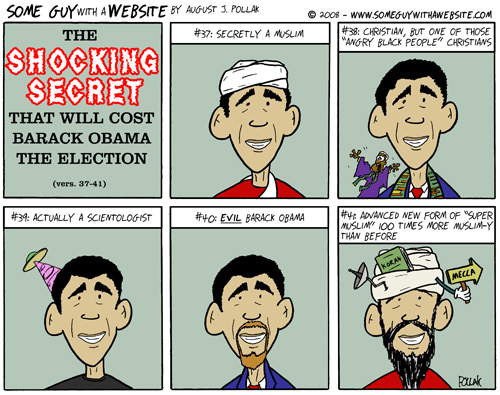
Although commonly known as false, 17% of registered voters still think that Obama is a Muslim. Carefully placed and constructed media and political narratives have created this false, yet influential narrative. I bring up this specific example because of a question posed to me at the NCA conference on the Romney and Mormonism panel. The panel was questioned why voters would consider a Muslim more “mainstream” than a Mormon. After a few stunned moments and a brief corrective response, I wondered as to the likelihood of finding a well-educated academic asking such a question to me at a panel specifically addressing the intersection of religion and politics at a competitive national conference.
The reality that such narratives can gain traction in the public sphere demonstrate who damaging unregulated political advertising and web presence can be. Though Geer argues for the benefit of negative advertising in "In Defense of Negativity", there appears to be more evidence to the contrary. Increased levels of personal attacks, deceptive and manipulated information, and subtle racial comments have become commonplace in American politics. Even though Obama can counter such narratives on his web sites and in media statements, for those who doubt Obama or are looking for confirmation of their skepticism can cling to relevant narratives and ignore contradictory information. Is Obama the most adamant and vocal Christian ever? No. Does he incorporate religion and traditional Judeo-Christian values into his politics as strongly as others? No. But does that mean that people have the right to doubt his Christianity? Furthermore, what does this say about our country when being a Muslim is a derogatory identification that precludes one from the presidency?
The truth is that negative campaigning increases cynicism, allows for the spread of misleading or outright false information, and creates a culture of division. My NCA experience represents for me the negative effects that I have studied being realized. It is one thing to read about the racial connotations of the William "Willie" Horton advertisement and it is another to encounter someone who truly believes what is nothing more than a conspiracy theory that survives only through the radical echo chambers that exist online. With low voter turnout and vicious character attacks from SuperPACs and 527s, I hope that negative campaigning will eventually reach its peak and disappear. For the sake of democracy, a healthy public sphere, and unity in the face of elections, the fostering of a negative political culture must end.