Showing posts with label Innovation. Show all posts

Sunday, August 30, 2015

Pedagogy Experiments: Grading in Public Speaking

In the beginning of Summer 2015, I taught COMM 204: Public Speaking to ten amazing undergraduate students. We tackled many important topics, such as logical fallacies, overcoming communication anxiety, and building sound, reasoned arguments. A few weeks before the course, one of my friends and colleagues, Kari Storla, forwarded me an article about autonomy and self-grading in the classroom. My first thought was dismay, shock, and disgust - let students....grade...themselves? It seemed like a ridiculous and pointless idea.

Image retrieved from this site.
But, after my gut reaction passed, I thought that public speaking might be the perfect course to tackle this interesting and innovative idea. I drafted a 25/25/50 rule: each student self-graded up to 25 points, the peer grades were averaged out of 25, and I provided the remaining 50. The article noted that few professors give scores below 50%. If 50% is given automatically, why not give the students some autonomy and control over that experience? I gave it a shot and this is what happened.

Overall, I found that the students were quite fair to themselves and their classmates. With the knowledge that everyone was peer-grading, there was a collective dependence on giving everyone decent scores. I averaged grades and all scores were anonymous, but the students still felt responsible for creating a supportive and welcoming environment. Even when comments were quite harsh, "This didn't really address the prompt, not sure I understood it," students (except for 1) still never graded below a 20/25. Across all speeches, there was agreement between the student self grade and the peer grade. Students, on average, gave themselves a 23.6 and the class gave them a 23.4. Even given the opportunity, only 1 student gave themselves perfect 25/25 across all 4 speeches. This same student also received the highest peer grades and the highest score in the course, despite the student having the third highest score from myself, on average.
Image retrieved from this site.
There were no statistically significant differences between grades and a student's race, but there were some interesting patterns. The top three peer graded students were Caucasian while the lowest three were students of color. Overall, though, the peer grades spanned 24.4 to 22.8, a difference of 6%, which could bump a student half a grade. The students of color were also more likely to give themselves lower peer grades. For example, the lowest average self grades, 22.25/25, 22.88/25, and 23.50/25 were all students of color (and two international students). One student (briefly mentioned above) gave consistent low scores to two students of color, averaging a 19.3/25 and 18.2/25. These discrepancies and outlying scores did not affect the overall student average nor did it vary significantly from peers. Because of the low number of students in the class, teachers may want to keep potential biases in mind (for themselves and students participating in peer grading).

Image retrieved from this site.
The self- and peer- grading was done through an app that I previously wrote a post about: Socrative. In the past, I used this app for pop quizzes and anonymous feedback, but in Public Speaking, I used it for immediate scoring of students after speeches. I did not allow technology use during speeches, but started the Socrative quiz for students to give feedback out of 25, with both positive comments and constructive criticism.

I also used Socrative to asked students how they liked the self- and peer- grading. In response to the questions, "I like the method of self and peer grading in COMM 204 this summer," all students responded "Agree" or "Strongly Agree." In response to "I felt like I had more control over my grade because of the self and peer grading policy," I only had 2 neutrals, with the rest "Agree" and "Strongly Agree." In response to "The self and peer grading makes the grading process more fair than just having a teacher grade," I had one neutral response and the rest "Agree" and "Strongly Agree." I had the same one neutral student in response to "I felt that my classmates and myself were reasonable and accurate graders." Students were more neutral towards, "I think that peer and self grading could work in other COMM classes," with four neutrals and the rest, "Agree" and "Strongly Agree." The students all marked "Agree" or "Strongly Agree" with "The self and peer grading policy has positively affected my experience in COMM 204."
Image retrieved from this site.
In the comments, the students were quite candid about how they marked themselves and others. One student admitted, "I felt that I was obviously more bias about grading myself than my peers. I tried to be as unbias[ed] as possible, but I think it was easier for me to mark someone off for something than myself." One student noted the potential risk, "It's an interesting system to implement, although it also relies on the assumption that your classmates also grade you honestly and fairly." Other students saw the process as very beneficial: "Getting to know peer and teacher feedback helps improve and motivate me and helped me boost my confidence."

Overall, I think this experiment was a success. The students responded positively to the policy, despite concerns at first. I was sure to emphasize the community aspects of the course and how important it was to be both fair and supportive. I think this helped the students see the benefit of engaging with this grading system and giving their full attention to their peers. I could imagine this process working well in other classes that might do presentations. In COMM 206: Communication and Culture in Spring 2015, I had many students mentally check out during student presentations about readings. If the students were tasked with grading, however, and knew that they would be as well, perhaps they would pay more attention to their peers. I'm happy that I experimented with this teaching experiment and would encourage students in a Public Speaking or other presentation-heavy course to try it out as well.

Sunday, April 26, 2015

Conflict Kitchen and the Politics of Food

People engage in political activity everyday. The body is a rich site of activity that as Susan Bordo argues, is an "unbearable weight" to the intelligence, power, and ideal state of the mind. People are constantly in turmoil between what the mind thinks is right and what the body wants. The separation of the material and the spiritual is the basis for many religious rituals and has plagued theorists like Descartes, Durkheim, and others for many years.

Comic retrieved from FarLeftSide
One arena where this emerges is the political action of eating. One's choice of food is immensely important in crafting one's identity, and happens, for most people, multiple times a day. It is an act of material consumption that reaffirms an identity. For some, choosing to eat or not to eat at Chick-Fil-A became a stance on gay rights. As a vegetarian, my abstaining from meat is a choice for environmental protection and animal rights. A choice for a high-class, Michelin-starred restaurant over a food truck or trip to the grocery store may communicate affluence, leisure, and class. From farmer's markets, health campaigns, and food norms, the rhetoric of food is a site of power and control.

Retrieved from this site
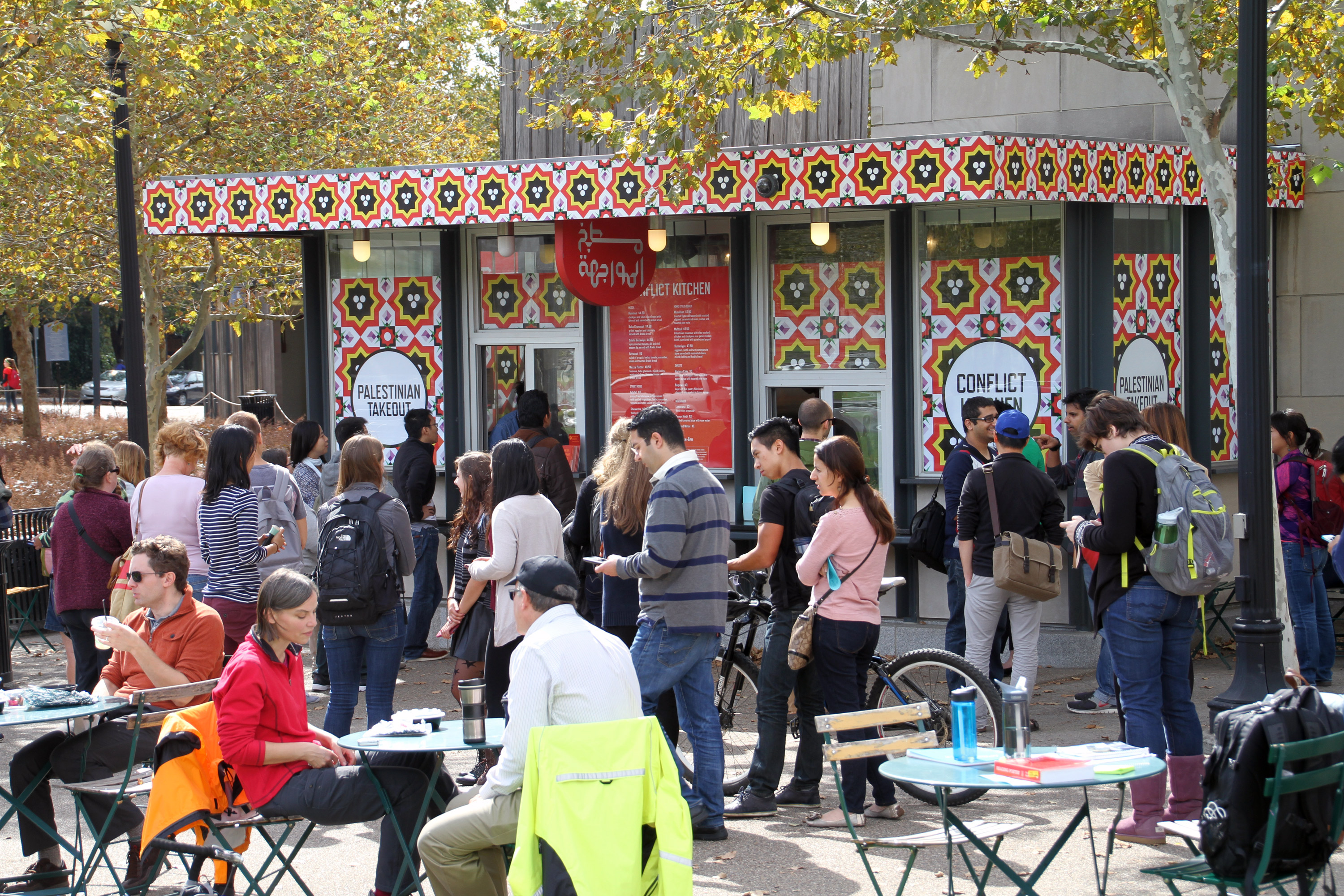
In believing that the material can argue and that food is itself symbolic and meaningful, it is easy to find examples of food's importance in everyday life. I was confronted with a particularly meaningful example when I visited Pittsburgh, PA. There is a restaurant called "Conflict Kitchen." The cuisine rotates but always features "cuisine from countries with which the United States is in conflict." The food experience is also complemented by activities, speakers, and events that draw attention to particular conflicts. Currently, the Conflict Kitchen prepares Palestinian food to bring awareness to the conflict in Palestine, the Gaza Strip, and Israel. Considering that America has only experienced 21 years of peace since it was created in the wake of the American Revolution, Conflict Kitchen will most likely have many food options for a long time.

Current Palestinian theme. Photo credit to Conflict Kitchen
Their mission statement is as follows: "Conflict Kitchen uses the social relations of food and economic exchange to engage the general public in discussions about countries, cultures, and people that they might know little about outside of the polarizing rhetoric of governmental politics and the narrow lens of media headlines." Through the medium of food, Conflict Kitchen reminds us of the cultural and personal aspects of conflict and war. It is easy to be distracted by the sweeping political statements and larger picture of global diplomacy. But it is hard to argue with the significance of cultural imports, cross-country interactions, and the new global village when eating. A simple, daily activity becomes a statement in support of cultural unity and against international conflict.

Different themes over time. Photo credit to Conflict Kitchen
Conflict Kitchen has also served food from Iran, Afghanistan, Venezuela, and North Korea. The variety of food available in this one kitchen highlights the relative lack of diversity in Pittsburgh's culinary offerings. Conflict Kitchen notes that it was the first and only of these ethnic restaurants "the city has ever seen." The lack of ethnic neighborhoods, outside of the European populations that are prominent in the city, makes the location of Conflict Kitchen particularly memorable. I am working on a paper that explores the ideas of experiential and rhetorical landscapes: the location of artifacts is commensurate with the site itself. Placing the Conflict Kitchen in Los Angeles may not have the same visceral effect as in the relatively homogeneous Pittsburgh.
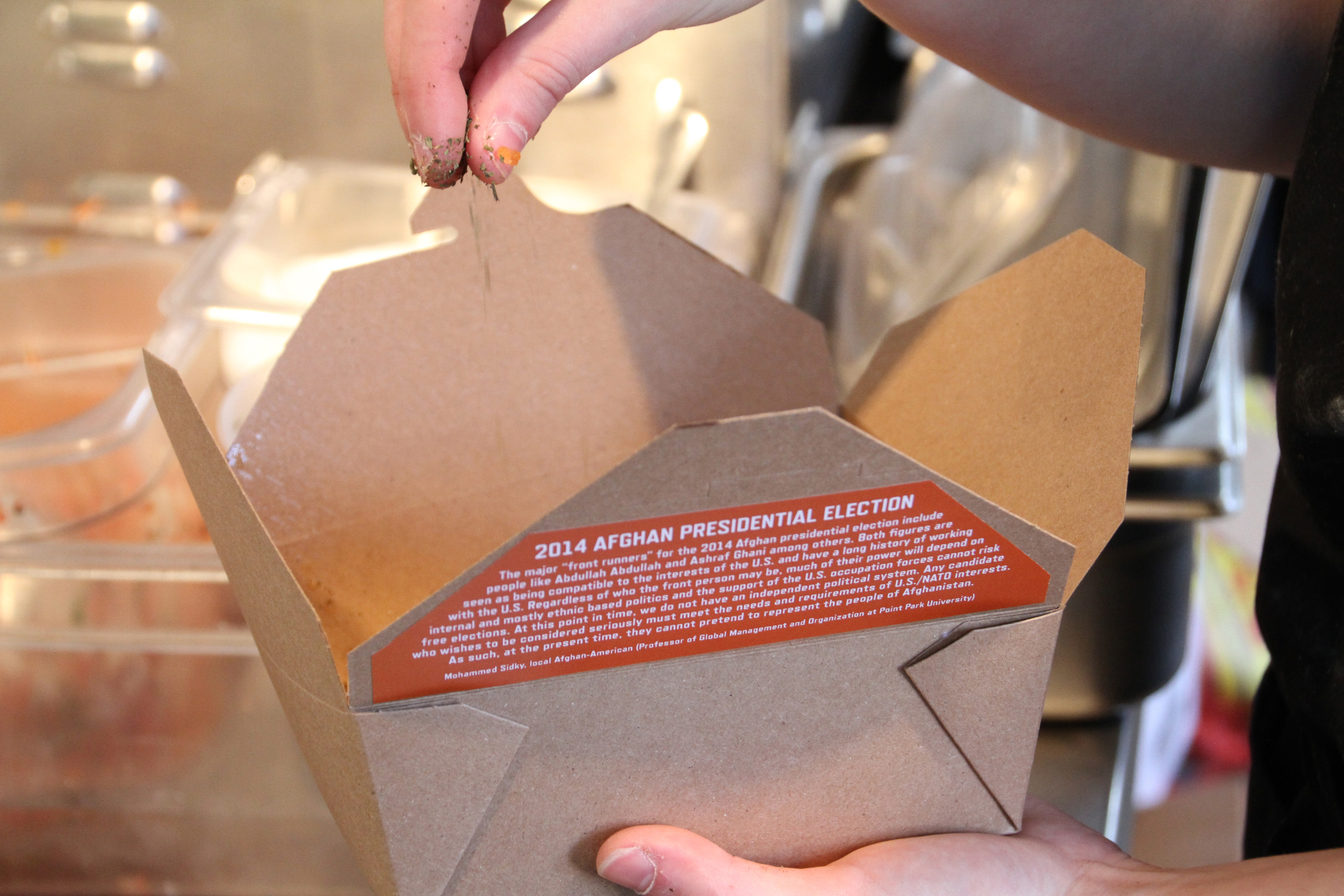
Information on take-out box. Photo credit to Conflict Kitchen

Food wrapped in information sheet. Retrieved from this site
Unwrapped sheet. Retrieved from this site


In addition to bringing food and culture to the attention of the city, Conflict Kitchen also wraps its food in large, informational sheets about the country. From government, politics, art, poetry, entertainment, and other areas, the unfolded food wrappers educate the food consumers about the country of origin. Conflict Kitchen thus offers food for thought and symbolic consumption as well as physical, material nourishment. For Conflict Kitchen, eating is a mindful act that calls us to consider the political and social implications of our daily consumption habits. There is an increasing trend in communication theory to explore how consumption, branding, and purchasing power has become a form of identity-management. What one buys, owns, and consumes is indicative of one's identity. I hope that more companies do adopt more conscious effort toward the impacts that their services and products have. Although there are concerns about the potential implications of charity-focused groups, I think overall there are steps to be made in shifting capitalist thought towards producing a more aware, global citizenry.

Monday, February 27, 2012

Against Innovation: Got Milk?

The latest set of advertisements from "Got Milk?" denigrate average Americans, scientists, and innovators who attempt to improve upon the world's health and well-being. The underlying narrative that underscores this new wave of advertisements is that the current definition of milk as cow's milk is good enough, why bother creating anything new? The two examples below clearly outline this theme of negativity.


The first commercial places a fat cat businessman on the "Board of Unnecessary" with literally money-to-burn who is looking for a way to waste his billions. With other ideas being "too practical" and "too easy", he finally decides to research how to make milk out of "beans and nuts" as a ludicrous and unnecessary endeavor. Not only does this frame the creators and manufacturers of non-cow milk products such as soy milk, almond milk, and coconut milk as evil, rich, and with bad intentions, but it also insults Americans who are foolish enough to purchase these "non-milk" products.


The caveman commercial mimics the first style of the unnecessary, but is perhaps more insulting. Instead of comparing non-milk product creators to businessmen, those who produce and purchase them are compared to primitive cavemen. Specifically, those of us who do not purchase milk are "Gary", the slow caveman who is ridiculed and scoffed at by his higher-intellect friends who cannot understand why Gary would want to make milk from a nut. I would call Gary an innovator, someone who is not just accepting what is told, but tries to create something better. Perhaps nuts are easier to come by than cows, perhaps using nuts reduces ethical concerns for the mistreatment of animals, and perhaps growing nuts does not waste gallons of water and acres of farmland. Gary, though portrayed negatively in this advertisement, has stumbled upon a healthier, more ethical, and environmentally friendly method of creating a cow's milk substitute. And we should fault him for such creativity? What other ideas would have never come to fruition if every idea was given as much scorn as the "Got Milk?" campaign treats non-milk products?

Obviously, the "Got Milk?" campaign is using these tactics to increase the purchase of cow's milk after their market has been invaded by companies such as Silk, 8th Continent, Almond Breeze, and others. The market is getting crowded and there is one thing that the other milks have in common: they do not come from cows. From a marketing standpoint, this position and isolation of other products makes sense, but I shudder to think at the consequences for consumers and the country if the ideals of milk is the only milk that should be consumed (especially if that means drinking whole milk) and that innovation against standards (the "if it ain't broke, don't fix it" mentality) is cause for criticism.


The final aspect of this new campaign that I would like to address is the new "Got Milk?" homepage entitled "many imitations, still no equal" that is an interactive game where viewers must find the "real milk", all the while being confronted with facts and ingredients about other types of milk that lie in wait on the page. Coconut milk is described as "spooky how real this looks, huh?" mocking the preservatives and gelling components of the beverage as attributing to coconut milk's fake quality, despite the ingredients being listed serving as milk's pasteurization process. Additionally, many non-milk products have a longer shelf-life due to those additives. Hazelnut milk is treated no better with the tagline "what's that stuff on the bottom? yikes" referring to the sediment that can arise in hazelnut milk (and other bean milks like soy milk), which is why they often contain the label "shake well before use". Almond milk is degraded for its color, "pretty funky color" despite its appearance as light gray on the screen, one of the closest to white. Lastly, soy milk is described as "this came from a cow? please" even though soy milk has never claimed to be from a cow. I can only surmise that this claim comes from soy milk's appropriation of the term "milk" for its product. And although it may not be milk as in the traditional definition (which specifically mentions being produced by a mammal), these products use the word milk as an indicator for how their product should be used: as a milk substitute.

Innovation is constructed by the new set of advertisements as something unnecessary, burdensome, and ultimately detrimental. A society without innovation, without progress or advancement would leave us without current technology, knowledge, and success in the world. Is this really the message that the "Got Milk?" campaign really wants to send to youth and parents who will be consuming this advertising and making choices at the supermarket? Milk, especially non-skim milk options, are full of sugar and fat with as many calories as a 12 oz Coca-Cola (around 140 calories) with as much as half of those calories from fat (in the case of whole milk). If "Got Milk?" is advertising the status quo in terms of milk consumption, perhaps there can be a suggestion to prefer skim over whole? Simply allowing for consumption of food products to stay the same downplays underscores larger issues of weight and obesity in America that it is not enough of a problem to pursue or give credence to healthier alternatives.

For more information about these advertisements in terms of the history of alternative milk products, please refer to http://skepticalvegan.wordpress.com/