It is impossible to ignore all of the online and offline discussion of the owner of the LA Clippers, Donald Sterling's racist remarks. He noted in a private conversation to his girlfriend that he didn't want her "associating with black people," and specifically bringing them to basketball games. The hypocrisy in Sterling becoming rich off of the labor of black bodies has been addressed better elsewhere, so I wish to address another important part of this discussion: the apologia. Using Kenneth Burke's guilt-redemption cycle, this post will discuss the similarities of Sterling's remarks to the racist statements of Earl Butz, and how these statements implicate the larger American public in the persistence of racism.
Earl Butz was Secretary of Agriculture in 1976 who eventually resigned his position after racist comments emerged. This site has the full timeline of the events including the offensive joke. A scholarly article was written about that event by Dr. James Klumpp and Dr. Thomas A. Hollihan called "Debunking the Resignation of Earl Butz: Sacrificing an Official Racist." The title reveals some important terms and information that will inform this comparison between Butz and Sterling. I will also highlight some important differences that reveal modern racial tensions. Butz was "sacrificed" as Klumpp and Hollihan say, as a part of Burke's guilt-redemption cycle. This cycle describes how pollution, or some type of disorder, is introduced into an order, which creates guilt and a subsequent need for purification, purging, and redemption.
For Butz and Sterling, the pollution was their racist statements that shattered the values of equality inherent in their respective social and political orders (government and sports). Both of these institutions are supposed to value equality, all Americans, and their constituents. As public figures, their voices can be seen as stand-ins for the groups that they represent. Butz was "sacrificed" by the Republican Party, who wished to separate their public appearance from racism. The NBA also separated itself from Sterling by banning him from the organization, fining him $2.5 million, and urging him to sell the team. The sacrifice can come in many forms, but it must make the punishment commensurate to the crime committed. Considering that the pollution for each was the potential crumbling of national organizations, the punishments were made quite prominent, public, and severe.
Another important similarity between the two are the separation between public and private. Klumpp and Hollihan address this dichotomy by nothing that officials are sometimes seen as not have the right to privacy: anything said even in private could destroy a public persona, one's reputation, and career. Some were quick to jump to Sterling's defense such as columnists at Fox who pointed to the "thoughts" of Sterling as harmless and a personal right. Some articles went as far as to implicate the girlfriend (who recorded the conversation) as the real criminal. In the aftermath of the announcement, Mark Cuban echoed the words of a Fox News reporter about whether convicting people for statements in private could be a "slippery slope" to the thought-police.
Though some of these concerns were raised, there has been overwhelming support for Sterling's punishment. One might say that it was a "success" in some ways in that an athletic profiteer who undermined his own team and the values of the NBA (and perhaps, the country) would be receiving a just punishment. However, Klumpp and Hollihan raise a point of contention with these types of guilt-redemption activities. They note that by creating a sacrificial goat out of Butz and Sterling, we as a nation do not have to address underlying and persistent racism that we may all (or at least most of us) be guilty of. Instead, we can claim that wrongs have been righted and that racism is an individual issue that does not have to be addressed on a societal level. They note that these overt punishments of racism create a culture that "tolerates private racism and its consequences” (p. 11). Jon Stewart adeptly addresses the issue of post-racial society in his critique of Sterling and the recent SCOTUS decision to uphold Michigan's ban on affirmative action.
What is to be learned by the Donald Sterling incident? One thing is perhaps most important: racism still exists. There is no magical, post-racial world because we have a black president. People haven't stopped being murdered because of their race, people haven't stopped trying to make relevant the KKK, and people still use the n-word. This is only the tip of the iceberg, however, as racism against other minorities, especially immigrant populations, is also a common American theme. Is this what America is all about? We need to take examples like Butz and Sterling and open our eyes to the underlying problems from which these individuals stem. Structural racism is happening and continues to happen; we cannot remain blind to it and only care when individuals break norms of keeping racism a private endeavor. All racism needs to be addressed, and we have a lot of work to do.
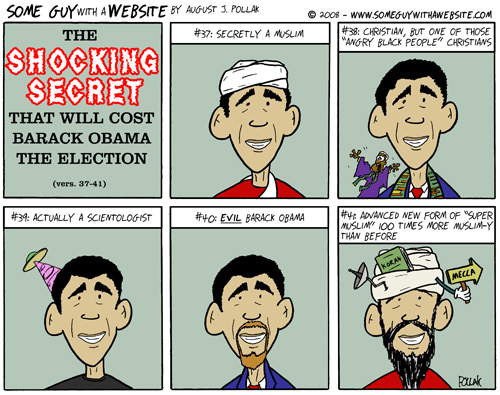
Although commonly known as false, 17% of registered voters still think that Obama is a Muslim. Carefully placed and constructed media and political narratives have created this false, yet influential narrative. I bring up this specific example because of a question posed to me at the NCA conference on the Romney and Mormonism panel. The panel was questioned why voters would consider a Muslim more “mainstream” than a Mormon. After a few stunned moments and a brief corrective response, I wondered as to the likelihood of finding a well-educated academic asking such a question to me at a panel specifically addressing the intersection of religion and politics at a competitive national conference.
The reality that such narratives can gain traction in the public sphere demonstrate who damaging unregulated political advertising and web presence can be. Though Geer argues for the benefit of negative advertising in "In Defense of Negativity", there appears to be more evidence to the contrary. Increased levels of personal attacks, deceptive and manipulated information, and subtle racial comments have become commonplace in American politics. Even though Obama can counter such narratives on his web sites and in media statements, for those who doubt Obama or are looking for confirmation of their skepticism can cling to relevant narratives and ignore contradictory information. Is Obama the most adamant and vocal Christian ever? No. Does he incorporate religion and traditional Judeo-Christian values into his politics as strongly as others? No. But does that mean that people have the right to doubt his Christianity? Furthermore, what does this say about our country when being a Muslim is a derogatory identification that precludes one from the presidency?
The truth is that negative campaigning increases cynicism, allows for the spread of misleading or outright false information, and creates a culture of division. My NCA experience represents for me the negative effects that I have studied being realized. It is one thing to read about the racial connotations of the William "Willie" Horton advertisement and it is another to encounter someone who truly believes what is nothing more than a conspiracy theory that survives only through the radical echo chambers that exist online. With low voter turnout and vicious character attacks from SuperPACs and 527s, I hope that negative campaigning will eventually reach its peak and disappear. For the sake of democracy, a healthy public sphere, and unity in the face of elections, the fostering of a negative political culture must end.
During my summer in Pittsburgh, I traveled across the state multiple times and saw many conservative billboards. My time spent in Philadelphia, Boston, and Los Angeles has not afforded me such exposure and I found many of them worthy of comment. The power of the billboard is in its simple, clear messaging, stylistic dimensions, and highly partisan statements. The limited space is no place for moderate remarks, especially when they come from third-party groups and can be as brutal as possible. One of my favorite billboards read "Coal: red, white, and blue, and always green". The appeal to colors highlights how patriotic it is to support coal, but also its eco- or environmentally friendly properties. There is no room for argument or debate on the billboard, simply a statement that the viewer can agree or disagree with as one drives past.
The purpose of this post, spurred by my interest in billboards and political advertising, is to describe a few political advertisements in the 2012 presidential election cycle. The advertisements share important information about candidates that are small, concise, sound bites for easy consumption. One that was prominently on display entering downtown Pittsburgh said:
Obama supports gay marriage and abortion, do you? The word "supports" portrays Obama as one who wants everyone to participate in gay marriage or have abortions, as opposed to supporting an individual's rights to choose these for themselves. Asking the viewer to reflect on these topics encourages an emotional and negative response in those questioning or already leaning conservative (at least on social issues). The enthymematic conclusion to this billboard is that by voting Republican, you will be voting for someone who does not support these rights, ergo Romney does not support gay marriage and abortion rights. This can be a powerful motivator for those who are undecided or conservatives who are concerned about Romney's reputation for flip-flopping on social issues.
Another way that Romney is trying to re-claim the conservative base is to promote the Christian ideals he shares as a Mormon. The Mormon.TV videos highlight their belief in Jesus Christ, "the savior of mankind", the variety of people who follow the Mormon faith. Mormonism has a negative association with being mysterious, cult-like, and secretive. This website and their television advertisements can help in part to assuage those concerns that Mormons are somehow dangerous, occult, or different by sharing the experiences of Mormons as people and how their faith is (for the most part) similar to mainstream Judeo--Christian beliefs. In fact, the differences between Mormonism and Christianity is the same between Christianity and Judaism, they simply believe in the divine inspiration of one more book.
An Obama advertisement that caught my eye was the "For All" advertisements that are being shared on Facebook. Borrowing from the unifying visual statements of the 99%, the advertisements show celebrities and everyday Americans and what they are passion about and fight for. The statement is quite unifying in the copying of the action, but also in the overarching statement that people vote not just for themselves, but to protect the rights of others.
The juxtaposition of celebrities and everyday Americans also creates an inclusive environment, while also capitalizing on the celebrity support that Obama receives. This is also a contagion effect, where supporters can also mimic the post position and upload their own versions. Just as the 99% signs showed people holding up signs to portray their economic/employment/education situations for the Internet to see, this simple act of writing on the hand (and holding it over the heart as in the Pledge of Allegiance) can be mimicked by everyone worldwide. The visual is a powerful one and one that supporters and independents feel they can engage and connect with.
As the debates are underway and the campaign is heading into the final stages, the advertisements are more likely going to be even more negative and targeted. I never realized how many political advertisements that I saw when I lived in Pennsylvania until I moved to Massachusetts and California and now have seen very few. The ability of technology to micro-target communities means that voters in swing states are receiving the most advertisements and attention from candidates whereas other "safe" states will get very little attention. Trends that I perceive are the increasingly negative third-party advertisements, the focus on values and "change" from Obama (who seems impervious to gaffes or media attention for mistakes), and the struggling Romney campaign trying to salvage the conservative wing with whatever means necessary.