Showing posts with label Dawkins. Show all posts

Sunday, September 22, 2013

Underestimating the Enemy: Creationism vs Evolution

At the beginning of August, I attended the Alta Argumentation Conference in Alta, Utah. There I was presenting a paper titled, "The Institute for Creation Research as a case study of scientific and religious argument: Revisiting argumentation fields in a postmodern context." The paper was presented on a panel of other papers about "religious argument." To summarize the points of my argument, I was discussing the ICR as an example of postmodern and contemporary creationism discourse. ICR is attempting to blur the lines between science and religion in order to present the illusion that science proves the story of Genesis.


The Logical Process of Science and Creationism: Source
My paper interrogated why creationism is still so persuasive to many people and why scientific consensus has not squashed this alternative story. In addition to this argument, I also stretched communication and argumentation theory by introducing a new term "deceptive controversy" and expanding the role of argument fields to creative normative standards. After finishing my speech and waiting for the Q&A, I thought about the theoretical implications for my argument and had prepped myself to defend my new term and the application of argument fields. Instead the first question I got was roughly paraphrased as: Aren't you giving ICR too much credit? They are obviously non-scientific, so what is the point of your paper?
To say I was shocked was an understatement. My extension of argument theory was not being questioned, but the very purpose and need for my intervention was. Unfortunately, I reacted more passionately and unprofessionally than I would have liked, feeling defensive of my research. I would like to take this blog post to react more professionally than I did then.
It is imperative that scholars and scientists take opposition from creationists seriously. Although science and logic show the truth of natural selection and evolutionary mechanics, that is unconvincing to more than half of the nation's population. The power of these narratives and the hold that biblical accounts have on the American public are underestimated at the risk of knowledge and innovation. There still remain issues of creationists gaining position on school boards, colleges accepting creationists on their staff, and the steady dominance of creationist thinking in the US.
Steady maintenance of science denial: Source
My inquiry was not to suggest that one should consider ICR scientific, but to examine how and why ICR does say that it is scientific. What is it about ICR's discourse that convinced hundreds of thousands of subscribers each month to read and examine its arguments? That was the point of my inquiry: to examine the patterns, rhetoric, and argument style that keep creationists relevant in modern society. Armed with this knowledge, how do we address and restrict its presence in areas of society it does not belong?
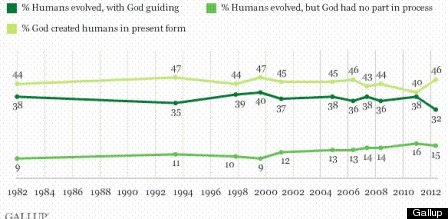
My paper took samples of ICR's discourse and broke the arguments down to their basic elements to determine if they really were scientific or not. Recent polls show only 15% of Americans believe in the occurrence of evolution without supernatural intervention, with 46% believing the in the Biblical account of origins with God (a Judeo-Christian one). That's nearly a majority of Americans who deny a scientific consensus of evolutionary mechanisms explaining origins. Groups such as ICR receive millions of dollars in charitable donations, run talking tours, sponsor museums and even a award degrees from an accredited school. Creationism discourse is alive and well in the United States, at least in the public sphere.


It is a mistake to assume that everyone approaches the creation/evolution controversy with the knowledge and capacity of intellectuals. What my questioner was really saying was that "isn't everyone in America as smart as I am? Only fools would believe in creationism." Because he saw the truth in evolution, he immediately discredited the possibility of creationism as being a valid threat. But it is. It has been and remains a threat to scientific standards, classroom education, and the knowledge of millions of Americans. To discredit their opposition is to err as many scientists have done before. To simply say "look at the science", "look at the consensus" is not enough. These facts are not convincing in the way that many academics and scholars wish that they were.


Sunday, March 18, 2012

Our Modern Day Scarlet Letters: Religion, Atheism, and Pride

Nathaniel Hawthorne's "The Scarlet Letter" is a classic story often referenced and rarely read about a woman, Hester Prynne, who has a child out of wedlock and is forced to wear a scarlet letter "A" around her chest. This story set in the late 19th century dates itself with Hester's sin being adultery and having sex before marriage. Even though this story is over 150 years old, the its themes of isolation, societal discipline, and labeling remain today.

Michel Foucault theorized about the institutional and discursive power of assigning meaning and labels to objects, behaviors, and bodies. Foucault's main interests were the study of the human body as it is disciplined by medicine, the legal system, and the constraints of sexuality. Those who are labeled "mentally ill" by discursive definitions are given treatment, isolated from others, and lose some rights as patients under care instead of as capable individuals. Take, for example, that the Diagnostic and Statistical Manual of Mental Disorders defined homosexuality as a mental illness up until the 1970s, labeling homosexuals as unstable mentally, of non-normative functioning, and in need of treatment. How society creates discourses has important implications for individuals and how they behave.

Although this post could take many directions from using the BMI scale to label people "morbidly" obese, to  how the abortion argument has been framed in terms of "killing babies" instead of "aborting fetuses". But, this post will focus on what I consider my scarlet letter and what Richard Dawkins has rightly created the same connection: atheism. In a world where nearly 90% of the world's population considers themselves religious and there are more people willing to identify as "non-religious" (9.42%) instead of "atheists" (2.04%), coming out as an atheist, one who will admit a belief that there is no God, is a mark of suspicion and shame. Even in a country where the founding fathers warned against the dangers of religion, an admission of any faith, or lack thereof, besides mainstream Christianity is political suicide (see my previous post for a discussion of Romney's Mormonism). Politicians like Santorum gain ground espousing conservative Christian ideals even though they negate many constitutional rights and court rulings. An emphasis on religious ideals can undermine human rights when they are imposed as the standards for all Americans.

Believing such ideas and being willing to express them openly and publicly is rare, so I feel that atheism could be considered the adultery of the modern era. The parallel of the "A"s is not lost on me, and there is the opportunity for the celebration of such a parallel instead of running from it. Dawkins, by selling pro-atheism jewelry on his website, appropriates the classic scarlet letter symbol and transforms it from a mark of shame to pride. Religious discourse may label atheists as sinners, or misguided and lost followers, reinforcing that these beliefs should be hidden and produce shame in the believer. Atheists, however, can transform this discourse, not by rejecting it and forming a new term, but by adjusting the definition of atheism from negative to positive, a badge, a letter, of a unique brand of faith.