It's been two years since Kenan Thompson came under fire for blaming a lack of diversity casing in Saturday Night Live on the poor quality of black female comedians. Women often lack representation in the media, especially women of color, and the comedy genre is no exception. Similar to previous posts I've written about tokenism, it seems that the few females that are successful serve as stand-ins for the general inability for women to be funny. If Amy Schumer or Garfunkel and Oates can achieve success, why not every woman? Those who are successful are held up as proof that there is no bias or discrimination, although they still represent a minority of comedic faces. It's clear that prejudice still remains, with men still chairing key positions on popular comedy news shows and women of color remaining relatively absent even as male diversity increases. There are some notable exceptions that I hope will become more frequent. One of my favorite Daily Show segments features Samantha Bee and Jessica Williams tackling race issues. Tell me these women aren't funny.
The new season of Inside Amy Schumer has also been receiving attention as she tackles important social issues with a comedic slant. Among the very many attempted sketch shows, this one seems likely to succeed with Amy's keen insight for satire. Among her many hilarious and poignant videos, Amy has addressed beauty standards (video below), female representation in the media (long, but completely worth it, especially if you like 12 Angry Men), rape culture, and obsession with the female anatomy. Catchy and hilarious, "Girl, You Don't Need No Makeup" is a satire of boy bands and requirements for female beauty that reinforce unnecessary adornment and pruning. They note, "with a little mascara, you'll look female" linking the wearing of makeup as a female gendered activity; to not wear makeup is to violate the female identity. It is okay for males to comment on and discipline the actions women should take regarding their appearance. At the end of the video, the male singers try on some of the makeup products and their reactions reveal the ridiculousness of the products women are expected to wear.
Garfunkel and Oates (who frequent one of my favorite LA coffee spots, Bricks & Scones) are a successful comedy duo that also release sketch comedy videos. They've commented on issues such as an emphasis on pregnancy as crucial to the female identity, the gender divide in sports, and chastity (video below). This is a heads up that the video on chastity does show some mimed sex acts and references anal and vaginal sex. The song is a humorous take on the religious restrictions placed on youth to avoid their sexuality and find "loopholes" to stay pure. For me, this video does a great job at highlighting the double standards for purity, where females cannot be pleased sexually but the male can. Overall, the song brings attention to a common side-effect of abstinence-only sex education that promotes female virginity over information and personal choice. It also brings into question why certain sexual acts are treated differently than others and the treatment of sodomy in homosexual vs heterosexual relationships.
Comedy is a persuasive means of communication that often keeps attention and promotes critical thinking (especially in works of satire). The rise of female comedians opens up new areas for this critical eye of importance to women. I don't think these spaces are exclusively for females to occupy, but it is hard to speak for others. Female comedians provide a sense of legitimacy and authenticity to these issues, having lived many of these double standards and social obstacles. The writers and performers of the jokes come from a standpoint that reflects the unique position of a female in contemporary society. I hope that these shows continue to be popular and I encourage people to support them!
In Communication and Culture, a class I teach at USC, we've been discussing themes of the intersection of capitalism, globalization, and culture. Something that immediately came to mind was the prevalence of capitalist themes within entertainment, particularly on reality television. Reality shows run the gamut from dating, cooking, tattoos, adventure, weight loss, and competition. Some of my favorite shows, and those that I've seen become increasingly popular and varied, are investment shows. These shows perpetuate and valorize the values of the American Dream and bring the token successes to national attention. While I enjoy these shows and generally think they are positive and helpful to participants, I worry about the larger implications of the show outcomes.
My issues with these shows are twofold. First, I worry that they revere money over all other elements. The dollar is still key to any measure of success and is the bottom line for the happiness of the participants, investors, and the way the participants "win." Even good ideas, which are often acknowledged on the shows, are turned aside if they cannot be executed, shown to be scalable, or have reasonable time limits on returns. I also worry that the success and proliferation of these types of shows reinforce that these experiences are commonplace and plentiful. This type of mentality may blind us to the structural and societal barriers that do exist.
Perhaps the largest and most profitable of the capitalist entertainment shows is "Shark Tank." Based on the British version "Dragon's Den," "Shark Tank" shows a series of sharks, successful entrepreneurs, as they vet potential investment opportunities. Participants on the show pitch their idea, explain their process, and talk profits. Oftentimes, it is only established businesses that have track records of success and profit receive deals. People who come in only with ideas are often dismissed as too new, untested, or risky. On this show, people who have in some sense already "made it" are given investments to become more profitable with the help of investments. Sometimes, the sharks offer mentorship and experience beyond the monetary contribution, but the ultimate goal of the show is to receive their ask at a reasonable valuation. The "About Shark Tank" page has this to say, "The Sharks will once again give people from all walks of life the chance to chase the American dream, and potentially secure business deals that could make them millionaires." Shark Tank is not discriminatory, but then again, it has an intense vetting process which means not everyone can appear on the show. They are also only given a "chance to chase" success because that power is ultimately not in the hands of the everyday American, but by the always already profitable and successful elites.
Restaurant Startup investor Joe Bastianich
A spin-off of "Shark Tank" is "Food Fortunes," a new shop that specifically focuses on food-related innovations. This show adds the element of audience participation, where a live audience tests the food concepts and provides real-time feedback on the product. Also in the food category, "Restaurant Startup" gives people the opportunity to run a pop-up restaurant and get an investment to open a long-standing one. These shows follow the "Shark Tank" model where there are proven elites that have the power over the financial success of the participants. In "Restaurant Startup," the participants have some autonomy over their styling, logo, food, aesthetic, and supplies in creating the restaurant. But, they are still at the whims of the investors to change elements that are not amenable to them in order to open a real restaurant. In the interview above, Bastianich notes that a "business without profit is a hobby," again reinforcing the bottom line of profits over innovation, creativity, and even good quality food.
Dana Cloud argued that token success stories, such as Oprah Winfrey, are harmful to the understanding of how power structures work and the barriers that exist to equality. When people see the success of Winfrey or others the myth of the American Dream, the self-made man, and Horatio Alger come alive. People are presented with proof "of the American Dream, implying the accessibility of this dream to black Americans despite the structural economic and political obstacles to achievement and survival posed in a racist society" (p. 116). This is not just race, however, but that the success of people who have overcome barriers in place are applicable to everyone. If anyone can succeed, everyone can. Winfrey's success is certainly something to be lauded, but it should not be generalized to the larger public. To do so is to blame individual agents for their positions and ignore larger social, cultural, and political issues that are beyond individual control.
Many of my students tell me that it is hard to look at media the same way after taking Communication and Culture. There are many things to be cynical of in the contemporary media landscape. Where it is gender issues in advertising, racial stereotypes in movies, or the proliferation of questionable tropes, how are scholars supposed to genuinely enjoy media? I will say that I do enjoy the shows I have discussed and think there are great lessons to be learned and fun to be had in watching them. I cannot fault the investors on these shows for doing what the show encourages them to do, or even being business-oriented. It's their money, after all. But, I wholeheartedly hope that people become active instead of passive consumers of media. To watch The Bachelor and understand the questionable gender elements is much better than avoiding it completely or to accept its messages passively. Scholars, critics, and everyday people should be immersed in contemporary society and also interested in its workings.
Students of mine have turned in papers this week that critique different advertisements. Their papers have prompted me to think, as I have before (gender in advertising, political advertisements, religion and advertising, interactive advertising, and exclusionary advertising) about different advertisements that propose a cause or campaign instead of a product. My students had the choice of a traditional product advertisement and one form a non-profit. It was much easier to see the direct purpose of the for-profit advertisement: to sell a product. Oftentimes, however, the advertisements for non-profit groups have to be more creative in order to peddle something far less tangible than a car or a purse. These attempts to be innovative can backfire, causing more attention to the advertisement campaign itself than the message it is trying to convey.
In rhetorical theory, this is called disingenuous controversy. Fritch, Palczewski, Farrell, and Short proposed the term to describe situations when an ancillary aspect of an event occupies attention and the actual message (which itself could be controversial and counter-hegemonic) is lost. Their example was the comments by Ward Churchill where he compared the workers in the World Trade Center as "little Eichmanns" when describing the justifications for the 9/11 attacks. The purpose was to raise questions about the American economic structure and how it constrained and motivated the actions of the 9/11 terrorists. But, instead of this critique gaining media attention, people focused on his comparison between the Nazi bureaucrat and workers in the World Trade Center as offensive, insensitive, and unpatriotic.
Following the Nazi theme, I first want to discuss the advertising campaign that ran in Germany to promote HIV/AIDS awareness. The campaign features graphic images of infamous leaders such as Adolph Hitler, Joseph Stalin, and Saddam Hussein having sex with women. This campaign was eventually pulled in part because of its graphic nature and outrage over the use of these infamous faces in relations with women. The campaign read, "AIDS is a mass murderer" and encouraged viewers to associate something traditionally thought-of as pleasurable with something inherently disgusting and deadly. The graphic depiction in the advertisement coupled with the unique history in Germany that makes the presentation of Hitler challenging, however, overshadowed the consciousness-raising of re-thinking about the dangers of unprotected sex.
The second campaign I'd like to present is a campaign by 10:10, which is a climate change advocacy non-profit. The advertisement shows various situations where people are asked about their opinions on climate change. A few that declare that they do not believe in global warming or that we should not act towards it are shown exploding violently. The version that received the most attention featured children exploding in their classrooms. The campaign seemed to be questioning the value of dissenters and how those who do not engage or pay attention are ultimately doomed. The violence, especially towards children, however, became the focus of the campaign instead of the message of the future of humanity.
These "dangerous" advertisements risk an audience backlash in favor of capturing people's attention. When the alternative is complete silence or apathy, perhaps a bit of attention-grabbing is in order. There are certainly risks to this type of advertisement. Non-profits may be more likely to risk these strategies because they are not beholden to shareholders or a bottom line. When attention is at an all time premium, with the variety of options for viewing, being offensive or crude is one way to be sure one gets eyes, if not support.
The consequences of climate change have become more prominent, but many of the harsher, more extreme consequences will not be felt by this generation. Part of the difficulty in crafting persuasive climate change arguments is about "jumping" the inter-generational gap. An intergenerational argument encourages people to act not in their own interest, but in the interest of future generations. Though most of us alive today will likely avoid most of the harshest effects of climate change, our children and certainly our grandchildren, will not be as lucky. People tend to be fickle, however. They are many things vying for our attention, pulling us in different directions, so anything further off than right NOW seems too far off to be worthy of our time. As Burke noted in Permanence and Change: “A philosopher, if he has
a toothache, is more likely to be interested in dentistry than in
mathematical symbolism. Communication cannot be satisfactory unless the
matter discussed bears in some notable respect upon the interests of the
auditor” (p. 37).
How do we get people to care for youth? For animals? For anyone but ourselves? It is not simply a matter of narcissism or selfishness; it is just far easier for people to react based on their immediate surroundings. Thinking ahead requires much more energy than simple observation, putting oneself in a different mindset is difficult, and there can be other, conflicting loyalties that stop one from accepting long-term arguments. One of these arguments is economic: short-term business and profits may suffer when making long-term environmentally friendly decisions. Another complicating factor may be religious beliefs about human's dominion over the earth. Or, it might simply be a political affiliation that often denies science and climate arguments in deliberative spaces (Gauchat, 2012).
Author and activist Zadie Smith. Retrieved from this site
One of the ways to spread intergenerational messages is online. When public spaces may be held to standards of balance or may receive denialist backlash, the internet can serve as a location for the expression of information. A recent article by author Zadie Smith called, "Elegy for a Country's Seasons" addresses the current apathy in the climate change debate and how she might explain our inaction to her granddaughter. This excerpt from the piece is particularly important as the excuses given seem to pale in comparison to the burden that we will leave this young girl and all children as we bicker over money and politics.
"This will no doubt look very peculiar to my seven-year-old granddaughter. I don’t expect she will forgive me, but it might be useful for her to get a glimpse into the mindset, if only for the purposes of comprehension. What shall I tell her? Her teachers will already have explained that what was happening to the weather, in 2014, was an inconvenient truth, financially, politically—but that’s perfectly obvious, even now. A global movement of the people might have forced it onto the political agenda, no matter the cost. What she will want to know is why this movement took so long to materialize. So I might say to her, look: the thing you have to appreciate is that we’d just been through a century of relativism and deconstruction, in which we were informed that most of our fondest-held principles were either uncertain or simple wishful thinking, and in many areas of our lives we had already been asked to accept that nothing is essential and everything changes—and this had taken the fight out of us somewhat" Smith, para. 11.
Written articles may take time to read through and may not offer direct and easy consumption of information (however beautiful and engaging Smith's article is). Another potential solution is to create videos that craft intergenerational arguments. This video is from the Australian Coal Mining Company that has a unique intergenerational plan for halting the effects of climate change.
This humorous video has an important point. It mirrors the argument by Smith about passing the buck onto future generations when we could have done something about it. When we stand back and look at the potential consequences, what are our excuses? Is it really enough to look at dollar signs or listen to denialists when we are faced with the guilt of harming all future life? Dramatic? Maybe. Accurate? Certainly. These arguments are not always successful, but people should try to become more attuned to them. Focusing on the current effects now can be an entryway in to discussing how it will only get worse, and our children will suffer for it.
This was not the intended blog post for this Sunday, but a few recent advertisements have been on my mind, recently. Their repetition on the TV channels I watch and on Hulu has increasingly bothered me in their portrayal of the female. I will link to them both here and then discuss the problems that emerge in the persistent stereotyping (especially gender stereotyping) that occurs in media.
The first commercial is from Verizon, which advertises that if you buy a phone, you'll get a second free. Then, the commercial explores various options for who the second phone should be given to. Attempting humor, the commercial proposes that a girlfriend may enjoy the free phone, "but don't tell her that it's free." The face of the female fades from happy to disgruntled. This commercial plays on the "high maintenance" girlfriend trope where females are not happy or satisfied unless a lot of money has been spent. Shows such as Bridezillas, MTV True Life, arguably every Real Housewives version, emphasize this theme of women as spoiled, needing immediate and constant care, and focused on the material. These stereotypes overpower a more dimensional representation of the female outside of material goods and characterize all women as high maintenance. This description itself is inherently offensive. One's provides maintenance to a car or an object, not to a person. There is the association with a female as an accessory, a tool, an object needing maintenance, improvement, and upgrades in order to function. This also implies that the partner (oftentimes male) in the relationship is the only one with purchasing power. This clip from Bridezillas, featuring Remy and Rob, illustrates the dynamic quite well.
The Verizon commercial bother me, because it ignites these stereotypes as women as only valuing the material, lacking purchasing power, and only superficially strong in their demand of items they cannot provide for themselves. Even in the portrayal of strong women who declare they deserve certain items or treatment, there is an underlying weakness in the women who rely on others for self-validation, respect, and attention.
The second commercial focuses more on the vegetarian as weak, but the non-present character is given a female gender. This is a commercial from Walmart about setting a table for an Easter lunch. The planner describes why certain people are placed in certain spots noting that her vegetarian sister is at the opposite end of the table "so she can't see the ham." My first reaction was one of disgust that a commercial would rely on stereotyping vegetarians as too weak to even see meat. Though this is just a small statement, a lot of information is imparted in a short amount of time to the viewer. The audience is surely meant to consider the planner quite respectful. But, the implications are that vegetarians (and perhaps specifically female ones) cannot stomach the sight of food they cannot consume.
Both of these commercials highlight the importance of stereotyping in the world of advertising. When a company has only 30 seconds to compare one's attention and express the benefits of a product or service, stereotyping is a potential strategy. Originally conceptualized as the images that one sees in one's head, stereotyping is now defined as a mental shortcut that associates certain characteristics with others. There are racial, gender, ethnic, religious, political, and geographic stereotypes, all which connect a person to a host of underlying associations. Stereotyping makes sense if one's goal is to impart information as quickly and as succinctly as possible. The human brain is lazy and would rather use mental shortcuts to absorb, process, and respond to information. Popkin called this "low information rationality" where people tend to use the least amount of information possible to make their decisions. He connected this specifically to voting, where people may vote in elections based solely on a party affiliation, a rumor about a candidate, or even their aesthetic appearance over delving in deeply into issues and more complex information.
Apologies for the video quality. South Park's "Museum of Tolerance"
Though stereotyping may make sense for advertisers, other media theories, such as cultivation, encourage us to reconsider the potential consequences of long term, frequent consumption of media tropes. If females are consistently portrayed as weak, high maintenance, powerless, vulnerable, and other "feminine" characteristics, how can we expect a new generation that is more open to feminism and equality? There are certainly many factors that influence people's attitudes, opinions, and behaviors, but it may not be surprising that a media that reflects and stereotypes females in such as way may also be contributing to other gender-based issues. There are many examples I could pull from, but I will encourage people to look at this video from Fox News about women being paid "what they're worth."
Sitting in on a class on media and religion, I was shocked to hear student responses to the question, "how would you describe this atheist?' The responses such as sad, angry, evil, cynical, and confused described Dr. House on the TV show House. We had just watched an episode where Dr. House is faced with a potential miracle where someone comes into the hospital hallucinating that an angel told him to go to the hospital. Finding that the illness he had did not include hallucinations as a side effect, there are implied themes of potential truth behind the patient's visions. Throughout the episode, House remarks negatively towards religion and the patient's employment as a priest. His cynicism and complete disdain for even considering religious explanations is highlighted prominently. I cannot fault the students for describing Dr. House in these ways. On the show, he is portrayed as a curmudgeon who is cynical and removed from meaningful relationships. What hadn't occurred to me until that moment is that this TV show may be communicating that these are qualities of atheists as a whole, with Dr. House serving as synecdoche.
I began to see this cynical portrayal as a pattern. I attended a play titled, "Freud's Last Session" which details a fictional therapy session between Sigmund Freud (a prominent atheist) and C. S. Lewis (the author of the Chronicles of Narnia and converted Christian). Freud is presented as a old, cynical man who has little left to live for and takes much pleasure in undermining Lewis's belief. Lewis, on the other hand, is presented as youthful, moving quickly around the stage, and speaks with hope and optimism about the world. The two are foils, dichotomies of one another, religious belief only one aspect of this dichotomy. Though they are presented in a type of balance, the implication is that when Lewis leaves, he leaves Freud to die, set in his ways, and without religious comfort in his final hours.
I would also like to point my readers to this film (trailer below), which presents a fictionalization of an encounter of a student with a professor who asks students to argue against God's existence. When the student challenges the professor, he makes the student debate him. What is most revealing about this trailer (in addition to the appearance of the stars of Duck Dynasty) is the exclamation from the student, "Why do you hate Him? Why do you hate God?" This exclamation reveals a disconnect between actual atheism and the perceived attributes of atheists. If someone is an atheist, they do not hate or have emotions towards God; He does not exist. It would be very hard at me to be mad at a unicorn, Big Foot, or people yet unborn. These things do not exist, so emotions cannot be directed towards them. People who believe in God or religion sometimes perceive atheists as jilted followers who have somehow been wronged and now take vengeance upon God by being atheist.
These three examples provide evidence of a potential theme of representing atheists as stereotypes of what we might call the Scrooge trope. Curmudgeons, only concerned with the material, dismissing happy emotions, hope, and relationships in favor of cynicism, solitude, and pessimism. Media effects literature might encourage me to conclude that these pervasive themes may be influencing the general public in their repeated and frequency consumption of media messages. Though these are fictionalizations that cannot be faulted for narrative short-cuts or simplifying characters. I believe it is harmful, however, to creating a more integrated and open space for people to "come out" as atheists. Though atheism is on the rise and secular humanism is becoming a prominent philosophical worldview, much of the perceived "Culture War" is really Christian and faith-based groups trying to isolate and legislate against non-believers. In a country where some states still hold laws against atheists holding public office and a world where they can be killed for not believing (Oh, look! It may have even happened in Texas), these media representations are performing even more harm upon the image and presence of atheists.
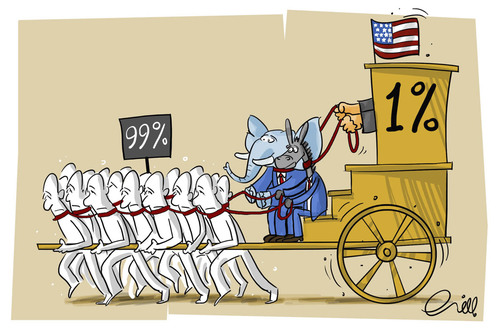
Past research of my has focused on the difficulties in defining values and applying them to different scenarios. Despite the research complications, values remain an important aspects of politics, religion, culture, organizations, and relationships. My recent readings of the God Strategy and the Faith Factor have reinforced my respect for the "values voters" that make up the religious right and conservatively 1/3 of the US electorate. As a united front, they are an invaluable voting block for Republicans. They typically do not vote Democratic (though recently ethnic evangelicals have for Obama) and are concerned with electing Republican nominees who reflect their values of hetero-normative definitions of marriage, anti-women's choice towards pregnancy and birth control, and a general aversion to stem cell research. The marrying of religion and politics allows for values to remain integral aspects of candidate character and personality.
Cartoon from Times-Picayune
As mentioned before, this focus on values is pervasive for all of all politics, but is especially important for Republicans. As the Grand Old Party, associated with nostalgia, antiquity, and maintaining the status quo, their candidates must embody those values more than the Democratic Party. Democrats, instead, often emphasize abstract goals for future engagement, inclusivity, and are the pioneers in equality and acceptance of minority groups (e.g., the current fight for LGBTQ rights). What has changed in recent years, however, is the polarization of these values into groups that cannot compromise on basic ideas. There is less freedom to express moderate values and politicians are in near constant campaigns. For example, the environment has become a haven for political isolation where Democrats are expected to be environmentally conscious and Republicans who are can be considered traitors. The Republican values of free market and enterprise trump those of the environment, and that is avoiding the larger issue of religious identification that also complicates the issue.
The graph above is from the Pew Research Center American Values Survey that shows the gap between support for the values. The environment has increased dramatically from only a 5% difference in those that support in 1987 to a 39% difference in those that support the environment in 2012. This polarization shows more established party lines on values where compromise is precluded by trying to remain party loyal. What is the future of American politics? How can the polarization continue with politicians and the general public operating as enemies? The 2008 election brought about massive celebrations for Barack Obama's election and massive despair from people convinced that a terrible decision had been made. Similarly, Obama's reelection was met by rumors of secession and outrage by Republicans. Perhaps my favorite response was the emerge of "White People Mourning Romney" tumblr which emerged out of whites being the only race that Romney earned the majority of their votes. South Park's rendition of the hyperbolic reactions that people had in their episode "About Last Night" perfectly sums up the political polarization currently plaguing America.
I would like to be optimistic and predict a reverse in the polarization or at least a breaking point where the polarization is no longer sustainable, but it is unlikely. I do find hope in the small compromises, but they are few and far between. One solution could be a more critical, "unlovable" media that encourages compromise by expressing the dysfunction of current polarization. The Internet can also serve as a new public sphere where citizens can serve as fact-checkers and critical observers to the political process. In the future, the polarization might decrease or change, but for now, politicians seem to be more concerned with maintaining their seats than reaching across the aisle.
Despite the proliferation of vampire/zombie/werewolf media figures in recent years, I find myself drawn into the various iterations and rule changes that simultaneously govern the characters and direct the plot in some popular shows and movies. How these rules change within the same mythology determine the flow of action and restrict plot twists complicate "lore" for the sake of an engaging narrative.
Dean and Sam on "Supernatural" encounter various ghosts, mythical creatures, and curses that each can be undone through their unique combination of research/brains and violence/brawn. There is a repetitive scene where Sam discusses the multitude of "lore" and history surrounding the supernatural occurrence and the two brothers discuss which solution or cure is the accurate one. Despite the various myths and folklore surrounding the situation, the brothers eventually find the solution, whether it be by manipulating the history or using a tried and true method.
Jessica on True Blood
Vampire on Supernatural
Caroline on Vampire Diaries
For example, the vampires on Supernatural are different from the ones on Vampire Diaries or True Blood. On Supernatural, vampires grow an extra row of teeth that emerge from the top gums. On Vampire Diaries, the creatures' teeth only emerge when they see blood or are about to feed and it is only the canines that grow to be longer and pointed. True Blood also only has one set of teeth grow, but it is the lateral incisors instead of the canines. Supernatural vampires create more vampires by bleeding into an open wound on a human's body. Those on Vampire Diaries become vampires when they die with vampire blood inside of them (and complete the transition once they consume human blood). True Blood vampires turn when they are drained of their vampire blood and replace it by drinking (and thus replacing) their blood with vampire blood (and complete the transition once they are buried in the ground). These various methods of transformation drastically change the plot of each show. Unique to Vampire Diaries, someone could be at risk for becoming a vampire without their knowledge (accidentally or unknowingly consuming vampire blood), while the other shows involve some type of direct contact with a vampire.
Perhaps the most interesting adaptation to the vampire myth is the sun. In True Blood, the vampires almost exclusively interact in the evening. They are vulnerable during the day when they are resting in their coffins and burn to death once entering the sun. This allows for interesting plot devices where vampires must fight through the pain of sun to help humans, the creation of vampire-friendly hotels with blacked out windows, and the constant threat of attack during the daylight hours. The setting and rising sun becomes a countdown clock for action in the show where tasks cannot be or have to be completed before a certain time. Fairy blood thus becomes a powerful and all-consuming commodity because it allows the vampires to walk unharmed in the sun, driving much of the action and focus around Sookie Stackhouse.
Eric and Russell burning in the sunlight
Vampire Diaries gets around this biopower by relieving the vampires of their reliance on the sun. By using the power of witches, they have magical rings that allow them to walk in the daytime. This creates another interesting set of restrictions that makes vampires more difficult to identify. Danger is thus more prominent and surprising as people who cannot come out during the day are easily identified in True Blood as vampires. In both series, vampires are restricted in their consumption of human blood. True Blood vampires use a synthetic blood (the namesake of the show) to curb their thirst for human blood, though there emerges a strong divide between vampires who consume True Blood (mainstreamers) and those who still feed on humans. An analogy can be made to this distinction and the Chick Fil-A argument that constructs consumption with identity politics. Vampire Diaries vampires do not have a synthetic blood option, but many choose to rob blood banks or feed from animals in order to avoid harming humans. Again, the stigma involved in the consumption of humans is both honored and vilified as competing groups determine their own consumption rules. Interestingly, Vampire Diaries vampires can consume "human" food, while True Blood vampires cannot (instead they "flavor" their food by changing the diet of the human).
Vampires and supernatural creatures are similarly constructed with different rules and restrictions in the media to allow for and direct certain plot points and devices. The key to the differences is keeping them believable, probable, and consistent. Fisher used the terms narrative fidelity (internal consistency) and narrative probability (external consistency). The interesting twist in shows such as Supernatural, Vampire, Diaries, and True Blood is that the existence of these creatures in and of themselves problematic to "reality". Given their existence, however, the shows can construct their own rules based on different mythologies. As long as they make sense within their own narrative reality, the audience can watch multiple shows and still engage with the vampire narrative.
Arguments over the beauty of models has become under greater scrutiny with the use of Photoshop. Images and visuals, traditionally considered "truthful" as they show reality before the lens, can now be manipulated pre and post photo shoot. Many websites have made their focus highlighting Photoshop mistakes, the drastic differences in appearance when celebrities are "caught" without makeup, and how makeup and photoshop exaggerate the beauty of models.
JennaMarbles: How to Trick People into Thinking You're Pretty
Disclaimer: minor foul language
But how offensive are these "lies" and "manipulations"? What damage is caused when ideals of perfection are unreachable? Backlash from the over-usage of make-up and photo-editing tools call into question the health and well-being of youth, especially young females, who may feel pressured to perform dangerous activities to keep pace with media images.
Communities such as Pro-Ana and Pro-Mia groups (advocating, providing information about, or discussing anorexic and bulimic lifestyles) and "thinspo" or "thinspiration" groups are becoming more prevalent in online spaces. The accessibility and limited rules of the Internet allow for previously sequestered, shamed, or otherwise isolated groups to connect in open, free access spaces. These groups oftentimes detail strict dieting plans, workout routines, or glorify thin bodies in their quest for "perfection". Are the exaggerated and fake images in the media responsible for such behavior? Do they initiate or augment feelings of inadequacy in the population?
I find myself being drawn to Erving Goffman's presentation of self where he discusses the front stage and the backstage performances in the theatre of life. One's front stage performance is the act we put on in our every day lives, how we express and communicate ourselves to others. The backstage performance can be considered our true selves, or the identity that we hide, shield, or keep from others. The congruency between a front and backstage persona is often unachievable, as people are always trying to put their best foot forward and hide flaws (e.g., consider job interviews, politicians, dating, etc.). When the front and back stage do not match, or is revealed to be incongruent, one's identity and performance is questioned and mistrust, skepticism, and cynicism flourish.
Are these models not the same? The industry and media standards for beauty have literally become impossible. Even models and actors hired for the beauty can no longer meet the standards and must inflate and exaggerate their features through cosmetics or computers. And when their "true" identities are revealed or captured, there is ridicule and shame brought upon them. Can we truly fault these models for working? For meeting the requirements of their jobs? Perhaps this is an issue of the industry and the larger culture. So do we all not share the responsibility in creating and fostering these ridiculous beauty standards?
Part of me thinks that this is a good thing: when perfection is unobtainable, then the search for it can be forgotten. If models and celebrities cannot be perfect, surely no one can be, at least in current standards for beauty. When size 4 models are photoshopped to remove extra fat, when computers are altering cultural and racial representations of beauty, then can't the fight for perfection finally end?
Unfortunately, the issue is one of awareness and knowledge which is echoed beautifully in this article about a 14-year-old who is fighting back against photoshopping. Her criticism of photo manipulation stems simply from ignorance on the part of many that these levels of beauty are faked. In response to this lack of information, many organizations and countries have begun placing increased standards on media images because of the perceived health risks in exposing youth to harmful images (female and male alike). Israel, for example, has required advertisements to place disclaimers on advertisements that are photoshopped and all models have to provide a doctor's approval that they are of a healthy weight before working (i.e., to work in Israel, a model's BMI has to be above 18.5).
Even Pinterest, a site that has come under scrutiny for its large "thinspo" community that posts pictures of thin models and anorexia diet plans now places this disclaimer on "thinspiration"-themed searches:
Eating disorders are not lifestyle choices, they are mental disorders that if left untreated can cause serious health problems or could even be life-threatening.
For treatment referrals, information, and support, you can always contact the National Eating Disorders Association Helpline at 1-800-931-2237 or www.nationaleatingdisorders.org.
People are no longer free to establish their own standards of beauty, but are labeled as unhealthy or mentally ill because of their physical preferences. Should transgender individuals feel the same way because they alter their appearance against the "norm"? How about other cultures that may bind feet, stretch their neck, or brand members in a search for beauty? These are all serious questions for our world, because while we are a nation founded on choice and free speech, there are situations where the health and well-being of our citizens requires, necessitates, and deserves intervention.
The journey to stop such glamorization of thin frames, anorexic bodies, and manipulations of beauty have only begun. I can only say that everyone should define beauty their own way, without the undue influence of the fashion and modeling industries, media images, and peer pressure.
A few commercials have recently piqued my interest into the art of advertising, especially when the marketing of a product alienates users. This is, of course, a natural by-product of items such as feminine hygiene products that have gender specific functions, but for products that are not gender-specific, what would be the purpose in alienating possible buyers?
The first example that comes to mind are "Yorkie" candy bars that my family used to eat growing up. These are purpose chocolate bars that are so dark they are "not for girls"
Eating chocolate is obviously not exclusively a male-centered act nor is chocolate a male-centered item, but the advertising for Yorkies caters to this divide. The sign in the artwork implicates a standard restroom sign, so although the language might imply that "women" might eat the chocolate, visually, the statement is exclusionary to all genders.
My thoughts about Yorkies were initiated by the new Dr. Pepper commercial about their 10 calorie brand. As the first comment on the YouTube video states, "if people could just politely unknot their knickers we could all appreciate this for what it is: a joke." But what damage do jokes, even at their most parodied and stereotyped forms do for the formation of genders? Make a judgment for yourself while watching the video below.
Even as a joke, albeit not a very funny one, there is one statement in particular that is impossible to ignore: "keep your romantic comedies and lady drinks, we're good." The distinction between a 10 calorie soda and a "lady drink" is an interesting parody, as one might typically associate "diet" drinks as a female market. What is inherently "manly" about a 10 calorie soda is left unknown in the commercial, but the action movie backdrop (complete with large weaponry, a robotic snake, motorcycles and "catchphrases") as compared to a romantic comedy, makes the statement that women are less likely to enjoy these types of movies over romantic comedies. As a female who despises romantic comedies and adores horror and action, these types of generalizations are offensive and unnecessary. One might assume that even women who fall into these preferences would find the commercial distasteful. Even if not, why would marketers run the risk of alienating a large percentage of the consumer-base. Especially in a society where women are still the main shoppers and Robertson's theories of "low commitment consumer behavior" indicate an ease of changing shopping conditions, marketers are taking huge risks in associating the feminine with interpretative messages of weak, averse to excitement/action, boring, overly sensitive, and other negative notions often associated with "girly" tendencies.
I have issue with the association of the genders as a dichotomy, in general, but these dichotomies are rampant in mainstream media and are thus areas for criticism in scholarly research. What would advertisers say to transitioning consumers? Consumers that identify as both or neither male or female? How successful are these stereotypes still in reaching wide audiences for long-term brand association when the changing of the population indicates a trend away from these black and white distinctions?
Robertson, T. S. (1976). Low-commitment consumer behavior. Journal of Advertising Research 16(2), 19-24.
Every few years, millions of Catholics gather in a specified location on earth to celebrate being Catholic and engage in religious activities. This event is called World Youth Day (WYD). The Pope (previously John Paul II, now Benedict XVI) greets the youth and gives speeches about the future of the faith and how everyone all over the world can engage in the religion. Hundreds of thousands of youth register for these events, but attendance at some of the speeches are estimated by media to be in the millions. But, who is actually listening? The Holy See is a website that contains all papal documents and has website traffic of millions, but during the week of WYD this past year in Spain, despite this large interest in the event and the religion, there were few articles covering anything to do with the event itself. There were a few articles from US newspapers that discussed that it had rained during one of the Pope's speeches and a few Spanish papers detailed a few protests that were going on against the event. But where was the actual coverage of the event? The words that the Pope said, the activities the participants were engaged in, the overall themes of the event, etc were excluded from media coverage.
Why has religion (using WYD as an exemplar) been left out of mainstream media? What would taking a closer look at these important religious events mean for our understanding of citizens all over the world? This is a preliminary set of questions that I will attempt to tackle in a separate paper. As I gain more information and inquire into WYD's media coverage, I will be sure to update them on this blog.
Looking at the TIME Magazine archive, there is much to learn about the changing of cover images over the years. A comparison between images, especially of political figures, can lend themselves to historical analyses of the time period in which the magazine was published and what the main article’s view is on the topic or conflict in question.For this blog post, I will analyze similarities between five images of five world leaders regarded as “negative” or “evil” world leaders at the time of publication of the TIME Magazine cover (and arguably before and after). The ideas I will highlight are the similarities: faces, shadowing, layering, and angle and discuss the implications for further research about one of the lleaders that strayed drastically from the other four. The five leaders are Gaddafi, Hussein, Khomeini, Jong, and Ahmadinejad.
Chronologically, the first image is one of the Ayatullah Khomeini during the Iran hostage crisis published in 1979. The image of Khomeini is a cartoon drawing with heavy shading, a large black turban, sinister yellowed eyes, and a three-quarter profile. What’s noticeable about the angle of Khomeini’s face is that although the face is directed away from the viewer, the eyes are looking directly at the viewer. This depiction is a created one, so this small decision was still a decision made by the artist to express some type of peripheral awareness and slyness on the part of Khomeini. An additional artistic choice was to place a smaller photograph (not cartoon drawing) of Jimmy Carter, who was president during the crisis to the side, on Khomeini’s cheek. Carter’s angle mimics that of Khomeini’s, but his eyes are directed away from the viewer, possibly looking at Khomeini as a sign of aggression or imminent confrontation.
The second image is one of Saddam Hussein in 1997. The similarities between this image and the Khomeini image are the direct gaze of Hussein into the viewer, the placement of a competing figure blocking part of the face, and shadowing that discolors the face. The person in front of Hussein is Bill Clinton, president during the time when Hussein was kicking weapons inspectors out of Iraq, in a “showdown” of power struggle. Again, the image of the “evil” dictator is much larger than the US counterpart, and the US counterpart is not looking threateningly at the viewer, but at their nemesis.
The third image is of Kim Jong Il in 2003 at the beginnings of the 6 party talks about disarming North Korea’s nuclear program. This time, instead of having a US counterpart blocking the face, there are missiles (in some ways replacing an enemy with an ally) that block portions of his face and dominate the picture by being much larger in scale and number. The similar angle of the face is differentiated by a look away from the viewer. This variation may occur for many reasons, possibly because there was no direct “showdown” imminent as in the other situations with clear allies, but simply an overarching threat to many people, hence the multitude of weapons to symbolize the importance of the threat to people who may not think of him to be so.
The fourth image is the one that detracts most from the other similarities, the image of Mahmoud Ahmadinejad in 2006. Although there is a bit a text calling for a war, there is no US counterpart image, such as of George W. Bush, blocking the face of Ahmadinejad. Additionally, the top of Ahmadinejad’s head cuts off the word “TIME” which no other image does (except for the missiles in Kim Jong Il’s image) and he is an obvious focal point with no competing images, people, or words on the cover. Even the text in the corner is of a different shade of red than the background red that fades marginally into the background. The gaze of Ahmadinejad is towards the front, but up and over the viewer, giving the entire image a tone of reverence to the leader as opposed to direct conflict, although the cover calls for a description of what a war with this man would look like for America. The implications are as the text indicates, that war is not inevitable and that this man should not be seen as an enemy quite yet.
The final image is from 2011 and is an image of Gaddafi after he was removed from power in Libya. Although the gaze is not present in this image due to the dissolving of Gaddafi’s face, the face is directed forward and it is implied that the gaze would be forward as well, indicating a disappearing enemy and risk to the viewer. Like the Ahmadinejad image, there is little competing with Gaddafi’s image, but in this circumstance, Gaddafi’s face is not given importance in the sense that it only half appears, implying that what was once an enemy is now no longer a threat, emphasized by the empty space surrounding the image.
Each of these images share different representations of leaders and dictators considered enemies of the US in a national American magazine over the span of 30 years. Additional research should be done concerning these archival images to include other leaders represented on Time Magazine covers, an analysis of even more similarities and differences (too extensive to list in an essay of this size), and the additional background (such as the articles within the magazine themselves) to determine the exact points and view and purpose of each of the images. Especially considering some of the stark differences between leaders, there may be some insight through further research into why some images are similar and others deviate strongly from the others.
This blog post will look at the above image and the text of the 2010 TLC show, Sister Wives, about a polygamist family in Utah, the Browns, who subscribe to the fundamentalist Mormon faith. The symbolism in the above image is simple and mirrors the implications of the show for women both in and outside of the polygamist community. Using a feminist lens, the analysis of the image mirror the show's emphasis on the patriarchal system of the Brown family and the dominance of men over women in the form of polygamist marriage. Although the show hopes to portray this implementation of faith in a positive and compassionate light, there are many flaws in this representation that ignore obvious gender inequalities.
One of the more obvious elements of this image is the golden symbols of men and women. These are meant to be wedding bands that symbolize the women being bound to the men through the interlocking rings with no room for escape. Within this image, there is also the overwhelming indication that the women are dependent on the man and are being supported by him, lest they fall. The male sign, though, appears to support itself and is the stronger unit that is able to carry the three female symbols easily, while the female signs dangle beneath him, vulnerable and weak.
The female symbols are also indistinguishable from each other, reducing their uniqueness and individuality and reducing them to only their gender stereotypes. Their position in the household is not matriarchal or valuable, but is instead defined by their function as a wife, given importance through marriage to a man. The role of Kody's wives is merely that: they only have value as a wife, a hanging wedding ring, a child-giving, and homemaker. This is reflected in the show's repeated subscript of the wive's names with their corresponding number (wife #1, wife #2, wife #3, wife #4) while Kody's subscript labels him as “the patriarch.” There is a scene in the first season where Christine discusses how she only ever considered joining a family as wife #3, a position she feels provides balance to the sisterhood. Statements such as these reinforce the idea that the women are active members in creating their own dependence and obedience to Kody.
Big hugs for everyone sleeping with my husband!
An aspect of community is created between the women, where they live in the same house, share chores, cook, raise each other's children, and two of them have full-time jobs. There are many sentimental scenes where the women describe their sister wives as their best friends and are glad that they can go through the world with their friends by their side. In the traditional sense of friends, though, one would think of a friend who sleeps with your husband as the worst friend, not the best. Outside of the polygamist lens, these women are keeping their enemies closest, but within the polygamist structure, Meri, Janelle, Christine, and later, Robyn, view each other as the best support system, best friends, and mothers to each others' children.
The show puts heavy emphasis on the Brown's family as an alternative lifestyle, but an acceptable one and almost always begins and ends each episode with an attention to the benefits and positive aspects of living as “sister wives”. This image, through a feminist lens, can be seen as offensive to women and subjecting them as only as important as the man who supports them and marries them and that their position is solidified by the inevitability of getting married. It also capitalizes on the vulnerability of women and the process of marriage solely as an identity-forming action.
In playing devil's advocate to myself, I tried to image a show that had various forms of family make-ups and what their corresponding logos might look like. In each other couple I could imagine, female with female, male with male, and female with male, the idea of the partnership creates two interlocking rings that are on equal fields and connect, both strong and upright, working in tandem as a union, as I would expect a union to operate. So, my issue is, would I be equally offended by the female symbol supporting three male symbols? The answer is, on a fundamental level, that the issue of inequality is the largest hurdle that the Sister Wives image portrays and one that would be equally offensive in any of the above scenarios if even one ring was shown as being beneath any other. This idea of support and dependence creates the idea of an unequal marriage, which is an idea central to that of the show and the fundamental faith that purports this type of union. Why, then, does the show not have interlocking rings that more represent Olympic rings, strong on their own, but still creating an even stronger structure by being connected? Why do the women have to hang on their husband, weak, dependent, and vulnerable?