Sexuality and horror films often go together. They represent the promise of new life, the pleasure of intimacy coupled with the fear of death and the terror of isolation. Beginnings and endings are ideas I am pursuing in my dissertation. I'm interested in how these concepts emerge together in many contemporary controversies. Horror films are another place where beginnings and endings are merged seamlessly. In this three-post series, I take a comparative look at three horror films, Teeth, It Follows, and Crimson Peak. I find a pattern of sexual anxiety and sexual exploration that pushes boundaries of "normal" sexual behavior. If people haven't seen these films, or don't want to be "spoiled," this is a warning that I will be talking about film details and plot elements. These films have captured my imagination because they play with and expand on the agency and power of females, which I think is a positive (and at the very least interesting) trend in contemporary film.
Post image retrieved from this website.
This poster brings up an interesting correlation between Dawn's last name, O'Keefe, and the
association between flowers and vaginas in Georgia O'Keefe's paintings.
Teeth (2007) is about Dawn, an advocacy speaker for the purity movement at her church. When she is raped by a fellow church member, she discovers that she has vagina dentata or a "toothed vagina." These teeth act on their own accord and work to protect Dawn from her rapist, castrating him in a gruesome scene. At first, she is understandably frightened and considers her plight a result of her sin. After research about herself and these teeth, Dawn has an epiphany. Her enlightenment, as indicated by her name and frequent references to the sun, comes in the form of sexual empowerment, where she can use her teeth to her advantage. Although the teeth are not under Dawn's direct control, they do not attack in a scene where Dawn is enjoying consensual sex. When the same sex scene invites Dawn's scorn and rage, the teeth attack and emasculate him. There are certainly problems in this film that disempower Dawn. Dawn does not preemptively attack or fend off potentially negative sexual encounters. For Dawn to fight back in her unique way, she must first be penetrated and submit herself to the sexual advances of men. At the end of the film, Dawn takes refuge in a man's car, who begins licking his lips and making sexual advances towards Dawn. Knowledgeable that the imminent sexual encounter will result in his castration, she smiles.
Dawn at the end of the film. Image retrieved from Rotten Tomatoes.
This film blurs lines of consent in the sense that Dawn "willingly" engages in certain sexual encounters with the knowledge that her teeth would attack her sexual partner. Despite these issues, Teeth does show a sexual empowered female who explores her own sexuality and comes to terms with her unique strength and eroticism. In Audre Lorde's "The Uses of the Erotic," she argues, "the erotic is a resource within each of us that lies in a deeply female and spiritual plan, firmly rooted in the power of our unexpressed or unrecognized feeling" (p. 87). The erotic is a power that is oppressed and corrupted by dominant power structures to keep women from realizing its power. For Dawn, the religious group is the source of oppression, where her sexual power is "vilified, abused, and devalued" (p. 88). Issues of purity and virginity are non-identities, where a lack of participation (such as atheism or vegetarianism) in an action indicates membership. Lorde argues that this oppression keeps women "in the service of men" as "a distant/inferior" person (p. 88). Teeth offers Dawn the opportunity to reclaim her sexuality and eroticism from men who take advantage of her and only see her as a sexual object. Dawn transforms from a meek virgin to an empowered crusader throughout the film, in part from her increased knowledge about sexuality and the body. In one scene, Dawn removes a sticker (shaped liked a golden sun) from her sex ed textbook covering the anatomy of the vagina. The film makes a strong statement that her religious upbringing and lack of accurate and complete sexual education directly leads to her vulnerable, naive condition. It is through knowledge and an enlightenment religion that Dawn becomes a more powerful female. Lorde argues that when women embrace the erotic, they "rise up empowered" (p. 88).
With that empowerment, however, comes scorn. Lorde said, "women so empowered are dangerous" (p. 88). Women who claim power and dare to challenge the system, as seen in the new movie Suffragette, they receive backlash. The contemporary feminist movement is often accused of grasping for more than women are due, that attempts at "equality" are really clothed attempts at dominance. Similar to arguments about affirmative action, those that oppose feminism truly fear losing their place in the system or damaging what is deemed "normal," and thus the desired order. In a recent r/ChangeMyView post on Reddit, a female redditor claimed that "Men are superior to women." Her reasons were because of men and women's physical differences and also the presence of men in more challenging/intellectual jobs. It's clear to me that even disturbances in an order that disadvantages women receives scorn from women themselves. If everyone is equal, perhaps there is no reason other than our own shortcomings to blame on our failures. Or, if everyone is equal, then perhaps our successes are not as meaningful as others. In a powerful article by Carole Blair, Julie R. Brown, and Leslie A. Baxter, they argue that the academic review process, filled with intelligent and intellectual women, is also a biased space. They respond to an article that ranks the publication count of female communication scholars and rejection letters they received on an earlier version of the article. Their attempt to challenge the ranking article was met with scorn and rejection from both male and female reviewers. They argue that the original report "is a thematic marker of a masculinist ideology and that the anonymous reviews of our original essay are unusually explicit manifestations of the apparatuses that sustain and enable those ideological themes" (p. 384).
Teeth brings up these important issues of female agency and how sexuality can be used as a force of attraction but also creating fear. This film puts an interesting spin on how female sexuality can itself be a weapon, the monstrous female fighting back with the strength of her form. I see many movies that laud the adjusted or upgraded female, such as Aeon Flux and Ultraviolet, but less often do I see films that empower the everyday female to fight back. There are definitely a notable few which I hope to address in a later post. As recent articles have suggested, it is oftentimes females who end up surviving horror films, oftentimes with the help and intervention of others. Teeth, however, empowers the female protagonist to use not only her self, but her sexual self, to survive.
On Friday, September 25th, I attended an event at the USC Caruso Catholic Center hosted by many organizations including Pando Populus. This organization takes it name from the pando tree and describes its significance on its website: "Above ground, Pando appears to be a vast grove of individual trees. Underground they are all interconnected through a single root system. Each part is affected by and nourishes the other. It has survived this way for as long as 80,000 years." The pando tree is a synecdoche for the interconnectedness of all life and an analogy for how we must work together to correct the damage done to our environment.
The event was held in support of Pope Francis's visit to Washington D.C. and the release of his encyclical "Laudato Si." The event was religious-themed with the Bishop Mary Douglas Glasspool representing the Episcopal Diocese of Los Angeles, held in a Catholic Church, with speakers from the Muslim Public Affairs Council, Faith2Green, and Interfaith Power and Light. The theme, "The Pope is Pando" lauded the work of Francis as a figurehead and representative of how religion can be a uniting force for environmental activism. I've previously discussed the rhetoric of creation care as an emerging social movement with the potential power to tip the scales in favor of larger influence. While the group I studied was primarily evangelical rhetoric, it's clear that many religions are finding common ground in the spiritual to influence their view of the natural.
Logo for the Pope is Pando event. Retrieved from this site.
In Francis's encyclical, he made repeated mention of an "integral ecology" where life is integrated in a familial metaphor. Common to Catholic and Christian rhetoric, the familial metaphor connects people and faith leaders as fathers, mothers, sisters, and brothers. Francis incorporates the environment in the familial metaphor as shared children in God's creation. He argued that the Earth and nature are female family members: "our common home is like a sister with whom we share our life and a beautiful mother who opens her arms to embrace us" (p. 3). The feminization of "Mother Earth" is a phenomenon I would like to explore in a different blog post. For now, I will say that emphasizing the femininity of nature implies vulnerability in need of our protection and to motivate us to save her as one might a damsel in distress. Francis argued, "This sister now cries out to us because of the harm we have inflicted on her by our irresponsible use and abuse of the goods with which God has endowed her" (p. 3). If we are all interconnected - a united organism - then a threat to one part of it is a threat to the whole. Faith appears to be one way that people are transcending differences in order to focus attention away from economics and politics and onto justice, morality, and the environment.
The news about the Duggar family, stars of 19 Kids and Counting, reminded me of a draft blog post that I never published about homosexuality and hypocrisy. A friend of the family had been fired from his job after many years of service when he attempted to get a marriage license to his partner. Those that praised the school for standing up for religious values in the same breath cursed TLC for cancelling the show, Duck Dynasty.
Multiple generations of the Duggar Family. Picture retrieved from their family blog.
The hypocrisy for me was the inconsistent use of and illogical interpretation of freedom of speech. When the school fired the homosexual professor, it was their freedom of speech, so good for the school. When the cast of Duck Dynasty professed their faith and insulted homosexuals, it was their freedom of speech, so shame on TLC for cancelling their show. The reasoning behind both of these statements was intensely hypocritical to me, for in both situations a private entity is reacting to an employee's actions. To praise the school and curse TLC was to extend the freedom of speech to only those that agree with you, in this case, the (Christian) faithful. Besides my reservations about the ability for private, religious institutions to discriminate against women and homosexuals, the fact remains that the school had the legal right to fire the faculty member. Because they based their employment contracts on certain moral rules that homosexuality violated, the faculty member was in violation of that contract. Similarly, TLC had every legal right to cancel Duck Dynasty if their actions and statements did not align with the station's values. The backlash against the channel for cancelling the show, which resulted in it being un-cancelled, represents a fundamental misunderstanding of freedom of speech.
Freedom of speech protects individuals from governmental persecution. People can assemble, protest, and speak their mind without fear of imprisonment or execution or the removal of rights. A private employer, however, is certainly not the government and thus does not have to hire or employee people who violate certain standards or beliefs. There are even legal restrictions on certain types of speech, such as slander, false advertising, child pornography, and certain levels of obscenity.
This long introduction leads me to the topic at hand, the pedophilia and sexual assault by Josh Duggar, member of the Quiverfull family, the Duggars, another TLC show. The entire situation is disgusting and makes me question the teachings of this branch of Christianity in their teachings about sexuality. I've already discussed the potential issues with the purity movement and fear that something similar may be in operation here. Of the entire situation, I am perhaps most infuriated by the people who have come to the defense of Josh, such as potential presidential candidate Mike Huckabee. The same person who has repeatedly insulted and discriminated against the homosexual community has come out to support a child molester. Huckabee has commented on Josh's transformation where he has repented and asked forgiveness for his actions. So...this is now a valid legal defense? Forgiveness, divinely asked for, should not be a substitute for direct, legal action. In the same breath comparing homosexuals to that most hated community, Huckabee comes out in support of one. The hypocrisy is mind-blowing. I doubt that he would be so vocal about a child molester who had found forgiveness through Allah. Why do Christians get a free pass on corrupt sexual morality while at the same time questioning the morality of atheists?
This article does a fantastic job at comparing the hypocrisy of reactions to Josh's child molestation and homosexuality. If Josh had instead come out as gay, he would have received scorn and hatred from the same people now supporting him, simply because of his faith. In a study of religious bias on reactions to crimes, George Tamarin found that people's high approval of the Jericho massacre in the Bible drastically reduced (from 66% to 7%) when the situation was changed to a massacre in China. Richard Dawkins commented on the study in The God Delusion that this study represents the hypocrisy of faith. The same situation is treated much differently, crimes are given moral approval, and child molesters have their records destroyed, all in the name of faith.
Perhaps people would be better able to compare the horrid, disgusting crime of child molestation and sexual assault from a loving, homosexual partnership by learning a thing or two about consent.
It's been two years since Kenan Thompson came under fire for blaming a lack of diversity casing in Saturday Night Live on the poor quality of black female comedians. Women often lack representation in the media, especially women of color, and the comedy genre is no exception. Similar to previous posts I've written about tokenism, it seems that the few females that are successful serve as stand-ins for the general inability for women to be funny. If Amy Schumer or Garfunkel and Oates can achieve success, why not every woman? Those who are successful are held up as proof that there is no bias or discrimination, although they still represent a minority of comedic faces. It's clear that prejudice still remains, with men still chairing key positions on popular comedy news shows and women of color remaining relatively absent even as male diversity increases. There are some notable exceptions that I hope will become more frequent. One of my favorite Daily Show segments features Samantha Bee and Jessica Williams tackling race issues. Tell me these women aren't funny.
The new season of Inside Amy Schumer has also been receiving attention as she tackles important social issues with a comedic slant. Among the very many attempted sketch shows, this one seems likely to succeed with Amy's keen insight for satire. Among her many hilarious and poignant videos, Amy has addressed beauty standards (video below), female representation in the media (long, but completely worth it, especially if you like 12 Angry Men), rape culture, and obsession with the female anatomy. Catchy and hilarious, "Girl, You Don't Need No Makeup" is a satire of boy bands and requirements for female beauty that reinforce unnecessary adornment and pruning. They note, "with a little mascara, you'll look female" linking the wearing of makeup as a female gendered activity; to not wear makeup is to violate the female identity. It is okay for males to comment on and discipline the actions women should take regarding their appearance. At the end of the video, the male singers try on some of the makeup products and their reactions reveal the ridiculousness of the products women are expected to wear.
Garfunkel and Oates (who frequent one of my favorite LA coffee spots, Bricks & Scones) are a successful comedy duo that also release sketch comedy videos. They've commented on issues such as an emphasis on pregnancy as crucial to the female identity, the gender divide in sports, and chastity (video below). This is a heads up that the video on chastity does show some mimed sex acts and references anal and vaginal sex. The song is a humorous take on the religious restrictions placed on youth to avoid their sexuality and find "loopholes" to stay pure. For me, this video does a great job at highlighting the double standards for purity, where females cannot be pleased sexually but the male can. Overall, the song brings attention to a common side-effect of abstinence-only sex education that promotes female virginity over information and personal choice. It also brings into question why certain sexual acts are treated differently than others and the treatment of sodomy in homosexual vs heterosexual relationships.
Comedy is a persuasive means of communication that often keeps attention and promotes critical thinking (especially in works of satire). The rise of female comedians opens up new areas for this critical eye of importance to women. I don't think these spaces are exclusively for females to occupy, but it is hard to speak for others. Female comedians provide a sense of legitimacy and authenticity to these issues, having lived many of these double standards and social obstacles. The writers and performers of the jokes come from a standpoint that reflects the unique position of a female in contemporary society. I hope that these shows continue to be popular and I encourage people to support them!
There is a song I keep playing and have been since it was released: Sam Smith's "Lay Me Down." His voice is very powerful and the feelings of loss and love resonated with me. It was only recently, though, that I watched the music video and the deeper meaning of Smith's question "Can I lay by your side?" made sense to me.
Lloyd Bitzer argued that people speak when called to by their rhetorical situation. Smith's music video shows three distinct situations where the same question functions in drastically different ways. The rhetorical situation can be made up of scenic element such as the time, setting, and location, but it also extends to the historical moment, audience, and any urgent events that require (or command) speaking. The first rhetorical situation is a funeral, the second is a wedding ceremony, and the third is a church pew. They all take place in the same physical setting - a church - with the same questions posed by Smith, but are startlingly different rhetorical situations. Note the cross earrings that Smith wears throughout the video symbolizing the importance of faith in the asking and answering of these questions.
In the first scene, Smith sings in front of a closed casket. A funeral often calls forth the epideictic style of speaking, or a eulogy where the dead are praised. The epideictic focuses on the present and makes real and meaningful the death in the past for the present coping of the loss. Smith asks what must be unanswered questions about the ability for him to reconnect physically and emotionally with the person who has passed. The answer is a resounding "no." Smith cannot make sure the person is alright or lay by their side again. Their new home is not among the living. It is unclear who he is mourning which removes the sexual connotations that the question "Can I lay by your side?" could potentially evoke. This scene illuminates the sorrow of loss and the frequent trope of wishing to hold and keep close those we have lost, despite the impossibility of it.
The second scene slowly transitions from a somber funeral to a celebratory wedding. This situation is also one of epideictic, but a loss is not made meaningful in the present, but it is instead a celebration and praise of a relationship, it's past, present, and future. Smith's words transition from a eulogy to wedding vows, where he is asking permission of his partner to cement their relationship legally, to lay by his side and be his protector and keeper. Historically, the wedding night would be the first night of the relationship where couples spent the night. Although not often the case today, the question still poses symbolic connotations of a new stage in the relationship that solidifies monogamy, commitment, and physical compatibility. It should be noted that Smith's partner in the music video and reality is a man. This scene, thus, also carries political connotations surrounding the love and commitment between partners of any sex or gender that is legally allowed. The wedding guests are jumping with joy and dressed all in white in a stark comparison to the somber, black-clad mourning outfits.
This scene transitions, like the first scene, by the camera following a priest. Smith sits alone in a pew, again asking, "Can I lay by your side?" He looks up, pleading and asking his God or deity for permission. Can he perform such actions as a religious person? As a Christian? Is it morally appropriate, right, sinful? This scene poses the question: who has the power to regulate love and relationships? If one considers this scene the first scene chronologically, it is the story of a troubled man concerned about the morality of his sexuality. This scene shows his struggle with matching his desires, spiritually and physically. The assumption is that he overcomes these issues, finds faith and his sexuality compatible, and marries his partner in a religiously recognized church wedding. Then, he suffers the loss of his partner after an indeterminate amount of time and reflects on his series of questions that must once again be addressed to his love.
This music video and song are particularly poignant given the recent Indiana ruling that allows business owners to refuse service on the basis of religious grounds to members of the LGBTQ community. Similar to the Hobby Lobby decision, many are concerned that this ruling sets a dangerous precedent of discrimination as the norm and the dehumanization of certain people due to religious exemption. This reminds me of the recent approval of a ballot initiative in California that would make it legal to kill gay people.
Video made in response to the Indiana ruling
Music has become a prominent way for artists and people to gain more information and express themselves surrounding issues of homosexuality and sexuality. From Macklemore's Same Love, Arcade Fire's We Exist, Hozier's Take me to Church, and many others, music is a realm of public deliberation where the relationship between religion and sexuality is being discussed. With what consequences, we cannot say now, but I am hopeful that the proliferation of representation will not exploit this community but instead provide the opportunity to share their stories.
The concept of "materiality" and how physical objects argue is becoming popular in rhetorical criticism. Scholars are beginning to theorize that buildings, cities, monuments, and other physical objects can argue, influence people, and tell stories -- just like words. The history of "the material turn" is quiet expansive (as I've discovered while writing my dissertation about it), but I will summarize some key points before discussing examples.
Traditional rhetorical criticism focused on the speeches of great orators and analyzed the word choices and potential effects. Scholars slowly began to incorporate other objects of study like groups of speakers, genres of speeches, and non-elite speakers. These variations still focused on the spoken and written word, however. Larger changes emerged when scholars began looking at how physical spaces constrain or offer opportunities in the way that speeches invite or construct possibilities for audiences. Moving through a space that has physical obstacles is similar to spoken commands or laws that restrict movement. Physical spaces and objects can themselves be symbols (like words) that have embedded meaning, affect, and significance. Materiality invites audience participation and makes arguments.
The first example of arguing monuments is the Portrait Monument at the US Capitol. The marble monument shows three elegant busts of prominent women in the women's suffrage movement: Elizabeth Cady Stanton, Susan B. Anthony, and Lucretia Mott. There is room for a fourth bust in a lump of un-carved stone in the rear of the monument.
This monument makes a clear argument that the work of women's rights is unfinished. There may have been great women in the past who deserve to be honored, but there is still the need for activism, activists, and progress. Furthermore, viewers of the monument are invited to honor the memories of these three great women by continuing on their work. Their memories do not invoke a sense of completeness or finality; their faces encourage the audience to ask, "what more can be done?" Some people have thought that the unfinished section is meant to be completed when the US elects the first female President. This, however, goes against the intention of the artist, Adelaide Johnson, to show the perpetually unsolved state of gender equality.
Another example is the Atheism bench. This monument is the first public monument to atheism, or a lack of belief in divinity. The American Atheists lost a court case to have a monument to the Ten Commandments removed from a Florida Courthouse. Instead of removing the monument, the court offered them the opportunity to build their own monument. The monument is a bench so as to be a functional piece of public display. It is covered in quotations that specifically mention religion and the American political and legal systems.
The Atheism bench claims space for non-belief outside of a courtroom that, like Lady Liberty, should be blind to concerns of religion. The bench argues that religious belief should not be a factor in the courts. The bench also argues that public space should be free and open space where no ideas should dominate and none should be excluded. The bench also includes, in writing "consequences of breaking the Ten Commandments" as a direct verbal argument against the Ten Commandments monument displayed on the other end of the courthouse.
These are just two examples of how physical spaces can produce arguments. Oftentimes, memorials are coupled with verbal statements, like the Atheism bench, but it is important for scholars to note that images, monuments, and material things can produce independent, standalone arguments.
Due to my prospectus deadline looming, this week will have to be a short introduction to a topic that has been on my radar for some time. This trend that I have noticed, mainly in denialist rhetoric, uses religion as a negative characteristic that typifies history or science as "fantastic," "not to be trusted," or based solely on "belief" instead of fact.
I am currently working on a paper that links the denialist strategies of Holocaust-denialists, climate-deniers, and creationists (evolution-deniers). This paper will explore the strategic arguments made by each group and the potential means to address them. Although it will not directly address this phenomenon, the frequent presence of "religion" as a negative characteristic has prompted my attention. I hope that this brief inquiry, which will be continued in another post or paper, will delve into these characteristics and this odd, recurrent rhetorical pattern.
One Holocaust-denial page (http://expeltheparasite.com/2013/10/28/the-holocaust-hoax-it-never-happened/) argued that Holocaust-confirmers are wedded to their story of history with a religious fervor. The website argued:
"My guess is that people believe the hoax because they want to believe. It fills some deep emotional need—perhaps to overcome a sense of inferiority compared to the Germans, or to somehow join the dominant group in society. The exact answer is beyond any understanding of this writer—but it is an enormously important question nonetheless in the same way that one should try to understand why people believe in religion. Holocaust belief is a kind of new religion—as irrational and ridiculous as any other religion but enormously appealing. For those who have not totally lost their minds, the following reasons for rejecting the hoax may have meaning" (para. 8).
Belief in religion is characterized as "irrational and ridiculous" despite the author's many Christian symbols, crosses, and references to Christ's sacrifice for the good of the white race.
Climate deniers are also quite often religious and base their opposition to environmental protection on Christian teachings. The Cornwall Alliance (CA) is a religiously motivated group that denies the importance of climate change and its consequences as distracting from God's true work. Dr. Calvin Beisner, founder of the CA wrote, “religion is the root of any culture, and environmentalism has become a full-fledged religion in its own right. It is the most comprehensive substitute in the world today for Christianity so far as worldview, theology, ethics, politics, economics, and science are concerned” (Beisner, 2013, p. 1). He described environmentalism, or a focus and care on the environment, as a religion, based not on science, but on faith.
I've written about the Institute for Creation Research (ICR) before regarding a conference paper. The paper focused on ICR's magazine, Acts & Facts, that presents research done in their institute that proves creationism. They advertise their magazine as a tool “to counter the lies of evolution” and include education as one of the three prongs of their mission (along with research and communication). ICR undermines evolutionary science as “conflicting with biblical Christianity” and “detractors” to the true worldview (“Creationist Worldview,” para. 4; 6). They publish research articles that support creationism and also interest pieces about political, social, and cultural issues. In an article about education, author Henry Morris (1973) wrote, “One of the most amazing phenomena in the histoy of education is that a speculative philosophy based on no true scientific evidence could have been universally adopted and taught as scientific fact” (para. 1). He described evolution as a philosophy that worships that religion of naturalism and humanism. Evolution is “the established religion of the state” that has excluded competing voices because they fear the truth (Morris, 1973, para. 4). Evolution, often called "Darwinism," is a religion that worships Darwin as a deity that scientists follow blindly.
The extreme irony here is that groups who deny history or science (such as Neo-Nazis, creationists, and climate-deniers) are often themselves deeply religious, namely Christian. What is the logic in using religion as a negative characteristic when one follows religion oneself? It seems hypocritical for religious groups to undermine their opponents by trying to paint them as religious. In one sense, this places both sides on an equal playing field, treated both as beliefs that should be respected. Another possibility is that by reducing the opposing side to religion, the deniers can claim scientific superiority. Though they may rely on religion in their own beliefs, many groups understand the persuasive and authoritative power of evidence, models, and rationality.
The consequences of climate change have become more prominent, but many of the harsher, more extreme consequences will not be felt by this generation. Part of the difficulty in crafting persuasive climate change arguments is about "jumping" the inter-generational gap. An intergenerational argument encourages people to act not in their own interest, but in the interest of future generations. Though most of us alive today will likely avoid most of the harshest effects of climate change, our children and certainly our grandchildren, will not be as lucky. People tend to be fickle, however. They are many things vying for our attention, pulling us in different directions, so anything further off than right NOW seems too far off to be worthy of our time. As Burke noted in Permanence and Change: “A philosopher, if he has
a toothache, is more likely to be interested in dentistry than in
mathematical symbolism. Communication cannot be satisfactory unless the
matter discussed bears in some notable respect upon the interests of the
auditor” (p. 37).
How do we get people to care for youth? For animals? For anyone but ourselves? It is not simply a matter of narcissism or selfishness; it is just far easier for people to react based on their immediate surroundings. Thinking ahead requires much more energy than simple observation, putting oneself in a different mindset is difficult, and there can be other, conflicting loyalties that stop one from accepting long-term arguments. One of these arguments is economic: short-term business and profits may suffer when making long-term environmentally friendly decisions. Another complicating factor may be religious beliefs about human's dominion over the earth. Or, it might simply be a political affiliation that often denies science and climate arguments in deliberative spaces (Gauchat, 2012).
Author and activist Zadie Smith. Retrieved from this site
One of the ways to spread intergenerational messages is online. When public spaces may be held to standards of balance or may receive denialist backlash, the internet can serve as a location for the expression of information. A recent article by author Zadie Smith called, "Elegy for a Country's Seasons" addresses the current apathy in the climate change debate and how she might explain our inaction to her granddaughter. This excerpt from the piece is particularly important as the excuses given seem to pale in comparison to the burden that we will leave this young girl and all children as we bicker over money and politics.
"This will no doubt look very peculiar to my seven-year-old granddaughter. I don’t expect she will forgive me, but it might be useful for her to get a glimpse into the mindset, if only for the purposes of comprehension. What shall I tell her? Her teachers will already have explained that what was happening to the weather, in 2014, was an inconvenient truth, financially, politically—but that’s perfectly obvious, even now. A global movement of the people might have forced it onto the political agenda, no matter the cost. What she will want to know is why this movement took so long to materialize. So I might say to her, look: the thing you have to appreciate is that we’d just been through a century of relativism and deconstruction, in which we were informed that most of our fondest-held principles were either uncertain or simple wishful thinking, and in many areas of our lives we had already been asked to accept that nothing is essential and everything changes—and this had taken the fight out of us somewhat" Smith, para. 11.
Written articles may take time to read through and may not offer direct and easy consumption of information (however beautiful and engaging Smith's article is). Another potential solution is to create videos that craft intergenerational arguments. This video is from the Australian Coal Mining Company that has a unique intergenerational plan for halting the effects of climate change.
This humorous video has an important point. It mirrors the argument by Smith about passing the buck onto future generations when we could have done something about it. When we stand back and look at the potential consequences, what are our excuses? Is it really enough to look at dollar signs or listen to denialists when we are faced with the guilt of harming all future life? Dramatic? Maybe. Accurate? Certainly. These arguments are not always successful, but people should try to become more attuned to them. Focusing on the current effects now can be an entryway in to discussing how it will only get worse, and our children will suffer for it.
Many bloggers have been commenting on the recent Supreme Court ruling on for-profit businesses and the availability of birth control for employees. There are many directions this post could take, and each of those could be an entire post long. In favor of breadth over depth (and in deference to others who have done the details better justice than I could), I will list a few points regarding this ruling.
I have been abroad for an argumentation conference, so the news of the Supreme Court ruling in favor of Hobby Lobby came as a NYT update on my phone. At first, I was absolutely shocked, then heartbroken to hear that the ruling was 5-4. I could hear the chanting in my head: Hobby Lobby is people! Hobby Lobby is people! Businesses were given the rights of humans, where a non-human is ascribed the rights guaranteed to citizens and people in American law, while the rights of females are destroyed.
1) This only impacts for-profit businesses: specifically religious non-profits were already exempt from the Obamacare mandate. Now, all businesses and industries can impose religious beliefs despite the nature of the company. One could make the argument that choosing or accepting employment at a religious organization may require adherence with certain religious rules. But, these expectations have now been extending to employment at a Chick-Fil-A or Hobby Lobby or any business that decided birth control was immoral.
2) Pro-choice and pro-reproductive freedom does not mean support for abortion or birth control: I hear the conflation quite frequently that because people are pro-choice that they support abortion or want women to have abortions. Likewise, to be pro-birth control means that all women should always be taken some kind of birth control. The support is for choice. The support is for females as rational, decision-makers to decide for themselves what is best for their own bodies.
3) Businesses are not people: Though Citizens United and this Supreme Court case have stated otherwise, I firmly argue that businesses are not and cannot be people. People have the freedom of speech, the freedom of religious expression, the freedom to protest, etc. Businesses are non-human, economic networks that are organized around profit. Businesses are made up of people, but a business itself is not capable of free speech, protest, or religious expression. Simply put: how could a business be religious? Do Hobby Lobby stores attend mass? Do they pray? Do they get baptized, confirmed, or search for vocations?
4) Birth control is not just for reproduction regulation: Although this is obviously the most important and contested use, there are other non-reproductive reasons (such as regulating periods and estrogen levels) for the use of birth control. Providing the opportunity for businesses to deny birth control for "moral" reasons also allow for the denial of its purely medical uses. Though I dislike slippery slope arguments, I feel the need here to make a short one. If anything and everything can be subsumed under the idea of "violating religious expression," then anything from wearing a headscarf, getting divorced, wearing a cross, or any "religious whim" could result in firing.
There will certainly be many subsequent cases that unfold from this important decision. I hope that courts will stop rolling back the rights of females and move away from valuing businesses over actual human beings. This decision was certainly a disappointment for women's rights and the pro-choice movement. It is important, however, to acknowledge that despite the negative consequences of this ruling, people do have reasonable, legitimate reasons for their religious views and how they choose to express them. What is not acceptable is having these personal religious views interfere with and impose on the lives of others.
I am traveling for the next few weeks to attend the International Society for the Study of Argumentation Conference in Amsterdam. Instead of a longer, more in-depth piece, I hope that you may read a few blog pieces that I've written for the Earth Sciences Communication Initiative. This is a long-running research partnership that I've had that focuses on the intersection of the environment, politics, communication, rhetoric, and advocacy. More information on the group can be found on ESCInitiative.org.
Harm to Animal and Plant Life as Motivation
This article explores the potential threats of climate change to animal and plant life. More specifically, it addresses how these threats are conceptualized as motivation for taking action towards environmental protection. These might not be as successful rhetorical strategies as appealing to direct threats to ourselves or future generations, but they still reflect a potential opportunity for change.
Creation Care: Uniting Science with Moral Imperatives
In response to Pope Francis I's recent discussions of climate change and environmental stewardship, this article addresses the creation care movement and how it marries environmental concern with a moral imperative to act. You can read my four part, intensive critique of this movement here (Part 1, Part 2, Part 3, Part 4).
Climate Change is No Joke. . . or Is It?
This article interrogates the use of humor as a potential tactic in promoting forgiveness and action. Instead of condemning and punishing people for environmental crimes, the comic frame could allow for a more positive, productive engagement with environmental topics.
In 1925, a small town became the center of national attention. It housed the court case John Thomas Scopes vs the State of Tennessee that addressed the teaching of the Bible in science education. In 2014, this same small town of Dayton, Tennessee is undergoing a similar controversy where science and religion meet in the realm of education.
Bryan College, founded in memory of Williams Jennings Bryan after the Scopes Trial, has issued a new statement of faith that faculty must sign. This clarification in BC policy is receiving heatedbacklashfrom faculty and students. Due to the stricter statement, BC may lose25% of its faculty. BC students have released apetitionagainst the new statement and BC faculty has voted no confidence on the school’s administrators. This new statement of faith is not changing the stance of BC, which aligns with its namesake’s opinion on the immorality of evolution and the truth of biblical creationism. Instead, this change highlights the literalism of the Bible by further polarizing acceptable belief systems. This article will explore these changes in light of the ever-present dichotomy of science and religion, with the context of the Scopes trial, and the actual teachings of Bryan. In short, BC is working against two of the characteristics of Bryan’s teachings (the potential for interpretation and the importance of populism) and in essence, abandoning its namesake.
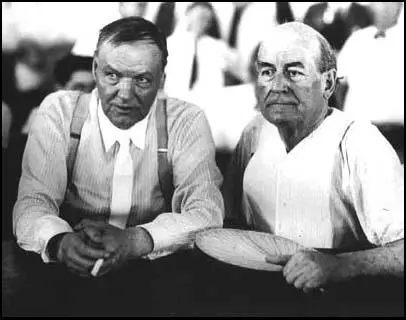
Clarence Darrow (left) sitting with William Jennings Bryan (right) before Scopes Trial. Retrieved from this site.
Bryan was the prosecutor in the famous 1925 trial, arguing in favor of fining Scopes for teaching that humanity descended from a lower order of animals. The Butler Act, which Scopes was tried for violating, declared the immutability of the Bible and the inerrancy of the Genesis account of Adam and Eve. This was and still is an important element of fundamentalism, the values on which BC was founded. In the cross-examination day of the trial, however, Bryan compromised literalism but noting that “I believe everything in the Bible should be accepted as it is given there: some of the Bible is given illustratively. For instance: "Ye are the salt of the earth." I would not insist that man was actually salt, or that he had flesh of salt, but it is used in the sense of salt as saving God's people.” Bryan also said that the six days of creation were “not six days of twenty-four hours.” For Bryan, the statements in the Bible were accurate descriptions, but what was more important was not individual interpretations but the values that the Bible upheld.
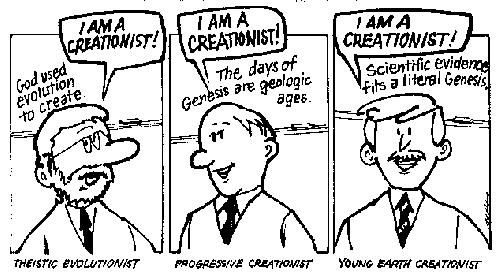
In Bryan’s summation of the trial, he proposed a strict dichotomy between religion and science, saying that one was the path to Christ and the other would crucify Him. In the 1920’s, and perhaps not until the intelligent design movement of the 1990’s, the idea that evolution and creationism could be rectified was perhaps outside of the purview of many Americans. But, many faculty members at BC do ascribe to labels such as “progressive evolutionists and theistic evolutionists and old-Earth creationists.” The previous BC statement of faith noted that “the origin of man was by fiat of God.” Interpreting fiat to be an all-encompassing act of creating the world, some professors at BC married religion and science and incorporating evolutionary theory into their personal beliefs and classroom teachings. They have taken the words of the Bible illustratively, so they are able to stay in line with the statement of faith.
Different forms of creationism. Retrieved from this site.
The new statement of faith, however, undermines these creative interpretations. Now, faculty must agree that “all humanity is descended from Adam and Eve. They are historical persons created by God in a special formative act, and not from previously existing life forms.” This statement puts many jobs at risk because it removes faculty that believe in any evolutionary history of humanity or of Adam and Eve as symbolic placeholders.
Upon a recent trip to Dayton in March, I had a conversation with a priest and an archivist at BC’s library. We were all reading through documents about Bryan, the trial, and the founding of the college. The priest was in the archive reading for clarification on Bryan’s teachings about biblical literalism. He was concerned that many of his closest friends, the best faculty at the school, and devout, loyal Christians would be unable to sign the new, stricter, and, at this point only proposed, new statement of faith. The priest was concerned that many great, Christian teachers would be lost and hard to replace. Although they may have had more creative interpretations of some biblical phrases, the priest considered their marrying of physical observation with biblical teachings as in line with Bryan’s teachings.
Logo of BC student newspaper. Retrieved from the Brian Triangle website.
BC students are also in agreement. They noted in their petition that they are saddened that BC “will alienate faculty, our brothers and sisters in Christ, by requiring them to affirm a negative on an ancillary matter of faith.” For the populous of BC, the tightening of the statement of faith only serves to divide rather than unite people of faith that have the common goal of teaching Bryan’s creationist values.
The archivist gave me a card for her husband’s creationist non-profit and seemed unconcerned with the changes. Although she said that some faculty taught evolution or believed in it, what was important was that the Genesis story was still taught at BC and the values of it were fully ingrained in all parts of its curriculum. She noted that if students had issues with particular professors and their more creative interpretations, they could easily take classes with a more fundamentalist professor. The campus was an open place where at least variations on creationism were discussed freely. The new clarification would place this openness in jeopardy. BC is surely staying within its rights to clarify its statement and to fight for literalism, especially within a threatening, secular environment. This statement is adopted, however, against the wishes of its students and faculty, making the authorities at BC domineering and elite over the wants of its people. Bryan’s values of populism, the will of the people over the elites, were once in opposition to the elitism of science that would remove all mention of Christ from classrooms. Now, BC wishes to do the same, but to strip its students of all access to evolution, despite that it awards biology and environmental science degrees.
What is at issue here is the extreme polarization of science and religion that is shrinking the opportunity for middle ground, mutual respect, and open deliberation. I do not mean to argue that creationism is a valid scientific explanation, but simply that people should not be so quick to judge people for staying true to religious ideals while incorporating scientific and material evidence in their belief systems. As more and more people take note of scientific evidence for evolution, there is more vocal push back from religious fundamentalists that distance themselves from intelligent design perspectives. Adopting new frameworks and stretching current ones is incredibly difficult. Attempts at marrying them and making sense of one’s religious convictions in light of science is something to be valued, not disdained.
BC student protest image. #hearmyvoiceBC. Retrieved from this site.
BC cannot avoid the protests and disagreement from their own students and faculty, nor from the general public about the favoring of religion over science. As the students said themselves, “the clarification promotes factionalism at the cost of honest debate and discussion.” This decision, perhaps in response to more prominent attention to the issue, is minimizing the space for education about scientific explanation for origins. BC was created when creationism and evolution simply could not be rectified. But, now, it is clear that BC is isolating itself from its students, faculty, the potential partnership of science and religion, and illustrative biblical teachings, in contrast to the teachings of its namesake. We will never know what Bryan would say about this iteration of the human origins controversy. But, I would put money on the will of the people over the BC elites that work risk compromise and biblical values in favor of fervent literalism.
There have been scholarly discussions over the purpose/value/potential impact that the creation care movement might have. It is tempting to be pessimistic in a political culture that seems to be stuck in the constant polarization between affirmation and denial instead of focusing on efficacy to action. I see some potential in the creation care movement, however. Although the loudest voices we hear are focused on denialism and their detractors who try to debate them, most Americans lie in the middle. I am not concerned with convincing the denialists, but with changing the debate. Creation care could potentially be an avenue to speak the (religious) language of many Americans and people around the globe. The movement shifts the conversation from quibbling over scientific data, undermining science as a field of inquiry, and valuing money over people, to intergenerational arguments about charity, and a deep concern for the poor and nature.
Though I agree that too much optimism will only lead to disappointment, I feel that there are positive steps being taken and creation care messages being presented in the media. Recently, Pope Francis I made a strong statement in support of creation care. This was perhaps his most prominent and widely covered statement directly about the environment. Francis has repeatedly spoken out about the values of charity, has decried the poverty specifically relative to the wealth of some priests. It may come as no surprise, then, that Francis links these values to caring for the environment “because if we destroy Creation, Creation will destroy us.” The full remarks can be heard here, which outline Francis’s emphasis on balance between humans, humans and the environment, and humans and their spirituality.
Referencing his namesake (St. Francis of Assisi), Francis encouraged his followers, and indeed all of humanity, to be “custodians of creation.” This phrase is interchangeable with the “stewardship” of creation that reflects Genesis 2:15 which calls for humans to “work and take care of” the Garden of Eden (New International Version). The story of Genesis is often considered to be in contradiction with itself, as it contains phrases that seem to laud the role of humanity as having dominion over the world and also phrases that support taking care of cultivating the earth. This reflects a difference in interpretation, which Francis is trying to push towards the latter view where Creation is a gift rather than property to be exploited.
Creation care has also been in the news with the works of Katharine Hayhoe, a climatologist from Texas Tech and an outspoken evangelical Christian. She was named to Time's 100 Pioneers list with an article written about her by Don Cheadle. They worked together on Years of Living Dangerously, a Showtime TV series that used celebrities as correspondents to investigate issues surrounding climate change. The episode "Preacher's Daughter," specifically addresses creation care as a movement that could impact policies and public opinion about the environment. At an event with Ian Somerhalder (a correspondent in the Preacher's Daughter episode), he noted that the more people who watch the show, the more the media networks will understand that this is an important issue that real people want real answers to, instead of just pundits and talking heads.
There is certainly language a plenty to indicate despair, irreparable damage, and apathy. But, there is also hope. Hope may live in the gaps of these contradictions, between science and religion as incompatible frameworks, comfort and sacrifice as dichotomous values, and the future versus the end of the world as motivating eschatologies.
To continue the discussion of creation care, I will discuss the fluidity of Bible verses. There are many, ongoing discussions about interpretations of certain phrases with sometimes a wide range of translations based on different versions of the Bible. Concerns over contradictions in the Bible can lead to difficulties in creating a coherent picture of one's religious beliefs and identity. McCammack (2007) argued that the
differing interpretations of the Bible are not trivial, for adherence to
biblical accuracy is of the utmost importance for evangelicals, who make up a growing percentage of the creation care movement, "green evangelicals."
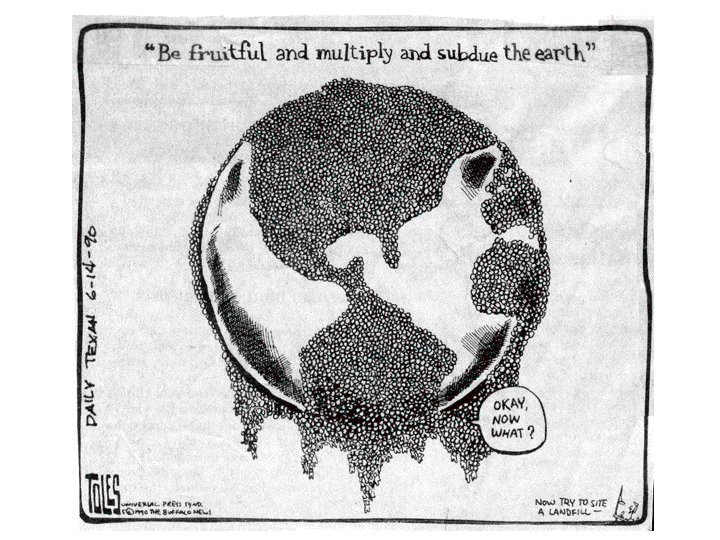
A few prominent phrases that appear to contradict one another are Genesis 1:26 and Genesis 2:15. Genesis 1:26 reads, "Then God said, 'Let us make mankind in our image, in our likeness, so that they may rule over the fish in the sea and the birds in the sky, over the livestock and all the wild animals, and over all the creatures that move along the ground'" (New International Version). This verse makes use of "rule over," an equivalent of Genesis 1:28's "dominion" or "subdue", to place humanity in a hierarchical position over that of animals and others living creatures in the world. If humanity (Adam and Eve) were God's most important creations, then it may logically follow that everything else in the world is not worthy of protection or keeping. On the other hand, Genesis 2:15 reads "The LORD God took the man and put him in the Garden of Eden to work it and take care of it" (NIV). Other versions swap out these verbs for "tend and watch over it" (New Living Translation), "cultivate it and keep it" (New American Standard Bible), "work it and guard it" (International Standard Version), and "care for it and maintain it" (NET Bible). These verse, only a few after the ones above, appear to place humanity within its scene, not over it. Humanity has been given the divine charge of maintaining and caring for the Earth as another of God's creations. There are many more verses that address the relationship of humanity to nature, but these might be the best known.
Another respondent noted that "dominion is so often misinterpreted as carte blanche permission to do what we want with creation." Dominion implies "that we will be held to account by God for how we manage his creation." Humans will thus be judged for their treatment of the Earth and how kind they were as rulers as one might expect God to be. These responses further support the ability of creation care members to fill in gaps and overcome contradictions where others may perceive them.
Respondents were asked about the apparent contradictions between these two verses in the study and to describe their meaning and compatibility. A frequent response was that people took "rule over" and other verbs of domination too literally, and it might better be translated as calling for stewardship, a kind and tender position of power that cares for the Earth. One respondent noted, "God has created us in His image, and it is this image we are to reflect in our dominion. The second verse describes what this Godly dominion can look like, tending and keeping a garden." For this respondent, the phrases are not contradictory, but complementary. Humanity can rule over animals but also tend to and take care of the Earth; a position of power does not have to be an oppressive one.