Showing posts with label Entertainment. Show all posts

Sunday, September 4, 2016

Reclaiming Shakespeare: Bomb-itty of Errors at the Nevada Conservatory Theater

After a long (and busy) summer, I am excited to be back to writing my weekly blog posts. Friday night, I attended the opening of Bomb-itty of Errors at the Nevada Conservatory Theater at UNLV. The play billed itself as the precursor to Hamilton, so I was expecting to hear intricate wordplay and have a great time. Bomb-itty of Errors definitely delivered. I disagree with a recent review of the play by the Review Journal that Shakespeare would not have recognized the source material. On the contrary, I think this adaptation is perhaps more faithful to Shakespeare's plays than faithful reenactments.

Promotional poster. Retrieved from Bomb-itty.com.
While Shakespeare is now considered to be high culture and difficult to understand, but it was once low-class entertainment for the common man. Shakespeare invented words and focused on lyricism and rhythm in his plays. Men played female roles and oftentimes multiple characters. While some people could enjoy the dramatic soliloquy of Lady Macbeth, others could be entertained by a man calling attention to his "woman's breasts." Shakespeare appealed to a variety of audiences in the original performances, not only high society that we sometimes associate with Shakespearean theater.


Bomb-itty of Errors capitalized on these associations and adjusted Shakespeare's play Comedy of Errors to contemporary hip-hop themes. Hip-hop and rap are common vernacular of today, making it a fitting substitute. The flow and rhythm of the rapped dialogues brought back the cadence of the original writing. I was amazed by the amount of information that the 4 actors memorized. They played all of the parts, so memorized at least 1/4 of the 2-hour play's discourse. They also had to remember what position to be in and what outfit they had to be wearing (and sometimes what accent to use) throughout the play. Even with this heavy burden, the actors succeed flawlessly in delivering funny, engaging, and understandable lyrics. Many of the jokes were subtly hidden within the dialogue (such as adding in lines about taming shrews), or in an actor mimicking the style of a famous rapper (I noticed DMX in particular). There were also overt comedic moves, like the overbearing, racist cop and the ditzy sister, Luciana. The variety, however, made this adaptation true to the performances of Shakespeare's days.

Play promotional image. Retrieved from UNLV's Events Calendar.

Three of the male actors played sizable female roles (and the fourth played one momentarily), adjusting their voices, outfits, and demeanor to be good actors but also sources of comedy simultaneously. One of the highlights of the play was the scene where the two Dromios argued about which of the two female characters (played by each of them) was more attractive. The self-awareness was refreshing and elicited a laugh from me even after I thought the play had come to an end. The play highlighted the humor of men playing female roles by creating close contact between the actors and outrageous costumes.

I previously commented on a play adaptation of The Picture of Dorian Gray. That play modeled itself after a rock opera, seeking to emphasize Gray's fall to sin with rock and roll. I found that adaptation fell flat, primarily because of the adjustments made to the story itself. Bomb-itty of Errors, however, seamlessly updated the story to contemporary hip-hop culture, using stereotypes to its comedic advantage. Theater allows for immense creativity and the ephemeral quality of performance. The Bomb-itty of Errors show I watched had many references to Las Vegas and the current election season. The lyrics and jokes could be updated, adapted, even ad-libbed (as many rap battles are) to fit the situation. The play and the actors' words are now lost in the wind, remnants of a contemporary oral culture where lyricism and word play still capture public attention.

Monday, November 30, 2015

Penn & Teller: Social Comedy and Edutainment

This past week, I was in Las Vegas, Nevada for the National Communication Association conference. I participated in a great pre-conference on sustainable communication, saw fabulous panels in rhetoric, religion, and science, and was honored to see a former student shine at her panel on material space and architecture. In the evening, I was able to explore some of Las Vegas's shows and strip night life. I attended Penn & Teller's show at the Rio Saturday night and knew immediately that I wanted to write a post about it. In this post, I will discuss some of my favorite tricks from the show and also my thoughts about the political, social, and scientific commentary that highlighted for me the importance of educational entertainment. I do not mean to give "spoilers" or to ruin the magic for anyone, so read at your own risk.

Retrieved from this site.
My first observation of the show was how honest and open Penn & Teller were about the art of deception. Many times, they blatantly told us what they doing and yet we were still bamboozled and confused. For example, Penn gave a speech condemning "psychics" who use tactics of cold reading to make audiences think that they have supernatural powers. Penn called out John Edward and Sylvia Browne, for example, for capitalizing on people's pain and misery in giving false hope through magic masquerading as messages from people who have passed. Penn has prepped us then, that what he is doing is really a trick. But, he does the readings so quickly and so spectacularly, it's really a wonder how he does it at all. In fact, being prepped and reminded about how the show is entirely full of tricks elevates one's awe and wonder because it has a natural explanation. If the answer is supernatural, then it is the supernatural power that is impressive, not the artist.

Retrieved from this site.
One of the themes of the show was represented on a sign that Teller held up during one of the tricks: "We aren't doing the trick you think we are doing." He flat out tells the audience that deception is occurring and Penn & Teller cannot be trusted, and yet the audience still falls for the trap, time and time again. My favorite trick was relatively simple in its set-up. Teller chose a woman from the audience and gave her a coin jar. He then began picking water drops from a fish tank and turned them into pennies which he placed in the jar. Even though I was in the very back corner of the mezzanine, I could still see and understand the tricks easily as they happened. The trick ended with Teller picking up a handful of pennies and dumping them back into the water. Instead of the pennies turning back into water, however, they sank to the bottom while dozens of goldfish appeared in the tank - it was truly incredible.

Retrieved from this site.
Part of what I was not expecting was the prevalence of social and political commentary in the show. Penn & Teller are widely known as libertarians and Penn is an outspoken public atheist. One trick included a short speech by Penn about airport security using a TSA metal detector. The trick was, again, amazing, but it also gave the audience an opportunity to reflect on the sacrificing of values and the usefulness of the TSA. Penn noted that the audience member chosen to come up on stage had as much training as a real TSA agent. They also showed how inaccurate and thus unnecessary many of the practices are. My favorite part of the sketch was Penn summarizing that we should all think about how our temporary security is often valued more highly than our eternal liberty. This is the type of comedy that reminds me of Lewis Black, where the jokes are purposeful and cause us to reflect on larger social issues.
Retrieved from this site.
This activism-comedy was also apparent in Penn & Teller's card trick. Teller performed sleight of hand magic while Penn played a guitar and told a story about "The Atheist's Deck of Cards." Based on a song by Tex Ritter, Penn & Teller tell the story about an audience member (Teller) who interrupts a physics lecture by Lawrence Krauss (who helped them write the song) and then tells a story using the cards to justify having them at the lecture. I was blown away by the amount of scientific information (which my partner, who is earning his PhD in Cosmology confirmed for me was accurate) packed into the song. From the four fundamental interactions in nature, the cosmological constant, and the size of the universe, the audience were learning about physics while also being mesmerized by Teller's sleight of hand.

Retrieved from this site.
I highly recommend Penn & Teller's show at the Rio. I'm not trying to advertise for them nor am I getting any reimbursement for this review. I am simply hopeful that Penn & Teller, along with other types of "edutainment" can help everyone learn more when they are not expecting it and give audiences chances for reflection and advocacy. Entertainment has aspects of education and can be harnessed to create a more active, engaged public. In a city known for its debauchery, sinfulness, and extravagance, I felt the simplicity and insight of Penn & Teller's show a welcome change of pace.

Sunday, May 10, 2015

Female Comedians aren't Funny: Gender and Sketch Comedy

It's been two years since Kenan Thompson came under fire for blaming a lack of diversity casing in Saturday Night Live on the poor quality of black female comedians. Women often lack representation in the media, especially women of color, and the comedy genre is no exception. Similar to previous posts I've written about tokenism, it seems that the few females that are successful serve as stand-ins for the general inability for women to be funny. If Amy Schumer or Garfunkel and Oates can achieve success, why not every woman? Those who are successful are held up as proof that there is no bias or discrimination, although they still represent a minority of comedic faces. It's clear that prejudice still remains, with men still chairing key positions on popular comedy news shows and women of color remaining relatively absent even as male diversity increases. There are some notable exceptions that I hope will become more frequent. One of my favorite Daily Show segments features Samantha Bee and Jessica Williams tackling race issues. Tell me these women aren't funny.

Daily Show news team. Retrieved from Comedy Central.
The new season of Inside Amy Schumer has also been receiving attention as she tackles important social issues with a comedic slant. Among the very many attempted sketch shows, this one seems likely to succeed with Amy's keen insight for satire. Among her many hilarious and poignant videos, Amy has addressed beauty standards (video below), female representation in the media (long, but completely worth it, especially if you like 12 Angry Men), rape culture, and obsession with the female anatomy. Catchy and hilarious, "Girl, You Don't Need No Makeup" is a satire of boy bands and requirements for female beauty that reinforce unnecessary adornment and pruning. They note, "with a little mascara, you'll look female" linking the wearing of makeup as a female gendered activity; to not wear makeup is to violate the female identity. It is okay for males to comment on and discipline the actions women should take regarding their appearance. At the end of the video, the male singers try on some of the makeup products and their reactions reveal the ridiculousness of the products women are expected to wear.


Garfunkel and Oates (who frequent one of my favorite LA coffee spots, Bricks & Scones) are a successful comedy duo that also release sketch comedy videos. They've commented on issues such as an emphasis on pregnancy as crucial to the female identity, the gender divide in sports, and chastity (video below). This is a heads up that the video on chastity does show some mimed sex acts and references anal and vaginal sex. The song is a humorous take on the religious restrictions placed on youth to avoid their sexuality and find "loopholes" to stay pure. For me, this video does a great job at highlighting the double standards for purity, where females cannot be pleased sexually but the male can. Overall, the song brings attention to a common side-effect of abstinence-only sex education that promotes female virginity over information and personal choice. It also brings into question why certain sexual acts are treated differently than others and the treatment of sodomy in homosexual vs heterosexual relationships.


Comedy is a persuasive means of communication that often keeps attention and promotes critical thinking (especially in works of satire). The rise of female comedians opens up new areas for this critical eye of importance to women. I don't think these spaces are exclusively for females to occupy, but it is hard to speak for others. Female comedians provide a sense of legitimacy and authenticity to these issues, having lived many of these double standards and social obstacles. The writers and performers of the jokes come from a standpoint that reflects the unique position of a female in contemporary society. I hope that these shows continue to be popular and I encourage people to support them!

Sunday, April 19, 2015

Capitalism and Entertainment: Show me the Money

In Communication and Culture, a class I teach at USC, we've been discussing themes of the intersection of capitalism, globalization, and culture. Something that immediately came to mind was the prevalence of capitalist themes within entertainment, particularly on reality television. Reality shows run the gamut from dating, cooking, tattoos, adventure, weight loss, and competition. Some of my favorite shows, and those that I've seen become increasingly popular and varied, are investment shows. These shows perpetuate and valorize the values of the American Dream and bring the token successes to national attention. While I enjoy these shows and generally think they are positive and helpful to participants, I worry about the larger implications of the show outcomes.

Retrieved from this site
My issues with these shows are twofold. First, I worry that they revere money over all other elements. The dollar is still key to any measure of success and is the bottom line for the happiness of the participants, investors, and the way the participants "win." Even good ideas, which are often acknowledged on the shows, are turned aside if they cannot be executed, shown to be scalable, or have reasonable time limits on returns. I also worry that the success and proliferation of these types of shows reinforce that these experiences are commonplace and plentiful. This type of mentality may blind us to the structural and societal barriers that do exist.

Retrieved from ABC
Perhaps the largest and most profitable of the capitalist entertainment shows is "Shark Tank." Based on the British version "Dragon's Den," "Shark Tank" shows a series of sharks, successful entrepreneurs, as they vet potential investment opportunities. Participants on the show pitch their idea, explain their process, and talk profits. Oftentimes, it is only established businesses that have track records of success and profit receive deals. People who come in only with ideas are often dismissed as too new, untested, or risky. On this show, people who have in some sense already "made it" are given investments to become more profitable with the help of investments. Sometimes, the sharks offer mentorship and experience beyond the monetary contribution, but the ultimate goal of the show is to receive their ask at a reasonable valuation. The "About Shark Tank" page has this to say, "The Sharks will once again give people from all walks of life the chance to chase the American dream, and potentially secure business deals that could make them millionaires." Shark Tank is not discriminatory, but then again, it has an intense vetting process which means not everyone can appear on the show. They are also only given a "chance to chase" success because that power is ultimately not in the hands of the everyday American, but by the always already profitable and successful elites.

Restaurant Startup investor Joe Bastianich

A spin-off of "Shark Tank" is "Food Fortunes," a new shop that specifically focuses on food-related innovations. This show adds the element of audience participation, where a live audience tests the food concepts and provides real-time feedback on the product. Also in the food category, "Restaurant Startup" gives people the opportunity to run a pop-up restaurant and get an investment to open a long-standing one. These shows follow the "Shark Tank" model where there are proven elites that have the power over the financial success of the participants. In "Restaurant Startup," the participants have some autonomy over their styling, logo, food, aesthetic, and supplies in creating the restaurant. But, they are still at the whims of the investors to change elements that are not amenable to them in order to open a real restaurant. In the interview above, Bastianich notes that a "business without profit is a hobby," again reinforcing the bottom line of profits over innovation, creativity, and even good quality food.

Retrieved from this site
Dana Cloud argued that token success stories, such as Oprah Winfrey, are harmful to the understanding of how power structures work and the barriers that exist to equality. When people see the success of Winfrey or others the myth of the American Dream, the self-made man, and Horatio Alger come alive. People are presented with proof "of the American Dream, implying the accessibility of this dream to black Americans despite the structural economic and political obstacles to achievement and survival posed in a racist society" (p. 116). This is not just race, however, but that the success of people who have overcome barriers in place are applicable to everyone. If anyone can succeed, everyone can. Winfrey's success is certainly something to be lauded, but it should not be generalized to the larger public. To do so is to blame individual agents for their positions and ignore larger social, cultural, and political issues that are beyond individual control.

Retrieved from this site
Many of my students tell me that it is hard to look at media the same way after taking Communication and Culture. There are many things to be cynical of in the contemporary media landscape. Where it is gender issues in advertising, racial stereotypes in movies, or the proliferation of questionable tropes, how are scholars supposed to genuinely enjoy media? I will say that I do enjoy the shows I have discussed and think there are great lessons to be learned and fun to be had in watching them. I cannot fault the investors on these shows for doing what the show encourages them to do, or even being business-oriented. It's their money, after all. But, I wholeheartedly hope that people become active instead of passive consumers of media. To watch The Bachelor and understand the questionable gender elements is much better than avoiding it completely or to accept its messages passively. Scholars, critics, and everyday people should be immersed in contemporary society and also interested in its workings.

Monday, June 16, 2014

Dorian's Descent: All Art is Quite Useless

Dorian's Descent is a new stage adaptation of The Picture of Dorian Gray by Oscar Wilde. Dorian's Descent is a musical that has added an element to the story: the Devil. In this article, I wish to explore the narrative elements of The Picture of Dorian Gray through Walter Fisher's narrative probability and narrative fidelity, the Faust trope, and how the character of the Devil is a narrative disaster. Although I did enjoy the show and thought the singing was quite impressive, the actual lyrics, words, and acting were sub-par, especially compared to a few other musicals and adaptations I have seen in Los Angeles. I will be discussing the play and the book in detail (i.e., spoiler alert!), so I encourage readers to read the book or acquaint themselves with the story.
Poster for Dorian's Descent
The Picture of Dorian Gray is about a young man, Dorian Gray, who becomes obsessed with a portrait that Basil Hallward has painted of him. It shows him in his youth and his prime, characteristics that he realizes, once prompted by his friend Lord Henry Wotton, will fade. In a state of hopelessness, Dorian wishes that the painting might age instead of him, for in its current stage it only serves as a reminder of what he would lose. Without explanation, the painting does begin to change as Dorian becomes involved in the hedonism of Lord Henry's lifestyle. Dorian scorns Basil, engages in illicit sexual activity, murders, and experiments with various vices. The picture ages, its face is marred by a snarl, and the brow is furrowed in perpetual anger and disdain. Eventually disgraced by the harm he has caused, Dorian attempts to absolve himself by stabbing the picture. The two reverse, leaving Dorian himself dead, aged, and hideous and the portrait returned to the beauty which Basil painted.

The picture and Dorian from the movie adaptation
Dorian's Descent infuses a rock opera theme onto the story, which pairs nicely with the descent into hedonism and sin. The element of the Devil, however, removes a very powerful and meaningful part of the play: Dorian's agency, choice, and self-mortification. In the play, the Devil appears and makes an explicit Faustian deal with Dorian so that he may stay young and the portrait may age. The character is doubly unnecessary. First, Lord Henry already serves as the Faustian Devil, the foil to Basil between which Dorian must decide. Having the Devil character undermines Lord Henry's role as the tempting, evil character that lives a sinful, yet seemingly fulfilling life. His presence mirrors the Devil, instead of captivating Dorian's attention in his own right. Furthermore, the Devil as a mystical, magical character removes the potential for Dorian's choice. The supernatural can seem to constrain the choices and available actions of humans, making Dorian's descent into hedonism part of the Devil's plan instead of a meaningful choice of evil over good, Sir Henry over Basil, self over others.

The Devil makes a deal
The beauty of The Picture of Dorian Gray is the unspoken Faust trope. Any one might utter an "I wish . . . " or make selfish requests, placing oneself squarely in the shoes of Dorian, connecting and identifying with him in finding himself in a peculiar situation. Walter Fisher described two elements of narrative rationality (or the logic of stories): narrative fidelity and narrative probability. Narrative fidelity is the perception of how faithful a story is to reality (or the audience's world). Although one might think that this would preclude fantasy, science fiction, or non-fiction from having fidelity. On the contrary, stories such as Harry Potter have high narrative fidelity because they seem real and possible, despite their fantasy elements. We could imagine, though we may not have seen or experienced it, a secret world hidden within our own (thus justifying its lack of presence). Though we may not have experienced or believed possible a changing portrait, we can faithfully imagine our lives as confronting something wholly un-explainable and what our reactions to it might be. The element of the Devil fully violates this type of realismo mágico (think Guillermo del Toro) where it could be possible, and makes the subtle Faust trope seem more like a cliche.

Sibyl Vane's forgotten lyrics
Perhaps most disappointing for me was the changes to the Sibyl Vane character, Dorian's brief love. Before his shift into full hedonism, Dorian fell in love with an actress. Her devotion to her art and her skill in bringing love to life in her performances captivates him. In his courtship of her, however, Dorian destroys Sibyl's ability to act. I have copied her confession after a particularly terrible performance of Romeo & Juliet below, which is one of the more beautiful passages in the book.

"Dorian, Dorian," she cried, "before I knew you, acting was the one reality of my life. It was only in the theatre that I lived. I thought that it was all true. I was Rosalind one night and Portia the other. The joy of Beatrice was my joy, and the sorrows of Cordelia were mine also. I believed in everything. The common people who acted with me seemed to me to be godlike. The painted scenes were my world. I knew nothing but shadows, and I thought them real. You came -- oh, my beautiful love! -- and you freed my soul from prison. You taught me what reality really is. To-night, for the first time in my life, I saw through the hollowness, the sham, the silliness of the empty pageant in which I had always played. To-night, for the first time, I became conscious that the Romeo was hideous, and old, and painted, that the moonlight in the orchard was false, that the scenery was vulgar, and that the words I had to speak were unreal, were not my words, were not what I wanted to say. You had brought me something higher, something of which all art is but a reflection. You had made me understand what love really is. My love! My love! Prince Charming! Prince of life! I have grown sick of shadows. You are more to me than all art can ever be. What have I to do with the puppets of a play?"

Sibyl has so greatly fallen for Dorian that she cannot pretend to love as she once did. This confession is made all the more beautiful when she takes her life after Dorian rejects her love. In the play version, Sibyl is a singer whose voices makes Dorian fall in love. Substituting singing for acting makes sense in the musical, but it is the other change that ruins it for me. Instead of falling out of love, causing Sibyl to ruin her craft, the Devil character makes Sibyl forget her lines before a show. The audience loses this beautiful insight into Sibyl's innocence and thus undermines her death as the tipping point in Dorian's sanity. This change further supports my comments below about Dorian's actions being orchestrated and not of his own choice.
Retrieved from this site
Dorian's Descent is an interesting adaptation of The Picture of Dorian Gray, but its creative changes served only to undermine the beauty, simplicity, and complicity of the book in an attempt to be unique. Without our ability to empathize with Dorian's decisions, which we believe are of his own accord, the audience can only observe and cannot be active participants in the narrative. We are not convinced that this could happen to us, that we would make such a deal with the Devil, or that we are only a few steps away from falling into sin ourselves.

Although this is not the shining review that I'm sure the fledgling play is hoping for, I hope that they take to heart the immortal words of Lord Henry: "There is only one thing in the world worse than being talked about, and that is not being talked about." Certainly this adaptation has given me and I hope any readers some food for thought about how narratives are updated, adapted, and changed in the pursuit of artistic creativity and to teach us about issues that plague society.

Sunday, April 20, 2014

The Weak and the High Maintenance: Female Stereotypes in Advertising

This was not the intended blog post for this Sunday, but a few recent advertisements have been on my mind, recently. Their repetition on the TV channels I watch and on Hulu has increasingly bothered me in their portrayal of the female. I will link to them both here and then discuss the problems that emerge in the persistent stereotyping (especially gender stereotyping) that occurs in media.

The first commercial is from Verizon, which advertises that if you buy a phone, you'll get a second free. Then, the commercial explores various options for who the second phone should be given to. Attempting humor, the commercial proposes that a girlfriend may enjoy the free phone, "but don't tell her that it's free." The face of the female fades from happy to disgruntled. This commercial plays on the "high maintenance" girlfriend trope where females are not happy or satisfied unless a lot of money has been spent. Shows such as Bridezillas, MTV True Life, arguably every Real Housewives version, emphasize this theme of women as spoiled, needing immediate and constant care, and focused on the material. These stereotypes overpower a more dimensional representation of the female outside of material goods and characterize all women as high maintenance. This description itself is inherently offensive. One's provides maintenance to a car or an object, not to a person. There is the association with a female as an accessory, a tool, an object needing maintenance, improvement, and upgrades in order to function. This also implies that the partner (oftentimes male) in the relationship is the only one with purchasing power. This clip from Bridezillas, featuring Remy and Rob, illustrates the dynamic quite well.


The Verizon commercial bother me, because it ignites these stereotypes as women as only valuing the material, lacking purchasing power, and only superficially strong in their demand of items they cannot provide for themselves. Even in the portrayal of strong women who declare they deserve certain items or treatment, there is an underlying weakness in the women who rely on others for self-validation, respect, and attention.

The second commercial focuses more on the vegetarian as weak, but the non-present character is given a female gender. This is a commercial from Walmart about setting a table for an Easter lunch. The planner describes why certain people are placed in certain spots noting that her vegetarian sister is at the opposite end of the table "so she can't see the ham." My first reaction was one of disgust that a commercial would rely on stereotyping vegetarians as too weak to even see meat. Though this is just a small statement, a lot of information is imparted in a short amount of time to the viewer. The audience is surely meant to consider the planner quite respectful. But, the implications are that vegetarians (and perhaps specifically female ones) cannot stomach the sight of food they cannot consume.

Both of these commercials highlight the importance of stereotyping in the world of advertising. When a company has only 30 seconds to compare one's attention and express the benefits of a product or service, stereotyping is a potential strategy. Originally conceptualized as the images that one sees in one's head, stereotyping is now defined as a mental shortcut that associates certain characteristics with others. There are racial, gender, ethnic, religious, political, and geographic stereotypes, all which connect a person to a host of underlying associations. Stereotyping makes sense if one's goal is to impart information as quickly and as succinctly as possible. The human brain is lazy and would rather use mental shortcuts to absorb, process, and respond to information. Popkin called this "low information rationality" where people tend to use the least amount of information possible to make their decisions. He connected this specifically to voting, where people may vote in elections based solely on a party affiliation, a rumor about a candidate, or even their aesthetic appearance over delving in deeply into issues and more complex information.

Apologies for the video quality. South Park's "Museum of Tolerance"

Though stereotyping may make sense for advertisers, other media theories, such as cultivation, encourage us to reconsider the potential consequences of long term, frequent consumption of media tropes. If females are consistently portrayed as weak, high maintenance, powerless, vulnerable, and other "feminine" characteristics, how can we expect a new generation that is more open to feminism and equality? There are certainly many factors that influence people's attitudes, opinions, and behaviors, but it may not be surprising that a media that reflects and stereotypes females in such as way may also be contributing to other gender-based issues. There are many examples I could pull from, but I will encourage people to look at this video from Fox News about women being paid "what they're worth."

Sunday, April 13, 2014

Media Representations of Atheists as the Scrooge Trope

Sitting in on a class on media and religion, I was shocked to hear student responses to the question, "how would you describe this atheist?' The responses such as sad, angry, evil, cynical, and confused described Dr. House on the TV show House. We had just watched an episode where Dr. House is faced with a potential miracle where someone comes into the hospital hallucinating that an angel told him to go to the hospital. Finding that the illness he had did not include hallucinations as a side effect, there are implied themes of potential truth behind the patient's visions. Throughout the episode, House remarks negatively towards religion and the patient's employment as a priest. His cynicism and complete disdain for even considering religious explanations is highlighted prominently. I cannot fault the students for describing Dr. House in these ways. On the show, he is portrayed as a curmudgeon who is cynical and removed from meaningful relationships. What hadn't occurred to me until that moment is that this TV show may be communicating that these are qualities of atheists as a whole, with Dr. House serving as synecdoche.

Retrieved from FluffyAtheist's YouTube

I began to see this cynical portrayal as a pattern. I attended a play titled, "Freud's Last Session" which details a fictional therapy session between Sigmund Freud (a prominent atheist) and C. S. Lewis (the author of the Chronicles of Narnia and converted Christian). Freud is presented as a old, cynical man who has little left to live for and takes much pleasure in undermining Lewis's belief. Lewis, on the other hand, is presented as youthful, moving quickly around the stage, and speaks with hope and optimism about the world. The two are foils, dichotomies of one another, religious belief only one aspect of this dichotomy. Though they are presented in a type of balance, the implication is that when Lewis leaves, he leaves Freud to die, set in his ways, and without religious comfort in his final hours.

Scene from Freud's Last Session at the Chicago Mercury Theater

I would also like to point my readers to this film (trailer below), which presents a fictionalization of an encounter of a student with a professor who asks students to argue against God's existence. When the student challenges the professor, he makes the student debate him. What is most revealing about this trailer (in addition to the appearance of the stars of Duck Dynasty) is the exclamation from the student, "Why do you hate Him? Why do you hate God?" This exclamation reveals a disconnect between actual atheism and the perceived attributes of atheists. If someone is an atheist, they do not hate or have emotions towards God; He does not exist. It would be very hard at me to be mad at a unicorn, Big Foot, or people yet unborn. These things do not exist, so emotions cannot be directed towards them. People who believe in God or religion sometimes perceive atheists as jilted followers who have somehow been wronged and now take vengeance upon God by being atheist.

Retrieved from the Denison Forum

These three examples provide evidence of a potential theme of representing atheists as stereotypes of what we might call the Scrooge trope. Curmudgeons, only concerned with the material, dismissing happy emotions, hope, and relationships in favor of cynicism, solitude, and pessimism. Media effects literature might encourage me to conclude that these pervasive themes may be influencing the general public in their repeated and frequency consumption of media messages. Though these are fictionalizations that cannot be faulted for narrative short-cuts or simplifying characters. I believe it is harmful, however, to creating a more integrated and open space for people to "come out" as atheists. Though atheism is on the rise and secular humanism is becoming a prominent philosophical worldview, much of the perceived "Culture War" is really Christian and faith-based groups trying to isolate and legislate against non-believers. In a country where some states still hold laws against atheists holding public office and a world where they can be killed for not believing (Oh, look! It may have even happened in Texas), these media representations are performing even more harm upon the image and presence of atheists.

Sunday, February 23, 2014

Book of Mormon: A Latter Day for the Latter Day Saints?

Book of Mormon has recently come to Los Angeles and I have now seen the musical twice. There are a few important notes that I would like to make regarding the musical. I won't have too many spoilers or descriptions of the musical, but if you haven't seen it or would like to remain in mystery, then turn back now!

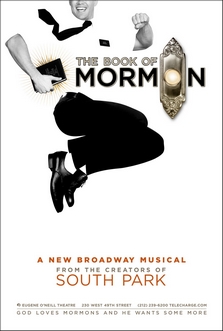
Retrieved from Wikipedia

The first point I'd like to make about the musical is the various reactions it has received due to its concentrated treatment of the Mormon faith. Based on an episode of South Park where the Mormon faith is described in song, including a chorus calling it "dumb," the Book of Mormon primarily follows Elder Price on his missionary trip. Matt Stone and Trey Parker are comedians and the musical follows the comedic and often offensive style of their TV show and movies. Though the show has received much praise including Tony awards and nominations, there has been much backlash from the Mormon community that the show paints their faith as something to laugh at, and not seriously consider as a legitimate faith. I have previously written about the Mormon faith and how it complicated Mitt Romney's run for presidency. Part of its problem is its youth where "ancient upstate New York" is a biblical location and the Garden of Eden is located in Missouri. The relative "all-American" prophet is something foreign and different from the traditional Middle Eastern locations.

The backlash that it has received overestimates the exclusivity of Stone and Parker's critique. What the Book of Mormon does is present the Mormon faith as similar to other faiths, not distinct. When one considers the equally occult and supernatural forces that define other religions, laughing at the Mormon faith means that people are laughing at all faiths. In the song "I Believe" Elder Price sings about all the things that he believes in as a part of his faith. The first two lines are quite Christian in nature: "I believe that the Lord God created the universe" and "I believe that he sent his only son to die for my sins." Not until line three is a marked changed expressed where he sings, "I believe that ancient Jews built boats and sailed to America" that elicits much laughter from the audience. The chorus notes that "I am a Mormon and a Mormon just believes." In a sense, this is a critique of all religions that just believe the doctrines put forth by their faith. Is it any less funny or unbelievable for their to be a Christian version that statements "I believe that Christ turned water into wine"? Or "I believe that Mary gave a virgin birth?" Or "I believe that Christ resurrected after being crucified?"


This song touches on the key component of all religions: faith. There is little to no evidence of all of these supernatural and religious occurrences, so for Mormon doctrine is equally as legitimate and believable as all other faiths. Even if the audience does not catch onto the criticism, the Book of Mormon expertly causes everyone to consider the beliefs that they hold as true and examine why their faith holds weight, if any, over others. The Book of Mormon also expresses other similarities to faiths such as missionary trips, studying the Bible, guilt over sinning, and uncertainties about its teachings. As an atheist, it was clear to me upon watching the show that this was a critique of all religions, their systems of beliefs, and the arbitrary hierarchy and discrimination directed towards Mormonism.

Perhaps the Mormon Church understood the great potential in the play as an avenue to reach new members. In the playbill for Book of Mormon, the Church took out three full page advertisements. The first is a white male noting "I read the book." The second is a Latina female with the text, "the book is always better." The final page is a black male who notes, "you've seen the play, now read the book." All three advertisements contain three methods to learn more information: a QVC, website address, and instructions to text "BOOK" to 33733. The faces of the individuals are highlighted to reveal their diversity and the power of the individual to find more information. The play centers around the "Book" of Mormon, so the advertisements push viewers to explore the book through its original text instead of simply through the play version. For the first advertisement, having read the book is a point of pride, a way for savvy-going theater-goers can engage with the play more fully. The advertisements take advantage of a captive audience that is engaging, perhaps for the first time, with the Mormon faith and gives them the opportunity to learn more.

Retrieved from this review
Those who may be visiting the show and preparing to laugh may not be the best audience to find converts. I thought similarly after seeing street preachers in Las Vegas. But, the places where there may be the most resistance are also perhaps the areas with the most potential and opportunity. Just as Elder Price entered a missionary location in a poor town in Africa, the Mormon Church is braving hostile territory with an unlikely chance of success. But just as Elder Price and Elder Cunningham attempt to change the landscape for Mormon missionaries, the Church also attempts to affect the narrative of attendees by offering its own version. Either way, this musical has people discussing the faith and has exposed many people worldwide to its teachings and doctrines. The Church is smart to see this as an opportunity instead of a threat and everyone would be best served by appreciating the critical nature of the play not as anti-Mormon, but as inquiry of the role of faith in general.

Tuesday, September 3, 2013

Cyborgs: Entertainment and Reality

Many great scholars before me and currently have performed more extensive inquiries into the nature of cyborgs and the growing intersection of humankind with technology. My interest has been piqued in this topic tangentially, as I have interests in the use of technology for information gathering, dissemination, validation, and power. Inf/using technology in our daily lives is simply an inevitability that communication scholars must address, and cyborgs are an interesting "end product" in my mind. The cyborg represents a unity between humans and technology, faults and flaws permanently mended by technological advancements and prowess.

Because the cyborg, for the most part, only exists in fiction, much of the cyborg's mythology comes from media representations. The relationship between humans and technology range from fully robotic operation with human appearance (e.g., The Stepford Wives) to humans with technological modifications (e.g., Planet Terror) with traditional definitions of "cyborgs" operating near the halfway point (e.g., the Six Million Dollar Man). They key appears to be integration, where a character has equal or mostly equal human and technological parts that operate as parts of a unified whole. Someone using a gun (i.e., picking it up and using it) is quite different from having one functioning as a leg and being able to fire it from internal signals instead of pulling the trigger.


After some pondering (and heated discussion with my significant other) about the nature of cyborgs, we also reached a conclusion that cyborgs are not merely people with technological parts (e.g., a person with a pacemaker), but this technological addition must perform a fundamentally inhuman task. Iron Man, though he has a metallic plate protecting his heart, the addition of this technology does not provide him inhuman strength, power, or wit (that's just Robert Downey Jr.). Will Smith, however, in I-Robot, does have robotic additions that give him extra strength and powers, like the superhero that Iron Man is. Instead of a suit that can be taken on and off, true cyborgs have integrated technology with their human bodies to advance the form beyond what was previously possible.

The thinking about cyborgs began with my viewing of The Amazing Spiderman, where the antagonist has lost a limb and pines for its re-growth and repair. Whereas he believes the solution lies in cross-species DNA, the attempt to achieve this ends spectacularly well, a la The Fly. When I think of his pining over perfection, and yet the inability to consider a prosthetic arm, it echoes my feelings above that the functionality of the cyborg is the key. A prosthetic arm would perform basic functionality of an arm, but to replicate it perfectly and to extend its strength, a robotic replacement would be needed. What Dr. Collins realizes is that in his search for perfection, he must replace the entirety of the human body, for it is weak and vulnerable. In his transition to a lizard-human hybrid, he becomes similar to a cyborg in that his human form has been replaced with stronger and more powerful parts to complement the human form.


A live example of the cyborg may be found in Neil Harbisson, a color blind person who used a prosthetic eye piece to hear colors. Though he sees colors in shades of grey, the eye piece translates each types of color, including its shade and vibrancy, into sounds that he can understand. He is attempting to have the eye piece surgically attached to his spine, fully integrating the eye piece to his human form. There's no need for me to define him as a cyborg, he's done that already.


The Cyborg Foundation that he founded is the first organization working to defend cyborg rights and indeed encourages people to embrace technological additions. One of their listed aims is "to extend human senses and abilities by creating and applying cybernetic extensions to the body" and they describe their missions statement as "helping people to become cyborgs." This is quite a radical step in theory but these changes are already beginning. Consider the Futurama episode "Eye-Phone" that made fun of the attachment that people have to their technology by implanting one's phone behind the eye socket. Now, Google Glass is in its "explorer" mode and may soon become a normalized part of our technological experience.


Photo source
In the future, cyborgs may become the new human rights campaign. Whereas in the past, people have been dehumanized based on the color of their skin, their choice of religion, and their sexuality and partner preferences, the future may hold civil rights battles on behalf of cyborgs and their definition as more than/human. If the past battles were about defining humanity in terms of property, voting, and marriage, then future definitions of humanity will surely be tested.

Wednesday, February 13, 2013

The Appeal of Horror

Although I've always known that my preference for horror films over romantic comedies draws curiosity and concern from others, I never understood why. What is it about horror films that makes my interest in Saw, Hostel, and The Cabin in the Woods inherently worse than in No Strings Attached, The Notebook, or Sweet Home Alabama?

This is not an avenue of research I would pursue with any intensity, but its frequent occurrence in my life makes it a perfect blog post entry. Below are some musings and thoughts I've had about why horror is offensive on a basic level to human nature and why some yearn for that experience in the theater.


One of the issues in horror films is their defiance and utilization of reality. Whereas science fiction and fantasy is inherently "unbelievable", romantic comedies are life-like and true to reality. Outside of the necessary fantasy of Hollywood, unique plot points, and unlikelihood that come with a film, there is a transcendence that occurs naturally with romance, comedies, and dramas. Real people being dealt unlikely, but possible events, with real emotion and reaction. For the most part, these films follow standard structures with the protagonist achieving their goal or the couple uniting in the end. Aberrations from this structure may serve as a twist to surprise the audience, but the structure remains mostly intact.

Horror changes this structure by combining the reality of dramas, comedies, and romance with the abnormal and occult of science fiction and fantasy. Just as Harry Potter takes the reality of a rough childhood and transforms it into magical fantasy, horror films take the reality of normal, everyday people and sends them directly to Hell. The Saw films punish people for taking life for granted, something that everyone can be considered guilty of. The Hostel films torture people on vacation based on random acquisition. The reality of people's stories create an affinity and connection between the audience and the characters, allowing for a dangerous and frightening transcendence. Connecting with characters about to undergo bodily, mental, and psychological damage and harm can be an uncomfortable position for the average movie-goer.

People are willing to go and see them, however. The same adrenaline rush that brings people to amusement parks for a roller coaster ride fills the seats at the midnight premiere of the 7th Saw movie. The fear that arises from the films might be in the loss of power. Denying the basic, happy-ending structure of other films, horror movies remove the viewer from a position of power: from knowledge and expectations. Horror villains may have no explanation, attacks may come at any time from any location, and the fate or safety of the characters is variable. For example, the complete back story of Jigsaw, the villain in Saw, is revealed slowly and in pieces over the course of the movies, making his actions and the actions of his disciples mysterious and random. Epitomizing the random attacks is the Final Destination series, where "fate" is literally the villain that interacts with the environment around the characters to kill them in accidental ways. There is no man or monster hiding and approaching, but merely objects and spaces manipulated to attack and murder the characters at any point. Because it is a horror film, there are almost always murders or deaths, especially of the main characters. The survival of the characters (if any) usually only follows the deaths of others in the group.


The fear that these movies create is often avoided by movie-goers looking for an "escape" or pleasant experience. For those that do enjoy them, myself included, the pleasure comes from not knowing and experiencing something that is unique to movies and entertainment. The horror movie is an escape from the normal, everyday, average life, by exposing viewers to the dark side of reality.

I do not know what my favorite horror film would be, but I have to say that the recent Joss Whedon film, The Cabin in the Woods, has become a strong contender. The variety of emotions, from nervous and terrified, to intrigued and confused, to laughing out loud in the theater, this movie was the perfect horror film for me. Even for those not a fan of horror films, familiarity with the genre will help you appreciate the satire and exaggeration that makes this film an instant classic.


Wednesday, January 16, 2013

Post-Racial Society and Django Unchained

First, the title is a bit of a misnomer, as I believe there is no such thing as a post-racial society, a society "behind" or "after" race. It is merely used as a foil to the representation of slavery in Tarantino's Django Unchained and as an entry point into this inquiry into modern race relations and more specifically, the changing role of race in American society, culture, and politics. Here I will insert a fairly large disclaimer that I am not the person who can/should/ought to be writing about this topic, but I am attempting to broaden my rhetorical and scholarly horizons that have been opened to me by colleagues whom I deeply respect. This is an initial attempt to incorporate these discussions into my scholarly purview.

Photo from Wikipedia of the 1,000,000 Hoodie March in honor of Trayvon Marting
Walkers wore hoodies and carried Skittles representing Trayvon's outfit/pocket contents when killed
Considering the long, complicated history of race in America, it is naive to think that a simple presidential election could replace, mitigate, or somehow atone for the past. Stories that make headline news about the disenfranchisement of minorities in elections, Arizona's SB1070, and the murder of Trayvon Martin should reiterate that racial hierarchies and prejudice are still alive and well in America.

Though not "healed" fully in any way, Django Unchained has emerged as a cinematic reminder of how far we have come from the days of slavery some 200 years ago. Though there is little evidence of Mandingo fighting, the classic Tarantino emphasis on gore was a startling reminder of the gruesome way that slaves were treated. The whippings, dog attacks, punishments, and exploitation of "comfort slaves" serve as stark visual counterparts to the often diluted textbook descriptions. Though audiences have positively responded to Django, notable critic of Tarantino's works, Spike Lee, made a strong statement for not watching the film as blaxploitative and racist. I have already read further into this divide in an article by Sean Tierney called "Quentin Tarantino in Black and White" in the book Critical Rhetorics of Race. To summarize the argument with undeserved brevity, Tierney seeks to explain the negative opinions of Spike Lee towards Tarantino. Primarily, interviews with Tarantino and citing directly from his films show that Tarantino's co-opting of black culture is both offensive and hegemonic. Tarantino profits from black culture without acknowledging the hierarchy that allows him to do so without retribution or without the reverse being possible. Tierney (published before Django Unchained) also mentioned critics' aversion to the overuse of the n-word in Tarantino films. He mentions that the word is often removed from its political context and becomes what the re-appropriation was meant to avoid: having whites use the term and blacks use the term without respect to its political meaning. Though Django is set in times of slavery, the word is used over 100 times during the film, often times for laughs, quote Samuel Jackson, "It that a nigger on a horse?"
Django Movie Poster
I will admit that as a film, I enjoyed Django, but I find myself wondering, if it should have angered me. Over the winter break, I heard a story from my Mom who heard it from my recently passed Great Auntie Phil. She told me about her ancestors, my Great Auntie Phil and her brother, my Grandfather, and their family, who were brought from Africa to Jamaica as slaves. In Africa, the tribe my family belonged to differentiated wealth with bracelets made from various quality material. My Mom told me about the bracelet that she saw passed down to the youngest of the Harry's, my new baby cousin, a finely threaded bracelet of silver, a sign of wealth. I felt a pang of guilt, thinking of the unity of my family that represents a joining of white and black, free and slave, past and present, and what role I, as a blonde, blue-eyed white female, play in that narrative. I do not look in any way like my Jamaican and thus African ancestry, but like my 100% English father, a country that perpetrated much violence and conquered half of the world under the cover of imperialism, progress, and hegemony. Should movies like Django offend me in honor of my family history? The simple answer is that they cannot offend me in the same way they might have offended my Grandfather. Despite the history in my blood, I have not had, could never have, nor could ever imagine a life unlike the privileged one I currently have. Understanding that in and of itself has been a life-changing realization. The truth is that I did sit in the movie theater, ponder the recent readings on racial rhetoric, but at the end of the day, simply enjoyed the film as a Tarantino epic, an Inglorious Basterds of the Civil War era.

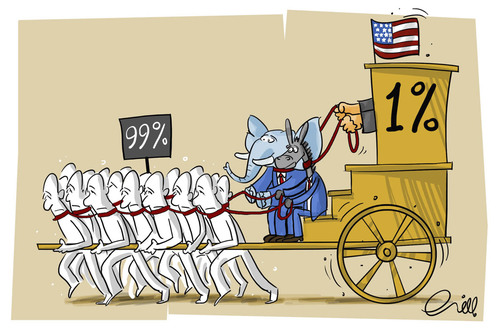
Political Cartoon retrieved online: thoughtful representation of race dynamics
I don't know what movies like Django Unchained offer to race relations in America. I would assume that these films complicate the relationship by glorifying a by-gone era and reinforcing that the changes from then to now is somehow sufficient or substantial. Spike Lee has said that he will not see the film, but I wish that he would. I would much appreciate a more critical and knowledgeable lens on the details of the film. I've merely laid brushstrokes over the existence of the film and its director. A more in-depth look into the film would be quite enlightening.

Award update: Quite a noticeable pan of Jamie Foxx's performance but great praise for Tarantino, DiCaprio, and Waltz this award season. At the Golden Globes, Django was up for best picture, Tarantino for best director and best screenplay (winner), Waltz and DiCaprio were up for best supporting actor (Waltz won), yet Foxx was not nominated. Again, the Oscars has Django nominated for best screenplay and best picture, with Waltz gaining the only actor win.