Showing posts with label Vegetarianism. Show all posts

Sunday, September 6, 2015

Food Culture and Masculinity in China: Surviving as a Vegetarian

When I went to live in China for three weeks, I knew that being a vegetarian would be hard. All of the blog posts I read warned me of the lack of options, difficulty in communicating dietary needs, and frustration with the lack of translations on menus and in stores. Only a few articles discussed China's Buddhist history and praised China's openness to vegetarians. With my handy printed copies of Chinese words and characters and pictures of animals with red X'ed circles, I went out prepared to let everyone know "wo chi su" - I eat vegetables. What I wasn't prepared for was how many of my food decisions weren't made for me - and how masculinity and food culture are intertwined in Beijing, China.

Flight into China.
Before I elaborate on the previous statement, I do want to say that I greatly enjoyed my time in China, am grateful for the opportunity, and am deeply indebted to my hosts there and the many friends that I made. This post is not about my overall experience, but about the unique difficulties I had as a lacto-ovo vegetarian (no meat, fish, or poultry, yes to eggs and dairy) in Beijing. The food I did have was delicious and I think future vegetarian travelers (and travelers in general) can benefit from learning more about Chinese food culture.

At many of the restaurants I went to in China, large groups were given private rooms with huge round tables with a rotating plate in the center. Family-style restaurants are usually a niche market in the US, but it was the standard practice for Chinese restaurants. In those settings, the communal nature of China brought me face-to-face with my own individualistic tendencies. Even in the US, family-style means taking food from communal pots and placing it on individual plates. We had personal plates in China, but more often than not, the people at the table would take food directly from the communal plates into the mouth. The most dexterous man I saw would pop individual peanuts covered in sauce from the bowl to his mouth without dropping a single one. Those who use have tried using chopsticks know how difficult this is. The avoidance of personal plates signified that the meal was everyone's. There was no "hoarding" of favorite plates or claiming ownership over food by amassing it in front of you. Instead, everyone was patient, waited for the food to rotate, and grabbed what we needed as it passed.

Picture of fermented egg on tofu, a vegetarian Chinese specialty.

For me, it could be a long wait for what I needed to come around, and a few times I felt compelled to break the personal plate rule and accumulate stray mushrooms and pieces of eggplant. At a communal table, there was no individually-owned items, so everyone took from meat dishes and vegetarian ones, even if I could only take from a few. For the Chinese, this wasn't an issue because over-ordering is the norm. No plates are ever left completely empty - it is considered rude. So instead, the staff will dump the remaining pieces on one shared plate to save space for the many more dishes to come. On many occasions, vegetable dishes that were ordered had meat sauces, chunks, or components. I completely understand the need to be flexible when traveling, but for someone who was raised vegetarian, those dishes can make me extremely sick.

My blog post promised some musings about masculinity and patriarchy - and here it comes. The Chinese food culture was communal, but the head of the table was the boss. During our first meal in China, a fellow American sat at the back seat facing the door. I think this is a common practice in the US, as it is the most difficult seat to get to, so if often taken first to avoid inconveniencing others. Our advisor, however, encouraged him to move, unless he "wanted to pick up the tab" for our table of 15. The host paid the bill for the entire table; "splitting" checks was not common, but sometimes at smaller outings we would throw money into a communal payment pot. For the three weeks I was in China, the host was female one time, when we dined with the director of the school the group was teaching at. The other nights were all male hosts who oftentimes spoke little to no English. This made communicating to them my dietary concerns quite difficult and I sometimes felt that my request was treated flippantly or as unimportant.

Picture of the Night Market in Beijing, where they sold scorpions, snakes, starfish, and many other things on a stick.
What the hosts ordered, we had to eat and drink, including alcohol when it was not desired. We were told when to take food, when to drink, and how much of what we could have. I was offered meat (usually Peking Duck) many, many times, and found it difficult to explain to my hosts why I refused their very generous offers. A few hosts got quite upset and raised their voices while my advisor tried to explain the situation and encouraged me to try "just a little bit" to appease the hosts. I don't fault anyone for the situation; it's really a classic case of cultural clash and miscommunication. It's rude for me to refuse food and drink in Chinese culture; it's rude for people to force food and drink on people who don't want it in American culture. For both cultures, it's a matter of respect, either to the hierarchy of the community, or the power of the individual.

I saw, very often, women at the table, including myself, struggling to refuse alcohol. Chinese dinners, especially business ones, were filled with alcohol. And it was no one's choice when to drink but the host, who would stand, make a speech, and demand that everyone finish their glass. To not follow the call of "gānbēi!" by downing your drink was considered a rejection of the toaster's well-wishes. Furthermore, the host and other guests would often move around the table and toast everyone individually - meaning a toaster could go through a shot of alcohol (caled baiju) for each guest present. The male hosts were often complimentary to the female guests' looks, which emphasized my and my other American female companion's "exoticness." Those hosts would often touch, hug, or try to kiss us, as complete strangers, without warning.

I greatly enjoyed my time in China, but dinners were often wrought with nerves. Would the host order something I could eat? Would this meal have "secret meat" in it? Would we do a lot of toasts? Would I be given baiju instead of something I want to drink? Would the host make advances on myself or my friend? Would the host get angry if I refused his offer of Peking duck? If there were vegetarian food, would other people eat it before I could have any?

Obligatory panda photo
My favorite foods in China were the stewed eggplant, assorted mushrooms (sometimes called tree and ground fungus), and baozi (vegetable filled and steamed buns). I greatly enjoyed their variety of fruits such as jackfruit (inspiration for Juicy Fruit gum) and trying interesting-tasting fruit like durian. It was an adventure that I will never forget and I hope to go back soon. The food culture, in particular, made me reflect on the differences between China and America and the challenges of establishing a global community.

Sunday, April 26, 2015

Conflict Kitchen and the Politics of Food

People engage in political activity everyday. The body is a rich site of activity that as Susan Bordo argues, is an "unbearable weight" to the intelligence, power, and ideal state of the mind. People are constantly in turmoil between what the mind thinks is right and what the body wants. The separation of the material and the spiritual is the basis for many religious rituals and has plagued theorists like Descartes, Durkheim, and others for many years.

Comic retrieved from FarLeftSide
One arena where this emerges is the political action of eating. One's choice of food is immensely important in crafting one's identity, and happens, for most people, multiple times a day. It is an act of material consumption that reaffirms an identity. For some, choosing to eat or not to eat at Chick-Fil-A became a stance on gay rights. As a vegetarian, my abstaining from meat is a choice for environmental protection and animal rights. A choice for a high-class, Michelin-starred restaurant over a food truck or trip to the grocery store may communicate affluence, leisure, and class. From farmer's markets, health campaigns, and food norms, the rhetoric of food is a site of power and control.

Retrieved from this site
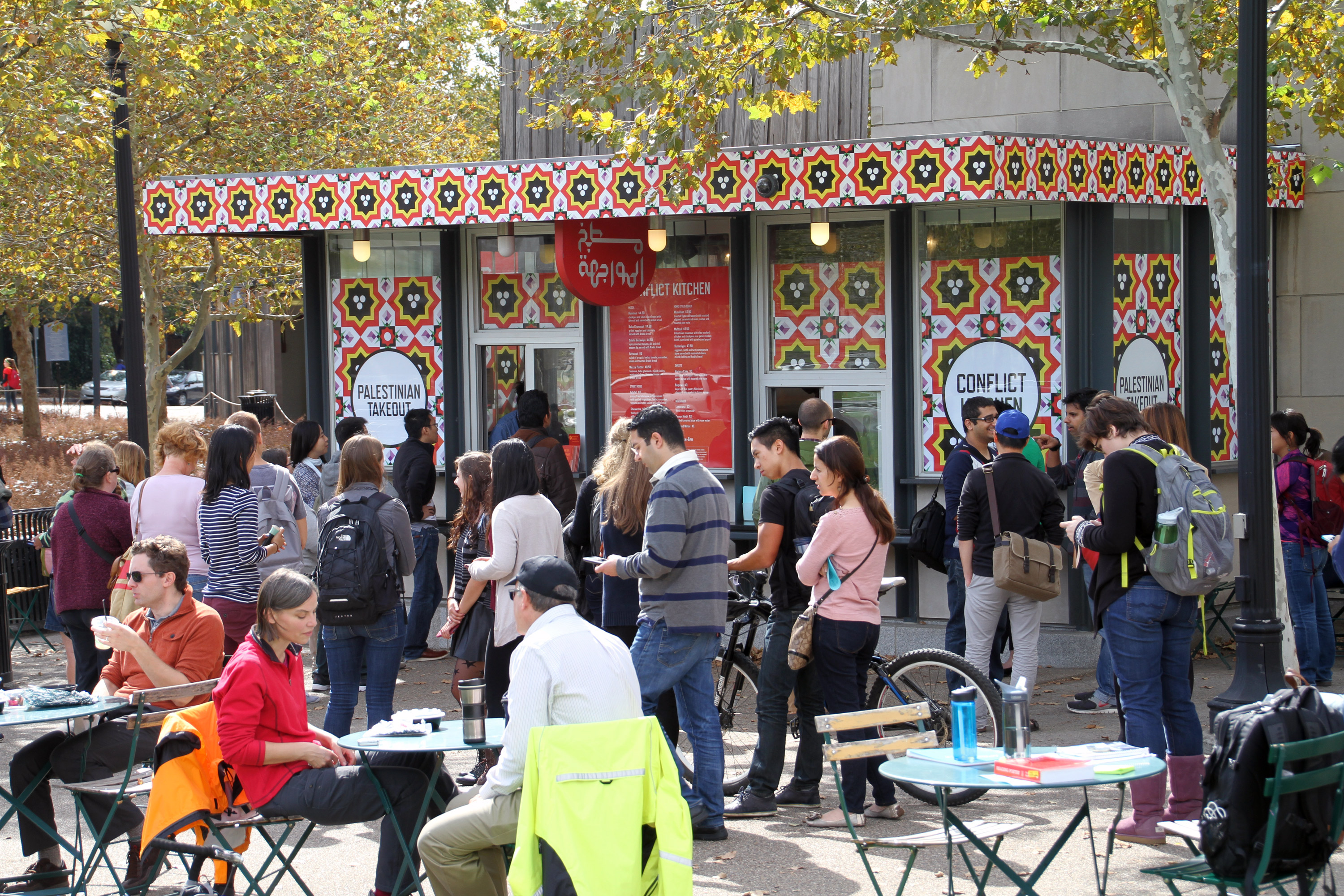
In believing that the material can argue and that food is itself symbolic and meaningful, it is easy to find examples of food's importance in everyday life. I was confronted with a particularly meaningful example when I visited Pittsburgh, PA. There is a restaurant called "Conflict Kitchen." The cuisine rotates but always features "cuisine from countries with which the United States is in conflict." The food experience is also complemented by activities, speakers, and events that draw attention to particular conflicts. Currently, the Conflict Kitchen prepares Palestinian food to bring awareness to the conflict in Palestine, the Gaza Strip, and Israel. Considering that America has only experienced 21 years of peace since it was created in the wake of the American Revolution, Conflict Kitchen will most likely have many food options for a long time.

Current Palestinian theme. Photo credit to Conflict Kitchen
Their mission statement is as follows: "Conflict Kitchen uses the social relations of food and economic exchange to engage the general public in discussions about countries, cultures, and people that they might know little about outside of the polarizing rhetoric of governmental politics and the narrow lens of media headlines." Through the medium of food, Conflict Kitchen reminds us of the cultural and personal aspects of conflict and war. It is easy to be distracted by the sweeping political statements and larger picture of global diplomacy. But it is hard to argue with the significance of cultural imports, cross-country interactions, and the new global village when eating. A simple, daily activity becomes a statement in support of cultural unity and against international conflict.

Different themes over time. Photo credit to Conflict Kitchen
Conflict Kitchen has also served food from Iran, Afghanistan, Venezuela, and North Korea. The variety of food available in this one kitchen highlights the relative lack of diversity in Pittsburgh's culinary offerings. Conflict Kitchen notes that it was the first and only of these ethnic restaurants "the city has ever seen." The lack of ethnic neighborhoods, outside of the European populations that are prominent in the city, makes the location of Conflict Kitchen particularly memorable. I am working on a paper that explores the ideas of experiential and rhetorical landscapes: the location of artifacts is commensurate with the site itself. Placing the Conflict Kitchen in Los Angeles may not have the same visceral effect as in the relatively homogeneous Pittsburgh.
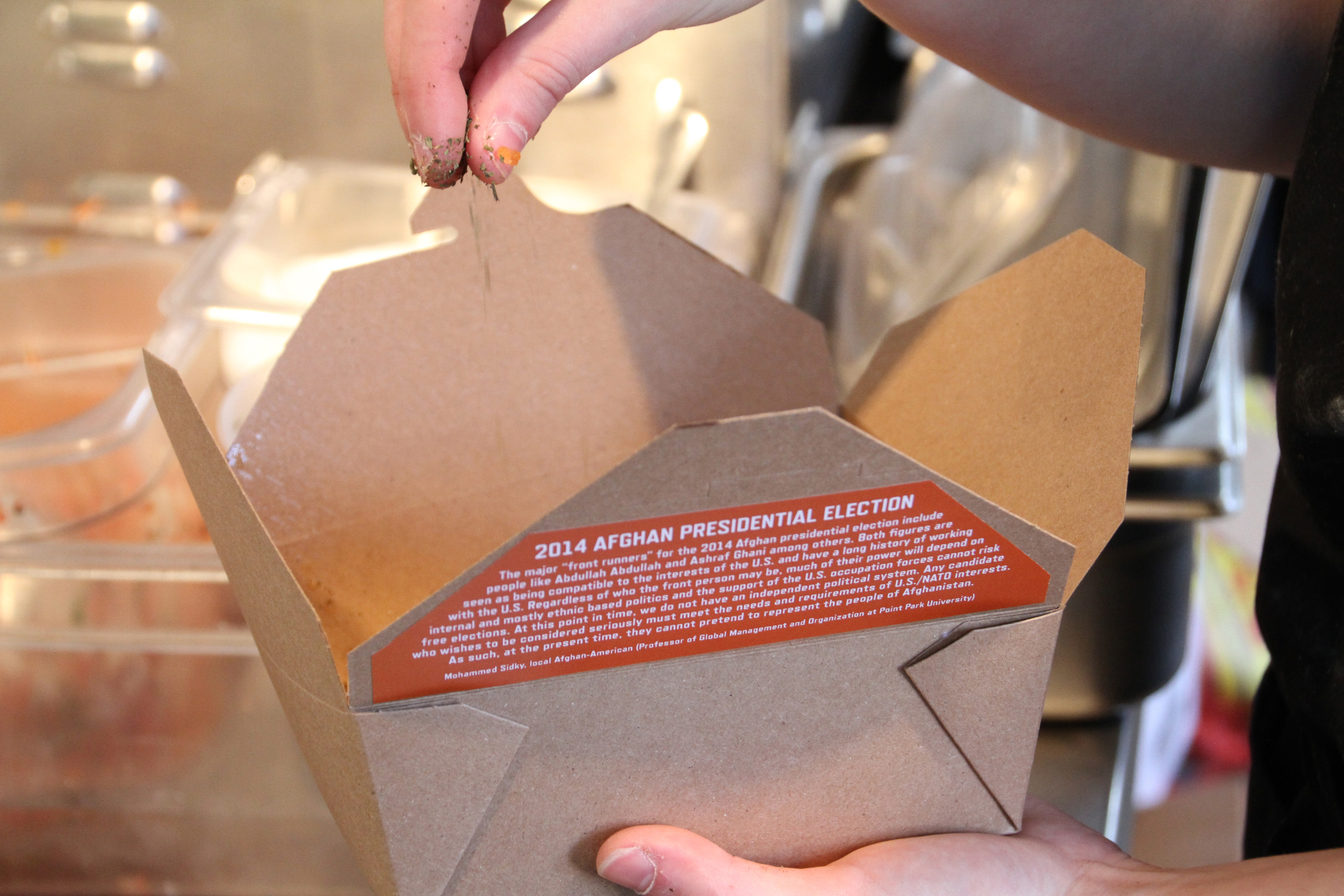
Information on take-out box. Photo credit to Conflict Kitchen

Food wrapped in information sheet. Retrieved from this site
Unwrapped sheet. Retrieved from this site


In addition to bringing food and culture to the attention of the city, Conflict Kitchen also wraps its food in large, informational sheets about the country. From government, politics, art, poetry, entertainment, and other areas, the unfolded food wrappers educate the food consumers about the country of origin. Conflict Kitchen thus offers food for thought and symbolic consumption as well as physical, material nourishment. For Conflict Kitchen, eating is a mindful act that calls us to consider the political and social implications of our daily consumption habits. There is an increasing trend in communication theory to explore how consumption, branding, and purchasing power has become a form of identity-management. What one buys, owns, and consumes is indicative of one's identity. I hope that more companies do adopt more conscious effort toward the impacts that their services and products have. Although there are concerns about the potential implications of charity-focused groups, I think overall there are steps to be made in shifting capitalist thought towards producing a more aware, global citizenry.

Sunday, April 20, 2014

The Weak and the High Maintenance: Female Stereotypes in Advertising

This was not the intended blog post for this Sunday, but a few recent advertisements have been on my mind, recently. Their repetition on the TV channels I watch and on Hulu has increasingly bothered me in their portrayal of the female. I will link to them both here and then discuss the problems that emerge in the persistent stereotyping (especially gender stereotyping) that occurs in media.

The first commercial is from Verizon, which advertises that if you buy a phone, you'll get a second free. Then, the commercial explores various options for who the second phone should be given to. Attempting humor, the commercial proposes that a girlfriend may enjoy the free phone, "but don't tell her that it's free." The face of the female fades from happy to disgruntled. This commercial plays on the "high maintenance" girlfriend trope where females are not happy or satisfied unless a lot of money has been spent. Shows such as Bridezillas, MTV True Life, arguably every Real Housewives version, emphasize this theme of women as spoiled, needing immediate and constant care, and focused on the material. These stereotypes overpower a more dimensional representation of the female outside of material goods and characterize all women as high maintenance. This description itself is inherently offensive. One's provides maintenance to a car or an object, not to a person. There is the association with a female as an accessory, a tool, an object needing maintenance, improvement, and upgrades in order to function. This also implies that the partner (oftentimes male) in the relationship is the only one with purchasing power. This clip from Bridezillas, featuring Remy and Rob, illustrates the dynamic quite well.


The Verizon commercial bother me, because it ignites these stereotypes as women as only valuing the material, lacking purchasing power, and only superficially strong in their demand of items they cannot provide for themselves. Even in the portrayal of strong women who declare they deserve certain items or treatment, there is an underlying weakness in the women who rely on others for self-validation, respect, and attention.

The second commercial focuses more on the vegetarian as weak, but the non-present character is given a female gender. This is a commercial from Walmart about setting a table for an Easter lunch. The planner describes why certain people are placed in certain spots noting that her vegetarian sister is at the opposite end of the table "so she can't see the ham." My first reaction was one of disgust that a commercial would rely on stereotyping vegetarians as too weak to even see meat. Though this is just a small statement, a lot of information is imparted in a short amount of time to the viewer. The audience is surely meant to consider the planner quite respectful. But, the implications are that vegetarians (and perhaps specifically female ones) cannot stomach the sight of food they cannot consume.

Both of these commercials highlight the importance of stereotyping in the world of advertising. When a company has only 30 seconds to compare one's attention and express the benefits of a product or service, stereotyping is a potential strategy. Originally conceptualized as the images that one sees in one's head, stereotyping is now defined as a mental shortcut that associates certain characteristics with others. There are racial, gender, ethnic, religious, political, and geographic stereotypes, all which connect a person to a host of underlying associations. Stereotyping makes sense if one's goal is to impart information as quickly and as succinctly as possible. The human brain is lazy and would rather use mental shortcuts to absorb, process, and respond to information. Popkin called this "low information rationality" where people tend to use the least amount of information possible to make their decisions. He connected this specifically to voting, where people may vote in elections based solely on a party affiliation, a rumor about a candidate, or even their aesthetic appearance over delving in deeply into issues and more complex information.

Apologies for the video quality. South Park's "Museum of Tolerance"

Though stereotyping may make sense for advertisers, other media theories, such as cultivation, encourage us to reconsider the potential consequences of long term, frequent consumption of media tropes. If females are consistently portrayed as weak, high maintenance, powerless, vulnerable, and other "feminine" characteristics, how can we expect a new generation that is more open to feminism and equality? There are certainly many factors that influence people's attitudes, opinions, and behaviors, but it may not be surprising that a media that reflects and stereotypes females in such as way may also be contributing to other gender-based issues. There are many examples I could pull from, but I will encourage people to look at this video from Fox News about women being paid "what they're worth."

Wednesday, August 8, 2012

The Politics of Food and Consumption

Consumption and food are not new contributors to political identities, but one may imagine it is so considering the multitude of coverage surrounding the Chick Fil-A "eat-ins" and political denouncements. The old adage, "you are what you eat" echoes common academic themes of consumption outlining important characteristics of someone. Eating is something that people do consistently, and even the absence of eating communicates political, social, and personal values.

As a vegetarian, I have had my entire life of experience defending my choice of following a specific dietary habit. Refusing meat, questioning waiters at restaurants, and scrutinizing ingredients lists are often activities that I have to defend or justify as outside of the norm. People are vegetarians for multiple reasons, often attributing actions to animal rights, environmental concerns, allergies, and religious restrictions. For me, my vegetarianism is a product of tradition and family, being raised a vegetarian since birth and eating and cooking in the vegetarian lifestyle is an important part of my family life. For any reason, removing certain parts of a diet begs the question of explanation (and sometimes inclusion of certain foods, such as cultural foods). These questions would not be necessary unless one's choice in consumption were meaningful or symbolic.


This relationship has risen to great importance and attention in the media with the recent discussion of Chick Fil-A's support of traditional marriage groups and anti-homosexual groups. The politics of the organization has encouraged politicians, celebrities, and the general public to associate their products with their ideologies. Similar reactions have plagued organizations that participate in child-labor, unfair business practices, or are unfair to their employees. Boycotting has been around since the creation of the United States, when people refused to purchase items that were unfairly taxed. What, then, is the issue with Chick Fil-A boycotts and the discussion at hand?

I don't necessarily think that there is anything inherently "wrong" about the Chick Fil-A argument. I would rather media attention be focused on the rights of the LGBTQ community or contextualize these discussions within the larger battle for universal rights and marriage equality. Instead, news reports are often solely focused on the actions of individuals and the organization as opposed to the cause that is driving the discussion. When the news reports become overwhelmed with free speech and balancing the scales by allowing both sides their viewpoints, the actions of Rahm Emanuel and Tom Menino are undermined and discredited.


The most important part of these demonstrations is the power of the individual. Through simple actions such as spending money, kissing, and eating, bodies act as rhetorical tools for the creation and expression of identity. Even if I did consume meat, I would have been happy to participate in the Chick Fil-A boycott, using my consumption, or lack thereof, to complement my political and personal values. Although I admit I was skeptical of the ban at first and questioned its fairness, I am now proud of my alma mater, Northeastern University, for banning Chick Fil-A's establishment in our student center. Banning Chik Fil-A represents the importance of the LGBTQ community on Northeastern's campus, which recently approved general neutral housing, preferred name and pronoun identification, and multiple student groups and training groups for inclusiveness on campus.


Instead of allowing for the power of consumption to force the Chick Fil-A to leave, Northeastern used its political power to avoid the issue altogether. The issue, then, becomes when people are willing to consume, purchase, and use their bodies as supporters of hate, bigotry, and exclusion and are defended as heroes of free speech. In that world, our world, change will be slow and riddled with obstacles. Recognizing the power of consumption and encouraging people to eat consciously may be part of the solution towards equality and empowering businesses as political entities.

Sunday, April 1, 2012

Ethical Meat and Bourdieu's Distinction

A recent news article caught my eye about "frankenmeat" or "ethical meat" which is meat created from stem cells. The positives are overwhelming: less damage to the environment, people can enjoy steak without harming animals, and vegetarians no longer have to abstain from their favorites making the switch more palatable for many people. My initial reaction to this article was one of disgust, as the consumption of flesh is forever linked in my mind to the harming of animals. Eating flesh, no matter its origins, would literally make those who have adopted a vegetarian lifestyle ill, as bodies over time lose the enzymes needed for the consumption of meat. These enzymes can be restored through slowly adopting the eating habit, but one might ask, "why bother?". The article above makes the argument that vegetarians have the obligation to eat this meat in order to drive down prices to compete with animal-producing meat, thus creating a viable alternative. My response to such audacity is to question why the onus of purchasing this "ethical meat" is on the vegetarians, those who have already made a conscious decision to improve their dietary habits for the sake of others. Are those who are consuming meat getting a free ride? They are allowed to continue their harmful consumption while vegetarians are burdened with changing the entire food market on our stomachs alone? This type of argumentation allows for regular meat-consuming people to ignore the scientific advances and play ignorant to other possibilities. Instead of dumping responsibility onto vegetarians, this article should be encouraging everyone to consume the "ethical meat" to drive down prices and save the environment. Are these not values that everyone should share?


The most offensive part of the second article is the conclusion that vegetarians simultaneously refuse to eat meat on the subject of "taste" as well as values, as if children everywhere have the obligation to eat "frankenvegetables" because they don't like the taste of regular ones. The matter of food preference should not be minimized merely to taste, but should be recognized for what it is: a commitment to a healthier lifestyle that is better for the environment and animals. To do otherwise reinforces the stereotype of the "snobby" vegetarian who is trying to convert everyone to vegetarianism. In fact, eating and food is a personal choice, often laden with cultural, social, and class distinctions. Bourdieu wrote in "Distinction" that food preferences, as well as cultural and artistic preferences, are directly linked with educational and economic status. Many cultures engage in dietary habits based off of traditions such as sacrificing red meat during lent for Catholics or refraining from non-kosher meats for Jews. This aspect of vegetarianism, as the adoption of a lifestyle in line with traditional and societal values, and the subsequent importance, is forgotten. Many vegetarians, even though they might approve of "ethical meat", such as PETA (People for the Ethical Treatment of Animals) does, do not have any obligation to consume it themselves. There is no requirement for being a vegetarian to convert others to the cause, nor to carry on those same values in other aspects of their life (such as recycling or volunteering at an animal shelter). Everyone decides their own values and adjusts their behavior accordingly, and that is exactly why this is a personal decision, not for any politician, journalist, or scientist to decide. If there are more options available for people to enjoy meat and not to harm animals, I would be hard-pressed to think of people (besides perhaps avid hunters) who would be opposed to an abandonment of violence towards animals. Thus, the onus of consumption falls to no one, it is merely a choice, another option, that most everyone could agree is preferable to harming animals and the environment. The greatest ability for change, then, is to target those who are currently consuming meat and changing their habits, creating government subsidies for this meat, or investing more in its development for cheaper methods of production, instead of force-feeding it down the throats of vegetarians already helping the cause.


In conclusion, no one, not even those who currently eat meat have any obligation to consume "ethical meat". Dietary habits are personal choices that should be decided as such, without economic, social, or political pressures. Even if it were as easy to change markets as the article suggests, there is no reason to isolate vegetarians as carrying that burden. Everyone should consider their own habits and determine whether "ethical meat" is right for them. Just as economic class influences taste preferences in food (Bourdieu, 1984), the high price of the "ethical meat" most likely prohibits most people from trying it or adopting it as a common dietary addition. In time, however, the prices may fall and become more accessible to all economic classes. This change in price, however, does not need to be assigned to a portion of the population to achieve. Instead, the focus on scientific advancement and governmental support can help create better, more appetizing, and cheaper forms for global consumption.