Showing posts with label Theater. Show all posts

Sunday, September 4, 2016

Reclaiming Shakespeare: Bomb-itty of Errors at the Nevada Conservatory Theater

After a long (and busy) summer, I am excited to be back to writing my weekly blog posts. Friday night, I attended the opening of Bomb-itty of Errors at the Nevada Conservatory Theater at UNLV. The play billed itself as the precursor to Hamilton, so I was expecting to hear intricate wordplay and have a great time. Bomb-itty of Errors definitely delivered. I disagree with a recent review of the play by the Review Journal that Shakespeare would not have recognized the source material. On the contrary, I think this adaptation is perhaps more faithful to Shakespeare's plays than faithful reenactments.

Promotional poster. Retrieved from Bomb-itty.com.
While Shakespeare is now considered to be high culture and difficult to understand, but it was once low-class entertainment for the common man. Shakespeare invented words and focused on lyricism and rhythm in his plays. Men played female roles and oftentimes multiple characters. While some people could enjoy the dramatic soliloquy of Lady Macbeth, others could be entertained by a man calling attention to his "woman's breasts." Shakespeare appealed to a variety of audiences in the original performances, not only high society that we sometimes associate with Shakespearean theater.


Bomb-itty of Errors capitalized on these associations and adjusted Shakespeare's play Comedy of Errors to contemporary hip-hop themes. Hip-hop and rap are common vernacular of today, making it a fitting substitute. The flow and rhythm of the rapped dialogues brought back the cadence of the original writing. I was amazed by the amount of information that the 4 actors memorized. They played all of the parts, so memorized at least 1/4 of the 2-hour play's discourse. They also had to remember what position to be in and what outfit they had to be wearing (and sometimes what accent to use) throughout the play. Even with this heavy burden, the actors succeed flawlessly in delivering funny, engaging, and understandable lyrics. Many of the jokes were subtly hidden within the dialogue (such as adding in lines about taming shrews), or in an actor mimicking the style of a famous rapper (I noticed DMX in particular). There were also overt comedic moves, like the overbearing, racist cop and the ditzy sister, Luciana. The variety, however, made this adaptation true to the performances of Shakespeare's days.

Play promotional image. Retrieved from UNLV's Events Calendar.

Three of the male actors played sizable female roles (and the fourth played one momentarily), adjusting their voices, outfits, and demeanor to be good actors but also sources of comedy simultaneously. One of the highlights of the play was the scene where the two Dromios argued about which of the two female characters (played by each of them) was more attractive. The self-awareness was refreshing and elicited a laugh from me even after I thought the play had come to an end. The play highlighted the humor of men playing female roles by creating close contact between the actors and outrageous costumes.

I previously commented on a play adaptation of The Picture of Dorian Gray. That play modeled itself after a rock opera, seeking to emphasize Gray's fall to sin with rock and roll. I found that adaptation fell flat, primarily because of the adjustments made to the story itself. Bomb-itty of Errors, however, seamlessly updated the story to contemporary hip-hop culture, using stereotypes to its comedic advantage. Theater allows for immense creativity and the ephemeral quality of performance. The Bomb-itty of Errors show I watched had many references to Las Vegas and the current election season. The lyrics and jokes could be updated, adapted, even ad-libbed (as many rap battles are) to fit the situation. The play and the actors' words are now lost in the wind, remnants of a contemporary oral culture where lyricism and word play still capture public attention.

Monday, June 16, 2014

Dorian's Descent: All Art is Quite Useless

Dorian's Descent is a new stage adaptation of The Picture of Dorian Gray by Oscar Wilde. Dorian's Descent is a musical that has added an element to the story: the Devil. In this article, I wish to explore the narrative elements of The Picture of Dorian Gray through Walter Fisher's narrative probability and narrative fidelity, the Faust trope, and how the character of the Devil is a narrative disaster. Although I did enjoy the show and thought the singing was quite impressive, the actual lyrics, words, and acting were sub-par, especially compared to a few other musicals and adaptations I have seen in Los Angeles. I will be discussing the play and the book in detail (i.e., spoiler alert!), so I encourage readers to read the book or acquaint themselves with the story.
Poster for Dorian's Descent
The Picture of Dorian Gray is about a young man, Dorian Gray, who becomes obsessed with a portrait that Basil Hallward has painted of him. It shows him in his youth and his prime, characteristics that he realizes, once prompted by his friend Lord Henry Wotton, will fade. In a state of hopelessness, Dorian wishes that the painting might age instead of him, for in its current stage it only serves as a reminder of what he would lose. Without explanation, the painting does begin to change as Dorian becomes involved in the hedonism of Lord Henry's lifestyle. Dorian scorns Basil, engages in illicit sexual activity, murders, and experiments with various vices. The picture ages, its face is marred by a snarl, and the brow is furrowed in perpetual anger and disdain. Eventually disgraced by the harm he has caused, Dorian attempts to absolve himself by stabbing the picture. The two reverse, leaving Dorian himself dead, aged, and hideous and the portrait returned to the beauty which Basil painted.

The picture and Dorian from the movie adaptation
Dorian's Descent infuses a rock opera theme onto the story, which pairs nicely with the descent into hedonism and sin. The element of the Devil, however, removes a very powerful and meaningful part of the play: Dorian's agency, choice, and self-mortification. In the play, the Devil appears and makes an explicit Faustian deal with Dorian so that he may stay young and the portrait may age. The character is doubly unnecessary. First, Lord Henry already serves as the Faustian Devil, the foil to Basil between which Dorian must decide. Having the Devil character undermines Lord Henry's role as the tempting, evil character that lives a sinful, yet seemingly fulfilling life. His presence mirrors the Devil, instead of captivating Dorian's attention in his own right. Furthermore, the Devil as a mystical, magical character removes the potential for Dorian's choice. The supernatural can seem to constrain the choices and available actions of humans, making Dorian's descent into hedonism part of the Devil's plan instead of a meaningful choice of evil over good, Sir Henry over Basil, self over others.

The Devil makes a deal
The beauty of The Picture of Dorian Gray is the unspoken Faust trope. Any one might utter an "I wish . . . " or make selfish requests, placing oneself squarely in the shoes of Dorian, connecting and identifying with him in finding himself in a peculiar situation. Walter Fisher described two elements of narrative rationality (or the logic of stories): narrative fidelity and narrative probability. Narrative fidelity is the perception of how faithful a story is to reality (or the audience's world). Although one might think that this would preclude fantasy, science fiction, or non-fiction from having fidelity. On the contrary, stories such as Harry Potter have high narrative fidelity because they seem real and possible, despite their fantasy elements. We could imagine, though we may not have seen or experienced it, a secret world hidden within our own (thus justifying its lack of presence). Though we may not have experienced or believed possible a changing portrait, we can faithfully imagine our lives as confronting something wholly un-explainable and what our reactions to it might be. The element of the Devil fully violates this type of realismo mรกgico (think Guillermo del Toro) where it could be possible, and makes the subtle Faust trope seem more like a cliche.

Sibyl Vane's forgotten lyrics
Perhaps most disappointing for me was the changes to the Sibyl Vane character, Dorian's brief love. Before his shift into full hedonism, Dorian fell in love with an actress. Her devotion to her art and her skill in bringing love to life in her performances captivates him. In his courtship of her, however, Dorian destroys Sibyl's ability to act. I have copied her confession after a particularly terrible performance of Romeo & Juliet below, which is one of the more beautiful passages in the book.

"Dorian, Dorian," she cried, "before I knew you, acting was the one reality of my life. It was only in the theatre that I lived. I thought that it was all true. I was Rosalind one night and Portia the other. The joy of Beatrice was my joy, and the sorrows of Cordelia were mine also. I believed in everything. The common people who acted with me seemed to me to be godlike. The painted scenes were my world. I knew nothing but shadows, and I thought them real. You came -- oh, my beautiful love! -- and you freed my soul from prison. You taught me what reality really is. To-night, for the first time in my life, I saw through the hollowness, the sham, the silliness of the empty pageant in which I had always played. To-night, for the first time, I became conscious that the Romeo was hideous, and old, and painted, that the moonlight in the orchard was false, that the scenery was vulgar, and that the words I had to speak were unreal, were not my words, were not what I wanted to say. You had brought me something higher, something of which all art is but a reflection. You had made me understand what love really is. My love! My love! Prince Charming! Prince of life! I have grown sick of shadows. You are more to me than all art can ever be. What have I to do with the puppets of a play?"

Sibyl has so greatly fallen for Dorian that she cannot pretend to love as she once did. This confession is made all the more beautiful when she takes her life after Dorian rejects her love. In the play version, Sibyl is a singer whose voices makes Dorian fall in love. Substituting singing for acting makes sense in the musical, but it is the other change that ruins it for me. Instead of falling out of love, causing Sibyl to ruin her craft, the Devil character makes Sibyl forget her lines before a show. The audience loses this beautiful insight into Sibyl's innocence and thus undermines her death as the tipping point in Dorian's sanity. This change further supports my comments below about Dorian's actions being orchestrated and not of his own choice.
Retrieved from this site
Dorian's Descent is an interesting adaptation of The Picture of Dorian Gray, but its creative changes served only to undermine the beauty, simplicity, and complicity of the book in an attempt to be unique. Without our ability to empathize with Dorian's decisions, which we believe are of his own accord, the audience can only observe and cannot be active participants in the narrative. We are not convinced that this could happen to us, that we would make such a deal with the Devil, or that we are only a few steps away from falling into sin ourselves.

Although this is not the shining review that I'm sure the fledgling play is hoping for, I hope that they take to heart the immortal words of Lord Henry: "There is only one thing in the world worse than being talked about, and that is not being talked about." Certainly this adaptation has given me and I hope any readers some food for thought about how narratives are updated, adapted, and changed in the pursuit of artistic creativity and to teach us about issues that plague society.

Sunday, February 23, 2014

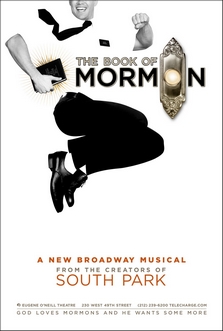
Book of Mormon: A Latter Day for the Latter Day Saints?

Book of Mormon has recently come to Los Angeles and I have now seen the musical twice. There are a few important notes that I would like to make regarding the musical. I won't have too many spoilers or descriptions of the musical, but if you haven't seen it or would like to remain in mystery, then turn back now!

Retrieved from Wikipedia

The first point I'd like to make about the musical is the various reactions it has received due to its concentrated treatment of the Mormon faith. Based on an episode of South Park where the Mormon faith is described in song, including a chorus calling it "dumb," the Book of Mormon primarily follows Elder Price on his missionary trip. Matt Stone and Trey Parker are comedians and the musical follows the comedic and often offensive style of their TV show and movies. Though the show has received much praise including Tony awards and nominations, there has been much backlash from the Mormon community that the show paints their faith as something to laugh at, and not seriously consider as a legitimate faith. I have previously written about the Mormon faith and how it complicated Mitt Romney's run for presidency. Part of its problem is its youth where "ancient upstate New York" is a biblical location and the Garden of Eden is located in Missouri. The relative "all-American" prophet is something foreign and different from the traditional Middle Eastern locations.

The backlash that it has received overestimates the exclusivity of Stone and Parker's critique. What the Book of Mormon does is present the Mormon faith as similar to other faiths, not distinct. When one considers the equally occult and supernatural forces that define other religions, laughing at the Mormon faith means that people are laughing at all faiths. In the song "I Believe" Elder Price sings about all the things that he believes in as a part of his faith. The first two lines are quite Christian in nature: "I believe that the Lord God created the universe" and "I believe that he sent his only son to die for my sins." Not until line three is a marked changed expressed where he sings, "I believe that ancient Jews built boats and sailed to America" that elicits much laughter from the audience. The chorus notes that "I am a Mormon and a Mormon just believes." In a sense, this is a critique of all religions that just believe the doctrines put forth by their faith. Is it any less funny or unbelievable for their to be a Christian version that statements "I believe that Christ turned water into wine"? Or "I believe that Mary gave a virgin birth?" Or "I believe that Christ resurrected after being crucified?"


This song touches on the key component of all religions: faith. There is little to no evidence of all of these supernatural and religious occurrences, so for Mormon doctrine is equally as legitimate and believable as all other faiths. Even if the audience does not catch onto the criticism, the Book of Mormon expertly causes everyone to consider the beliefs that they hold as true and examine why their faith holds weight, if any, over others. The Book of Mormon also expresses other similarities to faiths such as missionary trips, studying the Bible, guilt over sinning, and uncertainties about its teachings. As an atheist, it was clear to me upon watching the show that this was a critique of all religions, their systems of beliefs, and the arbitrary hierarchy and discrimination directed towards Mormonism.

Perhaps the Mormon Church understood the great potential in the play as an avenue to reach new members. In the playbill for Book of Mormon, the Church took out three full page advertisements. The first is a white male noting "I read the book." The second is a Latina female with the text, "the book is always better." The final page is a black male who notes, "you've seen the play, now read the book." All three advertisements contain three methods to learn more information: a QVC, website address, and instructions to text "BOOK" to 33733. The faces of the individuals are highlighted to reveal their diversity and the power of the individual to find more information. The play centers around the "Book" of Mormon, so the advertisements push viewers to explore the book through its original text instead of simply through the play version. For the first advertisement, having read the book is a point of pride, a way for savvy-going theater-goers can engage with the play more fully. The advertisements take advantage of a captive audience that is engaging, perhaps for the first time, with the Mormon faith and gives them the opportunity to learn more.

Retrieved from this review
Those who may be visiting the show and preparing to laugh may not be the best audience to find converts. I thought similarly after seeing street preachers in Las Vegas. But, the places where there may be the most resistance are also perhaps the areas with the most potential and opportunity. Just as Elder Price entered a missionary location in a poor town in Africa, the Mormon Church is braving hostile territory with an unlikely chance of success. But just as Elder Price and Elder Cunningham attempt to change the landscape for Mormon missionaries, the Church also attempts to affect the narrative of attendees by offering its own version. Either way, this musical has people discussing the faith and has exposed many people worldwide to its teachings and doctrines. The Church is smart to see this as an opportunity instead of a threat and everyone would be best served by appreciating the critical nature of the play not as anti-Mormon, but as inquiry of the role of faith in general.

Wednesday, February 29, 2012

Heracles: Modern Lessons from Ancient Tales

What can Ancient Greek texts tell us about our modern times? Aquila Theatre would argue they tell us just as much today as they did when they were first performed. In the case of Euripides's Heracles during the Peloponnesian War during the 400s BCE, the horrors of war and violence brought home mirror the stories of today's veterans. At the USC Vision and Voices event I attended last night, I was in absolute awe at the integration of Greek themes in modern wars, not the least of which were two of the actors who were themselves veterans of the Vietnam War. Additionally, the chorus, a staple of Greek theatre, was played by footage of interviews with veterans echoing themes of chorus lines in the original script. The acting was impressive, especially behind the main characters' masks and the interpretation of madness striking Heracles was nothing short of incredible. The real reason I would like to write this post, though, is not necessarily to praise the play, but to discuss the salient points about war and narrative that it evokes.
Heracles Performance

What was most striking about the event was the similarity in war narratives from all veterans from WWII to Vietnam to Iraq and Afghanistan, which were all ultimately similar to the Peloponnesian narrative of Heracles. The themes of loss, isolation, madness, and brotherhood span the gaps of space and time and were apparent in every veteran's war narrative. I will expand about these similarities below, but first, I would like to pose the question about what this means for our servicemen and women, that they have a unifying, common experience that the rest of society cannot hope to even imagine? How can a return to civilian life ever truly occur? Has the experience of war created permanently fractured minds and roles for the veteran?

A common theme was one of brotherhood and isolation during and after times of war. An Iraq veteran discussed the scariest moment of his service was when he saw his bunk mate disappear in a cloud of sand produced by a mortar. The fear of losing his friend, not the danger to himself was the moment he remembered, the feeling he had was of brotherhood and loyalty to the friend. Theseus was this friend to Heracles in the play, where he immediately forgave Heracles for murdering his family because of the friendship that they had. Even going so far as to help Heracles up, though he was covered in blood, to take him to Athens to start again. The bonds creating through fighting side by side, risking lives side by side as one veteran described as happening with people who were "previously strangers" not months before. These bonds become stronger than blood and isolate soldiers from friends and family who were not at war. One of the first scenes was of a woman who was lamenting her loss of relationship with her family who now did not know her. She could not be the person she was after war, because that person was foreign to them. Instead, she had to start over, completely from scratch, to build a relationship with her own family. A younger sister had aged from a child to a college student and they were to each each other, complete strangers.

The final theme that pervaded the stories was that of madness. Many interviewees mentioned comrades in war that has become obsessed with killing and the power that came with it. One veteran told a story of a soldier who had stopped another soldier from killing an old man. Instead of killing the man, he lit up a cigarette for each of them. After lighting the cigarettes and enjoying a few puffs, the soldier then proceeded to kill the man, previously showing mercy, then showing incredible hate and fury soon afterward. The madness of Heracles was similarly swift and temperamental, influenced by interference from the Gods. Although Heracles was ultimately able to find some solace in knowing that his actions were not completely his own, today's veterans can take no refuge from their actions, because no matter how influenced by the terrors of war, there are still performed by their own hands.

Within the topic of madness, it is easy to apply Burke's dramatist pentad. When one analyzes the five points of  an event (act, actor, agency, purpose, and scene), emphasizing one part over the other can lead to different conclusions about responsibility and motivation. The story of the old man can be seen as: actor - soldier, act - killing the old man, scene - war torn Iraq, purpose - killing the enemy, and agency - the military weapon and command. If one emphasizes the purpose, scene, and agency, that this was a soldier commanded by superior officers in a time of war to kill the enemies, then the act can be justified as heroic, honorable, and a call of duty. Emphasizing the act, and the actor, however changes the event from a war-time standard to a single man, a soldier, but a solitary one under no direct duress, killing an elderly man. When you minimize scene, the time of war, and instead just focus on the killing of an elderly man after a sign of compassion becomes a terrible, horrific, and unjustifiable act of murder. One thing is certain, one can never truly separate any of these five, just as one cannot separate a soldier from his duty and the scene of war. Is the soldier's act truly one of madness then? Or is it a justified response given the situation and motivation for the action?  In either interpretation, there is a theme of madness and its effects on a soldier that is prominent and of great importance to the sanity and well-being of soldier's returning home.

The play was a marvel in that it succinctly and uniquely linked the modern atrocities of war with a classic Greek text. The combination created a contextualization of war in theatrical terms and the application of theatre to the real world.