I recently saw a pre-screening of M. Night Shyamalan's "The Visit" at USC. I was excited to see the film because the trailer looked creepy and, as others have noted, this was potentially a epic comeback for the director. I am a fan of horror movies, so even without the hype, I probably would have gone to see it. I have to say that while it is better than many of Shyamalan's movies, I was very disappointed with the film. I am not going to "spoil" the cliché Shyamalan twist, but address the three main problems I had with the film. First, I will address my small concerns about the flow of the movie and its stylistic choices. I also was concerned by its attempts to corner the "comedy horror" genre through racial appropriation. Finally, I find problematic the use of disability as the catalyst for shock moments. Although there are no spoilers, I will discuss some scenes of the film in detail.
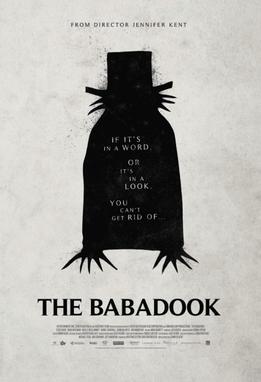
The appeal of the first-person, found footage horror films has waned for me. Original uses, such as the Blair Witch Project, were pioneers in filmmaking style. Other films made great use of the medium, such as the V/H/S series. I also found that this style worked for the gritty and entertaining As Above So Below. For most movies, however, I feel that the found footage genre reduces the thrills that it tries to engage. The camera angles and the following of the drama is completely limited by one of the characters moving it or its placement in a fixed position. Thus, the camera is either a static frame or is missing a character. Because the camera reacts with the character, frightening sequences are often cut short. In The Visit, the two children often interrupt or come across their grandma in various aggressive or startling actions. The audience, however, gets barely a glimpse before the main characters run away in fear. What could be longer, thrilling scenes turn into brief "shock" moments where the music amps up and something flashes before the screen. This type of horror tricks seems quite overplayed, where there are far more intriguing moments of horror in present day films. I hope to discuss It Follows more in an upcoming post, but I will note briefly here that it makes fabulous use of every day activities and long scenes where there is immense building of terror and suspense. Another great contemporary example is The Babadook, where the female protagonist bravely encounters the ghoul in her home in long, terrifying battle, instead of a brief flash in a window or doorway.
Now that I've indulged my pure opinions on the horror genre, I will now engage more theoretically motivated concerns. While I did find The Visit funny (Katy Perry!), the humor was mostly nested in appropriating black culture and the juxtaposition between freestyle culture and a young, white boy. The younger brother in the film, Tyler, adopts the style, mannerisms, and attitude of black culture for the purpose of comedic relief. Comedy and horror often go together. For example, the iconic Evil Dead series could seamlessly make you laugh while you were terrified and a bit uneasy. This is epitomized in the Evil Dead 2 (my favorite of the series) scene in which the items in the cabin start laughing along with Ash - frightening and yet you cannot help but laugh along. Another one of my favorite horror films, Cabin in the Woods, makes you pause for reflecting at our own fascination with horror. The office party scene epitomizes the movie's brilliant satire work (and its opening is delightfully Funny Games-esque). Instead, the comedy in The Visit is pure relief, with no purpose behind it but to distract from what we just saw (brief as it already was) or poke fun at the disabled grandparents. I will discuss more about the grandparents later, but first I want to further discuss Tyler's character.
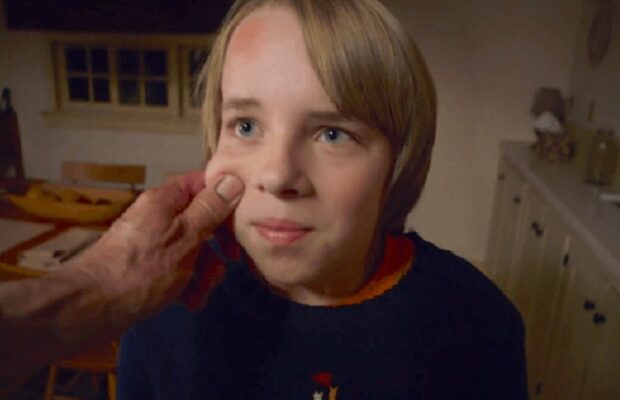
Image of Tyler in The Visit. Retrieved from this site.
The character is quite sweet and has his vulnerable moments where he seeks his sister's comfort. More often than not, Tyler draws his strength through his impersonation of black culture. As The Wrap's review noted, scenes where Tyler raps about women and sex are "burp[s] of coarse comedy." They seem out of place and forced, as if the only thing funny about the situation is that a young white boy might imitate gangster culture. This imitation, however, appropriates a different culture and undermines its history and purpose. The scene where Tyler raps on the train next to a black men, who is a worker on the train, is truly cringe-worthy. Kenneth Burke called this "perspective by incongruity" - where a word is applied in a completely new context and given a new meaning. What was once a unique part of black culture is now applied in a different context - a juxtaposition that creates humor. The humor is crude and appropriates black culture and further distracts from what could have been intriguing horror scenes.
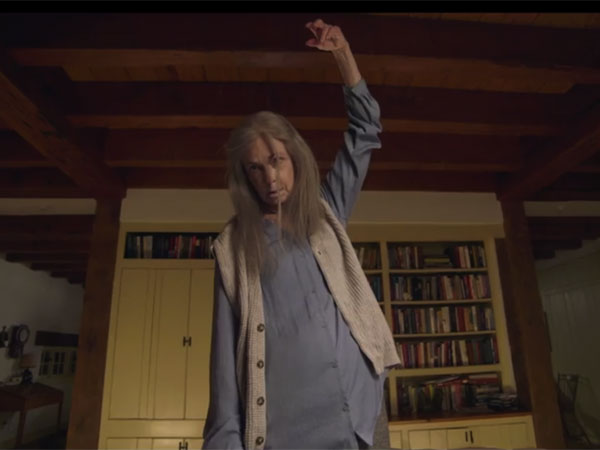
Terror - supposedly, from a scene in The Visit. Retrieved from this site.
More central to the plot of the film is the mental and physical condition of the grandparents. The mother, who they Skype with, frequently brush off erratic behavior as "old people problems" and nothing out of the ordinary. Incontinence, memory loss, confusion, and generally odd behaviors are boiled down to "normal" plights of the elderly. Natural, elderly bodies become a source of scorn and disgust because of there differing abilities. In one scene, Tyler follows his grandfather to a hut, where Tyler thinks he is hiding "secrets." To recall the horror of "what's in the box?" among this reveal is truly embarrassing. The hut does not contain dismembered bodies, secret writings, or clues to a great family mystery. Instead, it contains the grandfather's incontinent diapers. The thrilling sequence of entering the space and watching for the grandfather's return is let down by the "big reveal." At points, I felt quite bad for the grandparents, who were constantly pestered by the granddaughter, Rebecca's, video camera. In an interview with the grandmother, Rebecca repeatedly asked her what happened on the day Rebecca's mother left the house. The grandmother responded many times with sadness, confusion, and aggressive outbursts; this event had obviously caused her great stress and trauma. I felt pity where Shyamalan wanted me to be frightened. But, I wasn't. I wasn't frightened by the effects of aging and sometimes erratic confusion caused by people who may have Alzheimer's or another disorder.
The "evil" in the film is simply that: being old. There is no evil spirit, motivated killer, or other source of evil besides the mentally and physically disabled. And that is a horror trope I simply cannot support: that the elderly and differently-abled are a source of evil and horror. Shyamalan sets up the elderly as the "other"; the ones against which the main characters (and thus the audience) contrasts our identity. But, one day, we may all experience these same problems and I hope that we are met with comfort and appreciation instead of fear and isolation. For those who have seen the movie, I am aware that there is more going on than simple aging. Despite this fact, I believe that this film constructs a rhetorical framework that isolates the elderly and reifies ability as normal.
It's been two years since Kenan Thompson came under fire for blaming a lack of diversity casing in Saturday Night Live on the poor quality of black female comedians. Women often lack representation in the media, especially women of color, and the comedy genre is no exception. Similar to previous posts I've written about tokenism, it seems that the few females that are successful serve as stand-ins for the general inability for women to be funny. If Amy Schumer or Garfunkel and Oates can achieve success, why not every woman? Those who are successful are held up as proof that there is no bias or discrimination, although they still represent a minority of comedic faces. It's clear that prejudice still remains, with men still chairing key positions on popular comedy news shows and women of color remaining relatively absent even as male diversity increases. There are some notable exceptions that I hope will become more frequent. One of my favorite Daily Show segments features Samantha Bee and Jessica Williams tackling race issues. Tell me these women aren't funny.
The new season of Inside Amy Schumer has also been receiving attention as she tackles important social issues with a comedic slant. Among the very many attempted sketch shows, this one seems likely to succeed with Amy's keen insight for satire. Among her many hilarious and poignant videos, Amy has addressed beauty standards (video below), female representation in the media (long, but completely worth it, especially if you like 12 Angry Men), rape culture, and obsession with the female anatomy. Catchy and hilarious, "Girl, You Don't Need No Makeup" is a satire of boy bands and requirements for female beauty that reinforce unnecessary adornment and pruning. They note, "with a little mascara, you'll look female" linking the wearing of makeup as a female gendered activity; to not wear makeup is to violate the female identity. It is okay for males to comment on and discipline the actions women should take regarding their appearance. At the end of the video, the male singers try on some of the makeup products and their reactions reveal the ridiculousness of the products women are expected to wear.
Garfunkel and Oates (who frequent one of my favorite LA coffee spots, Bricks & Scones) are a successful comedy duo that also release sketch comedy videos. They've commented on issues such as an emphasis on pregnancy as crucial to the female identity, the gender divide in sports, and chastity (video below). This is a heads up that the video on chastity does show some mimed sex acts and references anal and vaginal sex. The song is a humorous take on the religious restrictions placed on youth to avoid their sexuality and find "loopholes" to stay pure. For me, this video does a great job at highlighting the double standards for purity, where females cannot be pleased sexually but the male can. Overall, the song brings attention to a common side-effect of abstinence-only sex education that promotes female virginity over information and personal choice. It also brings into question why certain sexual acts are treated differently than others and the treatment of sodomy in homosexual vs heterosexual relationships.
Comedy is a persuasive means of communication that often keeps attention and promotes critical thinking (especially in works of satire). The rise of female comedians opens up new areas for this critical eye of importance to women. I don't think these spaces are exclusively for females to occupy, but it is hard to speak for others. Female comedians provide a sense of legitimacy and authenticity to these issues, having lived many of these double standards and social obstacles. The writers and performers of the jokes come from a standpoint that reflects the unique position of a female in contemporary society. I hope that these shows continue to be popular and I encourage people to support them!
I've already addressed my opinions on the societal shun of horror films. I think that horror films are much more inventive and experimental than traditional genre films and I wish more of my peers appreciated their subtle depth and creativity. This post is specifically about the second installment of The Purge, which I highly encourage everyone watch. Unlike the original, The Purge: Anarchy is a slick thriller with a moral message about class, race, and oppression. I will briefly discuss the horror aesthetics in this film (and its original) before discussing this interconnected themes of hierarchy and exploitation. The cultural scholar and common person alike would greatly benefit from exploring these themes on the silver screen (even with a bit of gore). It may not need saying, but this post will contain spoilers of both films.
The Purger: Anarchy Trailer. Retrieved from YouTube.
The first film was typical of its genre. There were cliche pop-out-from-behind-a-corner fake scares, misdirection, and a dearth of larger meaning than the human urge to kill. The film centered around the near future where a government has issued a 24-hour lift of all laws allowing society to "purge" through murder, robbery, etc. This results in a lower crime rate through the rest of the year and a boon in sales of home defense systems. The first film followed a family that had a break-in in their home after the young son tried to save a man being hunted in their neighborhood. This film was simply okay, an interesting idea poorly executed and mostly abandoned for the cheap and easy scares. I almost didn't go see the second film because of my disappointment in the first. I'm very glad that I didn't miss it.
The Purge: Anarchy focuses on the streets that are ravaged by roaming bands of vigilantes and the mysterious presence of military and government forces patrolling the streets. A Malcolm X type figure (Carmelo) becomes a prominent character who preaches that the purge is a government tactic to eradicate the poor (and subsequently, minorities) in order to keep the crime rate down during the year. We find out during the film that the government is targeting low income neighborhoods, kidnapping people, and performing genocides of the lower classes. One black woman and her daughter are saved from this government kidnapping by a (white) purger looking for revenge on the man who killed his son in a car accident.
Two scenes stand out for me as particularly shocking and expressive. The father of the woman saved from government forces disappears early in the film. The daughter and granddaughter find out that he has sold himself to a rich white family for $100,000 to allow them to purge in the safety of their home. The white family has literally bought a poor, black body as if it were property, to ruthlessly destroy and exploit it without exposing themselves to the risks of the purge. There is a poignant frame where the nuclear family is standing around the father wielding weapons in their pristine suits and plastic-wrapped living room of expensive art. Their massacre of this man will be their new art, their secret expression of white privilege that protects their valuables, status, and domination over the lower class.
Auctioneer before the hunt. Retrieved from this site.
The second powerful scene is shown briefly at the end of the trailer where a woman in a blue dress announces before a seated group of people in fancy dress that they have collected the last purge of the evening. The main characters are released into a pitch black maze where the highest bidders enter with night vision goggles and weapons to hunt them down. There are obvious echoes here about the purchasing of bodies as in the previous scene, but it also echoes themes from Richard Connell's "The Most Dangerous Game." This short story is about a stranded man looking for protection who ends up being hunted down for sport like an animal in a rich man's safari game. Humans being the most cunning (and thus perhaps most satisfying to kill) animal provides an elevated type of sport than the traditional hunt. Indeed, the highest bidders in The Purge: Anarchy wear traditional British fox hunting uniforms as if they were out in a normal hunting activity and not viciously murdering other people. In a quite satisfying ending, I will simply mention that the group manages to get a hold of one of the night vision goggles and weapons, making the hunt more of a fair fight.
Both of these scenes highlight for me the interrelationship between class and race and the exploitative powers of a system that only reifies the lasting order and undervalues the lives of poor and minority bodies. In this film, both the rich and the government specifically target and kill blacks, the homeless, deviants, and youth in an attempt to eradicate and "purge" the society of perceived evils. This movie asks us all to reflect on who is in power, what oppressive acts are they committing, and who does society really serve. Both the murderers and the white families who can afford to lock up and hide are complicit in the exploitation and eradication of people deemed unworthy of life. Just as a police officer in Ferguson made a decision of life and death for Michael Brown, The Purge: Anarchy asks us to consider who is in control and what those consequences are. Who gets to define who is worthy of life? Who gets to define how punishment is laid out? Who is in control of our streets, our livelihoods, our identities as targets or as civilians?
Carmelo, leader of the anti-purge movement. Retrieved from this site.
Carmelo is trying to start a revolt against this system. He targets the rich, white, and off-limits bodies to upend the genocide of the poor and the minorities. His tactics are in part successful, at least in saving the lives of the main characters, but his ultimate goal is left unfulfilled. Will it take violent revolution to change the system? Can violence itself do anything but reify the use of violence as a peace-keeping tactic? If anything can be learned in the current state of Ferguson, it is that the tensions between authority, race, and class run deep, and define for entire groups of people their ability to claim a place on this earth free from fear and death. That is unacceptable and violates the very basics of human rights. The Purge: Anarchy brings these themes to life in an exaggerated thriller that asks us to ponder our own situation: how far off are we from this being our reality?