Showing posts with label Atheism. Show all posts

Sunday, November 16, 2014

Arguing Monuments and Material Rhetoric

The concept of "materiality" and how physical objects argue is becoming popular in rhetorical criticism. Scholars are beginning to theorize that buildings, cities, monuments, and other physical objects can argue, influence people, and tell stories -- just like words. The history of "the material turn" is quiet expansive (as I've discovered while writing my dissertation about it), but I will summarize some key points before discussing examples.

Traditional rhetorical criticism focused on the speeches of great orators and analyzed the word choices and potential effects. Scholars slowly began to incorporate other objects of study like groups of speakers, genres of speeches, and non-elite speakers. These variations still focused on the spoken and written word, however. Larger changes emerged when scholars began looking at how physical spaces constrain or offer opportunities in the way that speeches invite or construct possibilities for audiences. Moving through a space that has physical obstacles is similar to spoken commands or laws that restrict movement. Physical spaces and objects can themselves be symbols (like words) that have embedded meaning, affect, and significance. Materiality invites audience participation and makes arguments.

The first example of arguing monuments is the Portrait Monument at the US Capitol. The marble monument shows three elegant busts of prominent women in the women's suffrage movement: Elizabeth Cady Stanton, Susan B. Anthony, and Lucretia Mott. There is room for a fourth bust in a lump of un-carved stone in the rear of the monument.

Picture retrieved from Architect of the Capitol
This monument makes a clear argument that the work of women's rights is unfinished. There may have been great women in the past who deserve to be honored, but there is still the need for activism, activists, and progress. Furthermore, viewers of the monument are invited to honor the memories of these three great women by continuing on their work. Their memories do not invoke a sense of completeness or finality; their faces encourage the audience to ask, "what more can be done?" Some people have thought that the unfinished section is meant to be completed when the US elects the first female President. This, however, goes against the intention of the artist, Adelaide Johnson, to show the perpetually unsolved state of gender equality.

Another example is the Atheism bench. This monument is the first public monument to atheism, or a lack of belief in divinity. The American Atheists lost a court case to have a monument to the Ten Commandments removed from a Florida Courthouse. Instead of removing the monument, the court offered them the opportunity to build their own monument. The monument is a bench so as to be a functional piece of public display. It is covered in quotations that specifically mention religion and the American political and legal systems.

Picture retrieved from Time Magazine
The Atheism bench claims space for non-belief outside of a courtroom that, like Lady Liberty, should be blind to concerns of religion. The bench argues that religious belief should not be a factor in the courts. The bench also argues that public space should be free and open space where no ideas should dominate and none should be excluded. The bench also includes, in writing "consequences of breaking the Ten Commandments" as a direct verbal argument against the Ten Commandments monument displayed on the other end of the courthouse.

These are just two examples of how physical spaces can produce arguments. Oftentimes, memorials are coupled with verbal statements, like the Atheism bench, but it is important for scholars to note that images, monuments, and material things can produce independent, standalone arguments.

Sunday, June 8, 2014

Bryan College Controversy: Religion on (Scopes) Trial

In 1925, a small town became the center of national attention. It housed the court case John Thomas Scopes vs the State of Tennessee that addressed the teaching of the Bible in science education. In 2014, this same small town of Dayton, Tennessee is undergoing a similar controversy where science and religion meet in the realm of education.

Image retrieved from Biologos

 Bryan College, founded in memory of Williams Jennings Bryan after the Scopes Trial, has issued a new statement of faith that faculty must sign. This clarification in BC policy is receiving heated backlash from faculty and students. Due to the stricter statement, BC may lose 25% of its faculty. BC students have released a petition against the new statement and BC faculty has voted no confidence on the school’s administrators. This new statement of faith is not changing the stance of BC, which aligns with its namesake’s opinion on the immorality of evolution and the truth of biblical creationism. Instead, this change highlights the literalism of the Bible by further polarizing acceptable belief systems. This article will explore these changes in light of the ever-present dichotomy of science and religion, with the context of the Scopes trial, and the actual teachings of Bryan. In short, BC is working against two of the characteristics of Bryan’s teachings (the potential for interpretation and the importance of populism) and in essence, abandoning its namesake.

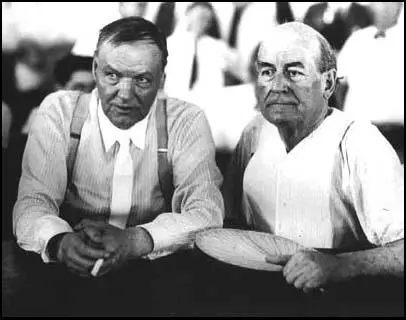
Clarence Darrow (left) sitting with William Jennings Bryan (right) before Scopes Trial. Retrieved from this site.

 Bryan was the prosecutor in the famous 1925 trial, arguing in favor of fining Scopes for teaching that humanity descended from a lower order of animals. The Butler Act, which Scopes was tried for violating, declared the immutability of the Bible and the inerrancy of the Genesis account of Adam and Eve. This was and still is an important element of fundamentalism, the values on which BC was founded. In the cross-examination day of the trial, however, Bryan compromised literalism but noting that “I believe everything in the Bible should be accepted as it is given there: some of the Bible is given illustratively. For instance: "Ye are the salt of the earth." I would not insist that man was actually salt, or that he had flesh of salt, but it is used in the sense of salt as saving God's people.” Bryan also said that the six days of creation were “not six days of twenty-four hours.” For Bryan, the statements in the Bible were accurate descriptions, but what was more important was not individual interpretations but the values that the Bible upheld.

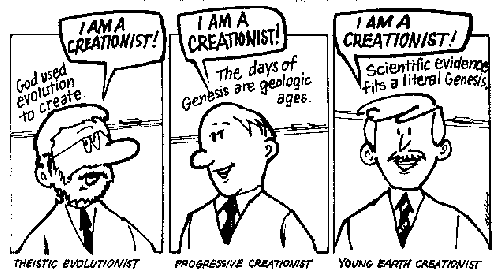
In Bryan’s summation of the trial, he proposed a strict dichotomy between religion and science, saying that one was the path to Christ and the other would crucify Him. In the 1920’s, and perhaps not until the intelligent design movement of the 1990’s, the idea that evolution and creationism could be rectified was perhaps outside of the purview of many Americans. But, many faculty members at BC do ascribe to labels such as “progressive evolutionists and theistic evolutionists and old-Earth creationists.” The previous BC statement of faith noted that “the origin of man was by fiat of God.” Interpreting fiat to be an all-encompassing act of creating the world, some professors at BC married religion and science and incorporating evolutionary theory into their personal beliefs and classroom teachings. They have taken the words of the Bible illustratively, so they are able to stay in line with the statement of faith.

Different forms of creationism. Retrieved from this site.

The new statement of faith, however, undermines these creative interpretations. Now, faculty must agree that “all humanity is descended from Adam and Eve. They are historical persons created by God in a special formative act, and not from previously existing life forms.” This statement puts many jobs at risk because it removes faculty that believe in any evolutionary history of humanity or of Adam and Eve as symbolic placeholders.

Upon a recent trip to Dayton in March, I had a conversation with a priest and an archivist at BC’s library. We were all reading through documents about Bryan, the trial, and the founding of the college. The priest was in the archive reading for clarification on Bryan’s teachings about biblical literalism. He was concerned that many of his closest friends, the best faculty at the school, and devout, loyal Christians would be unable to sign the new, stricter, and, at this point only proposed, new statement of faith. The priest was concerned that many great, Christian teachers would be lost and hard to replace. Although they may have had more creative interpretations of some biblical phrases, the priest considered their marrying of physical observation with biblical teachings as in line with Bryan’s teachings.

Logo of BC student newspaper. Retrieved from the Brian Triangle website.

BC students are also in agreement. They noted in their petition that they are saddened that BC “will alienate faculty, our brothers and sisters in Christ, by requiring them to affirm a negative on an ancillary matter of faith.” For the populous of BC, the tightening of the statement of faith only serves to divide rather than unite people of faith that have the common goal of teaching Bryan’s creationist values.

The archivist gave me a card for her husband’s creationist non-profit and seemed unconcerned with the changes. Although she said that some faculty taught evolution or believed in it, what was important was that the Genesis story was still taught at BC and the values of it were fully ingrained in all parts of its curriculum. She noted that if students had issues with particular professors and their more creative interpretations, they could easily take classes with a more fundamentalist professor. The campus was an open place where at least variations on creationism were discussed freely. The new clarification would place this openness in jeopardy. BC is surely staying within its rights to clarify its statement and to fight for literalism, especially within a threatening, secular environment. This statement is adopted, however, against the wishes of its students and faculty, making the authorities at BC domineering and elite over the wants of its people. Bryan’s values of populism, the will of the people over the elites, were once in opposition to the elitism of science that would remove all mention of Christ from classrooms. Now, BC wishes to do the same, but to strip its students of all access to evolution, despite that it awards biology and environmental science degrees.

What is at issue here is the extreme polarization of science and religion that is shrinking the opportunity for middle ground, mutual respect, and open deliberation. I do not mean to argue that creationism is a valid scientific explanation, but simply that people should not be so quick to judge people for staying true to religious ideals while incorporating scientific and material evidence in their belief systems. As more and more people take note of scientific evidence for evolution, there is more vocal push back from religious fundamentalists that distance themselves from intelligent design perspectives. Adopting new frameworks and stretching current ones is incredibly difficult. Attempts at marrying them and making sense of one’s religious convictions in light of science is something to be valued, not disdained.

BC student protest image. #hearmyvoiceBC. Retrieved from this site.
BC cannot avoid the protests and disagreement from their own students and faculty, nor from the general public about the favoring of religion over science. As the students said themselves, “the clarification promotes factionalism at the cost of honest debate and discussion.”  This decision, perhaps in response to more prominent attention to the issue, is minimizing the space for education about scientific explanation for origins. BC was created when creationism and evolution simply could not be rectified. But, now, it is clear that BC is isolating itself from its students, faculty, the potential partnership of science and religion, and illustrative biblical teachings, in contrast to the teachings of its namesake. We will never know what Bryan would say about this iteration of the human origins controversy. But, I would put money on the will of the people over the BC elites that work risk compromise and biblical values in favor of fervent literalism.

Sunday, April 13, 2014

Media Representations of Atheists as the Scrooge Trope

Sitting in on a class on media and religion, I was shocked to hear student responses to the question, "how would you describe this atheist?' The responses such as sad, angry, evil, cynical, and confused described Dr. House on the TV show House. We had just watched an episode where Dr. House is faced with a potential miracle where someone comes into the hospital hallucinating that an angel told him to go to the hospital. Finding that the illness he had did not include hallucinations as a side effect, there are implied themes of potential truth behind the patient's visions. Throughout the episode, House remarks negatively towards religion and the patient's employment as a priest. His cynicism and complete disdain for even considering religious explanations is highlighted prominently. I cannot fault the students for describing Dr. House in these ways. On the show, he is portrayed as a curmudgeon who is cynical and removed from meaningful relationships. What hadn't occurred to me until that moment is that this TV show may be communicating that these are qualities of atheists as a whole, with Dr. House serving as synecdoche.

Retrieved from FluffyAtheist's YouTube

I began to see this cynical portrayal as a pattern. I attended a play titled, "Freud's Last Session" which details a fictional therapy session between Sigmund Freud (a prominent atheist) and C. S. Lewis (the author of the Chronicles of Narnia and converted Christian). Freud is presented as a old, cynical man who has little left to live for and takes much pleasure in undermining Lewis's belief. Lewis, on the other hand, is presented as youthful, moving quickly around the stage, and speaks with hope and optimism about the world. The two are foils, dichotomies of one another, religious belief only one aspect of this dichotomy. Though they are presented in a type of balance, the implication is that when Lewis leaves, he leaves Freud to die, set in his ways, and without religious comfort in his final hours.

Scene from Freud's Last Session at the Chicago Mercury Theater

I would also like to point my readers to this film (trailer below), which presents a fictionalization of an encounter of a student with a professor who asks students to argue against God's existence. When the student challenges the professor, he makes the student debate him. What is most revealing about this trailer (in addition to the appearance of the stars of Duck Dynasty) is the exclamation from the student, "Why do you hate Him? Why do you hate God?" This exclamation reveals a disconnect between actual atheism and the perceived attributes of atheists. If someone is an atheist, they do not hate or have emotions towards God; He does not exist. It would be very hard at me to be mad at a unicorn, Big Foot, or people yet unborn. These things do not exist, so emotions cannot be directed towards them. People who believe in God or religion sometimes perceive atheists as jilted followers who have somehow been wronged and now take vengeance upon God by being atheist.

Retrieved from the Denison Forum

These three examples provide evidence of a potential theme of representing atheists as stereotypes of what we might call the Scrooge trope. Curmudgeons, only concerned with the material, dismissing happy emotions, hope, and relationships in favor of cynicism, solitude, and pessimism. Media effects literature might encourage me to conclude that these pervasive themes may be influencing the general public in their repeated and frequency consumption of media messages. Though these are fictionalizations that cannot be faulted for narrative short-cuts or simplifying characters. I believe it is harmful, however, to creating a more integrated and open space for people to "come out" as atheists. Though atheism is on the rise and secular humanism is becoming a prominent philosophical worldview, much of the perceived "Culture War" is really Christian and faith-based groups trying to isolate and legislate against non-believers. In a country where some states still hold laws against atheists holding public office and a world where they can be killed for not believing (Oh, look! It may have even happened in Texas), these media representations are performing even more harm upon the image and presence of atheists.

Sunday, February 23, 2014

Book of Mormon: A Latter Day for the Latter Day Saints?

Book of Mormon has recently come to Los Angeles and I have now seen the musical twice. There are a few important notes that I would like to make regarding the musical. I won't have too many spoilers or descriptions of the musical, but if you haven't seen it or would like to remain in mystery, then turn back now!

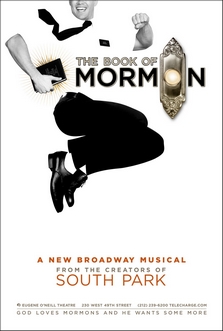
Retrieved from Wikipedia

The first point I'd like to make about the musical is the various reactions it has received due to its concentrated treatment of the Mormon faith. Based on an episode of South Park where the Mormon faith is described in song, including a chorus calling it "dumb," the Book of Mormon primarily follows Elder Price on his missionary trip. Matt Stone and Trey Parker are comedians and the musical follows the comedic and often offensive style of their TV show and movies. Though the show has received much praise including Tony awards and nominations, there has been much backlash from the Mormon community that the show paints their faith as something to laugh at, and not seriously consider as a legitimate faith. I have previously written about the Mormon faith and how it complicated Mitt Romney's run for presidency. Part of its problem is its youth where "ancient upstate New York" is a biblical location and the Garden of Eden is located in Missouri. The relative "all-American" prophet is something foreign and different from the traditional Middle Eastern locations.

The backlash that it has received overestimates the exclusivity of Stone and Parker's critique. What the Book of Mormon does is present the Mormon faith as similar to other faiths, not distinct. When one considers the equally occult and supernatural forces that define other religions, laughing at the Mormon faith means that people are laughing at all faiths. In the song "I Believe" Elder Price sings about all the things that he believes in as a part of his faith. The first two lines are quite Christian in nature: "I believe that the Lord God created the universe" and "I believe that he sent his only son to die for my sins." Not until line three is a marked changed expressed where he sings, "I believe that ancient Jews built boats and sailed to America" that elicits much laughter from the audience. The chorus notes that "I am a Mormon and a Mormon just believes." In a sense, this is a critique of all religions that just believe the doctrines put forth by their faith. Is it any less funny or unbelievable for their to be a Christian version that statements "I believe that Christ turned water into wine"? Or "I believe that Mary gave a virgin birth?" Or "I believe that Christ resurrected after being crucified?"


This song touches on the key component of all religions: faith. There is little to no evidence of all of these supernatural and religious occurrences, so for Mormon doctrine is equally as legitimate and believable as all other faiths. Even if the audience does not catch onto the criticism, the Book of Mormon expertly causes everyone to consider the beliefs that they hold as true and examine why their faith holds weight, if any, over others. The Book of Mormon also expresses other similarities to faiths such as missionary trips, studying the Bible, guilt over sinning, and uncertainties about its teachings. As an atheist, it was clear to me upon watching the show that this was a critique of all religions, their systems of beliefs, and the arbitrary hierarchy and discrimination directed towards Mormonism.

Perhaps the Mormon Church understood the great potential in the play as an avenue to reach new members. In the playbill for Book of Mormon, the Church took out three full page advertisements. The first is a white male noting "I read the book." The second is a Latina female with the text, "the book is always better." The final page is a black male who notes, "you've seen the play, now read the book." All three advertisements contain three methods to learn more information: a QVC, website address, and instructions to text "BOOK" to 33733. The faces of the individuals are highlighted to reveal their diversity and the power of the individual to find more information. The play centers around the "Book" of Mormon, so the advertisements push viewers to explore the book through its original text instead of simply through the play version. For the first advertisement, having read the book is a point of pride, a way for savvy-going theater-goers can engage with the play more fully. The advertisements take advantage of a captive audience that is engaging, perhaps for the first time, with the Mormon faith and gives them the opportunity to learn more.

Retrieved from this review
Those who may be visiting the show and preparing to laugh may not be the best audience to find converts. I thought similarly after seeing street preachers in Las Vegas. But, the places where there may be the most resistance are also perhaps the areas with the most potential and opportunity. Just as Elder Price entered a missionary location in a poor town in Africa, the Mormon Church is braving hostile territory with an unlikely chance of success. But just as Elder Price and Elder Cunningham attempt to change the landscape for Mormon missionaries, the Church also attempts to affect the narrative of attendees by offering its own version. Either way, this musical has people discussing the faith and has exposed many people worldwide to its teachings and doctrines. The Church is smart to see this as an opportunity instead of a threat and everyone would be best served by appreciating the critical nature of the play not as anti-Mormon, but as inquiry of the role of faith in general.

Sunday, August 25, 2013

Papal Authority and Ethos

Ethos is a term that Aristotle used to describe one of the modes of proof, or support for an argument. Ethos is most commonly and simply summarized as authority and credibility, or how well supported the argument is by the speaker, sources, situation, or position. In terms of ethos, the Pope has one of the most powerful appeals to ethos in the world. With over 1 billion Catholics in the world and support for his position coming directly from God, the Pope is an example of a single, infallible speaker with immense authority and control. Indeed, the Pope is considered a direct disciple of Saint Peter, meant to carry out God's will and speak for God on Earth. I expect most of this information is well-known and thus unnecessary, but I repeat it to emphasize the gravity of the next part of the post.

Following the traditional and literal approaches of Pope John Paul II and particularly Pope Benedict XVI, Jorge Mario Bergoglio began his papacy as Pope Francis I on March 13, 2013. Even only a few months into his papacy, he has already caused much stir over his non-traditional approaches to papal speech and behavior. He has forgone the papal "throne" and opted for a less adorned seat in addition to wearing only white.

Source: Pope Benedict XVI (left) and Pope Francis I (right)

He has also washed the feet of a Serbian Muslim woman and of prisoners instead of traditionally having his own feet washed after his appointment.

Source: Feet-washing by Pope Francis I

More recently, he was under media attention after carrying his own luggage on his trip to Brazil for World Youth Day.

Source: "Only Pope Francis would carry his own bags aboard the plane for Rio!"

But perhaps most important are the words that he has said about traditional Church positions that have prompted prominent members of the Church and the Vatican itself to issue correctives. I cannot emphasize the irony and importance of this statement enough: prominent Church leaders and the Vatican have corrected the appointed voice of God on Earth, the infallible and unerring. Pope Francis I said on his return from Brazil that he and others should not judge the calling of gays to the priesthood. For a Church who argues for the immorality of gay marriage, this is really only a small step for acceptance, but is revolutionary nonetheless. This statement, however, was rejected by prominent New York Cardinal Timothy Dolan in a statement confirming the Church's official position that still considers sexual relations outside of male/female marriage immoral.

Additionally, Pope Francis I made a statement regarding the morality of atheists. Even those without a belief in God, let alone a Catholic follower could still do good and "we'll find a meeting point." People have interpreted this to mean that good people, no matter their religious affiliation, could be allowed into heaven. After this statement, the Vatican issued a statement that anyone who rejects the Catholic Church "cannot be saved."

What does it mean for the ethos of the Pope to be challenged? Is the Church so tied to tradition and antiquity that it must reverse even the slightest hint of progressive, liberal, and welcoming rhetoric? What role does Pope Francis I play if his position as voice of God is subject to human correction? Can he be trusted and considered an authority by followers?

I do not believe that these small statements truly mean that Pope Francis I is a liberal or that the Church is anywhere close to changing its positions (considering the correctives). To say that finding a place for women in the Church is revolutionary is really to forget the fact that it is 2013. The implications of these statements should not be completely ignored, however. What these statements represent is a small, but meaningful step towards increased inclusion in the Catholic Church. These symbolic gestures, though rejected by others, might promote the increased openness of Catholics or at least temper Catholic backlash to liberal social issues. At least this is a positive step away from some of the past teachings that were highly restrictive and more concerned with pomp and circumstance than change.

Source

Wednesday, September 19, 2012

When Freedom isn't Really Free: Church and Politics

Ever since I gave a lecture on Foucault to the undergraduates at USC, I have begun to link my interests in politics with issues of power, gender, the body, the environment, and religion. Each of these areas has their own discourse, language, and regulations. When these discourses begin to mix and gain voices in each other's spheres, problems can emerge. Consider the mixing of religion in the educational system, where scientific and religious discourses collide in how to teach the origin of humanity. Some would argue that religion should be separate from education and has no role to play, where others would defend its inclusion and right to be there wholeheartedly. Whichever side one would fall on, the reality is that the mixing of discourses complicates ideas of knowledge, power, and truth.


This specific example explores the relationship between religion and science/politics that has been a sordid affair for centuries. From recent debates about abortion, birth control to the nomination of Paul Ryan as the vice presidential nominee, religion and political regulation has risen to prominence. Whereas political discourse relies on the participation of the people and elected politicians to craft and decide regulations, religious discourse (primarily Judeo-Christian in America) places knowledge and truth within the Bible and religious leaders. The problem when they become mixed is that people who are atheists or follow a different faith are subjugated to non-universal laws. Religious discourses are better suited to personal or community spheres for those who believe, whereas political discourses are better suited to federal and governmental policies.

I was surprised at the proposed mixing of the two advocated at a sermon I attended in Pittsburgh. The overall theme of the sermon was to redefine freedom to be less self-centered and more inclusive of community, family, and religious purposes. The preacher discussed the traditional definition of freedom as "doing what you want whenever you want" as a participant in the sin of pride. He instead argued for freedom meaning the opportunity to follow God's plan and do what we were designed to do in life. While seemingly a plea for people to help others and avoid what can sometimes become a self-centered, navel-gazing activity of "I want", I found more sinister and underlying ideologies.

In a world, in a discourse where freedom doesn't mean free to choose or free to follow one's own actions, freedom is actually replaced with restriction, regulation, and oppression. When we sacrifice individual liberties in order to follow God's design, we ignore the 16% of people in the United States with no religious affiliation, those not part of the Christian majority religion, and those who do not wish to mix their religion and politics in favor, we lose freedom. I define freedom as the elusive ability to choose, to have options, to serve oneself as one desires as long as one does not harm, silence, or oppress others. Following God's law means that people do not have the freedom to choose, especially when one thinks of women's rights over their own bodies.


An inquiry into the complications and fears surrounding the female form would be a whole blog post in and of itself to fully address the issue. Suffice to say for this post that religious discourse has traditionally treated the female body as a sexual instrument, subordinate to and property of men. Even in current times, women are being denied their right to regulate their bodies, control becoming pregnant, and accessing services such as Planned Parenthood. The message that bothered me in the previously mentioned service was that by allowing for the discourses to mix, to take the personal focus out of freedom, fosters a community and ideology where restrictions on personal choice flourish. I imagine that women listening to sermons like these when they were younger (e.g., Sarah Palin and Ann Coulter) begin to believe that their rights should be restricted and they do not deserve the choice over their own body. Whether one would choose to have an abortion or not is not the issue, it is the right to be able to choose. If someone, for religious reasons, decides to keep an accidental pregnancy, they are equally without choice if it is mandated so by law.

Sermons and ideas such as these foster a culture comfortable with religious lessons and teachings leaving the Church, personal values, and family life and becoming commonplace in political discourse. When the voices of some are oppressed on the journey to power, freedom is distorted, and ultimately lost. Politicians and the general public should fight against these inclusions and keep the discourses separate. When there is freedom, true choice involved, those who wish to follow God's laws can do so as a personal choice, not a legal mandate.

Just like in American History X, I will defer to the words of others to summarize and inspire my words on freedom. I hope that in the future, human behavior, biopower, and personal choice can be left mostly unregulated, giving people true freedom over themselves and relinquishing them from the ideology of others.

Those who deny freedom to others deserve it not for themselves.
-Abraham Lincoln

Freedom is never voluntarily given by the oppressor; it must be demanded by the oppressed
-Martin Luther King, Jr.

For to be free is not merely to cast off one's chains, but to live in a way that respects and enhances the freedom of others.
-Nelson Mandela


Sunday, March 18, 2012

Our Modern Day Scarlet Letters: Religion, Atheism, and Pride

Nathaniel Hawthorne's "The Scarlet Letter" is a classic story often referenced and rarely read about a woman, Hester Prynne, who has a child out of wedlock and is forced to wear a scarlet letter "A" around her chest. This story set in the late 19th century dates itself with Hester's sin being adultery and having sex before marriage. Even though this story is over 150 years old, the its themes of isolation, societal discipline, and labeling remain today.

Michel Foucault theorized about the institutional and discursive power of assigning meaning and labels to objects, behaviors, and bodies. Foucault's main interests were the study of the human body as it is disciplined by medicine, the legal system, and the constraints of sexuality. Those who are labeled "mentally ill" by discursive definitions are given treatment, isolated from others, and lose some rights as patients under care instead of as capable individuals. Take, for example, that the Diagnostic and Statistical Manual of Mental Disorders defined homosexuality as a mental illness up until the 1970s, labeling homosexuals as unstable mentally, of non-normative functioning, and in need of treatment. How society creates discourses has important implications for individuals and how they behave.

Although this post could take many directions from using the BMI scale to label people "morbidly" obese, to  how the abortion argument has been framed in terms of "killing babies" instead of "aborting fetuses". But, this post will focus on what I consider my scarlet letter and what Richard Dawkins has rightly created the same connection: atheism. In a world where nearly 90% of the world's population considers themselves religious and there are more people willing to identify as "non-religious" (9.42%) instead of "atheists" (2.04%), coming out as an atheist, one who will admit a belief that there is no God, is a mark of suspicion and shame. Even in a country where the founding fathers warned against the dangers of religion, an admission of any faith, or lack thereof, besides mainstream Christianity is political suicide (see my previous post for a discussion of Romney's Mormonism). Politicians like Santorum gain ground espousing conservative Christian ideals even though they negate many constitutional rights and court rulings. An emphasis on religious ideals can undermine human rights when they are imposed as the standards for all Americans.

Believing such ideas and being willing to express them openly and publicly is rare, so I feel that atheism could be considered the adultery of the modern era. The parallel of the "A"s is not lost on me, and there is the opportunity for the celebration of such a parallel instead of running from it. Dawkins, by selling pro-atheism jewelry on his website, appropriates the classic scarlet letter symbol and transforms it from a mark of shame to pride. Religious discourse may label atheists as sinners, or misguided and lost followers, reinforcing that these beliefs should be hidden and produce shame in the believer. Atheists, however, can transform this discourse, not by rejecting it and forming a new term, but by adjusting the definition of atheism from negative to positive, a badge, a letter, of a unique brand of faith.