Showing posts with label Democracy. Show all posts

Monday, March 24, 2014

Sticky Reputations by Gary Alan Fine: Book Review

When folk singer Peter Seeger died in late January of this year, people were quick to mourn the loss of an American folk legend and activist. People now fondly remember and honor his legacy, but, in the 1950s, Seeger’s reputation was far from respected. “Seeger’s institutional enshrinement is striking when contrasted with his vilification as a political subversive during the McCarthy era” (p. 92). Though Seeger’s historical associations with the party and his testimony at the House Un-American Activities Committee had not changed, public memory of them has. What accounts for these drastic changes in how society remembers individuals? What do consistency and change in reputations tells us about collective memories and societal values?

Retrieved from ABC News

In Sticky Reputations: The Politics of Collective Memory in Midcentury America, Gary Alan Fine explores these issues of individual reputations, group dynamics, collective memory, and political commemoration. Fine approaches issues of memory from a sociological and historical approach, focusing on descriptions of events and the social and dynamic responses to them. Midcentury America encompasses the years between 1935 and 1955, a time of unease and fears about home-grown terrorism. Often referred to as the “McCarthy era”, this narrow time frame still allows for detailed insight into how memory functions politically. Fine’s main contribution to the study of memory is the reliance on and explicating of reputations as imperative to understanding groups, political maneuverings, and a time period. Representatives of and experts in these categories shape collective memories of history. In some cases, memories live on and affect current policy, such as the pervasive metaphor of the Red Scare. Other memories may be forgotten, such as Seeger’s past or the Brown Scare.  How society remembers individuals is a collective process that reflects the memories of groups, institutions, history, and our roles within society. These reputations outlive the individual attached to them, creating varying levels of “stickiness” that continue to resonate and have influence over time.

Sticky Reputations begins by outlining the major themes of reputation, collective memory, and American politics. Fine argues for the lasting importance of individuals and, more importantly, the memory of them that transcends their material being. He begins by describing the quality of memories as interconnected through time. Memories are chained together and influence one another with varying consequences. How society chooses to remember, or is influenced into remembering by institutions, is often due to previous memory “work” that guides how society can and should remember the past.

The book could roughly be divided by its treatment of shifting and sticky reputations. Shifting reputations are ones that change or are modified over time, while sticky ones are immutable and immune to modification. To represent shifting reputations, Fine explores how the Jewish community was once stereotyped as members of the Communist Party. Despite their original association with communism in the 1930s, by the 1950s, “the perceptual linkage . . .  had largely vanished” (p. 23).  The Jewish community’s reputation also changed as individuals broke patterns of association and revealed discrepancies in perceptions of the group. Although the reputations of individuals shifted Jews away from a negative association, some reputations shift group identifications towards one. Fine explores how the demonization of a prominent American First Committee member, Charles Lindberg, and his actions tainted the entire organization. The explanation for Seeger’s memory transformation did not go from individual to group, but instead was a transformation of the same memory over time. In Seeger’s case, “memory agents” actively worked to adjust his reputation and “purified” his reputation (p. 92). Others, such as Elia Kazan, reveal that reputations are “historically unpredictable” (p. 108).

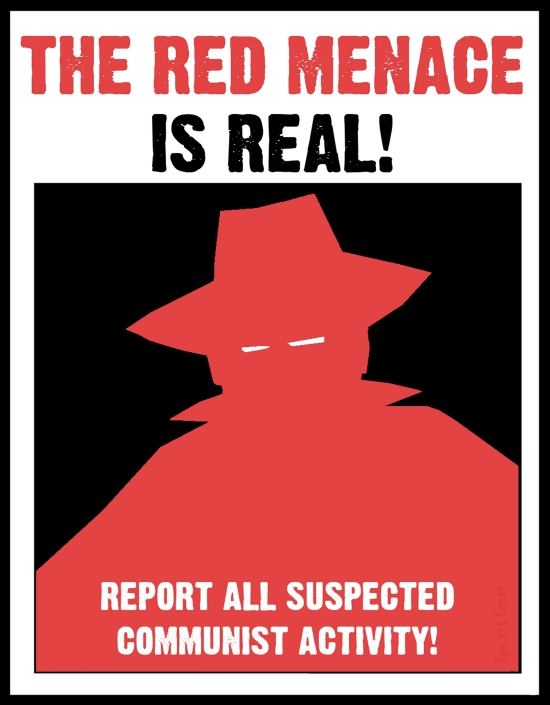
Fine also notes the dichotomy between presence and absence of memory as oversimplified. Using the Brown Scare and Red Scare, Fine explores how these events are equated through metaphor, but the Brown Scare is often lost in history. Oftentimes, the “presence of absence” still carries meaning in politics and, in this case, perceptions of home-grown terrorism. The borrowing of the term “scare” is meant to draw parallels, in part to equate the situation, severity, and needed reaction to extreme right affiliations as with extreme left ones. The fact that the Brown Scare has been lost in public memory indicates a potential misalignment in naming, or perhaps mirrors the more salient threat that people felt from communism than fascism. Though the Brown Scare was important and legitimate at the time, collective memory has forgotten it and only the Red Scare “has entered into American historical consciousness” (p. 80).
Retrieved from this blog
The final chapter returns to the book’s title and discusses Adolf Hitler as the quintessential sticky reputation. Sticky reputations resist change, argument, and transcend individual actions to encompass entire value systems. These types of reputations can be positive or negative. Fine argues that Dr. Martin Luther King, Jr. represents a positive sticky reputation, where criticisms of him are seen as attacks on his work and civil rights, in general. King is now a stand-in for the larger movement, so one is unable to criticize him without criticizing the legacy of civil rights in America. Similarly, negative reputations mean that one cannot reclaim anything positive from Hitler (such as the Nazi health care system) without risking the glorification of the Holocaust. Sticky reputations mean that the individual cannot be separated from values, groups, and the unfolding of history.

Outside of the shifting and sticky aspects of reputation, Fine also explores the nature of expertise and the role of celebrity in political activism. In analyzing the “Who Lost China?” debate, Fine provides a useful framework for qualifying reputation as a combination of qualifications, influence, and innocence. Innocence is perhaps the most complicated term, as it implies that in order for reputations to be considered “experts,” they must be free of any guilty associations with the parties involved. Instead of using the term “unbiased,” Fine connects the potential influence of institutions and politics on experts as guilty, unclean, and impure practices. Only individuals that can maintain a pure, professional relationship with mitigating factors are experts capable of testifying, such as on the economic and political factors in China. Fine also address the politicization of celebrity through a discussion of Hollywood blacklisting. He questions the validity of considering celebrities as political agents who should be held accountable for opinions to the government, the public, and their industry. Using Lilian Gish as an example, Fine traces her film career with her political activism, noting her shifts in political affiliation as leading to her being blacklisted.

Overall, the thread of reputations could be more strongly connected throughout the chapters. All of the chapters touch upon these themes, but they can be disjointed in their continuation of previous chapters and transition to subsequent ones. The common theme of a time period does not entirely succeed in linking these separate, discrete investigations of collective memory and reputations. The book might better be called Reputations without a qualifier, for the lack of a consistent theme of stickiness. The common themes more closely run between memory, how it is socialized, and how people and groups are remembered. The brevity of chapters also leave less than adequate room for the full discussion of these historical events, which is exacerbated by the occasional enumeration of  potential standards and norms for evaluating collective memories. The scholar interested in collective memory and how exemplars can change the course of history will be quite pleased with Sticky Reputations. This book will also appeal to scholars interested in the political aspects of this era of American history. Though unified by common themes of memory and reputation, this book would also serve well as chapter case studies of how memory, and particular characteristics of it, functioned politically in American history. Fine puts forth many illuminating points about the role of the individual and how their reputation has unforeseen influences on their group memberships, political affiliations, American policy, social movements, and modern memory of history. The narrow time frame does not restrict as much as allows Fine to contextualize an important part of American history and allow the audience to find similarities in today’s heightened terror levels and the unease of political threats.

Retrieved from Photoreading


Although the flowers, young girls, and young men may be gone, their reputations will live on, sticking in varying degrees to public memory of history and American identity. Seeger’s reputation changed, allowing for his songs and activism to become synonymous with American values of protest and freedom. Others cannot be appropriated no matter the amount of memory work performed. These sticky reputations reverberate through time and affect group identification, advocacy of certain policies, and collective memory of American history. America remembers itself and finds a place in society by commemorating its exemplary individuals, their actions, and how they transcended history. Fine argues that these aspects of memory combine and chain together to do more than just influence memory; they affect how society remakes itself in the present through comparison with history. How America remembers itself and how contemporary society functions are directly and irrevocably linked to identity formation in the present. Which reputations stick and which are subject to change is an opportunity for inquiry that Fine prompts all scholars of memory and history to consider. For now, only time will tell what reputations stick in the minds of the American public and which are absent from collective memory, with yet unforeseen consequences.

Wednesday, October 23, 2013

The Importance of Values in Polarization

Past research of my has focused on the difficulties in defining values and applying them to different scenarios. Despite the research complications, values remain an important aspects of politics, religion, culture, organizations, and relationships. My recent readings of the God Strategy and the Faith Factor have reinforced my respect for the "values voters" that make up the religious right and conservatively 1/3 of the US electorate. As a united front, they are an invaluable voting block for Republicans. They typically do not vote Democratic (though recently ethnic evangelicals have for Obama) and are concerned with electing Republican nominees who reflect their values of hetero-normative definitions of marriage, anti-women's choice towards pregnancy and birth control, and a general aversion to stem cell research. The marrying of religion and politics allows for values to remain integral aspects of candidate character and personality.

Cartoon from Times-Picayune

As mentioned before, this focus on values is pervasive for all of all politics, but is especially important for Republicans. As the Grand Old Party, associated with nostalgia, antiquity, and maintaining the status quo, their candidates must embody those values more than the Democratic Party. Democrats, instead, often emphasize abstract goals for future engagement, inclusivity, and are the pioneers in equality and acceptance of minority groups (e.g., the current fight for LGBTQ rights). What has changed in recent years, however, is the polarization of these values into groups that cannot compromise on basic ideas. There is less freedom to express moderate values and politicians are in near constant campaigns. For example, the environment has become a haven for political isolation where Democrats are expected to be environmentally conscious and Republicans who are can be considered traitors. The Republican values of free market and enterprise trump those of the environment, and that is avoiding the larger issue of religious identification that also complicates the issue.


The graph above is from the Pew Research Center American Values Survey that shows the gap between support for the values. The environment has increased dramatically from only a 5% difference in those that support in 1987 to a 39% difference in those that support the environment in 2012. This polarization shows more established party lines on values where compromise is precluded by trying to remain party loyal. What is the future of American politics? How can the polarization continue with politicians and the general public operating as enemies? The 2008 election brought about massive celebrations for Barack Obama's election and massive despair from people convinced that a terrible decision had been made. Similarly, Obama's reelection was met by rumors of secession and outrage by Republicans. Perhaps my favorite response was the emerge of "White People Mourning Romney" tumblr which emerged out of whites being the only race that Romney earned the majority of their votes. South Park's rendition of the hyperbolic reactions that people had in their episode "About Last Night" perfectly sums up the political polarization currently plaguing America.


I would like to be optimistic and predict a reverse in the polarization or at least a breaking point where the polarization is no longer sustainable, but it is unlikely. I do find hope in the small compromises, but they are few and far between. One solution could be a more critical, "unlovable" media that encourages compromise by expressing the dysfunction of current polarization. The Internet can also serve as a new public sphere where citizens can serve as fact-checkers and critical observers to the political process. In the future, the polarization might decrease or change, but for now, politicians seem to be more concerned with maintaining their seats than reaching across the aisle.

Monday, September 30, 2013

Discrimination and Rhetoric in the Judiciary

Recently I read Stephen Toulmin's "Tyranny of Principles," an article written in 1981, but one I found highly relevant to current times. Toulmin, perhaps most famous for his Toulmin Model of Argumentation, describes the evolution of rules and laws from traditional discretionary practices in Roman times. I found this piece fascinating because it helps contextualize a common point of controversy in modern judicial and moral arguments, and also because I find rhetoric's roots in the judicial system and its constant tension with "ethics" (the good man speaking well) worthy of discussion.


Toulmin begins the article by describing previous methods of judiciary practices, where there were no written laws or precedents in Rome for judges to base decisions. Instead, each individual case was handled as a separate, distinct scenario in which all mitigating or unique circumstances were taken into consideration. People trusted the knowledge and discretion of the pontiffs, not an overarching law. But, as Toulmin describes, multiple factors (including immigration that changed societal norms and a need for more and thus less trained judges) constructed a need for established and referable rules which today are the basis for Western judicial systems. This transition is truly a double-edged sword, for now equality and consistency have been established, but in its stead, we sacrifice equity. Simply consider Jean Valjean in Hugo's Les Misérables, who served 19 years (5 for the crime and 14 additional for trying to escape) for 

stealing bread to feed his nephew. Did he steal? Yes. Was this crime worthy of 5 years in jail? 
To Javert, a servant of God and the Law, there are no mitigating circumstances, a crime is a crime. 
And even when the tables turn and Valjean lets Javert escape, Javert is still bent on returning 
Valjean to jail. He eventually experiences a mental break where he cannot justify living in a world 
where people like Valjean violate his standards of right and wrong.


Philip Quast: Javert's Suicide

The transformation of the judicial system, our reliance on the Constitution and precedent has 
emphasized the letter over the spirit of the law, removed wiggle room, and devalued mitigating 
circumstances. One need only consider the death of Savita Halappanavar, who died from birth 
complications after the abortion she requested was denied. The religious (and in this case Catholic) 
view of abortion as wholly wrong contributed to Savita's death, whose health was not a justification 
for the abortion. Many anti-choice advocates do allow for abortion in cases of rape, incest, or the 
health of the mother, but there are prominent American politicians and even doctors that do not. 
In response to Savita's death, Irish politicians are attempting to re-legislate the rules concerning 
abortions and when the health of the mother overrides the abortion ban. As Toulmin argues, society 
must be wary of an over-reliance on these rules, and must refrain from adjusting laws with more laws, 
instead of addressing the morality and ethics of the original law.


Toulmin's article is a useful transition for me to discuss inherent discrimination and a lack of equity in 

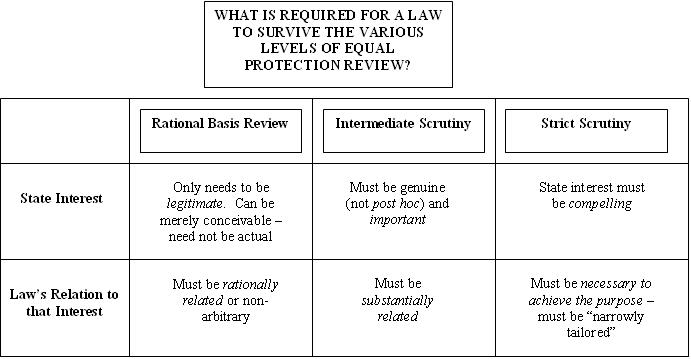
the judicial system that I learned about in a fall class. We discussed the different levels of scrutiny that 
the courts in America give to different types of discriminatory laws under the equal protection clause. 
For example, the strictest level of  scrutiny is given to laws based on race and national origin, which is 
a prominent reason why many affirmative action cases lose when brought to court, because they treat 
people of different races differently. This fact, though in part justified through previous discriminatory 
measures that make affirmative action necessary, are not mitigating circumstances. The only way for 
racial discrimination of any kind to be allowed through governmental approval is if there is a "compelling 
state interest" and the discrimination is the most efficient way to address that interest. A famous example 
of this is the Japanese Internment Camps that were ruled constitutional since they did address American 
fears over Japanese immigrants during World War II.


Image Retrieved from National Paralegal
Under strict scrutiny is intermediate scrutiny, for cases of gender discrimination. Under that is rational 
basis review, where discrimination cases based on sexual orientation or mental health are decided. 
I find it quite ironic that such levels exist at all. Why are different forms of discrimination created into 
a hierarchy of discrimination? Isn't this organization in and of itself discriminatory? It seems to me quite
hypocritical and unjust for someone to receive different punishments or court ruling simply because they 
are a different type of bigot than someone else.

I find these different strands inextricably linked. How deeply and strongly do we rely on rules of law, and 
for example, these seemingly hypocritical rules, when they lead to death and discrimination? Toulmin argued
 that we as a society should not mistake equality for equity, be satisfied with unjust laws, and tie our morality
unquestionably to the rule of law. "We need to recognize that a morality based entirely on general rules and
principles is tyrannical and dis-proportioned, and that only those who make equitable allowances for subtle 
individual differences have a proper feeling for the deeper demand of ethics" (p. 107 in Foss's 
Readings in Contemporary Rhetoric). I would hope that people would learn to be open-minded towards 
people's circumstances, take into account circumstances and mitigation, and let ourselves be human,
reasonable, and overcome our obsession with perfection, black/white dichotomies, and absolutism.

Wednesday, November 21, 2012

Negative Narratives: Obama is a Muslim

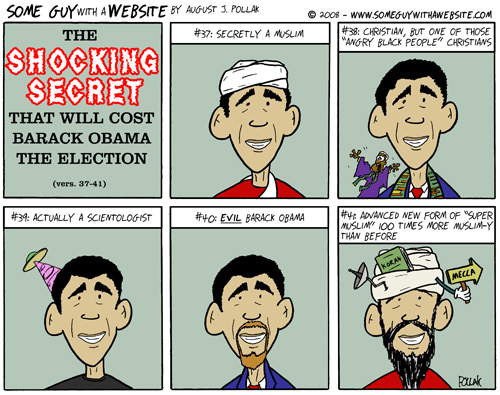
Although commonly known as false, 17% of registered voters still think that Obama is a Muslim. Carefully placed and constructed media and political narratives have created this false, yet influential narrative. I bring up this specific example because of a question posed to me at the NCA conference on the Romney and Mormonism panel. The panel was questioned why voters would consider a Muslim more “mainstream” than a Mormon. After a few stunned moments and a brief corrective response, I wondered as to the likelihood of finding a well-educated academic asking such a question to me at a panel specifically addressing the intersection of religion and politics at a competitive national conference.
The reality that such narratives can gain traction in the public sphere demonstrate who damaging unregulated political advertising and web presence can be. Though Geer argues for the benefit of negative advertising in "In Defense of Negativity", there appears to be more evidence to the contrary. Increased levels of personal attacks, deceptive and manipulated information, and subtle racial comments have become commonplace in American politics. Even though Obama can counter such narratives on his web sites and in media statements, for those who doubt Obama or are looking for confirmation of their skepticism can cling to relevant narratives and ignore contradictory information. Is Obama the most adamant and vocal Christian ever? No. Does he incorporate religion and traditional Judeo-Christian values into his politics as strongly as others? No. But does that mean that people have the right to doubt his Christianity? Furthermore, what does this say about our country when being a Muslim is a derogatory identification that precludes one from the presidency?
The truth is that negative campaigning increases cynicism, allows for the spread of misleading or outright false information, and creates a culture of division. My NCA experience represents for me the negative effects that I have studied being realized. It is one thing to read about the racial connotations of the William "Willie" Horton advertisement and it is another to encounter someone who truly believes what is nothing more than a conspiracy theory that survives only through the radical echo chambers that exist online. With low voter turnout and vicious character attacks from SuperPACs and 527s, I hope that negative campaigning will eventually reach its peak and disappear. For the sake of democracy, a healthy public sphere, and unity in the face of elections, the fostering of a negative political culture must end.

Wednesday, September 19, 2012

When Freedom isn't Really Free: Church and Politics

Ever since I gave a lecture on Foucault to the undergraduates at USC, I have begun to link my interests in politics with issues of power, gender, the body, the environment, and religion. Each of these areas has their own discourse, language, and regulations. When these discourses begin to mix and gain voices in each other's spheres, problems can emerge. Consider the mixing of religion in the educational system, where scientific and religious discourses collide in how to teach the origin of humanity. Some would argue that religion should be separate from education and has no role to play, where others would defend its inclusion and right to be there wholeheartedly. Whichever side one would fall on, the reality is that the mixing of discourses complicates ideas of knowledge, power, and truth.


This specific example explores the relationship between religion and science/politics that has been a sordid affair for centuries. From recent debates about abortion, birth control to the nomination of Paul Ryan as the vice presidential nominee, religion and political regulation has risen to prominence. Whereas political discourse relies on the participation of the people and elected politicians to craft and decide regulations, religious discourse (primarily Judeo-Christian in America) places knowledge and truth within the Bible and religious leaders. The problem when they become mixed is that people who are atheists or follow a different faith are subjugated to non-universal laws. Religious discourses are better suited to personal or community spheres for those who believe, whereas political discourses are better suited to federal and governmental policies.

I was surprised at the proposed mixing of the two advocated at a sermon I attended in Pittsburgh. The overall theme of the sermon was to redefine freedom to be less self-centered and more inclusive of community, family, and religious purposes. The preacher discussed the traditional definition of freedom as "doing what you want whenever you want" as a participant in the sin of pride. He instead argued for freedom meaning the opportunity to follow God's plan and do what we were designed to do in life. While seemingly a plea for people to help others and avoid what can sometimes become a self-centered, navel-gazing activity of "I want", I found more sinister and underlying ideologies.

In a world, in a discourse where freedom doesn't mean free to choose or free to follow one's own actions, freedom is actually replaced with restriction, regulation, and oppression. When we sacrifice individual liberties in order to follow God's design, we ignore the 16% of people in the United States with no religious affiliation, those not part of the Christian majority religion, and those who do not wish to mix their religion and politics in favor, we lose freedom. I define freedom as the elusive ability to choose, to have options, to serve oneself as one desires as long as one does not harm, silence, or oppress others. Following God's law means that people do not have the freedom to choose, especially when one thinks of women's rights over their own bodies.


An inquiry into the complications and fears surrounding the female form would be a whole blog post in and of itself to fully address the issue. Suffice to say for this post that religious discourse has traditionally treated the female body as a sexual instrument, subordinate to and property of men. Even in current times, women are being denied their right to regulate their bodies, control becoming pregnant, and accessing services such as Planned Parenthood. The message that bothered me in the previously mentioned service was that by allowing for the discourses to mix, to take the personal focus out of freedom, fosters a community and ideology where restrictions on personal choice flourish. I imagine that women listening to sermons like these when they were younger (e.g., Sarah Palin and Ann Coulter) begin to believe that their rights should be restricted and they do not deserve the choice over their own body. Whether one would choose to have an abortion or not is not the issue, it is the right to be able to choose. If someone, for religious reasons, decides to keep an accidental pregnancy, they are equally without choice if it is mandated so by law.

Sermons and ideas such as these foster a culture comfortable with religious lessons and teachings leaving the Church, personal values, and family life and becoming commonplace in political discourse. When the voices of some are oppressed on the journey to power, freedom is distorted, and ultimately lost. Politicians and the general public should fight against these inclusions and keep the discourses separate. When there is freedom, true choice involved, those who wish to follow God's laws can do so as a personal choice, not a legal mandate.

Just like in American History X, I will defer to the words of others to summarize and inspire my words on freedom. I hope that in the future, human behavior, biopower, and personal choice can be left mostly unregulated, giving people true freedom over themselves and relinquishing them from the ideology of others.

Those who deny freedom to others deserve it not for themselves.
-Abraham Lincoln

Freedom is never voluntarily given by the oppressor; it must be demanded by the oppressed
-Martin Luther King, Jr.

For to be free is not merely to cast off one's chains, but to live in a way that respects and enhances the freedom of others.
-Nelson Mandela


Wednesday, September 12, 2012

Please Vote for Me: Introducing Democracy to Children

In my media and politics class in the spring, we watched a fascinating documentary called "Please Vote for Me". It is currently available on Netflix and I encourage everyone to watch it as it has interesting implications for systems of government and global politics in addition to being a fun and enjoyable watch.

The premise of the film is that a classroom of young children (8-9 years old) in China is going to implement democratic voting for their class monitor. This position was previously appointed by the teacher, but now a student will be chosen as a representative of the class. Three children decide to run for the position, the previous class monitor (Luo Lei) and a female (Xu Xaoifei) and male challenger (Cheng Cheng).


From nearly the very beginning of the election, Cheng Cheng takes aggressive action in securing votes and manipulating his classmates. Though very young and unfamiliar with democracy and elections, he instinctively employs political tactics. For example, during various stages of the election, Cheng Cheng promises classmates positions if they vote for him, makes a promise to Luo Lei that he will get Cheng Cheng's vote (in order to get Luo Lei to vote for him), fabricates lies about Luo Lei and Xu Xaoifei and tells them to each other, plants students in Xu Xaoifei's audience to yell at her during speech, and overall using language and strategies that one would assume are beyond his 9 years of age. Making promises that cannot be fulfilled is a common tactic of American politics and one that happens near immediately in the classroom election. Catchy slogans such as "read my lips: no new taxes" sounds great and are persuasive, but practically are unlikely and strategic fabrications. Lying about candidate positions or exaggerating negative qualities has become more and more prevalent in negative advertisements and debates. From "swift-boating" to claims of Mormonism being a cult, exaggerations and lies are commonplace in political rhetoric.


I don't want to spoil the ending and who wins the election, but the tactics involved and the strategies that emerge in these three young children are truly fascinating. I believe that this movie speaks to the complications that emerge when people are given a voice, as the temptation to cheat, lie, and manipulate for each vote to power is an unmistakable part of the system. One would hope that politicians would be above the immature attitudes of children, but it is obvious from this film that people of all ages can be consumed by the thought of power in the climb to the top.

A connection that I cannot help but make is the relationship to values, a topic that highly interests me. I have previously discussed values in political speeches, and this topic is also relevant to "Please Vote for Me", because each student appeals to different values when searching for the election. In a tense debate between Cheng Cheng and Luo Lei, the question of honesty versus confidence arises. Previously, in an attempt to guilt Luo Lei into casting a vote for him, Cheng Cheng says that his vote will be for Luo Lei, because that is what is fair (despite his intention to vote for himself). In the debate, Luo Lei asks Cheng Cheng who he will vote for, prepared to either attack Cheng Cheng on his confidence or his honesty. When Cheng Cheng is called out on his lie, the classroom begins to question Cheng Cheng's previously made promises, collapsing his efforts to garner votes.

It brings to mind what values Americans place in their leaders and hope to find. Is the value of loyalty important? Then perhaps there is the explanation for Gingrich's fall, as his series of wives does not paint a loyal husband figure. Is the value of faith important? Then perhaps Romney will be facing a large difficulty convincing the American public that his Mormonism is a Christian faith. Is the value of change as important this time around? Then perhaps Obama still has a chance to be re-elected. What is interesting is the parallel between how values are influential in an American presidential election and a classroom election in China. The act of electing someone draws forth not only their policies, but also their character as an entire person, regardless of situation, location, age, or importance.