Showing posts with label Myth. Show all posts

Sunday, October 11, 2015

Rape Myths still Happen Here: Sexual Assault on College Campuses

It has been a few weeks since my last post. I've been hard at work at job applications and this post has been particularly difficult to write. This post is about a movie screening of "It Happened Here" held at USC. The movie addresses issues of sexual assault on college campuses and the effects on students there. "The Hunting Ground" is another recent movie that addresses these concerns and I recommend both of them to people interested in delving more into real life experiences and stories of those affected by sexual assault and rape. I will first summarize the reasons why I find films like these extremely important and the rhetorical techniques they used to communicate their message. Then, I will discuss the prevalence of rape myths and why I had to walk out of the Q&A at the movie screening.


IHH and THG tell the larger story of rape and sexual assault that plagues women across the country through the individual stories of a handful of women. The startling statistics that 1 in 5 women are victims of sexual assault during their time in college are presented through the voices of the few. These exemplars add detail, nuance, and a face to the victims of this particular crime. Statistics can often feel cold or unpersuasive - especially if people do not (think they) know anyone affected. There are many reasons why people may not want to share their story, so these crimes may appear anonymously in public discourse - or we only hear the amplified stories of the very few that are false. Kenneth Burke argued that the "circumference" of an event affects its communicative influence. The circumference is related to what counts as the event or environment for an action. For example, if we expand the circumference of "bullying" from only in person to also online and cyber-bullying, the term can take on a whole new meaning. In these films, they seem to be narrowing the circumference, and showing only a few campuses and a few women as stand-ins, or synecdoche, for all college-aged women. The audience is forced to engage and experience the narratives of each woman and, at least in part, sympathize with their situation.

Angie Epifano - one of the storytellers in IHH. Image retrieved from the IHH website.
The two films showed a variety of people affected by sexual assault and rape. There were women who had been drunk, those sober. Some women were at a party, some were victims in their own dorm rooms. Some didn't know their attacker, others were assaulted by friends and significant others. The variation in stories gave the impression that rape and sexual assault happen in many different ways to many different types of people. THG contained a few stories from men who had experienced rape or sexual assault. Overall, the individual narratives united to create a holistic view of sexual assault and college life. The films could have easily focused on the past and fetishized the experiences of the story-tellers. Both films, however, emphasized the present and even the future, choosing to spend most of the films engaged in the reactions of the college administrators and the steps the women were taking to combat future sexual assaults at their universities and across the nation. Descriptions of the assaults were left in the victim's own words and comprised very little of the movie's time. Instead, the films focused on the larger impact of these occurrences and how the women were working to reclaim their voice through campus events and protests (like Take Back the Night) and Title IX lawsuits. I have previously argued, among many others, that documentary films have an immense power to shift public discourse. These films are certainly persuasive and advance an argument, but they also provide real life examples packaged for public consumption. I hope that films like this will help to shift how people talk about sexual assault and rape.

Image retrieved from this website.
My optimism upon seeing this film and reflecting upon it and THG was almost immediately tempered during the Q&A. I first want to thank Director Lisa F. Jackson for attending the screening and handling two audiences members with aplomb and respect. It was far better than I would have done in that position. There was a couple in the back of the auditorium that dominated the Q&A session. As I told people of the event and even as I write it now, I am convinced no one will believe me. They presented a startling cliche of rape myths and expressed my greatest fear - that the film could not soften the hardened distrust of women and rape victims in the public. This is a warming that the following description of the Q&A may be triggering.

The gentleman in the back of the room raised his hand and was called on with the first question. He started his question with a preface about how he was the eldest brother of four sisters. Thinking back, this should have been an immediate red flag a la "I have a lot of black friends" before racists start talking. He asked Jackson why she didn't include any stories of false reporters and those who lied about their assault. He noted that this would have been more "fair" to share "both sides" of the story. Media representations of controversial events are often framed as debates, where there are two equally balanced sides. Similar to John Oliver's report on global warming, Jackson argued that there are so few false reports that giving them space in the film would not be reflective of the overarching narrative. Indeed, the number of false rape reports mirrors the false reports for other crimes. I groaned a bit at his question and I saw a few people shifting in their seats, but so far, it was bearable.

Image retrieved from this website.
A few other people asked questions, but my friend in the back wasn't done. He raised his hand and asked whether women don't "disassociate" themselves from the event while its happening and then "forget" in the morning that the activity was consensual. Perhaps, when reflecting on the event, women "make up" a story to make themselves feel better. It was "obvious" from the film that some of the women couldn't remember a lot of details, and that was an indicator that they were lying as opposed to those that would have a factually accurate and complete story. The women had "wanted" the attention initially, but then regretted the potential effect it would have on their "reputation" and thus cried rape afterwards. Everyone had turned to look at him, and I asked, "Are you serious?" The woman a few seats away from me said, "You're victim blaming." This person, sitting through the entire film, seeing women share their painful stories, hearing the statistics about the frequency of this crime, and learning about how the system fails victims, held fast to his beliefs that it was the victim who was at fault.

In response, a brave woman in the front of the room shared her story of assault and noted that there were probably more women like her in the audience as well. She wondered whether it was the larger culture that encouraged this type of behavior and rewarded men for aggressive behaviors. Our friend raised his hand once more and it was all I could do not to interrupt and claim the microphone back for the female voices in the room. As he received the microphone again, a handful of women left the room. The man echoed the concerns of the previous speaker and talked about the powerful force of masculinity over the mind. He argued that men are not at fault at all and it is really their sexual drives, natural to all men, that are at fault. This man was truly a sight to behold. Some of the most common rape myths that pervade our culture and insidiously undermine the stories of those brave enough to speak out. In retrospect, I'm surprised that he didn't ask what the women in the film were wearing when they were assaulted.

Lady Gaga's music video, "Til it Happens to You" about sexual assault

I mentioned that this person was a part of a couple because at this point, she spoke up. She asked Jackson why more women don't go to the cops right away to have their story verified. She said that the issue of lying and false reporting would be eliminated by lie detector tests. I applaud Jackson for ignoring the absurd part of this question and focused on the many reasons why women may not feel comfortable going to the police and how we might create changes in police protocols. The response I wanted to give, but could not muster the strength to, was to say that all women experience trauma differently. Expecting anyone to submit themselves to being tied up in a chair being asked probing questions about their assault shortly afterwards is completely illogical. Furthermore, lie detector tests measure nervousness and heart rate to detect lying, two things basically guaranteed to happen after an assault. There is a reason why they aren't used in criminal justice systems - they are not accurate enough. This woman echoed her partner's concerns that the victim should be analyzed and be on trial for being assaulted.

I was deeply hurt but this couple's comments and had to leave the audience when the man raised his hand again. He was overpowering all of our collective voices and challenging the basic tenets of what I felt was an excellent film. The Q&A experience highlighted for me that there is still a lot of work to be done to change the minds of many members of the public. This films are making important strides, but rape myths and dominating ideologies can be intractable parts of culture.

Monday, July 14, 2014

The Selfie: Self-Love and Object-Love

There has been an influx of attention on the phenomenon of "the selfie." I know that I am perhaps a little late to this discussion, partly because it is far outside my typical realm of interest. A small epiphany regarding them, however, has prompted me to address what I think is an overlooked but important aspect of the selfie: the Freudian divide between self-love and object-love. The selfie is the perfect integration of our love for technology and our love for ourselves. To illustrate this union, I will first describe the myths of Narcissus and Pygmalion on which Freud based the two extreme disorders of love: ego-libido and object-libido.

Retrieved from this site.
Narcissus was a Greek youth that was captivated by his beauty reflected in the river. He wasted away and finally died being unable to leave his mirror and break his own gaze. The basic version often excludes the presence of Echo, the nymph who falls for Narcissus but is unable to warn him of the danger. She can only repeat the words of others and represents the love that others felt for Narcissus that was not returned. Instead, Narcissus turned his love inward and loved only himself (and specifically, only his aesthetics and beauty). The myth of Narcissus has inspired the phrase "narcissistic personality disorder" or Freud's ego-libido, which links a physical and emotional desire for oneself over others or objects. This is also associated with megalomania, or the idea that oneself is more important or better than others. Before summarizing the tale of Pygmalion, it is easy to note how narcissistic themes can be seen in today's individualized society.

Narcissus discovering his reflection. Retrieved from this site.
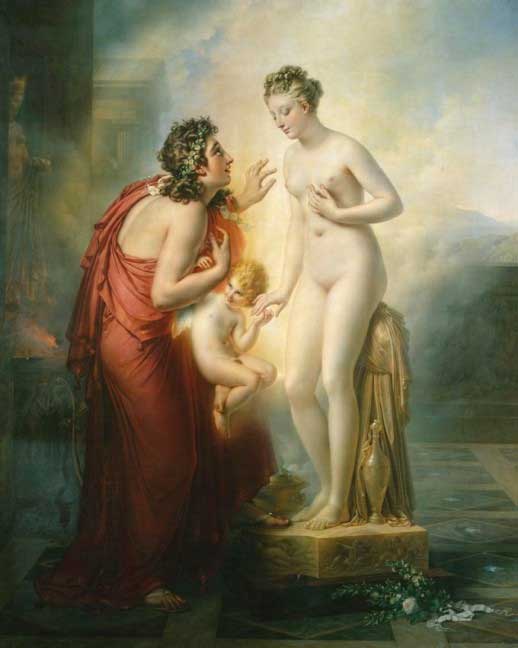
Pygmalion was a Greek artist who built a statue so beautiful that he fell in love with it. Appealing to the gods for reprieve from his unrequited love, his statue Galatea was brought to life by Aphrodite. They married and Pygmalion was able to spend his life with his creation. Many variations, plays and films, have emerged from this myth, where different variations on "brought to life" have emerged. A notable one might be the recent film, Her, where Joaquin Phoenix falls in love with the operating system in his phone. His phone, as an object, came to life with a personalized, teachable, intelligent female voice. In a brilliant dualism, Phoenix even has a sexual experience with Samantha less creepy than phone sex he previously performed with an actual person. Pygmalion is the myth of object-love, in opposition to Narcissus as the myth of self-love. Physical and emotional eros is directed as certain people and objects that epitomize how people can love.

Pygmalion discovers that Galatea is now human.  Image retrieved from this site.
Currently on display in The Lourve, Paris.
The two forms of libido and love: inward and outward come together in the selfie. This new trend in photo-taking simultaneously emphasizes the importance and singularity of the individual and glorifies the technology that allows the self to be captured and spread so easily and prolifically. This is particularly apparent in images that also show the camera in a mirror as opposed to a front facing camera shot. The phone is immortalized in partnership with the individual, a perfect union of self- and object-love. We love ourselves, so we wish to capture our image and likeness. We love our technology, so we capitalize on its capabilities to connect ourselves with the world. As in Narcissus and Pygmalion, the love is often an aesthetic, physical love for appearances, than a deeper emotional love as is lauded in Plato's Symposium.

What Would Jesus Post? Retrieved from this site.
To worship ourselves, we fall into the phone's lens which collapses Narcissus's river. Our phone becomes our partner, come to life in its utility, friendship, and closeness. People cannot be without their technology, phones at their sides or in their hands, preferring the reflective screen to the faces of people around them. Some may say that like Narcissus, we will waste away focused on ourselves, individuality, and narcissism that restricts us from progressing or experiencing the world. Some may say that like Pygmalion, we are too emotionally and physically involved in our technology that we miss the beauty of the world around us in favor of a Google search for its likeness. In my cursory experience with selfies, I take very few and have posted even fewer, I see many positives and negatives to the phenomenon.

Comic by The Oatmeal about the negatives of selfies
Undoubtedly, it has taken news media by storm. The selfie of Obama and Biden made headline news and people were discussing the Oscar selfie (which was potentially a contrived Samsung advertisement) almost as much as the award winners. I'm not sure about the wide appeal of other people's selfies (in the immortal words of Mallory Archer: why would anyone want a picture of someone else's food?), but as a personal expression of self-worth, confidence, and creativity, selfies do have an important role in the rhetoric of identification. Especially considering that some people may not always find themselves presented in media (or they are expressed negatively), online, or in safe spaces, selfies could help establish an online presence and carve out spaces for open discussion about personal identification, labels, and communities. Selfies create visibility, are unapologetic, and bluntly express one's visual appearance, identity, and existence as important and worthy of appreciation. Even if it is produced for personal consumption, it necessary sharing (often on social media sites) encourages a reflection of how it may influence a larger public. The physical presentation of the body demands attention, space, and gaze onto individual, their stories, and potential arguments. The selfie also glamorizes the power of technology, to turn what would have taken many hours of labor to produce a self-portrait can be accomplished in seconds and sent around the world instantaneously.

I hear the cries on both sides about the narcissism and objectification that is implicit in the selfie. But, I see the selfie as merely an offshoot of these larger cultural changes than a root cause or responsible for them. There are innovative potentials in how the selfie could carve out rhetorical communities, enhance identities, and change norms of personal expression. Though I can imagine Kenneth Burke terrified by the reliance on technology that he warned against, I hope that he might appreciate the rhetorical opportunities for identification, mimicry, and understanding between people that may otherwise never have met. And, the rhetorical opportunities for personal expression and control over how one defines themselves and their relation to the world.