Showing posts with label Physics. Show all posts

Sunday, September 15, 2013

Unified Theory of Everything: Physics and Communication

I've come across the dichotomy of physics and communication one too many times to not comment on it as a pattern. When scholars look to compare communication (as a humanities or social science) to a "hard" science, the topic usually turns to physics.

I do not know the reasons for this, but I can make basic assumptions about the two fields. Communication has humans, people, and their interactions as its focus, but physics concerns the interaction between forces, atoms, and particles that are not sentient or of free will. Although humans and particles are quite different in their motivations, actions, and behavior, the two fields actually overlap quite a bit. Both are concerned with interactions, relationship, causes and effects, and patterns. Both fields are also undergoing large arguments about the purpose of the field and how it can be united into one universal theory. For communication scholars, the journey to defining "communication" and linking disparate scholars (from cultural studies to rhetoric to psychology) in their ideology and methodology has been a task thus far daunting and unreachable.

The Theory of Everything is an equally inscrutable theory of physics that links all physical phenomena under one theoretical boundary. The purpose of creating these overarching theories is not lost on me, but I fear they may never be fully realized, especially in our lifetime. The main issue that links both physics and communication in their search for the theories of everything is to find the balance between application and oversimplification. For physics, the search for the universal theory of everything is admission that some theoretical concepts do not universally apply to everything. Fundamental forces are grouped into two categories, general relativity and the three: electromagnetism, weak, and strong forces. These two groups operate under opposing principles, meaning currently, physicists are still pondering the universal forces that govern all interactions. From the rotation and orbits of planets, to the relationship between atoms and particles, there is no one solution to how forces work. The current contender for the theory of everything is "string" theory, that changes the way that matter is defined in order to negotiate the hypocrisy between weak and strong forces. Unfortunately, the theory is still being developed and is not yet being used by current researchers.
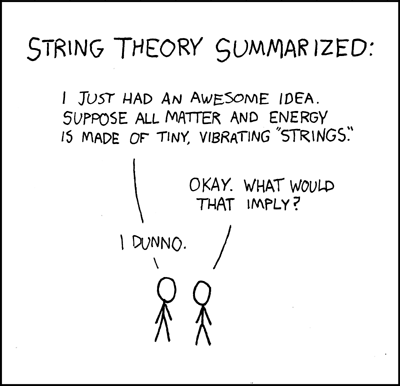
XKCD.com
In communication, there is no one theory to when, where, how, and why communication occurs. Some believe that communication is constant, some believe that only meaningful, intentional communication is important. Some believe that communication is a matter of power and oppression, where other focus on communication as persuasion, information, or networks. Introduction to Communication courses are largely a result of the professor's personal inclinations, for a class such as this could not truly begin to be an introduction to every aspect of communication, at least not as it is defined now. There are researchers currently trying to define what communication is and how all aspects of it can be linked with one unified theory with the purpose of creating unified though, research, and meaning out of the field.

I am skeptical that such unified theories will ever truly exist, at least not in ways that everyone can agree on. For what purpose is a communication theory that discounts racial, ethnic, or gender differences? How applicable can a theory be that does not acknowledge the impact of technology, networks, and relationships among people? There are so many different aspects of communication, that to create a unified theory must privilege some and reject others. Reducing the varied, exciting, and unique field of communication to one theory would undermine the ability of researchers to address specific problems, artifacts, and inquiries with the most appropriate theoretical tool. The theory of everything for physics would mainly help simplify physical formulas and streamline research and data, but little would change for most researchers. Simply because, current theories function well to predict small interactions, and general relativity functions well to predict large interactions. Combining them would change very little about these predictions, except for that they would be linked. The one exception would be for those objects that are both tiny and massive; namely, black holes complicate this separation. Black holes are massive, but occupy very little space, so theoretically, both sets of theories should apply, and yet, they cannot.
I applaud scholars whose research finds them looking to larger, theoretical problems. I believe that most researchers, though, might find their time better spent analyzing and solving smaller, more meaningful communication and physics issues.

Smbc-comics.com

Wednesday, February 20, 2013

The Best of Larry List

After not checking my mail.com account for a few months, I was shocked to find over 3000 emails from Dr. Larry Gross as a subscriber to his infamous "Larry List". These emails are all fascinating and interesting articles that Dr. Gross shares to this email list and can number in the dozens per day. Going through them all finally, I wanted to share my favorite articles. There is really no rhyme or reason to them besides that I found them interesting. Enjoy!


Atmosphere of Distortion
This article discusses the relationship between climate change and daily temperatures. Though climate change  is reflective of long term changes and patterns, skeptics often point to snow and cold weather as arguments against climate change.


DOLLY Data
This map represents aggregated Twitter data on the presence of "beer" (blue) and "church" (red) by frequency and quantity. This is an interesting use of Twitter which echoes my involvement with the Twitter sentiment project at the Annenberg Innovation Lab. Twitter is still a new arena for communication scholars, so I find these endeavors into how to operationalize the data fascinating.


Infinity
This article interests me because of the interesting connection math has between sciences and humanities. Theoretical math has inextricable ties to both physics and philosophy, which this article explores. Especially when one thinks about why we are here, where did we come from, and how do things function, areas such as physics, communication, religion, mathematics, and philosophy all find space to explore the answers.


Sky Monsters
These images are not interesting from a research perspective, but simply because they are beautiful representations of what might otherwise be a normal storm cloud.


Movies in Miniatures
This portfolio of pictures represents (as the artist describes) an intersection between Eastern art with Western film. My interests in narrative make these photographs interesting. Without captioning or explaining, viewers can instantly recognize the scene and thus, the film that the pictures are representatives and icons of the narratives themselves. Despite the difference in style and presentation, the image above is instantly recognizable as the scene from Alien where the creature emerges from the character's chest.


Singapore Airport Art
There have been many attempts at airport art, as a distraction from the banality of airport travel and inevitable delays and lost baggage. This one might be the most successful. It is reminiscent of a lava lamp, with its simple shapes and movements, but hypnotizing and enticing.

Prius Features
This video is just hilarious. The irony in adopting environmentally friendly policies is that you can never truly offset the carbon one produces from being alive. Massive deaths (a la Soylent Green) could be advocated for on behalf of the environment. Funny and philosophical, the perfect Onion piece.


*Images retrieved from websites listed