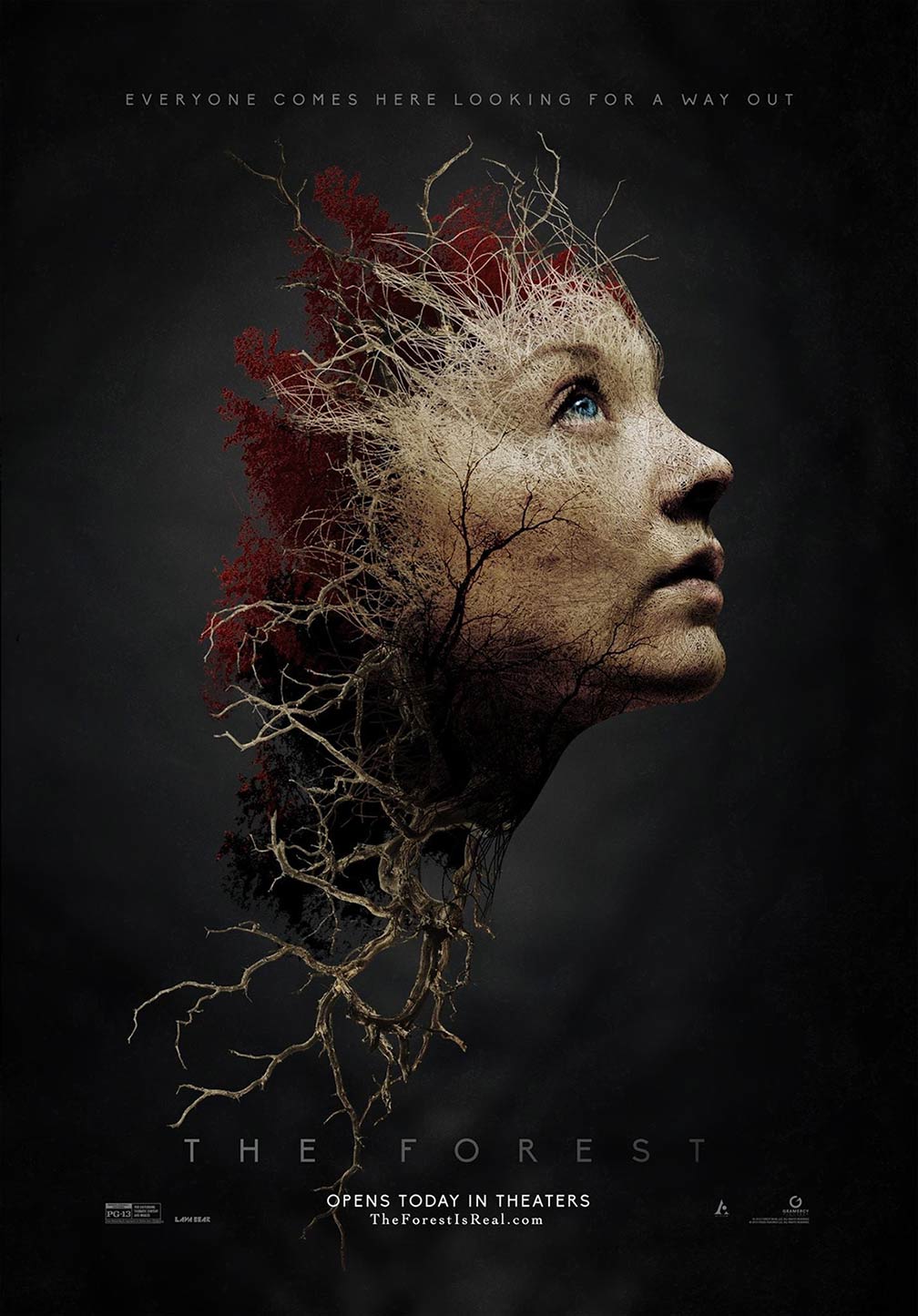
I recently saw "The Forest," a horror movie that discusses the Aokigahara Forest in Mount Fuji, Japan. The forest is known for its association with people committing suicide in the forest. The forest is said to be haunted by yurei, or the ghosts of those who have taken their lives in the forest. As with other horror films that I have analyzed (The Purge: Anarchy, Teeth, Crimson Peak, It Follows, The Visit, and Pride + Prejudice + Zombies), I will first summarize the film and then discuss some elements of the film that bear further critique. For "The Forest," I'd like to address issues of exoticism and Orientalism, responses to trauma, as well as issues of agency and explanation. This review will contain spoilers of the movie's key moments and plot developments.
The movie focuses on Sara and her twin sister, Jess. Sara travels to Japan to look for Jess once notified by police that her sister is missing in the Aokigahara Forest. Convinced that her twin bond tells her that Jess is alive, Sara disregards the warnings of pretty much everyone in the film and goes into the forest. With this incredibly long build-up and character development, Sara finally enters the forest and camps out with Aiden, a man she met hours earlier in a local bar. This is where the visions start happening and Sara is confronted with haunting images of dead bodies, ghosts, and people she isn't quite sure are alive or not. The climax of the film comes when she becomes suspicious enough of Aiden to stab him and leave herself alone in the forest. A final vision consumes her and she re-enacts finding her parents dead in her house with Jess. In this vision, Sara and Jess's father comes back to life and attacks Sara with a death-grip on her arm. Sara slices at her father's hand to free herself from his grasp. At this point, the continuity is not clear to me, so I will piece together what I think happened. Sara, in her mind, escapes her father's grasp and runs through the forest, trying to get back to the path. But, she's actually sliced her own wrists instead of her father's non-existent hands and has bled out. Her soul, or perhaps spirit, running through the forest alerts her sister, who had been camping the entire movie and seemingly unaffected by the yurei, and starts her running towards the path. Jess is eventually led back to the forest's entrance (in part by her sister's yurei?) and is reunited with Sara's fiance, who at first thinks it is Sara that has emerged from the forest. As the two look into the forest, they see Sara's yurei with glowing eyes.
Sara and Aiden in the forest. Image retrieved from this site.
Overall, I was not wowed by the film and would rate it as below average compared to other horror films, although not quite as awful as The Visit. In watching it, however, I was struck by a few details that stood out to me as unique in films I've recently watched and unique to my usual blog analysis. First, I'll address issues of Orientalism and exoticism. Edward Said argued that Western culture patronizes and infantilizes Eastern culture. Western media portrayals of Asia exoticizes Eastern culture and provides them no personal value or consideration beyond gross stereotypes. These inaccurate representations undermine the ability of the West and Western people to understand or value Eastern culture. When The Forest came out, there was backlash in the press that the film painted Japanese culture in a negative light. Many reviewers noted the distinct lack of any Japanese main characters, despite the film happening in Japan (why couldn't Aiden have been Japanese?), and the odd behaviors of many of those that were highlighted. When Sara enters her sister's classroom in Japan, one of the schoolgirls literally freaks out and cannot be consoled at the sight of seeing her teacher again. Although Jess is presumably there to teach children English, the girl is unable to communicate at all in English and instead stammers with cliche wide-eyes and a schoolgirl uniform about the supernatural and ghost stories. Every Japanese person appears to be an expert on local folklore and preoccupied with death. From the woman who keeps dead bodies in her basement and the tour guide who seems numb to cutting down hanged bodies, the movie portrays Japanese people as uncaring and obsessed with death. Many reviewers pointed out the potential for racism and mischaracterization. I must agree that the film engaged in white-washing of a Japanese health epidemic and used the Aokigahara Forest as nothing more than a foreign, exotic backdrop for foregrounding the important, tragic lives of white Americans.
Sara being dragged away by the yurei. Image retrieved from this site.
Reviews also condemned the film for ignoring an important mental health crisis and making light of a serious epidemic in Japan. One review asked, what if a similar film was made about the Golden Gate Bridge in San Francisco, another location that experiences many suicides. Borrowing from my previous points, this conceptualization of Japanese sites as specifically "haunted," exoticizes Japanese culture as being odd, occult, or unnatural. The suicide forest is not addressed as meaningful or an issue for the protagonist to tackle. The forest is merely a "creepy" location for the protagonist to search for her sister. In ignoring the mental health issues inherent in the forest, the movie does touch upon the trauma that Sara and Jess went through in their parents death. The distinction drawn between them is that Jess actually saw her parents' dead bodies while Sara did not. Sara frequently mentions that in not looking, she was not fully there for her sister and could not help her bear that burden. It is then Sara and not Jess who is repeatedly told that she is "filled with sadness," and should not enter the forest. Having seen her parents' bodies, Jess is somehow more fully able to cope with her parents' death. I do not wish to make grand conclusions about what is appropriate and not, but it does strike me as an incredibly interesting statement on trauma and coping mechanisms. There are many different ways to respond with losing loved ones, this case in a murder-suicide. The film seems to argue, or at least, imply that in not fully seeing and acknowledging her trauma, Sara has set herself up for her own suicide. Jess is much stronger against the yurei and the influences of the forest, because she has "faced" her trauma and has overcome it. The messages, however coded and unapparent, may send harmful messages to people coping with their own trauma, who may or may not be seeking actual medical and professional advice to counter or correct media images. While many reviewers advocated boycotting the film for its damaging portrayal of the forest and mental illness, others noted that "art should not be censored."
The very first analytical thought I had about the movie was about the lack of agency given to the people who enter the forest. I was struck by the fact that in showing Sara killing herself based on a "trick" of the yurei, that they were removing agency from everyone else who entered the forest. Perhaps they didn't really want to die, but were similarly tricked. Suicide is truly an awful act, and one that I have familiarity with, but minimizing the decision-making power of those who engage in it left me with a bad taste in my mouth. For the film to pawn off the responsibility from individuals to ghosts and supernatural trickery is to provide an explanation that denies the need for broad consideration of mental health and depression. To invoke Burke's pentadic ratio, the film removes agency from individuals and instead focuses on the scene, the Aokigahara Forest, as mitigating the individual's responsibility for their actions. I'm not saying that we should be blaming individuals for taking their lives, there are oftentimes many influencing factors at play. But, I am wary of a film that seems to reduce suicide to the hallucinations caused by the supernatural. I am reminded of Aaron Mahnke's podcast, Lore. In episode 11, Black Stockings, Mahnke discusses myths about fairies who would kidnap children and adults and replace them with "changelings." In his description of the podcast, Mahnke's describes the human need to create stories "to explain the unexplainable." Faced with mental illness and physical disability, it was easier for people to see others as less-than-human and others, instead of caring for fellow humans who were different. Instead of working to solve the issues that lead to suicide sites, like the Aokigahara Forest, people may excuse the actions using supernatural circumstances. This removes agency from individuals, particularly those with mental illness, and ignores larger societal problems.
As far as horror movies go, I thought this film was full of cliches and added nothing to the genre. It also brought up some interesting rhetorical implications for its depictions of Asian cultures, trauma, and mental illness. I hope that in the future that horror films might take more caution in subject matter selection and treatment of sensitive subjects. I agree with one blogger that art should not be censored, but I do think that in making films, people should be concerned with how their treatment might influence audiences and make statements about other cultures and mental illnesses.
I meant to publish this post on Sunday, but I couldn't even remotely wrap my head around the twists and turns in the Rachel Dolezal story to make a coherent blog post. With the extra time to think, this may come closer. As a white, cisgender, able-bodied, heterosexual woman - I know that I fall victim to the same privileges of Dolezal and many people commenting on this story. I hope that my voice comes across as an ally and curious academic instead of offensive.
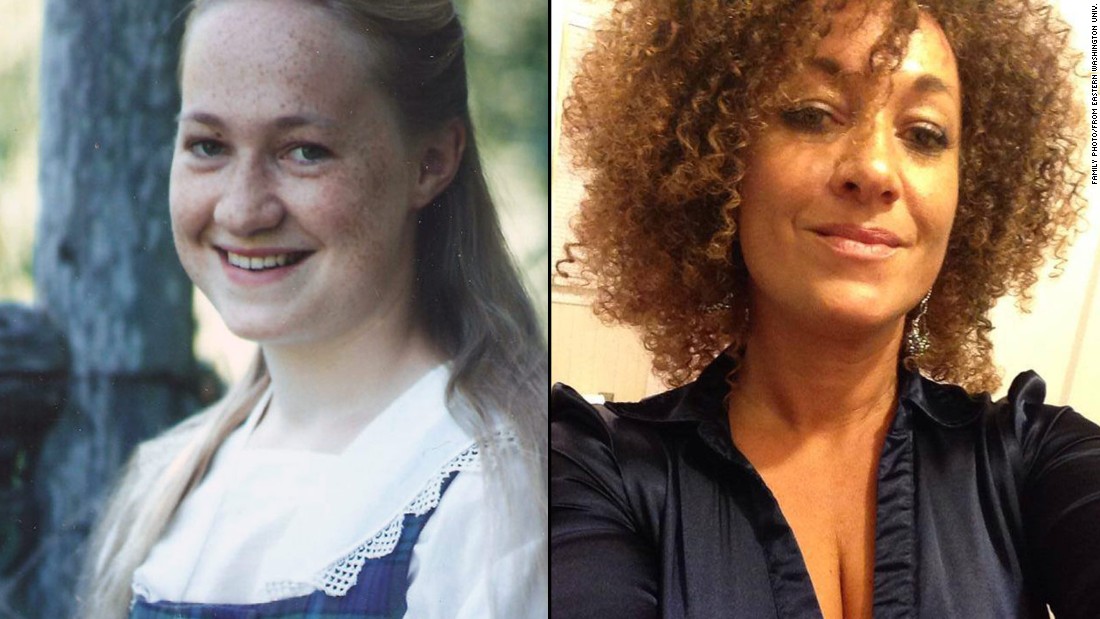
Dolezal as a white and black woman. Retrieved from CNN.
Let's start with the facts (or as close as we can get). Dolezal's parents are Caucasian and her heritage is made up of German, Swedish, and Czech ancestry. She went to Howard University and then got a job in Africana Studies at Eastern Washington University and became a chapter leader in the NAACP in Spokane, Washington. This is a relatively uninteresting history, even for a white person. There are no rules about who is allowed to teach what type of courses and many white people have been prominent actors in the NAACP. White women have taught courses about black women and men have taught feminist theory classes. Academic knowledge about these subjects is not exclusive. Of course, there are benefits to having professors who can address these perspectives from a particular standpoint, but having allies address these topics is also beneficial.
What, then, is the issue? The issue is that Dolezal, despite being a white woman, a blonde-haired, blue-eyed white woman at that, identifies and presented herself as a black woman. Dolezal's birth race did not jibe with the identity that she wished to portray, so she performed the identity of an African American. Many people believe that race, gender, and sexuality are social constructs - they are performed behaviors and identities that communicate to others who and what we are. Dolezal decided to perform and go through life (at least for those ten years) as an African American.
Prince Koyangi's first Tumblr post with profile picture. Retrieved from this site.
For those who were as confused as I was by this discovery of a potentially "transracial" person, I am going to walk through my thought process on the matter. I am aware this term traditionally refers to transracial adoption, where birth parents are of a different race than their children. The term was first brought to my attention, however, through the excellent work of friend and colleague, Alex Sastre. She discussed the transracial/transethnic Tumblr case of Prince Koyangi. For me, this term linguistically matches a similar, but different phenomenon in transgender people. I do not wish to make this comparison, at least in a fully equal sense, but I do want to explain the difficulties for people, and perhaps especially cisgender white people, to unpack the trans* identity.
One thing that I initially noted was a similarity in language between how news sites and people on Facebook were responding to Dolezal's actions. For me, terms like "impostor," "deceived," "pretended," "misleading," "lied," and others echoed claims that transgender people are somehow lying or deceiving people with impure motivations. One need only recall the disgusting words of Mike Huckabee in response to Caitlyn Jenner's announcement: "Now I wish that someone told me that when I was in high school that I could have felt like a woman when it came time to take showers in PE." These accusations assume that people are deceitful in their gender identity for the purpose of advantage in some way. People began to talk about Dolezal in this same manner - that posing as black would somehow benefit her in her job prospects and appointment in the NAACP. A poignant note here is, as others have pointed out, that Dolezal potentially took that appointment away from a woman of color. There are other reports that Dolezal faked hate crimes against her to garner sympathy. Certainly, these are negative, consequential, and deceitful actions. But does that mean that transracial people do not exist?
A friend and colleague, Kari Storla, emailed me the above video by a black, trans*female vlogger, Kat Blaque. I appreciated the link and spent a lot of time thinking about Blaque's arguments. For me, I couldn't get past the apparent hypocrisy - Blaque was telling her truth, but was denying the possibility that Dolezal was telling hers. Isn't it really a matter of personal identity that is not something that any of us can determine? How is it Blaque's or any of our responsibilities to tell Dolezal that she is in fact lying and we are the ones with truth? When Dolezal says, that she "identifies" as a black woman, why do we not take her at her word? Many trans*people discover their identities later in life and some may never transition in an aesthetically explicit way for many reasons such as safety, finances, or personal choice. Dolezal certainly identified as white when she sued Howard for racial discrimination, but perhaps she discovered her identity later in life? Any way I sliced it, I couldn't see a tangible difference between transgender and transracial individuals, despite a gut instinct that they were different. There are many times when my personal opinion towards something (that Dolezal is crazy and this can't possibly be a thing) is offset by my intellectual musings. There must be a reason to my nagging doubts, right? A small epiphany occurred during a conversation with my partner. We discussed the idea of privilege and how men transition into women and Dolezal transitioned into a black woman. We discussed ideas of passing and that some people can transition into the other gender more easily than others, can "pass" as something they are not. We discussed how I am a Caucasian woman and would never be mistaken for something else, despite having African ancestry. We discussed how people like Barack Obama, Tiger Woods, and even Stuart Hall, will never be anything but black men.
Cartoon explanation of white privilege. Retrieved from this site.
That's when it clicked - transgender people reflect a spectrum of identities. Trans*people identity as male-to-female, female-to-male, gender fluid, agender, and many other evolving labels. But, the idea of transracial-ness is distinctively a privilege of whites. Whites can "put on" and appropriate the culture of other races, and have for centuries. They are able to do this, as Richard Dyer notes, because they are the center, the normal, the non-race. If a black woman adopts a white hairstyle and bleaches her skin, she will never be anything but a black woman. But, if a white woman adopts a black hairstyle and a tan, she can be (and was) perceived as black. This lack of equality, of cross-racial mobility, solidified my opinion. Dolezal is not transracial, she is not a black woman, but a white woman who has appropriated black culture for personal reasons. There is no trans*ness about being transracial, because the privilege is reserved for those able to adopt the races of others - whites. I am still musing about this topic, but thinking through Dolezal's story has enlightened me about the different ways that white privilege functions in today's society. This post certainly ignores other complicated aspects of this story such as historical racism, biological determinants of race, and blackface. Those are all important points as well that I do not mean to undermine. They did not, however, play a role in clarifying for me why the Dolezal story is so disturbing and yet simultaneously worthy of philosophical discussion. This story will probably engage more people as more facts are learned and I hope that it culminates in more important conversations about race and its tangible effects on life and society. It also brings attention to the unending struggle between the mind and body and the danger of not conforming with society's expectations.