It's been two years since Kenan Thompson came under fire for blaming a lack of diversity casing in Saturday Night Live on the poor quality of black female comedians. Women often lack representation in the media, especially women of color, and the comedy genre is no exception. Similar to previous posts I've written about tokenism, it seems that the few females that are successful serve as stand-ins for the general inability for women to be funny. If Amy Schumer or Garfunkel and Oates can achieve success, why not every woman? Those who are successful are held up as proof that there is no bias or discrimination, although they still represent a minority of comedic faces. It's clear that prejudice still remains, with men still chairing key positions on popular comedy news shows and women of color remaining relatively absent even as male diversity increases. There are some notable exceptions that I hope will become more frequent. One of my favorite Daily Show segments features Samantha Bee and Jessica Williams tackling race issues. Tell me these women aren't funny.
The new season of Inside Amy Schumer has also been receiving attention as she tackles important social issues with a comedic slant. Among the very many attempted sketch shows, this one seems likely to succeed with Amy's keen insight for satire. Among her many hilarious and poignant videos, Amy has addressed beauty standards (video below), female representation in the media (long, but completely worth it, especially if you like 12 Angry Men), rape culture, and obsession with the female anatomy. Catchy and hilarious, "Girl, You Don't Need No Makeup" is a satire of boy bands and requirements for female beauty that reinforce unnecessary adornment and pruning. They note, "with a little mascara, you'll look female" linking the wearing of makeup as a female gendered activity; to not wear makeup is to violate the female identity. It is okay for males to comment on and discipline the actions women should take regarding their appearance. At the end of the video, the male singers try on some of the makeup products and their reactions reveal the ridiculousness of the products women are expected to wear.
Garfunkel and Oates (who frequent one of my favorite LA coffee spots, Bricks & Scones) are a successful comedy duo that also release sketch comedy videos. They've commented on issues such as an emphasis on pregnancy as crucial to the female identity, the gender divide in sports, and chastity (video below). This is a heads up that the video on chastity does show some mimed sex acts and references anal and vaginal sex. The song is a humorous take on the religious restrictions placed on youth to avoid their sexuality and find "loopholes" to stay pure. For me, this video does a great job at highlighting the double standards for purity, where females cannot be pleased sexually but the male can. Overall, the song brings attention to a common side-effect of abstinence-only sex education that promotes female virginity over information and personal choice. It also brings into question why certain sexual acts are treated differently than others and the treatment of sodomy in homosexual vs heterosexual relationships.
Comedy is a persuasive means of communication that often keeps attention and promotes critical thinking (especially in works of satire). The rise of female comedians opens up new areas for this critical eye of importance to women. I don't think these spaces are exclusively for females to occupy, but it is hard to speak for others. Female comedians provide a sense of legitimacy and authenticity to these issues, having lived many of these double standards and social obstacles. The writers and performers of the jokes come from a standpoint that reflects the unique position of a female in contemporary society. I hope that these shows continue to be popular and I encourage people to support them!
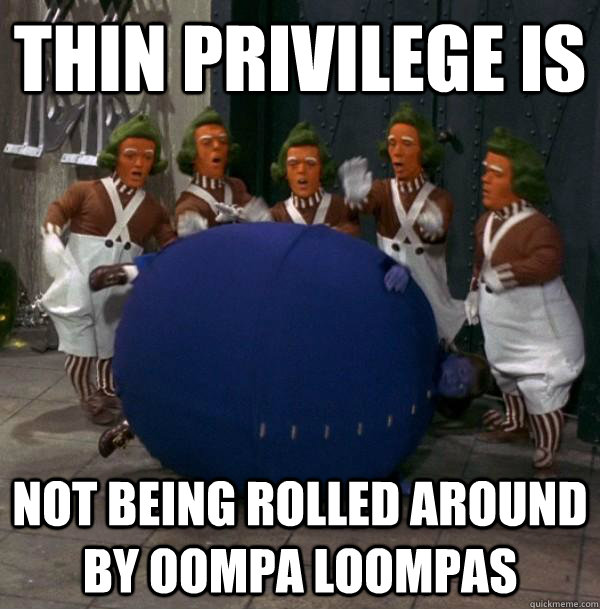
There has been a recent surge in websites, blogs, and tumblrs that deal with "Thin Privilege." These sites have also spawned spoof or parody sites which have in turn encouraged reaction sites. In the back-and-forth on these websites that I have followed, I would like to comment on a common theme which I think connects issues of health and bodies to the LGBTQ community: choice. First, I will explain these communities then I will draw from examples from each and compare them through Burke's pentad as revolving around agency and choice.
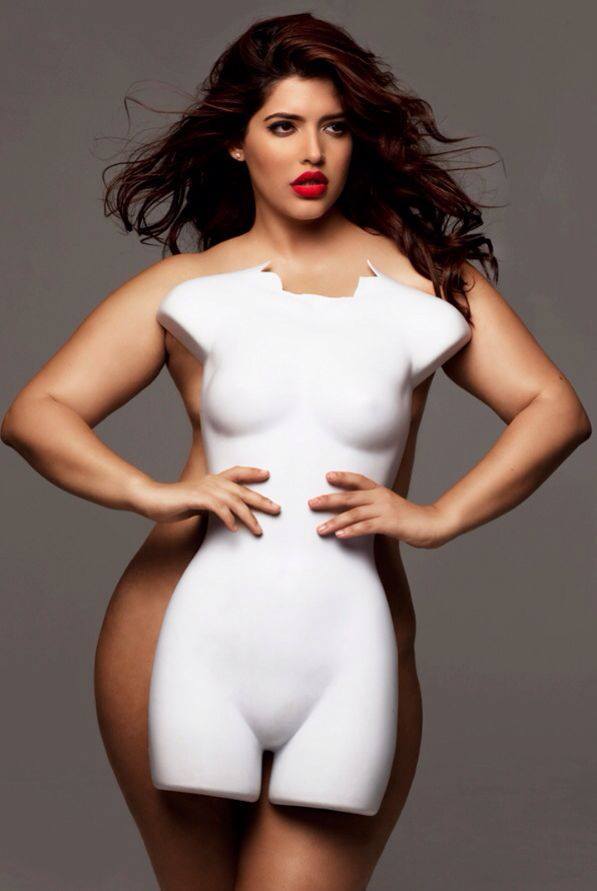
Thin Privilege reflects the advantages and benefits that come with being thin (or non-fat) in a society that values skinny bodies over large bodies. This has resulted in cultural and institutionally prejudices levied at non-thin people. Thisisthinprivilege.tumblr.com is dedicated to individuals sharing their personal stories of discrimination because of their size. Key themes are the idea that being large in body is associated with unhealthiness (which they argue is not necessarily true), being impacted by a lack of services available to them (such as the size of airplane seats), lacking role models in media, and experiencing fat stigma (e.g., strangers trying to give diet advice or calling names). The stories range from not being able to find clothing sizes in stores to having doctors ignore potential health issues because weight was a perceived larger concern. This site often posts "troll" questions and comments and critiques them as coming from a place of privilege or purposefully trying to undermine their cause. The key take-away from this site is that no one with privilege can deny others their claim to discrimination, police their language, or undermine their cause.
Retrieved from this blog as an example of skewed expectations and a world made for unrealistic body sizes.
From comments on these webpages, I found immense similarities to discussions of LGBTQ rights. The similarities center around the idea of choice. If one believes that being fat or being LGBTQ is a choice, they are more likely to be negative, critical, and dismissive of societal backlash that occurs for them. If one believes that these identifications happen naturally or are a product of the environment (e.g., hereditary/genetic), then one is more sympathetic to the effects experienced. This proclivity to blame the individual (agent) or the environment (scene) can be mapped onto Burke's pentad. The pentad is a tool that critic's can use to analyze situations in terms of its agent, agency, purpose, scene, and act. If the act performed is discrimination against someone, emphasizing the agent may cause one to believe that the recipient caused it themselves. Emphasizing the scene, however, may cause one to believe that society fosters discriminatory attitudes against minority communities. Papers I've been working on, influenced strongly by papers by Brock (1990), argue that these can be directly related to political ideology. Republicans may be more likely to consider the agent responsible (e.g., pull one up by one's bootstraps) and Democrats may be more likely to consider extenuating circumstances (e.g., how scenic factors influence one's actions and treatment).
To consider a large person and a gay person autonomous agents that make choices about their identity is to remove environmental and societal factors from responsibility. This type of view undermines the culpability of institutions and those with normative privilege (e.g., thin and hetero-) for discrimination. Somehow, making a choice to do something as opposed to having it happen to you, makes one more deserving of disdain and scorn. Those who had no choice can be viewed as vulnerable, victims, and innocent. Analyzing these situations as similar help us to connect issues of discrimination and shared experiences of minorities against ableist/cis/hetero/white/male society. From within that community, it is hard to assign oneself culpability and guilt; people would rather blame the individual than admit shared responsibility for discrimination. Just as people were quick to yell "post-race!" with the election of Obama, people are quick to jump to answers that do not include our own or systemic faults.
Retrieved from this site to represent the traditional Barbie size to the new "real proportions" doll
How does society move beyond discrimination? I think it's important for those of us with privilege is to step back and truly listen to the words of those without privilege or those at the intersections. We cannot understand the discrimination not having been privy to it. Trying to deny the stories of others or to argue with our own stories of discrimination only perpetuates structural inequalities. Just consider the backlash that happened when a new Barbie copy with "realistic proportions" came out that would encourage girls to idolize being unhealthy. Instead, why can we not consider these positive steps to creating a more inclusive culture that teaches people to love and respect their own bodies, no matter its size? ThisisThinPrivilege.tumblr.com is fighting against other blogs and the system that devalues fat bodies. Though this article is not meant to be evaluative, it cannot help but reach the conclusion that to reduce people's identities to arbitrary choices is to undermine the perpetual problem of discrimination. As posted on the website, people are fighting a system that "systematically reduces each of us to our dress size, hip measurement, and waist size, then grants favors, opportunities, or simple lack of punishment when the numbers are low enough" and instead fights for a system that treats everyone as equally human.
I'd previously wanted to title this: Words you shouldn't say anymore, but I changed the title to reflect how my opinions aren't those of everyone. Prescribing language changes for all people, though I believe that these are respectful and accurate changes, is problematic for many reasons. These suggestions are more for people who are already in line with my beliefs, namely liberal ones, and how to adjust your language choices to be more respectful of others and values.
Racial slurs: First of all, my previous post on Django referenced this briefly, but racial slurs are not appropriate in every day use. This primarily applies to the non-African American, black, brown, or identifying groups that may use racial slurs in jest, for shock value, or as a political statement. They are not words that most of us should or can say, by re-appropriating them into white vernacular, they lose their political meaning and importance. Simply put, these words can be used to reinforce power hierarchies and should not be used lightly or at all by dominant groups.
Tarantino Responding to Criticism about Django
Pro-life: This term has bothered me for a long time. What exactly is pro-life about banning women from having abortions? Abortions can be a life-saving procedure and refusing one can lead to complications and death. The idea that a fetus is alive is based on religious definitions that life begins at conception. For non-believers or those that operate under a different definition of when life begins, the life of the mother is the life that needs to be protected. The life of the mother is not always immediately in physical danger, as was Savita Halappanavar's, but there is always emotional and psychological life to worry about. Although many pregnancies are intentional, women do become pregnant for many reasons accidental or through force. Denying these women the right to closure and healing from rape, incest, or other emotional traumas can be damaging to a woman's life as well. Instead of "pro-life" which I have described as very misleading, I endorse the term "anti-choice" to emphasize the true issue: deciding for women what they wish to do with their bodies. If life were really the issue, then the woman's life would weigh importance as well, which for many anti-choice groups, though not all, it is of secondary importance, if that. Perhaps the most disturbing part of the anti-choice movement is that by equating the fetus with a child, they respond to abortion clinics and places like Planned Parenthood as if they were attacking murderers. Abortion practitioners have been threatened and killed (pro-life, huh?) and funding for PP has been cut in many states.
Savita Halappanavar
English in general: I recently read an amazing chapter from bell hooks who discussed the emphasis on clean, pure English as a means of stripping people (primarily former slaves and their descendants) from keeping in touch with their roots through dialect. She quoted a poem by Adrienne Rich saying, "this is the language of my oppressor, but I need it to talk to you". This statement is powerful and I feel needs no explanation or extrapolation except to say that the hegemony of the English language is not something always laudable. We should all try to learn other languages and encourage others (as bell hooks describes in a teaching role) whether they be friends, family, or students to speak how they feel comfortable speaking and encourage expression in multiple voices.
Boy/girlfriend, wife/husband: I think that these words should be replaced with the gender neutral counterparts of "significant other", "partner", "spouse", etc. Assigning and using these terms reinforces heteronormative definitions of marriage that use the binary gender terms, male and female, as the standard. Despite setbacks, such as Proposition 8, marriage is on its way to being redefined as open to homosexual couples. To reflect this openness and one's agreement with the changes, more gender neutral terms should be used to describe couples. Some homosexual couples may prefer the girl/girl friend or boy/boy friend terms, and that should be respected. For general conversation, however, the gender neutral terms are more encompassing and respectful. This gender neutrality follows for trans* and members of the queer community. Pronoun and name usage is something that I am still struggling with, but I find that simply asking for one's preferred gender pronoun is the best option. For some, their outward appearance may not reflect where they are on their personal journey of identification and which gender pronoun they would prefer. One's sexual organs does not adequately describe most people's gender identities and can be restricting in terms of expression. I remember hearing a quotation from a friend at an LGBTQ event at Northeastern: "I wish I had been born a girl, instead of just having this vagina." This statement highlights the struggle of many people attempting to realign their physical gender with one's felt gender and how sexual organs should be not be defining characteristic of a human being.
These are a few suggestions for different word choices that I think might be helpful for more open, liberal-minded people. For people who are anti-choice, pro-heteronormativity, and perhaps unconcerned with issues of race, these suggestions may fall on deaf ears. For others, I hope that these at least spark some thinking about the power of the words that we use, what context we use them, and who we use them with in defying hierarchies and promoting equality.
With a brief intermission in honor of the Dark Knight Rises, the past three blog posts have focused on nudity, tattoos, and eyewitness testimony and their relationship with the visual communication topic of "the body".
The connection I found between all of these pieces was the idea of power transferred and disciplined through the gaze, specifically, a masculine, powerful gaze. The male gaze is the primary consumer of the ESPN magazine and the differences in framing the masculine and feminine bodies draw the male gaze to the female form. The gaze on the masculine bodies is one of camaraderie, but the gaze on the feminine bodies implies sexuality, ownership, and conquest. The tattoo as a public display directs one's gaze to certain locations on the body, hides other parts, and draws attention to one's narrative and modifications. Victims of and eye-witnesses to crime are robbed of well-being, safety, and peace of mind. Their gaze in identifying the suspect (whether innocent or guilty) reclaims some of that uncertainty and paranoia with power, retribution, and relief. The gaze, then, that tracks the faces and makes the ultimate decision is a tool of power and control reclaimed and operated by the victim.
Gaze and power are two powerful concepts that have importance implications for communication scholars, especially those interested in feminist, cultural, and rhetorical studies. Those in power use different methods of oppression and discipline others, one of those ways in through the gaze. I have had experience with this power at a bar on New Year's Eve two years ago. After dancing and having fun with my friends, a man approached me and told me that his friend wanted to meet me. Unsure why, but optimistic that my single friend might be entertained by the current man while I spoke with his friend, I followed him back to the bar. After awkward introductions and seeing my friend be abandoned at the bar, I tried to break off the conversation with the friend. Upon leaving, he grabbed my arm tightly and said a few words that I can hear clearly even today: "I've been looking at you all night. You will dance with me." The idea that his gaze somehow controlled me or that his gaze provided him power over me was simultaneously ridiculous and terrifying. Was my body not my own? Did simply being out in public make me vulnerable and even complicit in the gaze of others? This particular person seemed to think that the very act of looking, gazing, staring was a service, labor, and favor to me that I was obligated to return or compensate him in some way. This is an event, unfortunately, not unique to me and is the result of a patriarchal society that objectifies and sexualizes the feminine.
Rihanna's "Man Down" Video
But one's gaze should not provide undue or unwanted power over another. The women in the ESPN magazine should be given the same emphasis on skills and abilities instead of their naked form. Those who chose to get ink on their skin to tell stories, personal or public, should not be denigrated or ridiculed for their decisions. Criminal investigations should not rely on the unreliable, reclaim to power that is the eye-witness testimony. No one should be controlled simply because another's gaze is directed towards another person. The power in the gaze is well-documented and remains an important idea for communication scholars as the heteronormative, male hegemony of the gaze has important implications for relationships, argumentation, and power.