Showing posts with label Consumption. Show all posts

Sunday, April 26, 2015

Conflict Kitchen and the Politics of Food

People engage in political activity everyday. The body is a rich site of activity that as Susan Bordo argues, is an "unbearable weight" to the intelligence, power, and ideal state of the mind. People are constantly in turmoil between what the mind thinks is right and what the body wants. The separation of the material and the spiritual is the basis for many religious rituals and has plagued theorists like Descartes, Durkheim, and others for many years.

Comic retrieved from FarLeftSide
One arena where this emerges is the political action of eating. One's choice of food is immensely important in crafting one's identity, and happens, for most people, multiple times a day. It is an act of material consumption that reaffirms an identity. For some, choosing to eat or not to eat at Chick-Fil-A became a stance on gay rights. As a vegetarian, my abstaining from meat is a choice for environmental protection and animal rights. A choice for a high-class, Michelin-starred restaurant over a food truck or trip to the grocery store may communicate affluence, leisure, and class. From farmer's markets, health campaigns, and food norms, the rhetoric of food is a site of power and control.

Retrieved from this site
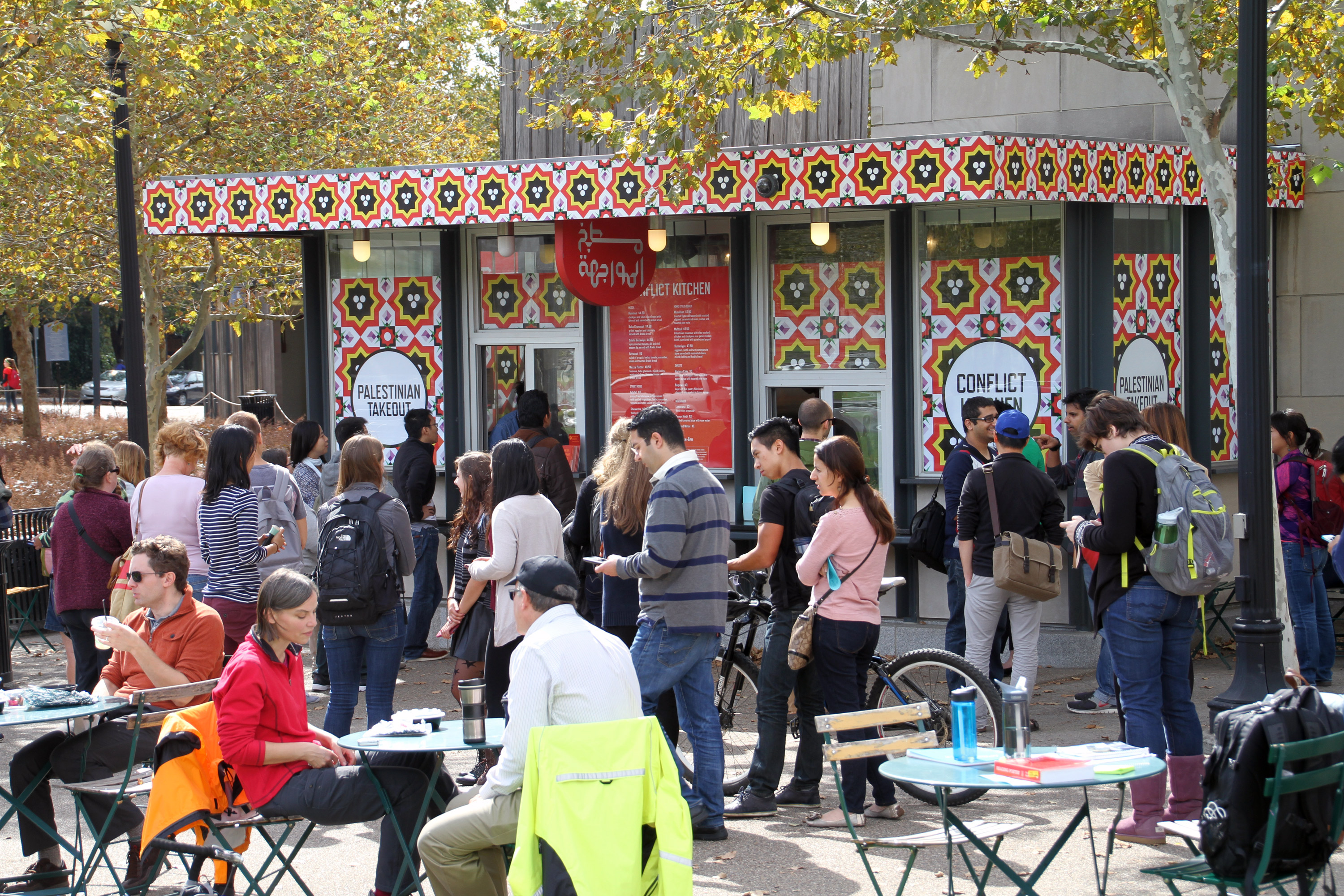
In believing that the material can argue and that food is itself symbolic and meaningful, it is easy to find examples of food's importance in everyday life. I was confronted with a particularly meaningful example when I visited Pittsburgh, PA. There is a restaurant called "Conflict Kitchen." The cuisine rotates but always features "cuisine from countries with which the United States is in conflict." The food experience is also complemented by activities, speakers, and events that draw attention to particular conflicts. Currently, the Conflict Kitchen prepares Palestinian food to bring awareness to the conflict in Palestine, the Gaza Strip, and Israel. Considering that America has only experienced 21 years of peace since it was created in the wake of the American Revolution, Conflict Kitchen will most likely have many food options for a long time.

Current Palestinian theme. Photo credit to Conflict Kitchen
Their mission statement is as follows: "Conflict Kitchen uses the social relations of food and economic exchange to engage the general public in discussions about countries, cultures, and people that they might know little about outside of the polarizing rhetoric of governmental politics and the narrow lens of media headlines." Through the medium of food, Conflict Kitchen reminds us of the cultural and personal aspects of conflict and war. It is easy to be distracted by the sweeping political statements and larger picture of global diplomacy. But it is hard to argue with the significance of cultural imports, cross-country interactions, and the new global village when eating. A simple, daily activity becomes a statement in support of cultural unity and against international conflict.

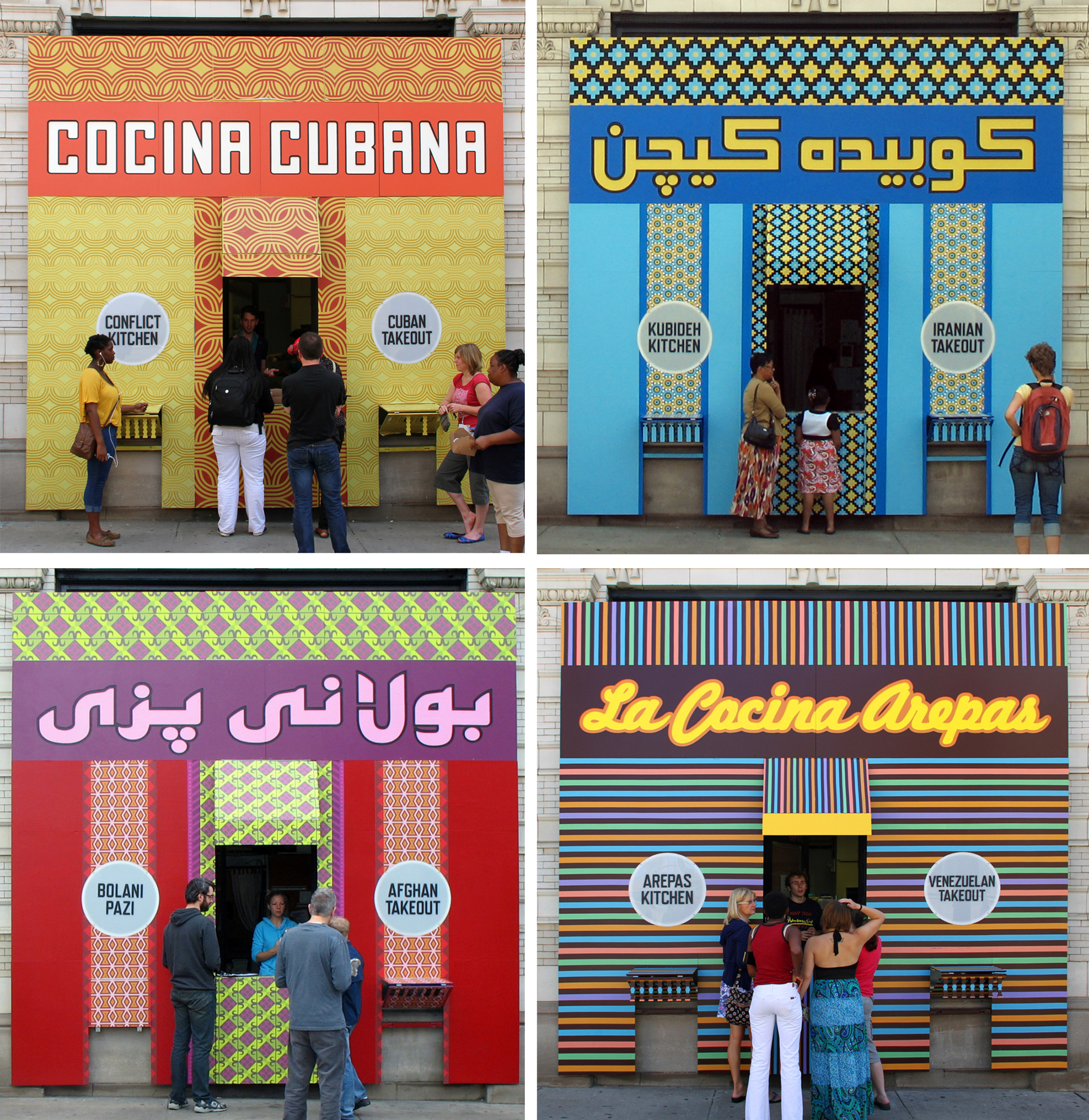
Different themes over time. Photo credit to Conflict Kitchen
Conflict Kitchen has also served food from Iran, Afghanistan, Venezuela, and North Korea. The variety of food available in this one kitchen highlights the relative lack of diversity in Pittsburgh's culinary offerings. Conflict Kitchen notes that it was the first and only of these ethnic restaurants "the city has ever seen." The lack of ethnic neighborhoods, outside of the European populations that are prominent in the city, makes the location of Conflict Kitchen particularly memorable. I am working on a paper that explores the ideas of experiential and rhetorical landscapes: the location of artifacts is commensurate with the site itself. Placing the Conflict Kitchen in Los Angeles may not have the same visceral effect as in the relatively homogeneous Pittsburgh.
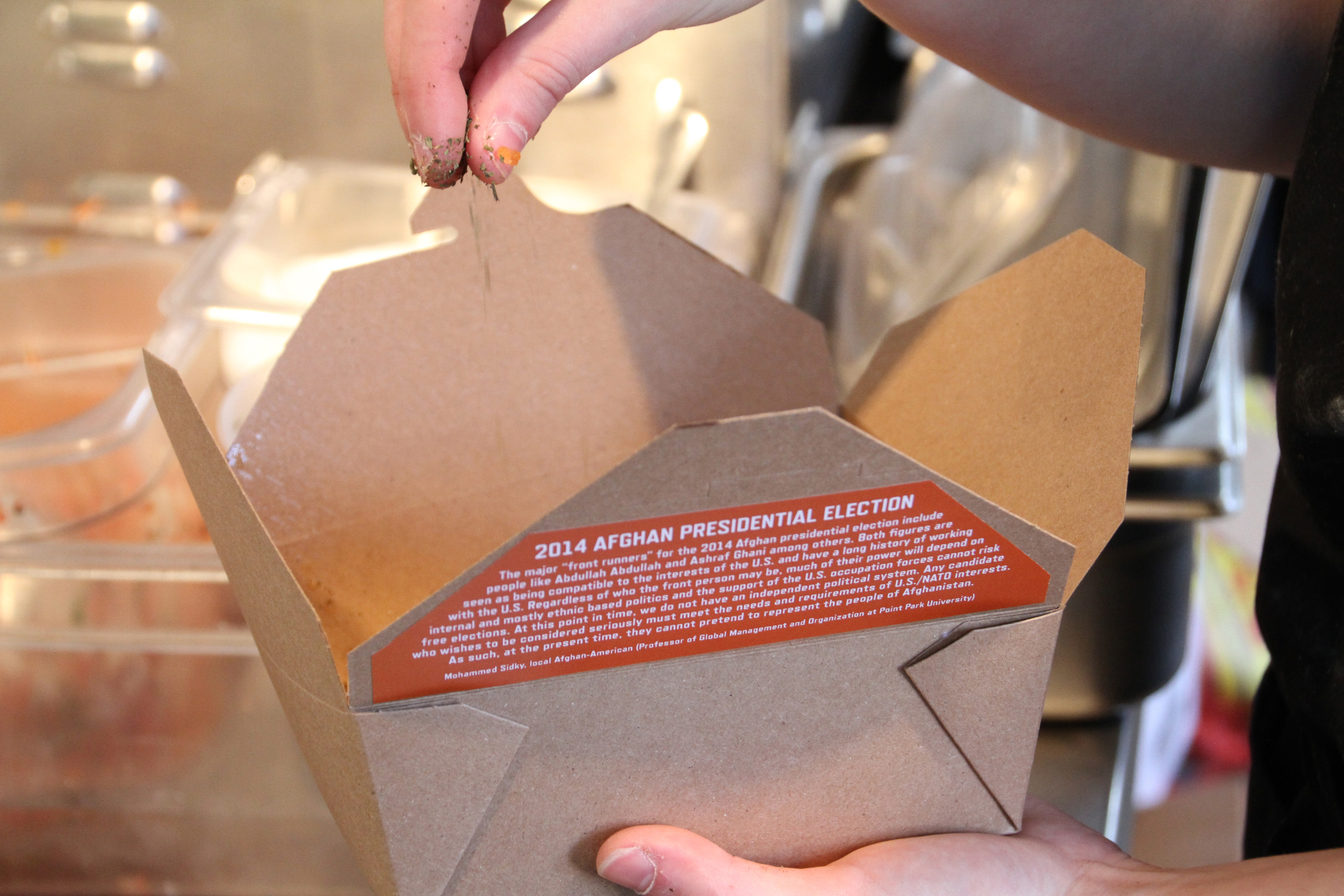
Information on take-out box. Photo credit to Conflict Kitchen

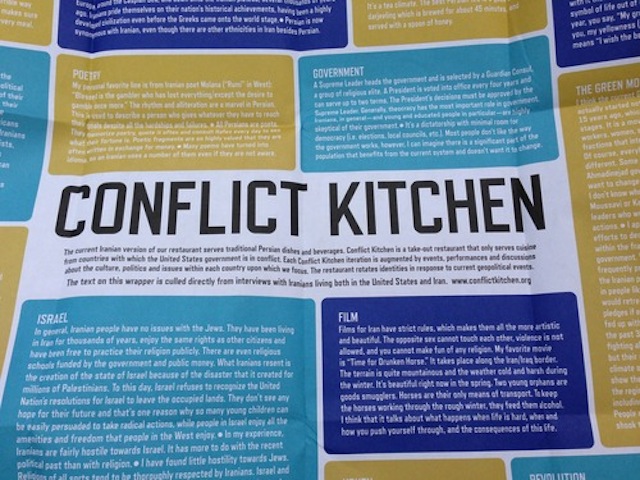
Food wrapped in information sheet. Retrieved from this site
Unwrapped sheet. Retrieved from this site


In addition to bringing food and culture to the attention of the city, Conflict Kitchen also wraps its food in large, informational sheets about the country. From government, politics, art, poetry, entertainment, and other areas, the unfolded food wrappers educate the food consumers about the country of origin. Conflict Kitchen thus offers food for thought and symbolic consumption as well as physical, material nourishment. For Conflict Kitchen, eating is a mindful act that calls us to consider the political and social implications of our daily consumption habits. There is an increasing trend in communication theory to explore how consumption, branding, and purchasing power has become a form of identity-management. What one buys, owns, and consumes is indicative of one's identity. I hope that more companies do adopt more conscious effort toward the impacts that their services and products have. Although there are concerns about the potential implications of charity-focused groups, I think overall there are steps to be made in shifting capitalist thought towards producing a more aware, global citizenry.

Wednesday, April 3, 2013

Vampires and the Narrative of TV Shows

Despite the proliferation of vampire/zombie/werewolf media figures in recent years, I find myself drawn into the various iterations and rule changes that simultaneously govern the characters and direct the plot in some popular shows and movies. How these rules change within the same mythology determine the flow of action and restrict plot twists complicate "lore" for the sake of an engaging narrative.

Dean and Sam on "Supernatural" encounter various ghosts, mythical creatures, and curses that each can be undone through their unique combination of research/brains and violence/brawn. There is a repetitive scene where Sam discusses the multitude of "lore" and history surrounding the supernatural occurrence and the two brothers discuss which solution or cure is the accurate one. Despite the various myths and folklore surrounding the situation, the brothers eventually find the solution, whether it be by manipulating the history or using a tried and true method.
Jessica on True Blood

Vampire on Supernatural
Caroline on Vampire Diaries

For example, the vampires on Supernatural are different from the ones on Vampire Diaries or True Blood. On Supernatural, vampires grow an extra row of teeth that emerge from the top gums. On Vampire Diaries, the creatures' teeth only emerge when they see blood or are about to feed and it is only the canines that grow to be longer and pointed. True Blood also only has one set of teeth grow, but it is the lateral incisors instead of the canines. Supernatural vampires create more vampires by bleeding into an open wound on a human's body. Those on Vampire Diaries become vampires when they die with vampire blood inside of them (and complete the transition once they consume human blood). True Blood vampires turn when they are drained of their vampire blood and replace it by drinking (and thus replacing) their blood with vampire blood (and complete the transition once they are buried in the ground). These various methods of transformation drastically change the plot of each show. Unique to Vampire Diaries, someone could be at risk for becoming a vampire without their knowledge (accidentally or unknowingly consuming vampire blood), while the other shows involve some type of direct contact with a vampire.

Perhaps the most interesting adaptation to the vampire myth is the sun. In True Blood, the vampires almost exclusively interact in the evening. They are vulnerable during the day when they are resting in their coffins and burn to death once entering the sun. This allows for interesting plot devices where vampires must fight through the pain of sun to help humans, the creation of vampire-friendly hotels with blacked out windows, and the constant threat of attack during the daylight hours. The setting and rising sun becomes a countdown clock for action in the show where tasks cannot be or have to be completed before a certain time. Fairy blood thus becomes a powerful and all-consuming commodity because it allows the vampires to walk unharmed in the sun, driving much of the action and focus around Sookie Stackhouse.

Eric and Russell burning in the sunlight
Vampire Diaries gets around this biopower by relieving the vampires of their reliance on the sun. By using the power of witches, they have magical rings that allow them to walk in the daytime. This creates another interesting set of restrictions that makes vampires more difficult to identify. Danger is thus more prominent and surprising as people who cannot come out during the day are easily identified in True Blood as vampires. In both series, vampires are restricted in their consumption of human blood. True Blood vampires use a synthetic blood (the namesake of the show) to curb their thirst for human blood, though there emerges a strong divide between vampires who consume True Blood (mainstreamers) and those who still feed on humans. An analogy can be made to this distinction and the Chick Fil-A argument that constructs consumption with identity politics. Vampire Diaries vampires do not have a synthetic blood option, but many choose to rob blood banks or feed from animals in order to avoid harming humans. Again, the stigma involved in the consumption of humans is both honored and vilified as competing groups determine their own consumption rules. Interestingly, Vampire Diaries vampires can consume "human" food, while True Blood vampires cannot (instead they "flavor" their food by changing the diet of the human).

Vampires and supernatural creatures are similarly constructed with different rules and restrictions in the media to allow for and direct certain plot points and devices. The key to the differences is keeping them believable, probable, and consistent. Fisher used the terms narrative fidelity (internal consistency) and narrative probability (external consistency). The interesting twist in shows such as Supernatural, Vampire, Diaries, and True Blood is that the existence of these creatures in and of themselves problematic to "reality". Given their existence, however, the shows can construct their own rules based on different mythologies. As long as they make sense within their own narrative reality, the audience can watch multiple shows and still engage with the vampire narrative.

Wednesday, August 8, 2012

The Politics of Food and Consumption

Consumption and food are not new contributors to political identities, but one may imagine it is so considering the multitude of coverage surrounding the Chick Fil-A "eat-ins" and political denouncements. The old adage, "you are what you eat" echoes common academic themes of consumption outlining important characteristics of someone. Eating is something that people do consistently, and even the absence of eating communicates political, social, and personal values.

As a vegetarian, I have had my entire life of experience defending my choice of following a specific dietary habit. Refusing meat, questioning waiters at restaurants, and scrutinizing ingredients lists are often activities that I have to defend or justify as outside of the norm. People are vegetarians for multiple reasons, often attributing actions to animal rights, environmental concerns, allergies, and religious restrictions. For me, my vegetarianism is a product of tradition and family, being raised a vegetarian since birth and eating and cooking in the vegetarian lifestyle is an important part of my family life. For any reason, removing certain parts of a diet begs the question of explanation (and sometimes inclusion of certain foods, such as cultural foods). These questions would not be necessary unless one's choice in consumption were meaningful or symbolic.


This relationship has risen to great importance and attention in the media with the recent discussion of Chick Fil-A's support of traditional marriage groups and anti-homosexual groups. The politics of the organization has encouraged politicians, celebrities, and the general public to associate their products with their ideologies. Similar reactions have plagued organizations that participate in child-labor, unfair business practices, or are unfair to their employees. Boycotting has been around since the creation of the United States, when people refused to purchase items that were unfairly taxed. What, then, is the issue with Chick Fil-A boycotts and the discussion at hand?

I don't necessarily think that there is anything inherently "wrong" about the Chick Fil-A argument. I would rather media attention be focused on the rights of the LGBTQ community or contextualize these discussions within the larger battle for universal rights and marriage equality. Instead, news reports are often solely focused on the actions of individuals and the organization as opposed to the cause that is driving the discussion. When the news reports become overwhelmed with free speech and balancing the scales by allowing both sides their viewpoints, the actions of Rahm Emanuel and Tom Menino are undermined and discredited.


The most important part of these demonstrations is the power of the individual. Through simple actions such as spending money, kissing, and eating, bodies act as rhetorical tools for the creation and expression of identity. Even if I did consume meat, I would have been happy to participate in the Chick Fil-A boycott, using my consumption, or lack thereof, to complement my political and personal values. Although I admit I was skeptical of the ban at first and questioned its fairness, I am now proud of my alma mater, Northeastern University, for banning Chick Fil-A's establishment in our student center. Banning Chik Fil-A represents the importance of the LGBTQ community on Northeastern's campus, which recently approved general neutral housing, preferred name and pronoun identification, and multiple student groups and training groups for inclusiveness on campus.


Instead of allowing for the power of consumption to force the Chick Fil-A to leave, Northeastern used its political power to avoid the issue altogether. The issue, then, becomes when people are willing to consume, purchase, and use their bodies as supporters of hate, bigotry, and exclusion and are defended as heroes of free speech. In that world, our world, change will be slow and riddled with obstacles. Recognizing the power of consumption and encouraging people to eat consciously may be part of the solution towards equality and empowering businesses as political entities.