Last week, I started a series of three posts about horror films and sexuality. The first week discussed "Teeth" and the complications of sexual purity, education, and consent. This week addresses "It Follows," a 2015 film with a unique and exciting "monster." I will first discuss the film as an innovative step forward in the horror genre. Then, I will praise the film's subtle but profound incorporation of female sexual empowerment. All three of these posts will contain detailed plot information and reflection, so those who do not want to be "spoiled" should skip these posts.
It Follows was simultaneously praised as an instant classic and creative horror endeavor. The plot is simple, yet immediately and strikingly unnerving. The film's "monster" is a shape-shifting, unidentified creature that slowly but adamantly walks directly towards its prey. Once caught, the person is ripped to shreds. The creature has no shape of its own; the monster is truly hidden in plain sight, hiding with the appearance of strangers, friends, or family. This set-up has the unique ability to invoke fear in the audience with scenes of people walking towards the camera in the background. What is normally considered an average part of everyday life becomes a potential and immediate threat. Without seeing the film yourself, it is hard to convey the silliness one feels at being completely terrified at a young girl or old woman walking slowly towards you. That is part of the genius of the film; the banal, everyday activities become risky, dangerous, and potentially life-ending. What actions do we participate in everyday, how many people do we cross paths with, that could alter our lives indefinitely? The film also conveys intense paranoia, where anyone approaching the main characters are met with skepticism and aggression before they can be identified. Even when the characters flee the town briefly and relax on the beach, there is an ominous aura that the creature will catch up eventually; any safety is only temporary.
I will now discuss the sexual elements of the film. The "creature" follows individuals based on their sexual partners. The origins of the creature are left quite murky, but, in short, the creature follows whoever the person it was previously following has sex with. Jay, the lead female character, has sex on a date and catches "It." Her sexual partner was kind enough to explain the creature to her and warn her to pass "It" along quickly or else it will kill her. There are certainly undertones of sexual anxiety here. Any sexual partner could result in an STD or pregnancy, which is an obvious metaphor for "It" that silently follows but has the potential to kill. This metaphor breaks down, however, when one thinks of passing the creature to others so that one could be rid of it themselves. STDs are reciprocal and cannot be erased by sex with others. Indeed, this type of thinking is indicative of myths where sex with virgins can cure AIDS. Some have called It Follows as an exercise in sexual fear and anxiety, because of the potential consequences and risks one takes when engaging in sexual activity, especially casually so. Despite these potentially shaming interpretations, I see positive and productive scenes that sexually empower women. I will discuss three of them: when Jay is originally passed "It," the discussions the main characters have about destroying the creature, and the act of following and stalking.
There is a long-lasting myth that women use sex for power, money, and ulterior motives. The stereotype is that men require sex more and women less, so women can dangle sexual relief as a bargaining chip. I feel no need to explicate why these stereotypes are just that, stereotypes with little practical application. Given this assumption and other sexual myths that circulate in popular culture, I find the scene where Jay is passed the creature by Hugh a welcome inversion. Hugh, a male, is the one using Jay and sex for a non-sexual purpose - to pass the creature along. He dates Jay and acts with a motivation unrelated to the relationship and having sex. Instead, he has sex out of the need for self-preservation, out of fear, not unlike a victim of domestic assault. Instead of the female using sex maliciously or with ulterior motives, Jay enjoys her casual, sexual encounter and we feel no animosity towards her. Instead, our scorn is directed towards Hugh, however briefly, the man who has sex to save his own skin and endangers the main character's life. Sex becomes a betrayal of her consent; Jay got far more than she expected from the encounter. Unlike current arguments about abortion and birth control, we don't feel that Jay's consent to the sexual encounter makes her somehow "deserving" of this fate.
After Jay convinces her friend of the danger she is in, they discuss how to kill it. Jay decides and consents to sex with a member of the group to pass the creature along to buy them more time. There is the implication that the male may be better able to protect himself, or simply that this is Jay's sexual preference. Either way, his brutal death confirms for the group that there is no safety based on one's gender. Everyone is equally susceptible to the actions of this creature. Perhaps it is time or death itself that marches towards all of us. Later in the film, Jay has sex with another male friend, who quickly has sex with a prostitute. Sex, in the film, is removed from its traditional, romantic settings. Instead, it becomes a normal part of life that may be engaged in for many reasons besides love. Although we might condemn Hugh at first for his actions, we become accustomed quickly to the idea that if sex is the way "It" operates, sex may also be the solution to defeating it. Jay and Paul have sex from a platonic, friendship type of love, concerned for Jay's safety. This sexual act blossoms into romantic love, but this was not its roots. It Follows presents an alternative view of sex. Unlike Teeth, sex is not dangerous or shameful. There are potential consequences to its engagement, but the danger of "It" is separated and distinct from the sex itself. Sex is a more normalized, everyday activity that holds no more or no less threat than other daily activities. Sex is not given the importance that is provided in Teeth and thus removes the common sex-shaming in horror films and the "sluts die first" mentality.
Catcalling video mentioned below.
While watching It Follows, I couldn't help but be reminded of the video where a woman filmed herself walking along in New York City for a day. The simple act of walking, of being followed, is a fear that women every day fear. As someone who has been followed from a bus to a Metro being taunted by a man, and on a separate occasion been grabbed by someone approaching from behind (in addition to numerous verbal assaults), the fear and uncertainty of being followed is well communicated in the film. Everyone may not immediately recognize the potential danger in stalkers or people following, but the film illuminates this potential danger. Anyone walking behind the main characters is noticed and understood as a threat. I don't believe that everyone is a potential threat, but it is clear that everyone has the potential to be. Unexpectedly, strangers (and sometimes even friends) can become risks to one's self-hood and safety. And it may begin with a simple act of following.
It Follows quickly became one of my favorite horror films. I applaud the interesting and exciting decisions made about the actions and appearance of the creature and greatly enjoyed the sexual themes throughout the film. No film is perfect, and indeed I may have changed a few elements of the film to further its cohesion and consistency, but It Follows communicated a positive, inclusive message that I hope will be furthered in future horror films. Films have the power to influence public opinion and insert educational messages in an entertaining way. The normalization of sex and the empowerment of female sexuality are productive trends in the journey towards equality and sexual freedom.
In Communication and Culture, a class I teach at USC, we've been discussing themes of the intersection of capitalism, globalization, and culture. Something that immediately came to mind was the prevalence of capitalist themes within entertainment, particularly on reality television. Reality shows run the gamut from dating, cooking, tattoos, adventure, weight loss, and competition. Some of my favorite shows, and those that I've seen become increasingly popular and varied, are investment shows. These shows perpetuate and valorize the values of the American Dream and bring the token successes to national attention. While I enjoy these shows and generally think they are positive and helpful to participants, I worry about the larger implications of the show outcomes.
My issues with these shows are twofold. First, I worry that they revere money over all other elements. The dollar is still key to any measure of success and is the bottom line for the happiness of the participants, investors, and the way the participants "win." Even good ideas, which are often acknowledged on the shows, are turned aside if they cannot be executed, shown to be scalable, or have reasonable time limits on returns. I also worry that the success and proliferation of these types of shows reinforce that these experiences are commonplace and plentiful. This type of mentality may blind us to the structural and societal barriers that do exist.
Perhaps the largest and most profitable of the capitalist entertainment shows is "Shark Tank." Based on the British version "Dragon's Den," "Shark Tank" shows a series of sharks, successful entrepreneurs, as they vet potential investment opportunities. Participants on the show pitch their idea, explain their process, and talk profits. Oftentimes, it is only established businesses that have track records of success and profit receive deals. People who come in only with ideas are often dismissed as too new, untested, or risky. On this show, people who have in some sense already "made it" are given investments to become more profitable with the help of investments. Sometimes, the sharks offer mentorship and experience beyond the monetary contribution, but the ultimate goal of the show is to receive their ask at a reasonable valuation. The "About Shark Tank" page has this to say, "The Sharks will once again give people from all walks of life the chance to chase the American dream, and potentially secure business deals that could make them millionaires." Shark Tank is not discriminatory, but then again, it has an intense vetting process which means not everyone can appear on the show. They are also only given a "chance to chase" success because that power is ultimately not in the hands of the everyday American, but by the always already profitable and successful elites.
Restaurant Startup investor Joe Bastianich
A spin-off of "Shark Tank" is "Food Fortunes," a new shop that specifically focuses on food-related innovations. This show adds the element of audience participation, where a live audience tests the food concepts and provides real-time feedback on the product. Also in the food category, "Restaurant Startup" gives people the opportunity to run a pop-up restaurant and get an investment to open a long-standing one. These shows follow the "Shark Tank" model where there are proven elites that have the power over the financial success of the participants. In "Restaurant Startup," the participants have some autonomy over their styling, logo, food, aesthetic, and supplies in creating the restaurant. But, they are still at the whims of the investors to change elements that are not amenable to them in order to open a real restaurant. In the interview above, Bastianich notes that a "business without profit is a hobby," again reinforcing the bottom line of profits over innovation, creativity, and even good quality food.
Dana Cloud argued that token success stories, such as Oprah Winfrey, are harmful to the understanding of how power structures work and the barriers that exist to equality. When people see the success of Winfrey or others the myth of the American Dream, the self-made man, and Horatio Alger come alive. People are presented with proof "of the American Dream, implying the accessibility of this dream to black Americans despite the structural economic and political obstacles to achievement and survival posed in a racist society" (p. 116). This is not just race, however, but that the success of people who have overcome barriers in place are applicable to everyone. If anyone can succeed, everyone can. Winfrey's success is certainly something to be lauded, but it should not be generalized to the larger public. To do so is to blame individual agents for their positions and ignore larger social, cultural, and political issues that are beyond individual control.
Many of my students tell me that it is hard to look at media the same way after taking Communication and Culture. There are many things to be cynical of in the contemporary media landscape. Where it is gender issues in advertising, racial stereotypes in movies, or the proliferation of questionable tropes, how are scholars supposed to genuinely enjoy media? I will say that I do enjoy the shows I have discussed and think there are great lessons to be learned and fun to be had in watching them. I cannot fault the investors on these shows for doing what the show encourages them to do, or even being business-oriented. It's their money, after all. But, I wholeheartedly hope that people become active instead of passive consumers of media. To watch The Bachelor and understand the questionable gender elements is much better than avoiding it completely or to accept its messages passively. Scholars, critics, and everyday people should be immersed in contemporary society and also interested in its workings.
I've already addressed my opinions on the societal shun of horror films. I think that horror films are much more inventive and experimental than traditional genre films and I wish more of my peers appreciated their subtle depth and creativity. This post is specifically about the second installment of The Purge, which I highly encourage everyone watch. Unlike the original, The Purge: Anarchy is a slick thriller with a moral message about class, race, and oppression. I will briefly discuss the horror aesthetics in this film (and its original) before discussing this interconnected themes of hierarchy and exploitation. The cultural scholar and common person alike would greatly benefit from exploring these themes on the silver screen (even with a bit of gore). It may not need saying, but this post will contain spoilers of both films.
The Purger: Anarchy Trailer. Retrieved from YouTube.
The first film was typical of its genre. There were cliche pop-out-from-behind-a-corner fake scares, misdirection, and a dearth of larger meaning than the human urge to kill. The film centered around the near future where a government has issued a 24-hour lift of all laws allowing society to "purge" through murder, robbery, etc. This results in a lower crime rate through the rest of the year and a boon in sales of home defense systems. The first film followed a family that had a break-in in their home after the young son tried to save a man being hunted in their neighborhood. This film was simply okay, an interesting idea poorly executed and mostly abandoned for the cheap and easy scares. I almost didn't go see the second film because of my disappointment in the first. I'm very glad that I didn't miss it.
The Purge: Anarchy focuses on the streets that are ravaged by roaming bands of vigilantes and the mysterious presence of military and government forces patrolling the streets. A Malcolm X type figure (Carmelo) becomes a prominent character who preaches that the purge is a government tactic to eradicate the poor (and subsequently, minorities) in order to keep the crime rate down during the year. We find out during the film that the government is targeting low income neighborhoods, kidnapping people, and performing genocides of the lower classes. One black woman and her daughter are saved from this government kidnapping by a (white) purger looking for revenge on the man who killed his son in a car accident.
Two scenes stand out for me as particularly shocking and expressive. The father of the woman saved from government forces disappears early in the film. The daughter and granddaughter find out that he has sold himself to a rich white family for $100,000 to allow them to purge in the safety of their home. The white family has literally bought a poor, black body as if it were property, to ruthlessly destroy and exploit it without exposing themselves to the risks of the purge. There is a poignant frame where the nuclear family is standing around the father wielding weapons in their pristine suits and plastic-wrapped living room of expensive art. Their massacre of this man will be their new art, their secret expression of white privilege that protects their valuables, status, and domination over the lower class.
Auctioneer before the hunt. Retrieved from this site.
The second powerful scene is shown briefly at the end of the trailer where a woman in a blue dress announces before a seated group of people in fancy dress that they have collected the last purge of the evening. The main characters are released into a pitch black maze where the highest bidders enter with night vision goggles and weapons to hunt them down. There are obvious echoes here about the purchasing of bodies as in the previous scene, but it also echoes themes from Richard Connell's "The Most Dangerous Game." This short story is about a stranded man looking for protection who ends up being hunted down for sport like an animal in a rich man's safari game. Humans being the most cunning (and thus perhaps most satisfying to kill) animal provides an elevated type of sport than the traditional hunt. Indeed, the highest bidders in The Purge: Anarchy wear traditional British fox hunting uniforms as if they were out in a normal hunting activity and not viciously murdering other people. In a quite satisfying ending, I will simply mention that the group manages to get a hold of one of the night vision goggles and weapons, making the hunt more of a fair fight.
Both of these scenes highlight for me the interrelationship between class and race and the exploitative powers of a system that only reifies the lasting order and undervalues the lives of poor and minority bodies. In this film, both the rich and the government specifically target and kill blacks, the homeless, deviants, and youth in an attempt to eradicate and "purge" the society of perceived evils. This movie asks us all to reflect on who is in power, what oppressive acts are they committing, and who does society really serve. Both the murderers and the white families who can afford to lock up and hide are complicit in the exploitation and eradication of people deemed unworthy of life. Just as a police officer in Ferguson made a decision of life and death for Michael Brown, The Purge: Anarchy asks us to consider who is in control and what those consequences are. Who gets to define who is worthy of life? Who gets to define how punishment is laid out? Who is in control of our streets, our livelihoods, our identities as targets or as civilians?
Carmelo, leader of the anti-purge movement. Retrieved from this site.
Carmelo is trying to start a revolt against this system. He targets the rich, white, and off-limits bodies to upend the genocide of the poor and the minorities. His tactics are in part successful, at least in saving the lives of the main characters, but his ultimate goal is left unfulfilled. Will it take violent revolution to change the system? Can violence itself do anything but reify the use of violence as a peace-keeping tactic? If anything can be learned in the current state of Ferguson, it is that the tensions between authority, race, and class run deep, and define for entire groups of people their ability to claim a place on this earth free from fear and death. That is unacceptable and violates the very basics of human rights. The Purge: Anarchy brings these themes to life in an exaggerated thriller that asks us to ponder our own situation: how far off are we from this being our reality?
There has been an influx of attention on the phenomenon of "the selfie." I know that I am perhaps a little late to this discussion, partly because it is far outside my typical realm of interest. A small epiphany regarding them, however, has prompted me to address what I think is an overlooked but important aspect of the selfie: the Freudian divide between self-love and object-love. The selfie is the perfect integration of our love for technology and our love for ourselves. To illustrate this union, I will first describe the myths of Narcissus and Pygmalion on which Freud based the two extreme disorders of love: ego-libido and object-libido.
Narcissus was a Greek youth that was captivated by his beauty reflected in the river. He wasted away and finally died being unable to leave his mirror and break his own gaze. The basic version often excludes the presence of Echo, the nymph who falls for Narcissus but is unable to warn him of the danger. She can only repeat the words of others and represents the love that others felt for Narcissus that was not returned. Instead, Narcissus turned his love inward and loved only himself (and specifically, only his aesthetics and beauty). The myth of Narcissus has inspired the phrase "narcissistic personality disorder" or Freud's ego-libido, which links a physical and emotional desire for oneself over others or objects. This is also associated with megalomania, or the idea that oneself is more important or better than others. Before summarizing the tale of Pygmalion, it is easy to note how narcissistic themes can be seen in today's individualized society.
Narcissus discovering his reflection. Retrieved from this site.
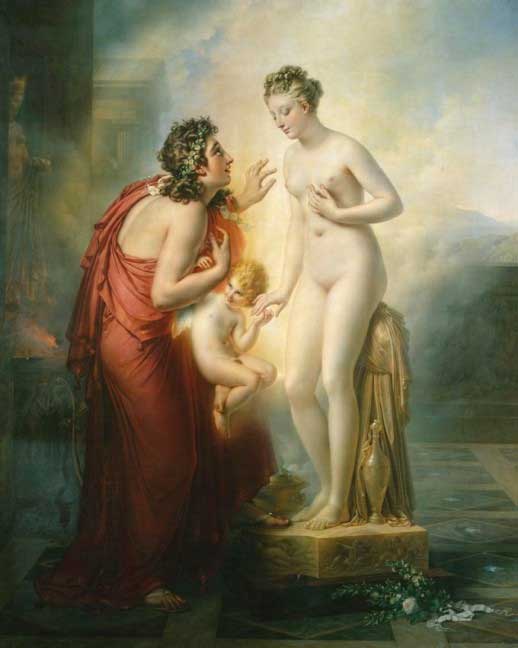
Pygmalion was a Greek artist who built a statue so beautiful that he fell in love with it. Appealing to the gods for reprieve from his unrequited love, his statue Galatea was brought to life by Aphrodite. They married and Pygmalion was able to spend his life with his creation. Many variations, plays and films, have emerged from this myth, where different variations on "brought to life" have emerged. A notable one might be the recent film, Her, where Joaquin Phoenix falls in love with the operating system in his phone. His phone, as an object, came to life with a personalized, teachable, intelligent female voice. In a brilliant dualism, Phoenix even has a sexual experience with Samantha less creepy than phone sex he previously performed with an actual person. Pygmalion is the myth of object-love, in opposition to Narcissus as the myth of self-love. Physical and emotional eros is directed as certain people and objects that epitomize how people can love.
Pygmalion discovers that Galatea is now human. Image retrieved from this site.
Currently on display in The Lourve, Paris.
The two forms of libido and love: inward and outward come together in the selfie. This new trend in photo-taking simultaneously emphasizes the importance and singularity of the individual and glorifies the technology that allows the self to be captured and spread so easily and prolifically. This is particularly apparent in images that also show the camera in a mirror as opposed to a front facing camera shot. The phone is immortalized in partnership with the individual, a perfect union of self- and object-love. We love ourselves, so we wish to capture our image and likeness. We love our technology, so we capitalize on its capabilities to connect ourselves with the world. As in Narcissus and Pygmalion, the love is often an aesthetic, physical love for appearances, than a deeper emotional love as is lauded in Plato's Symposium.
To worship ourselves, we fall into the phone's lens which collapses Narcissus's river. Our phone becomes our partner, come to life in its utility, friendship, and closeness. People cannot be without their technology, phones at their sides or in their hands, preferring the reflective screen to the faces of people around them. Some may say that like Narcissus, we will waste away focused on ourselves, individuality, and narcissism that restricts us from progressing or experiencing the world. Some may say that like Pygmalion, we are too emotionally and physically involved in our technology that we miss the beauty of the world around us in favor of a Google search for its likeness. In my cursory experience with selfies, I take very few and have posted even fewer, I see many positives and negatives to the phenomenon.
Comic by The Oatmeal about the negatives of selfies
Undoubtedly, it has taken news media by storm. The selfie of Obama and Biden made headline news and people were discussing the Oscar selfie (which was potentially a contrived Samsung advertisement) almost as much as the award winners. I'm not sure about the wide appeal of other people's selfies (in the immortal words of Mallory Archer: why would anyone want a picture of someone else's food?), but as a personal expression of self-worth, confidence, and creativity, selfies do have an important role in the rhetoric of identification. Especially considering that some people may not always find themselves presented in media (or they are expressed negatively), online, or in safe spaces, selfies could help establish an online presence and carve out spaces for open discussion about personal identification, labels, and communities. Selfies create visibility, are unapologetic, and bluntly express one's visual appearance, identity, and existence as important and worthy of appreciation. Even if it is produced for personal consumption, it necessary sharing (often on social media sites) encourages a reflection of how it may influence a larger public. The physical presentation of the body demands attention, space, and gaze onto individual, their stories, and potential arguments. The selfie also glamorizes the power of technology, to turn what would have taken many hours of labor to produce a self-portrait can be accomplished in seconds and sent around the world instantaneously.
I hear the cries on both sides about the narcissism and objectification that is implicit in the selfie. But, I see the selfie as merely an offshoot of these larger cultural changes than a root cause or responsible for them. There are innovative potentials in how the selfie could carve out rhetorical communities, enhance identities, and change norms of personal expression. Though I can imagine Kenneth Burke terrified by the reliance on technology that he warned against, I hope that he might appreciate the rhetorical opportunities for identification, mimicry, and understanding between people that may otherwise never have met. And, the rhetorical opportunities for personal expression and control over how one defines themselves and their relation to the world.
There has been a recent surge in websites, blogs, and tumblrs that deal with "Thin Privilege." These sites have also spawned spoof or parody sites which have in turn encouraged reaction sites. In the back-and-forth on these websites that I have followed, I would like to comment on a common theme which I think connects issues of health and bodies to the LGBTQ community: choice. First, I will explain these communities then I will draw from examples from each and compare them through Burke's pentad as revolving around agency and choice.
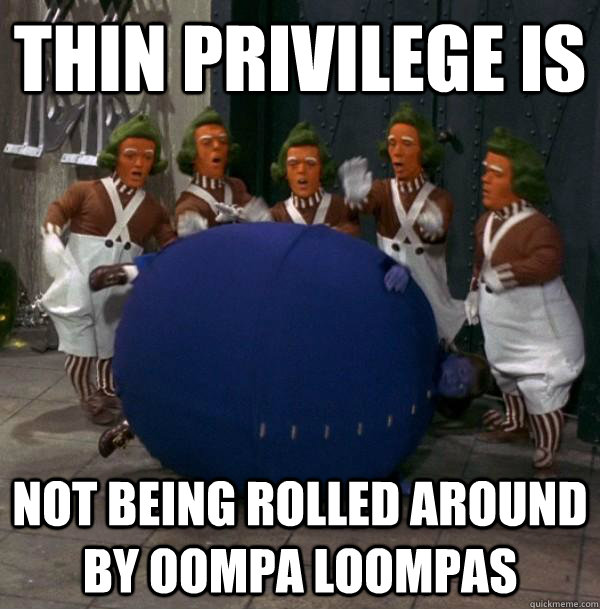
Thin Privilege reflects the advantages and benefits that come with being thin (or non-fat) in a society that values skinny bodies over large bodies. This has resulted in cultural and institutionally prejudices levied at non-thin people. Thisisthinprivilege.tumblr.com is dedicated to individuals sharing their personal stories of discrimination because of their size. Key themes are the idea that being large in body is associated with unhealthiness (which they argue is not necessarily true), being impacted by a lack of services available to them (such as the size of airplane seats), lacking role models in media, and experiencing fat stigma (e.g., strangers trying to give diet advice or calling names). The stories range from not being able to find clothing sizes in stores to having doctors ignore potential health issues because weight was a perceived larger concern. This site often posts "troll" questions and comments and critiques them as coming from a place of privilege or purposefully trying to undermine their cause. The key take-away from this site is that no one with privilege can deny others their claim to discrimination, police their language, or undermine their cause.
Retrieved from this blog as an example of skewed expectations and a world made for unrealistic body sizes.
From comments on these webpages, I found immense similarities to discussions of LGBTQ rights. The similarities center around the idea of choice. If one believes that being fat or being LGBTQ is a choice, they are more likely to be negative, critical, and dismissive of societal backlash that occurs for them. If one believes that these identifications happen naturally or are a product of the environment (e.g., hereditary/genetic), then one is more sympathetic to the effects experienced. This proclivity to blame the individual (agent) or the environment (scene) can be mapped onto Burke's pentad. The pentad is a tool that critic's can use to analyze situations in terms of its agent, agency, purpose, scene, and act. If the act performed is discrimination against someone, emphasizing the agent may cause one to believe that the recipient caused it themselves. Emphasizing the scene, however, may cause one to believe that society fosters discriminatory attitudes against minority communities. Papers I've been working on, influenced strongly by papers by Brock (1990), argue that these can be directly related to political ideology. Republicans may be more likely to consider the agent responsible (e.g., pull one up by one's bootstraps) and Democrats may be more likely to consider extenuating circumstances (e.g., how scenic factors influence one's actions and treatment).
To consider a large person and a gay person autonomous agents that make choices about their identity is to remove environmental and societal factors from responsibility. This type of view undermines the culpability of institutions and those with normative privilege (e.g., thin and hetero-) for discrimination. Somehow, making a choice to do something as opposed to having it happen to you, makes one more deserving of disdain and scorn. Those who had no choice can be viewed as vulnerable, victims, and innocent. Analyzing these situations as similar help us to connect issues of discrimination and shared experiences of minorities against ableist/cis/hetero/white/male society. From within that community, it is hard to assign oneself culpability and guilt; people would rather blame the individual than admit shared responsibility for discrimination. Just as people were quick to yell "post-race!" with the election of Obama, people are quick to jump to answers that do not include our own or systemic faults.
Retrieved from this site to represent the traditional Barbie size to the new "real proportions" doll
How does society move beyond discrimination? I think it's important for those of us with privilege is to step back and truly listen to the words of those without privilege or those at the intersections. We cannot understand the discrimination not having been privy to it. Trying to deny the stories of others or to argue with our own stories of discrimination only perpetuates structural inequalities. Just consider the backlash that happened when a new Barbie copy with "realistic proportions" came out that would encourage girls to idolize being unhealthy. Instead, why can we not consider these positive steps to creating a more inclusive culture that teaches people to love and respect their own bodies, no matter its size? ThisisThinPrivilege.tumblr.com is fighting against other blogs and the system that devalues fat bodies. Though this article is not meant to be evaluative, it cannot help but reach the conclusion that to reduce people's identities to arbitrary choices is to undermine the perpetual problem of discrimination. As posted on the website, people are fighting a system that "systematically reduces each of us to our dress size, hip measurement, and waist size, then grants favors, opportunities, or simple lack of punishment when the numbers are low enough" and instead fights for a system that treats everyone as equally human.