Showing posts with label presentation of self. Show all posts

Sunday, September 7, 2014

The Online Activist: Making Charity Cold as Ice

There have been many commentaries on the ALS Ice Bucket Challenge, hereafter IBC, including some by my colleagues at Annenberg. I have very mixed feelings about the challenge and they are quite scattered. I will attempt, then, to parse some of my more scholarly opinions on the matter in my overall criticism of the challenge as an event in narcissism and exploitation that has ultimately generated a lot of money for a great cause. In this sentence, I want it to be clear that the process by which these donations are raised is where my primary concern lies and not with the cause itself. Certainly, encouraging donations is a positive enterprise, but I am not completely deontological in that I feel that a critical look at the process and means by which these are obtained are necessary.
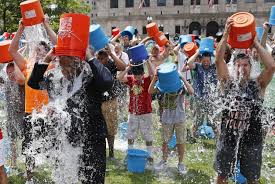
Retrieved from this site.
My first issue with the IBC is the notion of "challenge." There has been an increase of challenge and dare activities on the Internet where people are constantly trying to one-up each other. We had planking, for example, where people would try and lie supine on random objects, often in danger. The more dangerous or precarious the planking, the more valuable in terms of Internet clout. Then, came the video challenges by which people were dared to do something inherently dangerous, like jump off a bridge. Not surprisingly, this resulted in the deaths of a few people after drowning trying to meet the dare. Though meant as harmless fun (of which even my lovely siblings have participated in), these challenges raise important questions of safety and what activities the Internet are encouraging off-line. Others have been injured in so-called "cold water plunges" that are often media stunts to raise money for charities or certain causes. These challenges raise questions of agency and the choice of the "dared." When we are really talking about life and death, how can we not see challenge culture as a negative aspect of the Internet that encourages risky and dangerous behavior?

Planking on the edge of a building. Retrieved from this site.
These "I nominate X, X, and X" phrases remind me of the chain letters of the 90s where you had to forward these ridiculous stories (in Yahoo and Hotmail, typically) or someone would come kill you in the evening. What actually happens if you don't accept an IBC, cold water challenge, or forward a chain email? Absolutely nothing. The challenge culture simply takes your unwillingness to do a dare from middle school slumber parties to a global audience. In a word, it's childish. The maintenance of these challenges perpetuates the dangerous culture of one-upping and daring, although not specifically present in the IBC. What we communicate has essentially stayed the same, but how we communicate it has changed. Ong would see the evolving communication technologies as simply offering new forms that communication can take, such as the dare. The IBC has the countdown clock and the threat of non-compliance that email chains (and blackmail, by the way) have to motivate people to act. The dare takes the spirit of altruism out of the donations, because it is reduced to the act of one-upping others, blending in with the crowd, and passing the dare on to others.

My second issue is the notion that this particular charity is particularly worthy, or that I am forced to donate to this particular one. I think that donating to charity is definitely a worthwhile cause and one that the IBC has reminded me that I should do more of. But, why ALS? They have simply come up with this marketing campaign. They, like all charities, are not particularly worthy or more deserving than so many other of the great charities out there that one could donate to. Why should my choice in charity donation be limited because of a "dare" I receive on Facebook? Why shouldn't I donate to a charity that I care about? That I believe does good work? That I feel is not getting enough attention? Perhaps I have been personally affected by close family member having Alzheimer's or diabetes and wish to donate to them. Is this somehow less acceptable because I am not performing the dare made of me? Why should someone else decide where I give my money? This article brings up important concerns about what the money will be used for and the benefits of massive donations to a specific charity (especially one like ALS which focuses on research and impacts very few people).

Retrieved from this site.
My third issue is the performative aspect of the challenge that promotes narcissism and exhibitionism rather than a concern for the charity. Why should I have to dump water on my head to do a good deed? Not to mention the many concerns this has raised in California because of the drought. Why do I have to film it and share it with others? Why isn't donation a private act that doesn't need public display? Because it's not about my donation, it's about me. It's about my public performance of doing good work. Modern culture cannot do a good deed without getting recognized for it. We need public recognition of every A, every act of kindness, every charity. Dumping water is about including myself in the story of ALS and its success, about feeling good about my involvement. The IBC reminds me quite strongly of the "Fitch the Homeless" movement where people donated all of their Abercrombie & Fitch clothes to the homeless. On the surface, just like the IBC, this campaign did provide many donations of much-needing clothing for the homeless. But, this campaign leaves a similarly negative taste in my mouth because of the reasoning behind the actual donations. They were not out of the sake of the good deeds or that the homeless were in need, but that we were getting back at Abercrombie & Fitch CEO would made comments about his clothing being only for "cool kids." Yes, in response to this statement, let's donate all of the Abercrombie & Fitch clothing to the most non-cool kids ever. As this article put it: "what [this campaign] ends up doing is using people experiencing homelessness as pawns to make a political statement." The IBC similarly exploits the narcissism and dare culture of the Internet to encourage donations. Is the end result a positive? Definitely. But should we condone these types of reasons to donate? Absolutely not.

Retrieved from this site.
Donations are not a matter of being dared or used as a way to spite others. Donations should be about caring, giving, appreciating others, working monetarily towards a cause that you believe in. If this is the new way that people donate, then it changes the dynamics of charity, and may shift our thinking so that we require dares and challenges to make a donation. We couldn't act independently or privately for the benefit of a cause, but would need to publicly present ourselves and declare that others must congratulate or copy us in order for the good deed to be meaningful.

I want to reiterate that I think the donations raised about the IBC are absolutely amazing. I never would have thought that reinvigorating the giving spirit (sort of) especially for my generation could be done so successfully (especially after the Kony 2012 disaster). I think that the impassioned speeches of my colleagues on Facebook have been well heard and I do not look down or condemn anyone for doing the IBC. I merely wish to raise questions (albeit rather passionately myself) about the purpose of these type of videos, what they are actually promoting, and the motivations behind the good deeds that make me skeptical of the lasting power of this campaign and others that may try to imitate it.

I will not participate in this if someone challenges me. I've decided that I don't want to perpetuate a culture that made my brother jump off of a bridge, take away people's agency in deciding to donate, or reducing the act of charity to an event in narcissism. I do think that donations are a positive act and this challenge has caused me to see that people don't donate enough. I may donate because of this, I may not. It may be to ALS, it may be to a different charity, or none at all. But, I will not make it a public spectacle or "dare" others to have the giving spirit or shame them into performing for a Facebook audience. Instead, I encourage everyone to see the larger message in the beauty of charity and reject the process by which this challenge is perpetuated.


Monday, July 14, 2014

The Selfie: Self-Love and Object-Love

There has been an influx of attention on the phenomenon of "the selfie." I know that I am perhaps a little late to this discussion, partly because it is far outside my typical realm of interest. A small epiphany regarding them, however, has prompted me to address what I think is an overlooked but important aspect of the selfie: the Freudian divide between self-love and object-love. The selfie is the perfect integration of our love for technology and our love for ourselves. To illustrate this union, I will first describe the myths of Narcissus and Pygmalion on which Freud based the two extreme disorders of love: ego-libido and object-libido.

Retrieved from this site.
Narcissus was a Greek youth that was captivated by his beauty reflected in the river. He wasted away and finally died being unable to leave his mirror and break his own gaze. The basic version often excludes the presence of Echo, the nymph who falls for Narcissus but is unable to warn him of the danger. She can only repeat the words of others and represents the love that others felt for Narcissus that was not returned. Instead, Narcissus turned his love inward and loved only himself (and specifically, only his aesthetics and beauty). The myth of Narcissus has inspired the phrase "narcissistic personality disorder" or Freud's ego-libido, which links a physical and emotional desire for oneself over others or objects. This is also associated with megalomania, or the idea that oneself is more important or better than others. Before summarizing the tale of Pygmalion, it is easy to note how narcissistic themes can be seen in today's individualized society.

Narcissus discovering his reflection. Retrieved from this site.
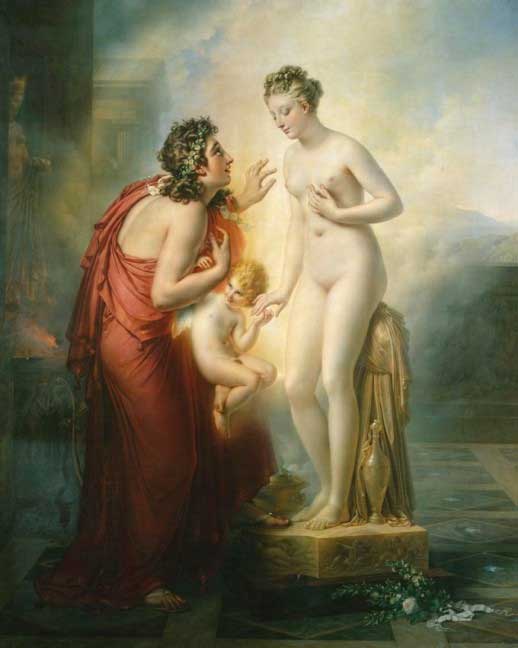
Pygmalion was a Greek artist who built a statue so beautiful that he fell in love with it. Appealing to the gods for reprieve from his unrequited love, his statue Galatea was brought to life by Aphrodite. They married and Pygmalion was able to spend his life with his creation. Many variations, plays and films, have emerged from this myth, where different variations on "brought to life" have emerged. A notable one might be the recent film, Her, where Joaquin Phoenix falls in love with the operating system in his phone. His phone, as an object, came to life with a personalized, teachable, intelligent female voice. In a brilliant dualism, Phoenix even has a sexual experience with Samantha less creepy than phone sex he previously performed with an actual person. Pygmalion is the myth of object-love, in opposition to Narcissus as the myth of self-love. Physical and emotional eros is directed as certain people and objects that epitomize how people can love.

Pygmalion discovers that Galatea is now human.  Image retrieved from this site.
Currently on display in The Lourve, Paris.
The two forms of libido and love: inward and outward come together in the selfie. This new trend in photo-taking simultaneously emphasizes the importance and singularity of the individual and glorifies the technology that allows the self to be captured and spread so easily and prolifically. This is particularly apparent in images that also show the camera in a mirror as opposed to a front facing camera shot. The phone is immortalized in partnership with the individual, a perfect union of self- and object-love. We love ourselves, so we wish to capture our image and likeness. We love our technology, so we capitalize on its capabilities to connect ourselves with the world. As in Narcissus and Pygmalion, the love is often an aesthetic, physical love for appearances, than a deeper emotional love as is lauded in Plato's Symposium.

What Would Jesus Post? Retrieved from this site.
To worship ourselves, we fall into the phone's lens which collapses Narcissus's river. Our phone becomes our partner, come to life in its utility, friendship, and closeness. People cannot be without their technology, phones at their sides or in their hands, preferring the reflective screen to the faces of people around them. Some may say that like Narcissus, we will waste away focused on ourselves, individuality, and narcissism that restricts us from progressing or experiencing the world. Some may say that like Pygmalion, we are too emotionally and physically involved in our technology that we miss the beauty of the world around us in favor of a Google search for its likeness. In my cursory experience with selfies, I take very few and have posted even fewer, I see many positives and negatives to the phenomenon.

Comic by The Oatmeal about the negatives of selfies
Undoubtedly, it has taken news media by storm. The selfie of Obama and Biden made headline news and people were discussing the Oscar selfie (which was potentially a contrived Samsung advertisement) almost as much as the award winners. I'm not sure about the wide appeal of other people's selfies (in the immortal words of Mallory Archer: why would anyone want a picture of someone else's food?), but as a personal expression of self-worth, confidence, and creativity, selfies do have an important role in the rhetoric of identification. Especially considering that some people may not always find themselves presented in media (or they are expressed negatively), online, or in safe spaces, selfies could help establish an online presence and carve out spaces for open discussion about personal identification, labels, and communities. Selfies create visibility, are unapologetic, and bluntly express one's visual appearance, identity, and existence as important and worthy of appreciation. Even if it is produced for personal consumption, it necessary sharing (often on social media sites) encourages a reflection of how it may influence a larger public. The physical presentation of the body demands attention, space, and gaze onto individual, their stories, and potential arguments. The selfie also glamorizes the power of technology, to turn what would have taken many hours of labor to produce a self-portrait can be accomplished in seconds and sent around the world instantaneously.

I hear the cries on both sides about the narcissism and objectification that is implicit in the selfie. But, I see the selfie as merely an offshoot of these larger cultural changes than a root cause or responsible for them. There are innovative potentials in how the selfie could carve out rhetorical communities, enhance identities, and change norms of personal expression. Though I can imagine Kenneth Burke terrified by the reliance on technology that he warned against, I hope that he might appreciate the rhetorical opportunities for identification, mimicry, and understanding between people that may otherwise never have met. And, the rhetorical opportunities for personal expression and control over how one defines themselves and their relation to the world.

Sunday, June 22, 2014

Donald Sterling as a Modern Day Earl Butz

It is impossible to ignore all of the online and offline discussion of the owner of the LA Clippers, Donald Sterling's racist remarks. He noted in a private conversation to his girlfriend that he didn't want her "associating with black people," and specifically bringing them to basketball games. The hypocrisy in Sterling becoming rich off of the labor of black bodies has been addressed better elsewhere, so I wish to address another important part of this discussion: the apologia. Using Kenneth Burke's guilt-redemption cycle, this post will discuss the similarities of Sterling's remarks to the racist statements of Earl Butz, and how these statements implicate the larger American public in the persistence of racism.

Donald Sterling and the Clippers's logo
Earl Butz was Secretary of Agriculture in 1976 who eventually resigned his position after racist comments emerged. This site has the full timeline of the events including the offensive joke. A scholarly article was written about that event by Dr. James Klumpp and Dr. Thomas A. Hollihan called "Debunking the Resignation of Earl Butz: Sacrificing an Official Racist." The title reveals some important terms and information that will inform this comparison between Butz and Sterling. I will also highlight some important differences that reveal modern racial tensions. Butz was "sacrificed" as Klumpp and Hollihan say, as a part of Burke's guilt-redemption cycle. This cycle describes how pollution, or some type of disorder, is introduced into an order, which creates guilt and a subsequent need for purification, purging, and redemption.

Earl Butz, retrieved from this site
For Butz and Sterling, the pollution was their racist statements that shattered the values of equality inherent in their respective social and political orders (government and sports). Both of these institutions are supposed to value equality, all Americans, and their constituents. As public figures, their voices can be seen as stand-ins for the groups that they represent. Butz was "sacrificed" by the Republican Party, who wished to separate their public appearance from racism. The NBA also separated itself from Sterling by banning him from the organization, fining him $2.5 million, and urging him to sell the team. The sacrifice can come in many forms, but it must make the punishment commensurate to the crime committed. Considering that the pollution for each was the potential crumbling of national organizations, the punishments were made quite prominent, public, and severe.
Some prominent reactions to Sterling's statements
Another important similarity between the two are the separation between public and private. Klumpp and Hollihan address this dichotomy by nothing that officials are sometimes seen as not have the right to privacy: anything said even in private could destroy a public persona, one's reputation, and career. Some were quick to jump to Sterling's defense such as columnists at Fox who pointed to the "thoughts" of Sterling as harmless and a personal right. Some articles went as far as to implicate the girlfriend (who recorded the conversation) as the real criminal. In the aftermath of the announcement, Mark Cuban echoed the words of a Fox News reporter about whether convicting people for statements in private could be a "slippery slope" to the thought-police.

Though some of these concerns were raised, there has been overwhelming support for Sterling's punishment. One might say that it was a "success" in some ways in that an athletic profiteer who undermined his own team and the values of the NBA (and perhaps, the country) would be receiving a just punishment. However, Klumpp and Hollihan raise a point of contention with these types of guilt-redemption activities. They note that by creating a sacrificial goat out of Butz and Sterling, we as a nation do not have to address underlying and persistent racism that we may all (or at least most of us) be guilty of. Instead, we can claim that wrongs have been righted and that racism is an individual issue that does not have to be addressed on a societal level. They note that these overt punishments of racism create a culture that "tolerates private racism and its consequences” (p. 11). Jon Stewart adeptly addresses the issue of post-racial society in his critique of Sterling and the recent SCOTUS decision to uphold Michigan's ban on affirmative action.

Retrieved from the Daily Show

What is to be learned by the Donald Sterling incident? One thing is perhaps most important: racism still exists. There is no magical, post-racial world because we have a black president. People haven't stopped being murdered because of their race, people haven't stopped trying to make relevant the KKK, and people still use the n-word. This is only the tip of the iceberg, however, as racism against other minorities, especially immigrant populations, is also a common American theme. Is this what America is all about? We need to take examples like Butz and Sterling and open our eyes to the underlying problems from which these individuals stem. Structural racism is happening and continues to happen; we cannot remain blind to it and only care when individuals break norms of keeping racism a private endeavor. All racism needs to be addressed, and we have a lot of work to do.

Wednesday, September 5, 2012

Supermodels Without Photoshop: Goffman's Presentation of Self

Arguments over the beauty of models has become under greater scrutiny with the use of Photoshop. Images and visuals, traditionally considered "truthful" as they show reality before the lens, can now be manipulated pre and post photo shoot. Many websites have made their focus highlighting Photoshop mistakes, the drastic differences in appearance when celebrities are "caught" without makeup, and how makeup and photoshop exaggerate the beauty of models.

JennaMarbles: How to Trick People into Thinking You're Pretty
Disclaimer: minor foul language

But how offensive are these "lies" and "manipulations"? What damage is caused when ideals of perfection are unreachable? Backlash from the over-usage of make-up and photo-editing tools call into question the health and well-being of youth, especially young females, who may feel pressured to perform dangerous activities to keep pace with media images.

Communities such as Pro-Ana and Pro-Mia groups (advocating, providing information about, or discussing anorexic and bulimic lifestyles) and "thinspo" or "thinspiration" groups are becoming more prevalent in online spaces. The accessibility and limited rules of the Internet allow for previously sequestered, shamed, or otherwise isolated groups to connect in open, free access spaces. These groups oftentimes detail strict dieting plans, workout routines, or glorify thin bodies in their quest for "perfection". Are the exaggerated and fake images in the media responsible for such behavior? Do they initiate or augment feelings of inadequacy in the population?

I find myself being drawn to Erving Goffman's presentation of self where he discusses the front stage and the backstage performances in the theatre of life. One's front stage performance is the act we put on in our every day lives, how we express and communicate ourselves to others. The backstage performance can be considered our true selves, or the identity that we hide, shield, or keep from others. The congruency between a front and backstage persona is often unachievable, as people are always trying to put their best foot forward and hide flaws (e.g., consider job interviews, politicians, dating, etc.). When the front and back stage do not match, or is revealed to be incongruent, one's identity and performance is questioned and mistrust, skepticism, and cynicism flourish.


Are these models not the same? The industry and media standards for beauty have literally become impossible. Even models and actors hired for the beauty can no longer meet the standards and must inflate and exaggerate their features through cosmetics or computers. And when their "true" identities are revealed or captured, there is ridicule and shame brought upon them. Can we truly fault these models for working? For meeting the requirements of their jobs? Perhaps this is an issue of the industry and the larger culture. So do we all not share the responsibility in creating and fostering these ridiculous beauty standards?

Part of me thinks that this is a good thing: when perfection is unobtainable, then the search for it can be forgotten. If models and celebrities cannot be perfect, surely no one can be, at least in current standards for beauty. When size 4 models are photoshopped to remove extra fat, when computers are altering cultural and racial representations of beauty, then can't the fight for perfection finally end?


Unfortunately, the issue is one of awareness and knowledge which is echoed beautifully in this article about a 14-year-old who is fighting back against photoshopping. Her criticism of photo manipulation stems simply from ignorance on the part of many that these levels of beauty are faked. In response to this lack of information, many organizations and countries have begun placing increased standards on media images because of the perceived health risks in exposing youth to harmful images (female and male alike). Israel, for example, has required advertisements to place disclaimers on advertisements that are photoshopped and all models have to provide a doctor's approval that they are of a healthy weight before working (i.e., to work in Israel, a model's BMI has to be above 18.5).

Even Pinterest, a site that has come under scrutiny for its large "thinspo" community that posts pictures of thin models and anorexia diet plans now places this disclaimer on "thinspiration"-themed searches:


Eating disorders are not lifestyle choices, they are mental disorders that if left untreated can cause serious health problems or could even be life-threatening.

For treatment referrals, information, and support, you can always contact the National Eating Disorders Association Helpline at 1-800-931-2237 or www.nationaleatingdisorders.org.


People are no longer free to establish their own standards of beauty, but are labeled as unhealthy or mentally ill because of their physical preferences. Should transgender individuals feel the same way because they alter their appearance against the "norm"? How about other cultures that may bind feet, stretch their neck, or brand members in a search for beauty? These are all serious questions for our world, because while we are a nation founded on choice and free speech, there are situations where the health and well-being of our citizens requires, necessitates, and deserves intervention.

The journey to stop such glamorization of thin frames, anorexic bodies, and manipulations of beauty have only begun. I can only say that everyone should define beauty their own way, without the undue influence of the fashion and modeling industries, media images, and peer pressure.


Segment from National Geogrphic's "Taboo: Beauty"
Disclaimer: images of extreme anorexia

Wednesday, August 8, 2012

The Politics of Food and Consumption

Consumption and food are not new contributors to political identities, but one may imagine it is so considering the multitude of coverage surrounding the Chick Fil-A "eat-ins" and political denouncements. The old adage, "you are what you eat" echoes common academic themes of consumption outlining important characteristics of someone. Eating is something that people do consistently, and even the absence of eating communicates political, social, and personal values.

As a vegetarian, I have had my entire life of experience defending my choice of following a specific dietary habit. Refusing meat, questioning waiters at restaurants, and scrutinizing ingredients lists are often activities that I have to defend or justify as outside of the norm. People are vegetarians for multiple reasons, often attributing actions to animal rights, environmental concerns, allergies, and religious restrictions. For me, my vegetarianism is a product of tradition and family, being raised a vegetarian since birth and eating and cooking in the vegetarian lifestyle is an important part of my family life. For any reason, removing certain parts of a diet begs the question of explanation (and sometimes inclusion of certain foods, such as cultural foods). These questions would not be necessary unless one's choice in consumption were meaningful or symbolic.


This relationship has risen to great importance and attention in the media with the recent discussion of Chick Fil-A's support of traditional marriage groups and anti-homosexual groups. The politics of the organization has encouraged politicians, celebrities, and the general public to associate their products with their ideologies. Similar reactions have plagued organizations that participate in child-labor, unfair business practices, or are unfair to their employees. Boycotting has been around since the creation of the United States, when people refused to purchase items that were unfairly taxed. What, then, is the issue with Chick Fil-A boycotts and the discussion at hand?

I don't necessarily think that there is anything inherently "wrong" about the Chick Fil-A argument. I would rather media attention be focused on the rights of the LGBTQ community or contextualize these discussions within the larger battle for universal rights and marriage equality. Instead, news reports are often solely focused on the actions of individuals and the organization as opposed to the cause that is driving the discussion. When the news reports become overwhelmed with free speech and balancing the scales by allowing both sides their viewpoints, the actions of Rahm Emanuel and Tom Menino are undermined and discredited.


The most important part of these demonstrations is the power of the individual. Through simple actions such as spending money, kissing, and eating, bodies act as rhetorical tools for the creation and expression of identity. Even if I did consume meat, I would have been happy to participate in the Chick Fil-A boycott, using my consumption, or lack thereof, to complement my political and personal values. Although I admit I was skeptical of the ban at first and questioned its fairness, I am now proud of my alma mater, Northeastern University, for banning Chick Fil-A's establishment in our student center. Banning Chik Fil-A represents the importance of the LGBTQ community on Northeastern's campus, which recently approved general neutral housing, preferred name and pronoun identification, and multiple student groups and training groups for inclusiveness on campus.


Instead of allowing for the power of consumption to force the Chick Fil-A to leave, Northeastern used its political power to avoid the issue altogether. The issue, then, becomes when people are willing to consume, purchase, and use their bodies as supporters of hate, bigotry, and exclusion and are defended as heroes of free speech. In that world, our world, change will be slow and riddled with obstacles. Recognizing the power of consumption and encouraging people to eat consciously may be part of the solution towards equality and empowering businesses as political entities.

Wednesday, August 1, 2012

Hegemony, Choice, and Struggle: Taylor Cotter

This article has received much coverage and critique over the past month, but I wish to add my opinions on the matter of struggle, privilege, and hegemony.

It is not lost on me that this critique of Taylor Cotter's article is hypocritical as she is almost my complete double: Northeastern graduate, female, white, employed, and journalism/communication focused. In spite of these similarities, I would like to dissect Taylor's article and view it as a communication scholar would: in terms of issues of power. The ideas in her article, "A Struggle of Not Struggling" have been met with much contention, minimal but loud support, and debate over her intentions. The article is short so I recommend reading it, but to summarize, the main point of the article is that, for Taylor, having been successful has kept her from experiencing life from a different perspective: the struggling, freelancing journalist. Overall, she imagines what a different life might have been had she not been successful, or, as she describes, if she had fallen on the other side of the statistics.

In part, I can empathize with a general life feeling of uncertainty of making the right choice, wondering about making different decisions, or planning for the worst case scenario. These are natural feelings of anxiety, worry, and preparation that most people experience. The difference, then, is what the topic of anxiety is and what the side the grass is greener on. For Taylor, she pines for the less green side of the fence, the struggle and character-building that comes from falling on the other side of the statistics. Though Taylor could easily change her situation and decide that she wanted to leave her job and move to New York to live her dream lifestyle, she does not. In keeping the job and complaining about it, she denies herself the dreams she pines for, and further insults others who might not have been as fortunate.


The key issue for me is choice. At the end of the day, Taylor chose her life and could easily change her decision. "I chose the path of a full-time job and an adult life. I gave up on the adventures, on freedom, on youth. " Her pining for the other side mistakenly equates a part-time job, living at home, and financially struggling with adventure, freedom, and youth. There is nothing inherently adult about having a job and there is nothing inherently youthful about having adventures. Condemning oneself to a boring, full time job is simply that: a mistake has been made and one has the opportunity to change it. Those who are not as lucky are not necessarily in a different situation, but are trapped, cannot choose. Working a part-time job, living at home, and eating ramen may seem a glamorous, enviable life to one in a higher, more entitled position. To those for which it is daily life, a necessity to survive, the glamor fades quickly.

I may not know what it means to be anything but a privileged, Caucasian, heterosexual, and middle-class ciswoman, but I would not pretend to know anything else. I would not claim to look through the lens of others, understand others, or envy others (at least not intentionally). I, therefore, see the hypocrisy in writing this article and critiquing Taylor, not knowing her full story. But from the article, the only easy-accessible evidence in which she is explicit about her situation, I feel that a character-evaluation and full opinion can be made. The underlying narrative of the greener grass always being on the other side is undermined by hegemonic, pompous overtones.

Hegemony and power are important concepts in communication, especially in gender and cultural studies, where issues of power define all relationships and communication. Whether one believes in the Marx or Foucault brand of hegemony and power, one could argue that Taylor is a representative of the top or ruling class because of her self-reported situation (e.g., in terms of economy, race, opportunity, and social status). Marx would argue that power is held in the top and oppresses those beneath whereas Foucault argued that power is found in every level of society. The power of Marx is oppressive and top-down, but Foucault's power is flexible and multi-directional. Those in the top have the choice to abandon their post, the factory owner could leave power and become employed at the factory, Taylor could quit and pursue a different life. Those in the bottom, however, have no such independent, personal choice, the factory worker cannot simply become the owner, part-time workers cannot simply obtain a full time, well-paying job. The different positions are inherently issues of freedom, choice, and independence. While Taylor "often laments" her life were not different, she does not take the action to change it that others have no power to do. Instead, her lamentations of the path not taken appear as navel-gazing whining of an unnecessary quarter-life crisis. Nothing is permanent about her life, nothing is permanent about anyone's life when one has power. When one lacks power, however, they would not write such an article, for there would have been no choice to be made and thus no opportunity for regret.


Why this article offends, upsets, and bothers people is because by pining for the "other" life, Taylor denies her privilege as a benefit, insults those who have no choice, and embarrass those in her same position that must now justify and defend the hegemonic claims to entitlement by those who are so ungrateful. This is not a question of wishing better decisions had been made, regretting mistakes, or pondering other avenues. This article puts under scrutiny the very definitions of sacrifice, success, hegemony, power, and personal freedom. When choice is stripped from you, you are not free, a fact that Taylor takes for granted.

Wednesday, July 18, 2012

Batman and Rhetoric: Transforming Human to Legend

The trilogy finale of the Batman series from Christopher Nolan finishes July 20th (or for the avid fans, midnight tomorrow night). The finality of the trilogy has been confirmed with Christopher Nolan and Christian Bale abandoning the project after this film. Though I was more than a little upset when rumors of Johnny Depp as the Riddler were squashed, I appreciate the finality of the series. I respect the ability of both actors and directors to sacrifice profit for the sake of a coherent and meaningful story line.


After re-watching the first two in preparation for the midnight premiere, I was struck by the iconic Liam Neeson line from Batman Begins: "If you make yourself more than just a man, if you devote yourself to an ideal, and if they can't stop you, then you become something else entirely...a legend, Mr. Wayne." The line is meant to encourage Bruce Wayne to abandon his mortality and chase immortality as a symbol, a legend. Many people around the world have devoted themselves to causes and emerged as icons for movements, causes, goals, and values. Rosa Parks, Mother Teresa, and Harvey Milk were just people, but through their actions and values, they have become legends, eternal, immortal symbols of equal rights, charity, and acceptance. The narratives of their lives have transcended the normal good and evil, the trials and tribulations of being human, and the faults, flaws, and sins inherent in all humans. These people, and many others are, in a way, superheros, super-people, because they have become more than just people. Their stories and actions become symbolic representations of events more significant than can be contained within one human life, body, and narrative.
Similarly, Batman is the comic representation of everyday heroes, who has transcended his Bruce Wayne, human persona for Batman, a superhero, legendary symbol of justice. By abandoning his humanity and replacing it with a mysterious persona, people in the comics turn to Batman as a savior, not as a person. Though Bruce Wayne has money and with that money comes power and the ability to transform into Batman, Bruce Wayne cannot fight crime, be an ally to the police force, and terrorize Gotham's criminals. Every person, though, has the power to become that better, idealized version of ourselves, immortal in our story and legacy. This occurs through committing oneself to a cause, extending oneself past human constraints, and becoming more than just a person. We can all leave legacies, whether positive or negative, and its corresponding strength and staying power is only restricted by our actions.


Not only do people become legacies, but the words that we use leave sometimes unforgettable impressions on the world. The power of the spoken word is why I wanted to pursue communication in an advance degree, so I could explore language as symbolic. Kenneth Burke famously described humans as symbol-using animals and rhetoric as the study of those symbols that create meaning (Grammar of Motives, 1970). Words are merely words, tools with different definitions, interpretations, and meanings. But when used with a purpose, for a cause, words can become infamous, last beyond the life of a person, and serve as everlasting symbols. 


Think of the immortal words of Abraham Lincoln: "this nation, under God, shall have a new birth of freedom -- and that government of the people, by the people, for the people, shall not perish from the earth." Or the words of Ghandi, "you must be the change you wish to see in the world" or Martin Luther King Jr., "when we allow freedom ring, when we let it ring from every village and every hamlet, from every state and every city, we will be able to speed up that day when all of God's children, black men and white men, Jews and Gentiles, Protestants and Catholics, will be able to join hands and sing in the words of the old Negro spiritual: Free at last! Free at last! Thank God Almighty, we are free at last!" These words have transcended each person and left a rhetorical legacy of the unity of the United States, the importance of peace, and the eternal struggle for equality.


One's legacy is thus a combination of actions and words (or just actions if we consider physical action and symbolic action) that is for the most part under each of our control. We can devote ourselves to a cause, use our language symbolically for a cause, and transcend mere mortality to leave a permanent mark on the world.


I am looking forward to the midnight premiere, in part for the transportation power of film and also to imagine for a few hours, that I can also reach immortality through my words and actions.