Showing posts with label LGBTQ issues. Show all posts

Sunday, April 12, 2015

Lay me Down in Indiana: Discrimination against the LGBTQ Community

There is a song I keep playing and have been since it was released: Sam Smith's "Lay Me Down." His voice is very powerful and the feelings of loss and love resonated with me. It was only recently, though, that I watched the music video and the deeper meaning of Smith's question "Can I lay by your side?" made sense to me.


Lloyd Bitzer argued that people speak when called to by their rhetorical situation. Smith's music video shows three distinct situations where the same question functions in drastically different ways. The rhetorical situation can be made up of scenic element such as the time, setting, and location, but it also extends to the historical moment, audience, and any urgent events that require (or command) speaking. The first rhetorical situation is a funeral, the second is a wedding ceremony, and the third is a church pew. They all take place in the same physical setting - a church - with the same questions posed by Smith, but are startlingly different rhetorical situations. Note the cross earrings that Smith wears throughout the video symbolizing the importance of faith in the asking and answering of these questions.


In the first scene, Smith sings in front of a closed casket. A funeral often calls forth the epideictic style of speaking, or a eulogy where the dead are praised. The epideictic focuses on the present and makes real and meaningful the death in the past for the present coping of the loss. Smith asks what must be unanswered questions about the ability for him to reconnect physically and emotionally with the person who has passed. The answer is a resounding "no." Smith cannot make sure the person is alright or lay by their side again. Their new home is not among the living. It is unclear who he is mourning which removes the sexual connotations that the question "Can I lay by your side?" could potentially evoke. This scene illuminates the sorrow of loss and the frequent trope of wishing to hold and keep close those we have lost, despite the impossibility of it.


The second scene slowly transitions from a somber funeral to a celebratory wedding. This situation is also one of epideictic, but a loss is not made meaningful in the present, but it is instead a celebration and praise of a relationship, it's past, present, and future. Smith's words transition from a eulogy to wedding vows, where he is asking permission of his partner to cement their relationship legally, to lay by his side and be his protector and keeper. Historically, the wedding night would be the first night of the relationship where couples spent the night. Although not often the case today, the question still poses symbolic connotations of a new stage in the relationship that solidifies monogamy, commitment, and physical compatibility. It should be noted that Smith's partner in the music video and reality is a man. This scene, thus, also carries political connotations surrounding the love and commitment between partners of any sex or gender that is legally allowed. The wedding guests are jumping with joy and dressed all in white in a stark comparison to the somber, black-clad mourning outfits.


This scene transitions, like the first scene, by the camera following a priest. Smith sits alone in a pew, again asking, "Can I lay by your side?" He looks up, pleading and asking his God or deity for permission. Can he perform such actions as a religious person? As a Christian? Is it morally appropriate, right, sinful? This scene poses the question: who has the power to regulate love and relationships? If one considers this scene the first scene chronologically, it is the story of a troubled man concerned about the morality of his sexuality. This scene shows his struggle with matching his desires, spiritually and physically. The assumption is that he overcomes these issues, finds faith and his sexuality compatible, and marries his partner in a religiously recognized church wedding. Then, he suffers the loss of his partner after an indeterminate amount of time and reflects on his series of questions that must once again be addressed to his love.


This music video and song are particularly poignant given the recent Indiana ruling that allows business owners to refuse service on the basis of religious grounds to members of the LGBTQ community. Similar to the Hobby Lobby decision, many are concerned that this ruling sets a dangerous precedent of discrimination as the norm and the dehumanization of certain people due to religious exemption. This reminds me of the recent approval of a ballot initiative in California that would make it legal to kill gay people.

Video made in response to the Indiana ruling

Music has become a prominent way for artists and people to gain more information and express themselves surrounding issues of homosexuality and sexuality. From Macklemore's Same Love, Arcade Fire's We Exist, Hozier's Take me to Church, and many others, music is a realm of public deliberation where the relationship between religion and sexuality is being discussed. With what consequences, we cannot say now, but I am hopeful that the proliferation of representation will not exploit this community but instead provide the opportunity to share their stories.

Sunday, September 21, 2014

The Danger and Opportunity in Speaking for/with Others

There are many issues that I feel compelled to address as a rhetorician and social agent of change (Klumpp and Hollihan argue). Engaging with these issues, however, requires reflexivity about my own status as a privileged, white, heterosexual, cisgender, able-bodied, female and how that type of person/body can speak for others. Can I speak for others? Perhaps literally, yes, I could use my platform on this blog and as an academic to speak for others. It wouldn't be well or with full knowledge, but I could. Thus, the better question would be should I speak for others?

On one hand, attention to these important issues of transgender rights, racial inequalities, gender equality, and equality more broadly should have as many advocates as possible. People of all description can be allies and amplify the voices and stories of those who can speak more genuinely about these problems.

Image retrieved from this site.
On the other hand, speaking for others complicates issues of voice, could serve to isolate the voices of others, and reifies a system in which certain voices are more valuable than other voices. In an academic exchange in a journal, Campbell and Biesecker addressed the issue of speaking for women in rhetorical history and how the "canon" of rhetoric that is studied systematically removes female voices. Though Campbell erred on the side of including as many voices as possible into the current canon, Biesecker was in favor of rejecting the canon as a system of tokenization.

The rhetoric of tokenism highlights certain voices that triumph against an oppressive system as evidence that the system is not oppressive. The lauded status of certain individuals (Cloud has an excellent article on Oprah as exemplar) is unique and worthy of note, and their success is linked to their individual qualities. If others simply embodied these same qualities, they could also rise above the system, meaning that change is unnecessary.

This is the token black character on South Park, literally named "Token." Retrieved from this site.
Part of the problem in speaking for others is this dynamic of visibility, voice, invisibility, and silence. To speak for others is to reify that certain voices are not being paid attention to, but it also silences their actual message in favor of a conduit. To remain silent, though, is to allow and passively participate in the maintenance of the status quo.

I am still working through these problems and try to keep them in mind in the work that I address and the comments that I make. I try to always be reflective and aware of the position from which I consume information and process opinions. For now, I err on the side of commenting from my limited position, especially when certain issues are prevalent and pressing.

One issue that has recently emerged, and one which I am reluctant to rehash considering the wishes of my colleagues, has been the Annenberg Innovation Lab Black Twitter project. I wish only to comment on this situation's similarities to the issues of authorship, voice, and who is allowed/should study others as a researcher. A summary of the incident can be read here and an excellent response by my colleague Dayna Chatman can be read here. This incident helped me reflect more on my status as a researcher and how academia as a whole can be more reflexive of how our personal situations affect our approaches to certain issues.

Sunday, June 1, 2014

What do Elliot Rodger and Tal Fortgang have in common?

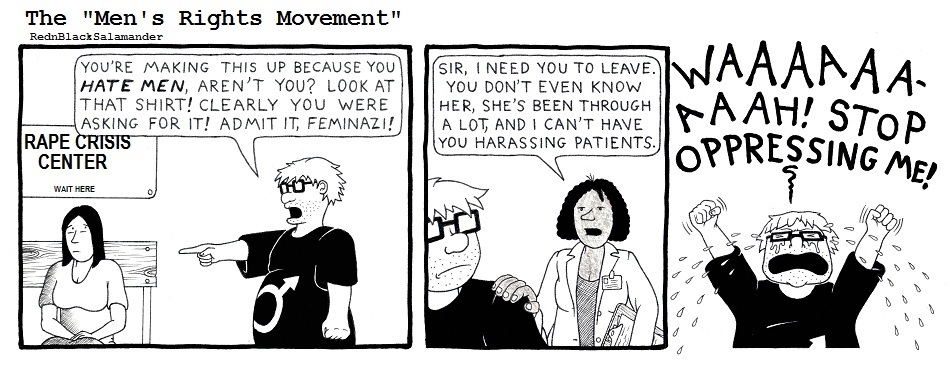
I had previously started writing a piece in response to the Tal Fortgang “check your privilege” article. I wanted to discuss the plethora of space and attention the media (and society) gives to the white, male, cisgender, able-bodied, heteronormative perspective. I briefly stopped working on that article when news of UCSB’s campus attack became public. I immediately thought that Elliot Rodger’s story was perhaps more deserving of being critiqued. This was when I realized the great similarities between these two men (albeit very far away on the violence spectrum) that can be linked to underlying societal de-valuing of trans- and cis- women. I will address these two situations separately before critiquing the reinforcement of hegemony that allows us to avoid blaming ourselves for the rampant presence of continuous threats of rape and death.

For Tal, being told to “check his privilege” is the worst part of his college experience. Tal’s rejection of his inherent privilege denied the negative experiences of others (at college or elsewhere) of racial discrimination, violence, and sexual assault. The stories of so many women, especially transwomen and women of color, are forever swept under the rug, but the whining of a Princeton-educated, non-struggling story of Tal are lauded as examples of how society is forcing white people to feel guilty “just for existing.” It is quite disheartening to know that one’s story will not be believed simply because one does not have the access to media forums in which to express them. Or, even when those stories are told, they are often the white, cis-woman perspective. Or, when women are threatened, we still rely on the charity of men to raise the alarm and offer suggestions.

I praise the strong, powerful women at other institutions, such as USC and Northeastern (my current and previous institution of higher education) that have shared their story and fought back against institutions that deny women the right to say no, and their legal recourse against perpetrators. I was not strong enough to tell my story. Even with my high level of privilege, I was terrified of the consequences of reporting my sexual assault by a trusted friend at Northeastern. The word “survivor” never rang true for me. “Survivor” would imply that I had faced a natural force, like a tsunami or a disease, and overcame the event and devastating effects.  I didn't, though. I was faced with a human force, a man in complete control of his actions, a friend, who I had given my trust to, had made a conscious decision to act, devalue our friendship, and violate my body. This is, unfortunately, the story of so many women in collegiate settings, but so few are given the space to share their stories, or feel that they can freely and without consequence equally access our rights.

Retrieved from this site
Elliot Rodger’s story is also garnering national attention, including his manifesto where he declares his hatred of women and need to enact revenge through murder. Despite such plain, obvious language, some people have come to Rodger’s defense by displacing blame from his white, male privilege to mental illness. One of my colleagues at USC, Francesca Marie Smith, argued that mental illness can be used as an argumentative strategy to undermine the culpable of agents in a given situation. Examining the 2011 shooting of Gabby Giffords, she concluded that a focus on the mental capacity of Jared Lee Loughner derailed larger conversations about the societal pressures and political polarization that may have fueled the attack.

Elliot should not be memorialized, lauded, made a hero, or removed from blame. This was a calculated, terrorist attack on women as a whole because he had been told “no.” He believed he had a right to the female body as sexual property and projected his own shortcomings on the failure of (female) others. People should not watch his videos or read his manifesto: let us not immortalize a misogynist who decided to take life instead of realize the privilege in his own.

Retrieved from this site
These two stories began and ended very differently. Tal has certainly upset people with his lack of awareness and care for the stories of others, but Elliot has murdered. I do not wish to equate these stories; I am not making claims about “all men.” I am instead commenting on the attributes that they share and what this says about our society.

Both are inherently linked to race and gender, because they laud the white, male perspective over all other bodies. Yes, Elliot was mixed race, but there is no denying his feelings of privilege and superiority that accompany this perspective. Both believe in the power of their privileged body to make decisions and that they have the right to remove of agency from others. Tal and Elliot are not allowed to be told “no,” especially not by people of color or women. Tal cannot be told to “check his privilege” and Elliot cannot be denied sex. These are the autonomous decisions of others that put into question the privilege that Tal and Elliot could not even recognize they had (being blind to their own condition and the conditions of others). 

Retrieved from this site
These men are just two chapters in the larger story of a society that allows their privilege to continue unabated, that celebrates and defends them, and that prevents us from looking inward at our own complicity. If it the fault of people who question Tal’s struggle, Elliot’s mental condition, or my inebriation, then society as a whole is declared “not guilty.” We can live in the façade of a world where these events are mere peppered outliers in a properly functioning society, instead of symptoms of a diseased organism. Walking down the street or taking public transportation is an opportunity for women to be yelled at, groped, followed, threatened, or even worse. Even spending time with trusted friends and family members can lead to the violation of the female body. Althusser's police officer defines the power structure and everyone's position in it by addressing someone, "Hey you!" When I walk down the street and am called "bitch" while being grabbed from behind, that also defines me without my permission, reaction, or ability to subvert.

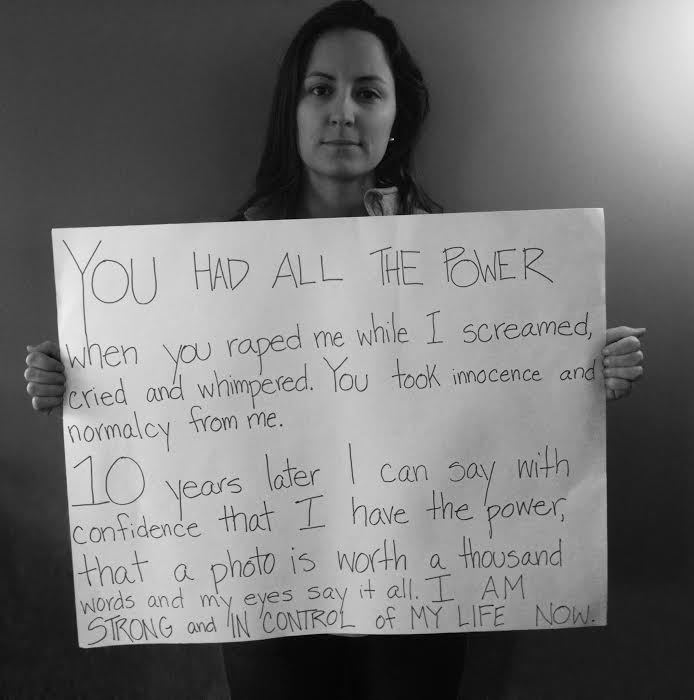
Many more stories of struggle and healing at Project Unbreakable
We cannot let these stories be drowned out by the mob quick to defend the current system. We must give space and attention to those that are fighting for change and awareness of larger issues. We perhaps cannot change the minds of current misogynists or denialists who will resist at all costs the crumbling of the society that preferences them. But, with increased effort, we may be able to usher in new generations brought up in a society that recognizes the issues that face the majority of us and fosters a culture that is actively trying to change it.

Sunday, March 16, 2014

Thin Privilege and LGBTQ Issues: Discrimination based on Choice

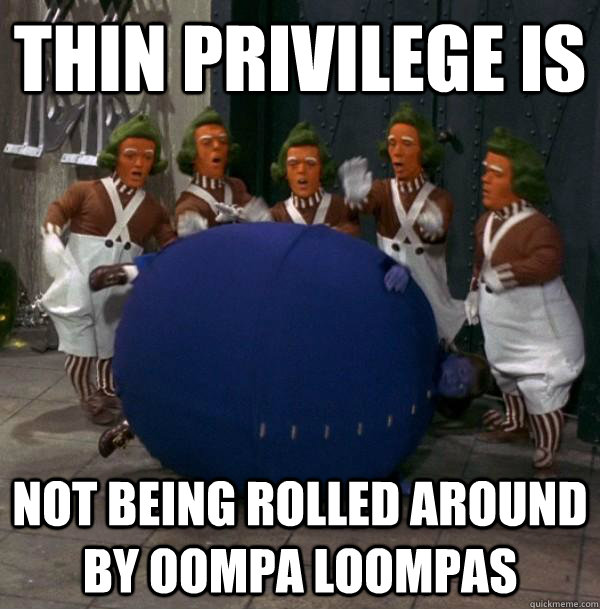
There has been a recent surge in websites, blogs, and tumblrs that deal with "Thin Privilege." These sites have also spawned spoof or parody sites  which have in turn encouraged reaction sites. In the back-and-forth on these websites that I have followed, I would like to comment on a common theme which I think connects issues of health and bodies to the LGBTQ community: choice. First, I will explain these communities then I will draw from examples from each and compare them through Burke's pentad as revolving around agency and choice.

Retrieved from this blog
Thin Privilege reflects the advantages and benefits that come with being thin (or non-fat) in a society that values skinny bodies over large bodies. This has resulted in cultural and institutionally prejudices levied at non-thin people. Thisisthinprivilege.tumblr.com is dedicated to individuals sharing their personal stories of discrimination because of their size. Key themes are the idea that being large in body is associated with unhealthiness (which they argue is not necessarily true), being impacted by a lack of services available to them (such as the size of airplane seats), lacking role models in media, and experiencing fat stigma (e.g., strangers trying to give diet advice or calling names). The stories range from not being able to find clothing sizes in stores to having doctors ignore potential health issues because weight was a perceived larger concern. This site often posts "troll" questions and comments and critiques them as coming from a place of privilege or purposefully trying to undermine their cause. The key take-away from this site is that no one with privilege can deny others their claim to discrimination, police their language, or undermine their cause.

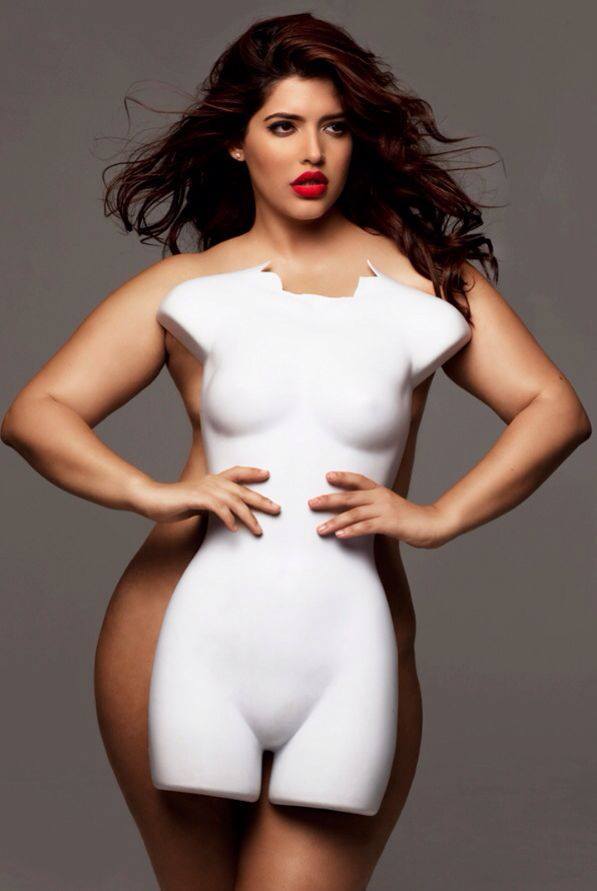
Retrieved from this blog as an example of skewed expectations and a world made for unrealistic body sizes.
From comments on these webpages, I found immense similarities to discussions of LGBTQ rights. The similarities center around the idea of choice. If one believes that being fat or being LGBTQ is a choice, they are more likely to be negative, critical, and dismissive of societal backlash that occurs for them. If one believes that these identifications happen naturally or are a product of the environment (e.g., hereditary/genetic), then one is more sympathetic to the effects experienced. This proclivity to blame the individual (agent) or the environment (scene) can be mapped onto Burke's pentad. The pentad is a tool that critic's can use to analyze situations in terms of its agent, agency, purpose, scene, and act. If the act performed is discrimination against someone, emphasizing the agent may cause one to believe that the recipient caused it themselves. Emphasizing the scene, however, may cause one to believe that society fosters discriminatory attitudes against minority communities. Papers I've been working on, influenced strongly by papers by Brock (1990), argue that these can be directly related to political ideology. Republicans may be more likely to consider the agent responsible (e.g., pull one up by one's bootstraps) and Democrats may be more likely to consider extenuating circumstances (e.g., how scenic factors influence one's actions and treatment).

Retrieved from this site
To consider a large person and a gay person autonomous agents that make choices about their identity is to remove environmental and societal factors from responsibility. This type of view undermines the culpability of institutions and those with normative privilege (e.g., thin and hetero-) for discrimination. Somehow, making a choice to do something as opposed to having it happen to you, makes one more deserving of disdain and scorn. Those who had no choice can be viewed as vulnerable, victims, and innocent. Analyzing these situations as similar help us to connect issues of discrimination and shared experiences of minorities against ableist/cis/hetero/white/male society. From within that community, it is hard to assign oneself culpability and guilt; people would rather blame the individual than admit shared responsibility for discrimination. Just as people were quick to yell "post-race!" with the election of Obama, people are quick to jump to answers that do not include our own or systemic faults.

Retrieved from this site to represent the traditional Barbie size to the new "real proportions" doll

How does society move beyond discrimination? I think it's important for those of us with privilege is to step back and truly listen to the words of those without privilege or those at the intersections. We cannot understand the discrimination not having been privy to it. Trying to deny the stories of others or to argue with our own stories of discrimination only perpetuates structural inequalities. Just consider the backlash that happened when a new Barbie copy with "realistic proportions" came out that would encourage girls to idolize being unhealthy. Instead, why can we not consider these positive steps to creating a more inclusive culture that teaches people to love and respect their own bodies, no matter its size? ThisisThinPrivilege.tumblr.com is fighting against other blogs and the system that devalues fat bodies. Though this article is not meant to be evaluative, it cannot help but reach the conclusion that to reduce people's identities to arbitrary choices is to undermine the perpetual problem of discrimination. As posted on the website, people are fighting a system that "systematically reduces each of us to our dress size, hip measurement, and waist size, then grants favors, opportunities, or simple lack of punishment when the numbers are low enough" and instead fights for a system that treats everyone as equally human.

Wednesday, October 23, 2013

The Importance of Values in Polarization

Past research of my has focused on the difficulties in defining values and applying them to different scenarios. Despite the research complications, values remain an important aspects of politics, religion, culture, organizations, and relationships. My recent readings of the God Strategy and the Faith Factor have reinforced my respect for the "values voters" that make up the religious right and conservatively 1/3 of the US electorate. As a united front, they are an invaluable voting block for Republicans. They typically do not vote Democratic (though recently ethnic evangelicals have for Obama) and are concerned with electing Republican nominees who reflect their values of hetero-normative definitions of marriage, anti-women's choice towards pregnancy and birth control, and a general aversion to stem cell research. The marrying of religion and politics allows for values to remain integral aspects of candidate character and personality.

Cartoon from Times-Picayune

As mentioned before, this focus on values is pervasive for all of all politics, but is especially important for Republicans. As the Grand Old Party, associated with nostalgia, antiquity, and maintaining the status quo, their candidates must embody those values more than the Democratic Party. Democrats, instead, often emphasize abstract goals for future engagement, inclusivity, and are the pioneers in equality and acceptance of minority groups (e.g., the current fight for LGBTQ rights). What has changed in recent years, however, is the polarization of these values into groups that cannot compromise on basic ideas. There is less freedom to express moderate values and politicians are in near constant campaigns. For example, the environment has become a haven for political isolation where Democrats are expected to be environmentally conscious and Republicans who are can be considered traitors. The Republican values of free market and enterprise trump those of the environment, and that is avoiding the larger issue of religious identification that also complicates the issue.


The graph above is from the Pew Research Center American Values Survey that shows the gap between support for the values. The environment has increased dramatically from only a 5% difference in those that support in 1987 to a 39% difference in those that support the environment in 2012. This polarization shows more established party lines on values where compromise is precluded by trying to remain party loyal. What is the future of American politics? How can the polarization continue with politicians and the general public operating as enemies? The 2008 election brought about massive celebrations for Barack Obama's election and massive despair from people convinced that a terrible decision had been made. Similarly, Obama's reelection was met by rumors of secession and outrage by Republicans. Perhaps my favorite response was the emerge of "White People Mourning Romney" tumblr which emerged out of whites being the only race that Romney earned the majority of their votes. South Park's rendition of the hyperbolic reactions that people had in their episode "About Last Night" perfectly sums up the political polarization currently plaguing America.


I would like to be optimistic and predict a reverse in the polarization or at least a breaking point where the polarization is no longer sustainable, but it is unlikely. I do find hope in the small compromises, but they are few and far between. One solution could be a more critical, "unlovable" media that encourages compromise by expressing the dysfunction of current polarization. The Internet can also serve as a new public sphere where citizens can serve as fact-checkers and critical observers to the political process. In the future, the polarization might decrease or change, but for now, politicians seem to be more concerned with maintaining their seats than reaching across the aisle.

Monday, September 9, 2013

Words to Reconsider

I'd previously wanted to title this: Words you shouldn't say anymore, but I changed the title to reflect how my opinions aren't those of everyone. Prescribing language changes for all people, though I believe that these are respectful and accurate changes, is problematic for many reasons. These suggestions are more for people who are already in line with my beliefs, namely liberal ones, and how to adjust your language choices to be more respectful of others and values.

Racial slurs: First of all, my previous post on Django referenced this briefly, but racial slurs are not appropriate in every day use. This primarily applies to the non-African American, black, brown, or identifying groups that may use racial slurs in jest, for shock value, or as a political statement. They are not words that most of us should or can say, by re-appropriating them into white vernacular, they lose their political meaning and importance. Simply put, these words can be used to reinforce power hierarchies and should not be used lightly or at all by dominant groups.


Tarantino Responding to Criticism about Django

Pro-life: This term has bothered me for a long time. What exactly is pro-life about banning women from having abortions? Abortions can be a life-saving procedure and refusing one can lead to complications and death. The idea that a fetus is alive is based on religious definitions that life begins at conception. For non-believers or those that operate under a different definition of when life begins, the life of the mother is the life that needs to be protected. The life of the mother is not always immediately in physical danger, as was Savita Halappanavar's, but there is always emotional and psychological life to worry about. Although many pregnancies are intentional, women do become pregnant for many reasons accidental or through force. Denying these women the right to closure and healing from rape, incest, or other emotional traumas can be damaging to a woman's life as well. Instead of "pro-life" which I have described as very misleading, I endorse the term "anti-choice" to emphasize the true issue: deciding for women what they wish to do with their bodies. If life were really the issue, then the woman's life would weigh importance as well, which for many anti-choice groups, though not all, it is of secondary importance, if that. Perhaps the most disturbing part of the anti-choice movement is that by equating the fetus with a child, they respond to abortion clinics and places like Planned Parenthood as if they were attacking murderers. Abortion practitioners have been threatened and killed (pro-life, huh?) and funding for PP has been cut in many states.

Savita Halappanavar
English in general: I recently read an amazing chapter from bell hooks who discussed the emphasis on clean, pure English as a means of stripping people (primarily former slaves and their descendants) from keeping in touch with their roots through dialect. She quoted a poem by Adrienne Rich saying, "this is the language of my oppressor, but I need it to talk to you". This statement is powerful and I feel needs no explanation or extrapolation except to say that the hegemony of the English language is not something always laudable. We should all try to learn other languages and encourage others (as bell hooks describes in a teaching role) whether they be friends, family, or students to speak how they feel comfortable speaking and encourage expression in multiple voices.

Source

Boy/girlfriend, wife/husband: I think that these words should be replaced with the gender neutral counterparts of "significant other", "partner", "spouse", etc. Assigning and using these terms reinforces heteronormative definitions of marriage that use the binary gender terms, male and female, as the standard. Despite setbacks, such as Proposition 8, marriage is on its way to being redefined as open to homosexual couples. To reflect this openness and one's agreement with the changes, more gender neutral terms should be used to describe couples. Some homosexual couples may prefer the girl/girl friend or boy/boy friend terms, and that should be respected. For general conversation, however, the gender neutral terms are more encompassing and respectful. This gender neutrality follows for trans* and members of the queer community. Pronoun and name usage is something that I am still struggling with, but I find that simply asking for one's preferred gender pronoun is the best option. For some, their outward appearance may not reflect where they are on their personal journey of identification and which gender pronoun they would prefer. One's sexual organs does not adequately describe most people's gender identities and can be restricting in terms of expression. I remember hearing a quotation from a friend at an LGBTQ event at Northeastern: "I wish I had been born a girl, instead of just having this vagina." This statement highlights the struggle of many people attempting to realign their physical gender with one's felt gender and how sexual organs should be not be defining characteristic of a human being.

These are a few suggestions for different word choices that I think might be helpful for more open, liberal-minded people. For people who are anti-choice, pro-heteronormativity, and perhaps unconcerned with issues of race, these suggestions may fall on deaf ears. For others, I hope that these at least spark some thinking about the power of the words that we use, what context we use them, and who we use them with in defying hierarchies and promoting equality.

Sunday, August 25, 2013

Papal Authority and Ethos

Ethos is a term that Aristotle used to describe one of the modes of proof, or support for an argument. Ethos is most commonly and simply summarized as authority and credibility, or how well supported the argument is by the speaker, sources, situation, or position. In terms of ethos, the Pope has one of the most powerful appeals to ethos in the world. With over 1 billion Catholics in the world and support for his position coming directly from God, the Pope is an example of a single, infallible speaker with immense authority and control. Indeed, the Pope is considered a direct disciple of Saint Peter, meant to carry out God's will and speak for God on Earth. I expect most of this information is well-known and thus unnecessary, but I repeat it to emphasize the gravity of the next part of the post.

Following the traditional and literal approaches of Pope John Paul II and particularly Pope Benedict XVI, Jorge Mario Bergoglio began his papacy as Pope Francis I on March 13, 2013. Even only a few months into his papacy, he has already caused much stir over his non-traditional approaches to papal speech and behavior. He has forgone the papal "throne" and opted for a less adorned seat in addition to wearing only white.

Source: Pope Benedict XVI (left) and Pope Francis I (right)

He has also washed the feet of a Serbian Muslim woman and of prisoners instead of traditionally having his own feet washed after his appointment.

Source: Feet-washing by Pope Francis I

More recently, he was under media attention after carrying his own luggage on his trip to Brazil for World Youth Day.

Source: "Only Pope Francis would carry his own bags aboard the plane for Rio!"

But perhaps most important are the words that he has said about traditional Church positions that have prompted prominent members of the Church and the Vatican itself to issue correctives. I cannot emphasize the irony and importance of this statement enough: prominent Church leaders and the Vatican have corrected the appointed voice of God on Earth, the infallible and unerring. Pope Francis I said on his return from Brazil that he and others should not judge the calling of gays to the priesthood. For a Church who argues for the immorality of gay marriage, this is really only a small step for acceptance, but is revolutionary nonetheless. This statement, however, was rejected by prominent New York Cardinal Timothy Dolan in a statement confirming the Church's official position that still considers sexual relations outside of male/female marriage immoral.

Additionally, Pope Francis I made a statement regarding the morality of atheists. Even those without a belief in God, let alone a Catholic follower could still do good and "we'll find a meeting point." People have interpreted this to mean that good people, no matter their religious affiliation, could be allowed into heaven. After this statement, the Vatican issued a statement that anyone who rejects the Catholic Church "cannot be saved."

What does it mean for the ethos of the Pope to be challenged? Is the Church so tied to tradition and antiquity that it must reverse even the slightest hint of progressive, liberal, and welcoming rhetoric? What role does Pope Francis I play if his position as voice of God is subject to human correction? Can he be trusted and considered an authority by followers?

I do not believe that these small statements truly mean that Pope Francis I is a liberal or that the Church is anywhere close to changing its positions (considering the correctives). To say that finding a place for women in the Church is revolutionary is really to forget the fact that it is 2013. The implications of these statements should not be completely ignored, however. What these statements represent is a small, but meaningful step towards increased inclusion in the Catholic Church. These symbolic gestures, though rejected by others, might promote the increased openness of Catholics or at least temper Catholic backlash to liberal social issues. At least this is a positive step away from some of the past teachings that were highly restrictive and more concerned with pomp and circumstance than change.

Source

Thursday, November 15, 2012

Transgender Awareness Week

In honor of Transgender Awareness Week in Boston, I wanted to discuss some ideas about gender identification. Although there have been great strides in marriage equality and LGBTQ issues, the transgender population and their issues are often left out of the conversation. In part, I find the inclusion of LGB with T a partial misnomer. Whereas lesbian, gay, and bisexual individuals are looking for acceptance based on sexual orientation, the transgender community is more concerned with gender norms and obstacles to identification. For example, the issues each group is concerned with varies greatly. When I lived in Boston, I remember regulations being discussed for allowing transgender people to enter bathrooms that may not correspond with societal norms. This was a large issue at the time, but would not an issue for an LGB individual, who would not be barred from entering a public bathroom.


When I consider issues of gender, I cannot help but think of reading I did for my summer project on the relationship between science and religion. Gender is a scientific and religious construction that defines gender as a binary and by physical characteristics. Even though modern science dictates gender as a more fluid identification, past categories have constricted gender expression into arbitrary labels fueled by religious needs for procreation. The first fact established about a person is their gender. Consider the first knowledge gained by a pregnant couple, even before the name, eye color, or personality, the parents know the child's gender in a male/female dichotomy. This piece of information determines color schemes for bedrooms, gifts for a baby shower, naming conventions and decisions, and expectations for the birth.

Simply put, one's gender is decided for oneself and becomes the defining factor for identity. Incongruity with a personal belief and experience and what has been provided for someone by others can create drastic psychological issues that can lead to destructive behaviors. As seen in the statistics below, transgender people are at risk for certain behaviors and are at risk for being treated differently because of their gender identity. I think it is important to remember how life-changing such an identity crisis may be. People are not simply changing their hair color, but they are undergoing a personal restoration to how they feel is the appropriate, representative, and correct gender, or anywhere along the spectrum.

Image retrieved from this site.
When people do not conform to these gender norms, society's discourse breaks down. Scientific, religious, and public discourse is only beginning to establish terms that break the binary and are truly representative for all people. The inability to express oneself, partially because of hegemonic discursive structures that restrict fluid definitions of gender. The way that society is structurally organized leaves little room for open spaces to discuss the body (e.g., at a doctor's office), naming transitions (e.g., at a university or with the government), or protection (e.g., with the police). The problems that face transgender people are still only on the horizon of LGBTQ concerns, but I hope that in the future, as more strides are made for LGB individuals that transgender issues will become more prominent. Leaders in this area should be lauded as they are paving the way for other people and politicians to become more aware of transgender concerns.

Wednesday, November 7, 2012

Faith in Humanity: Will it be Restored?

Doing research on the intersection of religion/politics and religion/science have brought forth some interesting, shocking, and saddening examples of what happens when these collisions occur.

Some things that I have read have made me echo the immortal words of Professor Farnsworth on Futurama:


This bill in Tennessee would place those who have had an abortion on an information-sharing list similar to sex-offenders.

The passage of this law in Idaho questions women's abilities to understand if they have been raped and requires them to view an ultrasound of the fetus before obtaining an abortion.

A doctor in Kansas is being stripped of her medical license for agreeing to provide an abortion to a 10 year-old rape victim carrying her uncle's child.

Protesters at Gay Day in Michigan threatened to rape and kill participants in the event, quoting and relying on biblical verses to justify the attack.

Representative Andy Gipson (R - MS) stated and then confirmed his opinion that it is people's duty to follow the word of God by having members of the LGBTQ community put to death.

Doctors in South Dakota are now required (as upheld by a recent ruling) to advise women seeking an abortion that there is a psychological link between having an abortion and depression and suicide.

Republican politicians confirm the active disenfranchisement techniques of Republicans towards African American and Latino voters.

Massachusetts judge approves a sex change operation for an inmate and sparks outrageous comments about the rights of prisoners, sex change operations, and tax allocation.

Stories like these ones above are not always bad, however. They remind me that there are still issues in the world that need to be addressed and corrected. We as people, part of humanity, cannot be satisfied with partial victories, segmented success, or the fracturing of freedom and equality.

Other news stories, however, help me to strike my best Freddie Mercury pose and exclaim:


The passage of the Affordable Care Act allow for equal coverage for women and access to preventative measures so they can be in more control of their health care.

Obama's statements on gay marriage and the Democratic Party supporting the repeal of the Defense of Marriage Act, though a small step, is an important first political gesture to inclusive marriage equality.

The repeal of Don't Ask, Don't Tell ended the prevention against open homosexuals from serving in the military and allowed for people to be open and honest about their identities.

The election of the first openly gay Senator and the passage of marriage equality in Maine and Maryland.

I hope that in the future, I will see more progress towards the acceptance, tolerance, and inclusion of all of humanity through equal treatment and opportunities. These are goals that we all can strive for and as scholars, voters, and communicators, we can strive for change together.

Thursday, November 1, 2012

Political Advertising: 2012 Election

During my summer in Pittsburgh, I traveled across the state multiple times and saw many conservative billboards. My time spent in Philadelphia, Boston, and Los Angeles has not afforded me such exposure and I found many of them worthy of comment. The power of the billboard is in its simple, clear messaging, stylistic dimensions, and highly partisan statements. The limited space is no place for moderate remarks, especially when they come from third-party groups and can be as brutal as possible. One of my favorite billboards read "Coal: red, white, and blue, and always green". The appeal to colors highlights how patriotic it is to support coal, but also its eco- or environmentally friendly properties. There is no room for argument or debate on the billboard, simply a statement that the viewer can agree or disagree with as one drives past.

The purpose of this post, spurred by my interest in billboards and political advertising, is to describe a few political advertisements in the 2012 presidential election cycle. The advertisements share important information about candidates that are small, concise, sound bites for easy consumption. One that was prominently on display entering downtown Pittsburgh said:


Obama supports gay marriage and abortion, do you? The word "supports" portrays Obama as one who wants everyone to participate in gay marriage or have abortions, as opposed to supporting an individual's rights to choose these for themselves. Asking the viewer to reflect on these topics encourages an emotional and negative response in those questioning or already leaning conservative (at least on social issues). The enthymematic conclusion to this billboard is that by voting Republican, you will be voting for someone who does not support these rights, ergo Romney does not support gay marriage and abortion rights. This can be a powerful motivator for those who are undecided or conservatives who are concerned about Romney's reputation for flip-flopping on social issues.

Another way that Romney is trying to re-claim the conservative base is to promote the Christian ideals he shares as a Mormon. The Mormon.TV videos highlight their belief in Jesus Christ, "the savior of mankind", the variety of people who follow the Mormon faith. Mormonism has a negative association with being mysterious, cult-like, and secretive. This website and their television advertisements can help in part to assuage those concerns that Mormons are somehow dangerous, occult, or different by sharing the experiences of Mormons as people and how their faith is (for the most part) similar to mainstream Judeo--Christian beliefs. In fact, the differences between Mormonism and Christianity is the same between Christianity and Judaism, they simply believe in the divine inspiration of one more book.


An Obama advertisement that caught my eye was the "For All" advertisements that are being shared on Facebook. Borrowing from the unifying visual statements of the 99%, the advertisements show celebrities and everyday Americans and what they are passion about and fight for. The statement is quite unifying in the copying of the action, but also in the overarching statement that people vote not just for themselves, but to protect the rights of others.

Retrieved from this site
The juxtaposition of celebrities and everyday Americans also creates an inclusive environment, while also capitalizing on the celebrity support that Obama receives. This is also a contagion effect, where supporters can also mimic the post position and upload their own versions. Just as the 99% signs showed people holding up signs to portray their economic/employment/education situations for the Internet to see, this simple act of writing on the hand (and holding it over the heart as in the Pledge of Allegiance) can be mimicked by everyone worldwide. The visual is a powerful one and one that supporters and independents feel they can engage and connect with.

As the debates are underway and the campaign is heading into the final stages, the advertisements are more likely going to be even more negative and targeted. I never realized how many political advertisements that I saw when I lived in Pennsylvania until I moved to Massachusetts and California and now have seen very few. The ability of technology to micro-target communities means that voters in swing states are receiving the most advertisements and attention from candidates whereas other "safe" states will get very little attention. Trends that I perceive are the increasingly negative third-party advertisements, the focus on values and "change" from Obama (who seems impervious to gaffes or media attention for mistakes), and the struggling Romney campaign trying to salvage the conservative wing with whatever means necessary.

Wednesday, August 8, 2012

The Politics of Food and Consumption

Consumption and food are not new contributors to political identities, but one may imagine it is so considering the multitude of coverage surrounding the Chick Fil-A "eat-ins" and political denouncements. The old adage, "you are what you eat" echoes common academic themes of consumption outlining important characteristics of someone. Eating is something that people do consistently, and even the absence of eating communicates political, social, and personal values.

As a vegetarian, I have had my entire life of experience defending my choice of following a specific dietary habit. Refusing meat, questioning waiters at restaurants, and scrutinizing ingredients lists are often activities that I have to defend or justify as outside of the norm. People are vegetarians for multiple reasons, often attributing actions to animal rights, environmental concerns, allergies, and religious restrictions. For me, my vegetarianism is a product of tradition and family, being raised a vegetarian since birth and eating and cooking in the vegetarian lifestyle is an important part of my family life. For any reason, removing certain parts of a diet begs the question of explanation (and sometimes inclusion of certain foods, such as cultural foods). These questions would not be necessary unless one's choice in consumption were meaningful or symbolic.


This relationship has risen to great importance and attention in the media with the recent discussion of Chick Fil-A's support of traditional marriage groups and anti-homosexual groups. The politics of the organization has encouraged politicians, celebrities, and the general public to associate their products with their ideologies. Similar reactions have plagued organizations that participate in child-labor, unfair business practices, or are unfair to their employees. Boycotting has been around since the creation of the United States, when people refused to purchase items that were unfairly taxed. What, then, is the issue with Chick Fil-A boycotts and the discussion at hand?

I don't necessarily think that there is anything inherently "wrong" about the Chick Fil-A argument. I would rather media attention be focused on the rights of the LGBTQ community or contextualize these discussions within the larger battle for universal rights and marriage equality. Instead, news reports are often solely focused on the actions of individuals and the organization as opposed to the cause that is driving the discussion. When the news reports become overwhelmed with free speech and balancing the scales by allowing both sides their viewpoints, the actions of Rahm Emanuel and Tom Menino are undermined and discredited.


The most important part of these demonstrations is the power of the individual. Through simple actions such as spending money, kissing, and eating, bodies act as rhetorical tools for the creation and expression of identity. Even if I did consume meat, I would have been happy to participate in the Chick Fil-A boycott, using my consumption, or lack thereof, to complement my political and personal values. Although I admit I was skeptical of the ban at first and questioned its fairness, I am now proud of my alma mater, Northeastern University, for banning Chick Fil-A's establishment in our student center. Banning Chik Fil-A represents the importance of the LGBTQ community on Northeastern's campus, which recently approved general neutral housing, preferred name and pronoun identification, and multiple student groups and training groups for inclusiveness on campus.


Instead of allowing for the power of consumption to force the Chick Fil-A to leave, Northeastern used its political power to avoid the issue altogether. The issue, then, becomes when people are willing to consume, purchase, and use their bodies as supporters of hate, bigotry, and exclusion and are defended as heroes of free speech. In that world, our world, change will be slow and riddled with obstacles. Recognizing the power of consumption and encouraging people to eat consciously may be part of the solution towards equality and empowering businesses as political entities.

Tuesday, May 1, 2012

Civil Rights and Marriage Equality Metaphors: One and the Same?

The first time I was confronted with the metaphor that compared the current LGBTQ rights movement to the civil rights movement was on an episode of the Tyra show called "Gay Kingdom".

Part 1 - other parts available from YouTube

At first, the comparison seemed odd to me, especially when one considers the history behind the civil rights movement and the connotations that the comparison brings. The treatment of these two groups, black rights and gay rights, are obviously different in the treatment that they received from the dominant white, straight and patriarchal hegemony of the United States. But, upon listening to the metaphor of "second class citizens", the comparison began to make more sense. Are members of the LGBTQ community not being undermined because of their sexuality and gender identity to second-class citizens? Their love, their relationships, and their unions are relegated to a less-than-human status by being denied the same rights as straight, heterosexual couples.

This metaphor is not a perfect metaphor, as one cannot directly relate discrimination based off of race to one based off of gender and sexuality. The commonality of discrimination, however, may be enough to make this metaphor narrative fidelity. Walter Fisher proposed that stories have to have probability (likelihood of happening) and fidelity (coherency) in order to be an acceptable story for people to live by.  The deaths and torment that occurred under slavery cannot truly be matched by the LGBTQ movement, even though there have been terrible crimes, murders, and persecution of the group. But, if one removes the history (perhaps impossible) from the equation, and solely focuses on the rights movement of each group, their are parallels. Both groups are struggling against inequalities, being treated like second-class citizens, as less than human, and have been met with strong opposition legally, politically, and socially. There are real physical risks to those who support the movement and it is a human rights issue that people are willing to fight for.

This CBS article also uses that metaphor in a quote from Assemblyman Reed Gusciora who is currently sponsoring the marriage equality law in New Jersey. It is clear that marriage equality laws are up against large protests and oppositions by politicians in many states, with very few states allowing same sex marriage and heated battles raging in many currently.


This info-graphic has gained much attention online at the inequality of marriage rights and it comically and bluntly portrays the limited rights of homosexual couples. This struggle has only just begun and the success of Proposition 8 exemplifies the hardships that still await equal marriage even in more liberal states. Politically, I am cautiously optimistic about the progress of achieving equal marriage in the United States. It is an inevitability, but I am unsure how quickly and how easily the laws will be passed. Additionally, gay marriage only scratches the surface of rights important to the LGBTQ community including but not exclusively: gender identification for transgender individuals in schools, housing, legal forms, sports, and restrooms, bias in the job market, college admissions, and politics, crime and vigilante persecution of individuals, and many others. There is much work to be done for gay rights and I wholeheartedly agree with Hilary Clinton's United Nations speech where she argues that gay rights are synonymous with human rights. Undermining the rights of any human based on discrimination for any reason is a battle that the world should fight for.


I believe it is possible to compare the civil rights movement and the LGBTQ rights movement in terms of rhetorical power and metaphoric strength, but doing so brings up problems. The danger in making the comparison, thus, is over simplifying each group's story, reducing the narrative to its basic structure and removing the unique history, culture, and variation that makes the stories ring true. The final verdict here is no matter the rhetorical and narrative choices the LGBTQ movement and supporters make, there is a responsibility for the country to fight for LGBTQ rights for the sake of equality for all.