Showing posts with label fisher. Show all posts

Wednesday, April 3, 2013

Vampires and the Narrative of TV Shows

Despite the proliferation of vampire/zombie/werewolf media figures in recent years, I find myself drawn into the various iterations and rule changes that simultaneously govern the characters and direct the plot in some popular shows and movies. How these rules change within the same mythology determine the flow of action and restrict plot twists complicate "lore" for the sake of an engaging narrative.

Dean and Sam on "Supernatural" encounter various ghosts, mythical creatures, and curses that each can be undone through their unique combination of research/brains and violence/brawn. There is a repetitive scene where Sam discusses the multitude of "lore" and history surrounding the supernatural occurrence and the two brothers discuss which solution or cure is the accurate one. Despite the various myths and folklore surrounding the situation, the brothers eventually find the solution, whether it be by manipulating the history or using a tried and true method.
Jessica on True Blood

Vampire on Supernatural
Caroline on Vampire Diaries

For example, the vampires on Supernatural are different from the ones on Vampire Diaries or True Blood. On Supernatural, vampires grow an extra row of teeth that emerge from the top gums. On Vampire Diaries, the creatures' teeth only emerge when they see blood or are about to feed and it is only the canines that grow to be longer and pointed. True Blood also only has one set of teeth grow, but it is the lateral incisors instead of the canines. Supernatural vampires create more vampires by bleeding into an open wound on a human's body. Those on Vampire Diaries become vampires when they die with vampire blood inside of them (and complete the transition once they consume human blood). True Blood vampires turn when they are drained of their vampire blood and replace it by drinking (and thus replacing) their blood with vampire blood (and complete the transition once they are buried in the ground). These various methods of transformation drastically change the plot of each show. Unique to Vampire Diaries, someone could be at risk for becoming a vampire without their knowledge (accidentally or unknowingly consuming vampire blood), while the other shows involve some type of direct contact with a vampire.

Perhaps the most interesting adaptation to the vampire myth is the sun. In True Blood, the vampires almost exclusively interact in the evening. They are vulnerable during the day when they are resting in their coffins and burn to death once entering the sun. This allows for interesting plot devices where vampires must fight through the pain of sun to help humans, the creation of vampire-friendly hotels with blacked out windows, and the constant threat of attack during the daylight hours. The setting and rising sun becomes a countdown clock for action in the show where tasks cannot be or have to be completed before a certain time. Fairy blood thus becomes a powerful and all-consuming commodity because it allows the vampires to walk unharmed in the sun, driving much of the action and focus around Sookie Stackhouse.

Eric and Russell burning in the sunlight
Vampire Diaries gets around this biopower by relieving the vampires of their reliance on the sun. By using the power of witches, they have magical rings that allow them to walk in the daytime. This creates another interesting set of restrictions that makes vampires more difficult to identify. Danger is thus more prominent and surprising as people who cannot come out during the day are easily identified in True Blood as vampires. In both series, vampires are restricted in their consumption of human blood. True Blood vampires use a synthetic blood (the namesake of the show) to curb their thirst for human blood, though there emerges a strong divide between vampires who consume True Blood (mainstreamers) and those who still feed on humans. An analogy can be made to this distinction and the Chick Fil-A argument that constructs consumption with identity politics. Vampire Diaries vampires do not have a synthetic blood option, but many choose to rob blood banks or feed from animals in order to avoid harming humans. Again, the stigma involved in the consumption of humans is both honored and vilified as competing groups determine their own consumption rules. Interestingly, Vampire Diaries vampires can consume "human" food, while True Blood vampires cannot (instead they "flavor" their food by changing the diet of the human).

Vampires and supernatural creatures are similarly constructed with different rules and restrictions in the media to allow for and direct certain plot points and devices. The key to the differences is keeping them believable, probable, and consistent. Fisher used the terms narrative fidelity (internal consistency) and narrative probability (external consistency). The interesting twist in shows such as Supernatural, Vampire, Diaries, and True Blood is that the existence of these creatures in and of themselves problematic to "reality". Given their existence, however, the shows can construct their own rules based on different mythologies. As long as they make sense within their own narrative reality, the audience can watch multiple shows and still engage with the vampire narrative.

Wednesday, February 27, 2013

God the Mother: Femininity and the Bible

On USC's campus in the past fall, I was approached by a woman as I was walking home from class. Thinking that she might be looking for directions, I was surprised when she approached me and asked if I had  heard of "God the Mother". I hadn't; of course I had heard of God the Father, the traditional Judeo-Christian  appositive for a higher power. I was intrigued and asked her to tell me more. This facet of Christianity follows a path of divinity for a character they call "the mother". She is described in Revelation and also in Galatians as Christ's "bride" and the "mother" of all humans. When Christ returns in his second coming, the World Mission Society Church of God believe that both female and male forms will come to rule.

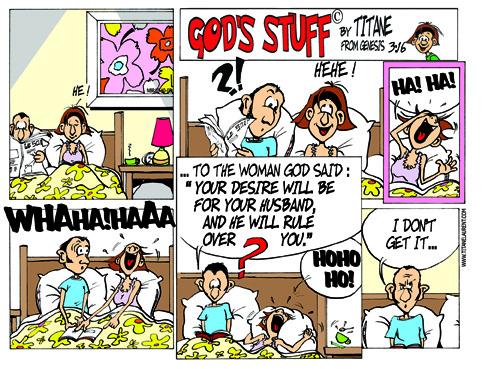
Upon first hearing, these ideas sounded unique and ground-breaking to me. A larger, more prominent role for women? To be considered divine and worshiped  playing a role (as opposed to the passive Virgin Mary role) in human salvation? It seemed a positive and reassuring step in the right direction for gender equality in faith. The patriarchal system in Christianity is undeniably exclusive to females. Although some facets do allow for women to be ordained and serve in higher roles, typically faiths that believe in consubstantiation do not allow for female priests as the priest becomes Christ momentarily during the transformation of the bread to the body of Christ. Furthermore, many biblical passages undermine the role of women and encourage subordination. For example, 1 Timothy 2:12 reads, "I do not permit a woman to teach or to exercise authority over a man; rather, she is to remain quiet". Titus 2:5 describes that women should "be self-controlled and pure, to be busy at home, to be kind, and to be subject to their husbands, so that no one will malign the word of God". This is of course excluding the many passages that discuss women as property or commodities to exchange. This hierarchy of the male over the female has been reinforced or at least continued through faith (and also science, see Ferngren's Science and Religion), so I thought that this group might be an interesting foil to traditional interpretations.

I agreed to attend weekly meetings with a missionary on campus and learn more about the faith. Fascinated, I took many notes on our meetings. I quickly found, though, that this church was not as different in their treatment as I initially thought. Learning about the "God the Mother" figure reinforced for me that this was merely a different manifestation of the already sexist female role in Christianity. Similar to the role of the Virgin Mary, as I briefly described above, the Heavenly Mother emerges as a vessel, place holder, and masculine foil, with no power, characteristics, or importance herself. Instead, the Heavenly Mother incorporates the traditional gender roles of femininity (i.e., bride, spouse, mother) into a divine form. Though it may seem encouraging to have a female face among the divine, her role as a foil to Christ removes any autonomy and importance in her narrative role. To maintain narrative fidelity (as proposed by Fisher's narrative paradigm), the patriarch must still be in place and the hero of the story must remain the male protagonist. The Heavenly Mother does not challenge this role, become a hero or protagonist herself, but merely complements the masculine figure.

From Godstuffcartoons.com

The Heavenly Mother, and consequentially, all women, are also only laded, valued, or given importance when they fulfill their gender roles. The Heavenly Mother does not have a name, like Christ, or a purpose, other than to serve Christ and be the mother of all humans. The Heavenly Mother thus becomes nothing more than the Virgin Mary: a divine vagina. Her sexual organs are the only meaning she provides for the narrative, as a sexual object for Christ as bride and a vessel for human life as mother. The woman I met with emphasized the importance of the family structure, the "nuclear" mother, father, children unit that is the backbone of society. This structure is a metaphor for the larger Father, Mother, and humankind as children. After prompting by me, my faith partner also admitted that the LGBTQ community does not fit this holy female-male binary (transfemales not in possession of the normative sexual organs) so should be banned from marriage.

My hopes for a more inclusive, engaging, and female-friendly version of Christianity were definitely dashed. I see no benefit to having a divine female figure if her only contribution to the faith is her vagina and its function. I continued to meet with the conversation partner for a few weeks, learning about why her faith was the "true" faith and the literal word of the Bible and its importance. Not only does this faith believe in the second coming, but they believe it will happen in our lifetime. During that apocalypse, we will be welcomed by both Christ and his bride, to be reunited as a heteronormative, nuclear family.