There has been an influx of attention on the phenomenon of "the
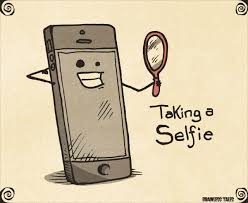
selfie." I know that I am perhaps a little late to this discussion, partly because it is far outside my typical realm of interest. A small epiphany regarding them, however, has prompted me to address what I think is an overlooked but important aspect of the selfie: the Freudian divide between self-love and object-love. The selfie is the perfect integration of our love for technology and our love for ourselves. To illustrate this union, I will first describe the myths of Narcissus and Pygmalion on which Freud based the two extreme disorders of love: ego-libido and object-libido.
 |
| Retrieved from this site. |
Narcissus was a Greek youth that was captivated by his beauty reflected in the river. He wasted away and finally died being unable to leave his mirror and break his own gaze. The basic version often excludes the presence of Echo, the nymph who falls for Narcissus but is unable to warn him of the danger. She can only repeat the words of others and represents the love that others felt for Narcissus that was not returned. Instead, Narcissus turned his love inward and loved only himself (and specifically, only his aesthetics and beauty). The myth of Narcissus has inspired the phrase "narcissistic personality disorder" or Freud's ego-libido, which links a physical and emotional desire for oneself over others or objects. This is also associated with megalomania, or the idea that oneself is more important or better than others. Before summarizing the tale of Pygmalion, it is easy to note how narcissistic themes can be seen in today's individualized society.
 |
| Narcissus discovering his reflection. Retrieved from this site. |
Pygmalion was a Greek artist who built a statue so beautiful that he fell in love with it. Appealing to the gods for reprieve from his unrequited love, his statue Galatea was brought to life by Aphrodite. They married and Pygmalion was able to spend his life with his creation. Many variations, plays and films, have emerged from this myth, where different variations on "brought to life" have emerged. A notable one might be the recent film, Her, where Joaquin Phoenix falls in love with the operating system in his phone. His phone, as an object, came to life with a personalized, teachable, intelligent female voice. In a brilliant dualism, Phoenix even has a sexual experience with Samantha less creepy than phone sex he previously performed with an actual person. Pygmalion is the myth of object-love, in opposition to Narcissus as the myth of self-love. Physical and emotional
eros is directed as certain people and objects that epitomize how people can love.
 |
Pygmalion discovers that Galatea is now human. Image retrieved from this site.
Currently on display in The Lourve, Paris. |
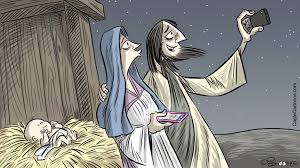
The two forms of libido and love: inward and outward come together in the selfie. This new trend in photo-taking simultaneously emphasizes the importance and singularity of the individual and glorifies the technology that allows the self to be captured and spread so easily and prolifically. This is particularly apparent in images that also show the camera in a mirror as opposed to a front facing camera shot. The phone is immortalized in partnership with the individual, a perfect union of self- and object-love. We love ourselves, so we wish to capture our image and likeness. We love our technology, so we capitalize on its capabilities to connect ourselves with the world. As in Narcissus and Pygmalion, the love is often an aesthetic, physical love for appearances, than a deeper emotional love as is lauded in Plato's
Symposium.
 |
| What Would Jesus Post? Retrieved from this site. |
To worship ourselves, we fall into the phone's lens which collapses Narcissus's river. Our phone becomes our partner, come to life in its utility, friendship, and closeness. People cannot be without their technology, phones at their sides or in their hands, preferring the reflective screen to the faces of people around them. Some may say that like Narcissus, we will waste away focused on ourselves, individuality, and narcissism that restricts us from progressing or experiencing the world. Some may say that like Pygmalion, we are too emotionally and physically involved in our technology that we miss the beauty of the world around us in favor of a Google search for its likeness. In my cursory experience with selfies, I take very few and have posted even fewer, I see many positives and negatives to the phenomenon.
Undoubtedly, it has taken news media by storm. The selfie of Obama and Biden made
headline news and people were discussing the
Oscar selfie (which was potentially a contrived Samsung advertisement) almost as much as the award winners. I'm not sure about the wide appeal of other people's selfies (in the immortal words of Mallory Archer: why would anyone want a picture of someone else's food?), but as a personal expression of self-worth, confidence, and creativity, selfies do have an important role in the rhetoric of identification. Especially considering that some people may not always find themselves presented in media (or they are expressed
negatively), online, or in safe spaces, selfies could help establish an online presence and carve out spaces for open discussion about personal identification, labels, and communities. Selfies create
visibility, are unapologetic, and bluntly express one's visual appearance, identity, and existence as important and worthy of appreciation. Even if it is produced for personal consumption, it necessary sharing (often on social media sites) encourages a reflection of how it may influence a larger public. The physical presentation of the body demands attention, space, and
gaze onto individual, their stories, and potential arguments. The selfie also glamorizes the power of technology, to turn what would have taken many hours of labor to produce a self-portrait can be accomplished in seconds and sent around the world instantaneously.
I hear the cries on both sides about the narcissism and objectification that is implicit in the selfie. But, I see the selfie as merely an offshoot of these larger cultural changes than a root cause or responsible for them. There are innovative potentials in how the selfie could carve out rhetorical communities, enhance identities, and change norms of personal expression. Though I can imagine Kenneth Burke terrified by the reliance on technology that he warned against, I hope that he might appreciate the rhetorical opportunities for identification, mimicry, and understanding between people that may otherwise never have met. And, the rhetorical opportunities for personal expression and control over how one defines themselves and their relation to the world.