On Friday, September 25th, I attended an event at the USC Caruso Catholic Center hosted by many organizations including Pando Populus. This organization takes it name from the pando tree and describes its significance on its website: "Above ground, Pando appears to be a vast grove of individual trees. Underground they are all interconnected through a single root system. Each part is affected by and nourishes the other. It has survived this way for as long as 80,000 years." The pando tree is a synecdoche for the interconnectedness of all life and an analogy for how we must work together to correct the damage done to our environment.
The event was held in support of Pope Francis's visit to Washington D.C. and the release of his encyclical "Laudato Si." The event was religious-themed with the Bishop Mary Douglas Glasspool representing the Episcopal Diocese of Los Angeles, held in a Catholic Church, with speakers from the Muslim Public Affairs Council, Faith2Green, and Interfaith Power and Light. The theme, "The Pope is Pando" lauded the work of Francis as a figurehead and representative of how religion can be a uniting force for environmental activism. I've previously discussed the rhetoric of creation care as an emerging social movement with the potential power to tip the scales in favor of larger influence. While the group I studied was primarily evangelical rhetoric, it's clear that many religions are finding common ground in the spiritual to influence their view of the natural.
Logo for the Pope is Pando event. Retrieved from this site.
In Francis's encyclical, he made repeated mention of an "integral ecology" where life is integrated in a familial metaphor. Common to Catholic and Christian rhetoric, the familial metaphor connects people and faith leaders as fathers, mothers, sisters, and brothers. Francis incorporates the environment in the familial metaphor as shared children in God's creation. He argued that the Earth and nature are female family members: "our common home is like a sister with whom we share our life and a beautiful mother who opens her arms to embrace us" (p. 3). The feminization of "Mother Earth" is a phenomenon I would like to explore in a different blog post. For now, I will say that emphasizing the femininity of nature implies vulnerability in need of our protection and to motivate us to save her as one might a damsel in distress. Francis argued, "This sister now cries out to us because of the harm we have inflicted on her by our irresponsible use and abuse of the goods with which God has endowed her" (p. 3). If we are all interconnected - a united organism - then a threat to one part of it is a threat to the whole. Faith appears to be one way that people are transcending differences in order to focus attention away from economics and politics and onto justice, morality, and the environment.
The consequences of climate change have become more prominent, but many of the harsher, more extreme consequences will not be felt by this generation. Part of the difficulty in crafting persuasive climate change arguments is about "jumping" the inter-generational gap. An intergenerational argument encourages people to act not in their own interest, but in the interest of future generations. Though most of us alive today will likely avoid most of the harshest effects of climate change, our children and certainly our grandchildren, will not be as lucky. People tend to be fickle, however. They are many things vying for our attention, pulling us in different directions, so anything further off than right NOW seems too far off to be worthy of our time. As Burke noted in Permanence and Change: “A philosopher, if he has
a toothache, is more likely to be interested in dentistry than in
mathematical symbolism. Communication cannot be satisfactory unless the
matter discussed bears in some notable respect upon the interests of the
auditor” (p. 37).
How do we get people to care for youth? For animals? For anyone but ourselves? It is not simply a matter of narcissism or selfishness; it is just far easier for people to react based on their immediate surroundings. Thinking ahead requires much more energy than simple observation, putting oneself in a different mindset is difficult, and there can be other, conflicting loyalties that stop one from accepting long-term arguments. One of these arguments is economic: short-term business and profits may suffer when making long-term environmentally friendly decisions. Another complicating factor may be religious beliefs about human's dominion over the earth. Or, it might simply be a political affiliation that often denies science and climate arguments in deliberative spaces (Gauchat, 2012).
Author and activist Zadie Smith. Retrieved from this site
One of the ways to spread intergenerational messages is online. When public spaces may be held to standards of balance or may receive denialist backlash, the internet can serve as a location for the expression of information. A recent article by author Zadie Smith called, "Elegy for a Country's Seasons" addresses the current apathy in the climate change debate and how she might explain our inaction to her granddaughter. This excerpt from the piece is particularly important as the excuses given seem to pale in comparison to the burden that we will leave this young girl and all children as we bicker over money and politics.
"This will no doubt look very peculiar to my seven-year-old granddaughter. I don’t expect she will forgive me, but it might be useful for her to get a glimpse into the mindset, if only for the purposes of comprehension. What shall I tell her? Her teachers will already have explained that what was happening to the weather, in 2014, was an inconvenient truth, financially, politically—but that’s perfectly obvious, even now. A global movement of the people might have forced it onto the political agenda, no matter the cost. What she will want to know is why this movement took so long to materialize. So I might say to her, look: the thing you have to appreciate is that we’d just been through a century of relativism and deconstruction, in which we were informed that most of our fondest-held principles were either uncertain or simple wishful thinking, and in many areas of our lives we had already been asked to accept that nothing is essential and everything changes—and this had taken the fight out of us somewhat" Smith, para. 11.
Written articles may take time to read through and may not offer direct and easy consumption of information (however beautiful and engaging Smith's article is). Another potential solution is to create videos that craft intergenerational arguments. This video is from the Australian Coal Mining Company that has a unique intergenerational plan for halting the effects of climate change.
This humorous video has an important point. It mirrors the argument by Smith about passing the buck onto future generations when we could have done something about it. When we stand back and look at the potential consequences, what are our excuses? Is it really enough to look at dollar signs or listen to denialists when we are faced with the guilt of harming all future life? Dramatic? Maybe. Accurate? Certainly. These arguments are not always successful, but people should try to become more attuned to them. Focusing on the current effects now can be an entryway in to discussing how it will only get worse, and our children will suffer for it.
I am traveling for the next few weeks to attend the International Society for the Study of Argumentation Conference in Amsterdam. Instead of a longer, more in-depth piece, I hope that you may read a few blog pieces that I've written for the Earth Sciences Communication Initiative. This is a long-running research partnership that I've had that focuses on the intersection of the environment, politics, communication, rhetoric, and advocacy. More information on the group can be found on ESCInitiative.org.
Harm to Animal and Plant Life as Motivation
This article explores the potential threats of climate change to animal and plant life. More specifically, it addresses how these threats are conceptualized as motivation for taking action towards environmental protection. These might not be as successful rhetorical strategies as appealing to direct threats to ourselves or future generations, but they still reflect a potential opportunity for change.
Creation Care: Uniting Science with Moral Imperatives
In response to Pope Francis I's recent discussions of climate change and environmental stewardship, this article addresses the creation care movement and how it marries environmental concern with a moral imperative to act. You can read my four part, intensive critique of this movement here (Part 1, Part 2, Part 3, Part 4).
Climate Change is No Joke. . . or Is It?
This article interrogates the use of humor as a potential tactic in promoting forgiveness and action. Instead of condemning and punishing people for environmental crimes, the comic frame could allow for a more positive, productive engagement with environmental topics.
There have been scholarly discussions over the purpose/value/potential impact that the creation care movement might have. It is tempting to be pessimistic in a political culture that seems to be stuck in the constant polarization between affirmation and denial instead of focusing on efficacy to action. I see some potential in the creation care movement, however. Although the loudest voices we hear are focused on denialism and their detractors who try to debate them, most Americans lie in the middle. I am not concerned with convincing the denialists, but with changing the debate. Creation care could potentially be an avenue to speak the (religious) language of many Americans and people around the globe. The movement shifts the conversation from quibbling over scientific data, undermining science as a field of inquiry, and valuing money over people, to intergenerational arguments about charity, and a deep concern for the poor and nature.
Though I agree that too much optimism will only lead to disappointment, I feel that there are positive steps being taken and creation care messages being presented in the media. Recently, Pope Francis I made a strong statement in support of creation care. This was perhaps his most prominent and widely covered statement directly about the environment. Francis has repeatedly spoken out about the values of charity, has decried the poverty specifically relative to the wealth of some priests. It may come as no surprise, then, that Francis links these values to caring for the environment “because if we destroy Creation, Creation will destroy us.” The full remarks can be heard here, which outline Francis’s emphasis on balance between humans, humans and the environment, and humans and their spirituality.
Referencing his namesake (St. Francis of Assisi), Francis encouraged his followers, and indeed all of humanity, to be “custodians of creation.” This phrase is interchangeable with the “stewardship” of creation that reflects Genesis 2:15 which calls for humans to “work and take care of” the Garden of Eden (New International Version). The story of Genesis is often considered to be in contradiction with itself, as it contains phrases that seem to laud the role of humanity as having dominion over the world and also phrases that support taking care of cultivating the earth. This reflects a difference in interpretation, which Francis is trying to push towards the latter view where Creation is a gift rather than property to be exploited.
Creation care has also been in the news with the works of Katharine Hayhoe, a climatologist from Texas Tech and an outspoken evangelical Christian. She was named to Time's 100 Pioneers list with an article written about her by Don Cheadle. They worked together on Years of Living Dangerously, a Showtime TV series that used celebrities as correspondents to investigate issues surrounding climate change. The episode "Preacher's Daughter," specifically addresses creation care as a movement that could impact policies and public opinion about the environment. At an event with Ian Somerhalder (a correspondent in the Preacher's Daughter episode), he noted that the more people who watch the show, the more the media networks will understand that this is an important issue that real people want real answers to, instead of just pundits and talking heads.
There is certainly language a plenty to indicate despair, irreparable damage, and apathy. But, there is also hope. Hope may live in the gaps of these contradictions, between science and religion as incompatible frameworks, comfort and sacrifice as dichotomous values, and the future versus the end of the world as motivating eschatologies.
To continue the discussion of creation care, I will discuss the fluidity of Bible verses. There are many, ongoing discussions about interpretations of certain phrases with sometimes a wide range of translations based on different versions of the Bible. Concerns over contradictions in the Bible can lead to difficulties in creating a coherent picture of one's religious beliefs and identity. McCammack (2007) argued that the
differing interpretations of the Bible are not trivial, for adherence to
biblical accuracy is of the utmost importance for evangelicals, who make up a growing percentage of the creation care movement, "green evangelicals."
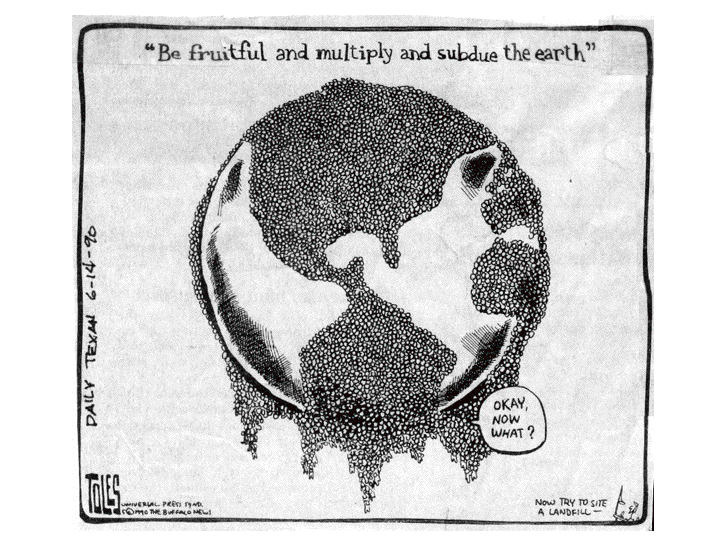
A few prominent phrases that appear to contradict one another are Genesis 1:26 and Genesis 2:15. Genesis 1:26 reads, "Then God said, 'Let us make mankind in our image, in our likeness, so that they may rule over the fish in the sea and the birds in the sky, over the livestock and all the wild animals, and over all the creatures that move along the ground'" (New International Version). This verse makes use of "rule over," an equivalent of Genesis 1:28's "dominion" or "subdue", to place humanity in a hierarchical position over that of animals and others living creatures in the world. If humanity (Adam and Eve) were God's most important creations, then it may logically follow that everything else in the world is not worthy of protection or keeping. On the other hand, Genesis 2:15 reads "The LORD God took the man and put him in the Garden of Eden to work it and take care of it" (NIV). Other versions swap out these verbs for "tend and watch over it" (New Living Translation), "cultivate it and keep it" (New American Standard Bible), "work it and guard it" (International Standard Version), and "care for it and maintain it" (NET Bible). These verse, only a few after the ones above, appear to place humanity within its scene, not over it. Humanity has been given the divine charge of maintaining and caring for the Earth as another of God's creations. There are many more verses that address the relationship of humanity to nature, but these might be the best known.
Another respondent noted that "dominion is so often misinterpreted as carte blanche permission to do what we want with creation." Dominion implies "that we will be held to account by God for how we manage his creation." Humans will thus be judged for their treatment of the Earth and how kind they were as rulers as one might expect God to be. These responses further support the ability of creation care members to fill in gaps and overcome contradictions where others may perceive them.
Respondents were asked about the apparent contradictions between these two verses in the study and to describe their meaning and compatibility. A frequent response was that people took "rule over" and other verbs of domination too literally, and it might better be translated as calling for stewardship, a kind and tender position of power that cares for the Earth. One respondent noted, "God has created us in His image, and it is this image we are to reflect in our dominion. The second verse describes what this Godly dominion can look like, tending and keeping a garden." For this respondent, the phrases are not contradictory, but complementary. Humanity can rule over animals but also tend to and take care of the Earth; a position of power does not have to be an oppressive one.
This post is part 2 of my discussion of a survey I performed of creation care members. Last week's post focused on the compatibility of science and religion and this week will discuss apocalypticism. Before analyzing answers about member's beliefs, I will describe the phenomenon of eschatology and human belief in end times.
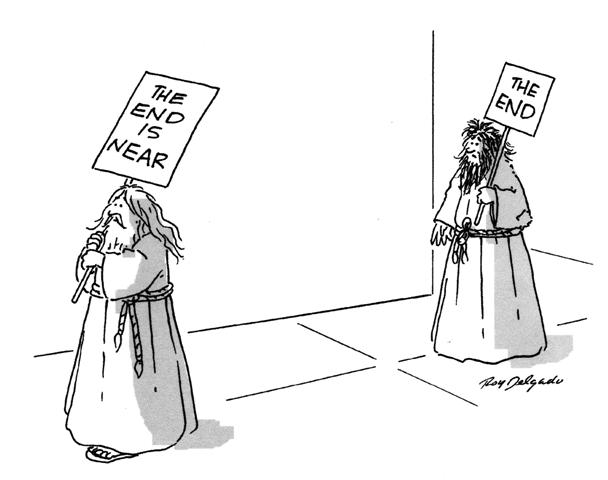
Kenneth Burke discusses the immense importance of beginnings and endings as creating the coherent drama of one's life. Similar to a novel or a poem, the ending makes sense because of the beginning and every beginning implies its ending. Oftentimes, there are clues, patterns, and events along one's life that provide insight into its potential endings. Looking back, people want to have their life make sense, justify choices, and being they took the road less traveled. People have always been interested in human origins even to the point of intense controversy and debate. Endings as well, have been of great interest of public concern. It seems, that people are more interested in the far past and the far future, instead of what's right in front of them.
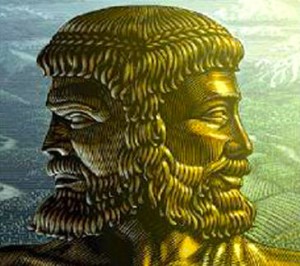
Looking forward and backward, but not at the present. Retrieved from this blog.
Creation care members, however, do not often focus on the future. They certainly believe in the apocalypse, but they do not have an established eschatology (or vision of how the world will end) that occupies their time or attention. One respondent noted, "speculations about an apocalyptic war and all the rest of this only detract us from the real issues of the world in which we have been placed by God." Nearly half of respondents discussed the purposeful vagueness of the Bible in leaving out specifics. Many responses referenced Matthew 24:36 which reads "But about about that day or hour no one knows, not even the angels in heaven, nor the Son, only the Father." "That day" references the day of apocalypse, or the day of revelation when the return of Christ will occur. This verse is often used when apocalyptic prophecies are unconfirmed.
These respondents noted discomfort in discussing the details of their beliefs. One respondent said, "I don't like to speculate on this. I believe Jesus will return, and He will renew all things. That's all I'm comfortable saying." They all, however, expressed that they had a personal eschatology and were trusting in God to save them. One respondent noted, "I have no idea and Scripture calls on me not to worry or guess when it will end." These responses indicate a shared commitment to the present and an awareness but lack of concern for the future. This appreciation of apocalypse may be in part how creation care members can unite religious belief in (potentially environmental) apocalypse and motivation for action. One respondent argued that thinking about the apocalypse is wasted time: " I'd rather spend my energy trying to make it a better place--a place where life can flourish, rather than focusing on an end that seems unclear."
A few respondents directly linked climate change with the apocalypse. "I do wonder whether climate change will be the physical change to the earth that will usher in Christ's return, simply because it has the potential to make the planet uninhabitable for humans and many other things," said one respondent. Another responded, "I think the climate crisis could end the world as we know it, with life reduced to a much more basic level in various parts of the world, and with great loss of life." A few respondents argued that the Rapture would occur and Christ would judge his followers based on how they treated the world. One noted, "I am committed to the idea that if or when Jesus comes back, there will be plenty of clean power technology around for helping humanity here on earth." This respondent believes in the rapture, but wants to leave the earth in a better environmental condition for those that are left behind.
Creation care members have somehow captured the idea of apocalypse and used it as motivation to act. Not only do they believe that Christ may judge them, but they are also concerned with those who will not be raptured to Heaven. Although belief in apocalypse is often associated with a lack of action or even the welcoming of climate change, creation care members appear to fall in a unique category. As discussed last week, creation care members have found a way to unite science and religion in a modern natural theology. Now, it appears that they have also managed to unite a belief in the apocalypse with an urge to mobilize and act.
Given the tumultuous and often contradictory natures of religion and the environment, the creation care movement has arisen in an unusual predicament. Guided by religion and undeterred by previous difficulties, creation care members seek to unite a moral obligation to the environment with climate change advocacy. This new movement operates in an important gap, often appealing to the youth, that could offer appealing solutions and arguments for grassroots progress on the environment. Interested in the opinions and demographics of this group, I performed an online survey of members on a few creation care mailing lists. In this post, I will discuss a few of the open-ended answers that were particularly interesting. This week, I am examining answers to one question about the compatibility of science and religion. Future posts will look at apocalypticism, interpretation of biblical verse, and optimism about the future.
60 participants completed the survey and 52 submitted complete responses. A few prominent patterns emerged that provide insight into the beliefs of creation care members. These responses could not be generalized to the entire creation care movement, and the Judeo-Christian creation care movements are certainly far different from other iterations such as Muslim or Hindu creation care. But, the prominence of these patterns do indicate the possibility of shared opinions and frameworks for future inquiries. Overall, survey takers were confident about their knowledge of climate change and its consequences. They also expressed a mix of worry and hope towards the possibility of mitigating climate change's consequences.
Survey takers were asked about the compatibility of science and religion. After coding for compatibility, unsure, and incompatibility, there was a consensus among the 52 surveys. All participants responded that they saw science and religion as compatible. Although it is common for scientific and religious frameworks to be in competition with one another, these creation care members viewed them as completely compatible. There are some religiously-oriented climate denial groups, such as the Cornwall Alliance, that undermine efforts to protect the environment. Oftentimes, a belief in climate change is associated with denying God's ultimate power over the apocalypse. Associations with religious identity and conservative politics often encourage thinking monetarily instead of environmentally. The respondents, though, who identity as members of creation care groups, do not fall along traditional correlations. Participants identified across the political spectrum, but they all agreed on the importance of protecting the environment because of underlying religious identifications. Science and religion both support the potential risks and encourage action. Skepticism and doubt can cause pervasive apathy and negative consequences that creation care has found a way to overcome.
One respondent noted that "science and religion are best friends." One commented that "they are completely compatible and if they appear to not be, then there is an error in the interpretation of the religious truth or of the scientific data." This respondent believes that it is not possible for science and religion to be contradictory. Many respondents echoed similar themes about finding God's work within scientific inquiry. "Science is an explanation of how God works and allows me to become more deeply rooted in Him and his beauty." Another simply wrote, "Science is Man's search for God in Nature." The closest a respondent got to noting incompatibility was the statement, "sometimes they are cranky with each other."