Showing posts with label Evil. Show all posts

Monday, June 16, 2014

Dorian's Descent: All Art is Quite Useless

Dorian's Descent is a new stage adaptation of The Picture of Dorian Gray by Oscar Wilde. Dorian's Descent is a musical that has added an element to the story: the Devil. In this article, I wish to explore the narrative elements of The Picture of Dorian Gray through Walter Fisher's narrative probability and narrative fidelity, the Faust trope, and how the character of the Devil is a narrative disaster. Although I did enjoy the show and thought the singing was quite impressive, the actual lyrics, words, and acting were sub-par, especially compared to a few other musicals and adaptations I have seen in Los Angeles. I will be discussing the play and the book in detail (i.e., spoiler alert!), so I encourage readers to read the book or acquaint themselves with the story.
Poster for Dorian's Descent
The Picture of Dorian Gray is about a young man, Dorian Gray, who becomes obsessed with a portrait that Basil Hallward has painted of him. It shows him in his youth and his prime, characteristics that he realizes, once prompted by his friend Lord Henry Wotton, will fade. In a state of hopelessness, Dorian wishes that the painting might age instead of him, for in its current stage it only serves as a reminder of what he would lose. Without explanation, the painting does begin to change as Dorian becomes involved in the hedonism of Lord Henry's lifestyle. Dorian scorns Basil, engages in illicit sexual activity, murders, and experiments with various vices. The picture ages, its face is marred by a snarl, and the brow is furrowed in perpetual anger and disdain. Eventually disgraced by the harm he has caused, Dorian attempts to absolve himself by stabbing the picture. The two reverse, leaving Dorian himself dead, aged, and hideous and the portrait returned to the beauty which Basil painted.

The picture and Dorian from the movie adaptation
Dorian's Descent infuses a rock opera theme onto the story, which pairs nicely with the descent into hedonism and sin. The element of the Devil, however, removes a very powerful and meaningful part of the play: Dorian's agency, choice, and self-mortification. In the play, the Devil appears and makes an explicit Faustian deal with Dorian so that he may stay young and the portrait may age. The character is doubly unnecessary. First, Lord Henry already serves as the Faustian Devil, the foil to Basil between which Dorian must decide. Having the Devil character undermines Lord Henry's role as the tempting, evil character that lives a sinful, yet seemingly fulfilling life. His presence mirrors the Devil, instead of captivating Dorian's attention in his own right. Furthermore, the Devil as a mystical, magical character removes the potential for Dorian's choice. The supernatural can seem to constrain the choices and available actions of humans, making Dorian's descent into hedonism part of the Devil's plan instead of a meaningful choice of evil over good, Sir Henry over Basil, self over others.

The Devil makes a deal
The beauty of The Picture of Dorian Gray is the unspoken Faust trope. Any one might utter an "I wish . . . " or make selfish requests, placing oneself squarely in the shoes of Dorian, connecting and identifying with him in finding himself in a peculiar situation. Walter Fisher described two elements of narrative rationality (or the logic of stories): narrative fidelity and narrative probability. Narrative fidelity is the perception of how faithful a story is to reality (or the audience's world). Although one might think that this would preclude fantasy, science fiction, or non-fiction from having fidelity. On the contrary, stories such as Harry Potter have high narrative fidelity because they seem real and possible, despite their fantasy elements. We could imagine, though we may not have seen or experienced it, a secret world hidden within our own (thus justifying its lack of presence). Though we may not have experienced or believed possible a changing portrait, we can faithfully imagine our lives as confronting something wholly un-explainable and what our reactions to it might be. The element of the Devil fully violates this type of realismo mรกgico (think Guillermo del Toro) where it could be possible, and makes the subtle Faust trope seem more like a cliche.

Sibyl Vane's forgotten lyrics
Perhaps most disappointing for me was the changes to the Sibyl Vane character, Dorian's brief love. Before his shift into full hedonism, Dorian fell in love with an actress. Her devotion to her art and her skill in bringing love to life in her performances captivates him. In his courtship of her, however, Dorian destroys Sibyl's ability to act. I have copied her confession after a particularly terrible performance of Romeo & Juliet below, which is one of the more beautiful passages in the book.

"Dorian, Dorian," she cried, "before I knew you, acting was the one reality of my life. It was only in the theatre that I lived. I thought that it was all true. I was Rosalind one night and Portia the other. The joy of Beatrice was my joy, and the sorrows of Cordelia were mine also. I believed in everything. The common people who acted with me seemed to me to be godlike. The painted scenes were my world. I knew nothing but shadows, and I thought them real. You came -- oh, my beautiful love! -- and you freed my soul from prison. You taught me what reality really is. To-night, for the first time in my life, I saw through the hollowness, the sham, the silliness of the empty pageant in which I had always played. To-night, for the first time, I became conscious that the Romeo was hideous, and old, and painted, that the moonlight in the orchard was false, that the scenery was vulgar, and that the words I had to speak were unreal, were not my words, were not what I wanted to say. You had brought me something higher, something of which all art is but a reflection. You had made me understand what love really is. My love! My love! Prince Charming! Prince of life! I have grown sick of shadows. You are more to me than all art can ever be. What have I to do with the puppets of a play?"

Sibyl has so greatly fallen for Dorian that she cannot pretend to love as she once did. This confession is made all the more beautiful when she takes her life after Dorian rejects her love. In the play version, Sibyl is a singer whose voices makes Dorian fall in love. Substituting singing for acting makes sense in the musical, but it is the other change that ruins it for me. Instead of falling out of love, causing Sibyl to ruin her craft, the Devil character makes Sibyl forget her lines before a show. The audience loses this beautiful insight into Sibyl's innocence and thus undermines her death as the tipping point in Dorian's sanity. This change further supports my comments below about Dorian's actions being orchestrated and not of his own choice.
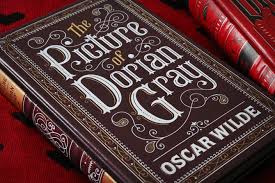
Retrieved from this site
Dorian's Descent is an interesting adaptation of The Picture of Dorian Gray, but its creative changes served only to undermine the beauty, simplicity, and complicity of the book in an attempt to be unique. Without our ability to empathize with Dorian's decisions, which we believe are of his own accord, the audience can only observe and cannot be active participants in the narrative. We are not convinced that this could happen to us, that we would make such a deal with the Devil, or that we are only a few steps away from falling into sin ourselves.

Although this is not the shining review that I'm sure the fledgling play is hoping for, I hope that they take to heart the immortal words of Lord Henry: "There is only one thing in the world worse than being talked about, and that is not being talked about." Certainly this adaptation has given me and I hope any readers some food for thought about how narratives are updated, adapted, and changed in the pursuit of artistic creativity and to teach us about issues that plague society.

Wednesday, February 13, 2013

The Appeal of Horror

Although I've always known that my preference for horror films over romantic comedies draws curiosity and concern from others, I never understood why. What is it about horror films that makes my interest in Saw, Hostel, and The Cabin in the Woods inherently worse than in No Strings Attached, The Notebook, or Sweet Home Alabama?

This is not an avenue of research I would pursue with any intensity, but its frequent occurrence in my life makes it a perfect blog post entry. Below are some musings and thoughts I've had about why horror is offensive on a basic level to human nature and why some yearn for that experience in the theater.


One of the issues in horror films is their defiance and utilization of reality. Whereas science fiction and fantasy is inherently "unbelievable", romantic comedies are life-like and true to reality. Outside of the necessary fantasy of Hollywood, unique plot points, and unlikelihood that come with a film, there is a transcendence that occurs naturally with romance, comedies, and dramas. Real people being dealt unlikely, but possible events, with real emotion and reaction. For the most part, these films follow standard structures with the protagonist achieving their goal or the couple uniting in the end. Aberrations from this structure may serve as a twist to surprise the audience, but the structure remains mostly intact.

Horror changes this structure by combining the reality of dramas, comedies, and romance with the abnormal and occult of science fiction and fantasy. Just as Harry Potter takes the reality of a rough childhood and transforms it into magical fantasy, horror films take the reality of normal, everyday people and sends them directly to Hell. The Saw films punish people for taking life for granted, something that everyone can be considered guilty of. The Hostel films torture people on vacation based on random acquisition. The reality of people's stories create an affinity and connection between the audience and the characters, allowing for a dangerous and frightening transcendence. Connecting with characters about to undergo bodily, mental, and psychological damage and harm can be an uncomfortable position for the average movie-goer.

People are willing to go and see them, however. The same adrenaline rush that brings people to amusement parks for a roller coaster ride fills the seats at the midnight premiere of the 7th Saw movie. The fear that arises from the films might be in the loss of power. Denying the basic, happy-ending structure of other films, horror movies remove the viewer from a position of power: from knowledge and expectations. Horror villains may have no explanation, attacks may come at any time from any location, and the fate or safety of the characters is variable. For example, the complete back story of Jigsaw, the villain in Saw, is revealed slowly and in pieces over the course of the movies, making his actions and the actions of his disciples mysterious and random. Epitomizing the random attacks is the Final Destination series, where "fate" is literally the villain that interacts with the environment around the characters to kill them in accidental ways. There is no man or monster hiding and approaching, but merely objects and spaces manipulated to attack and murder the characters at any point. Because it is a horror film, there are almost always murders or deaths, especially of the main characters. The survival of the characters (if any) usually only follows the deaths of others in the group.


The fear that these movies create is often avoided by movie-goers looking for an "escape" or pleasant experience. For those that do enjoy them, myself included, the pleasure comes from not knowing and experiencing something that is unique to movies and entertainment. The horror movie is an escape from the normal, everyday, average life, by exposing viewers to the dark side of reality.

I do not know what my favorite horror film would be, but I have to say that the recent Joss Whedon film, The Cabin in the Woods, has become a strong contender. The variety of emotions, from nervous and terrified, to intrigued and confused, to laughing out loud in the theater, this movie was the perfect horror film for me. Even for those not a fan of horror films, familiarity with the genre will help you appreciate the satire and exaggeration that makes this film an instant classic.


Wednesday, July 18, 2012

Batman and Rhetoric: Transforming Human to Legend

The trilogy finale of the Batman series from Christopher Nolan finishes July 20th (or for the avid fans, midnight tomorrow night). The finality of the trilogy has been confirmed with Christopher Nolan and Christian Bale abandoning the project after this film. Though I was more than a little upset when rumors of Johnny Depp as the Riddler were squashed, I appreciate the finality of the series. I respect the ability of both actors and directors to sacrifice profit for the sake of a coherent and meaningful story line.


After re-watching the first two in preparation for the midnight premiere, I was struck by the iconic Liam Neeson line from Batman Begins: "If you make yourself more than just a man, if you devote yourself to an ideal, and if they can't stop you, then you become something else entirely...a legend, Mr. Wayne." The line is meant to encourage Bruce Wayne to abandon his mortality and chase immortality as a symbol, a legend. Many people around the world have devoted themselves to causes and emerged as icons for movements, causes, goals, and values. Rosa Parks, Mother Teresa, and Harvey Milk were just people, but through their actions and values, they have become legends, eternal, immortal symbols of equal rights, charity, and acceptance. The narratives of their lives have transcended the normal good and evil, the trials and tribulations of being human, and the faults, flaws, and sins inherent in all humans. These people, and many others are, in a way, superheros, super-people, because they have become more than just people. Their stories and actions become symbolic representations of events more significant than can be contained within one human life, body, and narrative.
Similarly, Batman is the comic representation of everyday heroes, who has transcended his Bruce Wayne, human persona for Batman, a superhero, legendary symbol of justice. By abandoning his humanity and replacing it with a mysterious persona, people in the comics turn to Batman as a savior, not as a person. Though Bruce Wayne has money and with that money comes power and the ability to transform into Batman, Bruce Wayne cannot fight crime, be an ally to the police force, and terrorize Gotham's criminals. Every person, though, has the power to become that better, idealized version of ourselves, immortal in our story and legacy. This occurs through committing oneself to a cause, extending oneself past human constraints, and becoming more than just a person. We can all leave legacies, whether positive or negative, and its corresponding strength and staying power is only restricted by our actions.


Not only do people become legacies, but the words that we use leave sometimes unforgettable impressions on the world. The power of the spoken word is why I wanted to pursue communication in an advance degree, so I could explore language as symbolic. Kenneth Burke famously described humans as symbol-using animals and rhetoric as the study of those symbols that create meaning (Grammar of Motives, 1970). Words are merely words, tools with different definitions, interpretations, and meanings. But when used with a purpose, for a cause, words can become infamous, last beyond the life of a person, and serve as everlasting symbols. 


Think of the immortal words of Abraham Lincoln: "this nation, under God, shall have a new birth of freedom -- and that government of the people, by the people, for the people, shall not perish from the earth." Or the words of Ghandi, "you must be the change you wish to see in the world" or Martin Luther King Jr., "when we allow freedom ring, when we let it ring from every village and every hamlet, from every state and every city, we will be able to speed up that day when all of God's children, black men and white men, Jews and Gentiles, Protestants and Catholics, will be able to join hands and sing in the words of the old Negro spiritual: Free at last! Free at last! Thank God Almighty, we are free at last!" These words have transcended each person and left a rhetorical legacy of the unity of the United States, the importance of peace, and the eternal struggle for equality.


One's legacy is thus a combination of actions and words (or just actions if we consider physical action and symbolic action) that is for the most part under each of our control. We can devote ourselves to a cause, use our language symbolically for a cause, and transcend mere mortality to leave a permanent mark on the world.


I am looking forward to the midnight premiere, in part for the transportation power of film and also to imagine for a few hours, that I can also reach immortality through my words and actions.

Thursday, February 9, 2012

Born Evil


Last night, I attended a University of Southern California event where author Jeff Mudgett of Bloodstains, discussed human nature and the idea that some people are born evil.
Picture
When asked at the discussion, Mudgett responded strongly that some men were born evil and there was no hope for people like his ancestor, H. H. Holmes, when they are looked in prison forever, the important part is to have them separated from the population. In this discussion, I could not help but think of Foucault's structure of "madness" and what it truly means for someone to be considered psychotic, a menace to society, and unfit for a normal life. As far as Mudgett and scholars can tell, Holmes was a normal, functioning member of society who may have had the highest IQ score ever recorded. Not only was he intelligent, charming, and charismatic, he had a flair for hypnotism and had a fascination with the human body and the ageing process. These obsessions and talents led him to be on record for killing 27 people, with the possibility (and estimated amounts from researchers) to be up to 1,000 people. He might have been the most prolific serial killer of all times, and Mudgett, his great-great grandson, believes he was born that way. He was born to kill, born to be evil, and that there was no hope or retribution that society could offer to this man. What are the implications for people being capable of these atrocities, simply because of their genetic code? Is there a "serial killer" gene that lays dormant in Holmes' bloodline and may live in other seemingly functioning members of society? Perhaps, once isolated, women may be able to test for the gene in their unborn children, just as many diseases and genetic disorders (such as Down's syndrome or other chromosome deficiencies) are detected and chose to abort them. Can there be a genetic predisposition that we can code for, eliminating all serial killers those born to be evil before they have a chance to manifest? Should genetic predispositions guide our choices to presume those guilty before proven so? This brings to mind the current news story I saw about a 15-year old girl (now 18 at the sentencing) who was given life in person with the possibility for parole after torturing and killing her 9-year old neighbor.
http://antonia-monacelli.hubpages.com/hub/Murderous-Children-Alyssa-Bustamante
The most damning evidence of all was her diary that revealed her calculated plan to kill the neighbor just to see what it felt like to kill another person. Could this child's predispositions to murder been tested and controlled before this incident? How many lives would/could be at risk if such a risk were isolated? It makes one think of the idea that we are all masters of our own destiny, but are we really if our genetic make-ups have decided for us? Did Holmes truly have a chance to correct or downplay the "devil inside" him, or was his future and the bodies in his wake predestined from the moment that he was born?

These types of questions make me ponder how society constructs madness and how one defines "evil", "madness", and "unfit for society" in modern terms. People can be deemed sex offenders and remain on a list for the rest of their lives, whether they were convicted of rape to peeing in a public location. The wide variety of ways that indiscretions and transgressions of the law are defined as one penalty draws to mind sentencing laws that degree minimum penalties for crimes, no matter the mitigating circumstances. Is our definition of evil/madness incorrect, or merely how we punish/attempt to correct it misguided?

How many of us are born with evil inside us? How many of us cannot change our stars, our paths in lives, the lot that we were dealt because of something far beyond our control? Can humans who are truly capable of the most heinous crimes, still be considered human?