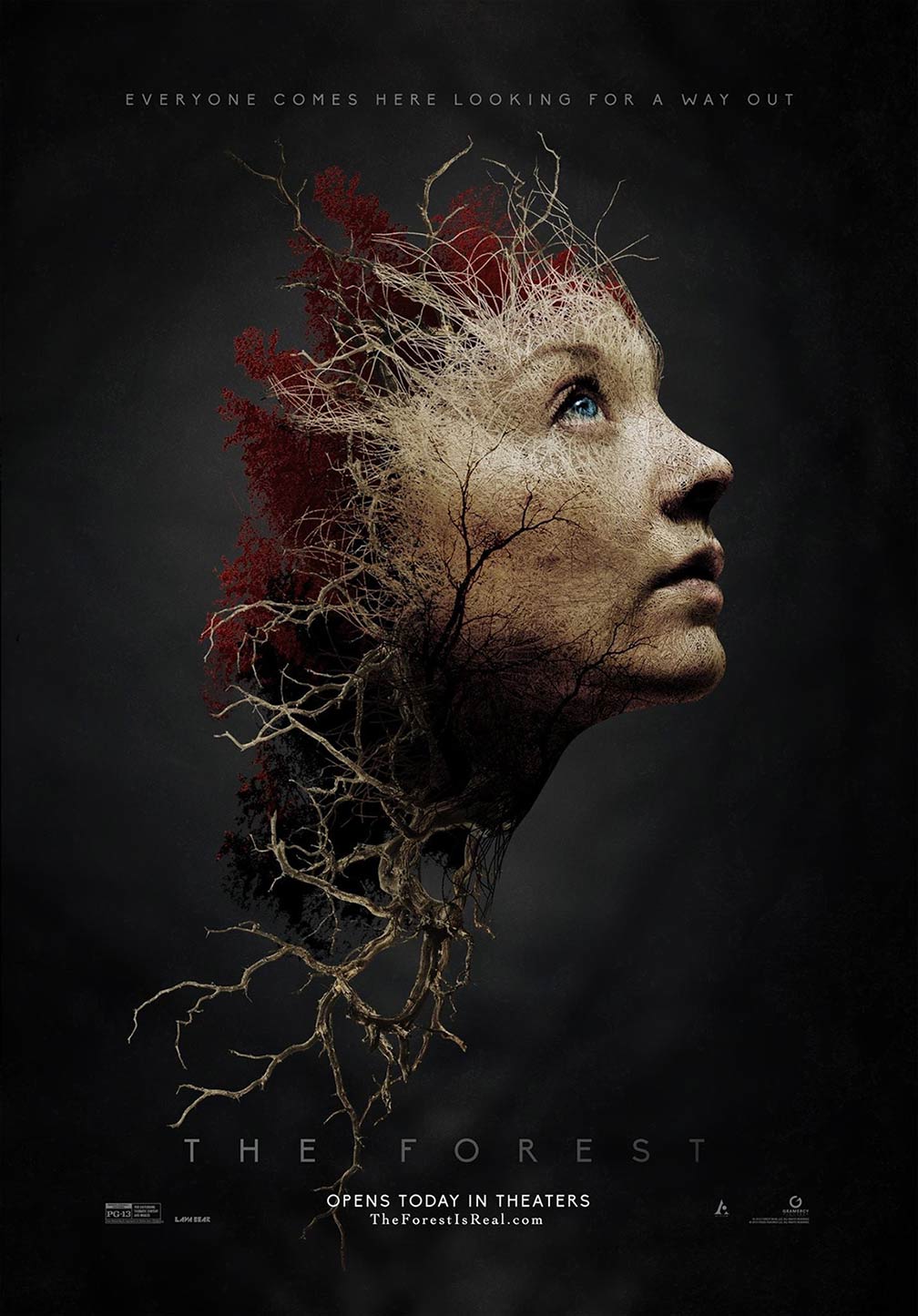
I recently saw "The Forest," a horror movie that discusses the Aokigahara Forest in Mount Fuji, Japan. The forest is known for its association with people committing suicide in the forest. The forest is said to be haunted by yurei, or the ghosts of those who have taken their lives in the forest. As with other horror films that I have analyzed (The Purge: Anarchy, Teeth, Crimson Peak, It Follows, The Visit, and Pride + Prejudice + Zombies), I will first summarize the film and then discuss some elements of the film that bear further critique. For "The Forest," I'd like to address issues of exoticism and Orientalism, responses to trauma, as well as issues of agency and explanation. This review will contain spoilers of the movie's key moments and plot developments.
The movie focuses on Sara and her twin sister, Jess. Sara travels to Japan to look for Jess once notified by police that her sister is missing in the Aokigahara Forest. Convinced that her twin bond tells her that Jess is alive, Sara disregards the warnings of pretty much everyone in the film and goes into the forest. With this incredibly long build-up and character development, Sara finally enters the forest and camps out with Aiden, a man she met hours earlier in a local bar. This is where the visions start happening and Sara is confronted with haunting images of dead bodies, ghosts, and people she isn't quite sure are alive or not. The climax of the film comes when she becomes suspicious enough of Aiden to stab him and leave herself alone in the forest. A final vision consumes her and she re-enacts finding her parents dead in her house with Jess. In this vision, Sara and Jess's father comes back to life and attacks Sara with a death-grip on her arm. Sara slices at her father's hand to free herself from his grasp. At this point, the continuity is not clear to me, so I will piece together what I think happened. Sara, in her mind, escapes her father's grasp and runs through the forest, trying to get back to the path. But, she's actually sliced her own wrists instead of her father's non-existent hands and has bled out. Her soul, or perhaps spirit, running through the forest alerts her sister, who had been camping the entire movie and seemingly unaffected by the yurei, and starts her running towards the path. Jess is eventually led back to the forest's entrance (in part by her sister's yurei?) and is reunited with Sara's fiance, who at first thinks it is Sara that has emerged from the forest. As the two look into the forest, they see Sara's yurei with glowing eyes.
Sara and Aiden in the forest. Image retrieved from this site.
Overall, I was not wowed by the film and would rate it as below average compared to other horror films, although not quite as awful as The Visit. In watching it, however, I was struck by a few details that stood out to me as unique in films I've recently watched and unique to my usual blog analysis. First, I'll address issues of Orientalism and exoticism. Edward Said argued that Western culture patronizes and infantilizes Eastern culture. Western media portrayals of Asia exoticizes Eastern culture and provides them no personal value or consideration beyond gross stereotypes. These inaccurate representations undermine the ability of the West and Western people to understand or value Eastern culture. When The Forest came out, there was backlash in the press that the film painted Japanese culture in a negative light. Many reviewers noted the distinct lack of any Japanese main characters, despite the film happening in Japan (why couldn't Aiden have been Japanese?), and the odd behaviors of many of those that were highlighted. When Sara enters her sister's classroom in Japan, one of the schoolgirls literally freaks out and cannot be consoled at the sight of seeing her teacher again. Although Jess is presumably there to teach children English, the girl is unable to communicate at all in English and instead stammers with cliche wide-eyes and a schoolgirl uniform about the supernatural and ghost stories. Every Japanese person appears to be an expert on local folklore and preoccupied with death. From the woman who keeps dead bodies in her basement and the tour guide who seems numb to cutting down hanged bodies, the movie portrays Japanese people as uncaring and obsessed with death. Many reviewers pointed out the potential for racism and mischaracterization. I must agree that the film engaged in white-washing of a Japanese health epidemic and used the Aokigahara Forest as nothing more than a foreign, exotic backdrop for foregrounding the important, tragic lives of white Americans.
Sara being dragged away by the yurei. Image retrieved from this site.
Reviews also condemned the film for ignoring an important mental health crisis and making light of a serious epidemic in Japan. One review asked, what if a similar film was made about the Golden Gate Bridge in San Francisco, another location that experiences many suicides. Borrowing from my previous points, this conceptualization of Japanese sites as specifically "haunted," exoticizes Japanese culture as being odd, occult, or unnatural. The suicide forest is not addressed as meaningful or an issue for the protagonist to tackle. The forest is merely a "creepy" location for the protagonist to search for her sister. In ignoring the mental health issues inherent in the forest, the movie does touch upon the trauma that Sara and Jess went through in their parents death. The distinction drawn between them is that Jess actually saw her parents' dead bodies while Sara did not. Sara frequently mentions that in not looking, she was not fully there for her sister and could not help her bear that burden. It is then Sara and not Jess who is repeatedly told that she is "filled with sadness," and should not enter the forest. Having seen her parents' bodies, Jess is somehow more fully able to cope with her parents' death. I do not wish to make grand conclusions about what is appropriate and not, but it does strike me as an incredibly interesting statement on trauma and coping mechanisms. There are many different ways to respond with losing loved ones, this case in a murder-suicide. The film seems to argue, or at least, imply that in not fully seeing and acknowledging her trauma, Sara has set herself up for her own suicide. Jess is much stronger against the yurei and the influences of the forest, because she has "faced" her trauma and has overcome it. The messages, however coded and unapparent, may send harmful messages to people coping with their own trauma, who may or may not be seeking actual medical and professional advice to counter or correct media images. While many reviewers advocated boycotting the film for its damaging portrayal of the forest and mental illness, others noted that "art should not be censored."
The very first analytical thought I had about the movie was about the lack of agency given to the people who enter the forest. I was struck by the fact that in showing Sara killing herself based on a "trick" of the yurei, that they were removing agency from everyone else who entered the forest. Perhaps they didn't really want to die, but were similarly tricked. Suicide is truly an awful act, and one that I have familiarity with, but minimizing the decision-making power of those who engage in it left me with a bad taste in my mouth. For the film to pawn off the responsibility from individuals to ghosts and supernatural trickery is to provide an explanation that denies the need for broad consideration of mental health and depression. To invoke Burke's pentadic ratio, the film removes agency from individuals and instead focuses on the scene, the Aokigahara Forest, as mitigating the individual's responsibility for their actions. I'm not saying that we should be blaming individuals for taking their lives, there are oftentimes many influencing factors at play. But, I am wary of a film that seems to reduce suicide to the hallucinations caused by the supernatural. I am reminded of Aaron Mahnke's podcast, Lore. In episode 11, Black Stockings, Mahnke discusses myths about fairies who would kidnap children and adults and replace them with "changelings." In his description of the podcast, Mahnke's describes the human need to create stories "to explain the unexplainable." Faced with mental illness and physical disability, it was easier for people to see others as less-than-human and others, instead of caring for fellow humans who were different. Instead of working to solve the issues that lead to suicide sites, like the Aokigahara Forest, people may excuse the actions using supernatural circumstances. This removes agency from individuals, particularly those with mental illness, and ignores larger societal problems.
As far as horror movies go, I thought this film was full of cliches and added nothing to the genre. It also brought up some interesting rhetorical implications for its depictions of Asian cultures, trauma, and mental illness. I hope that in the future that horror films might take more caution in subject matter selection and treatment of sensitive subjects. I agree with one blogger that art should not be censored, but I do think that in making films, people should be concerned with how their treatment might influence audiences and make statements about other cultures and mental illnesses.
When I went to live in China for three weeks, I knew that being a vegetarian would be hard. All of the blog posts I read warned me of the lack of options, difficulty in communicating dietary needs, and frustration with the lack of translations on menus and in stores. Only a few articles discussed China's Buddhist history and praised China's openness to vegetarians. With my handy printed copies of Chinese words and characters and pictures of animals with red X'ed circles, I went out prepared to let everyone know "wo chi su" - I eat vegetables. What I wasn't prepared for was how many of my food decisions weren't made for me - and how masculinity and food culture are intertwined in Beijing, China.
Flight into China.
Before I elaborate on the previous statement, I do want to say that I greatly enjoyed my time in China, am grateful for the opportunity, and am deeply indebted to my hosts there and the many friends that I made. This post is not about my overall experience, but about the unique difficulties I had as a lacto-ovo vegetarian (no meat, fish, or poultry, yes to eggs and dairy) in Beijing. The food I did have was delicious and I think future vegetarian travelers (and travelers in general) can benefit from learning more about Chinese food culture.
At many of the restaurants I went to in China, large groups were given private rooms with huge round tables with a rotating plate in the center. Family-style restaurants are usually a niche market in the US, but it was the standard practice for Chinese restaurants. In those settings, the communal nature of China brought me face-to-face with my own individualistic tendencies. Even in the US, family-style means taking food from communal pots and placing it on individual plates. We had personal plates in China, but more often than not, the people at the table would take food directly from the communal plates into the mouth. The most dexterous man I saw would pop individual peanuts covered in sauce from the bowl to his mouth without dropping a single one. Those who use have tried using chopsticks know how difficult this is. The avoidance of personal plates signified that the meal was everyone's. There was no "hoarding" of favorite plates or claiming ownership over food by amassing it in front of you. Instead, everyone was patient, waited for the food to rotate, and grabbed what we needed as it passed.
Picture of fermented egg on tofu, a vegetarian Chinese specialty.
For me, it could be a long wait for what I needed to come around, and a few times I felt compelled to break the personal plate rule and accumulate stray mushrooms and pieces of eggplant. At a communal table, there was no individually-owned items, so everyone took from meat dishes and vegetarian ones, even if I could only take from a few. For the Chinese, this wasn't an issue because over-ordering is the norm. No plates are ever left completely empty - it is considered rude. So instead, the staff will dump the remaining pieces on one shared plate to save space for the many more dishes to come. On many occasions, vegetable dishes that were ordered had meat sauces, chunks, or components. I completely understand the need to be flexible when traveling, but for someone who was raised vegetarian, those dishes can make me extremely sick.
My blog post promised some musings about masculinity and patriarchy - and here it comes. The Chinese food culture was communal, but the head of the table was the boss. During our first meal in China, a fellow American sat at the back seat facing the door. I think this is a common practice in the US, as it is the most difficult seat to get to, so if often taken first to avoid inconveniencing others. Our advisor, however, encouraged him to move, unless he "wanted to pick up the tab" for our table of 15. The host paid the bill for the entire table; "splitting" checks was not common, but sometimes at smaller outings we would throw money into a communal payment pot. For the three weeks I was in China, the host was female one time, when we dined with the director of the school the group was teaching at. The other nights were all male hosts who oftentimes spoke little to no English. This made communicating to them my dietary concerns quite difficult and I sometimes felt that my request was treated flippantly or as unimportant.
Picture of the Night Market in Beijing, where they sold scorpions, snakes, starfish, and many other things on a stick.
What the hosts ordered, we had to eat and drink, including alcohol when it was not desired. We were told when to take food, when to drink, and how much of what we could have. I was offered meat (usually Peking Duck) many, many times, and found it difficult to explain to my hosts why I refused their very generous offers. A few hosts got quite upset and raised their voices while my advisor tried to explain the situation and encouraged me to try "just a little bit" to appease the hosts. I don't fault anyone for the situation; it's really a classic case of cultural clash and miscommunication. It's rude for me to refuse food and drink in Chinese culture; it's rude for people to force food and drink on people who don't want it in American culture. For both cultures, it's a matter of respect, either to the hierarchy of the community, or the power of the individual.
I saw, very often, women at the table, including myself, struggling to refuse alcohol. Chinese dinners, especially business ones, were filled with alcohol. And it was no one's choice when to drink but the host, who would stand, make a speech, and demand that everyone finish their glass. To not follow the call of "gānbēi!" by downing your drink was considered a rejection of the toaster's well-wishes. Furthermore, the host and other guests would often move around the table and toast everyone individually - meaning a toaster could go through a shot of alcohol (caled baiju) for each guest present. The male hosts were often complimentary to the female guests' looks, which emphasized my and my other American female companion's "exoticness." Those hosts would often touch, hug, or try to kiss us, as complete strangers, without warning.
I greatly enjoyed my time in China, but dinners were often wrought with nerves. Would the host order something I could eat? Would this meal have "secret meat" in it? Would we do a lot of toasts? Would I be given baiju instead of something I want to drink? Would the host make advances on myself or my friend? Would the host get angry if I refused his offer of Peking duck? If there were vegetarian food, would other people eat it before I could have any?
Obligatory panda photo
My favorite foods in China were the stewed eggplant, assorted mushrooms (sometimes called tree and ground fungus), and baozi (vegetable filled and steamed buns). I greatly enjoyed their variety of fruits such as jackfruit (inspiration for Juicy Fruit gum) and trying interesting-tasting fruit like durian. It was an adventure that I will never forget and I hope to go back soon. The food culture, in particular, made me reflect on the differences between China and America and the challenges of establishing a global community.