Catcalling has been appearing frequently in article I've been reading, on social media, and in conversations with friends. I have already discussed more generally the problems that females face specifically on college campuses, but catcalling is a form of aggression that plagues all women. I use the term aggression purposefully and meaningfully as these catcalls are verbal, sexual assaults on females. These are, in many ways, hate crimes in that they are addressed and targeted towards a particular gender. I argue that these are violent, aggressive verbal attacks on females and are not addressed in order to be compliments or flattery. Any woman of all shapes and sizes in clothing from SoCal casual to Boston coats (I have seriously been catcalled walking down Boylston in my HUGE winter jacket) are catcalled. Like rape, catcalling is not about "flattering" or "complimenting" someone; it is about power, laying claim, objectifying, and reifying an order where men can and are allowed to "be men." The clip below is from a Fox News show where four clueless women and one man discuss how flattering and welcoming catcalling is.
The hosts argue "let men be men." This statement characterizes men as overly sexual, aggressive, and blameless for their actions. This attitude let's men off for perpetrating abusive, violent action towards women. The blame is shifted to the victims for not "taking a joke," their choice of outfit that incites a catcall, or walking in a certain area. Victim blaming is never something that should be encouraged or tolerated in society. Just like bullying or assault on college campuses, it is always the fault of the perpetrator, the person committing the crime and assault. It is never the fault of the victim. In the famous words of the recently passed Robin Williams in Good Will Hunting, victims must always remember, "it's not your fault." The hosts of the show should be ashamed of themselves for laughing and tolerating the inane slow clap of their male counterpart. The female presence is not a show or performance for the adoration or approval of males.
I have been catcalled many times and the first thing that I have thought was not, "oh how nice," or "how flattering!" Instead, it immediately places me in a subject position where my presence is only meaningful in that is a display and object for the male gaze. In one instance, I had a man follow me off a bus in Los Angeles and onto the Metro, yelling at me and attempting to accompany me to my destination. I will probably never forget the fear I felt when I realized he was behind me as I stepped off the bus. My relief in getting out of the situation became sheer panic. He ran up next to me and said, "I'm not trying to scare you sweetie, I just want to marry you." Another time, I was grabbed from behind by a young male on a skateboard on the very street where I live. This catcall, which I tried to ignore, ended in physical assault and made me feel like an object to be squeezed, held, and owned by others. When I step on the street, I have no control over the actions of others, what they may call me, how they may judge me, but I will say that it is more rare than not to have an assault-free day. Louis Althusser noted that when a police officer yells, "Hey you!" at someone, they immediately construct a subject position for them to inhabit. This interpellation is done from a position of power that constructs for the other person an identity that they have no part in constructing. Any reaction is to that assignment position within what Althusser called an "ideological state apparatus" that reifies hierarchy.
Buzzfeed attempted to create a humorous interpretation of catcalling. The video shows "What men are really saying when catcalling." This video is important because it addresses the counter-argument that many people use to defend catcalling: that it is a legitimate way to approach a female. If someone is interested, why not simply call out to them and engage them in conversation? Well, as the video shows and as I fully agree, catcalling is not an invitation. There is no desired or appropriate response. The male simply wishes to undermine the female, assert power, and inflate their own egos. As one of the males in the video states, "I noticed you're confident, so I'm cutting you down to feel powerful." Another notes that he's not sure why he's calling because he wouldn't know what to do if the female responded. When I have tried to respond to catcallers, I am either called a bitch, frigid, or am assumed to already have a boyfriend. Because already being owned by a male is the only reason to call off an approach.
Playboy also recently released a chart that describes when it is appropriate to catcall a female. Though my initial reaction was, "why do you need a flowchart to define the word 'never'?" this chart is important because it incorporates the participation of the female. The only way for catcalling to be appropriate, via this chart, is with the consent and agreement of the female party. This approach considers females active agents instead of simply passive objects to be called upon.
Catcalling engages issues of hierarchy and ideology. In what situations do females catcall men? In what situations do females have the power to objectify and undermine men? Simply put, they never do. The structure of hierarchy implies that the minority or discriminated group never has the agency or power to discriminate themselves. Any action is performed within that hierarchy. My response to a catcaller is always framed with the male in the right and myself in the wrong. Althusser's police office constructs the situation and appropriates the actions of the passerby without a need for reaction. Because of their respective positions within the system, the act of addressing and calling upon someone places them in the position of vulnerability, object, and minority. Catcalling reifies a structure that says that men are always in a position of power over women.
Retrieved from this site. Stats are specific to Hollaback Boston.
A few organizations, such as Hollaback , are trying to end street harassment. Hollaback focuses on sharing the stories of females who have been harassed in a triple-pronged attempt to promote awareness of how frequent and widespread the issue is, to provide validation for females who have been verbally harassed, and to promote healing through collective storytelling. I hope that initiatives like this can help to make real and present the plight of harassment that females experience every day. We as a society need to move away from victim blaming, listen to the stories of those shamed and objectified, and acknowledge the societal guilt that we all share by allowing this culture to exist. Though I am not knowledeable enough to comment in more depth, I do want to use this post as an opportunity to amplify how these issues often specifically and disproportionately affect women of color and the transgender community.
I've already addressed my opinions on the societal shun of horror films. I think that horror films are much more inventive and experimental than traditional genre films and I wish more of my peers appreciated their subtle depth and creativity. This post is specifically about the second installment of The Purge, which I highly encourage everyone watch. Unlike the original, The Purge: Anarchy is a slick thriller with a moral message about class, race, and oppression. I will briefly discuss the horror aesthetics in this film (and its original) before discussing this interconnected themes of hierarchy and exploitation. The cultural scholar and common person alike would greatly benefit from exploring these themes on the silver screen (even with a bit of gore). It may not need saying, but this post will contain spoilers of both films.
The Purger: Anarchy Trailer. Retrieved from YouTube.
The first film was typical of its genre. There were cliche pop-out-from-behind-a-corner fake scares, misdirection, and a dearth of larger meaning than the human urge to kill. The film centered around the near future where a government has issued a 24-hour lift of all laws allowing society to "purge" through murder, robbery, etc. This results in a lower crime rate through the rest of the year and a boon in sales of home defense systems. The first film followed a family that had a break-in in their home after the young son tried to save a man being hunted in their neighborhood. This film was simply okay, an interesting idea poorly executed and mostly abandoned for the cheap and easy scares. I almost didn't go see the second film because of my disappointment in the first. I'm very glad that I didn't miss it.
The Purge: Anarchy focuses on the streets that are ravaged by roaming bands of vigilantes and the mysterious presence of military and government forces patrolling the streets. A Malcolm X type figure (Carmelo) becomes a prominent character who preaches that the purge is a government tactic to eradicate the poor (and subsequently, minorities) in order to keep the crime rate down during the year. We find out during the film that the government is targeting low income neighborhoods, kidnapping people, and performing genocides of the lower classes. One black woman and her daughter are saved from this government kidnapping by a (white) purger looking for revenge on the man who killed his son in a car accident.
Two scenes stand out for me as particularly shocking and expressive. The father of the woman saved from government forces disappears early in the film. The daughter and granddaughter find out that he has sold himself to a rich white family for $100,000 to allow them to purge in the safety of their home. The white family has literally bought a poor, black body as if it were property, to ruthlessly destroy and exploit it without exposing themselves to the risks of the purge. There is a poignant frame where the nuclear family is standing around the father wielding weapons in their pristine suits and plastic-wrapped living room of expensive art. Their massacre of this man will be their new art, their secret expression of white privilege that protects their valuables, status, and domination over the lower class.
Auctioneer before the hunt. Retrieved from this site.
The second powerful scene is shown briefly at the end of the trailer where a woman in a blue dress announces before a seated group of people in fancy dress that they have collected the last purge of the evening. The main characters are released into a pitch black maze where the highest bidders enter with night vision goggles and weapons to hunt them down. There are obvious echoes here about the purchasing of bodies as in the previous scene, but it also echoes themes from Richard Connell's "The Most Dangerous Game." This short story is about a stranded man looking for protection who ends up being hunted down for sport like an animal in a rich man's safari game. Humans being the most cunning (and thus perhaps most satisfying to kill) animal provides an elevated type of sport than the traditional hunt. Indeed, the highest bidders in The Purge: Anarchy wear traditional British fox hunting uniforms as if they were out in a normal hunting activity and not viciously murdering other people. In a quite satisfying ending, I will simply mention that the group manages to get a hold of one of the night vision goggles and weapons, making the hunt more of a fair fight.
Both of these scenes highlight for me the interrelationship between class and race and the exploitative powers of a system that only reifies the lasting order and undervalues the lives of poor and minority bodies. In this film, both the rich and the government specifically target and kill blacks, the homeless, deviants, and youth in an attempt to eradicate and "purge" the society of perceived evils. This movie asks us all to reflect on who is in power, what oppressive acts are they committing, and who does society really serve. Both the murderers and the white families who can afford to lock up and hide are complicit in the exploitation and eradication of people deemed unworthy of life. Just as a police officer in Ferguson made a decision of life and death for Michael Brown, The Purge: Anarchy asks us to consider who is in control and what those consequences are. Who gets to define who is worthy of life? Who gets to define how punishment is laid out? Who is in control of our streets, our livelihoods, our identities as targets or as civilians?
Carmelo, leader of the anti-purge movement. Retrieved from this site.
Carmelo is trying to start a revolt against this system. He targets the rich, white, and off-limits bodies to upend the genocide of the poor and the minorities. His tactics are in part successful, at least in saving the lives of the main characters, but his ultimate goal is left unfulfilled. Will it take violent revolution to change the system? Can violence itself do anything but reify the use of violence as a peace-keeping tactic? If anything can be learned in the current state of Ferguson, it is that the tensions between authority, race, and class run deep, and define for entire groups of people their ability to claim a place on this earth free from fear and death. That is unacceptable and violates the very basics of human rights. The Purge: Anarchy brings these themes to life in an exaggerated thriller that asks us to ponder our own situation: how far off are we from this being our reality?
I had previously started writing a piece in response to the Tal
Fortgang “check your privilege” article.
I wanted to discuss the plethora of space and attention the media (and society)
gives to the white, male, cisgender, able-bodied, heteronormative perspective.
I briefly stopped working on that article when news of UCSB’s campus
attack became public. I immediately thought that Elliot Rodger’s story was perhaps
more deserving of being critiqued. This was when I realized the great
similarities between these two men (albeit very far away on the violence
spectrum) that can be linked to underlying societal de-valuing of trans- and
cis- women. I will address these two situations separately before
critiquing the reinforcement of hegemony that allows us to avoid blaming
ourselves for the rampant presence of continuous threats of rape and death.
For Tal, being told to “check his privilege” is the worst
part of his college experience. Tal’s rejection of his inherent privilege
denied the negative experiences of others (at college or elsewhere) of racial
discrimination, violence, and sexual assault. The stories of so many women,
especially transwomen and women of color, are forever swept under the rug, but
the whining of a Princeton-educated, non-struggling story of Tal are lauded as
examples of how society is forcing white people to feel guilty “just
for existing.” It is quite disheartening to know that one’s story will not
be believed simply because one does not have the access to media forums in
which to express them. Or, even when those stories are told, they are often the
white, cis-woman perspective. Or, when women are threatened, we still rely on the charity of men to raise the alarm and offer suggestions.
I praise the strong, powerful women at other institutions,
such as USC
and Northeastern
(my current and previous institution of higher education) that have shared
their story and fought back against institutions that deny women the right to
say no, and their legal recourse against perpetrators. I was not strong enough
to tell my story. Even with my high level of privilege, I was terrified of the
consequences of reporting my sexual assault by a trusted friend at Northeastern.
The word “survivor” never rang true for me. “Survivor” would imply that I had
faced a natural force, like a tsunami or a disease, and overcame the event and
devastating effects. I didn't, though. I
was faced with a human force, a man in complete control of his actions, a
friend, who I had given my trust to, had made a conscious decision to act,
devalue our friendship, and violate my body. This is, unfortunately, the story
of so many women in collegiate settings, but so few are given the space to
share their stories, or feel that they can freely and without consequence equally
access our rights.
Elliot Rodger’s story is also garnering national attention,
including his manifesto where he declares his hatred of women and need to enact
revenge through murder. Despite such plain, obvious language, some people have
come to Rodger’s defense
by displacing blame from his white, male privilege to mental
illness. One of my colleagues at USC, Francesca Marie Smith, argued that
mental illness can be used as an argumentative strategy to undermine the
culpable of agents in a given situation. Examining the 2011 shooting of Gabby
Giffords, she concluded that a focus on the mental capacity of Jared Lee
Loughner derailed larger conversations about the societal pressures and
political polarization that may have fueled the attack.
Elliot should not be memorialized, lauded, made a hero, or
removed from blame. This was a calculated, terrorist attack on women as a whole because he
had been told “no.” He believed he had a right to the female body as sexual
property and projected his own shortcomings on the failure of (female) others. People
should not watch his videos or read his manifesto: let us not immortalize a misogynist
who decided to take life instead of realize the privilege in his own.
These two stories began and ended very differently. Tal has
certainly upset people with his lack of awareness and care for the stories of
others, but Elliot has murdered. I do not wish to equate these stories; I am
not making claims about “all
men.” I am instead commenting on the attributes that they share and what
this says about our society.
Both are inherently linked to race
and gender, because they laud the white, male perspective over all other bodies. Yes, Elliot was mixed race, but there is no denying his feelings of privilege and superiority that accompany this perspective. Both believe in the power of their privileged body to make decisions and that they have the right to remove of agency from others. Tal and Elliot are not allowed to be told “no,”
especially not by people of color or women. Tal cannot be told to “check his
privilege” and Elliot cannot be denied sex. These are the autonomous decisions
of others that put into question the privilege that Tal and Elliot could not
even recognize they had (being blind to their own condition and the conditions
of others).
These men are just two chapters in the larger story of a society
that allows their privilege to continue unabated, that celebrates and defends
them, and that prevents us from looking inward at our own complicity. If it the
fault of people who question Tal’s struggle, Elliot’s mental condition, or my inebriation,
then society as a whole is declared “not guilty.” We can live in the façade of
a world where these events are mere peppered outliers in a properly functioning
society, instead of symptoms of a diseased organism. Walking down the street or
taking public transportation is an opportunity for women to be yelled at, groped, followed, threatened, or even worse. Even spending time
with trusted friends and family members can lead to the violation of the
female body. Althusser's police officer defines the power structure and everyone's position in it by addressing someone, "Hey you!" When I walk down the street and am called "bitch" while being grabbed from behind, that also defines me without my permission, reaction, or ability to subvert.
We cannot let these stories be drowned out by the mob quick
to defend the current system. We must give space and attention to those that
are fighting for change and awareness of larger issues. We perhaps cannot
change the minds of current misogynists or denialists who will resist at all
costs the crumbling of the society that preferences them. But, with increased
effort, we may be able to usher in new generations brought up in a society that
recognizes the issues that face the majority of us and fosters a culture that
is actively trying to change it.
Responding to security concerns regarding an on-campus shooting in the fall of 2012, the University of Southern California (USC) built a chain-link fence around its campus for the start of the 2013 spring semester. The main section of USC’s University Park Campus was enclosed and ushered in with it new security protocols. Previously, the campus was a free space to walk through at any time of day. Now, anyone wishing to enter campus must negotiate the new openings around the fence. USC affiliates and visitors alike are subject to the gaze of security guards who check identification at specified gate entrances after 9pm. In spite of USC’s presence that extends outside of the main campus area, community members and non-USC affiliates are restricted from accessing campus spaces. The previously unfettered access of the community to campus spaces has been replaced by prominent visual and physical barrier to movement and agency. The
fence has been justified as a security measure to protect students on campus
during certain hours. USC does have a primary importance in protecting its
students, but choosing to isolate community members because of a few
representatives influences the entire community. The consequence of such a
symbolic action is to conflate a few violent individuals with the community and
to reinforce narratives that off-campus spaces are not safe. This physical
division operates as a linguistic turn from the USC community to USC vs. the
community. This “us vs. them” mentality occurs through labeling the community
as separate from USC affiliates. Carrying a USC ID card provides one access;
without it, bodies are turned away and disciplined from entering. In creating
this distinction, the community is labeled as violent, criminals, trespassers,
unwelcome, and the other. “These names shape our relations
with our fellows. They prepare us for some functions and against others, for or
against the persons representing these functions. The names go further: they
suggest how you shall be for or against” (Burke, 1984, p. 4). The fence helps
establish hierarchies in naming that teach USC affiliates how to respond to and
treat community members. These rules only operate between 9pm and 6am, but the
labels last longer. Symbolic naming reconstructs the relationship between the
community and USC that cannot be changed by the hour of the day.
In
restricting the movement of the body, USC also controls when those bodies can
be seen, have a presence, and occupy certain spaces. Control over the body, or biopower
and biopolitics, is a power over the movement of the body, its ability to be
seen, and to be heard (Foucault, 1982; Hollinshead, 1999).
Casper and Moore (2009) refer to “hysterical blindness” where institutions or
people either choose not to or are somehow restricted from seeing or being seen
(p. 10). “Hypervisuality” is this opposite, where people are targeted, heavily
observed, and monitored (Casper & Moore, 2009, p. 10). This “complex
system” of sight and obstruction means that powerful political entities can
control who can see and who is seen (Casper
& Moore, 2009, p. 10). At USC, bodies of students become
marked, by carrying a marked ID, and those of community members unmarked as the
“other,” not welcome within campus spaces (Phelan, 2004). Visitors to campus can apply for single-entry access for a
specific purpose, creating a temporary mark of approval and access by
institutions of power. The body receives either acceptance or denial at the
fence border based on its membership in the Trojan Family. As Greg Dickinson (2002) notes, “the subject comes
to known itself in some more or less coherent way depends on an ability to
locate itself” (p. 7).
Locating oneself either inside or outside of the campus borders changes how one
defines membership, identity, and body autonomy. Knowledge of surveillance by
guards also contributes to one’s ability to locate oneself within the political
power structure as a target or threat worth monitoring.
There
are concerns that these policies endanger community members while offering
little extra protection for USC. Vice President of Student Affairs Michael
Jackson published an updated campus policy online that said, “We are taking these steps because we care about the security
and safety of our students, faculty, staff, guests and neighbors” (para. 4). It
is an interesting rhetorical decision to separate “guests” of USC from its
“neighbors,” but certainly these are fluctuating categories. The real
importance in this statement is that somehow the construction of the fence will
not only add protection for USC affiliates but also to the community members.
To the contrary, the
Los Angeles Times reported on January
13th, 2013, that blocking the USC campus off from non-students,
faculty, and staff poses a risk to community members. For example, community
members exiting the Exposition/USC stop on the new Metro Expo line used to be
able to walk through “the safe, well-lit
shortcut through campus” to catch buses at prominent Jefferson Boulevard stops (Jennings
& Xia, 2013, para. 9). Now, community members have to circle the entire USC
campus or change their regularly traveled public transportation routes home. The
construction of the fence not only places the community under additional
surveillance, but it also directly influences the movements of the community,
with yet unseen benefits for USC. A Daily
Trojan letter to the editor echoed these concerns noting that “as a university we should not sacrifice freedom of movement
for relatively little or no added security” (Brown, 2013, para. 4).
Though
erected and implemented for supposed safety and benefit, borders oftentimes
exacerbate economic, class, and racial divides by establishing rhetorical
divisions in identity and membership. How bodies are restricted in their movement,
displaced, or undervalued also restricts voice and visibility in terms of the
powerful and the powerless. Surveillance, monitoring, and the construction of
boundaries are all ways that bodies are disciplined and controlled. These
barriers to full cooperation and integration, both physical and symbolic,
construct an environment where identity is defined through one’s relationship
with institutions of power. USC’s fence highlights the modern implications of
race, borders, and visibility, where hierarchies still enact biopower and
violate political autonomy.
A Change.org petition has been started to “Take down the USC gates.” This
petition notes the importance of welcoming, opening spaces, and condemn the “us
vs them” mentality that the fence represents. The petition includes a space for
comments and a letter addressed to USC President Max Nikias and the Provost
Elizabeth Garrett. The petition is nearing the 500 signatures needed to be sent to Nikias and Garrett. The power of
such a petition may be limited in terms of practical changes, but the petition
is itself symbolic that the USC community is in part against the policy instituted by
the administration. A lack of student support and involvement, however, many indicate that many are already accustomed to the surveillance and limitations that it imposes. Some may be optimistic about the future of surveillance,
but it appears that great action and effort to shift notions of visibility are
needed to reclaim privacy and personal autonomy.
References
Brown, N. (2013,
January 22). In response to security measures. Daily Trojan. Retrieved
from http://dailytrojan.com/2013/01/22/letter-to-the-editor-75/
Burke, K. (1984). Attitudes toward history. Berkeley, CA:
University of California Press.
Casper, M. J., &
Moore, L. J. (2009). Missing bodies: The politics of visibility. New
York, NY: New York University Press.
Dickinson, G. (2002).
Joe’s rhetoric: Finding authenticity at Starbucks. Rhetoric Society
Quarterly,32(4), 5–27.
doi:10.1080/02773940209391238
Foucault, M. (1982).
The subject and power. Critical inquiry, 8(4), 777–795.
Foucault, M. (2012). The
history of sexuality: An introduction. New York, NY: Random House Digital,
Inc.
Hollinshead, K. (1999).
Surveillance of the worlds of tourism: Foucault and the eye-of-power. Tourism
Management, 20(1), 7–23. doi:10.1016/S0261-5177(98)00090-9
Jennings, A., &
Xia, R. (2013, January 15). USC rolls out the unwelcome mat. Los Angeles Times. Retrieved from
http://articles.latimes.com/2013/jan/15/local/la-me-usc-safety-20130116
Phelan, P. (2004). Unmarked:
The politics of performance. New York, NY: Routledge.
Recently I read Stephen Toulmin's "Tyranny of Principles," an article written in 1981, but one I found highly relevant to current times. Toulmin, perhaps most famous for his Toulmin Model of Argumentation, describes the evolution of rules and laws from traditional discretionary practices in Roman times. I found this piece fascinating because it helps contextualize a common point of controversy in modern judicial and moral arguments, and also because I find rhetoric's roots in the judicial system and its constant tension with "ethics" (the good man speaking well) worthy of discussion.
Toulmin begins the article by describing previous methods of judiciary practices, where there were no written laws or precedents in Rome for judges to base decisions. Instead, each individual case was handled as a separate, distinct scenario in which all mitigating or unique circumstances were taken into consideration. People trusted the knowledge and discretion of the pontiffs, not an overarching law. But, as Toulmin describes, multiple factors (including immigration that changed societal norms and a need for more and thus less trained judges) constructed a need for established and referable rules which today are the basis for Western judicial systems. This transition is truly a double-edged sword, for now equality and consistency have been established, but in its stead, we sacrifice equity. Simply consider Jean Valjean in Hugo's Les Misérables, who served 19 years (5 for the crime and 14 additional for trying to escape) for
stealing bread to feed his nephew. Did he steal? Yes. Was this crime worthy of 5 years in jail? To Javert, a servant of God and the Law, there are no mitigating circumstances, a crime is a crime. And even when the tables turn and Valjean lets Javert escape, Javert is still bent on returning Valjean to jail. He eventually experiences a mental break where he cannot justify living in a world where people like Valjean violate his standards of right and wrong.
Philip Quast: Javert's Suicide
The transformation of the judicial system, our reliance on the Constitution and precedent has emphasized the letter over the spirit of the law, removed wiggle room, and devalued mitigating circumstances. One need only consider the death of Savita Halappanavar, who died from birth complications after the abortion she requested was denied. The religious (and in this case Catholic) view of abortion as wholly wrong contributed to Savita's death, whose health was not a justification for the abortion. Many anti-choice advocates do allow for abortion in cases of rape, incest, or the health of the mother, but there are prominent American politicians and even doctors that do not. In response to Savita's death, Irish politicians are attempting to re-legislate the rules concerning abortions and when the health of the mother overrides the abortion ban. As Toulmin argues, society must be wary of an over-reliance on these rules, and must refrain from adjusting laws with more laws, instead of addressing the morality and ethics of the original law.
Toulmin's article is a useful transition for me to discuss inherent discrimination and a lack of equity in
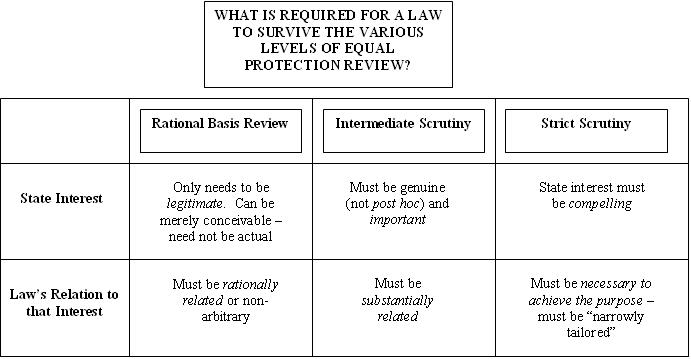
the judicial system that I learned about in a fall class. We discussed the different levels of scrutiny that the courts in America give to different types of discriminatory laws under the equal protection clause. For example, the strictest level of scrutiny is given to laws based on race and national origin, which is a prominent reason why many affirmative action cases lose when brought to court, because they treat people of different races differently. This fact, though in part justified through previous discriminatory measures that make affirmative action necessary, are not mitigating circumstances. The only way for racial discrimination of any kind to be allowed through governmental approval is if there is a "compelling state interest" and the discrimination is the most efficient way to address that interest. A famous example of this is the Japanese Internment Camps that were ruled constitutional since they did address American fears over Japanese immigrants during World War II.
Under strict scrutiny is intermediate scrutiny, for cases of gender discrimination. Under that is rational basis review, where discrimination cases based on sexual orientation or mental health are decided. I find it quite ironic that such levels exist at all. Why are different forms of discrimination created into a hierarchy of discrimination? Isn't this organization in and of itself discriminatory? It seems to me quite hypocritical and unjust for someone to receive different punishments or court ruling simply because they are a different type of bigot than someone else. I find these different strands inextricably linked. How deeply and strongly do we rely on rules of law, and for example, these seemingly hypocritical rules, when they lead to death and discrimination? Toulmin argued that we as a society should not mistake equality for equity, be satisfied with unjust laws, and tie our morality unquestionably to the rule of law. "We need to recognize that a morality based entirely on general rules and principles is tyrannical and dis-proportioned, and that only those who make equitable allowances for subtle individual differences have a proper feeling for the deeper demand of ethics" (p. 107 in Foss's Readings in Contemporary Rhetoric). I would hope that people would learn to be open-minded towards people's circumstances, take into account circumstances and mitigation, and let ourselves be human, reasonable, and overcome our obsession with perfection, black/white dichotomies, and absolutism.
I'd previously wanted to title this: Words you shouldn't say anymore, but I changed the title to reflect how my opinions aren't those of everyone. Prescribing language changes for all people, though I believe that these are respectful and accurate changes, is problematic for many reasons. These suggestions are more for people who are already in line with my beliefs, namely liberal ones, and how to adjust your language choices to be more respectful of others and values.
Racial slurs: First of all, my previous post on Django referenced this briefly, but racial slurs are not appropriate in every day use. This primarily applies to the non-African American, black, brown, or identifying groups that may use racial slurs in jest, for shock value, or as a political statement. They are not words that most of us should or can say, by re-appropriating them into white vernacular, they lose their political meaning and importance. Simply put, these words can be used to reinforce power hierarchies and should not be used lightly or at all by dominant groups.
Tarantino Responding to Criticism about Django
Pro-life: This term has bothered me for a long time. What exactly is pro-life about banning women from having abortions? Abortions can be a life-saving procedure and refusing one can lead to complications and death. The idea that a fetus is alive is based on religious definitions that life begins at conception. For non-believers or those that operate under a different definition of when life begins, the life of the mother is the life that needs to be protected. The life of the mother is not always immediately in physical danger, as was Savita Halappanavar's, but there is always emotional and psychological life to worry about. Although many pregnancies are intentional, women do become pregnant for many reasons accidental or through force. Denying these women the right to closure and healing from rape, incest, or other emotional traumas can be damaging to a woman's life as well. Instead of "pro-life" which I have described as very misleading, I endorse the term "anti-choice" to emphasize the true issue: deciding for women what they wish to do with their bodies. If life were really the issue, then the woman's life would weigh importance as well, which for many anti-choice groups, though not all, it is of secondary importance, if that. Perhaps the most disturbing part of the anti-choice movement is that by equating the fetus with a child, they respond to abortion clinics and places like Planned Parenthood as if they were attacking murderers. Abortion practitioners have been threatened and killed (pro-life, huh?) and funding for PP has been cut in many states.
Savita Halappanavar
English in general: I recently read an amazing chapter from bell hooks who discussed the emphasis on clean, pure English as a means of stripping people (primarily former slaves and their descendants) from keeping in touch with their roots through dialect. She quoted a poem by Adrienne Rich saying, "this is the language of my oppressor, but I need it to talk to you". This statement is powerful and I feel needs no explanation or extrapolation except to say that the hegemony of the English language is not something always laudable. We should all try to learn other languages and encourage others (as bell hooks describes in a teaching role) whether they be friends, family, or students to speak how they feel comfortable speaking and encourage expression in multiple voices.
Boy/girlfriend, wife/husband: I think that these words should be replaced with the gender neutral counterparts of "significant other", "partner", "spouse", etc. Assigning and using these terms reinforces heteronormative definitions of marriage that use the binary gender terms, male and female, as the standard. Despite setbacks, such as Proposition 8, marriage is on its way to being redefined as open to homosexual couples. To reflect this openness and one's agreement with the changes, more gender neutral terms should be used to describe couples. Some homosexual couples may prefer the girl/girl friend or boy/boy friend terms, and that should be respected. For general conversation, however, the gender neutral terms are more encompassing and respectful. This gender neutrality follows for trans* and members of the queer community. Pronoun and name usage is something that I am still struggling with, but I find that simply asking for one's preferred gender pronoun is the best option. For some, their outward appearance may not reflect where they are on their personal journey of identification and which gender pronoun they would prefer. One's sexual organs does not adequately describe most people's gender identities and can be restricting in terms of expression. I remember hearing a quotation from a friend at an LGBTQ event at Northeastern: "I wish I had been born a girl, instead of just having this vagina." This statement highlights the struggle of many people attempting to realign their physical gender with one's felt gender and how sexual organs should be not be defining characteristic of a human being.
These are a few suggestions for different word choices that I think might be helpful for more open, liberal-minded people. For people who are anti-choice, pro-heteronormativity, and perhaps unconcerned with issues of race, these suggestions may fall on deaf ears. For others, I hope that these at least spark some thinking about the power of the words that we use, what context we use them, and who we use them with in defying hierarchies and promoting equality.
On USC's campus in the past fall, I was approached by a woman as I was walking home from class. Thinking that she might be looking for directions, I was surprised when she approached me and asked if I had heard of "God the Mother". I hadn't; of course I had heard of God the Father, the traditional Judeo-Christian appositive for a higher power. I was intrigued and asked her to tell me more. This facet of Christianity follows a path of divinity for a character they call "the mother". She is described in Revelation and also in Galatians as Christ's "bride" and the "mother" of all humans. When Christ returns in his second coming, the World Mission Society Church of God believe that both female and male forms will come to rule.
Upon first hearing, these ideas sounded unique and ground-breaking to me. A larger, more prominent role for women? To be considered divine and worshiped playing a role (as opposed to the passive Virgin Mary role) in human salvation? It seemed a positive and reassuring step in the right direction for gender equality in faith. The patriarchal system in Christianity is undeniably exclusive to females. Although some facets do allow for women to be ordained and serve in higher roles, typically faiths that believe in consubstantiation do not allow for female priests as the priest becomes Christ momentarily during the transformation of the bread to the body of Christ. Furthermore, many biblical passages undermine the role of women and encourage subordination. For example, 1 Timothy 2:12 reads, "I do not permit a woman to teach or to exercise authority over a man; rather, she is to remain quiet". Titus 2:5 describes that women should "be self-controlled and pure, to be busy at home, to be kind, and to be subject to their husbands, so that no one will malign the word of God". This is of course excluding the many passages that discuss women as property or commodities to exchange. This hierarchy of the male over the female has been reinforced or at least continued through faith (and also science, see Ferngren's Science and Religion), so I thought that this group might be an interesting foil to traditional interpretations.
I agreed to attend weekly meetings with a missionary on campus and learn more about the faith. Fascinated, I took many notes on our meetings. I quickly found, though, that this church was not as different in their treatment as I initially thought. Learning about the "God the Mother" figure reinforced for me that this was merely a different manifestation of the already sexist female role in Christianity. Similar to the role of the Virgin Mary, as I briefly described above, the Heavenly Mother emerges as a vessel, place holder, and masculine foil, with no power, characteristics, or importance herself. Instead, the Heavenly Mother incorporates the traditional gender roles of femininity (i.e., bride, spouse, mother) into a divine form. Though it may seem encouraging to have a female face among the divine, her role as a foil to Christ removes any autonomy and importance in her narrative role. To maintain narrative fidelity (as proposed by Fisher's narrative paradigm), the patriarch must still be in place and the hero of the story must remain the male protagonist. The Heavenly Mother does not challenge this role, become a hero or protagonist herself, but merely complements the masculine figure.
From Godstuffcartoons.com
The Heavenly Mother, and consequentially, all women, are also only laded, valued, or given importance when they fulfill their gender roles. The Heavenly Mother does not have a name, like Christ, or a purpose, other than to serve Christ and be the mother of all humans. The Heavenly Mother thus becomes nothing more than the Virgin Mary: a divine vagina. Her sexual organs are the only meaning she provides for the narrative, as a sexual object for Christ as bride and a vessel for human life as mother. The woman I met with emphasized the importance of the family structure, the "nuclear" mother, father, children unit that is the backbone of society. This structure is a metaphor for the larger Father, Mother, and humankind as children. After prompting by me, my faith partner also admitted that the LGBTQ community does not fit this holy female-male binary (transfemales not in possession of the normative sexual organs) so should be banned from marriage.
My hopes for a more inclusive, engaging, and female-friendly version of Christianity were definitely dashed. I see no benefit to having a divine female figure if her only contribution to the faith is her vagina and its function. I continued to meet with the conversation partner for a few weeks, learning about why her faith was the "true" faith and the literal word of the Bible and its importance. Not only does this faith believe in the second coming, but they believe it will happen in our lifetime. During that apocalypse, we will be welcomed by both Christ and his bride, to be reunited as a heteronormative, nuclear family.
There are certain classes of discrimination that are protected under federal law: race, gender/sexuality, color/ethnicity, ancestry/national origin, age, familial status, religion, disability, veteran status, or genetic information. Discriminating against these groups in places of employment, housing, or education are illegal and can be prosecuted. A presentation that I organized about renter's rights in Pittsburgh over the summer enlightened me on these aspects of discrimination of which I was unaware. The stories that the representatives shared about fair housing violations were shocking and raised questions for me about the nature of discrimination, the legality of discrimination, and the types that are not outlawed.
I have previously discussed the politics of hegemony and the negotiation of power in the highly hierarchical social and cultural structure of the Western-dominated world. This meeting brought to light for me the power struggles that are manufactured in everyday relationships. Outside of the larger hierarchies of humans, nations, and cultures, there are power struggles in personal relationships, such as renter and landlord. Before someone even becomes a renter, the landlord is the gatekeeper to shelter and a home for many in Pittsburgh and around the world. What is not shocking is that fair housing organizations file complaints on behalf of discrimination on the classes above. What I did find interesting, though, was the admittance of types of discrimination (defined as creating distinctions and outlining differences ) that are legal ways to choose renters.
The difference between outlawed and enabled avenues of discrimination became apparent to me quite quickly: choice. Perhaps arguably veteran status, religion, and familial status are choices in some ways, but economic situation, upbringing, and traditions form the bulk of these decisions over personal choice in some cases. The choice in these situations can hardly be defined as detrimental, poor decisions, or somehow reprehensible.
Other choices, however, ones that can be used as discrimination, could be argued to be the result of poor decision-making. Examples of this type of discrimination (which I would consider "choices") that are allowed are smoking, credit history, personality, or pets. These four examples could be considered discrimination based on the choices that the applicant has made. Smoking is a personal choice that is a potentially rental-damaging habit. As one landlord in the meeting brought up, it can be quite expensive to steam clean an apartment after a smoker has lived there, and there's no guarantee that the smell can be removed, damaging their ability to gain additional tenants and revenue. Though he regretted rejecting applications from smokers, he said at the end of the day that his property was a business. Credit history is obviously influenced by one's financial capabilities, but it is at least in part determined by one's actions with one's money, in terms of being reliable and responsible. One's personality is something more intangible, but the representative assured the landlord that differentiated based on personality preferences was allowed. Having pets is almost always a choice, and one, just like smoking, that can be damaging to an apartment and its upkeep. These forms of discrimination outline choices that people make for which landlords are allowed.
As I've discussed previously, when it comes down to choice, there is an alienation of certain groups. Not everyone has the same opportunities, backgrounds, upbringings, and choices in life. One could argue that some of the "choices" I've outlined above are not actually choices, especially when one thinks of credit history. Credit history is linked to another form of differentiating potential renting applicants: ability to pay the rent. Simply put, this can be a form of discrimination if one considers the economic opportunities that some have and others do not. Economic abilities are not protected, though, for the law still upholds the right of the landlord to receive money from renters. Progress is being made by providing public services for those who need housing assistance.
The final point I would like to make is simply a research/methodological question. For those trying to "prove" housing discrimination, fair housing groups send various testers to renting facilities to see if any discrimination occurs. The simple idea is that if someone is told that they haven't been accepted and someone else is, who is to say that the choice that was made was based off of protected discrimination? As someone who is interested in research methodologies, I find answering these questions quite interesting. It is hard and complicated to prove with any certainty, but the housing organizations rely on the offering of the apartment to one person over another as operational proof of discrimination. It appears to be successful as well, based on her many stories of case wins.
I'm beginning to feel a bit like Foucault in my recent blog assertions that "power is everywhere". In the objects and articles that interest me, I find the underlying power struggles an unmistakable pattern. The way that words, laws, and politics discipline and negotiate this power is a way that I find unity between rhetoric and cultural studies in my research, if only tangentially.
I had previously scheduled a different topic, but in light of a few well-reasoned and interesting blog posts by my colleagues at USC, I've decided to throw my own hat into the ring about open-access journals and the future of publishing. I encourage you to read Alex Leavitt's initial post and Andrew Schrock's response post before reading my response below. First, I wish to declare my support for Alex and Andrew in their praise of open-access. In theory, the term is a sign of open information, shared meanings, and enlightenment. I find, however, that such thinking is, at least in current iterations, overly optimistic. In this vein, I agree more closely with Andrew's caution towards open-access in that there are other things to consider before launching a personal crusade. Alex has taken a more hard-line approach, calling for the complete abstention of "closed access", not only for himself, but for all scholars. Below I will enumerate issues that I have with such a declaration and why I would urge scholars to question the implications and consequences of such actions. I will also explain why I find Andrew's response and the continuation of some of his ideas as a more practical compromise. I would call attention to the overarching idea of the initial post: that open-access is moral and hortatorical/obligatory for scholars. This is known as the fallacy by composition, or the logical reasoning that assumes that something true of part of a whole must also be true of the whole. I completely agree that pursuing open access and supporting it is a noble goal for scholars, but I do not agree with its universal application. The implication in making such generalizations is that for all scholars, no matter their discipline or situation, that this is the correct or moral move. This, I believe, excludes the work of other scholars who may not study new technologies, be passionate about open-access and the share of information, or have the same gain by making such an announcement. The community in which and the topics which Alex studies uniquely positions him to make this declaration. Rhetorical scholars would have no interest in my admission to do the same. Creating a blanket statement by definition ignores scholarly differences that may prohibit and inhibit one from making the same choice. Although this would merit another blog post entirely, I will mention here briefly the notion of "white male privilege" that creates a hegemonic structure that rewards those in power for taking risks and penalizes others for not conforming. Whereas a great media and Internet scholar like danah boyd can "get away with" avoiding closed-access publishing, others without such clout or experience could have their careers dashed for making the same choice. This is also inherently linked to one's name/mark in a field and one's youth (read newness) to academia. This brings me to the issue of "choice" in general. I have previously written about this in regards to the Taylor Cotter incident, and the topic emerges here again. The truth is that although "open access" is a laudable goal, who is this information really "open" to? As Andrew mentions, scholars live in "privileged media and spaces that are not open to everyone" by definition, because our work is shared not necessarily to the general public, but for the purposes of academic advancement, theory, and methodology. This is not applicable to all scholars, of course, but I feel that for the majority, it is. For example, my current RAship with the Earth Science Communication Initiative is working on helping combine multiple voices (scientists, politicians, religious leaders, and activists) in working towards climate change. Will the people we work with and access be interested in the theory papers I write on apocalyptic rhetoric and political inaction? Probably not. Will they be interested in plans for action, evaluations of the conversations and solutions? Most likely. That distinction for me is the clear divide between open and closed access, simply not everything has to be or is somehow better because it can (but won't) be accessed by non-scholars. Andrew makes this point as well, noting that few people have ever denied him copies of papers he has wished to read. I have also never been denied and I have emailed copies of my papers after conferences when asked even if in theory they reside only in closed-accessed spaces. As a side note, aren't all universities closed systems of information? How many people get to see the paper I wrote for Randy Lake's "Social Movements as Rhetorical Form" class unless I publish it? Wasn't the creation of journals and online publications for this very reason? The ultimate goal of "open access", I would assume, is for the free and open sharing of information, an online Habermasian coffee shop of academic intellect. But, I think one of the best places for this to happen is at conferences and meet-ups. Of course, this brings me back to the idea of choice and the access related to money/wealth that some scholars do not have. Conferences, especially inter/national ones are not affordable for everyone, though I think academics are creating solutions to this such as local conferences (my VisComm conference in Utah was more engaging than the national ones I've been to) and creating tiers of payment for cheaper options of registration. Those issues aside, conferences are more personal and expressive points of interaction that online spaces (for now). I am sure that the capabilities will continue to grow, but for now, there is no equivalent to the panel experience. For example, my past panel at NCA gained me new colleagues, gave me new insights into the topic (Romney's Mormonism), and I exchanged numerous business cards from panel attendees. This most likely would not have been possible if I had merely posted this paper online. Part of the problem is in the bog of online scholarship, where does one begin? How to sift through all of the information accessible? Again, it comes down to one's name in the field. Whereas Alex may be receiving much attention for his post, this one will most likely go unnoticed. How does one get to the place where open-access is recognized, lauded, and meaningful? After participating in the current system. Andrew also praises the networking opportunities that come from associations and conferences that may not be hosting everything online, as spaces for expression and exchanging of ideas. These are possible because of communication associations that host them. These associations are also responsible for the publishing issues that we have. As a previous employee of a journal publishing company, I will first say that vilifying the publishing company for the state of academic research is not only unwarranted, but it is also counterproductive. Without going into too much detail about the process, I would merely say this: how successful would a publishing company be that placed restrictions on its clients? Publishing companies provide printing and online service at the request of the association/organization, nothing more. It is that group's decision for how to have journals accessed and available to members. These prices increase with options and there may be monetary royalties per subscriber or journal downloaded, but overall, these are restrictions and choices placed by the organizations themselves. Are we now to boycott any type of scholarly communication organization? Do we become lone wolf scholars trapped in an online bubble? Either way, the publishing company is simple providing a service, information and access is not for them to decide. In conclusion, though I admire Alex's passion for the open-access movement, I find it highly problematic to engage with at the exclusion of associations, journals, and other scholars. I find myself agreeing with Andrew, more or less and his more measured approach, that praises free and open publication, but does not demonizes those who do not engage, as there are many reasons for doing so. To think that I could not approach my friend and colleague to work on a paper, conference submission, or journal saddens me because those ideas/collaborations will be fully lost to the academic community, as opposed to being slightly restricted. I suppose that I will not be co-authoring anything with Alex in the future, but perhaps Andrew and I may. To summarize, TL;DR
Open access in theory is a moral no-brainer, but in application, it is problematized by issues of choice, universality, and execution
Female, minority, or any combination of intersectionality may not have the same "choice" that Alex made
Scholars who are young, at lower ranked universities, or not in technology/new media studies may be unduly hurt by restricting their publishing
The current system is changing to encompass more of these demands for online access (why destroy and boycott the system that is already attempting to do what we ask of it?)
Shouldn't we be opening access to those we know will read/are interested, as opposed to the general public out of principle? (obviously this depends on one's field/research)
There is no substitute currently for the in-person exchange of information
Associations/organizations that obtain/release information are to blame, not publishing companies
Currently, these associations provide scholars with more benefits that restrictions