Showing posts with label Conference. Show all posts

Tuesday, March 4, 2014

Academic Labor and Producing the Graduate Student

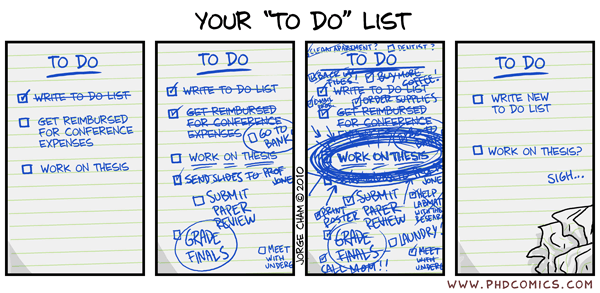
Now half-way through my 5-year program at USC, I have experienced a lot of pressure from the "publish or perish" graduate mindset. In short, I am making no big claims to state that graduate school is about producing research and work, whether in class, through conferences, or in journals. The need to be constantly producing becomes an expectation. Admitting that I did not get into a conference (which we are competitive and selective) elicited, "what do we pay you for?" as a response. People are always concerned with who is publishing where and how frequently and which conferences have deadlines coming up. One's success in performing academic labor is measured by output or the products made. The two papers I entered in that conference that are now works in progress do not "count" until they have been officially recognized at a conference or journal. Un-submitted ideas are never seen, never appreciated, never counted towards tenure. This post is not meant to be a eulogy for all of my un-works, but simply a lead-in to my larger discussion of what it means to produce academic labor.

Retrieved from PhD Comics

As a graduate student, faculty, or staff member at a university, there are constant measurements and metrics in place to ensure one is meeting the unspoken yet pervasive standards of constant productivity. In producing this labor, are we not falling into the trap of capitalism as warned by Marx? Are we not separated from the fruits of our production? Scholars may feel forced or compelled to produce quantity over quality, experiencing distance and separation from their work in an attempt to meet production standards. It is hard to reach the journal-level quality of work when we are constantly being asked to produce paper after paper for classes, conferences, grants, and outside projects. Our salary is fixed, yet we may work extra hours (if one can say the clock is ever off) without compensation. Though we may rise in the ranks to post-doc, clinical faculty, or tenure track faculty, we never fully emerge from the pressures of a proletariat lifestyle that conditions us in the ideology of produce, produce, produce. This is not to undermine the system or call anyone to blame, but simply to reflect on the structure that informs our actions, why it does so, and if can it be changed. If we mean to highlight quality over quantity, how does publish or perish help us get there?

Retrieved from Saturday Morning Breakfast Cereal

The pressure to be thinking, writing, and producing in part encouraged the creation of this blog. This motivation, coupled with my inability to produce journal-quality writings on all the topics I may want to comment on, encourages me to constantly update and consider life in an academic mindset. What is the value of this productive labor? For some, it may be monetary. Google Ads can be placed on Blogger and other Google hosted sites that provide the author a few cents per "click" on the ads placed within the site. I've also received emails about this blog asking me to write up posts about certain products and sell a permanent ad space that I would reference sporadically in my posts. Despite the fact that this is a research blog, not a consumer blog, they offered me $125 for the initial advertisement and $50 for every subsequent reference. This is the example blog post they asked me to use as a template. At first, I was surprised that my random musings on religion, the environment, and culture could be deserving of actual monetary compensation. Or, had I merely been trained by my other graduate work to consider my research a non-monetary exchange value? Although I am not sure what the value is of the words on this blog, I can say that the reputation I am building as a scholar is worth more than the few hundred dollars I would get from advertising for cars on my research blog. I suppose, there is some type of intangible productive value that I do retain from my work, only to be cashed in a few more years down the line, for a higher salary and job security. Until then, the alienation and potentially damaging stress appears to just be part of the process.

Sunday, September 22, 2013

Underestimating the Enemy: Creationism vs Evolution

At the beginning of August, I attended the Alta Argumentation Conference in Alta, Utah. There I was presenting a paper titled, "The Institute for Creation Research as a case study of scientific and religious argument: Revisiting argumentation fields in a postmodern context." The paper was presented on a panel of other papers about "religious argument." To summarize the points of my argument, I was discussing the ICR as an example of postmodern and contemporary creationism discourse. ICR is attempting to blur the lines between science and religion in order to present the illusion that science proves the story of Genesis.


The Logical Process of Science and Creationism: Source
My paper interrogated why creationism is still so persuasive to many people and why scientific consensus has not squashed this alternative story. In addition to this argument, I also stretched communication and argumentation theory by introducing a new term "deceptive controversy" and expanding the role of argument fields to creative normative standards. After finishing my speech and waiting for the Q&A, I thought about the theoretical implications for my argument and had prepped myself to defend my new term and the application of argument fields. Instead the first question I got was roughly paraphrased as: Aren't you giving ICR too much credit? They are obviously non-scientific, so what is the point of your paper?
To say I was shocked was an understatement. My extension of argument theory was not being questioned, but the very purpose and need for my intervention was. Unfortunately, I reacted more passionately and unprofessionally than I would have liked, feeling defensive of my research. I would like to take this blog post to react more professionally than I did then.
It is imperative that scholars and scientists take opposition from creationists seriously. Although science and logic show the truth of natural selection and evolutionary mechanics, that is unconvincing to more than half of the nation's population. The power of these narratives and the hold that biblical accounts have on the American public are underestimated at the risk of knowledge and innovation. There still remain issues of creationists gaining position on school boards, colleges accepting creationists on their staff, and the steady dominance of creationist thinking in the US.
Steady maintenance of science denial: Source
My inquiry was not to suggest that one should consider ICR scientific, but to examine how and why ICR does say that it is scientific. What is it about ICR's discourse that convinced hundreds of thousands of subscribers each month to read and examine its arguments? That was the point of my inquiry: to examine the patterns, rhetoric, and argument style that keep creationists relevant in modern society. Armed with this knowledge, how do we address and restrict its presence in areas of society it does not belong?
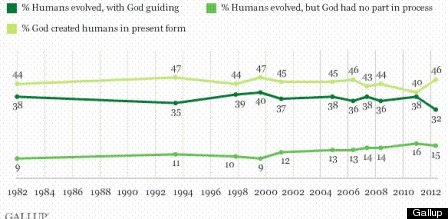
My paper took samples of ICR's discourse and broke the arguments down to their basic elements to determine if they really were scientific or not. Recent polls show only 15% of Americans believe in the occurrence of evolution without supernatural intervention, with 46% believing the in the Biblical account of origins with God (a Judeo-Christian one). That's nearly a majority of Americans who deny a scientific consensus of evolutionary mechanisms explaining origins. Groups such as ICR receive millions of dollars in charitable donations, run talking tours, sponsor museums and even a award degrees from an accredited school. Creationism discourse is alive and well in the United States, at least in the public sphere.


It is a mistake to assume that everyone approaches the creation/evolution controversy with the knowledge and capacity of intellectuals. What my questioner was really saying was that "isn't everyone in America as smart as I am? Only fools would believe in creationism." Because he saw the truth in evolution, he immediately discredited the possibility of creationism as being a valid threat. But it is. It has been and remains a threat to scientific standards, classroom education, and the knowledge of millions of Americans. To discredit their opposition is to err as many scientists have done before. To simply say "look at the science", "look at the consensus" is not enough. These facts are not convincing in the way that many academics and scholars wish that they were.


Wednesday, January 23, 2013

Open Access Journals: Information for/by everyone?

I had previously scheduled a different topic, but in light of a few well-reasoned and interesting blog posts by my colleagues at USC, I've decided to throw my own hat into the ring about open-access journals and the future of publishing. I encourage you to read Alex Leavitt's initial post and Andrew Schrock's response post before reading my response below.

First, I wish to declare my support for Alex and Andrew in their praise of open-access. In theory, the term is a sign of open information, shared meanings, and enlightenment. I find, however, that such thinking is, at least in current iterations, overly optimistic. In this vein, I agree more closely with Andrew's caution towards open-access in that there are other things to consider before launching a personal crusade. Alex has taken a more hard-line approach, calling for the complete abstention of "closed access", not only for himself, but for all scholars.  Below I will enumerate issues that I have with such a declaration and why I would urge scholars to question the implications and consequences of such actions. I will also explain why I find Andrew's response and the continuation of some of his ideas as a more practical compromise.

I would call attention to the overarching idea of the initial post: that open-access is moral and hortatorical/obligatory for scholars. This is known as the fallacy by composition, or the logical reasoning that assumes that something true of part of a whole must also be true of the whole. I completely agree that pursuing open access and supporting it is a noble goal for scholars, but I do not agree with its universal application. The implication in making such generalizations is that for all scholars, no matter their discipline or situation, that this is the correct or moral move. This, I believe, excludes the work of other scholars who may not study new technologies, be passionate about open-access and the share of information, or have the same gain by making such an announcement. The community in which and the topics which Alex studies uniquely positions him to make this declaration. Rhetorical scholars would have no interest in my admission to do the same. Creating a blanket statement by definition ignores scholarly differences that may prohibit and inhibit one from making the same choice. Although this would merit another blog post entirely, I will mention here briefly the notion of "white male privilege" that creates a hegemonic structure that rewards those in power for taking risks and penalizes others for not conforming. Whereas a great media and Internet scholar like danah boyd can "get away with" avoiding closed-access publishing, others without such clout or experience could have their careers dashed for making the same choice. This is also inherently linked to one's name/mark in a field and one's youth (read newness) to academia.

This brings me to the issue of "choice" in general. I have previously written about this in regards to the Taylor Cotter incident, and the topic emerges here again. The truth is that although "open access" is a laudable goal, who is this information really "open" to? As Andrew mentions, scholars live in  "privileged media and spaces that are not open to everyone" by definition, because our work is shared not necessarily to the general public, but for the purposes of academic advancement, theory, and methodology. This is not applicable to all scholars, of course, but I feel that for the majority, it is. For example, my current RAship with the Earth Science Communication Initiative is working on helping combine multiple voices (scientists, politicians, religious leaders, and activists) in working towards climate change. Will the people we work with and access be interested in the theory papers I write on apocalyptic rhetoric and political inaction? Probably not. Will they be interested in plans for action, evaluations of the conversations  and solutions? Most likely. That distinction for me is the clear divide between open and closed access, simply not everything has to be or is somehow better because it can (but won't) be accessed by non-scholars. Andrew makes this point as well, noting that few people have ever denied him copies of papers he has wished to read. I have also never been denied and I have emailed copies of my papers after conferences when asked even if in theory they reside only in closed-accessed spaces. As a side note, aren't all universities closed systems of information? How many people get to see the paper I wrote for Randy Lake's "Social Movements as Rhetorical Form" class unless I publish it? Wasn't the creation of journals and online publications for this very reason?

The ultimate goal of "open access", I would assume, is for the free and open sharing of information, an online Habermasian coffee shop of academic intellect. But, I think one of the best places for this to happen is at conferences and meet-ups. Of course, this brings me back to the idea of choice and the access related to money/wealth that some scholars do not have. Conferences, especially inter/national ones are not affordable for everyone, though I think academics are creating solutions to this such as local conferences (my VisComm conference in Utah was more engaging than the national ones I've been to) and creating tiers of payment for cheaper options of registration. Those issues aside, conferences are more personal and expressive points of interaction that online spaces (for now). I am sure that the capabilities will continue to grow, but for now, there is no equivalent to the panel experience. For example, my past panel at NCA gained me new colleagues, gave me new insights into the topic (Romney's Mormonism), and I exchanged numerous business cards from panel attendees. This most likely would not have been possible if I had merely posted this paper online. Part of the problem is in the bog of online scholarship, where does one begin? How to sift through all of the information accessible? Again, it comes down to one's name in the field. Whereas Alex may be receiving much attention for his post, this one will most likely go unnoticed. How does one get to the place where open-access is recognized, lauded, and meaningful? After participating in the current system.

Andrew also praises the networking opportunities that come from associations and conferences that may not be hosting everything online, as spaces for expression and exchanging of ideas. These are possible because of communication associations that host them. These associations are also responsible for the publishing issues that we have. As a previous employee of a journal publishing company, I will first say that vilifying the publishing company for the state of academic research is not only unwarranted, but it is also counterproductive. Without going into too much detail about the process, I would merely say this: how successful would a publishing company be that placed restrictions on its clients? Publishing companies provide printing and online service at the request of the association/organization, nothing more. It is that group's decision for how to have journals accessed and available to members. These prices increase with options and there may be monetary royalties per subscriber or journal downloaded, but overall, these are restrictions and choices placed by the organizations themselves. Are we now to boycott any type of scholarly communication organization? Do we become lone wolf scholars trapped in an online bubble? Either way, the publishing company is simple providing a service, information and access is not for them to decide.

In conclusion, though I admire Alex's passion for the open-access movement, I find it highly problematic to engage with at the exclusion of associations, journals, and other scholars. I find myself agreeing with Andrew, more or less and his more measured approach, that praises free and open publication, but does not demonizes those who do not engage, as there are many  reasons for doing so. To think that I could not approach my friend and colleague to work on a paper, conference submission, or journal saddens me because those ideas/collaborations will be fully lost to the academic community, as opposed to being slightly restricted. I suppose that I will not be co-authoring anything with Alex in the future, but perhaps Andrew and I may.

To summarize, TL;DR
  • Open access in theory is a moral no-brainer, but in application, it is problematized by issues of choice, universality, and execution
  • Female, minority, or any combination of intersectionality may not have the same "choice" that Alex made
  • Scholars who are young, at lower ranked universities, or not in technology/new media studies may be unduly hurt by restricting their publishing
  • The current system is changing to encompass more of these demands for online access (why destroy and boycott the system that is already attempting to do what we ask of it?)
  • Shouldn't we be opening access to those we know will read/are interested, as opposed to the general public out of principle? (obviously this depends on one's field/research)
  • There is no substitute currently for the in-person exchange of information
  • Associations/organizations that obtain/release information are to blame, not publishing companies
  • Currently, these associations provide scholars with more benefits that restrictions

Wednesday, October 10, 2012

Conference Pros and Cons

After going to three conferences so far in my academic career (a limited number compared to some of my prolific colleagues), I have already noticed some stark differences between the larger, medium-sized, and smaller conferences. The differences between the Eastern Communication Association, International Communication Association, and the Visual Communication Association conferences left me with much to think about for future conference planning, scheduling, and budgeting.

What is most surprising is that across the board, conferences cost around $700 each. Some of us are lucky enough to receive university funding to help subsidize these costs, but for most unfunded students, post-docs, and recent hires, these prices are restrictive in how many conferences it is feasible to attend. Using the ICA conference as my large conference and VisCom as my small conference, I have listed the pros and cons that I have experienced as a conference novice.


Large conferences - ICA as exemplar
  • great variety
    • I was thrilled to see all of the variety in panels that I could attend. From early morning to early evening, there were dozens of panels that interested me in a variety of topic areas and disciplines. There were even panels in different formats, from posters to panels to speed sessions, to keep my attention.
  • overlap in panels
    • Although the number and variety of panels were great, there was a lot of overlap where I was interested in multiple panels and had to chose which to attend. This is an obvious converse to the above point, but I still felt rude for leaving panels early and had difficulty choosing between panels of interest to me. A few times I felt that I had chosen incorrectly, but felt obligated to stay and be respectful to my fellow scholars.
  • large amount of people
    • This aspect is half green and red simply because for some, this is a positive attribute. For me, however, I felt quite overwhelmed by the amount of people at the conference, resulting in my clinging to the few people I knew and meeting very few new scholars. Surprisingly, for the conference being so large, I had only a dozen people present at my panel.
  • major city
    • Although I didn't explore Phoenix, I knew many of my colleagues who took time to visit the Grand Canyon, go on local tours, and simply wander the city. Next year the conference will be in London, so ICA offers even more sightseeing and travel opportunities. The major city also helped keep prices for flights and hotels down due to competition.
Small conferences - VisCom as exemplar
  • great variety
    • Although the conference was only about visual communication, a small subset of communication, the variety of presentations was astounding! From discussions of the body to politics to memorials to evolution, the panels did not disappoint in variety!
  • small amount of people
    • The small amount of people made for an inclusive and welcoming atmosphere. There was only one panel scheduled for each time slot, so everyone at the conference attended everyone else's panel. Not only was I presenting to many more people than at ICA, but I was having the same scholarly experience that my colleagues were having as well.
  • price for value
    • The registration fee for VisComm was more than double ICA's registration, which was surprising to me. One good aspect of this was that the food was included, so I did save some money there. Although I normally do not spend a lot of money on food anyway, it was a nice change to feel well-feed (and how good the food was!) at the conference.
  • location
    • This is in part related to the price issues above. The VisCom conference was in Midway, Utah, the closest airport being Salt Lake City, which was 1 hour away. The location was inconvenient and the prices to fly into Salt Lake City were expensive and the traveling complicated. The hotel site was beautiful, with a crater, mountains, and landscaping, but the high cost of the flight and hotel caused me to leave without venturing too far from the conference room.
View outside of the Homestead Resort in Midway, Utah

Poster Presentations - ECA as exemplar
  • genuine interest in project
    • People who stopped by to read more into my poster were genuinely interested in my project. Additionally, we had more in-depth and nuanced conversations about the specific aspects of my project that was particularly interesting. I was not talking to an entire room, answering a few generic questions, but was having a personal conversation with a fellow scholar. There was opportunity for sharing, brainstorming, and more intimate discussion.
  • repetition
    • Within those intimate conversations, though, I found myself repeating the basic tenets of my piece over and over again. In a larger panel discussion, I could have answered the questions for everyone a single time. For individuals, however, it was necessary to give my five minutes spiel for everyone who came around. For a two hour poster session, I was hoarse by the end of it.
  • chaotic/loud
    • The ECA's poster session was the first that it had put on for the undergraduates. They apparently had more interest than expected because the room was quite small and posters barely had enough space to stand beside without standing in front of someone else's. If the posters I were sandwiched between each had visitors, it was hard to even see my poster let alone have a conversation about it. These issues may have been alleviated with a different set-up and space, but it is an issue to consider when applying for a poster session.
Overall, I greatly enjoyed my conference experiences this year and look forward to my upcoming year of conferences, which is already being filled by my planned attendance at the National Communication Association conference in Orlando, Florida in November.

Wednesday, June 27, 2012

Visual Communication Reflection 1: Nudity

At the Visual Communication conference this past weekend, I saw a panel about the representation of the body that I feel merits additional discussion. I was fascinated by the topics that were all linked by images, visuals, and the body: nudity in sports magazines, the narratives of tattoos, and eyewitness testimony. I will devote a blog post to each of these ideas and then finally connect them all with an important communication concept and a personal example of that connection at work.

The first paper performed a critical rhetorical analysis of the visuals in ESPN Magazine's "body issue" that shows athletes in censored but mostly naked poses. As opposed to a pornographic magazine, the photographs were of athletes who covered genital and chest regions with creative posing, sports equipment, or other people.
Serena Williams - Tennis
The tagline for the body issue is the "bodies we want", an ode to the athletic form as the most desirable for both males and females. The issue even states that the reason for the special issue focusing on nudity is to "celebrate the athletic form", emphasizing the body as the ultimate tool of the athletes. Even though athletes may use soccer balls, nets, rackets, and bats, their fundamental tool and skill remains within the capabilities of their body. Strong legs, arms, and torsos, speed, agility, strength, and power are all attributes of the perfect athletic form that strives for victory and perfection.

"Each year, we stop to admire the vast potential of the human form. To unapologetically stand in awe of the athletes who've pushed their physiques to profound frontiers. To imagine how it would feel to inhabit those bodies, to leap and punch and throw like a god. To ... well, gawk. So go ahead; join us."

The idea is that "normal" people cannot achieve such physical fitness and athleticism is something "god-like", to be worshiped and praised. Athletes, though, arguably occupy a wide variety of physical fitness. From the small, thin frame of the jockey to the lean muscle of the runner to the bulky, muscular form of football players, athletes come in all shapes and sizes. Their bodies are thus icons of perfection, not because they fit a certain mold or standard of perfection, but because they are perfect tools to fulfill their specific role. Interesting additions to the body issue, infrequent, is the representation of Paralympic athletes such as Esther Vergeer (2010 issue) and Oksana Masters (2012 issue). Although their bodies may not be the "perfect", "god-like" bodies that one would initially think of, these athletes have become titans in their sport, serving as a symbol of the power of the athletic form, however one may define it.
Sarah Reinertsen - Marathon/Triathlon Runner
The part of the magazine that the researcher's focused on was that although the audience is almost exclusively young and middle-aged males, the magazine had nearly equal proportions of male and female athletes which would contradict heteronormative assumptions. Instead of only focusing on female forms to attract the attention of their target market, the magazine also included naked male bodies, complicating its association with pornographic material. 

The rationale behind the male/female frequency in the magazine was justified by the researchers in the comparison of the types of images. The female athletes were consistently shown in stoic, full body poses performing no action besides being a subject for the camera to focus on. For example, Venus Williams was shown supine in a bathing suit beside a pool, performing no action but relaxing. Julia Mancuso was standing facing the camera, bending a leg and crossing her arms to cover herself. From these photographs, we would have no indication of their sport, physical abilities, or skills as an athlete, but can only focus on their form as an attractive body.
Julia Mancuso - Olympic Skier
The male athletes, however, were consistently performing actions, such as aspects of their sport, exercising, or interacting with teammates. Instead of focusing on the body, the male photographs created action, a narrative, and activity to follow and contextualize the naked male form. For the female athletes, the only focus was directed to their body, showing no skill, talents, or actions specific to the sport or athletes. For example, Tim Howard was shown in goalie gloves diving across the photograph in an attempt to save an imaginary goal. Patrick Willis was shown exercising, lifting larger weights and emphasizing his strength, power, and muscles.

Jose Reyes - Baseball
Evaluating these differences as evidence of heteronormativity, the researchers conclude that the publication still objectifies female athletes for their attractive bodies and worships the male body as a site for action, victory, and athletic ability.

The methodology the researchers chose was based in gender and feminist studies, but I wish that the overall issue of the body and power had been explored. I find the inclusion of Paralympic bodies, the bodies of jockeys, bobsledders, and sumo wrestlers, and non-traditional athletic forms is a powerful statement about who can and should be considered an athlete.