Showing posts with label Ethics. Show all posts

Sunday, September 21, 2014

The Danger and Opportunity in Speaking for/with Others

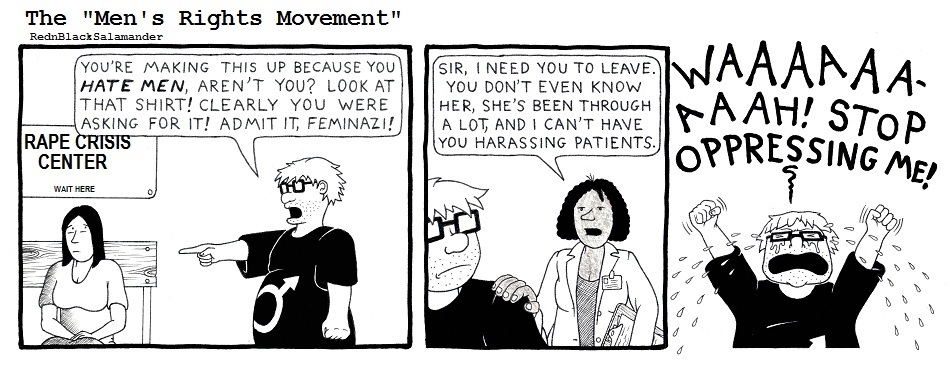
There are many issues that I feel compelled to address as a rhetorician and social agent of change (Klumpp and Hollihan argue). Engaging with these issues, however, requires reflexivity about my own status as a privileged, white, heterosexual, cisgender, able-bodied, female and how that type of person/body can speak for others. Can I speak for others? Perhaps literally, yes, I could use my platform on this blog and as an academic to speak for others. It wouldn't be well or with full knowledge, but I could. Thus, the better question would be should I speak for others?

On one hand, attention to these important issues of transgender rights, racial inequalities, gender equality, and equality more broadly should have as many advocates as possible. People of all description can be allies and amplify the voices and stories of those who can speak more genuinely about these problems.

Image retrieved from this site.
On the other hand, speaking for others complicates issues of voice, could serve to isolate the voices of others, and reifies a system in which certain voices are more valuable than other voices. In an academic exchange in a journal, Campbell and Biesecker addressed the issue of speaking for women in rhetorical history and how the "canon" of rhetoric that is studied systematically removes female voices. Though Campbell erred on the side of including as many voices as possible into the current canon, Biesecker was in favor of rejecting the canon as a system of tokenization.

The rhetoric of tokenism highlights certain voices that triumph against an oppressive system as evidence that the system is not oppressive. The lauded status of certain individuals (Cloud has an excellent article on Oprah as exemplar) is unique and worthy of note, and their success is linked to their individual qualities. If others simply embodied these same qualities, they could also rise above the system, meaning that change is unnecessary.

This is the token black character on South Park, literally named "Token." Retrieved from this site.
Part of the problem in speaking for others is this dynamic of visibility, voice, invisibility, and silence. To speak for others is to reify that certain voices are not being paid attention to, but it also silences their actual message in favor of a conduit. To remain silent, though, is to allow and passively participate in the maintenance of the status quo.

I am still working through these problems and try to keep them in mind in the work that I address and the comments that I make. I try to always be reflective and aware of the position from which I consume information and process opinions. For now, I err on the side of commenting from my limited position, especially when certain issues are prevalent and pressing.

One issue that has recently emerged, and one which I am reluctant to rehash considering the wishes of my colleagues, has been the Annenberg Innovation Lab Black Twitter project. I wish only to comment on this situation's similarities to the issues of authorship, voice, and who is allowed/should study others as a researcher. A summary of the incident can be read here and an excellent response by my colleague Dayna Chatman can be read here. This incident helped me reflect more on my status as a researcher and how academia as a whole can be more reflexive of how our personal situations affect our approaches to certain issues.

Monday, July 21, 2014

Intergenerational Arguments about Climate Change

The consequences of climate change have become more prominent, but many of the harsher, more extreme consequences will not be felt by this generation. Part of the difficulty in crafting persuasive climate change arguments is about "jumping" the inter-generational gap. An intergenerational argument encourages people to act not in their own interest, but in the interest of future generations. Though most of us alive today will likely avoid most of the harshest effects of climate change, our children and certainly our grandchildren, will not be as lucky. People tend to be fickle, however. They are many things vying for our attention, pulling us in different directions, so anything further off than right NOW seems too far off to be worthy of our time. As Burke noted in Permanence and Change: “A philosopher, if he has a toothache, is more likely to be interested in dentistry than in mathematical symbolism. Communication cannot be satisfactory unless the matter discussed bears in some notable respect upon the interests of the auditor” (p. 37).

Retrieved from this site
How do we get people to care for youth? For animals? For anyone but ourselves? It is not simply a matter of narcissism or selfishness; it is just far easier for people to react based on their immediate surroundings. Thinking ahead requires much more energy than simple observation, putting oneself in a different mindset is difficult, and there can be other, conflicting loyalties that stop one from accepting long-term arguments. One of these arguments is economic: short-term business and profits may suffer when making long-term environmentally friendly decisions. Another complicating factor may be religious beliefs about human's dominion over the earth. Or, it might simply be a political affiliation that often denies science and climate arguments in deliberative spaces (Gauchat, 2012).

Author and activist Zadie Smith. Retrieved from this site
One of the ways to spread intergenerational messages is online. When public spaces may be held to standards of balance or may receive denialist backlash, the internet can serve as a location for the expression of information. A recent article by author Zadie Smith called, "Elegy for a Country's Seasons" addresses the current apathy in the climate change debate and how she might explain our inaction to her granddaughter. This excerpt from the piece is particularly important as the excuses given seem to pale in comparison to the burden that we will leave this young girl and all children as we bicker over money and politics.

"This will no doubt look very peculiar to my seven-year-old granddaughter. I don’t expect she will forgive me, but it might be useful for her to get a glimpse into the mindset, if only for the purposes of comprehension. What shall I tell her? Her teachers will already have explained that what was happening to the weather, in 2014, was an inconvenient truth, financially, politically—but that’s perfectly obvious, even now. A global movement of the people might have forced it onto the political agenda, no matter the cost. What she will want to know is why this movement took so long to materialize. So I might say to her, look: the thing you have to appreciate is that we’d just been through a century of relativism and deconstruction, in which we were informed that most of our fondest-held principles were either uncertain or simple wishful thinking, and in many areas of our lives we had already been asked to accept that nothing is essential and everything changes—and this had taken the fight out of us somewhat" Smith, para. 11.

Written articles may take time to read through and may not offer direct and easy consumption of information (however beautiful and engaging Smith's article is). Another potential solution is to create videos that craft intergenerational arguments. This video is from the Australian Coal Mining Company that has a unique intergenerational plan for halting the effects of climate change.


This humorous video has an important point. It mirrors the argument by Smith about passing the buck onto future generations when we could have done something about it. When we stand back and look at the potential consequences, what are our excuses? Is it really enough to look at dollar signs or listen to denialists when we are faced with the guilt of harming all future life? Dramatic? Maybe. Accurate? Certainly. These arguments are not always successful, but people should try to become more attuned to them. Focusing on the current effects now can be an entryway in to discussing how it will only get worse, and our children will suffer for it.

Sunday, June 29, 2014

Earth Sciences Communication Initiative

I am traveling for the next few weeks to attend the International Society for the Study of Argumentation Conference in Amsterdam. Instead of a longer, more in-depth piece, I hope that you may read a few blog pieces that I've written for the Earth Sciences Communication Initiative. This is a long-running research partnership that I've had that focuses on the intersection of the environment, politics, communication, rhetoric, and advocacy. More information on the group can be found on ESCInitiative.org.

Harm to Animal and Plant Life as Motivation
This article explores the potential threats of climate change to animal and plant life. More specifically, it addresses how these threats are conceptualized as motivation for taking action towards environmental protection. These might not be as successful rhetorical strategies as appealing to direct threats to ourselves or future generations, but they still reflect a potential opportunity for change.

Polarizing/Politicizing the Climate Change Debate
This is a topic I've written about a few times before. The article addresses how political loyalties can trump considerations of environmental protection, making short term benefits more convincing than long term ones.

Creation Care: Uniting Science with Moral Imperatives
In response to Pope Francis I's recent discussions of climate change and environmental stewardship, this article addresses the creation care movement and how it marries environmental concern with a moral imperative to act. You can read my four part, intensive critique of this movement here (Part 1, Part 2, Part 3, Part 4).

Climate Change is No Joke. . . or Is It?
This article interrogates the use of humor as a potential tactic in promoting forgiveness and action. Instead of condemning and punishing people for environmental crimes, the comic frame could allow for a more positive, productive engagement with environmental topics.

Sunday, June 22, 2014

Donald Sterling as a Modern Day Earl Butz

It is impossible to ignore all of the online and offline discussion of the owner of the LA Clippers, Donald Sterling's racist remarks. He noted in a private conversation to his girlfriend that he didn't want her "associating with black people," and specifically bringing them to basketball games. The hypocrisy in Sterling becoming rich off of the labor of black bodies has been addressed better elsewhere, so I wish to address another important part of this discussion: the apologia. Using Kenneth Burke's guilt-redemption cycle, this post will discuss the similarities of Sterling's remarks to the racist statements of Earl Butz, and how these statements implicate the larger American public in the persistence of racism.

Donald Sterling and the Clippers's logo
Earl Butz was Secretary of Agriculture in 1976 who eventually resigned his position after racist comments emerged. This site has the full timeline of the events including the offensive joke. A scholarly article was written about that event by Dr. James Klumpp and Dr. Thomas A. Hollihan called "Debunking the Resignation of Earl Butz: Sacrificing an Official Racist." The title reveals some important terms and information that will inform this comparison between Butz and Sterling. I will also highlight some important differences that reveal modern racial tensions. Butz was "sacrificed" as Klumpp and Hollihan say, as a part of Burke's guilt-redemption cycle. This cycle describes how pollution, or some type of disorder, is introduced into an order, which creates guilt and a subsequent need for purification, purging, and redemption.

Earl Butz, retrieved from this site
For Butz and Sterling, the pollution was their racist statements that shattered the values of equality inherent in their respective social and political orders (government and sports). Both of these institutions are supposed to value equality, all Americans, and their constituents. As public figures, their voices can be seen as stand-ins for the groups that they represent. Butz was "sacrificed" by the Republican Party, who wished to separate their public appearance from racism. The NBA also separated itself from Sterling by banning him from the organization, fining him $2.5 million, and urging him to sell the team. The sacrifice can come in many forms, but it must make the punishment commensurate to the crime committed. Considering that the pollution for each was the potential crumbling of national organizations, the punishments were made quite prominent, public, and severe.
Some prominent reactions to Sterling's statements
Another important similarity between the two are the separation between public and private. Klumpp and Hollihan address this dichotomy by nothing that officials are sometimes seen as not have the right to privacy: anything said even in private could destroy a public persona, one's reputation, and career. Some were quick to jump to Sterling's defense such as columnists at Fox who pointed to the "thoughts" of Sterling as harmless and a personal right. Some articles went as far as to implicate the girlfriend (who recorded the conversation) as the real criminal. In the aftermath of the announcement, Mark Cuban echoed the words of a Fox News reporter about whether convicting people for statements in private could be a "slippery slope" to the thought-police.

Though some of these concerns were raised, there has been overwhelming support for Sterling's punishment. One might say that it was a "success" in some ways in that an athletic profiteer who undermined his own team and the values of the NBA (and perhaps, the country) would be receiving a just punishment. However, Klumpp and Hollihan raise a point of contention with these types of guilt-redemption activities. They note that by creating a sacrificial goat out of Butz and Sterling, we as a nation do not have to address underlying and persistent racism that we may all (or at least most of us) be guilty of. Instead, we can claim that wrongs have been righted and that racism is an individual issue that does not have to be addressed on a societal level. They note that these overt punishments of racism create a culture that "tolerates private racism and its consequences” (p. 11). Jon Stewart adeptly addresses the issue of post-racial society in his critique of Sterling and the recent SCOTUS decision to uphold Michigan's ban on affirmative action.

Retrieved from the Daily Show

What is to be learned by the Donald Sterling incident? One thing is perhaps most important: racism still exists. There is no magical, post-racial world because we have a black president. People haven't stopped being murdered because of their race, people haven't stopped trying to make relevant the KKK, and people still use the n-word. This is only the tip of the iceberg, however, as racism against other minorities, especially immigrant populations, is also a common American theme. Is this what America is all about? We need to take examples like Butz and Sterling and open our eyes to the underlying problems from which these individuals stem. Structural racism is happening and continues to happen; we cannot remain blind to it and only care when individuals break norms of keeping racism a private endeavor. All racism needs to be addressed, and we have a lot of work to do.

Monday, June 16, 2014

Dorian's Descent: All Art is Quite Useless

Dorian's Descent is a new stage adaptation of The Picture of Dorian Gray by Oscar Wilde. Dorian's Descent is a musical that has added an element to the story: the Devil. In this article, I wish to explore the narrative elements of The Picture of Dorian Gray through Walter Fisher's narrative probability and narrative fidelity, the Faust trope, and how the character of the Devil is a narrative disaster. Although I did enjoy the show and thought the singing was quite impressive, the actual lyrics, words, and acting were sub-par, especially compared to a few other musicals and adaptations I have seen in Los Angeles. I will be discussing the play and the book in detail (i.e., spoiler alert!), so I encourage readers to read the book or acquaint themselves with the story.
Poster for Dorian's Descent
The Picture of Dorian Gray is about a young man, Dorian Gray, who becomes obsessed with a portrait that Basil Hallward has painted of him. It shows him in his youth and his prime, characteristics that he realizes, once prompted by his friend Lord Henry Wotton, will fade. In a state of hopelessness, Dorian wishes that the painting might age instead of him, for in its current stage it only serves as a reminder of what he would lose. Without explanation, the painting does begin to change as Dorian becomes involved in the hedonism of Lord Henry's lifestyle. Dorian scorns Basil, engages in illicit sexual activity, murders, and experiments with various vices. The picture ages, its face is marred by a snarl, and the brow is furrowed in perpetual anger and disdain. Eventually disgraced by the harm he has caused, Dorian attempts to absolve himself by stabbing the picture. The two reverse, leaving Dorian himself dead, aged, and hideous and the portrait returned to the beauty which Basil painted.

The picture and Dorian from the movie adaptation
Dorian's Descent infuses a rock opera theme onto the story, which pairs nicely with the descent into hedonism and sin. The element of the Devil, however, removes a very powerful and meaningful part of the play: Dorian's agency, choice, and self-mortification. In the play, the Devil appears and makes an explicit Faustian deal with Dorian so that he may stay young and the portrait may age. The character is doubly unnecessary. First, Lord Henry already serves as the Faustian Devil, the foil to Basil between which Dorian must decide. Having the Devil character undermines Lord Henry's role as the tempting, evil character that lives a sinful, yet seemingly fulfilling life. His presence mirrors the Devil, instead of captivating Dorian's attention in his own right. Furthermore, the Devil as a mystical, magical character removes the potential for Dorian's choice. The supernatural can seem to constrain the choices and available actions of humans, making Dorian's descent into hedonism part of the Devil's plan instead of a meaningful choice of evil over good, Sir Henry over Basil, self over others.

The Devil makes a deal
The beauty of The Picture of Dorian Gray is the unspoken Faust trope. Any one might utter an "I wish . . . " or make selfish requests, placing oneself squarely in the shoes of Dorian, connecting and identifying with him in finding himself in a peculiar situation. Walter Fisher described two elements of narrative rationality (or the logic of stories): narrative fidelity and narrative probability. Narrative fidelity is the perception of how faithful a story is to reality (or the audience's world). Although one might think that this would preclude fantasy, science fiction, or non-fiction from having fidelity. On the contrary, stories such as Harry Potter have high narrative fidelity because they seem real and possible, despite their fantasy elements. We could imagine, though we may not have seen or experienced it, a secret world hidden within our own (thus justifying its lack of presence). Though we may not have experienced or believed possible a changing portrait, we can faithfully imagine our lives as confronting something wholly un-explainable and what our reactions to it might be. The element of the Devil fully violates this type of realismo mágico (think Guillermo del Toro) where it could be possible, and makes the subtle Faust trope seem more like a cliche.

Sibyl Vane's forgotten lyrics
Perhaps most disappointing for me was the changes to the Sibyl Vane character, Dorian's brief love. Before his shift into full hedonism, Dorian fell in love with an actress. Her devotion to her art and her skill in bringing love to life in her performances captivates him. In his courtship of her, however, Dorian destroys Sibyl's ability to act. I have copied her confession after a particularly terrible performance of Romeo & Juliet below, which is one of the more beautiful passages in the book.

"Dorian, Dorian," she cried, "before I knew you, acting was the one reality of my life. It was only in the theatre that I lived. I thought that it was all true. I was Rosalind one night and Portia the other. The joy of Beatrice was my joy, and the sorrows of Cordelia were mine also. I believed in everything. The common people who acted with me seemed to me to be godlike. The painted scenes were my world. I knew nothing but shadows, and I thought them real. You came -- oh, my beautiful love! -- and you freed my soul from prison. You taught me what reality really is. To-night, for the first time in my life, I saw through the hollowness, the sham, the silliness of the empty pageant in which I had always played. To-night, for the first time, I became conscious that the Romeo was hideous, and old, and painted, that the moonlight in the orchard was false, that the scenery was vulgar, and that the words I had to speak were unreal, were not my words, were not what I wanted to say. You had brought me something higher, something of which all art is but a reflection. You had made me understand what love really is. My love! My love! Prince Charming! Prince of life! I have grown sick of shadows. You are more to me than all art can ever be. What have I to do with the puppets of a play?"

Sibyl has so greatly fallen for Dorian that she cannot pretend to love as she once did. This confession is made all the more beautiful when she takes her life after Dorian rejects her love. In the play version, Sibyl is a singer whose voices makes Dorian fall in love. Substituting singing for acting makes sense in the musical, but it is the other change that ruins it for me. Instead of falling out of love, causing Sibyl to ruin her craft, the Devil character makes Sibyl forget her lines before a show. The audience loses this beautiful insight into Sibyl's innocence and thus undermines her death as the tipping point in Dorian's sanity. This change further supports my comments below about Dorian's actions being orchestrated and not of his own choice.

Retrieved from this site
Dorian's Descent is an interesting adaptation of The Picture of Dorian Gray, but its creative changes served only to undermine the beauty, simplicity, and complicity of the book in an attempt to be unique. Without our ability to empathize with Dorian's decisions, which we believe are of his own accord, the audience can only observe and cannot be active participants in the narrative. We are not convinced that this could happen to us, that we would make such a deal with the Devil, or that we are only a few steps away from falling into sin ourselves.

Although this is not the shining review that I'm sure the fledgling play is hoping for, I hope that they take to heart the immortal words of Lord Henry: "There is only one thing in the world worse than being talked about, and that is not being talked about." Certainly this adaptation has given me and I hope any readers some food for thought about how narratives are updated, adapted, and changed in the pursuit of artistic creativity and to teach us about issues that plague society.

Sunday, June 1, 2014

What do Elliot Rodger and Tal Fortgang have in common?

I had previously started writing a piece in response to the Tal Fortgang “check your privilege” article. I wanted to discuss the plethora of space and attention the media (and society) gives to the white, male, cisgender, able-bodied, heteronormative perspective. I briefly stopped working on that article when news of UCSB’s campus attack became public. I immediately thought that Elliot Rodger’s story was perhaps more deserving of being critiqued. This was when I realized the great similarities between these two men (albeit very far away on the violence spectrum) that can be linked to underlying societal de-valuing of trans- and cis- women. I will address these two situations separately before critiquing the reinforcement of hegemony that allows us to avoid blaming ourselves for the rampant presence of continuous threats of rape and death.

For Tal, being told to “check his privilege” is the worst part of his college experience. Tal’s rejection of his inherent privilege denied the negative experiences of others (at college or elsewhere) of racial discrimination, violence, and sexual assault. The stories of so many women, especially transwomen and women of color, are forever swept under the rug, but the whining of a Princeton-educated, non-struggling story of Tal are lauded as examples of how society is forcing white people to feel guilty “just for existing.” It is quite disheartening to know that one’s story will not be believed simply because one does not have the access to media forums in which to express them. Or, even when those stories are told, they are often the white, cis-woman perspective. Or, when women are threatened, we still rely on the charity of men to raise the alarm and offer suggestions.

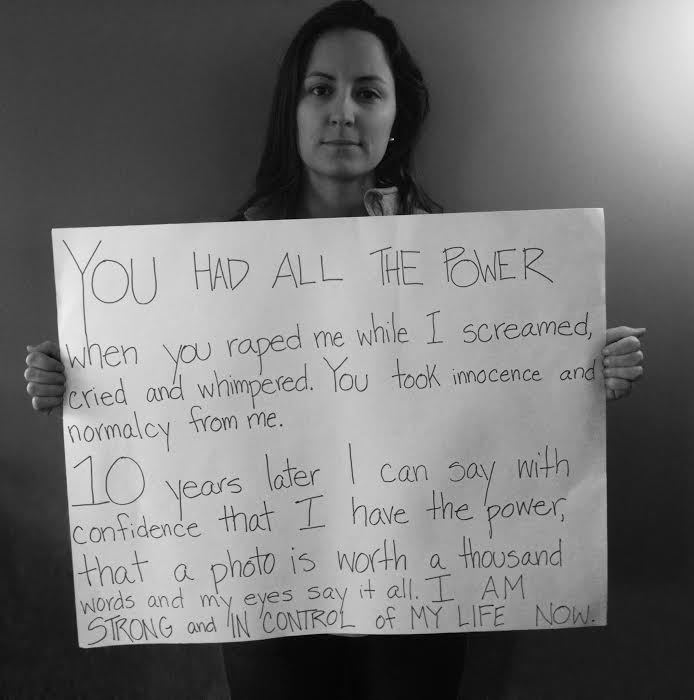
I praise the strong, powerful women at other institutions, such as USC and Northeastern (my current and previous institution of higher education) that have shared their story and fought back against institutions that deny women the right to say no, and their legal recourse against perpetrators. I was not strong enough to tell my story. Even with my high level of privilege, I was terrified of the consequences of reporting my sexual assault by a trusted friend at Northeastern. The word “survivor” never rang true for me. “Survivor” would imply that I had faced a natural force, like a tsunami or a disease, and overcame the event and devastating effects.  I didn't, though. I was faced with a human force, a man in complete control of his actions, a friend, who I had given my trust to, had made a conscious decision to act, devalue our friendship, and violate my body. This is, unfortunately, the story of so many women in collegiate settings, but so few are given the space to share their stories, or feel that they can freely and without consequence equally access our rights.

Retrieved from this site
Elliot Rodger’s story is also garnering national attention, including his manifesto where he declares his hatred of women and need to enact revenge through murder. Despite such plain, obvious language, some people have come to Rodger’s defense by displacing blame from his white, male privilege to mental illness. One of my colleagues at USC, Francesca Marie Smith, argued that mental illness can be used as an argumentative strategy to undermine the culpable of agents in a given situation. Examining the 2011 shooting of Gabby Giffords, she concluded that a focus on the mental capacity of Jared Lee Loughner derailed larger conversations about the societal pressures and political polarization that may have fueled the attack.

Elliot should not be memorialized, lauded, made a hero, or removed from blame. This was a calculated, terrorist attack on women as a whole because he had been told “no.” He believed he had a right to the female body as sexual property and projected his own shortcomings on the failure of (female) others. People should not watch his videos or read his manifesto: let us not immortalize a misogynist who decided to take life instead of realize the privilege in his own.

Retrieved from this site
These two stories began and ended very differently. Tal has certainly upset people with his lack of awareness and care for the stories of others, but Elliot has murdered. I do not wish to equate these stories; I am not making claims about “all men.” I am instead commenting on the attributes that they share and what this says about our society.

Both are inherently linked to race and gender, because they laud the white, male perspective over all other bodies. Yes, Elliot was mixed race, but there is no denying his feelings of privilege and superiority that accompany this perspective. Both believe in the power of their privileged body to make decisions and that they have the right to remove of agency from others. Tal and Elliot are not allowed to be told “no,” especially not by people of color or women. Tal cannot be told to “check his privilege” and Elliot cannot be denied sex. These are the autonomous decisions of others that put into question the privilege that Tal and Elliot could not even recognize they had (being blind to their own condition and the conditions of others). 

Retrieved from this site
These men are just two chapters in the larger story of a society that allows their privilege to continue unabated, that celebrates and defends them, and that prevents us from looking inward at our own complicity. If it the fault of people who question Tal’s struggle, Elliot’s mental condition, or my inebriation, then society as a whole is declared “not guilty.” We can live in the façade of a world where these events are mere peppered outliers in a properly functioning society, instead of symptoms of a diseased organism. Walking down the street or taking public transportation is an opportunity for women to be yelled at, groped, followed, threatened, or even worse. Even spending time with trusted friends and family members can lead to the violation of the female body. Althusser's police officer defines the power structure and everyone's position in it by addressing someone, "Hey you!" When I walk down the street and am called "bitch" while being grabbed from behind, that also defines me without my permission, reaction, or ability to subvert.

Many more stories of struggle and healing at Project Unbreakable
We cannot let these stories be drowned out by the mob quick to defend the current system. We must give space and attention to those that are fighting for change and awareness of larger issues. We perhaps cannot change the minds of current misogynists or denialists who will resist at all costs the crumbling of the society that preferences them. But, with increased effort, we may be able to usher in new generations brought up in a society that recognizes the issues that face the majority of us and fosters a culture that is actively trying to change it.

Sunday, May 25, 2014

Creation Care Part 4: Where do we go from here?

There have been scholarly discussions over the purpose/value/potential impact that the creation care movement might have. It is tempting to be pessimistic in a political culture that seems to be stuck in the constant polarization between affirmation and denial instead of focusing on efficacy to action. I see some potential in the creation care movement, however. Although the loudest voices we hear are focused on denialism and their detractors who try to debate them, most Americans lie in the middle. I am not concerned with convincing the denialists, but with changing the debate. Creation care could potentially be an avenue to speak the (religious) language of many Americans and people around the globe. The movement shifts the conversation from quibbling over scientific data, undermining science as a field of inquiry, and valuing money over people, to intergenerational arguments about charity, and a deep concern for the poor and nature.

Though I agree that too much optimism will only lead to disappointment, I feel that there are positive steps being taken and creation care messages being presented in the media. Recently, Pope Francis I made a strong statement in support of creation care. This was perhaps his most prominent and widely covered statement directly about the environment. Francis has repeatedly spoken out about the values of charity, has decried the poverty specifically relative to the wealth of some priests. It may come as no surprise, then, that Francis links these values to caring for the environment “because if we destroy Creation, Creation will destroy us.” The full remarks can be heard here, which outline Francis’s emphasis on balance between humans, humans and the environment, and humans and their spirituality.

St. Francis of Assisi, retrieved from this site
Referencing his namesake (St. Francis of Assisi), Francis encouraged his followers, and indeed all of humanity, to be “custodians of creation.” This phrase is interchangeable with the “stewardship” of creation that reflects Genesis 2:15 which calls for humans to “work and take care of” the Garden of Eden (New International Version). The story of Genesis is often considered to be in contradiction with itself, as it contains phrases that seem to laud the role of humanity as having dominion over the world and also phrases that support taking care of cultivating the earth. This reflects a difference in interpretation, which Francis is trying to push towards the latter view where Creation is a gift rather than property to be exploited.

You can order Hayhoe's book on Amazon
Creation care has also been in the news with the works of Katharine Hayhoe, a climatologist from Texas Tech and an outspoken evangelical Christian. She was named to Time's 100 Pioneers list with an article written about her by Don Cheadle. They worked together on Years of Living Dangerously, a Showtime TV series that used celebrities as correspondents to investigate issues surrounding climate change. The episode "Preacher's Daughter," specifically addresses creation care as a movement that could impact policies and public opinion about the environment. At an event with Ian Somerhalder (a correspondent in the Preacher's Daughter episode), he noted that the more people who watch the show, the more the media networks will understand that this is an important issue that real people want real answers to, instead of just pundits and talking heads.


There is certainly language a plenty to indicate despair, irreparable damage, and apathy. But, there is also hope. Hope may live in the gaps of these contradictions, between science and religion as incompatible frameworks, comfort and sacrifice as dichotomous values, and the future versus the end of the world as motivating eschatologies.

Sunday, March 9, 2014

Energy Darwinism: Substituting Economic Benefits with Moral Imperatives

Concerns over climate change has pushed the delicate relationship between short term benefits and long term risks and economic and environmental balance. Recent reports published by Citi (and subsequent national commentary on them) have focused on the idea of "Energy Darwinism." In this post, I hope to explicate this term, relate it to evolution and natural selection as the metaphor implies, and what this says about moral and religious obligations to the environment. 


Retrieved from this blog
As a brief point of introduction, natural selection, or "Darwinism" is the basic mechanism of evolution. From the assemblage of single-celled organisms to humanity, genetic variations accumulate over time and create branches of descendants and all of the life on earth today. The basic tenets of natural selection is that mutations occur in DNA to produce variations which are then competitively selected by the environment, mating preferences, and predator/prey relationships. Interpretations of evolution often forgo the opportunity for supernatural or divine intervention, making it a materialist theory of origins. Thus, evolutionary theory has often been opposed by religious adherents who regard it as immoral and too largely focused on the environment as a guiding force. Alternative narratives often find a role for a deity such as creationism or intelligent design. Labeling evolution "Darwinism" is in part a rhetorical strategy to reduce the explanatory power of evolution to the worship of an individual.


Retrieved from this blog
Although natural selection was not meant to be applied to other areas of life, especially not human life, many people have demonized the competitive spirit of natural selection as damaging to humanity. Social Darwinism is an attempt to label philosophies of human competition with evolutionary characteristics. Energy Darwinism is a new application of evolutionary theories to industry reactions to environmental protection. The concept refers to the economic benefits of businesses becoming more eco-friendly. As carbon becomes more expensive as demand remains (or increases) and supply decreases, businesses themselves will move towards alternative sources in order to remain competitive. There is an irony in professing that Darwinism, which is often levied as a negative descriptor of human competition, aggression, and exploitation is used as industry competition that may drive down prices, encourage innovation for selfish needs for profit/money. Energy Darwinism may seem a simple, logical concept, but there are sinister implications and consequences for such thinking.

If the changing economic environment will change naturally to encourage better business practices, this removes the responsibility of industry to be purposeful actors and the government from intervening in environmental protection. There would be no need for regulations, national laws, and international agreements about reducing carbon and encouraging change because industries will naturally adjust to environmental pressures. Industries are reduced to the world of motion (such as the basic functions of animals), incapable of rational and symbolic action (such as the functioning of humans) that would require thoughtful reflection and intervention. Furthermore, the discussion of environmental protection is reduced to economic benefits, arguably the reason why the environment has been harmed to such extent. Energy Darwinism removes economic structures from culpability and instead worships it as the source of salvation. The system will correct itself, so there is no need for activism or change.


Retrieved from this blog
A better motivation for environmental protection perhaps lies in moral arguments instead of economic ones. Though Energy Darwinism provides hope that businesses might be motivated to act, economic motivations are certainly questionable for immediate actions. Especially considering the Key Stone Pipeline and other important changes happening now, it seems that waiting for industries to succumb to pressures in the economic system will be too little, too late. Religious arguments, however, often propose moral obligations to protect the Earth for future generations and appeals to charity to help those in less developed countries accommodate environmental change. These arguments are certainly more appealing on a basic level of caring for fellow humanity, but it is perhaps overly optimistic to think that these arguments might ever have the persuasive power of dollar signs. 

Sunday, February 16, 2014

Defining Life: Visual Representations of Life and the Anti-Choice Movement

I've titled this piece specifically in reference to a previous post justifying anti-choice instead of pro-life for the description of abortion right's opponents. The point of the post is to discuss a few interesting manifestations of visual rhetoric in anti-choice arguments that I've recently noticed. The visual tactics of the abortion movement have been documented well by those scholars who have come before me, especially in terms of the photographs and images of aborted and damaged fetuses as resembling born children in appearance and described action (Petchesky, 1987; Lake & Pickering, 1998; Condit, 1990). My first artifact heavily references these visual elements in equating the fetus to a baby. A new service called "3D Babies" allows for parents to upload photographs of their ultrasounds which can then be printed into a doll-like plastic sculpture.

Retrieved from 3D Babies.

These dolls reflect the argumentative tactic of representing life as starting from conception. Due to the physical resemblances of a fetus to an infant, the doll represents a visual argument for the protection of the fetus as one would protect a child. This image is described on the website as a 23-24 week old baby "measuring 8 inches from crown to rump." At 24 weeks, the fetus is nearing the end of the second trimester, so is nearly considered a viable fetus that could survive outside of the womb. Because of this, third trimester abortions are currently illegal in most countries. Consequently, abortions at this stage in the pregnancy comprise less than 1.3% of all abortions. The likelihood of a fetus looking like this doll when aborted is very low. This decision, then, is strategic in that the fetus is as far along as possible without being illegal to abort, thus appearing much like an infant. 91.8% of fetuses are aborted in the first trimester, (or less than 13 weeks) which makes their appearance closer to an embryo, only called a fetus at 12 weeks.
Retrieved from this blog

These visual choices are strategies to associate a fetus with an infant, one of the most (if not the most) vulnerable population on the planet.This is paired with cries to protect those who cannot protect themselves. The power of the visual and the associations that come from it can serve to overpower logic and the verbal by calling upon the aesthetic and the visceral. This is in part the strategy of laws that require ultrasounds before allowing access to abortions. The law provides a visual connection that the woman/mother and fetus/child share. If one sees the ultrasound images, one might be less likely to abort, directly associating the images on the screen with a potential life that cannot be avoided. The efficacy or ethics of this law could surely be debated, but the point I'm making here is the ingrained power of the visual to elicit emotion and its role as an anti-choice strategy. Facing visually one's actions is tantamount to removing agency if it clouds the judgment of agents. The intended purpose of this law is certainly to halt abortions or at least give women pause (or immense guilt). The woman, then, cannot make a personal decision of her own thought without the visual pressures of the potentially aborted fetus. The ultrasound and 3D doll images present that problem: that the fetus is a potential life, baby, and child experienced and seen as true.

The 3D doll can be purchased by whomever might want one, and I would hope that it would not be used as a persuasive tool to encroach upon agency. The larger issue for me is the laws that force the power of visuals on women making important, stressful, and life-changing decisions. Certainly images and narrative hyperbole about well developed fetuses (past the second trimester) being aborted are questionably moral actions. One cannot, however, stop them from being used in public forums, protests, and billboards. Something that should not be allowed, however, are deceptive images and unnecessary invasive practices forced upon women before receiving a potentially life-saving medical procedure.

As an informed public, scholars, and voters, we must all consider the potentially deceptive qualities of visuals and the arguments that they are making. For the ongoing abortion controversy, visuals and they employment are extremely important in helping the anti-choice movement portray women seeking abortions as murderers and masking invasive, sexist laws as protective statues. There are many intriguing documentaries about this issue, specifically as realized in America. I would particularly recommend Unborn in the USA that does directly discuss the visual strategies involved in the debate.


Monday, September 30, 2013

Discrimination and Rhetoric in the Judiciary

Recently I read Stephen Toulmin's "Tyranny of Principles," an article written in 1981, but one I found highly relevant to current times. Toulmin, perhaps most famous for his Toulmin Model of Argumentation, describes the evolution of rules and laws from traditional discretionary practices in Roman times. I found this piece fascinating because it helps contextualize a common point of controversy in modern judicial and moral arguments, and also because I find rhetoric's roots in the judicial system and its constant tension with "ethics" (the good man speaking well) worthy of discussion.


Toulmin begins the article by describing previous methods of judiciary practices, where there were no written laws or precedents in Rome for judges to base decisions. Instead, each individual case was handled as a separate, distinct scenario in which all mitigating or unique circumstances were taken into consideration. People trusted the knowledge and discretion of the pontiffs, not an overarching law. But, as Toulmin describes, multiple factors (including immigration that changed societal norms and a need for more and thus less trained judges) constructed a need for established and referable rules which today are the basis for Western judicial systems. This transition is truly a double-edged sword, for now equality and consistency have been established, but in its stead, we sacrifice equity. Simply consider Jean Valjean in Hugo's Les Misérables, who served 19 years (5 for the crime and 14 additional for trying to escape) for 

stealing bread to feed his nephew. Did he steal? Yes. Was this crime worthy of 5 years in jail? 
To Javert, a servant of God and the Law, there are no mitigating circumstances, a crime is a crime. 
And even when the tables turn and Valjean lets Javert escape, Javert is still bent on returning 
Valjean to jail. He eventually experiences a mental break where he cannot justify living in a world 
where people like Valjean violate his standards of right and wrong.


Philip Quast: Javert's Suicide

The transformation of the judicial system, our reliance on the Constitution and precedent has 
emphasized the letter over the spirit of the law, removed wiggle room, and devalued mitigating 
circumstances. One need only consider the death of Savita Halappanavar, who died from birth 
complications after the abortion she requested was denied. The religious (and in this case Catholic) 
view of abortion as wholly wrong contributed to Savita's death, whose health was not a justification 
for the abortion. Many anti-choice advocates do allow for abortion in cases of rape, incest, or the 
health of the mother, but there are prominent American politicians and even doctors that do not. 
In response to Savita's death, Irish politicians are attempting to re-legislate the rules concerning 
abortions and when the health of the mother overrides the abortion ban. As Toulmin argues, society 
must be wary of an over-reliance on these rules, and must refrain from adjusting laws with more laws, 
instead of addressing the morality and ethics of the original law.


Toulmin's article is a useful transition for me to discuss inherent discrimination and a lack of equity in 

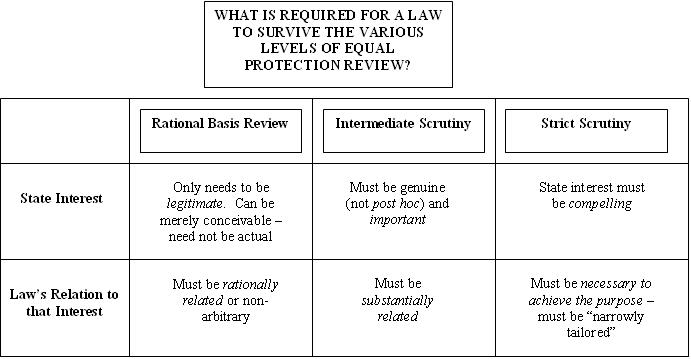
the judicial system that I learned about in a fall class. We discussed the different levels of scrutiny that 
the courts in America give to different types of discriminatory laws under the equal protection clause. 
For example, the strictest level of  scrutiny is given to laws based on race and national origin, which is 
a prominent reason why many affirmative action cases lose when brought to court, because they treat 
people of different races differently. This fact, though in part justified through previous discriminatory 
measures that make affirmative action necessary, are not mitigating circumstances. The only way for 
racial discrimination of any kind to be allowed through governmental approval is if there is a "compelling 
state interest" and the discrimination is the most efficient way to address that interest. A famous example 
of this is the Japanese Internment Camps that were ruled constitutional since they did address American 
fears over Japanese immigrants during World War II.


Image Retrieved from National Paralegal
Under strict scrutiny is intermediate scrutiny, for cases of gender discrimination. Under that is rational 
basis review, where discrimination cases based on sexual orientation or mental health are decided. 
I find it quite ironic that such levels exist at all. Why are different forms of discrimination created into 
a hierarchy of discrimination? Isn't this organization in and of itself discriminatory? It seems to me quite
hypocritical and unjust for someone to receive different punishments or court ruling simply because they 
are a different type of bigot than someone else.

I find these different strands inextricably linked. How deeply and strongly do we rely on rules of law, and 
for example, these seemingly hypocritical rules, when they lead to death and discrimination? Toulmin argued
 that we as a society should not mistake equality for equity, be satisfied with unjust laws, and tie our morality
unquestionably to the rule of law. "We need to recognize that a morality based entirely on general rules and
principles is tyrannical and dis-proportioned, and that only those who make equitable allowances for subtle 
individual differences have a proper feeling for the deeper demand of ethics" (p. 107 in Foss's 
Readings in Contemporary Rhetoric). I would hope that people would learn to be open-minded towards 
people's circumstances, take into account circumstances and mitigation, and let ourselves be human,
reasonable, and overcome our obsession with perfection, black/white dichotomies, and absolutism.

Wednesday, March 6, 2013

Climate Change Skepticism as a Roadblock to Progress

I have previously discussed climate change from the perspective of science and extrapolation to future consequences of global warming. Not only are the predictions highly varied, but the consequences of them range from changing in weather patterns to massive displacement, war, and global food insecurity. The Intergovernmental Panel on Climate Change (IPCC) is often considered the foremost authority on climate change and uses amassed scientific data to create a consensus surrounding climate change, urging countries and politicians to act.


Here is where the problems occur, because policies to limit the effects of climate change are not occurring, especially not in the United States. But why? The answer to this question lies in the polarization of politics and the divide between Republicans and Democrats on the climate change issue. Gauchat (2012) proposed the politicalization of science where over time, the issue of scientific authority has become inextricably tied to political loyalties. Consequently, Republicans and frequent church-goers have significantly lost faith and trust in science as the authority of truth. To accept science as the authority is to abandon other methods of explanation, such as faith, and become disloyal to party lines.

The evidence for this claim is seen not only in the polls that Gauchat analysed, but also from the actions of Congress and the Republicans in it. Funding for climate change research under the Republican chairs of committees and subcommittees has been debated and in some cases cut. In defense of removing National Science Foundation funding for climate change projects, Chairman Ralph Hall (R-TX) said, “the reluctance to engage in conversations with people who have doubts or question the veracity of climate science is at the heart of the wrong doing that undermines trust in climate change science”, thereby legitimating climate contrarians by placing them at even footing with scientists (“Witnesses Highlight Flawed Processes Used to Generate Climate Change Science, Inform Policy,” 2011).

Perhaps most shocking and incredible is the recent ruling by North Carolina that scientists are no longer allowed to use extrapolations to predict future implications of climate change, but can only use past data. This is an exemplar of politics directly interfering with scientific integrity, capabilities, and validity with no justification. Stephen Colbert mocked this bill excellently by noting that North Carolina are blocking scientific inquiry in attempts to hide data that would force them to act in favor of the scientific consensus. Literally restricting science's ability to chart and model future climate change implications further undermines science's ability to predict problems and urge political action. For without powerful, scientifically accurate, and frankly, worrisome data, how are politicians to be convinced to action?

Herein lies another complication: the urgency of climate change and in fact its very existence is wholeheartedly rejected by many politicians, making any attempt to convince them quite fruitless. Climate change skeptics or contrarians simply will not be persuaded by any scientific plea for action, no matter how urgent or convincing. The situation is remarkably quite similar to the idea of the religious apocalypse: for no matter how urgent or persuasive a prophet of the rapture is, non-religious, agnostic, or atheistic people will simply not be persuaded. Faith to them, just as science appears to be for Republicans and church-goers, does not hold any persuasive clout.


The result of this skepticism is the questioning of all scientific data to support policy ideas. Instead of taking action, politicians wait for "conclusive" scientific evidence, which threatens the world's ability to ever fully prepare for the consequences of climate change. Soon, it may be too late to act, and we will reach the tipping point, where there is no longer the opportunity for preventative measures, but only response. How serious these consequences will be revealed only through time, but we know now that the longer we wait, the worse it will be. Soon, it will be too late to act, but the world will cry out the famous words of Macbeth (Act 3, Scene 4):


"I am in blood, stepped in so far that, should I wade no more,
Returning were as tedious as go o'er"

Wednesday, February 6, 2013

Housing Discrimination: Legalizing Hate?

There are certain classes of discrimination that are protected under federal law: race, gender/sexuality, color/ethnicity, ancestry/national origin, age, familial status, religion, disability, veteran status, or genetic information. Discriminating against these groups in places of employment, housing, or education are illegal and can be prosecuted. A presentation that I organized about renter's rights in Pittsburgh over the summer enlightened me on these aspects of discrimination of which I was unaware. The stories that the representatives shared about fair housing violations were shocking and raised questions for me about the nature of discrimination, the legality of discrimination, and the types that are not outlawed.


I have previously discussed the politics of hegemony and the negotiation of power in the highly hierarchical social and cultural structure of the Western-dominated world. This meeting brought to light for me the power struggles that are manufactured in everyday relationships. Outside of the larger hierarchies of humans, nations, and cultures, there are power struggles in personal relationships, such as renter and landlord. Before someone even becomes a renter, the landlord is the gatekeeper to shelter and a home for many in Pittsburgh and around the world. What is not shocking is that fair housing organizations file complaints on behalf of discrimination on the classes above. What I did find interesting, though, was the admittance of types of discrimination (defined as creating distinctions and outlining differences ) that are legal ways to choose renters.

The difference between outlawed and enabled avenues of discrimination became apparent to me quite quickly: choice. Perhaps arguably veteran status, religion, and familial status are choices in some ways, but economic situation, upbringing, and traditions form the bulk of these decisions over personal choice in some cases. The choice in these situations can hardly be defined as detrimental, poor decisions, or somehow reprehensible.


Other choices, however, ones that can be used as discrimination, could be argued to be the result of poor decision-making. Examples of this type of discrimination (which I would consider "choices") that are allowed are smoking, credit history, personality, or pets. These four examples could be considered discrimination based on the choices that the applicant has made. Smoking is a personal choice that is a potentially rental-damaging habit. As one landlord in the meeting brought up, it can be quite expensive to steam clean an apartment after a smoker has lived there, and there's no guarantee that the smell can be removed, damaging their ability to gain additional tenants and revenue. Though he regretted rejecting applications from smokers, he said at the end of the day that his property was a business. Credit history is obviously influenced by one's financial capabilities, but it is at least in part determined by one's actions with one's money, in terms of being reliable and responsible. One's personality is something more intangible, but the representative assured the landlord that differentiated based on personality preferences was allowed. Having pets is almost always a choice, and one, just like smoking, that can be damaging to an apartment and its upkeep. These forms of discrimination outline choices that people make for which landlords are allowed.

As I've discussed previously, when it comes down to choice, there is an alienation of certain groups. Not everyone has the same opportunities, backgrounds, upbringings, and choices in life. One could argue that some of the "choices" I've outlined above are not actually choices, especially when one thinks of credit history. Credit history is linked to another form of differentiating potential renting applicants: ability to pay the rent. Simply put, this can be a form of discrimination if one considers the economic opportunities that some have and others do not. Economic abilities are not protected, though, for the law still upholds the right of the landlord to receive money from renters. Progress is being made by providing public services for those who need housing assistance.

The final point I would like to make is simply a research/methodological question. For those trying to "prove" housing discrimination, fair housing groups send various testers to renting facilities to see if any discrimination occurs. The simple idea is that if someone is told that they haven't been accepted and someone else is, who is to say that the choice that was made was based off of protected discrimination? As someone who is interested in research methodologies, I find answering these questions quite interesting. It is hard and complicated to prove with any certainty, but the housing organizations rely on the offering of the apartment to one person over another as operational proof of discrimination. It appears to be successful as well, based on her many stories of case wins.


I'm beginning to feel a bit like Foucault in my recent blog assertions that "power is everywhere". In the objects and articles that interest me, I find the underlying power struggles an unmistakable pattern. The way that words, laws, and politics discipline and negotiate this power is a way that I find unity between rhetoric and cultural studies in my research, if only tangentially.