Showing posts with label Argument. Show all posts

Sunday, November 16, 2014

Arguing Monuments and Material Rhetoric

The concept of "materiality" and how physical objects argue is becoming popular in rhetorical criticism. Scholars are beginning to theorize that buildings, cities, monuments, and other physical objects can argue, influence people, and tell stories -- just like words. The history of "the material turn" is quiet expansive (as I've discovered while writing my dissertation about it), but I will summarize some key points before discussing examples.

Traditional rhetorical criticism focused on the speeches of great orators and analyzed the word choices and potential effects. Scholars slowly began to incorporate other objects of study like groups of speakers, genres of speeches, and non-elite speakers. These variations still focused on the spoken and written word, however. Larger changes emerged when scholars began looking at how physical spaces constrain or offer opportunities in the way that speeches invite or construct possibilities for audiences. Moving through a space that has physical obstacles is similar to spoken commands or laws that restrict movement. Physical spaces and objects can themselves be symbols (like words) that have embedded meaning, affect, and significance. Materiality invites audience participation and makes arguments.

The first example of arguing monuments is the Portrait Monument at the US Capitol. The marble monument shows three elegant busts of prominent women in the women's suffrage movement: Elizabeth Cady Stanton, Susan B. Anthony, and Lucretia Mott. There is room for a fourth bust in a lump of un-carved stone in the rear of the monument.

Picture retrieved from Architect of the Capitol
This monument makes a clear argument that the work of women's rights is unfinished. There may have been great women in the past who deserve to be honored, but there is still the need for activism, activists, and progress. Furthermore, viewers of the monument are invited to honor the memories of these three great women by continuing on their work. Their memories do not invoke a sense of completeness or finality; their faces encourage the audience to ask, "what more can be done?" Some people have thought that the unfinished section is meant to be completed when the US elects the first female President. This, however, goes against the intention of the artist, Adelaide Johnson, to show the perpetually unsolved state of gender equality.

Another example is the Atheism bench. This monument is the first public monument to atheism, or a lack of belief in divinity. The American Atheists lost a court case to have a monument to the Ten Commandments removed from a Florida Courthouse. Instead of removing the monument, the court offered them the opportunity to build their own monument. The monument is a bench so as to be a functional piece of public display. It is covered in quotations that specifically mention religion and the American political and legal systems.

Picture retrieved from Time Magazine
The Atheism bench claims space for non-belief outside of a courtroom that, like Lady Liberty, should be blind to concerns of religion. The bench argues that religious belief should not be a factor in the courts. The bench also argues that public space should be free and open space where no ideas should dominate and none should be excluded. The bench also includes, in writing "consequences of breaking the Ten Commandments" as a direct verbal argument against the Ten Commandments monument displayed on the other end of the courthouse.

These are just two examples of how physical spaces can produce arguments. Oftentimes, memorials are coupled with verbal statements, like the Atheism bench, but it is important for scholars to note that images, monuments, and material things can produce independent, standalone arguments.

Sunday, September 28, 2014

Using Religion as a Negative Characteristic

Due to my prospectus deadline looming, this week will have to be a short introduction to a topic that has been on my radar for some time. This trend that I have noticed, mainly in denialist rhetoric, uses religion as a negative characteristic that typifies history or science as "fantastic," "not to be trusted," or based solely on "belief" instead of fact.

Image retrieved from this site.
I am currently working on a paper that links the denialist strategies of Holocaust-denialists, climate-deniers, and creationists (evolution-deniers). This paper will explore the strategic arguments made by each group and the potential means to address them. Although it will not directly address this phenomenon, the frequent presence of "religion" as a negative characteristic has prompted my attention. I hope that this brief inquiry, which will be continued in another post or paper, will delve into these characteristics and this odd, recurrent rhetorical pattern.

One Holocaust-denial page (http://expeltheparasite.com/2013/10/28/the-holocaust-hoax-it-never-happened/) argued that Holocaust-confirmers are wedded to their story of history with a religious fervor. The website argued:
"My guess is that people believe the hoax because they want to believe. It fills some deep emotional need—perhaps to overcome a sense of inferiority compared to the Germans, or to somehow join the dominant group in society. The exact answer is beyond any understanding of this writer—but it is an enormously important question nonetheless in the same way that one should try to understand why people believe in religion. Holocaust belief is a kind of new religion—as irrational and ridiculous as any other religion but enormously appealing. For those who have not totally lost their minds, the following reasons for rejecting the hoax may have meaning" (para. 8).
Belief in religion is characterized as "irrational and ridiculous" despite the author's many Christian symbols, crosses, and references to Christ's sacrifice for the good of the white race.

Image retrieved from this site.
Climate deniers are also quite often religious and base their opposition to environmental protection on Christian teachings. The Cornwall Alliance (CA) is a religiously motivated group that denies the importance of climate change and its consequences as distracting from God's true work. Dr. Calvin Beisner, founder of the CA wrote, “religion is the root of any culture, and environmentalism has become a full-fledged religion in its own right. It is the most comprehensive substitute in the world today for Christianity so far as worldview, theology, ethics, politics, economics, and science are concerned” (Beisner, 2013, p. 1). He described environmentalism, or a focus and care on the environment, as a religion, based not on science, but on faith.

I've written about the Institute for Creation Research (ICR) before regarding a conference paper. The paper focused on ICR's magazine, Acts & Facts, that presents research done in their institute that proves creationism. They advertise their magazine as a tool “to counter the lies of evolution” and include education as one of the three prongs of their mission (along with research and communication). ICR undermines evolutionary science as “conflicting with biblical Christianity” and “detractors” to the true worldview (“Creationist Worldview,” para. 4; 6). They publish research articles that support creationism and also interest pieces about political, social, and cultural issues. In an article about education, author Henry Morris  (1973) wrote, “One of the most amazing phenomena in the histoy of education is that a speculative philosophy based on no true scientific evidence could have been universally adopted and taught as scientific fact” (para. 1). He described evolution as a philosophy that worships that religion of naturalism and humanism. Evolution is “the established religion of the state” that has excluded competing voices because they fear the truth (Morris, 1973, para. 4). Evolution, often called "Darwinism," is a religion that worships Darwin as a deity that scientists follow blindly.

Image retrieved from this site.


The extreme irony here is that groups who deny history or science (such as Neo-Nazis, creationists, and climate-deniers) are often themselves deeply religious, namely Christian. What is the logic in using religion as a negative characteristic when one follows religion oneself? It seems hypocritical for religious groups to undermine their opponents by trying to paint them as religious. In one sense, this places both sides on an equal playing field, treated both as beliefs that should be respected. Another possibility is that by reducing the opposing side to religion, the deniers can claim scientific superiority. Though they may rely on religion in their own beliefs, many groups understand the persuasive and authoritative power of evidence, models, and rationality.

Sunday, September 7, 2014

The Online Activist: Making Charity Cold as Ice

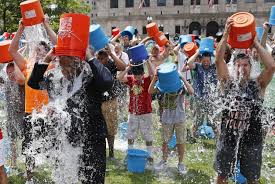
There have been many commentaries on the ALS Ice Bucket Challenge, hereafter IBC, including some by my colleagues at Annenberg. I have very mixed feelings about the challenge and they are quite scattered. I will attempt, then, to parse some of my more scholarly opinions on the matter in my overall criticism of the challenge as an event in narcissism and exploitation that has ultimately generated a lot of money for a great cause. In this sentence, I want it to be clear that the process by which these donations are raised is where my primary concern lies and not with the cause itself. Certainly, encouraging donations is a positive enterprise, but I am not completely deontological in that I feel that a critical look at the process and means by which these are obtained are necessary.
Retrieved from this site.
My first issue with the IBC is the notion of "challenge." There has been an increase of challenge and dare activities on the Internet where people are constantly trying to one-up each other. We had planking, for example, where people would try and lie supine on random objects, often in danger. The more dangerous or precarious the planking, the more valuable in terms of Internet clout. Then, came the video challenges by which people were dared to do something inherently dangerous, like jump off a bridge. Not surprisingly, this resulted in the deaths of a few people after drowning trying to meet the dare. Though meant as harmless fun (of which even my lovely siblings have participated in), these challenges raise important questions of safety and what activities the Internet are encouraging off-line. Others have been injured in so-called "cold water plunges" that are often media stunts to raise money for charities or certain causes. These challenges raise questions of agency and the choice of the "dared." When we are really talking about life and death, how can we not see challenge culture as a negative aspect of the Internet that encourages risky and dangerous behavior?

Planking on the edge of a building. Retrieved from this site.
These "I nominate X, X, and X" phrases remind me of the chain letters of the 90s where you had to forward these ridiculous stories (in Yahoo and Hotmail, typically) or someone would come kill you in the evening. What actually happens if you don't accept an IBC, cold water challenge, or forward a chain email? Absolutely nothing. The challenge culture simply takes your unwillingness to do a dare from middle school slumber parties to a global audience. In a word, it's childish. The maintenance of these challenges perpetuates the dangerous culture of one-upping and daring, although not specifically present in the IBC. What we communicate has essentially stayed the same, but how we communicate it has changed. Ong would see the evolving communication technologies as simply offering new forms that communication can take, such as the dare. The IBC has the countdown clock and the threat of non-compliance that email chains (and blackmail, by the way) have to motivate people to act. The dare takes the spirit of altruism out of the donations, because it is reduced to the act of one-upping others, blending in with the crowd, and passing the dare on to others.

My second issue is the notion that this particular charity is particularly worthy, or that I am forced to donate to this particular one. I think that donating to charity is definitely a worthwhile cause and one that the IBC has reminded me that I should do more of. But, why ALS? They have simply come up with this marketing campaign. They, like all charities, are not particularly worthy or more deserving than so many other of the great charities out there that one could donate to. Why should my choice in charity donation be limited because of a "dare" I receive on Facebook? Why shouldn't I donate to a charity that I care about? That I believe does good work? That I feel is not getting enough attention? Perhaps I have been personally affected by close family member having Alzheimer's or diabetes and wish to donate to them. Is this somehow less acceptable because I am not performing the dare made of me? Why should someone else decide where I give my money? This article brings up important concerns about what the money will be used for and the benefits of massive donations to a specific charity (especially one like ALS which focuses on research and impacts very few people).

Retrieved from this site.
My third issue is the performative aspect of the challenge that promotes narcissism and exhibitionism rather than a concern for the charity. Why should I have to dump water on my head to do a good deed? Not to mention the many concerns this has raised in California because of the drought. Why do I have to film it and share it with others? Why isn't donation a private act that doesn't need public display? Because it's not about my donation, it's about me. It's about my public performance of doing good work. Modern culture cannot do a good deed without getting recognized for it. We need public recognition of every A, every act of kindness, every charity. Dumping water is about including myself in the story of ALS and its success, about feeling good about my involvement. The IBC reminds me quite strongly of the "Fitch the Homeless" movement where people donated all of their Abercrombie & Fitch clothes to the homeless. On the surface, just like the IBC, this campaign did provide many donations of much-needing clothing for the homeless. But, this campaign leaves a similarly negative taste in my mouth because of the reasoning behind the actual donations. They were not out of the sake of the good deeds or that the homeless were in need, but that we were getting back at Abercrombie & Fitch CEO would made comments about his clothing being only for "cool kids." Yes, in response to this statement, let's donate all of the Abercrombie & Fitch clothing to the most non-cool kids ever. As this article put it: "what [this campaign] ends up doing is using people experiencing homelessness as pawns to make a political statement." The IBC similarly exploits the narcissism and dare culture of the Internet to encourage donations. Is the end result a positive? Definitely. But should we condone these types of reasons to donate? Absolutely not.

Retrieved from this site.
Donations are not a matter of being dared or used as a way to spite others. Donations should be about caring, giving, appreciating others, working monetarily towards a cause that you believe in. If this is the new way that people donate, then it changes the dynamics of charity, and may shift our thinking so that we require dares and challenges to make a donation. We couldn't act independently or privately for the benefit of a cause, but would need to publicly present ourselves and declare that others must congratulate or copy us in order for the good deed to be meaningful.

I want to reiterate that I think the donations raised about the IBC are absolutely amazing. I never would have thought that reinvigorating the giving spirit (sort of) especially for my generation could be done so successfully (especially after the Kony 2012 disaster). I think that the impassioned speeches of my colleagues on Facebook have been well heard and I do not look down or condemn anyone for doing the IBC. I merely wish to raise questions (albeit rather passionately myself) about the purpose of these type of videos, what they are actually promoting, and the motivations behind the good deeds that make me skeptical of the lasting power of this campaign and others that may try to imitate it.

I will not participate in this if someone challenges me. I've decided that I don't want to perpetuate a culture that made my brother jump off of a bridge, take away people's agency in deciding to donate, or reducing the act of charity to an event in narcissism. I do think that donations are a positive act and this challenge has caused me to see that people don't donate enough. I may donate because of this, I may not. It may be to ALS, it may be to a different charity, or none at all. But, I will not make it a public spectacle or "dare" others to have the giving spirit or shame them into performing for a Facebook audience. Instead, I encourage everyone to see the larger message in the beauty of charity and reject the process by which this challenge is perpetuated.

Sunday, August 24, 2014

Rites of Passage: The Qualifying Exam

I have taken time off from this blog to go through a PhD rite of passage: the qualifying exam. There has been plenty of time for me to reflect on the purpose of the exam and the idea of rite of passage in general. From tests of adulthood to tests of skill to tests of preparation, rites of passage are important rituals in human life. For the past summer, I have been undergoing intensive preparation, reading, memorizing, and note-taking in order to prove my knowledge of my specific areas of expertise. Many schools do the qualifying process differently (and even within a school), but they all share the same goal of measuring knowledge and readiness to achieve the PhD. Now finished the writing process (I still have to defend my answers orally in front of my committee), I have often asked myself why PhD programs require these types of exams and why rites of passage in general are so very important to the maintenance of society.

Define "calm." Retrieved from this site.
I certainly learned a lot about the importance of ritual during my studying. Kenneth Burke argued that rituals reinforce "piety," or the maintenance of an overarching order based on social and role expectations. For example, rituals of marriage reinforce the role that men and women should strive to be husbands and wives. The ritual of confession cleanses sin and reinforces how people perform the role of a good Christian. When I engage in the ritual of the qualifying exam, I reify the order that my knowledge is and should be accurately be measured through my performance on this exam. Considering that the PhD qualifies me to teach students at a university, it would make sense that my exam would try to measure my knowledge, ability to synthesize fields of inquiry, and grasp of my given specialty. But, will I ever truly be asked to perform this type of task again? What does a concentrated burst of studying and writing (without access to notes, materials, or the Internet) really prepare me for?

I think the answer lies in looking at the larger picture of rites of passage and their purpose. There is an episode of "Taboo" where boys undergo extensive body scarification with toothed instruments and razors that bleed profusely all over their bodies. Going through this pain and struggle is part of the child's proof that they are able to understand and undergo the pain of adulthood. Though they may never experience such intensive pain again, this ritual proves that if the child can go through this pain, they can survive everything else.

Warning: This video shows graphic cutting and blood. Retrieved from this site.

The PhD program requires me to undergo a different kind of pain: mental pain. Though comparing this process to extensive tattoos may seem a bit extreme, there are similarities here between pushing oneself to the limit so that all challenges that come afterwards are manageable. Perhaps because of this experience, I will be better able to tackle journal deadlines, advising my own students, preparing for classes, and the myriad of administrative tasks. Not only will I have a base level of understanding of this material to draw from, but I will also be used to the long hours, mental strain, and intense workload. The qualifying exam does not quite measure my ability to succeed in this specific task. It is instead a concentrated and purposefully exaggerated challenge.

On the other side...Retrieved from PhD Comics.
As one of my professors once said, I may thank everyone one day for pushing me to my limits, challenging me, and preparing me for the difficult work ahead of me as a professor. Of course, many people in the PhD program are not interested in continuing into academia. This rite of passage, however, has become a universal part of achieving the PhD, an expected mark of academic excellence that you must achieve to be awarded the degree. As my advisor said, he wouldn't let me take the exam unless he knew I was ready, which perhaps begs the question of whether I am really in danger of failing at all. The point, though, is to undergo the experience and come out a better and well prepared scholar. I remember the pain of running during my first half marathon, but the great feeling of accomplishment after it was over. Of course, the process was extremely difficult, taxing, and exhausting, but now that it is over, I do feel a sense of accomplishment. I hope that this accomplishment is rewarded with a pass in the weeks to come! Best of luck to everyone else going through this rite of passage. See you on the other side!

Monday, July 21, 2014

Intergenerational Arguments about Climate Change

The consequences of climate change have become more prominent, but many of the harsher, more extreme consequences will not be felt by this generation. Part of the difficulty in crafting persuasive climate change arguments is about "jumping" the inter-generational gap. An intergenerational argument encourages people to act not in their own interest, but in the interest of future generations. Though most of us alive today will likely avoid most of the harshest effects of climate change, our children and certainly our grandchildren, will not be as lucky. People tend to be fickle, however. They are many things vying for our attention, pulling us in different directions, so anything further off than right NOW seems too far off to be worthy of our time. As Burke noted in Permanence and Change: “A philosopher, if he has a toothache, is more likely to be interested in dentistry than in mathematical symbolism. Communication cannot be satisfactory unless the matter discussed bears in some notable respect upon the interests of the auditor” (p. 37).

Retrieved from this site
How do we get people to care for youth? For animals? For anyone but ourselves? It is not simply a matter of narcissism or selfishness; it is just far easier for people to react based on their immediate surroundings. Thinking ahead requires much more energy than simple observation, putting oneself in a different mindset is difficult, and there can be other, conflicting loyalties that stop one from accepting long-term arguments. One of these arguments is economic: short-term business and profits may suffer when making long-term environmentally friendly decisions. Another complicating factor may be religious beliefs about human's dominion over the earth. Or, it might simply be a political affiliation that often denies science and climate arguments in deliberative spaces (Gauchat, 2012).

Author and activist Zadie Smith. Retrieved from this site
One of the ways to spread intergenerational messages is online. When public spaces may be held to standards of balance or may receive denialist backlash, the internet can serve as a location for the expression of information. A recent article by author Zadie Smith called, "Elegy for a Country's Seasons" addresses the current apathy in the climate change debate and how she might explain our inaction to her granddaughter. This excerpt from the piece is particularly important as the excuses given seem to pale in comparison to the burden that we will leave this young girl and all children as we bicker over money and politics.

"This will no doubt look very peculiar to my seven-year-old granddaughter. I don’t expect she will forgive me, but it might be useful for her to get a glimpse into the mindset, if only for the purposes of comprehension. What shall I tell her? Her teachers will already have explained that what was happening to the weather, in 2014, was an inconvenient truth, financially, politically—but that’s perfectly obvious, even now. A global movement of the people might have forced it onto the political agenda, no matter the cost. What she will want to know is why this movement took so long to materialize. So I might say to her, look: the thing you have to appreciate is that we’d just been through a century of relativism and deconstruction, in which we were informed that most of our fondest-held principles were either uncertain or simple wishful thinking, and in many areas of our lives we had already been asked to accept that nothing is essential and everything changes—and this had taken the fight out of us somewhat" Smith, para. 11.

Written articles may take time to read through and may not offer direct and easy consumption of information (however beautiful and engaging Smith's article is). Another potential solution is to create videos that craft intergenerational arguments. This video is from the Australian Coal Mining Company that has a unique intergenerational plan for halting the effects of climate change.


This humorous video has an important point. It mirrors the argument by Smith about passing the buck onto future generations when we could have done something about it. When we stand back and look at the potential consequences, what are our excuses? Is it really enough to look at dollar signs or listen to denialists when we are faced with the guilt of harming all future life? Dramatic? Maybe. Accurate? Certainly. These arguments are not always successful, but people should try to become more attuned to them. Focusing on the current effects now can be an entryway in to discussing how it will only get worse, and our children will suffer for it.