This is the final installment of my three series set on horror films and sexuality. My first two posts examined Teeth and It Follows. Each of these films embraces female sexuality in different ways that I think deserve scholarly attention. Teeth creates a monstrous feminine that frames female sexuality to be a tool for empowerment that is often suppressed by male domination. It Follows neutralizes sex as an equalizer between the sexes and removes the stigma of promiscuity from female sexual interactions. In this final post, I will unpack the sexual anxieties present in Crimson Peak (2015). As with the last two posts and my other posts about horror films (e.g., The Visit, The Purge: Anarchy), this post will have spoilers and detailed analysis about the film's key ideas.
To be frank, Crimson Peak was an awkward film to see with my brother. The film addresses incest and the blurred lines of familial love and familial violence. I will discuss the use of incest in the film as well as the romantic aspects of this horror film. I think Guillermo Del Toro has created another horror masterpiece. I do not know if it will stand up to the classics of Pan's Labyrinth, the Devil's Backbone, and The Orphanage, but it does embody an aesthetically pleasing and intoxicating horror story. The main character, Edith, is a timid virgin that falls hopelessly in love with Thomas marries him, and goes to live with him in England. Edith can see ghosts, namely the ghost of her mother, and writes ghost stories inspired by her supernatural abilities. This power is at first terrifying as she finds deformed, blood-soaked ghosts wandering her new home. It becomes clear, however, that these ghosts are warning Edith about her fate and imminent death at the hands of her new spouse and his sister, Lucille. It is revealed that Thomas and Lucille are lovers and have conspired to murder Edith for her father's money. Fighting and blood-stained snow occurs before Edith manages to escape the clutches of the incestuous pair. In what follows, I will bring up a few important points where I find female sexuality explored in interesting ways and sexuality's role in horror. I first briefly address the use of romance in the film, examine the taboo nature of incest, then the character of Lucille, and finally the role of women and traditional gender roles.
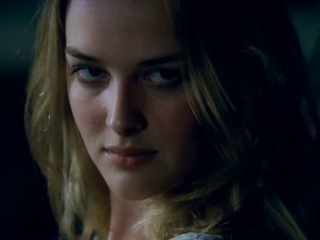
Lucille, Thomas, and Edith movie poster. Retrieved from this site.
In Edith's first rejection letter from a publisher, the editor laments that her ghost story does not include enough romance. This small scene was brilliantly added by Del Toro because it sets up the entire rest of the film for the audience to expect romance and not horror. Although Del Toro is the King of Horror and the film was marketed as such, this nearly throwaway line redirects the audience's attention from the ghost story to the romantic plot line. The film is really about Edith's love and, arguably more so, about Lucille's love. The two women have competing love stories that tie them together in a fight to death. Yes there are ghosts and yes there is blood, but the story's forward progress is not fear or anger, but love. Love is also an uncommon theme in horror films; more often it is lust, obsession, revenge, and sex that drives the character's actions. In this move, I think Del Toro does a great service to horror films by reminding contemporary audiences that fear and catharsis is but one aspect of a good story. Indeed, his film's often have the unique ability to incite both fear and awe, horror and hope, anger and sadness.
Del Toro immediately sets up the film so that we are suspect of Thomas and Lucille's intentions. There are secret meetings, unscrupulous attempts to raise money and to blackmail others, and an air of suggestive closeness between the two. At first, I thought perhaps they were married and were using a ruse of being siblings to attract dowries from Thomas's future spouses. The audience's mind, even though offered that they are related, first attempts other explanations to explain their lingering hugs, sideways glances, and Lucille's jealousy. When it is revealed in more explicit detail that Thomas and Lucille are sleeping together, Edith at first cannot believe it and shouts that she knew they were not brother and sister. Lucille responds, "but we are!" Confronted with the information directly before her eyes with knowledge of their deformed child, Edith still reconciles her perceptions with anything but incest. Incest becomes the twist, the plot point that was in front of our eyes the entire film, but we could not yet believe it until it is confirmed by Lucille. Incest is a sexual taboo not often addressed in horror films. It emerged in Here Comes the Devil, another film with a Spanish director, but is not a common media trope. Dysfunctional families and families undergoing trauma are often fodder for horror films, such as We Are What We Are, The Devil's Rejects, Red Dragon, The Babadook, and, of course, Psycho. Del Toro's use of incest and elevating the dysfunctional family to the level of incest draws forth interesting thoughts about how society differentiates between sexuality and love. If Lucille had simply loved her brother without having sex with him, perhaps the implications of their relationship would not be so terrifying.
I think that Lucille could have easily been the hero instead of the villain of the film if her sexuality had been removed from the film by either being Thomas's sister and not having sex with him, or not being his sister. Upon reflection, many of Lucille's actions are ones of pure love and adoration - she murders those who might come between her and Thomas, sacrifices her temporary satisfaction in the relationship to help the family financially, and is jealous of those that compete for Thomas's affection. For example, in Del Toro's other films, we don't fault the mother in The Orphanage for jeopardizing her relationship with her husband in her search for her son. In Mama, we don't question the actions of the lead character for protecting her boyfriends nieces. These familial relationships are honored and understandable, but we do not perceive of Lucille in the same way. Instead, Lucille is evil because her brand of love is taboo. I do not condone incest; it's presence caused me to think about the lines that all humans draw through symbols and communication that separate the sacred and profane. Mircea Eliade argued that religious thought is rooted in human separation between what is sacred and thus revered and worshiped, and what profane or filthy. Much like eating cow if you are Hindu, certain actions and rituals are deemed off limits to remain pious to a particular order. I remember talking in sociology class about how eating human flesh and incest are as close to the two most universal taboo actions in human history, and still they are not universal. Incest is close enough to it, however, that its presence in a narrative immediately defines those who are good and those who are evil. I wonder if this particular sexuality were removed from Lucille, however, that we would hate her so much for her actions. She is fighting for the wrong, most profane, most taboo type of love, whereas Edith's virginity and purity are the foil.
Brother and sister. Retrieved from this site.
These two arguments unfold what I think is the most important part of the film - it's not about Thomas. Although he does receive a good portion of screen time, the film is a war between Edith and Lucille with Thomas as merely a chess piece. You are clearly told through the plot that Thomas has been overwhelmingly influenced by his sister to act as he does and you wonder if Thomas is responsible for any of film's terrors. The audience becomes sympathetic to him as he tries to reconcile his sister with Edith, the new woman he loves. Thomas has no control over the action of the film; even in death he is only a brief distraction that Edith uses to kill Lucille. The female leads trump the "hero" doctor, Alan, who comes to save Edith and only ends up a burden to her as she slowly walks his injured self back to town. The men are ancillary characters to the epic battle between empowered and strong women. They fight for their lives and also for love and normalcy. Unlike the traditional story line of multiple men fighting over a woman like an object, it is Thomas who becomes the target of the audience's gaze as he is pushed and pulled between the two women, unable to control his own emotions and unable to act to protect himself, Alan, Lucille, or Edith. Instead it is Lucille and Edith who take strong, decisive action - they break rules to explore passages, they murder men with their bare hands, they beat and chase each other, they sacrifice their own flesh and blood for what they want.
In these three horror films, I find fascinating and interesting themes about female sexuality and how it can be used as a source of power, can be normalized in everyday life, and can be used to invert traditional roles for women. As I've mentioned in a previous post, one aspect that draws me to the horror genre is its penchant for creativity. Many genres become pigeon-holed in cliche plots that never seem to vary from the boy meets girl or person saves someone from place they aren't supposed to be narratives. In horror, however, I find innovation, inversion, and inquiry into the very aspects of what makes us human, and the different ways that people deal with reality and the supernatural. Unlike other genres, I also think horror addresses sexuality and the line between life and death in unique ways. I'm hopeful that the genre will continue to innovate and push our expectations for what we expect films to do.
Sexuality and horror films often go together. They represent the promise of new life, the pleasure of intimacy coupled with the fear of death and the terror of isolation. Beginnings and endings are ideas I am pursuing in my dissertation. I'm interested in how these concepts emerge together in many contemporary controversies. Horror films are another place where beginnings and endings are merged seamlessly. In this three-post series, I take a comparative look at three horror films, Teeth, It Follows, and Crimson Peak. I find a pattern of sexual anxiety and sexual exploration that pushes boundaries of "normal" sexual behavior. If people haven't seen these films, or don't want to be "spoiled," this is a warning that I will be talking about film details and plot elements. These films have captured my imagination because they play with and expand on the agency and power of females, which I think is a positive (and at the very least interesting) trend in contemporary film.
Post image retrieved from this website.
This poster brings up an interesting correlation between Dawn's last name, O'Keefe, and the
association between flowers and vaginas in Georgia O'Keefe's paintings.
Teeth (2007) is about Dawn, an advocacy speaker for the purity movement at her church. When she is raped by a fellow church member, she discovers that she has vagina dentata or a "toothed vagina." These teeth act on their own accord and work to protect Dawn from her rapist, castrating him in a gruesome scene. At first, she is understandably frightened and considers her plight a result of her sin. After research about herself and these teeth, Dawn has an epiphany. Her enlightenment, as indicated by her name and frequent references to the sun, comes in the form of sexual empowerment, where she can use her teeth to her advantage. Although the teeth are not under Dawn's direct control, they do not attack in a scene where Dawn is enjoying consensual sex. When the same sex scene invites Dawn's scorn and rage, the teeth attack and emasculate him. There are certainly problems in this film that disempower Dawn. Dawn does not preemptively attack or fend off potentially negative sexual encounters. For Dawn to fight back in her unique way, she must first be penetrated and submit herself to the sexual advances of men. At the end of the film, Dawn takes refuge in a man's car, who begins licking his lips and making sexual advances towards Dawn. Knowledgeable that the imminent sexual encounter will result in his castration, she smiles.
Dawn at the end of the film. Image retrieved from Rotten Tomatoes.
This film blurs lines of consent in the sense that Dawn "willingly" engages in certain sexual encounters with the knowledge that her teeth would attack her sexual partner. Despite these issues, Teeth does show a sexual empowered female who explores her own sexuality and comes to terms with her unique strength and eroticism. In Audre Lorde's "The Uses of the Erotic," she argues, "the erotic is a resource within each of us that lies in a deeply female and spiritual plan, firmly rooted in the power of our unexpressed or unrecognized feeling" (p. 87). The erotic is a power that is oppressed and corrupted by dominant power structures to keep women from realizing its power. For Dawn, the religious group is the source of oppression, where her sexual power is "vilified, abused, and devalued" (p. 88). Issues of purity and virginity are non-identities, where a lack of participation (such as atheism or vegetarianism) in an action indicates membership. Lorde argues that this oppression keeps women "in the service of men" as "a distant/inferior" person (p. 88). Teeth offers Dawn the opportunity to reclaim her sexuality and eroticism from men who take advantage of her and only see her as a sexual object. Dawn transforms from a meek virgin to an empowered crusader throughout the film, in part from her increased knowledge about sexuality and the body. In one scene, Dawn removes a sticker (shaped liked a golden sun) from her sex ed textbook covering the anatomy of the vagina. The film makes a strong statement that her religious upbringing and lack of accurate and complete sexual education directly leads to her vulnerable, naive condition. It is through knowledge and an enlightenment religion that Dawn becomes a more powerful female. Lorde argues that when women embrace the erotic, they "rise up empowered" (p. 88).
With that empowerment, however, comes scorn. Lorde said, "women so empowered are dangerous" (p. 88). Women who claim power and dare to challenge the system, as seen in the new movie Suffragette, they receive backlash. The contemporary feminist movement is often accused of grasping for more than women are due, that attempts at "equality" are really clothed attempts at dominance. Similar to arguments about affirmative action, those that oppose feminism truly fear losing their place in the system or damaging what is deemed "normal," and thus the desired order. In a recent r/ChangeMyView post on Reddit, a female redditor claimed that "Men are superior to women." Her reasons were because of men and women's physical differences and also the presence of men in more challenging/intellectual jobs. It's clear to me that even disturbances in an order that disadvantages women receives scorn from women themselves. If everyone is equal, perhaps there is no reason other than our own shortcomings to blame on our failures. Or, if everyone is equal, then perhaps our successes are not as meaningful as others. In a powerful article by Carole Blair, Julie R. Brown, and Leslie A. Baxter, they argue that the academic review process, filled with intelligent and intellectual women, is also a biased space. They respond to an article that ranks the publication count of female communication scholars and rejection letters they received on an earlier version of the article. Their attempt to challenge the ranking article was met with scorn and rejection from both male and female reviewers. They argue that the original report "is a thematic marker of a masculinist ideology and that the anonymous reviews of our original essay are unusually explicit manifestations of the apparatuses that sustain and enable those ideological themes" (p. 384).
Teeth brings up these important issues of female agency and how sexuality can be used as a force of attraction but also creating fear. This film puts an interesting spin on how female sexuality can itself be a weapon, the monstrous female fighting back with the strength of her form. I see many movies that laud the adjusted or upgraded female, such as Aeon Flux and Ultraviolet, but less often do I see films that empower the everyday female to fight back. There are definitely a notable few which I hope to address in a later post. As recent articles have suggested, it is oftentimes females who end up surviving horror films, oftentimes with the help and intervention of others. Teeth, however, empowers the female protagonist to use not only her self, but her sexual self, to survive.
Catcalling has been appearing frequently in article I've been reading, on social media, and in conversations with friends. I have already discussed more generally the problems that females face specifically on college campuses, but catcalling is a form of aggression that plagues all women. I use the term aggression purposefully and meaningfully as these catcalls are verbal, sexual assaults on females. These are, in many ways, hate crimes in that they are addressed and targeted towards a particular gender. I argue that these are violent, aggressive verbal attacks on females and are not addressed in order to be compliments or flattery. Any woman of all shapes and sizes in clothing from SoCal casual to Boston coats (I have seriously been catcalled walking down Boylston in my HUGE winter jacket) are catcalled. Like rape, catcalling is not about "flattering" or "complimenting" someone; it is about power, laying claim, objectifying, and reifying an order where men can and are allowed to "be men." The clip below is from a Fox News show where four clueless women and one man discuss how flattering and welcoming catcalling is.
The hosts argue "let men be men." This statement characterizes men as overly sexual, aggressive, and blameless for their actions. This attitude let's men off for perpetrating abusive, violent action towards women. The blame is shifted to the victims for not "taking a joke," their choice of outfit that incites a catcall, or walking in a certain area. Victim blaming is never something that should be encouraged or tolerated in society. Just like bullying or assault on college campuses, it is always the fault of the perpetrator, the person committing the crime and assault. It is never the fault of the victim. In the famous words of the recently passed Robin Williams in Good Will Hunting, victims must always remember, "it's not your fault." The hosts of the show should be ashamed of themselves for laughing and tolerating the inane slow clap of their male counterpart. The female presence is not a show or performance for the adoration or approval of males.
I have been catcalled many times and the first thing that I have thought was not, "oh how nice," or "how flattering!" Instead, it immediately places me in a subject position where my presence is only meaningful in that is a display and object for the male gaze. In one instance, I had a man follow me off a bus in Los Angeles and onto the Metro, yelling at me and attempting to accompany me to my destination. I will probably never forget the fear I felt when I realized he was behind me as I stepped off the bus. My relief in getting out of the situation became sheer panic. He ran up next to me and said, "I'm not trying to scare you sweetie, I just want to marry you." Another time, I was grabbed from behind by a young male on a skateboard on the very street where I live. This catcall, which I tried to ignore, ended in physical assault and made me feel like an object to be squeezed, held, and owned by others. When I step on the street, I have no control over the actions of others, what they may call me, how they may judge me, but I will say that it is more rare than not to have an assault-free day. Louis Althusser noted that when a police officer yells, "Hey you!" at someone, they immediately construct a subject position for them to inhabit. This interpellation is done from a position of power that constructs for the other person an identity that they have no part in constructing. Any reaction is to that assignment position within what Althusser called an "ideological state apparatus" that reifies hierarchy.
Buzzfeed attempted to create a humorous interpretation of catcalling. The video shows "What men are really saying when catcalling." This video is important because it addresses the counter-argument that many people use to defend catcalling: that it is a legitimate way to approach a female. If someone is interested, why not simply call out to them and engage them in conversation? Well, as the video shows and as I fully agree, catcalling is not an invitation. There is no desired or appropriate response. The male simply wishes to undermine the female, assert power, and inflate their own egos. As one of the males in the video states, "I noticed you're confident, so I'm cutting you down to feel powerful." Another notes that he's not sure why he's calling because he wouldn't know what to do if the female responded. When I have tried to respond to catcallers, I am either called a bitch, frigid, or am assumed to already have a boyfriend. Because already being owned by a male is the only reason to call off an approach.
Playboy also recently released a chart that describes when it is appropriate to catcall a female. Though my initial reaction was, "why do you need a flowchart to define the word 'never'?" this chart is important because it incorporates the participation of the female. The only way for catcalling to be appropriate, via this chart, is with the consent and agreement of the female party. This approach considers females active agents instead of simply passive objects to be called upon.
Catcalling engages issues of hierarchy and ideology. In what situations do females catcall men? In what situations do females have the power to objectify and undermine men? Simply put, they never do. The structure of hierarchy implies that the minority or discriminated group never has the agency or power to discriminate themselves. Any action is performed within that hierarchy. My response to a catcaller is always framed with the male in the right and myself in the wrong. Althusser's police office constructs the situation and appropriates the actions of the passerby without a need for reaction. Because of their respective positions within the system, the act of addressing and calling upon someone places them in the position of vulnerability, object, and minority. Catcalling reifies a structure that says that men are always in a position of power over women.
Retrieved from this site. Stats are specific to Hollaback Boston.
A few organizations, such as Hollaback , are trying to end street harassment. Hollaback focuses on sharing the stories of females who have been harassed in a triple-pronged attempt to promote awareness of how frequent and widespread the issue is, to provide validation for females who have been verbally harassed, and to promote healing through collective storytelling. I hope that initiatives like this can help to make real and present the plight of harassment that females experience every day. We as a society need to move away from victim blaming, listen to the stories of those shamed and objectified, and acknowledge the societal guilt that we all share by allowing this culture to exist. Though I am not knowledeable enough to comment in more depth, I do want to use this post as an opportunity to amplify how these issues often specifically and disproportionately affect women of color and the transgender community.
Although I've always known that my preference for horror films over romantic comedies draws curiosity and concern from others, I never understood why. What is it about horror films that makes my interest in Saw, Hostel, and The Cabin in the Woods inherently worse than in No Strings Attached, The Notebook, or Sweet Home Alabama?
This is not an avenue of research I would pursue with any intensity, but its frequent occurrence in my life makes it a perfect blog post entry. Below are some musings and thoughts I've had about why horror is offensive on a basic level to human nature and why some yearn for that experience in the theater.
One of the issues in horror films is their defiance and utilization of reality. Whereas science fiction and fantasy is inherently "unbelievable", romantic comedies are life-like and true to reality. Outside of the necessary fantasy of Hollywood, unique plot points, and unlikelihood that come with a film, there is a transcendence that occurs naturally with romance, comedies, and dramas. Real people being dealt unlikely, but possible events, with real emotion and reaction. For the most part, these films follow standard structures with the protagonist achieving their goal or the couple uniting in the end. Aberrations from this structure may serve as a twist to surprise the audience, but the structure remains mostly intact.
Horror changes this structure by combining the reality of dramas, comedies, and romance with the abnormal and occult of science fiction and fantasy. Just as Harry Potter takes the reality of a rough childhood and transforms it into magical fantasy, horror films take the reality of normal, everyday people and sends them directly to Hell. The Saw films punish people for taking life for granted, something that everyone can be considered guilty of. The Hostel films torture people on vacation based on random acquisition. The reality of people's stories create an affinity and connection between the audience and the characters, allowing for a dangerous and frightening transcendence. Connecting with characters about to undergo bodily, mental, and psychological damage and harm can be an uncomfortable position for the average movie-goer.
People are willing to go and see them, however. The same adrenaline rush that brings people to amusement parks for a roller coaster ride fills the seats at the midnight premiere of the 7th Saw movie. The fear that arises from the films might be in the loss of power. Denying the basic, happy-ending structure of other films, horror movies remove the viewer from a position of power: from knowledge and expectations. Horror villains may have no explanation, attacks may come at any time from any location, and the fate or safety of the characters is variable. For example, the complete back story of Jigsaw, the villain in Saw, is revealed slowly and in pieces over the course of the movies, making his actions and the actions of his disciples mysterious and random. Epitomizing the random attacks is the Final Destination series, where "fate" is literally the villain that interacts with the environment around the characters to kill them in accidental ways. There is no man or monster hiding and approaching, but merely objects and spaces manipulated to attack and murder the characters at any point. Because it is a horror film, there are almost always murders or deaths, especially of the main characters. The survival of the characters (if any) usually only follows the deaths of others in the group.
The fear that these movies create is often avoided by movie-goers looking for an "escape" or pleasant experience. For those that do enjoy them, myself included, the pleasure comes from not knowing and experiencing something that is unique to movies and entertainment. The horror movie is an escape from the normal, everyday, average life, by exposing viewers to the dark side of reality.
I do not know what my favorite horror film would be, but I have to say that the recent Joss Whedon film, The Cabin in the Woods, has become a strong contender. The variety of emotions, from nervous and terrified, to intrigued and confused, to laughing out loud in the theater, this movie was the perfect horror film for me. Even for those not a fan of horror films, familiarity with the genre will help you appreciate the satire and exaggeration that makes this film an instant classic.
There are certain classes of discrimination that are protected under federal law: race, gender/sexuality, color/ethnicity, ancestry/national origin, age, familial status, religion, disability, veteran status, or genetic information. Discriminating against these groups in places of employment, housing, or education are illegal and can be prosecuted. A presentation that I organized about renter's rights in Pittsburgh over the summer enlightened me on these aspects of discrimination of which I was unaware. The stories that the representatives shared about fair housing violations were shocking and raised questions for me about the nature of discrimination, the legality of discrimination, and the types that are not outlawed.
I have previously discussed the politics of hegemony and the negotiation of power in the highly hierarchical social and cultural structure of the Western-dominated world. This meeting brought to light for me the power struggles that are manufactured in everyday relationships. Outside of the larger hierarchies of humans, nations, and cultures, there are power struggles in personal relationships, such as renter and landlord. Before someone even becomes a renter, the landlord is the gatekeeper to shelter and a home for many in Pittsburgh and around the world. What is not shocking is that fair housing organizations file complaints on behalf of discrimination on the classes above. What I did find interesting, though, was the admittance of types of discrimination (defined as creating distinctions and outlining differences ) that are legal ways to choose renters.
The difference between outlawed and enabled avenues of discrimination became apparent to me quite quickly: choice. Perhaps arguably veteran status, religion, and familial status are choices in some ways, but economic situation, upbringing, and traditions form the bulk of these decisions over personal choice in some cases. The choice in these situations can hardly be defined as detrimental, poor decisions, or somehow reprehensible.
Other choices, however, ones that can be used as discrimination, could be argued to be the result of poor decision-making. Examples of this type of discrimination (which I would consider "choices") that are allowed are smoking, credit history, personality, or pets. These four examples could be considered discrimination based on the choices that the applicant has made. Smoking is a personal choice that is a potentially rental-damaging habit. As one landlord in the meeting brought up, it can be quite expensive to steam clean an apartment after a smoker has lived there, and there's no guarantee that the smell can be removed, damaging their ability to gain additional tenants and revenue. Though he regretted rejecting applications from smokers, he said at the end of the day that his property was a business. Credit history is obviously influenced by one's financial capabilities, but it is at least in part determined by one's actions with one's money, in terms of being reliable and responsible. One's personality is something more intangible, but the representative assured the landlord that differentiated based on personality preferences was allowed. Having pets is almost always a choice, and one, just like smoking, that can be damaging to an apartment and its upkeep. These forms of discrimination outline choices that people make for which landlords are allowed.
As I've discussed previously, when it comes down to choice, there is an alienation of certain groups. Not everyone has the same opportunities, backgrounds, upbringings, and choices in life. One could argue that some of the "choices" I've outlined above are not actually choices, especially when one thinks of credit history. Credit history is linked to another form of differentiating potential renting applicants: ability to pay the rent. Simply put, this can be a form of discrimination if one considers the economic opportunities that some have and others do not. Economic abilities are not protected, though, for the law still upholds the right of the landlord to receive money from renters. Progress is being made by providing public services for those who need housing assistance.
The final point I would like to make is simply a research/methodological question. For those trying to "prove" housing discrimination, fair housing groups send various testers to renting facilities to see if any discrimination occurs. The simple idea is that if someone is told that they haven't been accepted and someone else is, who is to say that the choice that was made was based off of protected discrimination? As someone who is interested in research methodologies, I find answering these questions quite interesting. It is hard and complicated to prove with any certainty, but the housing organizations rely on the offering of the apartment to one person over another as operational proof of discrimination. It appears to be successful as well, based on her many stories of case wins.
I'm beginning to feel a bit like Foucault in my recent blog assertions that "power is everywhere". In the objects and articles that interest me, I find the underlying power struggles an unmistakable pattern. The way that words, laws, and politics discipline and negotiate this power is a way that I find unity between rhetoric and cultural studies in my research, if only tangentially.
Ever since I gave a lecture on Foucault to the undergraduates at USC, I have begun to link my interests in politics with issues of power, gender, the body, the environment, and religion. Each of these areas has their own discourse, language, and regulations. When these discourses begin to mix and gain voices in each other's spheres, problems can emerge. Consider the mixing of religion in the educational system, where scientific and religious discourses collide in how to teach the origin of humanity. Some would argue that religion should be separate from education and has no role to play, where others would defend its inclusion and right to be there wholeheartedly. Whichever side one would fall on, the reality is that the mixing of discourses complicates ideas of knowledge, power, and truth.
This specific example explores the relationship between religion and science/politics that has been a sordid affair for centuries. From recent debates about abortion, birth control to the nomination of Paul Ryan as the vice presidential nominee, religion and political regulation has risen to prominence. Whereas political discourse relies on the participation of the people and elected politicians to craft and decide regulations, religious discourse (primarily Judeo-Christian in America) places knowledge and truth within the Bible and religious leaders. The problem when they become mixed is that people who are atheists or follow a different faith are subjugated to non-universal laws. Religious discourses are better suited to personal or community spheres for those who believe, whereas political discourses are better suited to federal and governmental policies.
I was surprised at the proposed mixing of the two advocated at a sermon I attended in Pittsburgh. The overall theme of the sermon was to redefine freedom to be less self-centered and more inclusive of community, family, and religious purposes. The preacher discussed the traditional definition of freedom as "doing what you want whenever you want" as a participant in the sin of pride. He instead argued for freedom meaning the opportunity to follow God's plan and do what we were designed to do in life. While seemingly a plea for people to help others and avoid what can sometimes become a self-centered, navel-gazing activity of "I want", I found more sinister and underlying ideologies.
In a world, in a discourse where freedom doesn't mean free to choose or free to follow one's own actions, freedom is actually replaced with restriction, regulation, and oppression. When we sacrifice individual liberties in order to follow God's design, we ignore the 16% of people in the United States with no religious affiliation, those not part of the Christian majority religion, and those who do not wish to mix their religion and politics in favor, we lose freedom. I define freedom as the elusive ability to choose, to have options, to serve oneself as one desires as long as one does not harm, silence, or oppress others. Following God's law means that people do not have the freedom to choose, especially when one thinks of women's rights over their own bodies.
An inquiry into the complications and fears surrounding the female form would be a whole blog post in and of itself to fully address the issue. Suffice to say for this post that religious discourse has traditionally treated the female body as a sexual instrument, subordinate to and property of men. Even in current times, women are being denied their right to regulate their bodies, control becoming pregnant, and accessing services such as Planned Parenthood. The message that bothered me in the previously mentioned service was that by allowing for the discourses to mix, to take the personal focus out of freedom, fosters a community and ideology where restrictions on personal choice flourish. I imagine that women listening to sermons like these when they were younger (e.g., Sarah Palin and Ann Coulter) begin to believe that their rights should be restricted and they do not deserve the choice over their own body. Whether one would choose to have an abortion or not is not the issue, it is the right to be able to choose. If someone, for religious reasons, decides to keep an accidental pregnancy, they are equally without choice if it is mandated so by law.
Sermons and ideas such as these foster a culture comfortable with religious lessons and teachings leaving the Church, personal values, and family life and becoming commonplace in political discourse. When the voices of some are oppressed on the journey to power, freedom is distorted, and ultimately lost. Politicians and the general public should fight against these inclusions and keep the discourses separate. When there is freedom, true choice involved, those who wish to follow God's laws can do so as a personal choice, not a legal mandate.
Just like in American History X, I will defer to the words of others to summarize and inspire my words on freedom. I hope that in the future, human behavior, biopower, and personal choice can be left mostly unregulated, giving people true freedom over themselves and relinquishing them from the ideology of others.
Those who deny freedom to others deserve it not for themselves.
-Abraham Lincoln
Freedom is never voluntarily given by the oppressor; it must be demanded by the oppressed
-Martin Luther King, Jr.
For to be free is not merely to cast off one's chains, but to live in a way that respects and enhances the freedom of others.